Maximum Shelf: House of Cotton by Monica Brashears

Maximum Shelf is the weekly Shelf Awareness feature focusing on an upcoming title we love and believe will be a great handselling opportunity for booksellers everywhere. The features are written by our editors and reviewers and the publisher has helped support the issue.

This review was published by Shelf Awareness on January 4, 2023.


Monica Brashears’s House of Cotton is an engrossing coming-of-age novel about ghosts, mothers and the struggle to survive. It is also a novel of the lingering challenges of race and class. Brashears’s prose style is sharp and incisive, and the entrancing, distinctive voice of her protagonist is by turns weary, sardonic and yearning. A haunting story and unusual perspective make this a memorable and thought-provoking debut.

Magnolia Brown is 19 years old when her grandmother, Mama Brown, dies. Her absent mother struggles with substance abuse and an abusive partner, so that leaves Magnolia more or less alone in the world, fending off a lecherous landlord (who is also deacon at her grandmother’s church) and struggling to get by. She works the night shift at a Knoxville, Tenn., gas station, where she tries to care for Cigarette Sammy, the muttering man who goes through the trash outside (“the only other Black person I see on this side of town”), between one-and-done encounters executed by her Tinder persona, Carolina Nettle. It’s a tenuous living, and she misses Mama Brown terribly. One night “a whistling man with blood-smeared hands” walks into the gas station. “Hearing a man whistle when he walks in a place he don’t own ain’t natural. Like finding a chipped tooth on concrete. An omen.” When he returns from the bathroom after cleaning his hands, she sees the man is polished, manicured, smooth-talking, wearing good cologne. Cotton offers Magnolia a modeling job, but she’s wary; Magnolia knows omens. But she’s also broke, and quite possibly pregnant.

At the address he gives her, Magnolia finds the Weeping Willow Parlor, a funeral home run by Cotton and his gleefully friendly, drunk Aunt Eden. The pair is eccentric: Cotton needs to constantly finger a piece of pocketed twine to remain calm; Eden is something of an alcoholic and firmly does not believe in ghosts. They are wealthy, and culturally foreign to Magnolia.

Cotton and Eden Productions offers Magnolia a most unusual modeling job: they provide families with lost or missing loved ones a final contact, a side business something like a séance. With Eden’s uncanny funeral-home makeup skills and Magnolia’s amateur acting, Magnolia will play the part of the dead. She’s used to pretending; it has long been her coping mechanism: “When I get this way, when I feel like kudzu is wrapped tight around my ribcage and I’m bleeding a bright heat, I like to slip inside my head.” She slides smoothly into Cotton and Eden’s world and their comfortable, decadent habits: cocktails at all hours, joyriding in the hearse. She moves into the funeral home, lets Eden apply pale body paint to allow her to become missing white women and men, and begins saving her money. The ghost of Mama Brown checks in with Magnolia: knowing, comforting, but judging as well. Reading a letter Mama Brown left her, Magnolia knows “[S]he ain’t left me. I ain’t seen her, but she sits by me. Unseen but real as humidity.” Soon the ghost will be seen as well.

Magnolia’s life becomes split. At the Weeping Willow, she lives in ease and has money to spare, but feels estranged from the very different world Cotton and Eden come from. The relationship is transactional, and she’s always acting, even when the makeup is off. And then there is Mama Brown’s home, where the garden (the place Magnolia still meets her Tinder dates) grows out of control. By tending the needs of the rich white folks who help support her, Magnolia has literally let her own house get out of order. Her caretaking of Cigarette Sammy has become disrupted. Cotton’s requests get weirder and weirder, and Mama Brown’s ghost expresses concerns about Magnolia’s choices, which have affected Mama Brown in the afterlife. The worldly and otherworldly pressures mount.

Set in the grand Weeping Willow Parlor, complete with secret passageways and haunted by Magnolia’s much-loved but literally disintegrating grandmother, House of Cotton pits traditional gothic elements (the haunted castle, women in distress, death and decay) against contemporary questions about race and class and the persistent legacy of slavery. It shares the genre’s sense of suspense and foreboding, but Magnolia’s struggles are very realistic. Her first-person narration brings an immediacy to the events, and an intimacy that’s advanced by her frank voice and turns of phrase. On its face, this is an intriguing ghost story with a compelling, beleaguered protagonist. In its layers, there is much more at stake.

“I am a tattered quilt of all the women before me. I am a broken puzzle,” Magnolia states, but she is clearly a survivor as well. Despite her many fears, she is somehow fearless in pursuing the truest version of herself. Brashears excels in strong characters and deeply felt emotions, and in a robust sense of place: Knoxville shines as both urban and cultural setting and in the details of its natural world. Brashears offers a fresh new perspective on Appalachia and the American South, and Magnolia’s rich voice will echo with readers long after the pages are closed.


Rating: 7 missing fingernails.

Come back Monday for my interview with Brashears.

Lakewood by Megan Giddings

This was a striking, chilling novel, which I’ve chosen to tag as horror although it is of the disquieting sort and relies less on jump-scares and gore (although the gore is not entirely absent). It contains very apt, detailed descriptions of contemporary young people and family dramas; characterization and specificity are strengths of Giddings’ writing no matter what she does. But it quickly moves beyond writerly deftness into seriously troubling subject matter, to make this a novel both thought-provoking and book-club-worthy, and riveting.

We meet Lena when she is a college student burying her beloved grandmother, Miss Toni. Her mother (Miss Toni’s daughter) Deziree is present, and can be a good friend to the younger woman; but Deziree is frequently ill, and it was Miss Toni who Lena thinks of as Mom. Now she is faced with a stack of bills: medical bills for Deziree and for Miss Toni, bills for the funeral, the house, general costs of living. She must maintain a high GPA to keep her scholarship. Her college roommate Tanya is a great friend but from a walk of life that makes her unable to empathize with financial strain. A letter arrives. “An invitation to participate in a series of research studies about mind, memory, personality, and perception. The Lakewood Project. It offered Lena and her family health insurance if she was selected to be a participant. Also housing and a weekly stipend… It was addressed specifically to her.” The money is so good – and more importantly, the medical care for Deziree – that Lena leaves college. If she can last a year in Lakewood, it could be life-changing.

Lena is a young Black woman in an unnamed Michigan city with a college and a sizable Black population. Lakewood is a small Michigan town in which she is almost the only Black face. Place is not one of the biggest elements of this story (and maybe I overemphasize it because you know it is always an important one for me), but the city/small town divide definitely accounts for part of Lena’s estrangement; she notices the differences in noise and quiet, and the anonymity of the one versus the sense of being watched in the other, which is of course very much about race as well as population density. Lena is very aware of race. With a single exception, the participants in the Lakewood Project are Black, Latinx or Native American. The staff, doctors and observers are all white. She is conscious about performing a “safe” version of herself in the town of Lakewood. The study itself involves acting, but so does her larger life.

I’ll stop here, because I hope to encourage you to read this book and be surprised by its turns as I was. But you can safely see from here that Lakewood is about the sinister side of medical research studies and race and racism in this country, both throughout history and in the present. Giddings is a rising writer of note, and this novel is quietly terrifying.


Rating: 8 teeth.

Boy, Snow, Bird by Helen Oyeyemi

My third Oyeyemi. She is brilliant and fascinating; her books have a momentum of their own. I am often left with the sense that she is smarter than me, that more is happening here than I was able to grasp. Gingerbread was the novel of hers that I most enjoyed, The Icarus Girl was the most confusing, and this one fits in the middle of the list by both measures.

I am going to keep this summary pretty brief, because there are some good-sized spoilers in the novel. We meet our protagonist, Boy Novak, when she is in her late teens. She has white-blond hair, a face somewhere between ‘harsh’ and ‘fine-boned,’ and a fascination with mirrors. She speaks to other versions of herself in them. She may be lonely. She lives in Manhattan with her father, a rat catcher and seriously abusive, until she runs away at age 20. She takes the last bus of the night to the end of the line, arriving in Flax Hill, Massachusetts in 1953 with few possessions, but she is able to start fresh, making friends, dating, working odd jobs, eventually marrying a man with a craft, a family, and a dear daughter named Snow. Part One is told in Boy’s first-person voice, but Parts Two and Three will shift perspective.

I can go no further with summary. The setting remains chiefly in Flax Hill, with exposition traveling to Boston, Mississippi, and back to New York. Oyeyemi’s characters are completely fascinating; among the secondary characters I love most are Mia, a driven journalist and free-thinker, and Mrs. Fletcher, who runs a bookshop and acts as a bit of a community mentor. Boy, Snow, Bird is concerned with race and gender identity, the true nature of love, family dynamics, damage and forgiveness, sisterhood, motherhood, and national and societal patterns around race and racism. It is billed as a bit of a riff on the Snow White tale, but is not exactly a retelling. There is the girl Snow; there is a stepmother who is (at one point) accused of evil; there is something strange going on with mirrors, and not only for Boy. There is definitely some commentary on vanity, beauty, and the shaping of family by these means. But it strays quite far from the fairy tale. Actually, this would be an awfully interesting one to study alongside stricter retellings. I feel unable to say more.

There are lots of images and concepts that I’m going to keep revisiting. I’m not sure I got it all: not always a comfortable feeling, but certainly a stimulating one. No question, I’m going to continue my study of Oyeyemi. Stay tuned. I do recommend this one, and feel free to come back and explain it to me.


Rating: 7 records.

Homegoing by Yaa Gyasi

I’ve had this one on my list(s) for a while now, but as it increasingly appeared in credits from books I enjoyed – as inspiration, as research, as most admired – I knew I needed to get to it sooner. Homegoing deserves the accolades. It’s both expansive and easy to read, in how beautifully it flows – although the subject matter is not generally easy.

There’s a helpful family tree in the front matter, as in These Ghosts are Family (which is one that refers to this book in an interview with the author at the end). This lets readers track the connections as we move through generations. Each chapter is titled for the character it focuses on, and each character appears in the family tree; they are featured chronologically across centuries. At the head of this tree is a woman called Maame who lived in what is now Ghana in the mid-1700s. We slowly learn that she had two husbands and two daughters at two different points in her life in Fante and Asante territories respectively. The daughters, Esi and Effia, did not know about each other, and their lives led in different directions. Near the novel’s beginning they are found under the same roof but in very different circumstances: one as the wife of a white British slaver, the other imprisoned in the dungeon underground. One is able to stay in her home region (Gold Coast as a British colony), while the other is kidnapped and carried across an ocean to become a slave in America. Later chapters follow their descendants until more or less contemporary times – everyone on the family tree gets a focus chapter except for Maame herself, whose story we learn only in pieces. These lives are filled with color and detail and struggle and pain, and love and music and beauty; in every iteration they continue to witness racism, colorism and the enduring legacies of slavery and colonialism, in different ways. I of course failed to mark the quotation that said so eloquently how the same prejudices were ongoing but in subtler and more insidious ways in later times than they had been in slavery’s heyday.

Homegoing is a beautiful, absorbing novel. Every one of the featured lives is so finely wrought, I spent at least half the book lost in each of them individually; it took me most of the book to begin anticipating their connections, although I was aware of those connections all along. They are all filled with such detail and richness, but it is possible that earlier chapters stand alone more securely than later ones. Some readers call this a novel in connected stories, and I do feel that each character’s story is a whole work in itself. But there’s no question in my mind that it is more novel than collection.

Aside from realistic portrayals of lives across a remarkable span of years and locations, Gyasi also offers threads of something mythic or otherworldly: there are persistent suggestions that this family may be cursed by ill luck and fire, and its members may have a special gift of foresight. Indeed, some coincidences are difficult to explain. On the more real-world side, Homegoing is very much about the legacy of slavery from African roots to American “improvement” of the system. It has big thoughts and observations to make while still being first a story about individual people.

The New Yorker is rather harder on this book in Laura Miller’s review, and I confess that she has some points, particularly about typing in the American characters versus the African ones. The larger impression I walk away with is much more positive than Miller’s seems to have been. But I am entirely on board with her optimism about Gyasi’s future work.


Rating: 9 cocoa nuts.

These Ghosts Are Family by Maisie Card

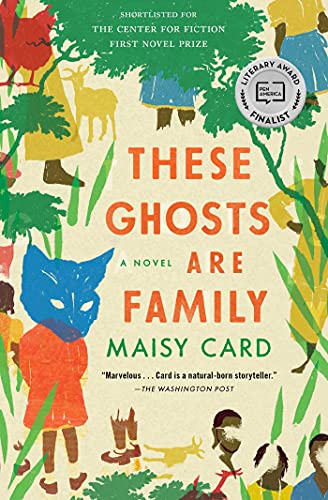
This was a fascinating journey. These Ghosts Are Family follows a family for generations, from slavery in Jamaica, through emancipation and decades of struggle with old class systems, immigration to London and New York, through permutations of relations, including a fresh start with a new identity (or, if you like, identity theft). The timeline jumps around and the focus and point of view shift, so that readers see this extended family at different times and from different perspectives. Issues of class, race and colorism and the relationships between privileged and less privileged classes, including but not limited to enslavement, will be obvious themes; we know that rape and issues of gender arise under these conditions too. The characters are infinitely fascinating. I was not so much expecting the question of supernatural elements: duppies or ghosts and Ol’ Hige, “a Caribbean version of a vampire story.” By the book’s end, I was left reeling with all the possibilities. There is plenty of heaviness: children abused, spouses failing to see eye to eye, parents and children letting each other down. But there are some quietly loving relationships scattered throughout. As I close the final pages, I’m a bit at a loss because there’s so much to consider. (And because we ended with a decidedly weird trio of spooky vampire children living in the woods.)

The book begins with a family tree, which I did refer to throughout. It presented me with a confusion that was answered on the first page. I’m going to spoil that one here because, again, first page of the novel (and it’s also given away on the back of the book and in most blurbs): the aged Stanford Solomon reveals, on his deathbed, that in fact he is (or was) also Abel Paisley, presumed dead some thirty-five years ago, at which point he took the identity of his friend Stanford. “Stanford” has both a wife and daughter and another daughter out of wedlock, all in New York; Abel left behind a wife and two children in Jamaica when he supposedly died. Stanford/Abel’s revelation obviously affects those around him. But I’m going to diverge from the blurbs here, and say that this is not the event around which the book revolves, and by its end, Stanford is by no means the central character. Rather, he is one branch on the family tree that is the book’s center. He’s just one link, and I don’t think he earns the role the blurb says he plays. Rather, I find the book more about larger patterns – slavery, class and race and colorism following slavery, migration and immigration, gender roles, the persistent damages of all these institutions and systems, trauma, and family dynamics. It’s about the multiple generations of this single family, for sure, but their combined story is very much about those larger patterns and systems. There’s nothing preachy or intentional-feeling about this, but the Paisley/Stanford family is inextricable from larger issues. I put Stanford/Abel at its center only in that he opens the book and occurs at the more-or-less center of the family tree as we find it here. The book ends somewhere very different, and that feels right.

In between, the story is told by numerous voices spanning some 200 years. That multiplicity of voices was a great choice for this story. (I have just said the same about a brilliant novel whose review is still forthcoming: Lookout by Christine Byl.) I love the kaleidoscopic or triangulated perspective on events offered by the different views. And for a novel whose focus is so broad – generations of a family across continents, countries, and centuries – it makes sense to move around like this. I guess such a big story told by one voice (with some kind of time-traveling power, I suppose) would be a different kind of accomplishment, and I can imagine it done beautifully, but Card’s choice feels just perfect here. The multiple voices also allow her to give us different dialects, which add to the texture and richness of the whole.

This adventure into these varied lives is expertly done, not always comfortable because of the subject matter, but engrossing and well worth the immersive experience. Card is a talent.


Rating: 7 names.

The Ballad of Black Tom by Victor LaValle

People who move to New York always make the same mistake… They come looking for magic, whether evil or good, and nothing will convince them it isn’t here.

The year is 1924, and Charles Thomas Tester wouldn’t call himself a con man; he thinks of himself as an entertainer. He’s not much of a musician, unlike his beloved father, but he knows how to put on the right look and scrape a living where he can. It helps to leave Harlem, where he supports his father and himself in a tenement apartment, and travel to the likes of Red Hook and Flushing. There’s risk there for a Black man, but more to be gained, too. Charles plays off wealthier New Yorkers’ search for magic–until he gets into more than he’d bargained for. In Flatbush he meets a wealthy eccentric named Robert Suydam with ideas about how to change the world. An anxious, sensitive police detective and a burly bully of a private investigator are on the tail of the unlikely allies, Charles and Suydam; between them they will certainly change the shape of the world, in unexpected ways.

The Ballad of Black Tom has magic and race and racism and wishes and love and violence and simple street entertainers’ illusions. There are characters from different walks of life – I love the varieties of ethnic foods available in the Victoria Society. Charles Thomas Tester is both a straightforwardly relatable character – loves his father, just wants a little financial wiggle room – and a dangerous enigma. This book is short, but it casts a spell. Victor LaValle continues to intrigue me. Recall that I loved one book of his and couldn’t finish the next. This one is compelling. I have The Devil in Silver waiting on my shelf. We shall see.

Meanwhile, Black Tom will keep me thinking for a while – not least with its final prophecy.


Rating: 7 pages.

Gone Missing in Harlem by Karla FC Holloway

This one’s a bit genre-defying. I really enjoyed it. Gone Missing in Harlem looked like a mystery at its outset, but it turned out to be broader than that. Historical fiction, clearly: it’s set in Harlem during the Great Depression, with flashbacks to Carolina (North or South, I’m not sure we ever know), highlighting the Great Migration of Black Americans from the rural South to northern cities. It handles mental health issues in several threads, and the challenges of parenting through traumas and breaking cycles. It ranges widely.

We see the title event in the very first chapter. A young mother, Selma, parks her pram just outside a grocery for a very short time while she pays for some apples; when she comes out, it is discovered that her baby is gone. An uproar immediately ensues. Harlem’s residents are horrified, excited, titillated, and incensed at the lackluster response from the police department: the city is still reeling from the disappearance and death of the Lindbergh baby, and Harlem can easily see the difference in how a poor baby from their community is treated. We do have the city’s first Black policeman on the job (and with a fresh Black cadet in tow), and he is both clever and committed. But weeks and months pass, and Selma’s baby Chloe is not recovered.

One of the things I loved best about this book was the constant shifting of perspective. While I’m fairly certain we never get a first-person point of view, chapters switch focuses in close third person perspectives between a large number of characters: Selma; the police officer; Selma’s brother Percy (aka June Bug); their mother (a central figure), DeLilah, aka Lilah, Mama Lil, or Mrs. Mosby; several members of the wealthy white family Lilah works for; the social-climbing Black woman she works for later; a neighbor down the hall; and others. (The policeman and his apprentice form a delightful Holmes-and-Watson pair – indeed with reference to their famous counterparts – and appreciate libraries, librarians and book research most pleasingly.) This multiplicity of perspectives enriches the narrative like nothing else might have, and help take this story from the (deceptively simple) mystery it might have been to a whole complex tapestry of questions, in the best way. Class is arguably as important as race, and race is complicated by colorism. Several generations address the difficulties of parenting; the complexities of love, fear, and aspiration; and the importance of making a plan. As for that deceptively simple mystery, there is a big surprise near the novel’s end that had me entirely, literally slack-jawed. I did stumble upon a handful of grammatical errors that I wish had been caught in editing, but that’s a small issue (and likely only for a few readers). I’m very impressed at the absorbing story, the wealth of those multiple POVs, and the tender handling of a broad range of issues.


Rating: 7 needles.

The Last Karankawas by Kimberly Garza

Another very fine one on Liz‘s recommendation.

The Last Karankawas has a lot going for it. And yes, for me personally a significant part of the appeal is personal: it’s set in Galveston, Texas (the beach town nearest my hometown of Houston, so a place where I spent a lot of time growing up), with ventures into the Texas Hill Country (where I lived last in my home state). These familiar locations are really well done (Garza’s bio note says “born in Galveston, raised in Uvalde,” giving her greater cred than my own): detailed, specific, absolutely recognizable. You know I’m a sucker for a strong sense of place in any location, but when that place also feels like home, you can bet this won my heart and gave me some homesickness (also a theme of the novel). So, sense of place and detailed execution of setting are objectives strengths here; my personal connections give me a more subjective love on top of that.

It’s a striking novel, not least in form. It could be considered a novel-in-stories: twelve characters each get chapters in their perspective (some first-person, some close third), plus the first chapter told in that unusual first-person plural “we” voice, by the Filipino-American women of Galveston’s Sacred Heart Catholic Church; one chapter focuses on two characters together. As the following image shows, the story centers on one in particular: Carly Castillo is the heart of the story. (I quibble mildly with this graphic because I think those people who relate to Carly through Jess, or others, should be graphically shown as connecting through those other names. Small issue.) Carly and Jess are the only characters who get more than one chapter’s perspective (and Jess only barely, with a second, very short one). Sometimes the connections back to Carly are tenuous, but they’re there. And the book ends with “A Glossary & Guide for the Uninitiated Traveler” to Galveston, which is a delightful piece of hermit-crab-style formal play, and includes the best definition of “state of Texas” I have ever read – hint: it includes multiple entries, some strikethrough text, “none of the above” and “all of the above.” To return to an earlier point, the evocation of place in all its complications and contradictions is absolutely one of my favorite things in literature.

Carly is born in Galveston to a Filipino immigrant mother and a first-generation Mexican-American father. Both parents leave when she is still small; she is raised by her paternal grandmother. We meet her first when she is a small child through the eyes of the church ladies where her maternal grandmother and mother attended. We know her as a teenager and young adult. Carly and the surrounding, orbiting characters are diverse, appropriate for the setting: Filipino and Mexican immigrants and their descendants, mostly. They work in nursing, in restaurants, on shrimp and oyster boats, or driving buses. They navigate class, race, immigration, family ties and ties to place; many wrestle with the opposing pressures to stay and to leave. The novel’s action comes to a head around 2008’s Hurricane Ike, which is catastrophic for Galveston and life-changing for our characters (and which I remember well in its lesser but still significant effects in Houston). It even visits with Isaac Cline, whom some readers will know from Erik Larson’s book Isaac’s Storm: A Man, a Time, and the Deadliest Hurricane in History. The title refers to the Karankawa Indians who were native to the Texas Gulf Coast region. Yes: there is a lot going on.

It’s a novel with things to say about many themes – class, race, immigration, family, place, community, coping with disaster – but also an emotionally evocative novel about people and relationships. Detail and voice are gorgeously rendered, including the tricks of bilingual culture. It is beautifully done and I won’t forget it anytime soon. Strongly recommend.


Rating: 9 pitches.

Citizen: An American Lyric by Claudia Rankine

Claudia Rankine’s voice is as powerful as you’ve heard, and Citizen is many things, in ways that can be challenging but also make it a rewarding meditation. A slim book, it rewards slower-paced reading, because there’s a lot to think about (and look at). I think I had envisioned a book of poetry in more traditional fashion, which would be challenging for me (because I find poetry difficult; I think I look too hard for literal readings). What I found was a little more form-bending, which mostly made it a little easier to take in. Lyric essays intersperse with poetry, and there are a handful of images of visual art as well, and references to other media, including YouTube videos and Rankine’s own “situation videos.” Predictably, I follow along better in the prose-ier sections than the poetry-leaning ones, and the former come first in the book, which I think made the transition a little harder. This is a problem on my end (when will I get over my fear of poems?). I sort of wish for a reading guide, although that runs the risk of prescriptivism.

Citizen is about race, or about race in America, or about what it is like to be Black in America. It relates macro- and microaggressions so that they build up: does the reader feel shocked? weary? angry? reading them? Well, maybe that’s the point. The small, everyday experiences have cumulative effect. The narrator spends a chapter (essay?) describing what it is to sigh incessantly, and be shushed in her sighs. She spends time observing Serena Williams: her play, the aggressions she experiences, when she does and does not react with outrage, and how the world reacts to her reactions. There is a chapter of scripts for Rankine’s situation videos, about which she says on her website: “It is our feeling that both devastating images and racist statements need management.” (I couldn’t figure out how to watch the actual videos on her website, although some are on YouTube.) There is a list of names of Black men and women killed by police; it fades out into gray text because the list is too long. The visual images that come in between the text sections might be said to offer a break, but it’s more like a different way of looking.

On the cover image, I most like these words from The New Yorker‘s review: “The book’s cover, an image of a black hood suspended in white space, seems to be a direct reference to Trayvon Martin’s death, but the image is of a work from 1993, two years after Rodney King was beaten senseless by members of the L.A.P.D. It’s called ‘In the Hood,’ and it suggests that racism passes freely among homonyms: the white imagination readily turns hoods into hoods. The image also makes you think of the hoods in fairy tales and illustrated books, part of the regalia of childhood. But its white backdrop recalls the haunting quotation from Zora Neale Hurston that keeps cropping up in Citizen: ‘I feel most colored when I am thrown against a sharp white background.’ The hood becomes an executioner’s headdress, too.”

In the end after finishing the book and trying to review, I find my impression is more of poetry than of prose, because there’s an overall feeling even between the moments where I was frustrated because I couldn’t always parse the literal meaning. (Maybe Vince will show up to explain it to me.) Not for the first time, the poet is smarter than I am. But it was a hell of an experience, and I’d read more. Her reputation is deserved.


Rating: 7 lessons.

rerun: The Barbarian Nurseries by Héctor Tobar

A deceptively quiet story, with swift currents running deep beneath its surface, considers the fate of an unprepared Mexican housekeeper in Orange County left to care for her employers’ young children.

Pulitzer Prize-winning journalist Héctor Tobar’s second novel tackles the ambitious goal of characterizing Southern California’s multicultural schizophrenia and achieves it admirably.

Araceli is quietly comfortable in her role as housemaid to the Torres-Thompson household in Orange County, one of three Mexican domestics; but when the gardener and nanny are suddenly dismissed, she is puzzled to find herself expected to care of three children she considers strangers. Worse, she wakes up one morning to find both her employers gone with their baby–-leaving her alone in the house with two young boys. In desperation, she sets off with them on a daunting trek through diverse and unfamiliar Los Angeles to try to find their estranged paternal grandfather.

Tobar creates an intriguing juxtaposition of cultures, as the Torres-Thompson children are thrust into a huge, unfamiliar, multiethnic city. Most observations are from Araceli’s perplexed, amused, lyrically bilingual perspective. At other times, we look through the boys’ eyes, with all the wonder of the new, including evidence of poverty they’ve never before encountered. The older boy (age 11), in particular, has a unique way of clinically interpreting new experiences through books he’s read, imbuing the world with fantasy. The adventure with the boys is a comedy of errors–-Araceli becomes suddenly famous as a symbol of racial politics, and her fate depends upon forces outside her control.

The Barbarian Nurseries is a beautifully written, contemplative and thought-provoking view into Southern California’s diversity and contradictions, as well as a fascinating and well-presented story.


This review originally ran in the September 23, 2011 issue of Shelf Awareness for Readers. To subscribe, click here, and you’ll receive two issues per week of book reviews and other bookish news.


I decided to skip the post-dated rating on this one, as it’s been a while and I’m genuinely curious as to how it’s aged. I did call it one of the best books of the year. Anybody have a more recent reading to report?