The Invisible Line: Three American Families and the Secret Journey from Black to White by Daniel Sharfstein

I recently read Isabel Wilkerson’s very impressive The Warmth of Other Suns, about the migration of black Americans out of the south throughout the 20th century. And then I immediately read Henry Wiencek’s Master of the Mountain, about Thomas Jefferson and the more than 600 slaves he owned throughout his life, and his treatment of them. (That review will post closer to the book’s publication date in mid-October.) This was a neat coincidence, and had me on a roll, thinking about slavery in the United States and the aftermath for freed slaves and their descendants; so I moved smoothly on to The Invisible Line, in which Daniel Sharfstein follows the transitions made by three families from being seen as black to being seen as white. It raises some interesting questions about the lines we draw and our tendency to think of race as having sharp corners and firm divides.

The mixed-race men and women Sharfstein tracks and studies in this book include “colored aristocrats” in Oberlin, Ohio and Washington, D.C. who hold public office, practice law, and exercise great influence on local politics. They also include back-woods residents of Appalachia whose lifestyles resemble those of hundreds of years ago, and Confederate soldiers and commissioned officers. Sharfstein follows these families to the present day, when their descendents represent a great range of professions, levels of education, and lifestyles. Some are more aware of their heritage than others, and they have different reactions to being accused of having “black blood.” Their experiences raise a number of interesting questions. It seems that it’s always been easy to view race as having cut-and-dried boundaries; but this book makes it equally clear that nothing could be further from accurate.

I liked that, like The Warmth of Other Suns, this book followed three individual stories – in this case, three families rather than three individuals, because it spans more than a lifetime. Again, this approach made the subject personal. It allowed Sharfstein to show the diversity of ways in which the process under discussion – the crossing of the color line – took place, and the diversity of ways the protagonists saw their own lives. The three families here represent different starting and finishing points in geography and in social and economic standing; and they represent different understandings of their own pasts. The book opens with a very powerful short scene involving a present-day white man who confesses to being a racist, and then discovers in his genealogy research that, what do you know, his own great-grandfather was a black man, a former slave.

My impression of The Invisible Line is that it includes solid research, and I thought it fairly and thoughtfully tackled this subject – one that has not been well-examined, or at least that I was not much aware of. I liked the personal element of the individual families. It made me think about some things I hadn’t considered before: how intertwined we all are, for one thing, and – not for the first time – how sad are certain elements of our national history. This was an excellent follow-up to my recent reading, and I recommend it if you’re interested in the subject matter.


Rating: 6 branches on the family tree.

Teaser Tuesdays: The Invisible Line by Daniel Sharfstein

Teaser Tuesdays is a weekly bookish meme, hosted by MizB of Should Be Reading. Anyone can play along! Just open your current read to a random page and share a few sentences. Be careful not to include spoilers!

I’m reading an impressive work of nonfiction today; but for my teaser I’ve chosen an especially *fun* quotation for you. It’s not entirely indicative of this book’s content, but it’s such a neat picture of another sort of writing that I couldn’t resist.

His plays were a garish parade of socialites, bounders, frauds, thieves, and gold diggers. Unhappy husbands tried to hang themselves. Long-lost lovers were reunited. The embraces were always “passionate,” the kisses unfailingly “violent.” A pistol placed on the mantel on page six was fired by page thirteen.

Isn’t that precious? Just a few sentences but I think it perfectly communicates exactly the sort of plays this man wrote!

And what are you reading today?

The Warmth of Other Suns: The Epic Story of America’s Great Migration by Isabel Wilkerson (audio)

I didn’t really know what this book was about when I picked it up – only that it was well-regarded. I’m so glad it found its way into my hands. Isabel Wilkerson has taken on a large-scale, ambitious subject here, and rendered it beautifully. And the audio reading by Robin Miles is lovely to boot.

The “great migration” in the subtitle refers to the movement of black Americans out of the South and into the northern and western United States in 1915-1975. Wilkerson starts from the very beginning, looking at the experiences of former slaves just after Emancipation in an impoverished region struggling to rebuild with a new order of things. The creation and expansion of Jim Crow laws designed to hold blacks down took time after the end of the Civil War to take effect. In the new caste system, former slaves and their descendents were unable to move up in the world and were in constant fear for their lives if they were to misstep around Southern whites. By 1915, they had begun to move out of the South, in what became a mass migration along lines so distinct that enclaves of blacks from specific towns and states were recreated in new locations.

Wilkerson shifts between two ways of studying the Great Migration. Sometimes she takes a broad view of history, in which she cites her own interviews (she states that she did over 1,200) with migrants and their descendents as well as a number of historical sources, to render the story of the Migration generally. And sometimes she follows the specific personal stories of three individuals who she interviewed at great length over a long period of time, traveling the country with them and becoming part of their lives. (In this respect, the journalist/author becoming part of the family of her subject, I was reminded of Rebecca Skloot’s amazing The Immortal Life of Henrietta Lacks.) George Swanson Starling moved from Eustis, Florida to New York City, later sending for his wife Inez to join him there. He had to leave Florida suddenly because a friend tipped him off that a lynch mob was coming for him; he had been involved in organizing his fellow citrus pickers to demand higher wages. Ida Mae Brandon Gladney moved with her husband George and their two children, with a third on the way, from Mississippi where they had been sharecroppers. They would eventually end up in Chicago, by way of Milwaukee. And Robert Joseph Pershing Foster was an ambitious surgeon and veteran from Monroe, Louisiana, with his heart set on Los Angeles. Known as Pershing in Monroe, he would resettle as Robert (or Bob, or Doc) in LA and send for his wife and daughters to join him there, where he built a new life in high society with the big house and booming practice he’d always wanted.

I found this shifting back and forth between the broad view and three personal histories extremely effective. Anecdotes from the lives of Southern blacks drove well home the misery of their bottom-rung status there; some of these stories are horrific, but important to show the desperation some migrants felt when they left their homes in the South. National trends played a role – for example, during WWII demand for Florida’s citrus was high while the supply of labor to pick the fruit was low, with everyone off at war, and this imbalance led to George Starling’s ability to demand higher wages. And the history of Chicago’s race relations and residential segregation puts Ida Mae Gladney’s home ownership into the proper perspective. You get the point. The history is well-documented and, I’m convinced, well-researched; and the personal stories make it all, well, personal. I was deeply involved with our three representative individuals by the end of the book and, yes, I cried.

I love that Wilkerson brought such a large-scale, important trend, that has had such huge effects on American history, to life the way she did. I also like that she examined the broad effects of the Great Migration, in terms of the cultures of both white and black residents of the North and the South, and took the time to show that black migrants were really far more like immigrant groups in history than like migrants within their own country. I recommend this book as part of a study of American history – but one need not be an academic to appreciate it. The story of the Great Migration is made accessible here, and I’m glad I know more about it now. This 19-disc audiobook (over 600 pages in print) went by easily. This is how I like to take my history lessons. Check it out.


Rating: 8 train rides north.

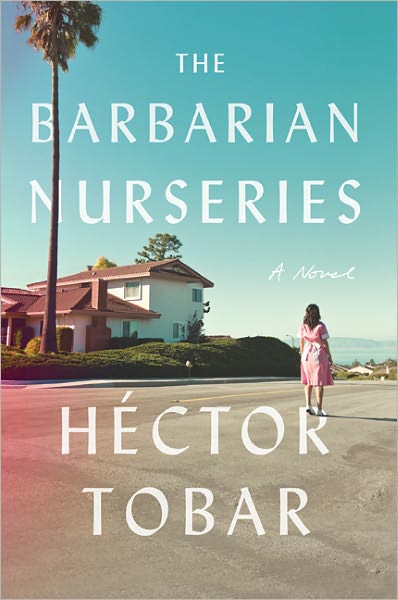
The Barbarian Nurseries by Héctor Tobar

A deceptively quiet story, with swift currents running deep beneath its surface, considers the fate of an unprepared Mexican housekeeper in Orange County left to care for her employers’ young children.

Pulitzer Prize-winning journalist Héctor Tobar‘s second novel tackles the ambitious goal of characterizing Southern California’s multicultural schizophrenia and achieves it admirably.

Araceli is quietly comfortable in her role as housemaid to the Torres-Thompson household in Orange County, one of three Mexican domestics; but when the gardener and nanny are suddenly dismissed, she is puzzled to find herself expected to care of three children she considers strangers. Worse, she wakes up one morning to find both her employers gone with their baby–leaving her alone in the house with two young boys. In desperation, she sets off with them on a daunting trek through diverse and unfamiliar Los Angeles to try to find their estranged paternal grandfather.

Tobar creates an intriguing juxtaposition of cultures, as the Torres-Thompson children are thrust into a huge, unfamiliar, multiethnic city. Most observations are from Araceli’s perplexed, amused, lyrically bilingual perspective. At other times, we look through the boys’ eyes, with all the wonder of the new, including evidence of poverty they’ve never before encountered. The older boy (age 11), in particular, has a unique way of clinically interpreting new experiences through books he’s read, imbuing the world with fantasy. The adventure with the boys is a comedy of errors–Araceli becomes suddenly famous as a symbol of racial politics, and her fate depends upon forces outside her control.

The Barbarian Nurseries is a beautifully written, contemplative and thought-provoking view into Southern California’s diversity and contradictions, as well as a fascinating and well-presented story.


This review originally ran in the September 27, 2011 issue of Shelf Awareness for Readers. To subscribe, click here, and you’ll receive two issues per week of book reviews and other bookish fun!


Y’all! One of the best books I’ve read this year! Rush out there and get it!!

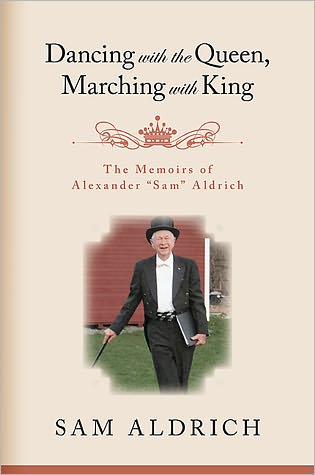
did not finish: Dancing with the Queen, Marching with King by Sam Aldrich

I was sent a galley copy of this book for review, but was not able to stomach it.

Alexander “Sam” Aldrich was born a blue-blood in New York state, silver spoon and all. He received a good classy upbringing, but pursued more philanthropic goals than just earning money as I believe was expected of him. He worked as a lawyer, then in city and state government. His book begins with an explanation of the title: first, a brief account of having danced with the Queen of England at age 25, and then a several-chapters-long narrative of his experience marching with Martin Luther King, Jr. from Selma to Montgomery, in his thirties. In telling of the march on Montgomery, Aldrich is at his strongest; his passion and indignation at injustice comes through. And although I looked carefully, he never claimed to have fully grasped what it was like to be a poor black man in Alabama in the 1960’s.

Throughout, Aldrich’s writing is very poor. He’s clearly writing as he talks; it’s conversational; but it’s also full of grammar mistakes, run-on sentences and the like. A conversational style can be endearing and casual, but this came across as amateurish; surely the State University of New York Press wants to keep its name clearer than this. Yes this is a galley copy, but I’m not talking about a few typographical errors that will be corrected in copy editing; I’m talking about a writing style that made my skin crawl.

Aldrich’s story fell short for me quickly. I made it about halfway through the 270ish pages and felt bored. I fear that the Selma to Montgomery march may have been his greatest moment, and if so, he may have done better to not let it go in the first few chapters. I think his claim to fame is his refusal to be a standard rich guy, but what he did instead did not strike me as so remarkable as to keep this book afloat.

The final straw was reference to the outing, blacklisting, and harassment of communists in the 1950’s, which I thought we were done being proud of; but this 2011 publication toes the McCarthyist party line perfectly. I had been peering suspiciously sideways at Aldrich’s semi-concealed conservative agenda, and coming across this ugliness was the end for me.

Final verdict? I can’t entirely judge, of course, having been unable to even finish the dern thing; but my impression is: a poorly written memoir of a semi-remarkable life, with a partially-concealed political agenda that I personally find abhorrent. Not for me.

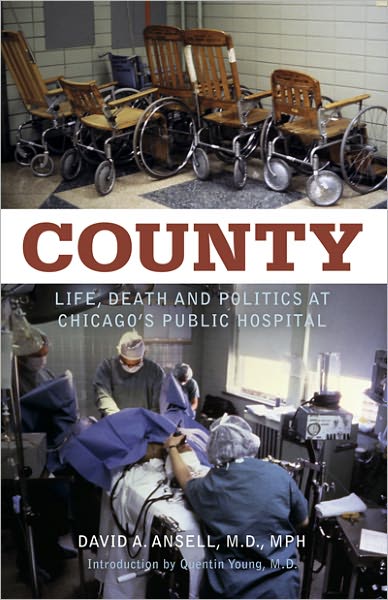
County: Life, Death and Politics at Chicago’s Public Hospital by David A. Ansell

I read ~150 of County‘s ~200 pages in one night, and forced myself off to bed. Finished the next day. Ansell is no professional writer; I itched to get out my red pen here and there. But his story is powerful and evocative, and his passion for the injustices he describes absolutely screams off the page.

I found myself swept away in the story of “County,” as Ansell refers to the Cook County Hospital in Chicago where he spent the bulk of his career. As a med student, he and his friends suspected they wanted to go to County, famous for its overcrowding, underfunding, racial disparity, and incredible challenge. His group was concerned about social injustice. Fresh off antiwar protests and sensitive to racism, these idealistic young med students drove down from New York to Chicago to visit the hospital and interview with Quentin Young, then Chairman of the Department of Internal Medicine, famous pioneer of desegregation and human rights in health care. They were shocked at the squalor and disorganization, even having come in with some impressions. Ansell & friends, eventually known as the “Syracuse Group,” conspired to become residents at County, precisely because of the challenges it presented.

Ansell is strongest when telling his personal story. Residents at County in his day (he started in 1978) had little to no supervision or assistance from their attending physicians; he describes an environment in which the residents all muddle through together, cooperatively, learning as they went. This was a great education but often resulted in less-than-optimal care for the poverty-stricken patients. From resident, he goes on to a position as an attending physician at County, although his original plan had been to head back east after completing his residency. He was immediately hooked, though, by the neediness of County, the organization, and his patients. He was also involved in politics and activism from his first moment on campus – literally. He attended a meeting on the day of his scheduled interview for residency.

Over the years, Dr. Ansell would serve in various positions in the ER and in the outpatient clinic, and be part of the birth of the Breast Cancer Screening Program and County’s AIDS Clinic. His patients, and their problems, made deep impressions on him. He was active in trying to right the wrongs of the health care system and of County’s management and underfunding in particular. When the politics really get going, Ansell can get a little bit soap-boxy. I have mixed feelings about this aspect of the book. While unquestionably passionate, righteous, and well-informed, he can tend to come on a little strong. Preachy, even. My concern here is the one my old buddy Gerber expressed about Barbara Ehrenreich’s Nickled and Dimed: On Not Getting By in America, years ago: the author’s personal political starting point is so overtly obvious that the (actually very strong) point of the book may be dismissed because of the author’s prejudice. Speaking as someone who DOES share Ansell’s politics, and who still feels that he can get a little preachy, I have concerns about the book achieving its goal of education and perhaps even changing minds.

But the stories about Ansell’s experience learning and working as a professional doctor, the stories about his patients and their troubles, and the stories about the challenges of County… its politics, the underfunding, the horrific and inhumane conditions… these are where Ansell shines. It’s a powerful, emotional, evocative book. It makes good points: it argues that access to health care is a human right, and should not be dependent upon health insurance or employment status. It is definitely a political book. I recommend it, just with a few reservations. Because it is short and engrossing, you can almost read this book in one sitting or two. And I think it is absolutely worth your time.

finally, meet Henrietta Lacks

What an amazing story. First, let me admit that I was perhaps a little wary of beginning this one because I feared it might be “heavy” (science-y, tech-y). But after a pleasant day pre-riding tomorrow’s race course with friends in perfect weather, I got brave and settled into it while the Husband worked on a bike in the garage.

I began with “A Few Words About This Book” and was enthralled in just a few sentences. Nothing about this story is dry or overly science-y. In the prologue I learned of the personal connection between author Rebecca Skloot and the story of Henrietta Lacks. This is too human to be heavy.

I’ll back up. In case you don’t know, The Immortal Life of Henrietta Lacks is a work of nonfiction, addressing the case of a Southern black woman whose cells were harvested without her knowledge shortly before a mysteriously aggressive cancer took her life just past the age of 30, leaving 5 small children to be raised by an enormous family of Lackses and friends. This family didn’t find out about the use of her cells for more than 20 years, during which time they were reproduced in numbers greater than can be contemplated. Henrietta’s cells have played an important and often the decisive role in innumerable medical and scientific advances: the polio vaccine, chemotherapy, genetic research, in vitro fertilization and the effects of the atom bomb. All of this without any attempt to inform her family, get consent, or discover their feelings; and without any compensation. While industries are birthed and men become rich,  the Lackses continue in the same culture that Henrietta’s parents knew, living in their forefather’s slave quarters and farming tobacco. Today’s Lackses are ill-equipped to even understand the story of Henrietta’s cells, and no one has bothered to try to explain it to them.

As soon as I started reading I was engrossed. Again, the author, Skloot, has a personal relationship to the story, and necessarily forms personal relationships with the modern-day players in the course of her research. I learn a surprising amount of science without feeling intellectually exercised, and it almost reads like a work of suspense; the pages keep turning; I’m anxious to hear the next bit of dialog. Human interactions with Henrietta’s relatives are interspersed with the science (which in itself is interspersed with the human stories of those players), and the thing just rolls along building momentum.

I had to tear myself away to write this entry for you. I find this to be an outrageous (as in, outrage-inducing) and educational story, and I recommend it. Skloot’s skills as a writer are commendable. I hope you’ll join me as I open a cold Avery IPA (just one, I’m racing tomorrow) and get back in it.