one new book

Before you get worried, I’m still reading and still enjoying Frederica, and I’m taking her home for the long weekend! But I’m also excited because I got a new shipment here at the library today, and one book that I am particularly and personally excited about arrived:


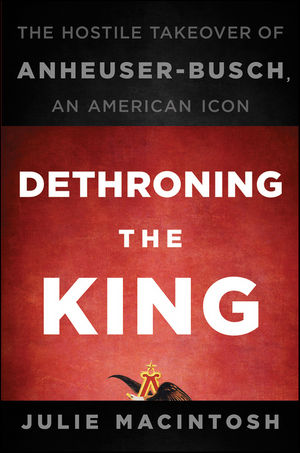
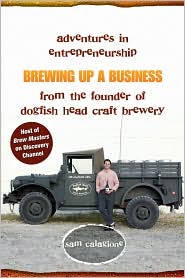
Dethroning the King by Julie Macintosh. As you can see, this is a story of beer and business. It will of course be a very different story from Brewing up a Business which I also enjoyed very much:


The latter is written by none other than Sam Calagione of Dogfish Head Craft Brewing, a personal hero of mine and now the star of Discovery Channel’s “Brewmasters” show.

But at any rate, both are of interest to me because I’m a fan and amateur connoisseur of beer (see my personal website here for personal tidbits or specifically here for beer-related ramblings). While not a fan of the *beers* that Anheuser-Busch produces, I do think they have a business model that deserves consideration if you’re into beer at all, and this story is relevant to serious beer drinkers the world over, regardless of whether you prefer their products. When I have a spare moment (ha) I do intend to read this one.

Onward to another long weekend and a new year! I will be mountain biking, celebrating with friends (thanks Rossis for hosting) and reading good books! Cheers!


Ahem. I should have pointed out as well that while I wrote this post the Husband was off with the Brother-in-law making beer.

several pots on the fire

So last night I found myself with some unexpected free time at home, and because it was *unexpected*, I had unfortunately left my current book, When Christ and His Saints Slept, at the library at work. Bummer. I’m already going to have several going at once when I start Faithful Place as planned tomorrow. So I picked up one of the many (many, many) lying around TBR, and started…

The Things They Carried, by Tim O’Brien. This is not a new book; it was originally published in 1990, and I became aware of it this year with the 20th anniversary republication and various discussions. It’s a collection of related short stories (or a novel, depending on who you ask) set in the Vietnam War, and based on O’Brien’s experiences there. I read only one story/chapter last night before bed; but I can see why this book has been so talked about. This story/chapter that I read is “The Things They Carried,” and I love how he uses those things to tell so much of a story. It’s sort of sparsely written, and using “things” rather than emotions, which to me makes for less telling and more showing. It’s beautiful and sad and evocative. I look forward to more.

I was a little sorry to start another book while reading one and ready to start another tomorrow. But then I realized that I have several going at any one time, as it is… there’s Dust by Martha Grimes on the bedside table, and Frederica by Georgette Heyer in the bathroom, and This Book is Overdue! by Marilyn Johnson on the coffee table. What fun, when a person gets to live like this. Do you read several books at a time?

finished Running the Books and more Burke

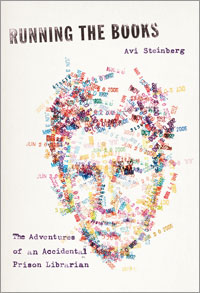
Well it turns out that Running the Books gets a resounding endorsement. Author Avi Steinberg started a touch slow, but he grabbed me hard in the end. As our protagonist, Steinberg develops as a character and as a human being as the book unfolds, making some real personal discoveries. It’s a very human story, poignant and forgiving and realistically ambivalent in its eventual conclusions (or lack thereof) about the nature of prisons and criminals. I really enjoyed it.

(If you can’t tell in the image at left, his face is made up of lots of date stamps. Like due date stamps. It’s rather an interesting and clever piece of librarian-art if you care.)

I’m now well into another James Lee Burke, The Tin Roof Blowdown, that my mother gave me quite a while ago. That’s the Dave Robicheaux novel set in New Orleans and New Iberia in the aftermath of Hurricane Katrina, and boy, you want to talk about something stark and visceral… putting aside for a moment the beauty that is a Dave Robicheaux novel, the realistic descriptions of Katrina’s destruction are gut-wrenching. The death and suffering, the necessary decisions about who lives, who dies, who a person chooses to save, the morals and ethics involved, the widespread racism, the political neglect, and the gritty reality of the blood and guts and sewage… it’s very real, and those moral dilemmas are evoked expertly. (I expect nothing less of Burke.) This one is grabbing me a lot harder than Cadillac Jukebox did recently. I really like the character of Alafair, Dave’s adopted daughter, too. (Burke has an adopted daughter named Alafair, who like her fictional namesake is also a writer; one wonders where fact meets fiction.) The chasing of the bad guys by Dave and and perennially self-destructive Clete Purcel is as finely wrought as ever, but for me, what’s special about this book is the rawness and realism of Katrina’s destruction. Whew.

I am, as usual, swamped in fine reading material, and don’t think Burke will take me too long, so stay tuned for one of the three books I recently named as coming next! 😉

identifying with the prison librarian

Well, you tell me, does this make me a little nuts, or just mean that Steinberg is a skilled author? It’s occurring to me that our situations are parallel: we both work in “special libraries” (that’s a real term), meaning we’re not in schools, universities, or public libraries. Prisons and hospitals are fairly unique environments. I’m not sure my employer would appreciate the comparison, but both are large institutions, and I have heard my patrons say they feel a little bit like they’re being processed in a machine. I’ve been thanked for using their names instead of 8-digit numerical identifiers. That’s kind of sad. I just had this strange feeling as I walked back from lunch, having reluctantly closed Running the Books, that perhaps it’s weird that I’ve become accustomed to seeing signs on escalators that say “If You Are Feeling Dizzy or Unstable, Please Use the Elevator” and in bathroom stalls that say “If you have had an accident or soiled your clothing and need help, please call XXX.XXX.XXXX.” People here are not necessarily happy to be here. Also, I share with Avi the prison librarian the embargo against connecting with our patrons. There are different reasons – his are a serious security risk, are considered to have lost the privilege of making friends, threaten his job. Mine have a federally protected right to privacy and are going through utterly life-changing events. But they’re all people and we all too easily see ourselves and our loved ones in these strangers. Of course, Avi sees the same people for long periods of time (very much the norm in prison I think) and my people come and go unpredictably (and when they go, I never know why). But I’m getting into this book and identifying with Avi’s workplace conundrums.

a few mysteries and more prison libraries

Well vacation was outstanding and too short as usual. Hope everyone enjoyed. With a total of 22 or so hours on planes and 8 or so hours on trains… I did some reading!

I started with Unhinged, by Sarah Graves, which is “A Home Repair is Homicide Mystery” – one of those specialist mysteries like the quilting or recipe-filled ones, or one of the book-related ones I binged on recently. Pretty interesting as such, but my fear with books of this sort is always that they’ll be sort of simplistic, or rely on their novelty status. This one didn’t do half bad; I was amused and interested and the characters were cute. It wasn’t terribly serious or literary and was definitely a cozy. I might pick up another with the same casual interest for an airplane ride, but it was unremarkable. I’m no home-repair buff, but the related details were light and unobtrusive. Of course if you were a home-repair buff, I’m not sure you’d be satisfied with those aspects.

Next came another Lee Child, One Shot. I am decidedly a fan. I love the Jack Reacher character; those who told me he’d be a good character for me based on my love for Connelly’s Bosch were so right! The fast pace and strong sense of place are great; I stayed up late into the night to finish this one, and have recommended it to the Husband, who likes Connelly, couldn’t get into the more thoughtful pace of Raymond Chandler, and reads just a few pages at a time with long gaps in between, so fast pace is pretty important to him. He likes it so far. One Shot is set in small-town Indiana, which is not an environment I’m familiar with, but Child makes it seem plenty real. I just love the suspense and the loner aspects of Reacher; he has the Bosch characteristics of seeming intolerant of people trying to form relationships, while really being something of a softie inside, though he has trouble giving in to this impulse. Reacher is a little bit of a caricature Rambo-type, but I’m so into it that I don’t mind. I’ll definitely be pursuing this series – and good thing, since I’m all out of Connelly for now.

Finally I picked up the James Lee Burke I found to bring along, Cadillac Jukebox. Classic Burke with Robicheaux going it alone (despite being a member of law enforcement) in renegade cowboy fashion against massive injustice, including the racial and sexual kinds. Clete Purcel makes a few minor appearances, and New Iberia, New Orleans, and the surrounding environs are strongly evoked. Burke writes beautiful, poetic, prose with an appreciation for nature. These are great books. But, I’m noticing that the more time I spend with Connelly and Child, the slower Burke feels to me. His books aren’t slowly paced by any means, but they’re decidedly more leisurely than the other two. Robicheaux is also a bad-boy loner, also with soft spots (the wife in this book is Bootsie and daughter Alafair is present as well), but his self-destructive tendencies almost feel more pronounced to me. Where Reacher is fairly well outside society, completely outside law enforcement, has no ties, and is completely unstoppable in physical combat, Burke is more human and seems to have more to lose. Where Bosch has loyal compatriots in the force and a teflon-like mastery of department politics, Burke feels isolated and more vulnerable. Here in Cadillac Jukebox he gets wrongly accused of sexual assault and is threatened with the loss of his health insurance, both of which somehow feel unlikely with Bosch, who (in the course of the series) leaves and returns to the LAPD without significantly changing his relationship with crime investigation. At any rate, full marks for Burke as usual, but I’m starting to notice that he’s not the perfect counterpart to Connelly I once thought he was – that might be Child – while on the other hand, I just had a patron request Connelly and Burke in the same sentence, so clearly I’m not alone in my tastes!

I was without reading material for the flight home 😦 but I made it anyway, and am now back to Avi Steinberg’s Running the Books and ready to render a verdict on the questions I asked earlier. Not tiresome, but fascinating and engaging! It took long enough, but by halfway through, I’m hooked and anxious to get back into it. The separate story lines have converged, if minimally, but more so, they’re no longer anecdotes but continuing tales involving characters that I really care about. These are real people (literally, but they also feel real) and I mourn them when they die. (This is about prison; not everyone gets a happy ending; just past halfway, I’ve yet to find one happy ending, in fact.) Avi, the narrator, is emerging as a real person with some soulful stuff on the line, too; he gets involved with his inmate patrons and some of the larger issues as well. I enjoyed the tour he takes of past prison and jail buildings and his historical/social/philosophical/literary discussion of them (look for Sylvia Plath). What I called a clever and potentially pretentious writing style I have come to find engaging, contemplative, self-reflective, maybe even slightly poetic. I enjoy the part I’m reading now, about the difference between archivists and librarians, and which of them Avi will turn out to be – bearing in mind he didn’t have a library degree or any background when he took the job, so he’s learning as he goes. I’m giving this book an endorsement, in case you can’t tell.

Stay tuned… next I’m trying to decide between Still Missing by Chevy Stevens, finally starting Larsson’s series with The Girl With the Dragon Tattoo, or getting into the fat Sharon Kay Penman I’ve got looking at me on my desk, When Christs and His Saints Slept. What are YOU reading?

I’d Know You Anywhere by Laura Lippman, and Running the Books by Avi Steinberg

I had some trouble selecting a new book to read over the weekend, and ended up taking home Avi Steinberg’s Running the Books: the adventures of an accidental prison librarian. But before I could get to it, while putting new books up on my new books display, I came across Laura Lippman’s I’d Know You Anywhere, and got involved in it!

I’d Know You Anywhere is about a woman with a pretty good life: husband, two kids, nice house, generally serene, other than her daughter’s beginning to be a teenager. Then she gets a letter from the man, on death row, who abducted, raped, and held her for six weeks when she was 15. Her life is disrupted by corresponding with him, which she feels powerless to avoid. Years of carefully constructed anonymity are threatened.

It was a fun book. I read it almost straight through; it was gripping and interesting; the characters felt like real people. I found a certain theme of family and motherhood, that’s a little new and different to me in the mystery/thriller genre; this was present in Lisa Scottoline’s Look Again as well. I’m not as excited or sentimental about motherhood as some, so this theme could potentially get a bit tiring for me, but in both of these examples the authors have pulled it off. Barely. I’d Know You Anywhere is fast-paced and realistic and raises some interesting questions about victim’s rights and the death penalty, but remains an easy read (it could be a thinker only if you choose it to be). I was glad to spend my time on it.

Then yesterday I got around to Avi Steinberg’s Running the Books. It’s biographical; he’s telling his own story: former Orthodox Jew, then Harvard student, then underachieving freelance obituary writer, finally turned prison librarian. (Whew.) I haven’t gotten very far in, but I’m walking a tightrope: enjoying his clever writing style while worrying that he’s getting a bit pretentious. There’s not much question that there are some interesting stories here, but so far they’re unrelated anecdotes. Let me say this book shows potential to be fascinating and amusing, or tiresome. Jury’s out.

I’m also housing a big, fat Sharon Kay Penman paperback called When Christ and His Saints Slept, and I enjoyed The Reckoning by the same author so much that I’m excited, and hope not to be disappointed since my expectations are so high! So that’s in the queue. Also, I fly to Belgium in just 3 days for a short vacation and will need ratty paperbacks that I can leave behind on the trip. (Not sure Penman’s qualifies for this job.) There’s always more to read…

Enjoy your holidays and please do let me know what you find!

readalike: Henrietta Lacks and The Spirit Catches You

The Immortal Life of Henrietta Lacks, by Rebecca Skloot, and The Spirit Catches You and You Fall Down, by Anne Fadiman, read almost like partner volumes to me. These two nonfiction works share author/narrators who get involved in their subjects, spending a great deal of time with the families involved and forming personal bonds. Both Fadiman and Skloot are bothered by a sense of, if not wrongdoing, something having gone awry. The subject of both books is medicine, and the interaction of the institution of western medicine with a culture that doesn’t fully understand it. Humans are important. Ethics are involved, and there are no clear rights and wrongs – or perhaps it would be better to say it’s easy to see where we went wrong, but difficult to see what the right path would have been. Even the structure and tone of the two books are similar: to understand the subject at hand, we are often taken back a step or zoomed out, to a perspective where we can see the history or the culture’s role in a specific situation. The reader learns medicine, science, history without feeling lectured. I strongly recommend both.

Lee Child’s Echo Burning, and some more nonfiction: The Spirit Catches You and You Fall Down

Sorry I’ve been absent for a bit. But I have been doing some good reading.

Last week, my workday reading was Lee Child’s Echo Burning. Child and his character, Reacher, were recommended to me in my RA class, and I picked up Echo Burning because it’s set in the vast west Texas desert, an area I’m a little bit familiar with.

Child’s series starring Jack Reacher was compared by my classmate and teacher to Connelly’s series starring Harry Bosch, of which you might have noticed I’m a fan. I really read Connelly to get more of Bosch, and Reacher does share some resemblance. Bosch, while an anti-authority loner type, does actually work for the authorities as a police detective, although he’s always at odds with his bosses and occasionally leaves the fold just to make things interesting. Reacher is a former military policeman (MP) turned rogue do-gooder, in a violent sort of way. Neither has a great deal of respect for authority or the rules that dictate the way they should go about solving crimes or problems, although Harry grudgingly plays along, most of the time, at least in the clues he leaves behind, because he has to present a prosecutable case to his DA.

Reacher doesn’t have a mission like Bosch does; in this book, and I get the impression in all, he’s merely drifting, moving through town, and gets caught up in problems he then goes about solving. Bosch has a job to do, and does it well and willingly; Reacher is just taking what comes up. Actually, in many ways the Reacher story reminds me of a western, especially with this setting; he’s the lone ranger rolling through town, taking care of business and moving along. He has an endearing, chivalrous care for the ladies, but he’s awfully rough around the edges, and starkly violent.

I loved it. It was just similar enough to Connelly to get me excited – the characters were similar but different, and would probably respect one another, although they wouldn’t stick around to get to be friends. I enjoyed the setting and recognized it, which is always fun (we all enjoy realistic settings in our own hometowns, right?). I guess it had a number of my requirements: strong sense of place; moody, gritty, dark tone; and a certain “type” of main character. I think I’ll be looking for Reacher again.

This weekend I got involved in another work of nonfiction, and I have to say, I find it remarkably similar to a recent read (but I’ll tell you about that another day, so as not to ruin it). I’m about two-thirds of the way through, now, with The Spirit Catches You and You Fall Down, by Anne Fadiman. (There’s an excellent chance I’ll finish tonight.)

This book is about a little girl and her family’s experience: Lia Lee is a Hmong child, born in Merced, CA to recent immigrants from the Hmong people’s extended journey through China and Laos. She has severe epilepsy, and the book centers around the conflict between her family and culture, and western medicine, in their two very different understandings of what her illness is, what causes it, and how it should be treated. In addressing Lia’s story, Fadiman gives us a brief history of the Hmong people’s culture and history. It is absolutely fascinating, and for me, the cultural aspects make this book special.

It’s an educational book because it provides lots of information and facts, properly cited, about medicine and epilepsy, as well as about the Hmong people in history (and the U.S. involvement in Vietnam and Laos), their immigration here, and the treatment of refugees by our welfare and other systems. But like I said, the cultural interactions are most interesting to me. The local hospital and medical system struggle to treat Lia and give her the best possible life; her parents likewise want her to be happy and healthy. But they have such fundamental differences… it’s not like two doctors debating two courses of treatment; we’re talking about two absolutely non-compatible, to the extent that they’re not really translatable, understandings of what’s wrong with her and the causes of her disease. Translation is almost not possible in the traditional sense because of cultural norms that don’t allow for direct translation. Californians and the Hmong have so recently met that there’s no precedent for much of a need for translation; there hasn’t been time for much bilingualism to develop, nor has their been much interest, on either side. (I should note this book is more than ten years old, so the current situation is a little different.)

I’m totally engrossed in the story of Lia and her family, but equally so in the story of the Hmong people in history. I’m also intrigued by the involvement of the author/narrator and her experience in researching the book. One lesson or concept that I’m coming away with is the ease with which we can condemn someone as having done the Wrong thing, and the difficulty with which we can come up with the Right thing. This is something that always occurs to me in politics. I can clearly see policies or politicians with whom I disagree because they’re Wrong; but in such a big, complicated, diverse world, with such intertwined goals, interrelated causes and effects, and various goals, I have an awfully hard time clearly seeing The Right Way. This is why I am not running for public office! Anyway – Lia’s story might well make you realize that nobody was entirely right or entirely wrong (certainly not wrong in their intentions and best efforts) and yet, Lia did not get optimal care. These cultural exchanges are, whew, hard.

I recommend this book and hope you’ll join me in enjoying it. If you haven’t already guessed what recent read I’m comparing it to, stay tuned. To me it’s just as obvious as anything but we’ll see. Feel free to post your guess here… Til soon, enjoy your week and your books.

vacation reading.

Hello! I’m home early from my vacation; some bad weather ran us off the trails at Tyler 😦 and it was so beautiful, too. I got plenty of reading done, though, and now I’m here to tell you about it.

I finished The Cases That Haunt Us by John Douglas and read Bridge to Terabithia by Katherine Paterson, The Reversal by Michael Connelly, and Look Again by Lisa Scottoline. (I also picked up a copy of J.D. Robb’s Fantasy in Death at a big-box store in Louisiana but didn’t need it since we came home early.) And I listened to about half of Ian McKellen’s reading of the Odyssey in the car. So, you’ll have to forgive this long post!

In order:

I finished The Cases That Haunt Us, which I’ve been taking in bits and pieces for some time now. Because it’s a compilation of Douglas’s notes about various cases, it reads well this way. I got a little impatient with his style occasionally, but to be fair, this is not a professional writer, but a criminal profiler. I found his analyses very interesting and it was well worth my time. I now have a longer list of serial killers that I want to look up and read about. Is that weird? Thanks Douglas for interesting stories and facts. I’m not sure why this subject is so fascinating to me!

I picked up a copy of Bridge to Terabithia on impulse, having read about it somewhere. This children’s read is not a new book, either, but I think stories like this one stay current. It reminded me of the 1991 movie My Girl with Macaulay Culkin, in which a girl full of her own issues and problems has her perspective widened by the death of her best friend. Bridge to Terabithia involves a 5th-grader short of friends and positive moments in his life, who makes a new best friend and loses her in an accident in which he feels some responsibility. I think it’s an age-old story about friendship, society/rejection (so important especially to kids), and loss. It’s a coming-of-age story, too, because we grow a little bit older when we experience tragedy. I’m not involved with any kids’ reading choices, so this was just a diversion for me… but even an adult can enjoy a quick-read high-quality kids’ story like this one.

Then the main event: Connelly’s latest release, The Reversal. I think I can handle this one without any spoilers, staying within the bounds of the blurb you’ll find online or on the dust jacket. In this book, we have a convergence of characters: defense attorney Mickey Haller teams up with his prosecutor ex-wife Maggie McPherson (“McFierce”) to work for the people this time, and they take Harry Bosch on as their case investigator. I find it exhilarating to have these three in the same room! And we get their daughters together, too, which several of us besides Haller have been looking forward too. As expected, family connections further develop the characters on a personal level. Earlier in the series, Bosch was much more “just” a police detective, but all this personal-life-material has really developed him into a full and complete human. I love it. This is what I read Connelly for.

As expected, we get a full dose of Hollywood society and L.A. setting in this high-profile case. Also, as I’ve come to expect from the Haller books, we get extra courtroom-procedural drama; I especially like the jury selection and analysis. (Here I find a parallel to the criminal profiling I also like.) The case is interesting and convoluted, of course; that’s not optional. But to me, the personal connections and family drama amongst our 3 chief characters is what really makes the book.

I have to file one complaint: I found the ending to be a little anti-climactic and unsatisfactory. I was looking for more answers, just like Harry Bosch was. I guess maybe this is realistic; maybe this is the way cases like this do end. It’s also not the first time Connelly has done this to me, and I still love him and will keep reading. But I guess it ended a little bit abruptly for me. Maybe I’ll come back and reconsider this later, more fully, when others have read the book. If there’s any interest shown. (Chime in here.)

This is where I ran out of reading material, gasp, and stopped off at the above-mentioned big-box store in Ruston, LA. (That’s an experience.) I picked up the J.D. Robb that I never got to (maybe that’s next) along with Lisa Scottoline’s Look Again. I’ve never read her, but I’ve read about her work and it sounds interesting.

Look Again is about a reporter in Philadelphia named Ellen who gets a missing-child postcard in the mail. As she goes to throw it away, she’s stopped by the face on the card: it is, uncannily, the face of her three-year-old adopted son, Will. Amidst drama at her tenuous place of employment, Ellen takes off work and flies to Miami to investigate a two-year-old abduction, and look into her adoption. We get a number of surprises, but not perhaps where Scottoline wanted them: I found the major plot revelation to be completely predictable, while the late-book romance and brief gory, graphic violence caught me off-guard. I wasn’t bothered, but I was surprised by the change in tone, after spending so much time on family and babies. Despite all this, I enjoyed the book. It was fast-paced, kept me involved and interested even as I predicted our big “surprise”, and I really cared about Will’s fate. I’d recommend it to someone who wanted a fast-paced, exhilarating suspense-mystery about family and children, even a little romance, in which setting is important (more on this in a moment) and the ending is fully satisfying (unlike Connelly, hmph). It was a quick, easy, satisfying read.

I observed in reading the Scottoline book that significant sense of place is important to me. I really like how Connelly uses the city of L.A. (and sometimes Vegas or other locales) almost as a character; the place is realistic and very important to the action of the book. For this quality, definitely look to James Lee Burke and his depiction of small-town New Iberia, Louisiana, as well as New Orleans and occasionally other places including Galveston, TX. (His main detective character has a lot in common with Harry Bosch, too.) I’ve only read one Nevada Barr book (starring Anna Pigeon): Deep South, set in Mississippi if I recall correctly. I got the same satisfying sense of place from her, and it’s my impression that this is true of all her books. I like it. I liked that Philadelphia and Miami were well characterized in Look Again. When I read Elizabeth George and Martha Grimes, I get a pretty good sense of place too, but their mysteries are set in Great Britain, and I have much less sense of their settings; I can’t judge how hackneyed or evocative their settings are for myself, if that makes any sense. Even though I’ve never been to Miami, I feel more at home in the U.S. settings mentioned here. So, I’m just still making observations about what’s important to me in a good murder-mystery. Sense of place. Wonder if there are any good ones set in Houston out there. I have read some Susan Wittig Albert; hers are set in small-town Texas not far from Austin. But they’re a bit cute and cozy for me.

Sorry about the rambling there – moving on: the Odyssey audiobook. I was excited about hearing it read aloud to me for the first time, after many readings. This work was composed in oral form before the invention of writing, so it’s really meant to be heard and not read off the page. And Ian McKellen seemed like an excellent selection for reader (he’s Gandalf in the Lord of the Rings movie trilogy in case you don’t know). The translation makes a big difference, of course, and forgive me for being picky but I prefer Fitzgerald’s to the Fagles one read here, which is still excellent.

It’s been a few years since my last reading of the Odyssey, and one of the first things to grab me was the use of repetition. Homer helps us keep track of who’s who and where’s where by use of repeated phrases: in the Fagles translation (from memory I paraphrase), “when they’d put aside desire for food and drink, they set their mind on other pleasures” and the epithet of dawn, “young dawn with her rose-red fingers” (Fitzgerald uses “rose-fingered Dawn” and maybe just because I was raised on it I find this more satisfying somehow). I enjoyed this repetition, and of course, the poetry of this beautiful work. McKellen does a beautiful, powerful, emotional job of reading. Although I’m not sure why we need a British accent to make poetry beautiful!

On the other hand, I was a little disappointed at some of the pacing issues. Maybe I’ve been pacing myself differently on the page all these years: maybe I skim more quickly over the repetitious or descriptive parts and rush towards the action (I’ve been guilty of this before). They’re such great stories, as well as being beautiful poetry. Maybe on different days and in different readings I prioritize these two aspects differently. The beauty of reading it myself off a page is that the power is mine to rush or linger. Or maybe I was just concerned, once I got the Husband in the car, about keeping his interest – I think for him, the action definitely needed to be prioritized. You can’t speed Sir Ian up.

Maybe I’m just not sold on the audiobook format. I’ve never been a listener as much as I am a reader. And I’ll stick with “real” books over the Kindle/Nook/etc. for now, thanks. 🙂

So, the vacation may not have gone perfectly (rain in Tyler, boo) but the reading was excellent and hopefully I’ve preserved the bulk of my thoughts long enough to get them online for you. 🙂 Thanks for checking in on me. What are YOU reading these days?

finished HeLa.

Wow. The Immortal Life of Henrietta Lacks really got me interested and taught me so much; and it was such an easy read, for something so educational. 🙂 When I finished the book I spent some time perusing the acknowledgements and notes, just out of regret that it was over. I am relieved to say that there is some measure of peace achieved in the end. It’s not a particularly happy or upbeat story; it’s very serious stuff. But there are some hopeful moments in the final wrap-up.

I count it in author Skloot’s favor that I became involved in her life as well as those of Deborah and the other Lackses we come to know. These people matter, and I know and care about some medical issues I had not bothered about before reading this book. I think this should be required reading for everyone, in the category of Knowing About Your World. Thank you KD for prompting my interest!