“fact vs. artistic license”

Thanks to Pops for today’s prompt (and post title). He sent me this article, from the New York Times. I hope that link works! If it doesn’t, it’s called “The Fact-Checker Versus the Fabulist”, written by Gideon Lewis-Kraus, published February 21, 2012, so hopefully you can find it online. In a nutshell, it discusses the following situation:

“Hi, John. I’m Jim Fingal. I’m the intern who’s been assigned to fact-check your article about Las Vegas, and I’ve discovered a small discrepancy between the number of strip clubs you’re claiming there are in Las Vegas and the number that’s given in your supporting documents.” To which [John] D’Agata responded: “Hi, Jim. I think maybe there’s some sort of miscommunication, because the ‘article,’ as you call it, is fine. It shouldn’t need a fact-checker; at least that was my understanding with the editor I’ve been working with. I have taken some liberties in the essay here and there, but none of them are harmful.”

The article under discussion, called “What Happens There,” is purportedly nonfiction, but takes liberties, as its author says, with the facts. Lewis-Kraus discusses what it means to take liberties with fact in nonfiction writing. D’Agata makes a case for the higher purpose of “art” taking precedent over facts. I think we can probably agree that this concept, taken to an extreme, is bad for nonfiction. But the fact (heh) is that much nonfiction, arguably most nonfiction, even more arguably, perhaps, all nonfiction leaves some room for concern over absolute truth. I mean, come on, truth is relative, in the eye of the beholder, and always subject to some argument.

Pops expresses concern over

the view of any given writer that s/he is creating art or entertainment, and therefore an obsession with extreme fact-checking just gets in the way (100% fact checking is exhausting & distracting from the writing process) – and it doesn’t matter because readers understand artistic license. It hadn’t occurred to me that writers could so knowingly & sincerely take this approach with eyes wide open.

And indeed, the attitude of D’Agata as expressed in Lewis-Kraus’s article is alarming. He seems pretty cavalier about the importance of facts (and fact-checking). But I was already aware of the blurry lines, even within “nonfiction”, between fact and… liberties. How do we tell the difference between pure fact and all the nuances that then follow, along a continuum, between pure fact and pure fiction? It’s an interesting and concerning issue. I’m not bothered by fiction, nor am I bothered by the many hybrids, but I think understanding what it is that we’re reading is important. If a reader forms a world-view based on a book, it’s pretty important that that reader be clear on where fact ends and personal opinion, interpretation, or imagination begins.

So how do we tell? Ideally, fiction is easy to identify. It’s in the realm of nonfiction – which label tends to be liberally applied – that we can get into trouble. Memoirs are famously vague in terms of fact, and I think that many readers are aware of that vagueness, but I’m sure many aren’t. And there is likely to be a very large portion of what we think of as nonfiction – that is published as such – that has some questionable areas of “fact.” Who polices these things? In theory, publishers do, at least to avoid embarrassment a la James Frey or Greg Mortenson. But how much of your life savings would you bet that every detail in that latest personal narrative is factually truthful?

We could impose a ratings system, I guess. But even if we were prepared to deal with the censorship threat implied, who would do the fact-checking and rating? The authors themselves? Editors? Publishers? A newly established institution subject to corruption and favoritism, and imposing a new cost on publishing? No, that’s not going to work.

I think the best solution – as is often the case – is to be responsible consumers of nonfiction. Reading authors’ notes, afterwords, acknowledgements, introductions, and footnotes should, in theory, assuming thorough and honest authors, give us an accurate idea of how much fact and how much author impression we’re getting. I love Sharon Kay Penman for her detailed author’s notes, in which she makes clear what is researched fact, what is educated extrapolation, and what is fiction. If all authors of historical fiction and nonfiction followed her lead, I would feel safer. But in practice, we’re pretty far from this standard.

I’ve blogged about this concept before, and I still don’t have an answer. And yet I still love to read historical fiction, and I read a lot of nonfiction, too. I’m sure I’m a more informed consumer than many; but I’m a long way from perfect. What advice would you give to me, or any reader of nonfiction and historical fiction, in keeping our facts straight? Is there anything we can do? Does the slippery slope of fiction vs. non bother you too?


A few authors’ notes:

Though this is not a work of fiction, it has some fictionalizing in it. Its facts are factual and the things it says happened did happen. But I have not scrupled to dramatize historical matter and thereby to shape its emphases as I see them, or occasionally to change living names and transpose existing places and garble contemporary incidents. Some of the characters, including at times the one I call myself, are composite. People are people, and if you put some of them down the way they are, they likely wouldn’t be happy. I don’t blame them. Nevertheless, even those parts are true in a fictional sense. As true as I could make them. —Goodbye to a River, by John Graves

The Edward Abbey of my books is largely a fictional creation: the true adventures of an imaginary person. The real Edward Abbey? I think I hardly know him. A shy, retiring, very timid fellow, obviously. Somewhat of a recluse, emerging rarely from his fictional den only when lured by money, vice, the prospect of applause. –Edward Abbey, from his journals, as quoted in The Life of Edward Abbey, by James M. Cahalan

What reactions do you have to these statements? Do these ambiguities about fact or “truth” compromise the integrity of the “nonfiction” works in question, or is their integrity somehow solidified by these explanations? Have you seen any interesting authors’ notes or statements of nonfictionality to share with us?

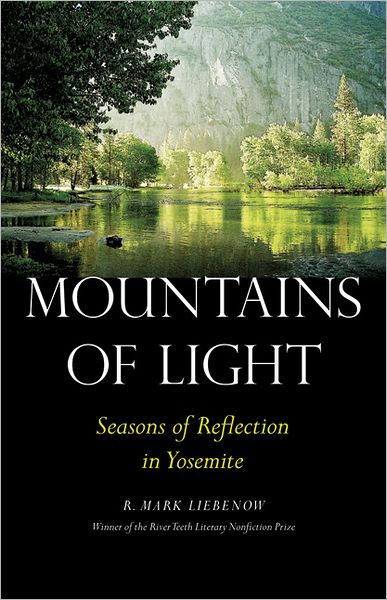
Mountains of Light by R. Mark Liebenow

A quiet, moving memoir of grief and recovery set in the Yosemite Valley.


When his wife of 18 years died, R. Mark Liebenow was overcome with grief. He sought relief by following in John Muir’s footsteps, consulting naturalists, historians, spiritual guides and artists along the way. Mountains of Light covers a year which he spends (in many short trips) in the Yosemite Valley, contemplating the natural world and the significance of death. He is “looking for the mystery of life,” he writes, “even if it can’t be solved but only hiked further into.”

Mountains of Light is lyrical and decidedly literary. Liebenow’s focus drifts: he describes a mountain vista, waxes mystical about the roles that insects and waterfalls and clouds play in the universe, quotes poetry (and Muir), confers with cutting-edge science and remembers his late wife. He includes morsels of history (particularly of Yosemite, from Native Americans through the Mariposa Battalion to the present) and catalogues plant and animal life. He considers various religious and spiritual understandings of nature and death and the mountains, mulling over his options for accepting his tragedy. The background for all this musing is dynamic, as Liebenow takes challenging hikes, explores, gets lost in the wilderness and watches his fellow campers and mountain climbers take still greater risks. The scenery changes drastically in four seasons, which Liebenow interprets metaphorically.

Part travelogue, part natural study and part memoir of grief, Mountains of Light is meditative, lovely, thought-provoking and, yes, sad–but worth it for the appreciation of this natural gem and the redemption it brings.


This review originally ran in the March 9, 2012 issue of Shelf Awareness for Readers. To subscribe, click here, and you’ll receive two issues per week of book reviews and other bookish fun!


Please note that this book makes a fine readalike for Fire Season or Edward Abbey’s Desert Solitaire. And look at that lovely cover, too!


Rating: 6 moments of contemplation.

book beginnings on Friday: Edward Abbey: A Life by James M. Cahalan

Thanks to Katy at A Few More Pages for hosting this meme. To participate, share the first line or two of the book you are currently reading and, if you feel so moved, let us know what your first impressions were based on that first line.

Today we’re taking a look at a biography of Edward Abbey.


The more Abbey I read, and love, the more I want to know about the man. Do you do this? My interest in an author of nonfiction invariably turns to the author himself (or herself). I’ve been looking for a few Abbey books, in this case. This was the biography I chose. I also have a copy on the way of Doug Peacock’s Walking It Off. Peacock was the inspiration for Abbey’s fictional character Hayduke, of The Monkey Wrench Gang, and his book is a reminiscence of their relationship. But that’s another post.

Cahalan’s biography of Abbey begins, in the introduction:

This is a book in which I seek to separate fact from fiction and reality from myth. At the outset, I have to tell readers that Edward Abbey was not born in Home, Pennsylvania; he resided in several other places before his family moved close to Home. And he never lived in Oracle, Arizona.

Already I’m learning things. I had already observed, as Cahalan continues, that Abbey claims a birth in Home and a late life and death in or near Oracle. These place-names are nicely symbolic, which has to have appealed to him, and his PO Box in Oracle helped to deflect some of the fans who pursued Abbey in his later years and who he (understandably, I think) wished to avoid. But who knew he fudged the truth so hard, and so early on, and in such relatively unimportant details? (There will be another post here soon about the friction between fact and nonfiction writings.)

I’m really excited about this biography, as I’m excited about Abbey in general and also debunking biographies in general. And I love that in the short introduction, Cahalan mentions Hemingway, riding bicycles, and the ill-fated trip through Big Bend with his then-fiance that Abbey writes about in The Journey Home – three things I love. 🙂

What are you reading this week? And are you excited?

library visit: the Julia Ideson building; and Some Recollections of a Western Ranchman by William French

My journey began thusly: having decided to visit the Gila National Forest with Husband this summer, I was doing some research on the website (above) relating to our trip: camping, weather, trails, maps, sights to see, what to expect. I was very pleased to find a suggested reading list (scroll to the bottom). Like many avid readers, I often like to do some reading relating to a place I plan to visit.

This reading list consists of some travel books, the Leopold which I was already interested in, and others that I either began searching for or decided I didn’t need. And then there was this one: Some Recollections of a Western Ranchman, by William French. I took a look at my local library’s catalog, without much luck; and then I looked on Amazon and figured out why: this book is long out of print, with used copies running well upwards of $100. Well, I don’t think I want the book that badly; I don’t really know if I want it at all. But I’m interested, because the Houston Public Library does house a copy in the Texas Room at the Houston Metropolitan Resource Center at the Julia Ideson Building.

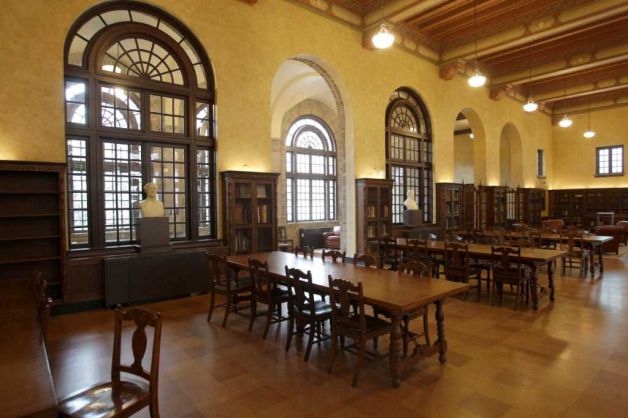
This had me intrigued enough to pay a visit. I hadn’t been to the Ideson Building in a few years, since I was a library student and toured with my mother. It’s a lovely space. For 50 years, from 1926 to 1976, this building served as Houston’s central library; its namesake was Houston’s head librarian from 1904-1945. In 1976, the Jones Building was opened on the same block, and today that’s our main library, and the one I grew up with; it’s some 5-6 stories tall, and I grew up with the children’s library in the basement, although now it gets a sunnier treatment (following a recent renovation). The Jones Building is, in my opinion, a fine library in its own right, but the Ideson Building is really lovely. Please do go check out some beautiful photographs (and renderings) provided by The Julia Ideson Library Preservation Partners. You can read more about the building and very recently completed and so well-deserved renovation here.


So what of the book? Well, I entered the Texas Room, which bibliophiles would recognize as a classic reading room in the days before Kindle. I was asked to lock my purse in a locker – no pens, water bottles, or theft opportunities allowed! – and then I waited in this lovely space while a librarian fetched the book I wanted from the closed stacks. There were accountant-style lamps on the tables, but I sat near a window and didn’t need one. I was given William French’s Recollections, in two volumes, bound in what I assume was a custom book box, and I gave it a look.

lovely reading room


As it turns out, the book itself was not the most impressive part of this visit. I spent a little time with it, and encountered a few funny or poignant anecdotes. But each volume being some 300 pages long, I knew I wasn’t interested in making the commitment with a book I couldn’t carry around myself. It is a memoir by a Dublin-born man who traveled to the American Southwest in the late 1800’s and had adventures there, and I read about ranching, local politics, tracking and hunting bears, frontier weddings, and more; apparently French was a friend to the Wild Bunch including Butch Cassidy, which is part of what has made his memoir of some enduring interest. (Not so much enduring interest, however, that this book is still in print.) I think it has some entertainment value, but is not so well-written or sensational to make for popular reading; clearly it has historical value to the time and place it represents, which is why it’s on the Gila’s list of suggested reading. How it ended up in the Texas Room is a little mysterious, as the librarian I asked said that the collection mostly covers not Texas, but more specifically Houston-related resources; I asked how this book (which mostly covers New Mexico) ended up there, and she guessed that perhaps its donor was somehow related to Houston. No worries, of course; I’m glad this hard-to-find book was available to me to touch and read in such a lovely setting.

hemingWay of the Day: as reported by his son Gregory


I’m stretching the definition of my hemingWay of the Day feature just a little bit. This is a quotation, not from Papa himself, but from Gregory H. Hemingway’s book Papa: A Personal Memoir. Here’s Gregory writing, and quoting his father.

He said he loved to read the Bible when he was seven or eight because it was so full of battles. “But I wasn’t much good reading at first, Gig, just like you. It was years before I realized that ‘Gladly, the cross I’d bear’ didn’t refer to a kindly animal. I could easily imagine a cross-eyed bear and Gladly seemed like such a lovely name for one.”

Isn’t that sort of darling? Aside from being funny, I think it’s a good example of what charmed me so much about Papa as seen through Gigi’s eyes: that he was often a tender and loving father. Here we see him reassuring his son the late reader. Gigi’s book is still resonating with me weeks afterward; isn’t it nice when a book does that for us?

Teaser Tuesdays: Down the River by Edward Abbey

Teaser Tuesdays is a weekly bookish meme, hosted by MizB of Should Be Reading. Anyone can play along! Just open your current read to a random page and share a few sentences. Be careful not to include spoilers!


I am continuing to love Edward Abbey (with that one outlier, Black Sun). I’ve just started Down the River but had to quote from page 3, already, because I find these lines funny.

None of the essays in this book requires elucidation, other than to say, as in everything I write, they are meant to serve as antidotes to despair. Despair leads to boredom, electronic games, computer hacking, poetry, and other bad habits.

Poetry lovers (and poets), keep your sense of humor as you’re lumped into the same category as boredom and electronic games! Ha. This is a very Abbey moment, seems to me.

First Lady of Fleet Street by Eilat Negev and Yehuda Koren

The biography of a pioneering female newspaper editor in early 20th-century London.


Rachel Sassoon was the heiress daughter of a wealthy Jewish businessman who was rooted in Baghdad but proud of the family’s new status after he moved them to London in 1860, while Rachel was still a baby. Only nine years old when her father died, Rachel’s options were increased by his fortune and broadened by his absence until, long past the standard marriageable age, and with considerable life experience behind her, she made what her family viewed as an unforgivable decision: she married Frederick Beer, who was also of Jewish ancestry but had converted to Christianity. (For this, Rachel was ostracized from the family until Frederick’s death, when a brother had her certified as “of unsound mind.”)

She found love with Frederick, but more importantly for posterity, she found a newspaper: Beer’s Observer drew her interest, but it took her own newspaper, the Sunday Times, to unleash Rachel’s creative and industrial spirit. She took on issues of women’s rights and suffrage, workers’ rights, the arts, criminal justice, and international political and social issues; the Sunday Times was for a decade Rachel Beer’s personal soapbox.

Eilat Negev and Yehuda Koren’s matter-of-fact portrayal of Rachel’s life sheds light on the experiences of women and people with Jewish backgrounds in her time, while the stories of the Beer and Sassoon families depict larger issues regarding the era’s immigration and business patterns. The First Lady of Fleet Street is an engaging snapshot of several aspects of early 20th-century life as seen through the lens of one remarkable woman.


This review originally ran in the March 2, 2012 issue of Shelf Awareness for Readers. To subscribe, click here, and you’ll receive two issues per week of book reviews and other bookish fun!


Rating: 5 understudied women.

book beginnings on Friday: A Difficult Woman: The Challenging Life and Times of Lillian Hellman by Alice Kessler-Harris

Thanks to Katy at A Few More Pages for hosting this meme. To participate, share the first line or two of the book you are currently reading and, if you feel so moved, let us know what your first impressions were based on that first line.

Alice Kessler-Harris is a well-respected author and historian, and here she tackles the formidable subject of Lillian Hellman. I am not terribly familiar with Hellman, so this book is my introduction, and so far it looks like it will be a fine one. I love biographies of ambiguous, contradictory, not-entirely-loveable characters; they’re so much more interesting than altogether sympathetic or entirely monstrous ones!

For this Happy Friday today I will be sharing several snippets, because I feel like it. First of all, Kessler-Harris opens her introduction with a quotation I loved:

If a man could say nothing against a character but what he can prove, history could not be written; for a great deal is known of men of which proof cannot be brought.
–John Boswell, The Life of Samuel Johnson

I love this idea, and the implication that history involves the unproveable, unavoidably. Beware! This quotation is followed by Kessler-Harris’s first sentences:

In 1976, aged seventy-one, playwright and memoirist Lillian Hellman posed in a mink coat for a resonant advertisement. Cigarette in hand, gazing insouciantly at the camera, Hellman claimed the legendary status she craved.

Indeed. Beginning her introduction with a description of that remarkable photograph (below) really evokes her subject right at the beginning. The photo in question:

The first chapter, however, returns to a standard biography’s beginning:

Beautiful Julia Newhouse, daughter of a wealthy southern family, married Max Hellman–who had nothing to recommend him but charm–in 1904. A year later, Julia gave birth to a child they called Lillian Florence Hellman.

These unadorned sentences tell us a little something about Julia & Max, which I appreciate. Hellman’s story is fascinating, and so far I really enjoy the way Kessler-Harris is portraying it, with the context of her time & place fully involved.

This quotation comes from an uncorrected advance proof and is subject to change.

looking back on early 2012… looking forward to a new trend

As I wrote at the beginning of the calendar year, I am moving away from challenges and lists and readalongs this year, hoping to follow more truly my reading urges, ideally with an emphasis on my TBR list(s) and shelf (shelves). Well, here we are two months (more or less) into 2012, and I see my reading urges taking shape. I wanted to share what I’m observing, and what I’m looking forward to.

First, what’s happened in the last eight weeks? I’ve read 25 books (wow! that many? really?), but I haven’t had really excellent luck. I really loved eight of them, which is a scant third: not very good stats. I loved:

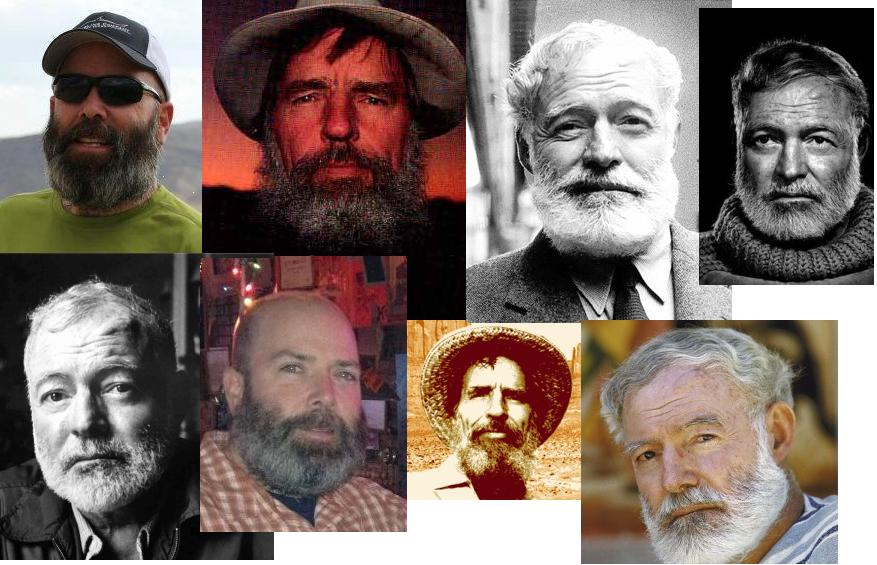
If you have noticed a pattern above, so have I: I am leaning heavily towards a certain two bearded men whose first names start with ‘E’. (On a personal note, I have been toying pictorially with the three bearded men in my life…)

Ernest Hemingway, Edward Abbey, and my Bearded Husband


My newfound (or newly recovered) interest in Abbey has come out of my love of Philip Connors’s Fire Season, which I called my favorite book of 2011. I’m still not done being moved by it; Husband is actually reading it himself (a truly momentous occurrence), I am planning a reread at the earliest available moment, and we’re planning a summer trip to the Gila National Forest itself, possibly even to meet the author who has graciously been corresponding with me and overlooking my rabid fandom. The unfortunate coincidence of Fire Season‘s publication with the worst drought in Texas’s history, and a series of wildfires including one that touched my family, has had me thinking about some of the themes involved. I’ve read a few other pieces of nature writing this year (Liebenow’s Mountains of Light and March’s River in Ruin – both lovely, and both reviews to come in Shelf Awareness). But mostly I’ve been revisiting Abbey himself, who represents the epitome of nature writing, at least for me in my not-very-well-read experience. I can’t begin to go into what his writing does for me at this moment; that’s another blog post. But he makes me laugh, and cry, and think and feel, and plan trips. I am trying to take to heart his exhortation to “get out there and hunt and fish and mess around with your friends, ramble out yonder and explore the forests, encounter the grizz, climb the mountains, bag the peaks. Run the rivers, breathe deep of that yet sweet and lucid air, sit quietly for a while and comtemplate the precious stillness, that lovely, mysterious and awesome space. Enjoy yourselves…”

And Connors, and Abbey, are shaping my reading, too, of course. I’m working on building my collection of Abbey’s books, and a few books about him; I have Aldo Leopold’s A Sand Country Almanac coming to my local library; and I have my eye on Muir, although with a few reservations. (I did love his Stickeen as a child. If you see it, grab it.) I have a few books on New Mexico and the Gila coming, too, to help plan our trip this summer.

Again, my thoughts on Abbey are large and evolving, and I’m not feeling worthy of trying to communicate them today. But I’m working on it.

And then there’s the other bearded man. I do have still a handful of Hemingway works on his little shelf that I haven’t read; and I have several biographies of him and other related fiction and nonfiction. My love for Hemingway has not faded yet.

So I guess what I’m trying to say, very long-windedly, is that I am finding great joy in my reading these days by focusing on a few areas that are holding my interest: mainly, two authors I greatly respect, and the writings about and surrounding them. I hope to delve more deeply into Abbey (and similar) and Hemingway, as 2012 rolls on by. Of course my reviews for Shelf Awareness continue; but they take 3-4 reviews a month from me, and that makes up a minority of my reading, so I have time to do my own thing. There will always be some variety, too – this weekend I checked out the new Girl Reading by Katie Ward just because it looked good – but I am doing pretty well at putting down the books that don’t work for me, because I know there’s lots more Abbey et al out there for me.

hemingWay of the Day: on nightlife

Nightlife is a funny thing. There seems to be no reason or rule that controls it. You cannot find it when you want it. And you cannot get away from it when you don’t want it. It is a European product.

from “European Nightlife: A Disease,” The Toronto Star Weekly, 15 December 1923

So true, Papa, so true! I feel like I’ve spent all my life either trying to find the party or to escape it. (Is that a metaphor for something?) This article was a charming little assessment of the nightlife scenes in a handful of European cities – not a travel guide or anything, since it’s so dated (!), but a snapshot in time of one man’s experience, at least, and well presented, and funny.