Braiding Sweetgrass: Indigenous Wisdom, Scientific Knowledge and the Teachings of Plants by Robin Wall Kimmerer

Hold out your hands and let me lay upon them a sheaf of freshly picked sweetgrass, loose and flowing, like newly washed hair.

Definitely one of the best of the year, Braiding Sweetgrass is a big serious one that I fear I won’t do justice. In good company, it reminds me of Pieces of White Shell and Soil. The good news is, many more thoughtful than I have also written rave reviews. It’s not a new one (original publication 2013) and the praise has been coming for years.

This is a beautifully written book, with poetry and metaphor and gentle, thoughtful articulations of big, important ideas. Robin Wall Kimmerer is a highly trained scientist – a botanist and a college professor; she is also a member of the Citizen Potawatomi Nation, with a background in thinking about the world in very different ways from the standard, Western, materialist, human-centered culture that many of us (including me) are more familiar with. Part of her life story has been the reconciling of those two parts of herself, or the training of them to work in concert, when one did not always welcome the other. But it’s to our great advantage that she’s been working so hard at that intersection, and sharing it here. I’ll characterize that work as the integration of a sense of interconnectedness, and the idea that other-than-human entities hold their own identities and importance aside from what they offer to humans, with modern “hard” science.

I love the structure of this book, which progresses through Kimmerer’s life and perspectives on the natural world and humans’ relationship with it, always with sweetgrass as an organizing principle. The preface, whose first line introduces this review, succinctly describes the importance of sweetgrass to the culture Kimmerer comes from. The braid “is an intertwining of science, spirit, and story–old stories and new ones that can be medicine for our broken relationship with earth, a pharmacopoeia of healing stories that allow us to imagine a different relationship, in which people and land are good medicine for each other.” There follow five sections–“Planting Sweetgrass,” “Tending Sweetgrass,” “Picking Sweetgrass,” and braiding and burning it–each composed of individual essays. The first essay, “Skywoman Falling,” begins with an origin story of North America as Turtle Island, starting with “a great turtle” that holds the earth on his shell, an origin story that holds significance for me; the first few pages of this book won me over completely. And I remained captivated throughout.

Any book about the natural world and human relationships and responsibilities these days is bound to contain some bad news; I find myself shrinking back from some of this reading, while I’m also still drawn toward it, because of the pain I feel at that bad news. But Kimmerer has some real wisdom to offer about the choice between despair and joy, the question of whether we can view hard truths and still find good parts too. “What could such a vision create other than woe and tears?… it is not enough to weep for our lost landscapes; we have to put our hands in the earth to make ourselves whole again. Even a wounded world is feeding us. Even a wounded world holds us, giving us moments of wonder and joy. I choose joy over despair. Not because I have my head in the sand, but because joy is what the earth gives me daily and I must return the gift.” Thank you, Sweetgrass, for that gift.

Gifts are an important topic throughout, too. The Native American culture of gift-giving, the importance of reciprocity, and the emphasis on giving with a faith that things will come back around applies not only to interhuman relationships but the ones with the earth and its nonhuman inhabitants too. The difference between a capitalist, materialist, consumerist culture and one of gifts and reciprocity is profound. An essay titled “Learning the Grammar of Animacy,” in part about language (and the near-extinction of the Anishinaabe languages Kimmerer might have learned to speak as a child, “had history been different,” and which she now studies as an adult), is also about some of these cultural concepts, and the fact that language shapes the concepts we’re even capable of comprehending. Like some of the best books in the world, Sweetgrass is about paying attention, and the importance of the choice of what we attend to.

Individual essays tell stories from Kimmerer’s family life (from childhood through motherhood), from the different communities in which she’s lived, from her experiences as a student and as a teacher. They take place in different parts of Turtle Island, including New York state and the Oregon rainforests, and integrate some pretty serious science with traditional storytelling and Kimmerer’s own. There is so much to learn here, and I love science made accessible by story. I won’t begin to try to tell you what all is available here; I really want you to discover it yourself.

This book might just change the way you look at the world. I hope it does. Please give it a chance.


Rating: 9 raindrops.

No Son of Mine by Jonathan Corcoran

Disclosure: Jon has taught as guest faculty in my MFA program. I admire his work and he is a dear friend.


Also, I am teasing you about a book that will not be published for months (April 1 of this year, no foolin’), but I’ll repost then to remind you.

Now on to the show.


I found this memoir remarkable. It encompasses much in terms of its time span and the bigger events in the world, and Jon accomplishes something special by being raw and vulnerable, and never self-indulgent. I think the struggles he portrays here will offer something to any reader, because we are all struggling to navigate even the closest of relationships. I am impressed by the writing in terms of that larger storytelling and meaning-making, as well as line by line.

Corcoran grew up in a small town in West Virginia that is just a few minutes’ drive from where I live now. (It’s always a little exciting to read a place written well that you personally know, and I did enjoy that part here. Elkins is not perfect, but I think this author has handled it with respect for both positive and negative qualities.) As a gay kid, he suffered in the town, in the evangelical church his family attended, and in his family itself. He did some secretive explorations of sexuality in West Virginia (not too dissimilar, I think, from those in The Rope Swing, which is however fiction), but did not live as an openly gay man until he left for college at Brown University. Coming from poverty, Brown was both a great accomplishment and a shock: a wider world, but rarified, and Jon was a foreigner to many of his peers and professors there. It’s at Brown that he met Sam.

In his second year at Brown, Jon is in Portland, Maine, with his boyfriend, Sam, meeting Sam’s family for the first time. It’s his twentieth birthday when his mother calls, seething with what she’s discovered. Jon confirms that he is gay. “You are no longer my son,” she says, and she hangs up. This leaves him traumatized, trying to finish college with no financial or emotional or any other kind of support, with no family, and no options, surrounded by Ivy League administrators whose understanding of what all this means is so poor that he is advised to take a year off and travel. His mother spends the next six months calling in the early morning and waking him up to tell him he will die of AIDS or go to hell, or both.

Jon and his mother spend years–fifteen years, the rest of her life–being estranged and trying again, having massive, blow-up fights and years of silence, and abuse and toxicity and cautious attempts at peace and acceptance. Her bad behavior is horribly, shockingly bad. But tangled up with the bad is the fact that this is his mother, his caretaker, whom he has loved, and who still (somewhere, twistedly) loves him, and misses him when they are on the outs. It’s a level of trauma that’s hard to fathom if you haven’t lived it. But as a narrator, he does a good job of describing its effects, including a mistrust of memory and various physical ailments. It also poses some challenges for his relationship with Sam, which will continue until they eventually marry, and into the present.

This is a memoir of trying to reconcile a parent that the narrator loves, his memories of her and of his hometown, with the pain inflicted at the hands of that same person (and place). It’s all a puzzle, to question the causes, to wonder how much forgiveness is due to such a figure. It’s a memoir that is also an assay, both a personal narrative and an exploration of ideas. “…some part of my brain is perpetually trying to explain her actions, to find the root cause for them, and what this really comes dangerously close to is the notion that her actions have an excuse, that if I searched hard and long enough the hurt and pain she caused me can be written away. But she hurt more, a voice says, and I don’t doubt that. So here I am, operating the world’s worst justice system from the recesses of my brain.” “I do not know how to balance all the pain she caused with all the pain she felt.”

There’s a lot to appreciate here, and a lot of wisdom that I think will help just about anybody. Not to say answers, but wise observations about one man’s experience. Most of us are wrestling with difficult, tangled-up relationships where abuse and love meet; many of us are struggling with what to take and what to leave about a family or a place. “I hear her laugh, hear the crinkle of her dyed-blonde hair. I rub her cracked feet, feel her hand on my back. I smell her nicotine fingers. There is her cup of Lipton tea in the little ceramic mug that is white with flowers around the brim. I taste the milky black tea. And I say, I don’t want to lose this all. I don’t want to lose what made me.” There is also some lovely writing here. If the story itself is often difficult, there’s a remarkable amount of grace, beauty, and hope. I think it’s a book for anybody and everybody. Thank you, Jon, for sharing so much in a way that feels both raw and wide-open, and careful and thoughtful. I’m awed.


Rating: 9 paper bags.

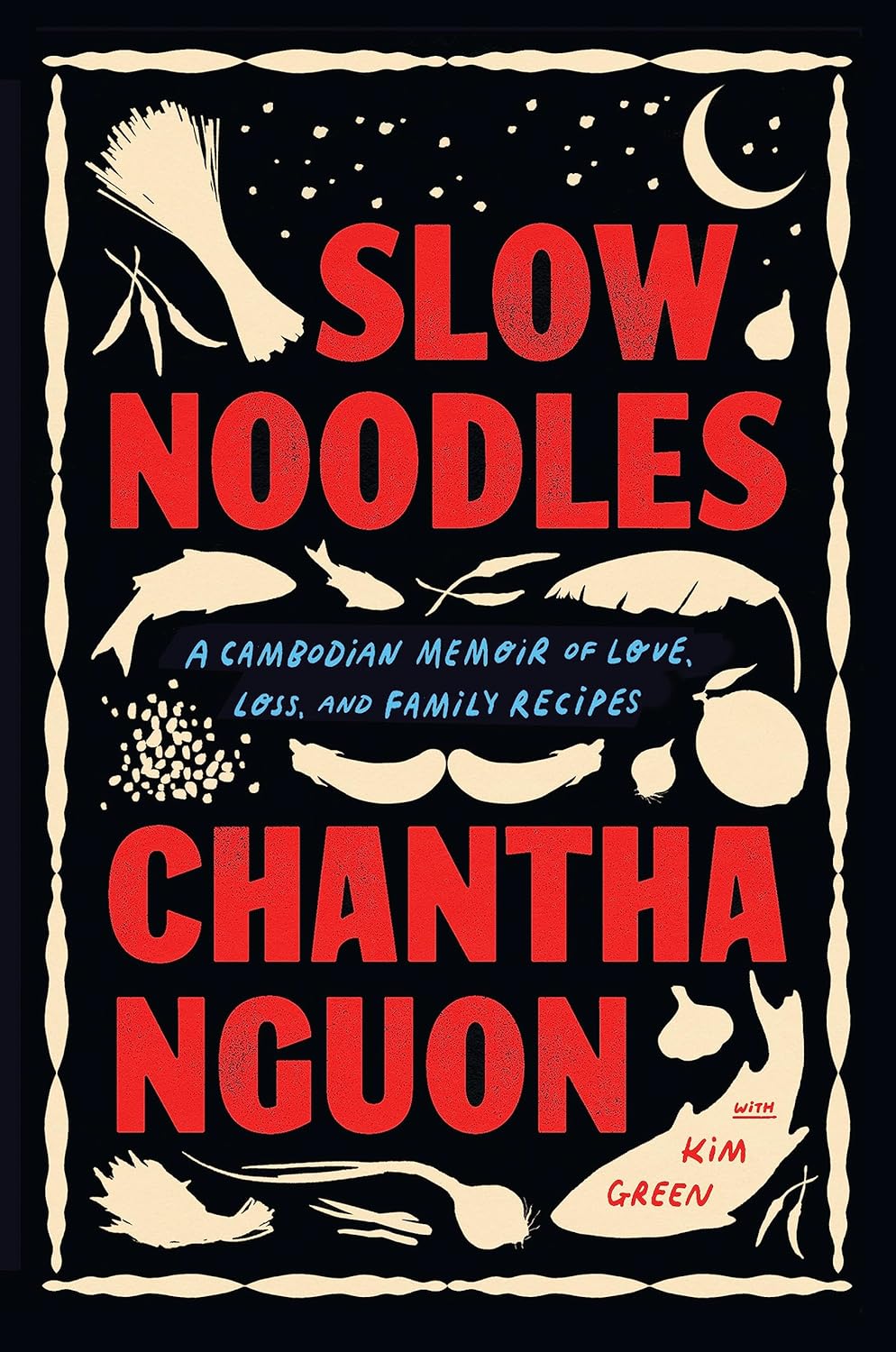
Slow Noodles: A Cambodian Memoir of Love, Loss, and Family Recipes by Chantha Nguon & Kim Green

This memoir of food, family, feminism, and Cambodian history, which includes enticing cookbook-quality recipes, is breathtaking in its emotional resonance and lovely writing.

Slow Noodles: A Cambodian Memoir of Love, Loss, and Family Recipes tells a story that is, by turns, heart-wrenching, inspiring, harrowing, and mouthwatering. Chantha Nguon’s memoir, written with Kim Green, encompasses both world history and an intimate personal account. Nguon, born the youngest child in a comfortable family in Cambodia’s Battambang, had nine years of soft living and good eating before Pol Pot reset time to Year Zero in the 1970s. Moving first to Saigon, where she weathered the end of the Vietnam War, and then escaping as a refugee into Thailand, Nguon gradually lost everyone she loved, ending with her mother’s death when Nguon was 23. She was a food-focused young child with a mother who took cooking very seriously; she became a young refugee in peril of starvation. For Nguon, rationing or missing entirely the most basic of ingredients is not only a literal life-or-death issue but also symbolically life-altering. With the loss of her family and, to some extent, her culture, she views herself as a repository of recipes, culinary knowledge, memories, pain, and strength.

Food metaphors enrich this book, which sparkles with poignant, deeply lovely writing: “The green-fresh fragrance of young rice is as lovely and fleeting as childhood itself.” Nguon’s mother “taught [her] the art of rebelling as quietly as a whisper of silk.” Twenty-two recipes learned from Nguon’s beloved mother, or developed throughout her own accomplished cooking life, are included, with clear instructions and helpful notes on ingredients (and accompanied by a glossary for potentially unfamiliar terms). These are joined by cleverly figurative recipes, such as the recipe for silken rebellion, which begins: “Find the pockets of freedom available to you. Exploit loopholes.”

By the end of the story, Nguon has transformed into an impressive woman, acting as her husband’s equal (a radical concept, encouraged by her quietly rebellious mother) and a fierce advocate for social change. Nguon, who becomes a staunch feminist, eventually undertakes medical and humanitarian work with AIDS patients and sex workers, fights for education and independence for Cambodian women, and with her husband, founds the Stung Treng Women’s Development Center in rural Cambodia.

Nguon’s titular noodles contribute enormous metaphorical meaning. In her childhood household, slow and proper cooking was prioritized (“my mother despised the flavor of shortcuts”). In Thai refugee camps and in the Cambodian jungle, instant noodles became a prized delicacy. And by the memoir’s end, this thoughtful narrator has integrated these experiences, valuing both the careful preparation of fine foods and the stark relief of basic nutrition. Slow Noodles is a rare gem of a story, gorgeously written, humble and stirring, and packed with tempting recipes.


This review originally ran in the December 14, 2023 issue of Shelf Awareness for the Book Trade. To subscribe, click here.


Rating: 9 silk threads.

Heavy: An American Memoir by Kiese Laymon

Kiese Laymon’s Heavy is everything they say it is. I’ll start with some adjectives from Roxane Gay’s front-cover blurb: “astonishing. Difficult. Intense. Layered.” Some books – well-regarded, reviewed by smarter, better-qualified folks than me – are hard to write about. I can only add my voice to the chorus.

I think I’d already begun hearing about Laymon when I read an essay of his in Oxford American, which featured (if I remember) Outkast and his Grandmama. I was impressed then and I knew I needed to read this; I’m just sorry it’s taken me this long.

Laymon comes from Missisippi, raised by his mother and grandmother with infrequent contact with his father. He comes from financial insecurity, and a black* American experience that knows it is wildly insecure in the face of white America. His mother and father are both politically minded, and he has plenty of exposure to questions about race and racial (in)justice, but no exposure to the kinds of questions that bother him from a young age: questions about gender and sexuality and safety, consent, bodies, sexual violence, physical health, eating, economic insecurity, housing discrimination, memory, honesty and lies. He has to pursue these questions himself, and while Heavy is the story of his coming-of-age, it’s much more about figuring out how to interact with some of those questions. Truthfulness, bodies, relationships. How to love responsibly, as he puts it.

*I am following his use of the little-b black here even though that’s a change for me.

I did not want to write to you. I wanted to write a lie. I did not want to write honestly about black lies, black thighs, black loves, black laughs, black foods, black addictions, black stretch marks, black dollars, black words, black abuses, black blues, black belly buttons, black wins, black beens, black bends, black consent, black parents, or black children. I did not want to write about us. I wanted to write an American memoir.

That’s his first paragraph. The book is written in the second person to a specific reader: his mother. The narrator and his mother love each other hard, but there is a lot of harm in their love. The reader gets to see young Kiese grow up, from age eleven or so (it jumps around a bit) to an adult professor earning tenure (in traumatizing fashion) at Vassar College. He keeps his reader up to date on body weight, as he tries to cope with his pain by eating his way up to 319 pounds and then by punishing his body with exercise and anorexia down to 150-something pounds. “I knew, and worried, about how much I weighed and exactly how much money I had every day of my life since I was eleven years old.” The title is not only about body weight, although that’s certainly part of it. It’s about the heaviness of life and responsibility. “To white folk and the police, you will always be huge no matter how skinny you are,” his mother tells him.

I love how carefully he cares about words. His mother pushed him to speak a certain way, to keep him safe: no contractions when talking to white people and police. But he defends the unique language that he and his friends use in school, rebelling in their majority-white eighth grade year by using speech patterns that make sense differently. His mother, an academic, has pushed his writing and revision since childhood, but he’s choosing a different language than the one she pushes. “I realized telling the truth was way different from finding the truth, and finding the truth had everything to do with revisiting and rearranging words. Revisiting and rearranging words didn’t only require vocabulary; it required will, and maybe courage.” WHEW. This book begins and ends with short sections titled respectively ‘Been’ and ‘Bend.’ He writes at the beginning, in ‘Been,’ to his mother: “I am writing a different book to you because books, for better and worse, are how we got here, and I am afraid of speaking any of this to your face.” There’s something powerful in writing down what’s that hard to say.

Heavy is artful, lyric, deathly serious, loving, stark. When Laymon becomes a young professor, he catalogs the ways in which he fails his students, and it’s absolutely raw and horrifying, and therefore brave. (I and most of us have failed worse.) It’s radical, in both senses, and I’m going to have to keep thinking about it. I didn’t do this book justice here. Go read it.


Rating: 8 miles.

Dear Sister: A Memoir of Secrets, Survival, and Unbreakable Bonds by Michelle Horton

The heartbreaking story of a woman incarcerated for killing her abuser, told by her sister, highlights systemic wrongs and the resilience of a family in trauma.

Dear Sister: A Memoir of Secrets, Survival, and Unbreakable Bonds is a harrowing story, a call to action, and a love letter between sisters.

In their 20s, Michelle Horton and her sister, Nikki, were very close, working together to raise Nikki’s two children and Horton’s son. Horton thought she knew everything about her sister’s life, and so was entirely caught off guard by the emergency call. Her niece and nephew’s father was dead. Nikki had killed him. He had been abusing her horrifically for years, and many members of the community had known it, had been working actively to get Nikki out. Horton was told to come and pick up her sister’s children, ages two and four, immediately.

In the months and years that followed, Horton’s life was consumed by the work of single-parenting three children while raising money for her sister’s legal defense, becoming an amateur expert on criminal law and the psychology of abuse, and advocating for survivors’ rights. The high-profile 2019 case of Nikki Addimando resulted in her conviction of second-degree murder and a sentence of 19 years to life in prison. Despite extensive evidence, the judge concluded that Nikki was not a victim of abuse.

Horton’s narrative (with supporting evidence) is available elsewhere, but she additionally brings to her memoir a close, personal account of Nikki’s trauma and that of the three children involved, the deep connection between sisters, and the continuing failure of the legal system adequately to handle abuse victims when they appear as criminal defendants. Horton delves into the sisters’ childhood, including earlier instances of abuse, and the culture in which so many–including the author–failed to recognize the signs of Nikki’s suffering. Keeping silent about her abuse did not serve Nikki in the end, but Horton observes that other victims will not be encouraged by Nikki’s experience to speak up.

The stories Horton relates are heartbreaking. She does not shy away from graphic descriptions of the brutal abuse Nikki experienced, which some readers will find difficult to read. These details do not feel gratuitous, but rather central to the painful but necessary account Horton offers. Her concern extends beyond her own family, to other victims of intimate partner violence who enter the justice system as criminals. Dear Sister is not only Horton’s story and Nikki’s story, but also an urgent appeal for reform. Heartfelt, disturbing, but ultimately hopeful, this memoir is an important part of an ongoing conversation, and a tribute to sisterhood.


This review originally ran in the November 20, 2023 issue of Shelf Awareness for the Book Trade. To subscribe, click here.


Rating: 7 half-tubes of toothpaste.

Winter Solstice by Nina MacLaughlin

The solstices are for fire. Summer flames say Keep the light alive (it’s never worked, not once). In winter, a more urgent message: Bring light back to life (it’s worked every time so far).

I was overjoyed to find out about this book in time to get it for the winter solstice last week. I really enjoyed Nina MacLaughlin’s Hammer Head: The Making of a Carpenter some years ago, and I was pleased to have such an event planned for my day: this little book, a batch of hot mulled wine, and my usual solstice/equinox tradition of a backyard fire. At just 80 pages, Winter Solstice is well designed to be read on the single day in question. I am choosing to share many of MacLaughlin’s lovely words here, so my review winds up practically as long as her book (not really…).

It’s an essay in four parts, each longer than the last, plus an afterword, plus an addendum. “Inhale the Darkness” begins: “Two boys strung the lights on houses in Ohio.” It’s a detailed description of that weekend job, the installation of light against darkness. “It’s an old impulse. To honor the dark with festivals of light, to battle it with same.”

Henri Bosco describes this almost-winter moment of the year, “when the world was poised on a pure ridge,” balanced between two seasons, casting “a glance back at the aging autumn, still misty with its wild moods, to contemplate deadly winter from afar.” The misty mood is behind us. We’re looking now at something dark and wilder.

Next, “The Shadows Below the Shadows” surveys traditions across time, Persephone and Demeter, Krampus, Saturnalia, the Eleusinian Mysteries, and Newgrange. It ends: “Pomegranate, holly branch, birch switch, mistletoe. We’ll leaf with life and pass below the secret places of this earth.” I love the way MacLaughlin integrates stories, legends, traditions, and the connections to nature, the plant life they are all in relationship with.

The Eleusinian Mysteries

were meant to elevate people above the human sphere. They were meant to launch them divinewards. As Cicero says: “In very truth we have learned from [the Mysteries] the beginnings of life, and have gained the power not only to live happily, but also to die with better hope.”

“In Winter We Get Inside Each Other” is about the danger and elemental fear of cold and darkness, and how we deal with those feelings. Describing sledding down a hill on the grounds of an institution for the criminally insane:

…it never felt crazy to cry out, there by yourself, going faster and faster, in your own private moment of fear and glee. Is that what made the lunatics yell inside their cells? Some same combination of soaring down a mountainside unstoppable? I’m happy, I’m afraid, I feel too much, I have to let it out. A cracking open in the descent.

Also sex, sensuality, connection. From a Mary Ruefle poem: “When it snows like this I feel the whole world has joined me in isolation and silence.” (You will have noticed that MacLaughlin makes reference to many others’ wise words.)

“Burn Something Today,” part four of this longform essay, brought me great pleasure as my fire was well underway and I was cozy and warm right up against it, just three or four feet from the remnant snow off to my left, and the page lit up by my headlamp.

Depending on where one lived, the ashes of the solstice fire were then spread on fields over the following days to up the yield of next season’s crops, or fed to cattle to fatten them and boost fertility in the herd, or placed under beds to protect against thunder and lightning, or sometimes worn in a vial around the neck. The lights we string on bushes, that glow on the trees in the center of town–something of these ancient fires lives in them, too. The ancient cults cast shadows in our minds, shift and flicker, their fears are still our fears, down in the darkest places of ourselves.

MacLaughlin’s afterword is “The Timing of the Light,” in which she as a child watched for an approaching car before switching on the electric ‘candle’ in a window, so as to offer hope, light, a bright moment for passersby. “I did not know about conference calls in middle school, but sensed adulthood could be possessed of certain drear.”

The addendum is “Plant Matter,” with a few entries for the plants most important to the winter solstice: holly, blessed thistle, mistletoe, cinnamon, yew, oak. (Others named but not featured: cedar, clove, rosemary, nutmeg, birch, pine, chamomile, juniper, frankincense, and wintergreen. A few of these went into my mulled wine. I considered a chamomile tea before bed but had a beer instead, a kettle sour with cranberry, rosemary, orange peel, salt, and coriander.) In the addendum’s final entry, Oak, which closes the book:

…an end here does not mean the end. The original fire lives in all fire. On the stove and in the hearth, in the bonfire on the beach, surrounded by stones in the woods by a river, in the explosion after the crash, between your ribs and behind your eyes, on the struck tip of the match, on the burning surface of the stars, the source of our fire, and us all. The fire goes out and lives on.

I can’t imagine a better way to observe the changing tide of light and dark. Thank you, Nina.


Rating: 9 timely moments.

“How Long ’til Black Future Month?” (essay) by N.K. Jemisin

After reviewing the story collection on Friday, I felt the need to go find the essay which gave the collection its name. I’ve decided to just repost it here for your pleasure rather than muddying it with my own words. I think it’s important. Please take the time to visit Jemisin’s site for…


In the Pines: A Lynching, A Lie, A Reckoning by Grace Elizabeth Hale

A historian with personal connections to its players expertly researches a specific lynching case in this razor-sharp report.

In the Pines: A Lynching, a Lie, a Reckoning is a story with personal significance for Grace Elizabeth Hale (Making Whiteness), who tackles some of the greatest race-relations demons–historical and continuing–in the United States. In this thoroughly researched account, Hale investigates the 1947 murder of a man named Versie Johnson in rural Jefferson Davis County, Miss. The author’s beloved grandfather served as sheriff at the time, and her mother originally offered this tale as one of righteous heroism: her white grandfather stood up to a mob and refused to release his Black prisoner, who was somehow nevertheless removed to the woods where he died. But Hale learns that her grandfather’s involvement was neither innocent nor heroic.

In her thoughtful narrative, Hale places the death of Versie Johnson in layers of context. She works to find personal information about Johnson, with limited results: one theme of her book is the lack of recorded facts about people judged inconsequential by the record-keepers. She struggles to reconcile very different accounts of Johnson’s alleged crime (rape of a white woman). She studies the history of lynching in the United States, by its various definitions; the history of Jeff Davis County and Mississippi; and a handful of similar cases in nearby counties before 1947. By the end, she reconstructs a passable version of events: possibilities about the life of Versie Johnson and an estimation of her grandfather’s decision-making on the night he was among the group that drove his prisoner from the town’s jail out to the field where a crowd of white locals witnessed Johnson’s murder.

A historian of American culture, Hale began her research for this book as she finished a doctoral dissertation on southern segregation, Jim Crow, lynching, and white supremacy. She brings this expertise to a subject about which much information has been lost. “Family trees, genealogies filled with relatives’ names and the dates when they were born and died, depend on archives. And official repositories of documents in turn depend on a society’s ideas about who matters.” Research skills and informed guesses (always clearly indicated) do, however, yield a story. “The past does not have to be ancient to be made of splinters and silence,” Hale writes, and what she reveals is important for a national reckoning as well as Hale’s personal one.

In the Pines is elevated by lovely writing: “Family trees are metaphors. They share with pines both a basic structure and a tendency to flourish only when conditions are right.” It is also marked by incisive thinking about race in history and in the present. Hale’s work is a significant contribution to that larger conversation.


This review originally ran in the September 18, 2023 issue of Shelf Awareness for the Book Trade. To subscribe, click here.


Rating: 7 unrecorded details.

Trace: Memory, History, Race, and the American Landscape by Lauret Savoy

It felt right to follow the outstanding Soil with Trace, which my father recommended some years ago. I wondered if this might be one of the books Dungy was looking for. It’s not in fact “radically domestic” enough, I think, to fill the void Dungy located–she did so well to write the book she wanted to see in the world. But Trace has its own special offerings that are equally rare and needed.

I am inclined to read this as a collection of closely linked essays, rather than chapters in a memoir or nonfiction monograph. It combines human history, natural history, studies on race, memoir, and nature writing; it ranges across the United States but always interrogates from a personal perspective what it means to be a non-white American in the natural world. [The author is Black and Native American.] Savoy is a gifted and lyric writer, to boot, investigating literal landscapes as well as figurative ones, keeping metaphor handy. I loved her consideration of the book’s title, which is a word that recurs.

The landscapes she travels and studies include the Grand Canyon’s Point Sublime; the Canadian Rockies; Oklahoma’s “Indian Territory”; a Wisconsin island; Washington, D.C.; Arizona’s border with Mexico, and more. She interacts with a wide range of literary voices, including Victor Frankl, Aldo Leopold, Homer, Thoreau, and Louise Erdrich. The front cover offers a New York Magazine reference to John McPhee meeting James Baldwin in Savoy’s voice; I was reminded of Eula Biss in how she pulls seemingly disparate threads together (those places and voices) to make exactly the point she needs to make. It’s impressive, precise, gorgeously written, and smart. She’s a professor of environmental studies and geology, well equipped for this exploration. A few of the ideas that really resonated with me I’ve collected here:

If the health of the land is its capacity for self-renewal, then the health of the human family could, in part, be an intergenerational capacity for locating ourselves within many inheritances: as citizens of the land, of nations even within a nation, and of Earth. Democracy lies within ever widening communities.

How a society remembers can’t be separated from how it wants to be remembered or from what it wishes it was–that is, if we believe stories of ancestors reflect who we are and how we came to be. The past is remembered and told by desire.

There’s a lot here that I’m still thinking about.


Rating: 7 chickadees.

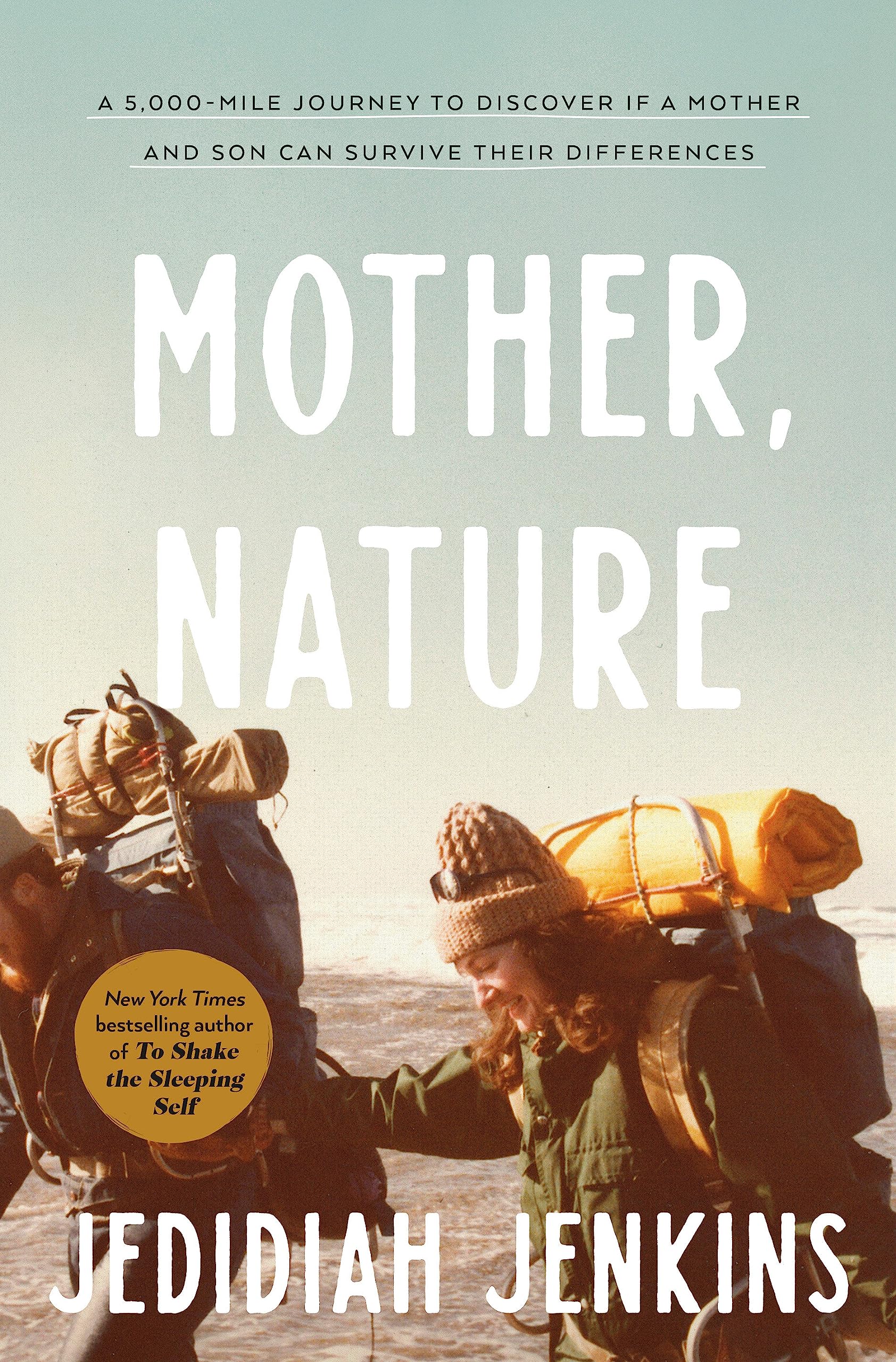
Mother, Nature: A 5,000-Mile Journey to Discover if a Mother and Son Can Survive Their Differences by Jedidiah Jenkins

A loving but troubled mother-son relationship takes center stage during a great American road trip in this reflective memoir about family.

In Mother, Nature: A 5,000-Mile Journey to Discover if a Mother and Son Can Survive Their Differences, Jedidiah Jenkins (Like Streams to the Ocean) presents both a literal and psychological voyage–and an investigation into family and tolerance.

Jenkins, nearing his 40th year, is troubled by his relationship with his mother: loving but fractured by her inability to accept his identity as a gay man. In November 2021, following the Covid lockdown, he undertakes a trip with her that he hopes will help them address their disagreements. The same journey will allow reconsideration of an aspect of her life that Jenkins paid little attention to. In the 1970s, his parents, Peter and Barbara Jenkins, walked across the United States, as famously documented in a series of books (including A Walk Across America and The Walk West) and National Geographic articles. As mother and son retrace those steps by car, Jedidiah wishes to learn more about his mother and her worldview; see the countryside and strengthen their relationship; and perhaps, finally, bring her to terms with his identity.

In driving from Tennessee to New Orleans and cross-country to the Oregon coast, Jedidiah (who lives in Los Angeles) and Barbara (whose best friends come from her Nashville Bible study group) struggle with what to listen to in the car–she likes Glenn Beck, and he likes NPR–what to eat, how to pray. Eventually, they will discuss the question that’s been weighing on the son’s mind: “Would you come to my wedding if I married a man?” Barbara’s conservative political and religious beliefs pose an obstacle to the love and acceptance that he craves from her. Their attempt to bridge such a divide feels relevant in polarizing times; the challenges faced by this loving but fundamentally diverging mother and son may resonate with many families.

Jenkins’s prose is unadorned, but his reflections are elemental ones about family and the static and changing aspects of relationships: “a mother’s influence is difficult to excise. It is not like the scorching sun. You cannot shade yourself from it. It is more enveloping and inescapable, like the air you need to survive.” By the memoir’s end, much is unresolved about the lives still in motion, but Jenkins has found his own peace, and learned a bit about the landscapes of his home country and his family background. Mother, Nature, a loving ode, suggests that the questions will continue to present themselves and that the journey toward discovery is worthwhile.


This review originally ran in the September 11, 2023 issue of Shelf Awareness for the Book Trade. To subscribe, click here.


Rating: 6 baby elephants.