Life After Dead Pool: Lake Powell’s Last Days and the Rebirth of the Colorado River by Zak Podmore


With Life After Dead Pool: Lake Powell’s Last Days and the Rebirth of the Colorado River, investigative journalist Zak Podmore tackles a massive, complicated set of questions about western water management and the Glen Canyon Dam, the construction of which created a reservoir called Lake Powell. Arguably the most politically fraught and symbolic dam in the southwestern United States, Glen Canyon has long had its fans and detractors. The Millennium Drought, “an indefinite change in precipitation patterns” in the region, has “done three-quarters of the work toward draining Lake Powell already,” but this leaves numerous challenges: Indigenous people’s water rights, engineering and hydrology puzzles, the ecological implications for long-flooded lands freshly exposed to open air or buried under millions of acre-feet of sedimentation, and more.

Podmore acknowledges his own biases about the dam, which was in place before he was born. But he proceeds with copious and in-depth research into the many and complex issues it poses, considers what he learns with an open mind, and integrates hard science, cultural awareness, and competing viewpoints into an admirably accessible work of creative nonfiction. Podmore avoids binary options and magical thinking, and his study is richer for it. Included are surprisingly hopeful notes, such as the rapid recovery of native plants and ecosystems in newly exposed side canyons: “A canyon one hundred miles away, drowned for half a century, had restored itself in fewer than twenty years.” With narrative style and colorful characters, Podmore (Confluence) has composed a compelling, readable, and entertaining as well as educational text. Life After Dead Pool is superlative: important, insightful, and a pleasure to read.


This review originally ran in the August 30, 2024 issue of Shelf Awareness for Readers. To subscribe, click here, and you’ll receive two issues per week of book reviews and other bookish news.


Rating: 8 cans of beans.

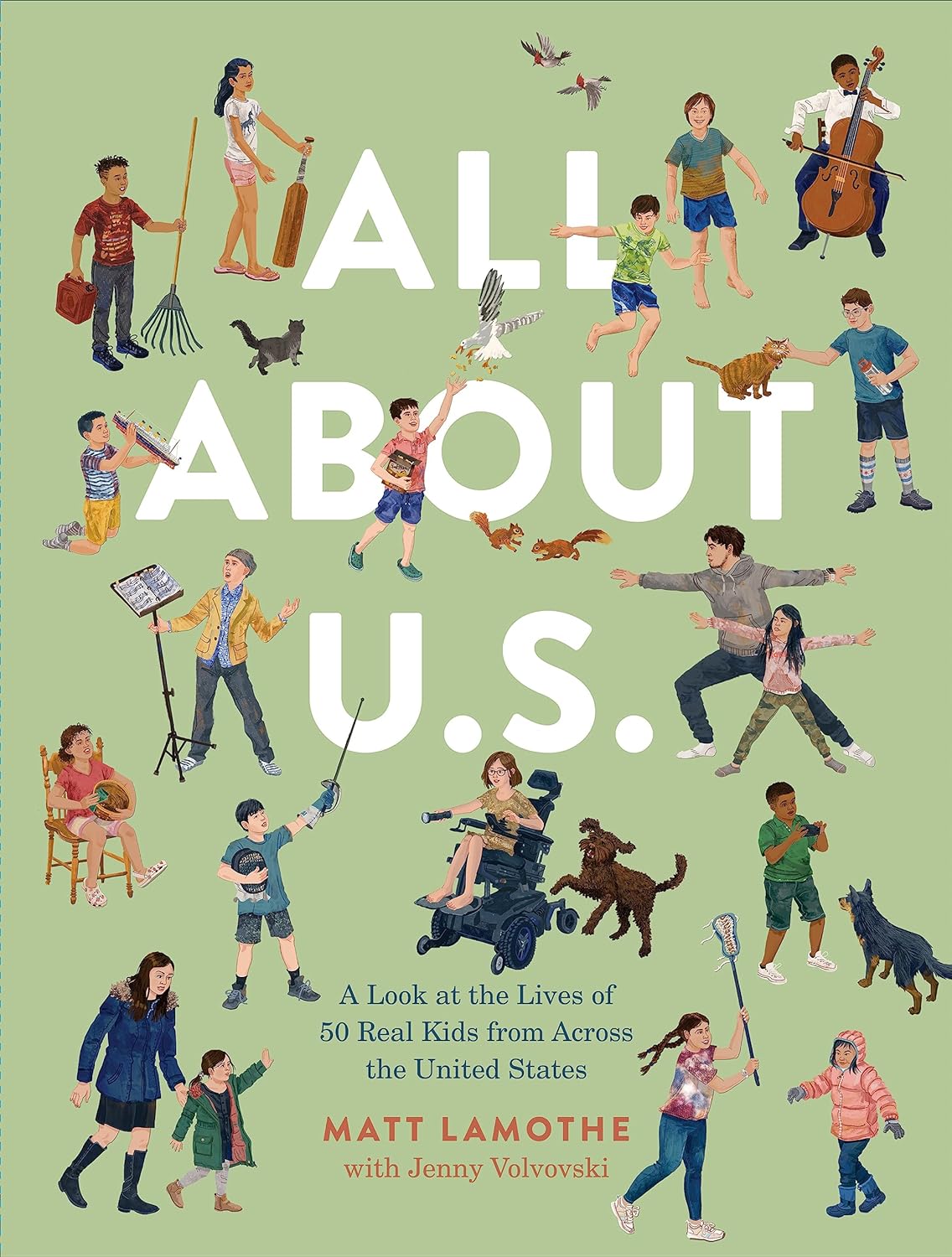
All About U.S.: A Look at the Lives of 50 Real Kids from Across the United States by Matt Lamothe & Jenny Volvovski, illus. by Matt Lamothe

I loved the look of this large-format illustrated book for kids (and their adults!), and preordered it for a couple of my favorite kids, sisters ages 8 and 12. The book is labeled as serving ages 8-12, so I figured that would be perfect. And naturally I had to take a look first.

I love the concept. From the authors of This Is How We Do It comes this glimpse into the lives of 50 kids, one apiece from the 50 states. Author/illustrator Lamothe and author/designer Volvovski took great pains to closely approximate the demographics of the country as a whole in choosing the kids and families they feature here: sections on Process and Demographics at the end of the book detail those elements, in writing that will skew toward the older end of the book’s projected age range and/or serve adults best. The 50 families in the book match national stats in religion, family type, structure and size, gender identities, school and home types, annual family income, national origin of parents and guardians, sexual orientation of parents and guardians, and more, quite closely. “The biggest demographic discrepancy in the book is the overrepresentation of multiracial kids. However, the race/ethnicity of their parents and guardians more closely matches the demographics of the country. According to Pew, the number of Americans who identify as more than one race almost doubled between 2010 and 2020 [when work began on the book]. As this trend seems likely to continue, we feel it is important to show how multiracial families balance their cultures and traditions.” This struck me as solid reasoning. I’m also comfortable with slight overrepresentation of traditionally underrepresented groups.

The bulk of the book is the kids themselves. Each gets either a single page or a two-page spread (of which most of the space is illustration; my impression is that the written stories are equal in size) in this large-format book. A beautiful, engaging, full-color, detailed illustration accompanies a brief written profile of a child, ages 5-11, in the context of their family and home. Generally, parents’ or guardians’ jobs or interests are mentioned, as well as siblings and pets, but the kid in question gets the most focus, via their hobbies, tastes, favorites foods and toys, activities, etc. I love the charming images as (yes) illustrations of what is described in print. I can easily see the sisters I’m giving this book to enjoying the combination of images with text; I expect the older sis to have an easier time with the reading part.

Clearly the enormous diversity of the kids and families featured here is a big part of the appeal. I really enjoyed how varied these lives appear. There are many skin tones, religions, family structures and styles; there are kids with mental and physical health differences and those who have faced major life challenges. Some are rural and some are urban (a demographic element apparently not tracked). I’m pretty sure that each story includes at least one direct quotation, so that the kids’ voices come through. Across all their differences, they all sound stimulated by the chance to talk about their own lives.

And these are real kids. Near the front of the book is a spread with each child’s illustrated head shot; near the back, a similar spread of photographs of the same kids. A few source images are included there as well, like landscape views, and descriptions of how this research was completed (many hours of video calls, online questionnaires, photographs and video tours). I especially appreciate how detailed are the illustrations, and liked reading that each family was consulted in back-and-forth correspondence on both the illustrations and the text before publication.

I was on the lookout for stereotypes. (I did note the authors’ acknowledgment that no one family could represent an entire state.) With such attention paid to demographic data, I feel good about the overall portrait of the country; but what does it look like to choose a single kid/family to stand for New York or Texas? Heavens. I of course turned first to the two states I know best, Texas and West Virginia. In Texas, Noah lives with a large family who enjoy traveling to Big Bend (yes!) from what might be San Antonio. In West Virginia, Jade raises prize-winning steers at his rural home. These are individual stories, woven into a tapestry with plenty of diversity in it.

All in all, it’s a beautiful book that I think will yield some great conversation, and I feel great about giving it to my young friends.


Rating: 8 windows.

Something in the Woods Loves You by Jarod K. Anderson

A profoundly depressed poet takes to the woods and delivers a lovely, moving memoir of nature writing and mental illness.

In his 40s, poet Jarod K. Anderson (Field Guide to the Haunted Forest; Love Notes from the Hollow Tree) left his job in academia to try to survive the debilitating depression he’d mostly hidden for decades. Early on in his memoir, he describes taking a walk in the woods, quietly observing nature as he had not in some time. He communes with a great blue heron and finds that there may be solace in a place where he’d forgotten to look.

Something in the Woods Loves You describes the slow and difficult process of seeking help and getting better, in increments, and with relapses. Anderson’s journey to wellness is not and perhaps never will be complete, but he does progress, and with a poet’s sensibility and attention to language and detail, this memoir relates not only his story but also philosophies and outlooks that will be helpful to many readers. While its subject matter is undeniably heavy, Something in the Woods Loves You is frequently light and positive.

There are notes of advice, but they’re always couched within Anderson’s personal experience, which he acknowledges will not be universal. The result is a memoir of the slow passage toward improved mental health, a deeply beautiful work of nature writing, and a treatise on the underestimated connections between the human and “natural” worlds. The setting is solidly grounded in Anderson’s home landscapes in Ohio (and, briefly, Tacoma, Wash.).

Organized in a seasonal cycle, Something in the Woods Loves You opens in winter: “A white page. An elm scribbled on a snow hill. Empty space making each syllable of life more vital…. Winter is the deep breath before a song.” In that stark season, not without effort, Anderson decides to seek help. In spring (“a gentle calamity of warmth and color”), he obtains access to antidepressant medication and, after a false start, finds a good fit in a counselor trained in cognitive behavioral therapy. In summer, the depression begins to lift. Fall brings a relapse, and the lesson that life will involve ups and downs.

Something in the Woods Loves You is also structured around 20 species, which include sugar maple, morel, eastern bluebird, lightning bug, raccoon, and human. “Fieldmouse” considers toxic masculinity in Western culture, including the unwillingness to ask for help. “Crow” contemplates a balance between science and magic. These are joined by many shining, glinting details, rendered in a poet’s prose under a careful eye: great blue herons “are a mix of shaggy and angular, a blade of yellow stone dressed in flowing robes stitched from overcast skies.” With these and other scintillating observations, Something in the Woods Loves You is revelatory.


This review originally ran in the July 16, 2024 issue of Shelf Awareness for the Book Trade. To subscribe, click here.


Rating: 8 seeds.

The Salt of the Universe: Praise, Songs, and Improvisations by Amy Leach

Playful, celebratory, wise, impertinent, Amy Leach turns her lyricism and wit on a fundamentalist upbringing and the wealth of experiences beyond.

Amy Leach’s third book, The Salt of the Universe: Praise, Songs, and Improvisations, upholds the singular spirit of Things That Are and The Everybody Ensemble with a deepening of personal and spiritual subject matter. Whimsical, frank, funny, shrewd, and ever unpredictable, Leach’s phrasing and concepts continue to surprise, delight, and edify.

Where her previous works explored the world with curiosity, awe, an endearing silliness, and joy, The Salt of the Universe picks up with a new focus on Leach’s upbringing and the Seventh-Day Adventist Church in which she was raised. “Now, in this book, I will let my soul speak for itself… I figure I’ve heard about five thousand sermons in my life, and now… I have something to say too.” What she has to say will be familiar in tone to her established readers, but fresh in its more personal angle.

Leach remains the master of the list, especially lists of the unexpected. Look out for how Walmart has taught her to find items she was not searching for, including “inflatable bathtub neck pillows and tropical Popsicles and Guinness Baltimore Blonde and misty-scented candles and Minions whistles.” Her subjects include not only gods but music and poetry; babies generally and her own two children in particular; snake grass and daffodils; brown dwarf stars and muons; an “interior Texas” and an outdoor heart and everything in between; the wide, wide world, both the small and the large; and the wonder and wondrousness of all forms of art, life, and love. In examining her relationship with Adventism and religion in general, Leach can be drolly tongue-in-cheek, and though earnest, never unfun.

This is a serious investigation into how to live, while coming from a religion that outlaws pickles and dancing. “We know not to read Shakespeare, or Boethius, but what are we to think of Snoop Dogg or Chubby Checker?… It is so hard to be stranded in the twenty-first century with only God as our guide.” Leach has split from Adventism, rejecting the prohibitions on spicy foods, literature, and, yes, pickles (though she still refrains from eating meat), but retains her sense of marvel and reverence at the vast and varied world–the tubax, dancing robots, sloths, Edith Wharton, Bob Dylan. “The apocalypse can’t be had for the hankering but the concerto sometimes can.” She does not profess to prescribe, but will still inspire. Sincerely inquisitive and wildly, fancifully imaginative, Leach’s perspective is a gift. The Salt of the Universe may be life-changing, even life-saving.


This review originally ran in the June 7, 2024 issue of Shelf Awareness for the Book Trade. To subscribe, click here.


Rating: 9 unsuitable subordinates.

The Wheel of the Year: An Illustrated Guide to Nature’s Rhythms by Fiona Cook, illus. by Jessica Roux

This beautiful book sold itself as soon as I walked into the art shop where it lived near the front door on display. I was absolutely ready for a treatment of cycles in the natural world as celebrated by human cultures, with gorgeously rendered art and suggested activities. I bought it in January, and all year have been reading the relevant sections at the appropriate times; I’m reviewing this book just after summer solstice, so haven’t made it all the way through yet, but I feel confident in my impressions.

The Wheel of the Year is geared toward younger readers with its introductory notes on safety (“always have an adult around… when you’re using the stove, oven, or knives”), but its offerings are for anybody. “Magic is real,” we are told. We are looking to find and recognize magic, and “just because something can be explained by science doesn’t mean it’s not also magical.” “The Earth and the Sun do a dance that turns the Wheel of the Year… there’s a rhythm to the seasons, and forming a relationship with your home and its inhabitants is true magic.” It’s definitely directed at kids (“Can you convince your grown-up to join you in sleeping outside, too?”), but works just as well for us young-at-heart, and I’m going to say it’s fun to think about convincing “my grown-up” to do any of this with me.

Following some brief remarks to this effect, we’re taking through the wheel of the year with its eight spokes: two equinoxes, two solstices, and four interstitial markers: beltane, lúnasa, samhain, and imbolc. The wheel is essentially pagan, “used by people who follow a nature-based spiritual path.” This guide surveys a number of cultures from around the world and different points in history, noting commonalities in how people recognize certain times of the year. As I began reading, I turned ahead to the moment in time I was living: imbolc, in early February, when various people observe Candelaria, Brigid’s Day, Carnival, the Lunar New Year, Groundhog Day, and more. I read about ways to get out and observe the changing world, how to make maple syrup, seasonal rituals and items for the imbolc altar, craft projects, and more. The glossary is pleasingly wide-ranging, with terms like cosmos and crepuscular, mycelium and solidarity.

The summer solstice is another rich one, and perhaps unsurprisingly, longer than some chapters. I love the positive messaging about being oneself: “Life, in its many forms, is expressing itself fearlessly in the world around you. Animals and plants wear their brightest colors, whether in fur, feather, fruit, or flower. You can do the same!” (Details follow.) I love the activities, rituals – each date has a ritual bath on offer; for midsummer we consider rose petals and coconut milk – and items to collect for an altar. It’s just lovely, wholesome stuff, celebrating and respecting the world around us.

I feel like my life has been improved by paying a little closer attention to moon phases, seasonal change, and solstices and equinoxes. A book like this is such a perfect fit, and such a genuine pleasure to read and touch and look at, with its large hardback format and beautiful art on thick pages. Check out those endpapers:

Highly recommend.


Rating: 9 tulips.

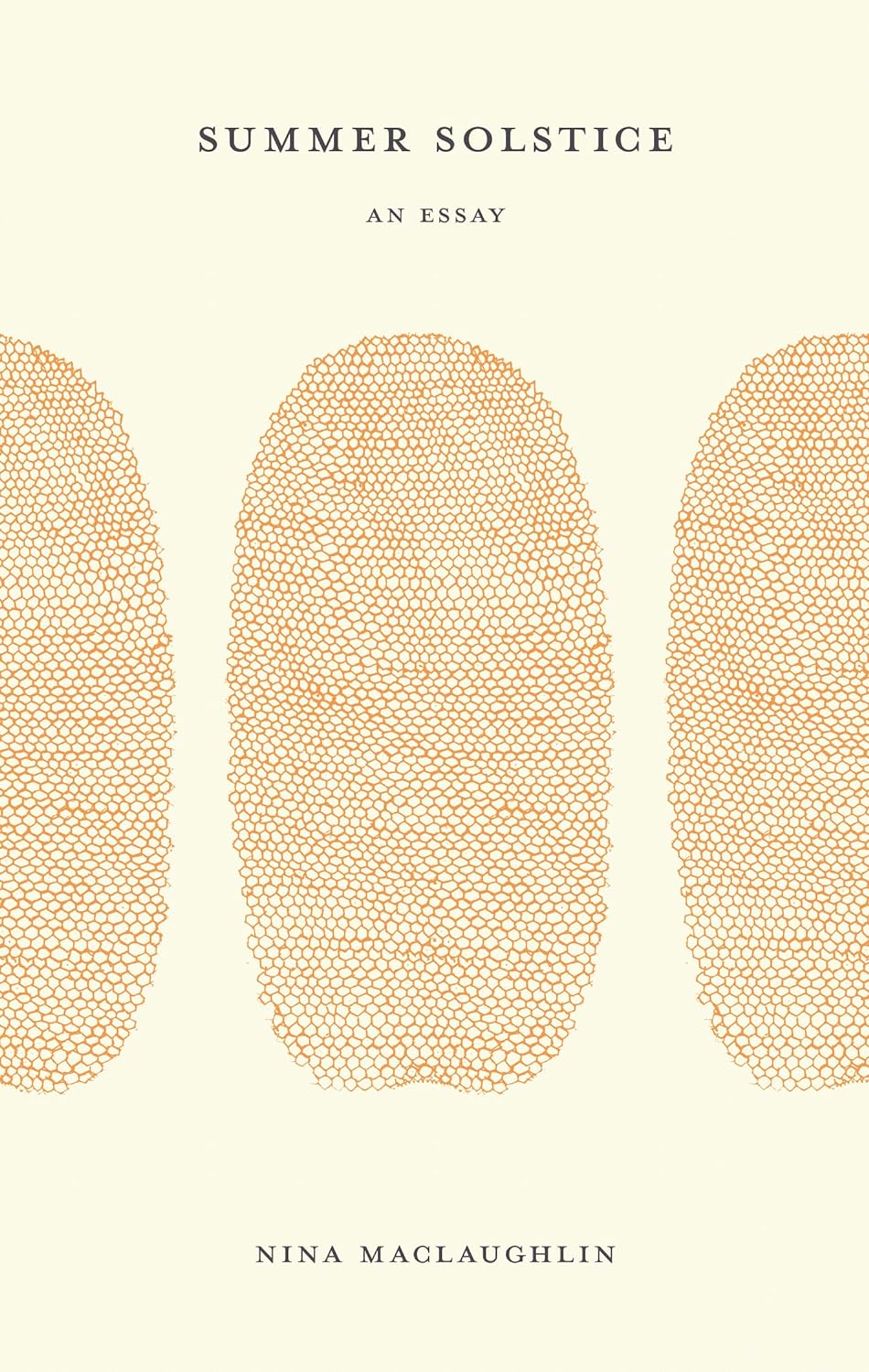
Summer Solstice by Nina MacLaughlin

Summer is the saturated season. The color floods back in. Each dip is another shot at being reborn, into summer where the world’s blood runs green.

For the summer solstice last night, I had my usual, traditional backyard fire. The traditions – my traditions – are accumulating: this time I had friends and food and drink around the fire as well. And I had a chapter from The Wheel of the Year to read (review forthcoming; it is wonderful), and I had a Nina MacLaughlin essay-book.

Six months ago I read her Winter Solstice, and now the summer one. It is the loveliest kind of homework to wake up and see what timely read I have for the day.

This little book barely clears 50 pages for the essay portion itself: perfectly sized for a same-day read, which is what I did. Now, this means I missed the advice to get up and wash one’s face in the solstice dew at dawn (also admittedly the summer solstice dawn is quite early for me). It is basically a lengthy meditation on summer and its resonances, for MacLaughlin and beyond; she has a number of works cited, mostly other works of literature (poetry, music) to which she refers, as jumping-off points for further musing. This won’t feel like ‘research’ so much in the traditional and dry-sounding way you might be thinking (although it *does* count as research!); more of a mining of other minds and cultural markers for how we think about summer, and midsummer or the solstice in particular. She does begin in early June, building into summer that way. MacLaughlin’s summer involves much swimming and waters, as well as fire, and sweat and sun and shade and fireflies (or lightning bugs) and a few other things we may hold, culturally, in common around here (several mentions are made of hot dogs). At least compared to my memory of Winter Solstice, I think there was less study of other cultural and historical handlings of the event. That could be my memory. Or it could be that Summer predated Winter by several years (ha) and the concept developed a bit in that time. This one does still offer an addendum of “Plant Matter,” featuring a few prominent plants and herbs associated with the summer solstice. I like that part.

I was not entirely surprised, in the Afterword, at MacLaughlin’s confession that she prefers winter. Again, perhaps it was just (or partly) the few years between books, but Winter Solstice felt fuller and richer to me. (Or maybe it was the hot mulled wine that accompanied that one, for this reader.) I am a summer person, myself, but her work on winter enriched that time for me considerably. There is still, here, the sensuality that I appreciated so much.

I would eat up more like this. I wonder if MacLaughlin would do the equinoxes, and maybe samhain and lúnasa and more…


The Rent Collectors: Exploitation, Murder, and Redemption in Immigrant LA by Jesse Katz

Street gangs and street vendors in L.A.’s MacArthur Park, a pair of botched murders, and a number of criminal trials shed light on social ills in this sensitive study.

Jesse Katz (The Opposite Field), longtime Los Angeles journalist, tackles a true story featuring a daunting number of characters and spanning years and tragedies in The Rent Collectors: Exploitation, Murder, and Redemption in Immigrant LA. With admirable clarity and compassion, Katz unravels a complex narrative that has no easy answers.

In the MacArthur Park neighborhood of L.A. in 2007, a teenaged gang member under orders fired five shots at a street vendor, in retaliation for the vendor refusing to pay “rent” to the gang. The intended victim was badly wounded by four bullets; the fifth bullet struck and killed a nearby 23-day-old infant. The shooter, Giovanni Macedo, was in turn the victim of a botched murder attempt at the hands of fellow members of his gang, the Columbia Lil Cycos, as punishment for his error. Giovanni eventually testified and helped put many gang members behind bars, receiving a sentence of 51 years for his crimes.

Katz’s thorough account details Giovanni’s personal and family history; the history of MacArthur Park; the cultural and economic predicament of L.A.’s immigrant street vendors; the background of the Columbia Lil Cycos, the larger 18th Street alliance, and the Mexican Mafia; the lives of Giovanni’s victims; and California’s law enforcement, judicial, and prison systems. It’s a sprawling story, but riveting and propulsive in this telling. The Rent Collectors deftly probes systemic ills. A large population of undocumented immigrant street vendors is squeezed between L.A. enforcement and street gangs: “MacArthur Park strained under the exigencies of that shadow population, a virtually permanent subclass left to invent its own opportunities, to improvise its own survival.”

Giovanni’s family background leaves him with a shortage of options and a desperate desire to belong to something bigger than himself. Immigration, legal, and prison systems fail, frustratingly often, to reward behaviors society deems “good” or to address adequately the “bad.” Giovanni is the protagonist of this story, drawing near a parole hearing at the time of this book’s publication; Katz portrays him with sensitivity and an eye to the complexities that led to his crimes. Giovanni is an imperfect symbol of redemption, but Katz shows that the marginalized teen was at the mercy of inexorable and deeply problematic societal forces. Abstaining from painting heroes or villains, Katz offers instead a plethora of thoughtful, nuanced profiles and a zoomed-out view of immigrant L.A., its street vendors, its gangs, and its intricacies. The result is relentless, multi-faceted, and incisive.


This review originally ran in the May 10, 2024 issue of Shelf Awareness for the Book Trade. To subscribe, click here.


Rating: 7 pairs of earrings.

The Talented Mrs. Mandelbaum: The Rise and Fall of an American Organized-Crime Boss by Margalit Fox

In the late 1800s, a female crime boss ruled New York City, as colorfully detailed in this exhilarating narrative history.

Margalit Fox (Conan Doyle for the Defense; The Riddle of the Labyrinth) brings a lively storytelling style and a flair for conveying personalities to a history that’s stranger than fiction with The Talented Mrs. Mandelbaum: The Rise and Fall of an American Organized-Crime Boss.

“‘You are caught this time, and the best thing that you can do is to make a clean breast of it,’ one of the Pinkertons… advised Mrs. Mandelbaum as she was led away. In reply, Fredericka Mandelbaum–upright widow, philanthropic synagogue-goer, doting mother of four, and boss of the country’s most notorious crime syndicate–whirled and punched him in the face.” To the modern mind, attuned to Scarface-style organized crime, Mandelbaum was an unlikely candidate for her role: Jewish, female, an immigrant, penniless upon her arrival in the United States in the mid-1800s. But through shrewd business practices and motivated by her desire for her family’s survival and comfort, the woman known as Ma, Mother, and Marm Mandelbaum established what would become a multi-million-dollar empire. She backed her staff of shoplifters, pickpockets, and bank burglars with training, supplies, project funding, bail money, and lodging–indeed, mothering them while setting a standard for criminal organization, including a highly specialized school for safebreakers.

Fox successfully tells this story by letting colorful characters stand out. “About six feet tall and of Falstaffian girth (she was said to have weighed between 250 and 300 pounds), pouchy-faced, apple-cheeked and beetle-browed, [Mandelbaum] resembled the product of a congenial liaison between a dumpling and a mountain.” She is pursued less by the New York police departments (multiple, corrupt, and at odds with one another) and more by the detectives of the nascent Pinkerton Agency who were hired to bring her down in a changing world. Both police and Pinkertons provide memorable characters to boot, on top of the regular and freelance lawbreakers Mandelbaum employed. Fox has a sharp eye for humor: “At the interment, it was reported afterward, some mourners deftly picked the pockets of others. Whether they did so in tribute to their fallen leader or simply from occupational reflex is unreported.” And she sets this wild narrative in the context of its time, Gilded Age America, aglitter and crooked and facing massive economic and social change. The world of Herbert Asbury’s Gangs of New York both provided the long shot for a Jewish matron, and punished her for her nerve.

With copious notes and research, Fox offers a tale as madcap and thrilling as it is illustrative of American history and culture. The Talented Mrs. Mandelbaum is riveting for fans of both history and entertaining storytelling.


This review originally ran in the April 16, 2024 issue of Shelf Awareness for the Book Trade. To subscribe, click here.


Rating: 7 diamond stickpins.

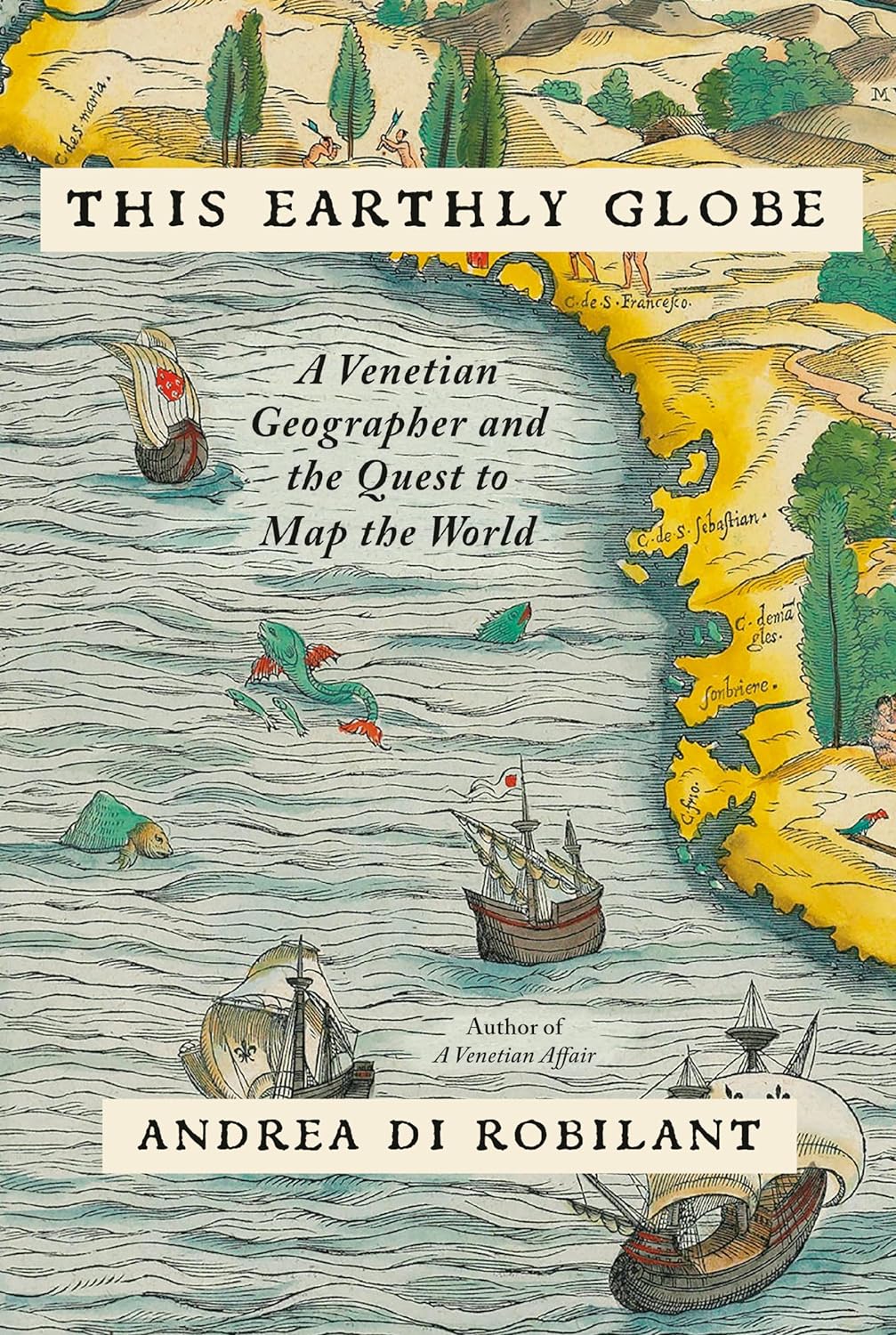
This Earthly Globe: A Venetian Geographer and the Quest to Map the World by Andrea di Robilant

This romp through history relates the lives and adventures of many travelers whose stories were compiled by a self-effacing Venetian civil servant in an extraordinary publishing feat.

With This Earthly Globe: A Venetian Geographer and the Quest to Map the World, Andrea di Robilant takes a convoluted but purposeful journey through history as well as geography to follow a remarkable achievement: the publication in the 1500s of an unprecedented three-volume collection. Navigationi et Viaggi, or Navigations and Journeys, was the life work of Giovambattista Ramusio, a career civil servant in Venice, but his name was not at first attached to “this remarkable collection of travel narratives, journals, private letters and classified government reports.” Humble and hardworking, Ramusio spent a lifetime compiling documents and notes from an impressive assortment of travelers. He found an early version of Marco Polo’s travel writings, corresponded with contemporary European explorers, and nurtured sources for long-secret documents; he was a dedicated editor, translator, and collector responsible for “one of the great publishing feats of the sixteenth century. It played a vital role in the final emancipation from a vision of the world still anchored to antiquity and became an indispensable source for the great cartographers of the second half of the sixteenth century.”

The world travelers whose notes, journals, drawings, and maps informed Ramusio’s work provide most of the color for di Robilant’s lively history. Ramusio’s own life is described, but it is Marco Polo, al-Hasan ibn Mohammad al-Wazzan, Antonio Pigafetta, Andrea Navagero, and many others whose adventures brighten these pages. Di Robilant (A Venetian Affair, Chasing the Rose, Face to Face) recounts their stories in vibrant detail. Marco Polo, in the region of present-day Afghanistan, saw “the landscape… stark against the deep blue sky: steep barren mountains, silvery green poplars along the banks of the river, the occasional mud village, and always a few flocks of sheep here and there nibbling at the rocky terrain.” Al-Wazzan, a “careful observer and diligent note taker… amassed a wealth of information on everything from the price of grains to particular weaving techniques to the quality of local wines in the places he visited.” He and Ramusio shared a “notion of what geography should be: not just maps and place-names but a more encompassing description of territory that might include observations on local crops, on manufacture, on trade patterns, on systems of transportation, irrigation and communication, on the social and political organizations of villages and towns, on religious practices.”

Di Robilant unfolds centuries of history, a dizzying array of characters, and a wide world of geography and culture in an easy storytelling style without falling into a dry recitation of facts and dates. This Earthly Globe offers a broad, accessible narrative about a publication that changed the world as it helped define it. Obviously for fans of history and geography, this sparkling story will also please general readers.


This review originally ran in the April 12, 2024 issue of Shelf Awareness for the Book Trade. To subscribe, click here.


Rating: 7 pomegranates.

Cactus Country: A Boyhood Memoir by Zoë Bossiere

This hard-edged, incisive memoir of gender-fluidity in a desert trailer park offers an essential perspective.

Memoirist Zoë Bossiere writes, “I see a lone, barefooted boy with short blond hair walking along the road in Cactus Country… looking for something despite feeling uncertain it could ever be found.” At age 11, Bossiere moved with their parents to a trailer park on the outskirts of Tucson, Ariz. Before leaving Virginia, Zoë gets a short haircut “like a boy’s.” “I’d thought I might need to go by a new name to pass as a boy in Tucson. But it quickly became apparent I was the only Zoë most people I encountered had ever met… so I kept it.” Cactus Country: A Boyhood Memoir tells of living as a boy in the desert, struggling with gender, class, and a shortage of options for self-expression, and eventually taking a great leap in leaving for a wider world.

Although Bossiere’s father introduced them as a daughter, they were on the whole able to make a fresh start in Cactus Country, inhabiting a long-held dream of boyhood. The version of masculinity they found in the desert is characterized by stoicism, camaraderie, and violence, as they learned from the trailer park’s revolving cast of boys and men how to perform toughness through acts of cruelty and self-defense. Especially as their body entered puberty, Bossiere struggled with gender expression in a world where they never encountered the concept of transgender, and the only queer role model they met insisted on a gender binary and harbored suspicions about bisexuality. Bossiere for a spell accepted the feminine identity assigned by the outside world, without settling into a self-identity that felt right. After a troubled childhood and young adulthood, it was by studying creative writing that they eventually saw a way out of the Tucson area and into new spaces, geographic and otherwise, including the concept of genderfluidity.

Cactus Country is a wise and wonderfully crafted memoir, treating its characters and subjects with compassion in the face of assaults, addictions, dysfunction, and violence. The desert and Bossiere’s experiences there are stark and severe but also include earnest attempts at connection. They must leave Cactus Country to grow and to find their truest self, but it’s only by returning in memory that their journey begins to feel whole. After a childhood as harsh as the desert sun, they write tenderly about place and a past “where broken boys with sunburned faces could be beautiful, kings worthy of inheriting the place they called their home. A place where a Cactus Country boy would always be a Cactus Country boy.”

Gorgeously written, thoughtful, and tough, this memoir of gender and a hardscrabble coming-of-age in the American Southwest excels at nuance.


This review originally ran in the March 19, 2024 issue of Shelf Awareness for the Book Trade. To subscribe, click here.


Rating: 7 paloverde beetles.