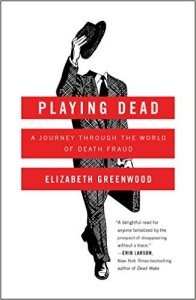
Playing Dead: A Journey Through the World of Death Fraud by Elizabeth Greenwood

This engrossing inquiry into faked deaths introduces curious characters and a litany of questions about life.
playing dead

Elizabeth Greenwood had recently quit teaching public school in New York City to return to school herself, and her student loan debt had hit six figures. She was feeling desperate, trapped and bored with her day-to-day existence. When a friend made a joke about faking her death to get away from it all, she was intrigued.

The idea became the research project that consumed her time and imagination for years, and resulted in Playing Dead: A Journey Through the World of Death Fraud. Greenwood explores the world of pseudocide from several angles. She speaks with several subjects of infamous botched cases, but fails to identify any successful fraudsters (by definition, they are hard to find). She visits with the investigators who pursue these attempted frauds on behalf of the insurance companies frequently scammed (“His workplace, in a way, is the DMV of death”), as well as with professionals in the field of helping people disappear. She also cozies up to a passionate “Believer” in Michael Jackson’s epic prank: that the singer is not dead at all, but in hiding, sending coded messages to his fans. When Greenwood sits down with family members who have been left behind, she finds the most damage inflicted. Finally, in the Philippines, she sets out to purchase her own death certificate.

Initially Playing Dead asks: Is this deception possible in a modern era of closed-circuit cameras, digital signatures and the inerasable Internet? Is it better to fake death, or simply to disappear? Are those who get caught really “morons and idiots,” as one specialist asserts? By the end of her journey, though, Greenwood asks different questions. Why are pseudocides overwhelmingly male? Is this an act of sacrifice or ego? “Is transformation without annihilation possible?” By the epilogue, she has reconsidered, for herself at least, which is preferable: a difficult life or a false death.

Along the way, she acquires a few tips: keep your first name when you take on a new identity. Stay in disguise. Don’t bother with a surrogate body. Quit driving altogether. Disappear on a hike, not into the ocean. And whatever you do, don’t assume you can return home to family and friends after just a few years dead. The exercise of seeking pseudocide for Greenwood, “acts as a gentle reminder that our realities are far from fixed.”

This energetic exploration of a world many readers may not have ever considered is perhaps slightly macabre, but ultimately very human; it is a questioning of how we seek satisfaction in life, and when we cut and run. Greenwood’s narrative voice is humble and approachable, but as an investigator she is tenacious, going the distance–to death and back–to bring this oddly fascinating story to her readers. Playing Dead will please those attracted to the eccentric, as well as anyone who has ever fantasized about leaving it all behind.


This review originally ran in the July 12, 2016 issue of Shelf Awareness for the Book Trade. To subscribe, click here.


Rating: 7 cars.

book beginnings on Friday: Origins of the Universe and What It All Means by Carole Firstman

origins of the universe

Thanks to Rose City Reader for hosting this meme. To participate, share the first line or two of the book you are currently reading and, if you feel so moved, let us know what your first impressions were based on that first line.

I’ve just begun a new memoir, about the author’s relationship with her decidedly eccentric father, a gifted biologist with poor social skills. It’s a little playful with formats within the book, and ranges from the personal to the broad. It’s called… Origins of the Universe and What It All Means.

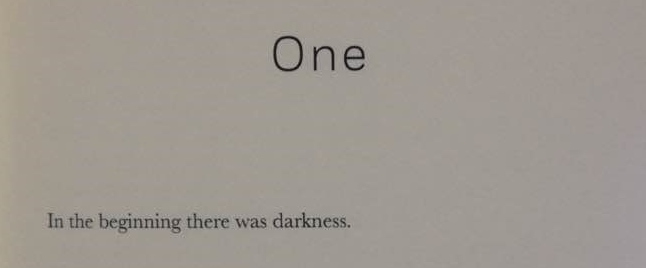
What a title, right? Wait til you see the opening page. I’ve zoomed in, but this is the entire content of page one and chapter one:

one

“In the beginning there was darkness.”

Don’t worry, though, it’s justified & appropriate for this book. Do I have your attention now? Stay tuned…

This quotation comes from an uncorrected advance proof and is subject to change.

The Art of History: Unlocking the Past in Fiction & Nonfiction by Christopher Bram

A succinct survey of history in both fiction and nonfiction offers advice for writers and readers.

the art of history

Christopher Bram takes on the broad subject of what history has to offer literature–and vice versa–with The Art of History: Unlocking the Past in Fiction & Nonfiction.

Beginning with memories of a high school English teacher, Bram celebrates the interest and value of reading and writing history. His thesis is that history need not be written in dry, textbook form: in both fiction and nonfiction, a talent for storytelling and a keen eye for just the right details, in the right quantity, can render the near and distant past in enthralling fashion. “Details,” he says, “are the raisins in the raisin bread.” He examines works including Gabriel García Márquez’s Love in the Time of Cholera, David McCullough’s The Path Between the Seas and Leo Tolstoy’s War and Peace, and topics ranging through war, slavery in the United States, comedic perspectives and the blending of lines between fiction and nonfiction. An author in both disciplines, Bram does not claim objectivity: he is clear about his love for Toni Morrison’s Beloved and his disregard for Hilary Mantel’s Wolf Hall, among others.

Books in “The Art of” series inspect craft from a perspective seemingly for writers and critics, and Bram offers good advice: “In both fiction and nonfiction, writing well means knowing what to leave out.” But The Art of History works for readers as well, as in an appendix of Bram’s recommended reading. Exploration, appreciation and instruction combine in this slim, accessible study of literary history and historical literature.


This review originally ran in the July 5, 2016 issue of Shelf Awareness for Readers. To subscribe, click here, and you’ll receive two issues per week of book reviews and other bookish news.


Rating: 6 details.

The Believer, issue 113: Chippy (fall 2015)

A little background: I’m working on developing as a reader and a writer, and approaching another graduate degree, this time in creative writing. As part of that process, I’m trying to read more literary journals. This is something we’re told to do if we want to get published by those journals, both to familiarize ourselves with what individual publications like and seek, and to support them. Over the course of six months or so, I’ve done a decent job of acquiring a bunch of print issues, but not such a great job of reading them. This summer, my resolution is to read a journal every Tuesday.

I don’t expect I’ll be writing about every one, but those I appreciate should certainly get a little space here at pagesofjulia. And that’s why I’m writing about The Believer today.

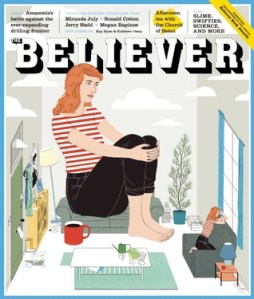
believer113The format is a little different. The table of contents is on the back cover, rather than in the first few pages. One element, the interview with Sheila Nevins (of HBO Documentary Films), is presented in pieces – “microinterviews” – spread throughout the issue. There are very few ads, and The Believer is printed on heavier, off-white paper, with nearly cardstock-weight covers. I’m sorry I don’t know the terms for these paper characteristics, but it’s got a nice feel in the hand. Oh, wait, here it is (from the website):

Each issue is perfect-bound and 128 pages, printed by friendly Canadians on recycled, acid-free, heavy-stock paper and suitable for archiving, framing in a very thick frame, or reading in the tub.

And despite the title, it’s got nothing to do with religion, or anything like that.

Also from the website, The Believer is

a bimonthly literature, arts, and culture magazine. In each issue, readers will find journalism and essays that are frequently very long, book reviews that are not necessarily timely, and interviews that are intimate, frank, and also very long.

In other words, overwhelmingly nonfictional and unafraid to go on a bit. I found the writing consistently very fine, and the widely-ranging subjects consistently fascinating. This is, in short, a magazine I want to read regularly. I am less sure that there is a place for my own writing on these pages (and if that’s self-centered, recall my original motivation in reading lit mags regularly), but that’s okay. I like finding good reading – obviously.

As to timing, I will note that the website still shows this issue, from Fall 2015, as the current issue. So I wonder a bit about their bimonthly-ness.

The highlights of issue 113, for me, included:

  • Kea Krause’s “What’s Left Behind,” about the nasty environmental disaster of a flooded copper mine on the edge of Butte, Montana. This piece made me think of Robert Michael Pyle, and hope that they know about one another.
  • Daniel Handler’s “What the Swedes Read,” a column in which he’ll read one book by each Nobel Laureate – this time, The Sovereign Sun by Odysseus Elytis, trans. by Kimon Friar. Handler’s often confused reading of these allusive poems, with frequent research digressions (“Out of my way, poem! I’m trying to understand you! Surely my loopy research was a disservice to poem and reader alike.”), really spoke to me and summed up some of my problems with poetry.
  • Ross Simonini’s interview with Miranda July finally got me really intrigued by this woman I’ve heard about here and there: now I want to check out her novel, The First Bad Man. Also, I was wowed by Simonini’s question, when July mentions that some of her early work embarrasses her: “Embarrassing because it wasn’t done well, or because it revealed something?” That is an exemplary interviewer: quick on his feet with an insightful question I wish I’d asked.

I’m excited to have discovered The Believer. I hope the missing issues of 2016 turn up, and I hope I can find the time to make this part of my regular reading.


Rating: 8 articles long enough to get lost in.

guest review: Mother Tongue: My Family’s Globe-Trotting Quest to Dream in Mandarin, Laugh in Arabic, and Sing in Spanish by Christine Gilbert, from Mom

My mother is here today to guest-review a book to which she brings special expertise. Mom has a Master’s degree in Applied Linguistics from the University of Houston; used to teach English as a foreign language to adults in community college settings; and now volunteers her time tutoring English language learners one-on-one. The disclosure here is that I was sent a free copy of this book in exchange for my mother‘s honest review. (It’s fun how that fact plays off this book’s title.) Thanks, Mom!

mother tongue

Christine Gilbert is quite the adventurous spirit. She tells the story in Mother Tongue about her quest to learn three languages – Mandarin, Arabic, Spanish – in less than three years, while living in three countries. This adventure includes a baby who acquires a sibling along the way. She and her husband have few ties to the U.S., and are able to work remotely. Thus they are perfectly placed for the language quest.

The quest is primarily hers, but includes her son as he grows and learns the local language effortlessly, as children do. (Her back-story includes a genetic disposition to Alzheimer’s disease, and she learns of brain research that suggests that young bilinguals have an advantage over monolinguals that gives about five extra years before onset of Alzheimer’s.) She sets out to understand language learning theories, while researching all the logistics of moving house and choosing the places.

Gilbert does her homework on language acquisition theory, and she makes her case for total immersion (no hanging out with English speakers!). She works long days in language study. In the beginning – Beijing during a very cold winter with pollution too severe for the family to go out much – she chooses to hire a tutor for working at home, as well as a housekeeper who doesn’t speak English. When a crisis takes the family away suddenly, she reviews her experience and decides complete isolation within the foreign country is not the only way to absorbing language and culture. Each move and new setting will bring more lessons, and Gilbert gets quite good at her tasks.

This is not a dry tome about memorizing vocabulary for long hours. We make friends along the journey, we learn to talk and savor local food. Gilbert is a fun character, and her husband’s story is equally interesting; the book is a travel story on lots of levels. As a parenting and family dynamics study, Mother Tongue is yet another book. I’ve been involved enough in the bigger story to follow her adventures as told on her blog, and can reveal that this is an unending quest – two more countries appear there, and since I haven’t looked lately, who knows where they may be now.

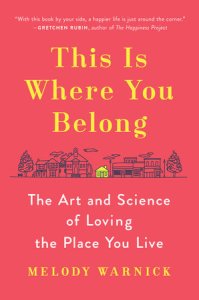
This Is Where You Belong: The Art and Science of Loving the Place You Live by Melody Warnick

A chronic mover seeks to settle down, and offers practical, accessible steps for readers to follow.

this is where you belong

When Melody Warnick, her husband and their two children moved for the sixth time in 13 years, from Austin, Tex. to Blacksburg, Va., she started to wonder if this new town would be a panacea, or if perhaps she was chasing an impossible dream. Had her family’s search for happiness via mobility been a form of magical thinking? So began the work of This Is Where You Belong: The Art and Science of Loving the Place You Live.

Warnick approaches the goal of settling, or of loving where she lives, enthusiastically and broadmindedly. Research is a major component of her work, but it never feels that way. Warnick consults social sciences studies and conducts myriad interviews, and distills what she learns into conversational musings that make the reader feel a part of the process. In the opening chapter, she identifies 10 “place attachment behaviors,” which form the chapters that follow. These include walking more, volunteering, exploring nature and creating something new. For each behavior, she sets a goal and records her progress; each chapter ends with a “love your city checklist” of suggested actions. This Is Where You Belong is a carefully documented experiment, explicitly designed for readers to replicate in their own lives.

By the end, Warnick has established herself as a fallible, likable everywoman, and her struggle to love Blacksburg comes to represent a universal concern. Her journey to feeling attached to where she lives is scientific and packed with research, but also feels like an old friend’s casual banter. This practical exercise in intentional place-based happiness is for the homesick and the optimistic alike.


This review originally ran in the June 24, 2016 issue of Shelf Awareness for Readers. To subscribe, click here, and you’ll receive two issues per week of book reviews and other bookish news.


Rating: 8 ticks on a list.

The Mindful Writer by Dinty W. Moore

This expanded second edition of the popular title about writing from a Buddhist perspective is a small book with big ideas.

mindful writer

Dinty W. Moore (Dear Mister Essay Writer Guy) is often asked to explain how Buddhism influences his writing practice. In struggling to answer this question articulately, he found himself shaping “The Four Noble Truths of the Writing Life.” From these musings was born 2012’s The Mindful Writer, a slim volume of very short, koan-like chapters offering writing advice and formed from quotations by other writers.

In its expanded second edition, The Mindful Writer offers a new introduction and for the first time includes writing prompts that follow the same concepts and quotations as its chapters. Words of wisdom from William Faulkner, Gustave Flaubert, Dorothy Parker, Stephen King and many more pose opportunities to ruminate on how to see and observe, how to work, how to think and live like a writer. Moore examines the sources of creativity as well as the plain hard work of writing, and “the freedom and importance of lousy first drafts.” Refreshingly, he reminds his reader that his advice “should be taken in the spirit of suggestion, not edict… it is not a good idea to cling too fiercely to the advice of others.” Moore is, as usual, funny but also takes his subject seriously. Its short chapters and encouraging prompts make this a guide to keep close at hand, for regular reference.

Its neatly packaged bits of wisdom mean that writers from beginners to experts equally will find inspiration and new perspectives in Moore’s unassuming manual of writerly mindfulness.


This review originally ran in the June 21, 2016 issue of Shelf Awareness for Readers. To subscribe, click here, and you’ll receive two issues per week of book reviews and other bookish news.


Rating: 7 moments.

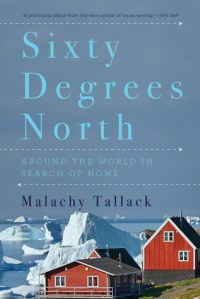
Sixty Degrees North: Around the World in Search of Home by Malachy Tallack

This broadly appealing travelogue combines carefully crafted writing with immersion in Northern lands and contemplation of the idea of home.

Print

Malachy Tallack comes to identify the northern Scottish archipelago of Shetland as home only after a long and troubled journey away and back again. In Sixty Degrees North: Around the World in Search of Home, Tallack grapples with the concept of belonging to a place, while traveling around the world on a single parallel. “For just as we inhabit the landscape, the landscape inhabits us, in thought, in myth and in memory.” He opens with the evocatively titled chapter “Homegoing,” and wraps up, naturally, with “Homecoming.” The chapters in between might be characterized as home-seeking.

These titles serve as shorthand for a considerably more complicated story. Tallack was not born in Shetland, but a loss he suffered in his teens left him there, feeling stranded. Ever since, he has vacillated with the attraction of other places, of movement, and the comforting appeal of an idea of home. Sixty Degrees North describes his travels through Greenland, Canada, Alaska, Russia and Scandinavia, which occupy the space of a year and thus document the North’s extreme seasons. This voyage is literally perambulatory, as Tallack compulsively walks, learning towns and cities by foot. In recalling an earlier time spent in Siberia, he studies his attraction to this place from a greater distance. He pursues home, even as he revolves around it.

While largely concerned with interior musings, Tallack makes a remarkable survey of cultures, climates and histories along the way. Ongoing themes include ties to nature and to community; the tension between isolation and engagement; stasis, movement and exile. His topics range over colonialism and native cultures, and the significance of peat, salmon and reindeer to indigenous peoples. He examines Scandinavia’s social and political systems, particularly in the Åland Islands, which belong officially to Finland but are politically independent and have a majority Swedish population. He touches on the science of climate change, the relative definition of “north” and the question of “denordification… as though by changing, by developing, by warming, the north can actually become less like itself.”

An introverted, quietly likable but troubled narrator, Tallack experiences no momentous events in the course of his travels, and even few conversations. His writing is thoughtfully composed, beautiful and often surprising, such as when he observes, “Loss shapes us like a sculptor, carving out our form, and we feel each nick of its blade.” Sixty Degrees North is not a book of action, but rather an extended meditation, on longing and belonging, on personal ties to place and on the particular nature of a certain band of earth and sea.


This review originally ran in the June 14, 2016 issue of Shelf Awareness for the Book Trade. To subscribe, click here.


Rating: 8 degrees (in two senses).

Magnum Cycling by Guy Andrews

Stunning photographs of bike racing across disciplines and decades, succinctly narrated, provide a compelling historical perspective.

magnum cycling

From Magnum Photos, one of the world’s oldest and most prestigious photo agencies, comes a collection of historic and iconic images of bike racing. Arranged and with accompanying text by Guy Andrews, Magnum Cycling is visually stunning and insightful.

Chapters are organized by themes, times and places, and photographers. The photographs of Robert Capa and Harry Gruyaert each fill a whole chapter, focusing on the 1939 and 1982 Tours de France, respectively. Guy le Querrec’s work covers “winter and spring,” including cyclocross racing in Belgium and France, and the Renault-Elf pro team’s winter training program in 1985. Chapters also address the velodrome, including six-day racing and the Paralympics, and the spectacle of the spectators. Henri Cartier-Bresson and John Vink join an impressive list of featured photographers. Along the way, Andrews explores the history of the Tour de France, national differences in spectator traditions and the legacy of figures like Bernard Hinault, Laurent Fignon and Lance Armstrong. His tone combines awe with humor when he calls cyclocross “simply bonkers… akin, perhaps, to bull-running in Pamplona or cheese-rolling in Gloucestershire.”

The balance of text to photographs is perfect: Andrews’s narrative and captions inform and elucidate, and then get out of the way of the extraordinary images that are the heart of this beautiful book. More than 200 gorgeous, intimate photographs in black-and-white and vibrant color present a view of a sport that is adrenaline-filled, fast-paced and deeply, tenderly human. Magnum Cycling is a superior collection of art, history and emotion.


This review originally ran in the June 1, 2016 issue of Shelf Awareness for Readers. To subscribe, click here, and you’ll receive two issues per week of book reviews and other bookish news.


Rating: 8 moments.

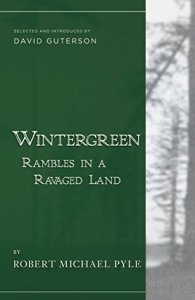
Wintergreen: Rambles in a Ravaged Land by Robert Michael Pyle

wintergreenAs I mentioned last week, I read Wintergreen in preparation for a class I am taking this very weekend from the author, Robert Michael Pyle. It was an intriguing read, and I’m looking forward to learning from the man himself.

The copy I read, borrowed from Pops, is a Pharos Edition, meaning that “one of today’s most exciting authors” hand-picked and introduced it in a reprint. Wintergreen was originally published in 1986 by Scribner; this 2015 edition is being called a 30-year anniversary, and David Guterson (The Other, Snow Falling on Cedars) brought it to Pharos.

In a word, Wintergreen is a book in defense of the ravaged land of the subtitle. That land is the Willapa Hills of southwest Washington (near where the Oregon line meets the coast), where Pyle settled after growing up in Colorado and studying in Seattle and at Yale, and some other stops along the way including Great Britain. This land is ravaged, of course, by logging; but Pyle argues that it is still beautiful, still deeply rich in natural wonders, and worth saving. Pyle is a biologist and a writer, and his style is both reverent and carefully descriptive and detailed. His tone can be occasionally irreverent and jokey; he is conversational, humble, and disarming, absolutely likable. I intend to like him, when I meet him.

In his own words,

This is the plan of the book: to describe the Willapa Hills and the wildlife they support, both native and alien; to examine the impact of intensive forestry upon the land and its life; and finally, to assay the ability of organisms (including ourselves) to survive in the aftermath of massive resource extraction. Throughout, questions of biogeography, ecology, and evolution in the wet, wintergreen world find their way into the text.

And four sections of four essays each do this work, as promised. It is kept from being overly square, in that structure, by Guterson’s intro, a Prologue, and an updated Afterword written for this 2015 edition.

I felt a great affinity for the sense of place that is so central to this work, especially because the place Pyle loves is an underdog, a humble and much-derided place. He writes,

In attending to these neglected hills I try to appreciate them for what they still are, without holding against them what they once were.

He takes his reader leisurely through what this place once was – the hugest of the huge old-growth Douglas firs et al, the ones whose stumps were repurposed as roomy homes for families – and what it is now – second-, third- and fourth-growth, and stump fields that however hold their own beauty, and remarkably biodiversity. He writes beautifully. There is undeniable poetry in the line,

The backs of old barns break and ancient boats and Studebakers deliquesce into the fundament.

Or, when introduced (and little-loved) nutria are quirkily described:

Wombatlike but generally black, they add a definite presence to an already-altered ecosystem, and they are somewhat more interesting than cows.

His audience is understood to be somewhat sympathetic to his feelings and beliefs: that the natural world deserves our protecting even while that is a rather arrogant concept; that old growth forests are special; that green is good. He takes some background knowledge for granted (first approaching the question, “what is old growth?” on page 198), but this is not much of a risk. He is right about the background his readers come to him with.

As he acknowledges in the newly-added Afterword, some of the specific details of politics, policy, and specific local conditions in the 1986 edition are a little dated now. But none are incorrect; and he brings us up to date in this Afterword. The questions I noted during my reading were well answered. Any period-specific feeling to the whole is enriching, if slightly distracting: it makes this text feel grounded in time as well as literal ground.

The pace of these 369 pages is not rushed, but indeed rambling. Patient readers, however, who love a certain level of detail and a good, rain-soaked, mature story, will be well rewarded.


Rating: 8 individually loved stumps.