Teaser Tuesdays: Cerulean Blues: A Personal Search for a Vanishing Songbird by Katie Fallon

Teaser Tuesdays is a weekly bookish meme, hosted by MizB of Books and a Beat.

Teaser

Again for school, I am reading Katie Fallon’s first memoir (she has Vulture: The Private Life of an Unloved Bird forthcoming from University Press of New England in March 2017). I look forward to meeting her in just ten days or so! This is not an assigned book; I’m reading it by choice to get to know her a little better.

cerulean-blues
Her opening lines read,

I stepped onto the tarmac in Bucaramanga, a city of more than five hundred thousand people in northeastern Colombia, and blinked in the fierce October sun. Black vultures lazily circled in the clear blue sky overhead, and swallows chittered to each other as they cut and dove above the Avianca jets idling on the runway.

I like that birds appear in the first two lines, since it is a bird that brings Fallon to these pages. The cerulean warbler does not appear so quickly; that’s a large part of the point of the book. I also enjoy the very full picture she paints in these few lines. Glad to be here with her.

This quotation comes from an uncorrected advance proof and is subject to change.

The Delicacy and Strength of Lace, letters between Leslie Marmon Silko & James Wright, ed. by Anne Wright

the delicacy and strength of laceAs I wrote in my beginning, I enjoyed this book more than I expected to. I struggle with poetry, and the snippets included here out of context (it seemed to me) challenged me. I was not familiar with the protagonists. But quickly their voices and personalities revealed themselves; and the story of James Wright’s death, and the introduction to this book by his wife, add a poignancy. There’s something about knowing the sad ending to a story before you read it.

I found many lovely lines (naturally) and scraps of wisdom here. My instinct is to just begin sharing those with you.

I enjoyed Wright’s lines,

I hope you don’t mind post cards. They are a way of sharing something, some place or other delight, and they can also, when written and sent truly, offer small wavelets, so to speak, to the rhythm of a correspondence.

and perhaps even more, that he wrote so instructively, so consciously of this – that he felt the need, and the meta-quality of explaining one’s correspondence. They were still kind of new to each other, you see.

From Silko,

I always resented Shakespeare’s use of the delayed messenger in Romeo and Juliet, maybe because such things are so ordinary and so possible, and so much can be lost for two people that way.

which is both amusing, and profound, and a little confusing – why resent the use of something ordinary and enormous, and isn’t that what we do as writers? Hm.

And then,

I believe more than ever that it is in sharing the stories of our grief that we somehow can make sense out – no, not make sense out of these things… But through stories from each other we can feel that we are not alone, that we are not the first and the last to confront losses such as these.

and I think of the impulse we all seem to share to tell our stories in response to one another. This can be selfish. One person shares something personal and painful, and the response is “well I…” or “my…” as if to turn it back to the speaker every time. But Silko has a point, that there is a function to this return-to-me, and that in the right setting & relationship it’s how we perform empathy. I think about this in conversation sometimes, the effort to not always “me” everything. But it can be well done.

And very pertinently to nonfiction writers in particular, Silko again –

Memory is tricky – memory for certain facts or details is probably more imaginative than anything, but the important this is to keep the feeling the story has. I never forget that: the feeling one has of the story is what you must strive to bring forth faithfully.

This is the trick, or the puzzle, and the much-discussed central problem, with creative nonfiction or with memoir: the tension between strict “fact” (which is what, exactly?) and the richness of imaginative memory. See also Sejal H. Patel’s “Think Different” in issue 58 of Creative Nonfiction (I reviewed here), where she and other memoirists explore the use of technologies to aid memory.

Finally, and perhaps most centrally to the question of correspondence in general and especially between writers:

With you to write to, I go through the day with a certain attention I might not always have. I look for things you might want to see for yourself, but I can’t seem to get them into a letter.


I enjoyed reading this slim epistolary collection, and I think I got a lot out of it. But what was I supposed to get out of it? Despite a few classes taken early this year, I feel rusty at reading literature with a class in mind, and I am so curious about what the seminar that assigned this book will hold. Most of all, I’m excited. So thank you, school and world, for that.


Rating: 8 roosters.

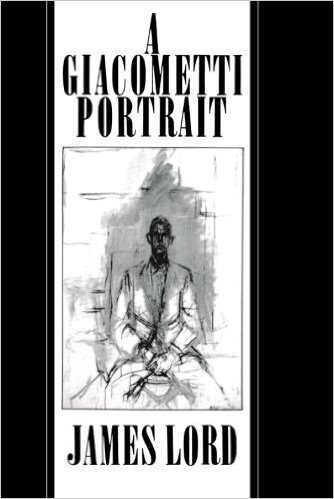
book beginnings on Friday: A Giacometti Portrait by James Lord

Thanks to Rose City Reader for hosting this meme. Participants share the first line or two of the book we are currently reading and comment on any first impressions inspired by that first line.

This is another I’m reading for school (see last week’s teaser), and deals with a work of visual art. The portrait of the title is both one being painted by the author’s friend of the author himself, and the book I hold in my hands: a portrait of the painter.

giacometti-portrait
James Lord is in conversation with the painter Alberto Giacometti as the former sits for his portrait.

“But is even a photograph really a reproduction of what one sees?” I asked.

“No. And if a photo isn’t, a painting is even less so. What’s best is simply to look at people.”

And I thought those lines began to capture part of what the book is about. Also, they spoke to me as a writer who tries to capture life. It makes it all a little futile, perhaps; or maybe it helps the artist to refocus. Plenty to think about.

This quotation comes from an uncorrected advance proof and is subject to change.

Gods, Wasps and Stranglers: The Secret History and Redemptive Future of Fig Trees by Mike Shanahan

A joyful, celebratory world history of the fig tree and its ecological impact.

gods-wasps-and-stranglers

Mike Shanahan’s Gods, Wasps and Stranglers: The Secret History and Redemptive Future of Fig Trees is a deceptively brief account of the Ficus genus of trees in history, emphasizing but not limited to their relationship with humans. Shanahan brings the expertise of decades of ecological fieldwork and a bubbling enthusiasm to a topic clearly close to his heart. He makes a strong argument that his readers should be attuned to and excited about fig trees, too.

The plant figures into the origin stories of cultures all over the world. Fig trees have provided food, shelter, medicine and materials to humans for as long as humans have existed: figs predate us by nearly 80 million years. Because of their contributions as keystone species in ecosystems around the world, figs offer distinctive services in reforestation efforts and the mitigation of climate change. They have contributed to the theory of evolution, the birth of agriculture and possibly humans’ development of opposable thumbs. The story of the fig is inseparable from that of fig wasps, numerous tiny insect species that have evolved to pair respectively in symbiosis with individual species of fig. Shanahan relates all this and more in a joyous voice with occasional lyricism, as when “the Buddhist monk’s robe sang out loud saffron over the rainforest’s muffled tones of brown and green and grey.”

Mythology, biology and hope for the future combine in this highly accessible story of the family of fig trees, with its profound ecological relevance.


This review originally ran as a *starred review* in the December 2, 2016 issue of Shelf Awareness for Readers. To subscribe, click here, and you’ll receive two issues per week of book reviews and other bookish news.


Rating: 8 rhinoceros hornbills.

Creative Nonfiction, issue 58: Weather (winter 2016)

You can buy issue 58 here.

You can buy issue 58 here.

I always find something to appreciate from Creative Nonfiction. And in this issue, I confess, I had the added thrill of seeing several essays I got to read as submissions, that made it all the way to publication. Being a reader for CNF has been an incredible learning experience for me.

In this weather-themed issue, I really enjoyed Joe Fassler’s interview with Al Roker (Fassler wrote the essay “Wait Times” that I found so mesmerizing). Andrew Revkin’s essay about climate change, on the other hand, though much praised by editor Lee Gutkind, failed to grasp me: I found it overlong and less-than-gripping, and I guess also I found his opinions hard to access.

Interestingly, among the essays in the magazine’s main section, I was more excited about Ashley Hay’s “The Bus Stop” and Tim Bascom’s “My First Baptist Winter” than I was about the prize-winning “Recorded Lightning” by Amaris Ketcham: I enjoyed Ketcham’s writing very much, but the lightning-shaped text formatting which I think ‘made it’ for some readers only distracted me. Beatrice Lazarus’s “The Snow” was another interesting reading experience. I found the writing sometimes lovely and sometimes awkward, and the story’s steering between extreme weather and human violence took me a minute to grab onto. There is no question these are all impressive essays, but as usual, some worked better for me, personally, than did others.

Sejal H. Patel’s “Writers at Work” piece, called “Think Different,” lets Patel and five other memoirists discuss the impact of technologies on how we access and write about our memories. How does Google Earth, for example, help or confuse our recollections of the houses we grew up in? (Much more on this topic lies within The House That Made Me, which I recommend if this subject interests you.)

This issue of CNF is not the one I’ve enjoyed most, but there’s no shortage of thoughts provoked. Your mileage may vary.


Rating: 7 tornadoes.

book beginnings on Friday: The Delicacy and Strength of Lace, letters between Leslie Marmon Silko and James Wright

Thanks to Rose City Reader for hosting this meme. Participants share the first line or two of the book we are currently reading and comment on any first impressions inspired by that first line.

And so begins graduate school: with advanced reading to prepare for the winter residency I’ll be attending in West Virginia in just a few weeks. I chose to begin with this collection of letters, which will inform a seminar entitled “Another Voice at the End of the Line: Correspondence Between Writers.”

Here’s a confession: I’ve never read any Silko or Wright before.

the delicacy and strength of laceWe begin:

Misquamicut
Rhode Island
August 28, 1978

Dear Mrs. Silko,
I trust you won’t mind hearing from a stranger.

And so began a strong friendship. I’ve really been enjoying this, actually, although I wasn’t sure at first that there would be enough to grasp onto, between two writers I was not familiar with. I’m also looking forward very much to this seminar, which I think speaks to some of the challenges of being a writer, let alone in a low-residency program; and it is taught by a faculty member I very much enjoyed meeting last summer, Doug Van Gundy. Plenty to go on there.

Happy Friday, friends.

Yokainoshima: Island of Monsters by Charles Fréger

A rich collection of photography explores the Japanese mythology that both celebrates and protects longstanding traditions.

yokainoshima

Yokainoshima is a lushly beautiful collection by photographer Charles Fréger (Wilder Mann: The Image of the Savage), with commentary by experts on his Japanese subjects. Yōkai are “spirits, ghosts and other monsters,” or, literally, “bewitching apparitions.” On Yokainoshima, the “island of monsters,” and in Japanese culture, these gods and ghosts emphasize links to other worlds, in which humans are not the only inhabitants.

The bulk of Yokainoshima is filled with nearly 200 glossy color images of masked and costumed performers representing specific yōkai in grassy fields, beaches, forests and snowfields. Standing alone, these powerful, vibrant photographs offer stories and evoke emotions. Descriptions of the depicted characters, groups and customs (located at the back of the book) elucidate the mysteries offered by the images: seasonal rites requesting fertility, abundance and protection. Short essays portray a culture defined by its spirits, monsters and connections, enriching Fréger’s striking visual art.


This review originally ran in the November 22, 2016 issue of Shelf Awareness for Readers. To subscribe, click here, and you’ll receive two issues per week of book reviews and other bookish fun!


Rating: 8 pieces of straw.

Paul Smith’s Cycling Scrapbook

In this love letter to professional cycling, a fashion luminary expresses his passion with visual pop.

cycling-scrapbook

British fashion designer Paul Smith once aspired to be a professional cyclist, and his love for the sport has persisted over the decades. Paul Smith’s Cycling Scrapbook presents assorted ephemera accompanied by Smith’s casual commentary, with a brief foreword by Scottish cyclist David Millar.

Smith has an impressive collection of cycling jerseys, pennants, advertisements and publications specific to professional road and track racing. Chapter headings present themes and artifacts, including racing personalities, events like grand tours and one-day classics, Smith’s own bicycles and what he refers to as “the look.” He admires the individual histories of heroes like Fausto Coppi, Jacques Anquetil and Eddy Merckx, and Smith’s friends among contemporary racing stars, including Mark Cavendish and Bradley Wiggins. Throughout, Smith’s tone is conversational and self-effacing, even as he is honored to design the 2013 Giro d’Italia’s maglia rosa (leader’s jersey).

Visually stunning and wide-ranging, Paul Smith’s Cycling Scrapbook elegantly marries Smith’s admiration for the heroes of road and track cycling with his passion for design.


This review originally ran in the November 22, 2016 issue of Shelf Awareness for Readers. To subscribe, click here, and you’ll receive two issues per week of book reviews and other bookish fun!


Rating: 7 polka dots.

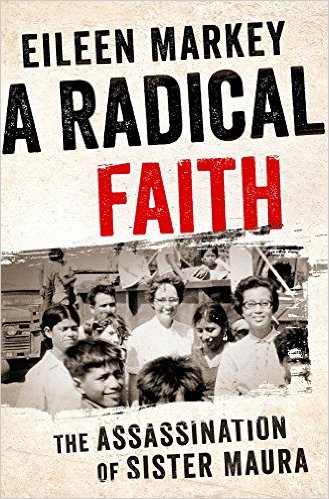
A Radical Faith: The Assassination of Sister Maura by Eileen Markey

One of the four churchwomen murdered in 1980 El Salvador is honored with a detailed biography.

radical-faith

In 1980, four United States churchwomen in El Salvador were raped and murdered by members of the U.S.-trained National Guard, calling into question U.S. support for the right-wing military dictatorship and leading to several high-level and international investigations. The four were treated as symbols and martyrs; journalist Eileen Markey wanted to make them individuals again. A Radical Faith: The Assassination of Sister Maura pursues that goal by examining the life of Maura Clarke.

Markey follows Maura from a close-knit Irish Catholic family in Rockaway, N.Y., to a Maryknoll convent at 19 in 1950, part of a staunchly anti-communist Catholic Church. Maura served in the Bronx, and then for 17 years in Nicaragua, where she was horrified by poverty and want. She gradually experienced a massive transformation of worldview, eventually becoming an outspoken activist, even as Markey outlines a parallel if gentler shift at the Church’s highest levels. When assigned to El Salvador, Maura worked a few short months before her murder.

A Radical Faith is not an objective inquiry: it assumes that Maura had few flaws and that missionary work in cultures abroad is good work. Markey nevertheless powerfully establishes Maura as an individual, and animates the story of her death. Her work brings an extraordinary level of detail, from Maura’s own journals and correspondence as well as redacted government documents, to a decades-old crime with higher-level instigators who have not been brought to justice. Though not impartial, A Radical Faith is a carefully researched and flattering portrait, moving and evocative.


This review originally ran in the November 18, 2016 issue of Shelf Awareness for Readers. To subscribe, click here, and you’ll receive two issues per week of book reviews and other bookish news.


Rating: 6 flights.

Teaser Tuesdays: Talking Back, Talking Black: Truths About American’s Lingua Franca by John McWhorter

Teaser Tuesdays is a weekly bookish meme, hosted by MizB of Books and a Beat.

Teaser

Linguistics, race, and what is weirdly unique about the United States: I was drawn to this book for its subjects. It’s just a slim little thing, too. Here’s a teaser for you:

talking-back

When humans move, or are moved, in large numbers and have to pick up a language quickly, typically their version of the language is more streamlined than the original one. This is worldwide linguistic reality, not special pleading for the speech of black people in the United States. We know this from Modern English itself, as well as, if anyone asks, from Mandarin Chinese compared to other Chineses like Cantonese, Persian compared to languages related to it, like Pashto and Kurdish, Indonesian, Swahili, and many, many others.

There is some ambiguity in those final clauses: are we to understand that Indonesian and Swahili are similar to Persian, too, or just the Pashto-and-Kurdish phrase? (I think the latter. Maybe some semicolons would help!) But the overall point is well taken. It’s been an interesting & informative read; I hope you’ll join me.


This quotation comes from an uncorrected advance proof and is subject to change.