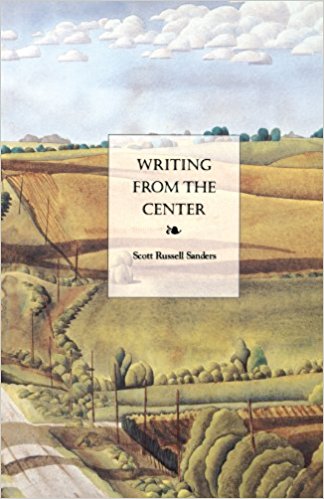
Writing from the Center by Scott Russell Sanders

I already admired Scott Russell Sanders for two essays I’d previously read a la carte: “Buckeye” and “The Inheritance of Tools.” Among other things, I love that both these essays do concentrate on “things,” that is, concrete physical objects that hold meaning. Also, his prose is lovely; he is thoughtful, and methodical in recording his thought processes; and he is concerned with the significance of place, and people’s ties to place. This last I mostly knew by reputation before reading this collection.

Sanders was already well-established and prolific when he released this essay collection, which has sort of a retrospective gaze. Essays focus on place, and the need for people (and writers) to be centered in place, and the author’s own underrated place, the Midwest. There is also some focus on humans’ role in a larger network of biological relationships, and a writer’s life and work, including literary studies. The opening essay “Buckeye” is the clear standout; I also really enjoyed “Writing from the Center” and “Letter to a Reader,” which come at the end. Some of the middle of the book faded out a little for me, though.

Writing from the Center moved a little slowly for me, in fact. There is much to praise here, but it’s quiet and ruminative, and I sometimes struggled to stay engaged, especially because many of the essays seemed to hit the same notes (same subjects, same points, same rhythms) again and again. There is an accumulative effect that is worthwhile, though. Sanders’s prose is quiet, straightforward, articulate but unadorned.

Of course I share Sanders’s concern with place and with staying put (Staying Put is another title of his I need to look into, in fact). It’s a little odd that I didn’t find this one more compelling, as I appreciated his points so much. He can do some extraordinarily beautiful writing. I loved this line:

A few turkey vultures perch on one of the crossbeams, their wings splayed to catch the early sun, like a row of black shirts hung out to dry.

I saw parallels from Kathleen Dean Moore’s “Stalking Seals” through Annie Dillard’s “Living Like Weasels” through the otters in Sanders’s “Voyageurs.” And I made notes of the best points about place: these may be jumping-off points for my own writing.

I may have just been in a reading funk when I hit this book. But I think it’s also true that the pacing and the prose are measured and meditative, and that several of these essays address the same points. This may be a liability when putting together a collection of related works.

The next two books I read for school electrified me, by contrast. Those reviews are up soon: Lidia Yuknavitch’s The Chronology of Water and Harry Crews’s A Childhood: The Biography of a Place.


Rating: 7 quasars.

The Boys of My Youth by Jo Ann Beard

I first read Jo Ann Beard’s essay “The Fourth State of Matter” for school, just a year (or so) ago, during one of my post-bacc courses at Western Washington University. I was floored. If you are unfamiliar, I strongly recommend that you read nothing about the essay, but dive in blindly as I did. You can read it here.

Or you could read this book, a collection of autobiographical essays including that one – which floored me again, even when I knew what was coming, and read differently this time around, of course. It is one of the best, but by no means head-and-shoulders from the rest of the essays. I took pleasure in this read, which wanders through Beard’s childhood and adulthood, jumping in time while focusing on certain characters here and there. I am coming to appreciate a certain balance in my reading for school, which I found here and which is sort of rare: I enjoyed reading this book, even while I was able to keep my eye on the craft side of things, recognizing the beauty in how it was done.

I feel like Beard has a certain tone in common with Haven Kimmel. They both tell childhood stories with the perspective of the time – that is, a child’s perspective – in a way that can be so funny. Beard is a little more self-effacing and wry, and occasionally somber, where Kimmel almost never breaks the construct of that humorous, wondrous sense of discovery and exclamation. But there is a sense of the absurd to the child’s POV, a sort of “oh my gosh, I had no idea the world had this in it!!!” that is just joyful and playful and funny and fun, that they both hit, in slightly different ways. I love that. Part of this, too, is that Beard often writes (especially, I think, earlier in the book) in the present tense, as if these things are just happening now, which gives that feeling of immediacy.

Overall, she shifts quite a bit between tenses and perspectives. She can be very conversational, as when she digresses to give background information and then comes back to the action at hand with a sort of “but anyway, I was telling you about…” kind of phrasing. She also refers to the writing of this book as it’s happening, especially in the final, title essay “The Boys of My Youth,” which shows her struggling to put the thing together, calling an old friend to consult on the details even as she’s sharing those details with us in the essay. I enjoy that transparency to the writing (as a writer, obviously, but also as a reader). As I’ve just finished this book, I have a feeling that it progresses from an innocent early childhood (the preface is a pre-verbal memory) to a more jaded adulthood (we finish with a divorced woman leery of new relationships). Looking again, the essays do progress in chronology; but within each there are huge jumps in time, so we see previews and flashbacks, too. It’s an interesting structure: subtle, but effective. A memoir in essays, and not the first of those I’ve read this semester, which is no mistake; it’s probably the kind I’m writing. Of special interest to me is the essay “Cousins,” a profile of Beard and her cousin Wendell, close friends, told in a series of anecdotes spread over many years, and out of chronological order.

One potentially troubling thing needs noting: Beard is comfortable with a certain amount of imagining in her nonfiction. Probably more comfortable than I am. I remember this objection being raised to “The Fourth State of Matter,” when I hadn’t caught it myself; she includes scenes where she was not present, but I guess I’d assumed she came by the information from other sources, where a closer look shows that to be in some cases impossible. I noticed it even more here, like when she describes in great detail a scene involving her mother and aunt, which took place before the author was born. I don’t know. The generous part of me wants to believe this scene was described to her (in detail! repeatedly!) and she filled in only some minor details (what color pants; what the sky looked like, because she came to know that same sky). But I’m not sure that’s true, and my personal code for nonfiction makes me a little uncomfortable with the possibility that she put her mother and aunt in that flat-bottomed boat, recklessly imagining. Discovering that Annie Dillard had no cat, as described in the opening paragraphs of Pilgrim at Tinker Creek, made me crazy. If she made up a whole cat of whole cloth, what else has she fabricated?! Here, I guess I’m feeling a bit more forgiving, perhaps because it’s a bit more obvious that Beard was not there when her mother was in that boat, pregnant with baby Jo Ann. (Dillard gives no clue that there is no cat.) But it’s not going to be my way.

This is one of the most enjoyable things I’ve read this semester. Easy-reading, entertaining, lovely, finely crafted but accessible.


Rating: 8 bananas.

Ecology of a Cracker Childhood by Janisse Ray

Early in my reading, I was ambivalent about this book, although I cannot now remember why. Did her writing get stronger as the book progressed? Did her vision & thesis take shape and grow on me? Was I just in a mood? By the end, I felt friendly towards the narrator and the book.

Janisse Ray grew up on a junkyard in south Georgia, one of four children. Her family was strictly religious, rural, somewhat isolated, and their lives were simply furnished for both religious and financial reasons, although they were not painfully poor: “We never ever lacked food, but we had few treats.” This book is an essay collection that is two things at once: a memoir; and a naturalist’s description of a nearly-vanished landscape–an elegy. The chapter/essays alternate between Ray’s personal and family story, and the ecological side. In reading this was a little less obvious to me, because I would argue that the ecology bits include some personal, and vice versa; but the table of contents makes this structure clear and intentional: the naturalist chapter titles are italicized, like Latin names of species would be. This is what the title is telling us, that it is both ecology and cracker childhood, and also the ecology of that childhood, and of the cracker people (one of the ecology essays is titled “Crackers,” as they are themselves one of the species at work in the system).

Ray’s homeland was once a longleaf pine forest, and that diverse ecosystem (and the pine savanna that wanders through it) is endangered and precious to her, now, but her upbringing did not emphasize it. The discovery of her homeland as a natural ecosystem, and its loss almost before she knew it, came later. As interesting as her childhood is, and the ecological part too, that young-adult awakening was perhaps the most compelling part of this story for me; maybe that’s part of why it became most appealing to me late in the book, when the awakening is told.

I learned a lot about a place and an ecosystem, and I enjoyed the personal memoir. I was especially fascinated by the strict religion that did not allow girls to wear pants, jewelry or makeup; had them cover their hair to pray; forbade holidays, ball games, parties, television, newspapers, dating, sports, on and on. This stuff is so far from my personal experience as to feel exotic, or weird, so I read it with that added curiosity we feel when we encounter the foreign. And it made Ray’s experience at college so compelling: alcohol, rappelling, skydiving, and simply swimming (something her family’s dress code never allowed), oh my! The parallel discovery, as I’ve said, is of nature as a subject for study, admiration or even just notice. She observes that she had a grandfather who loved the woods, but that her father couldn’t take the time; and a culture of people working to just get by didn’t have the energy to hug trees. It’s a sad story.

Ray does some lovely writing. I love the parallel of restoring a junkyard to a natural ecosystem, and restoring a ’58 Studebaker (with parts, presumably, to be found in the junkyard). I love this grandmother: “Her skin was soft and loose, and her face wrinkled in a beautiful way that showed she had always liked to smile. Her eyes, behind silver glasses that matched the soft halo of her hair, had life in them.” There are several noteworthy characteristics to this book. Its subjects were new to me, at least: that is, the place, the ecosystem, and the upbringing or culture. Its structure is interesting. I’m not sure why it grew on me so slowly, but grow on me it did.


Rating: 7 gopher tortoises.

The Pine Island Paradox: Making Connections in a Disconnected World by Kathleen Dean Moore

pine-island-paradoxThis is a complexly put together collection. These are essays, both personal/memoir and nature writing, based on islands, organized by disconnections (see the subtitle): human/nature, near/far, sacred/mundane. Back-of-book blurbs variously characterize these essays as being about nature; ecology; family; and philosophy. But I think they are about connections/disconnections and most of all about boundaries. Where does island end and sea begin, for example, if the tides change? Moore uses lovely, musical language; precise, apt images; and communicates emotion and intellectual difficulties nicely. From a craft perspective, this is a dense book; but it is easy to read for the simple experience.

It is Moore’s thesis, stated in her prologue, that our Western understanding of the world is based on divisions, on separating things and experiences out into categories. (She is a philosophy professor.) She sets out to take apart three of those separations: human/nature, near/far, and sacred/mundane. These are the three sections of the book; but also, each is set or at least organized around a specific island. After beginning and ending her prologue with the concept of geography, or mapmaking, she begins each main section with a page-and-a-half titled “Geography,” in which she describes these islands: Pine Island well off the Pacific coast of Alaska; a gravel island in the Willamette River in Oregon (near Moore’s home); and a volcanic sea stack off the Oregon coast. All of these organizational tools, taken in with her title, subtitle and explicit plans laid out in the prologue, combine to form complex but clear structure, focus and themes. Connections and disconnections; islands; boundaries; and the paradoxes implied. An important sub-theme involves Moore’s close relationship with her family: husband, two children, and eventually a daughter-in-law, who is called her third child in her acknowledgements. This is just another form of connection, so a sub-theme rather than an additional or secondary one.

Some of you will recall that less than a year ago I lived in the Pacific Northwest, too. I recognized much of what Moore described: the wet drippingness of the world for so many months, relief at seeing the sun, the importance of salmon. Some of this was hard for me to read: that pervasive wet really got under my skin (maybe even a little literally). I had some strong reactions to some of what I read here, which is a good thing: Robin Hemley wrote, “You should always be prepared to argue with a good book.”

This is not my new favorite piece of writing: there are a few places where I’d have enjoyed seeing things done a little differently. But it was very moving many times over; many individual essays were fantastic; I think (as a personal preference) I’d rather there had been a little more subtlety to the overall message. This was a bit too much explicit “I am writing this to make you care more about the natural world,” especially in the prologue. But again, that’s a personal reaction, and there’s no arguing Moore’s skill with words (musical language), images, her expertise and her use of emotion (nor do I doubt her sincerity). And if she inspired me to some argument, that’s useful, too.


Rating: 8 wet words.

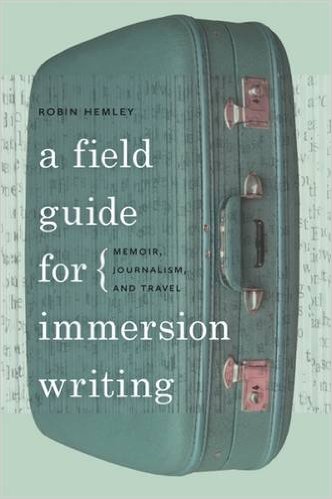
A Field Guide for Immersion Writing: Memoir, Journalism and Travel by Robin Hemley

field-guide-for-immersion-writingThis is the fourth “craft” book I’ve read this semester, and it’s one of the better ones. The Art of Subtext was an intriguing read, but so thoroughly geared toward fiction writing that it was less useful to me. The Situation and the Story felt a little wandering and indistinct. On Writing was of course wonderful – as an insight into King the man and the writer, as well as for his writing advice, which is largely on the sentence/language level and therefore applicable to nonfiction as well as the fiction that King specializes in.

By contrast, A Field Guide for Immersion Writing is specific in terms of the writing it addresses. I really appreciated Robin Hemley’s breaking down of immersion genres: first into travel, memoir, journalism, and then into quest, experiment, investigation, reenactment, and infiltration. (All of this makes sense in his thorough discussion. And there are examples.) I also really appreciate that he recognizes these as fluent: “The categories are meant to be useful, not binding.” He then works methodically through his categories and sub-categories of (nonfiction) immersion writing, addressing their fluid boundaries throughout, and offering advice about how to do both the immersion, the living and interviewing and learning, and the writing. He also speaks to the practical side of the writer’s life: how to pitch proposals, how to fund travel and research, that kind of thing.

Perhaps one of the most important things that made this book work for me was that I liked Hemley’s voice – which is to say first of all that he had a voice, that he let some feeling for his personality live in this book. (He was referring to immersive travel writing and not writing about craft, but see this line: “To me, it’s an act of generosity to introduce yourself, to say, This is who I am and why this story is important to me, and these are the people I met along the way.” [emphasis his] I hear this as an echo of something I’ve long believed: to not let oneself come into one’s writing is sort of dishonest. We know you’re there, so show yourself.) Hemley shows himself; and I liked, felt like I got along with, the person I met there. So I was primed to take advice from him. Also (as in the above parenthetical quotation) I found that we had some principles and opinions in common, again making me interested in following him. The point here I think is that our reactions as readers are subjective and personal (duh, right?), so if I vastly preferred Hemley’s craft book to Gornick’s, that doesn’t mean you’ll feel the same way.

That said, I do think that this “field guide” offers a wonder of practical advice, specifically geared towards a certain type of writer. Its specificity is definitely one of its greatest strengths (if you’re in that group of writers – see again The Art of Subtext), and it offers a huge number of examples of immersion writing that work in various ways. So, plenty of reading there.

More wisdom: Hemley writes, “Book projects are protean: you start out thinking you’re writing about one thing, but the book you write almost never turns out to be the book you set out to write.” This echoes something I’ve heard from a number of other students (and graduates, and faculty) in my MFA program, and it’s something I find intriguing, and both promising and scary.

I liked this book, and I liked the author enough that I intend to (someday) read his Nola: A Memoir of Faith, Art, and Madness, about his sister. That’s an endorsement.


Rating: 8 suitcases.

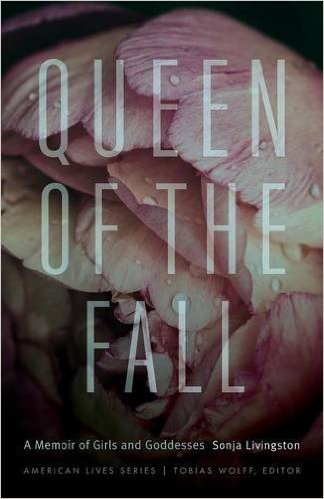
Queen of the Fall by Sonja Livingston

queen-of-the-fallThis is a memoir in the form of collected essays about girls, their experiences and generally a girl’s coming-of-age in New York state in the 1980s and ’90s. The whole book accumulates into something greater than its parts, which is a trick I love. Livingston’s writing is beautiful on the language level as well as in subjects and connections drawn. Her essays include lots of braided pieces, and a fairly heavy emphasis on having babies: avoiding having them too young and yearning for them later.

Livingston’s life is told not as a cohesive story, but in a series of observations and reflections – and anecdotes, but the autobiographical anecdotes feel in service to the reflections, not the other way around. The essays move well beyond Livingston’s autobiography, including studies of women distant to her own experiences: characters from Hollywood movies, television shows, history, the Bible. (Susan B. Anthony, the Virgin Mary, Ally McBeal.) There are also lots of girls and women she does know: her sisters, her mother, a niece; a bride from her childhood neighborhood, Judith Kitchen (briefly, Livingston’s writing instructor), girls she served as a school counselor, a woman she meets at a laundromat. As the subtitle points out, female characters are the unifying theme of this book. There are three sections, unnamed but with epigraphs at their start. They essays they include appear to be in chronological order, although this book in no way feels like a start-to-finish sort of narrative.

I’ve observed examples elsewhere (essays by Jessie Van Eerden and Rebecca McClanahan, Dorothy Allison’s Two or Three Things I Know for Sure) of an author using a single image, object, phrase (etc.), or a structure, to help apparently disconnected stories hold together and achieve a single effect. I’m particularly interested in this book for the way it holds together without quite such an easily identified unifier. To put it another way: Livingston does not quite promise (or deliver) a book “about” herself, her own life, her mother, or anything so straightforward. Instead she muses on “girls and goddesses,” and while I think this book is about herself and her mother and the women in her community, she has plenty of room to roam away from those topics; and the essays that roam still feel like they fit. This is the trick I want for myself: to write about more than just the one thing and still achieve a cohesive collection.

A lovely book to read simply for the experience; also thought-provoking; also plenty to think about from a craft perspective. Win-win-win.


Rating: 8 olive trees.

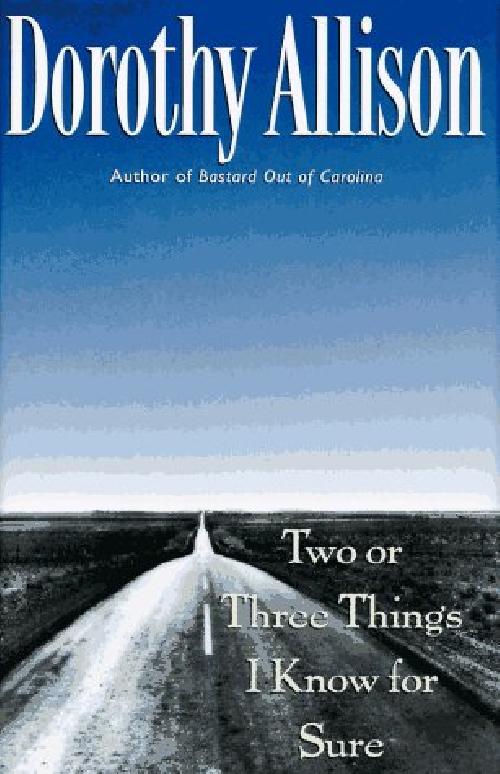
Two or Three Things I Know for Sure by Dorothy Allison

two-or-three-things-i-knowThis is a lovely, very brief but powerfully feeling memoir by the author of Bastard Out of Carolina, which I have not read.

It offers a look at the author’s life, and of the women in her extended family: chronological, but otherwise loosely attached to events, more musing and reflective than reportorial. Allison jumps in and out of time, so although events take place in chronological order, it’s not a straightforward start-to-finish narrative. She also includes family photos, and thus reminds me of Judith Kitchen’s Half in Shade. (This one came first.) Allison is concerned with the challenges these women have faced, and how they’ve handled them, with attention to place, culture, feminism and lesbianism; but family relationships are central. Her second-person address repeats “Let me tell you a story…” and weaves in the title line. This through-line provides another unifying tactic, like those I saw in essays by Van Eerden and McClanahan (here). Like Queen of the Fall (review coming up on Friday), Allison also offers some thoughts, and inspires some thinking, on women’s experiences and place in the world. Specifically in this book, that is the world of poverty-stricken Greenville, South Carolina.

At under 100 pages, this is a super-quick read; maybe too quick. I flashed through it in an evening and am left unsure of what I learned, although I enjoyed the experience. The good news is that a reread would be quick to do, too.


Rating: 7 quarter-miles.

The Pine Barrens by John McPhee

the-pine-barrensThe Pine Barrens came to my MFA reading list from my advisor Katie Fallon, and I can’t recall her justification, I just took it. It was a good tip. I’m a fan of McPhee now. I knew his name but don’t believe I’d read any of his work before.

I would call this a collection of related essays about the region of New Jersey called the Pine Barrens. I don’t known a ton about New Jersey, and had not heard of this place before. It’s a vast region in the southern part of the state that is thickly forested and very thinly populated; it is distinctive in climate, flora and fauna, and human culture, not very well known and subject to unfair stereotypes.* In these ways, it reminded me a little of the Driftless region I read about in this book, which is a less artful piece of literature than McPhee’s, but a similarly fascinating profile, I think. I am trying to say that peculiar places, especially when they come with peculiar peoples, are very interesting to me. (As much as I love nature, and nature writing, I admit to a weakness for people.) So, I enjoyed the subject of this book very much.

And also the writing. McPhee has certain qualities in common with Joseph Mitchell (see Up in the Old Hotel): neutral, journalistic, mostly absent from his own story. His descriptions are matter-of-fact and seemingly unadorned, although they are also often lovely images: they only seem straightforward. As a classmate of mine once said, easy-to-read writing that flows effortlessly is deceptively hard to write. He has an eye for just the right characterizing line of dialog:

“Horace’s mother and mine used to make their own yeast, too–out of potato water and hops. Modern women aren’t up to that.”

“They give you cold beans,” Horace Adams said.

Something about those cold beans really tickled me. Or this line:

He is about fifty, and he has a manner that suggests that he is not afraid to work and not afraid not to work.

The backwoods, simpler-times feel of the Pine Barrens and the pineys struck me somehow as… not bucolic, but pleasantly green and calm and quiet. McPhee felt for me like Mitchell but a little more foreign, because my personal experiences are a little closer to Mitchell’s urban setting than to this one. Both writers use language and sentences that feel simple rather than poetic or flowery, although both their language and their sentences are more complicated than they first appear. McPhee ties in research and outside sources with the immediate scenes he describes (visiting a piney cabin to ask for water, talking with its inhabitants) neatly; one flows into the other without much transition needed. It’s a smoothly flowing piece of narrative even though it covers a lot of ground.

I fear it is the work of some close reading indeed to figure out how to make such lovely work seem so effortless, but I’ll try.

In related news, thanks, Tassava, for sending me the link to this inteview with McPhee by The Paris Review. He sent it (unknowing) mere hours after I finished reading this, my first McPhee. It’s a great read – long, but juicy with gems, both funny lines and helpful thoughts for writers. What a joy.


Rating: 8 jugs.

*This book was first published in 1967, and my impression of the Pine Barrens is mostly based on this dated account. How remote and untouched is the region still today? I am not the one to say. Wikipedia calls it “largely undisturbed.” But there is also a website, www.njpinebarrens.com, which begs the question…

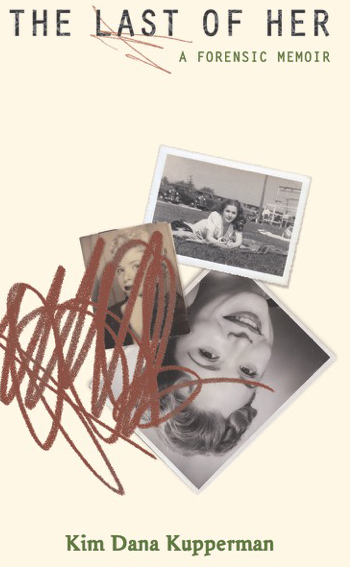
The Last of Her: A Forensic Memoir by Kim Dana Kupperman

Disclosure: Kim is a visiting faculty member in my MFA program, and one I’m looking forward to working with.


“Have a good life,” my mother wrote in March 1989, at the bottom of page four of her nineteen-page suicide letter.

This is a really good beginning, in that it certainly grabs my attention.

the-last-of-herThe Last of Her is Kim Dana Kupperman’s investigation into her mother: who she was, who she wasn’t, why she went.

This mother, Dolores, was a serial liar. She told many, many stories of her own personal history, leaving a real challenge for her only daughter in tracking that history. Kim was 29 when her mother killed herself, apparently to escape being busted for insurance fraud. It took some decades before she was ready to do the work that this book communicates: the research, the travel and the reconsidering of past crimes. Those are literal/legal crimes (Dolores was a junkie, a con artist, an identity thief, and apparently guilty though never convicted of assaulting a [pregnant] romantic rival with a hammer) as well as psychic ones, including mistreating and manipulating her daughter. The adult Kim eventually finds sympathy for this flawed and damaged woman, but it is quite an (understandable) journey to get there.

As a piece of creative nonfiction, The Last of Her is intriguing. The Preface deals heavily in birds, as Kim sketches the trauma of her mother’s suicide and then describes visiting the gravesites of family members she never knew. A few more birds season the rest of the story, although they do not end up playing as large a role as I expected. This lent a feeling, for me, of something larger and less knowable than human nature; not supernatural, but something of the mystery of the natural world, which is often absent (or mere scenery) in human stories.

This is also very much a memoir, not of Kim’s life or Dolores’s, or Kim’s memories of Dolores (although there is some of each), but of Kim’s study of her mother years after her death. In other words, this is the story of her research, including her reading of her father’s giant “Secret File” about Dolores and the custody battle she lost. I am drawn to this kind of story: the story of finding the story, that transparency. Kim’s tone keeps some distance, almost austerely observing the 20-something daughter to which this thing happened. It’s a remarkable piece of writing, on the sentence level (of course). I will also say that the chapter headings (quotations from a wide range of literature) quite baffle me; I need a guide to those.

This is a memoir about a sensational event that never approaches sensationalism, expertly crafted like a long poem, with precise emotional tone. A good study. Keep your eyes open as well for Kim’s (earlier) essay collection, I Just Lately Started Buying Wings, and the work of Welcome Table Press, where she is founding editor.


Rating: 7 phones hung up.

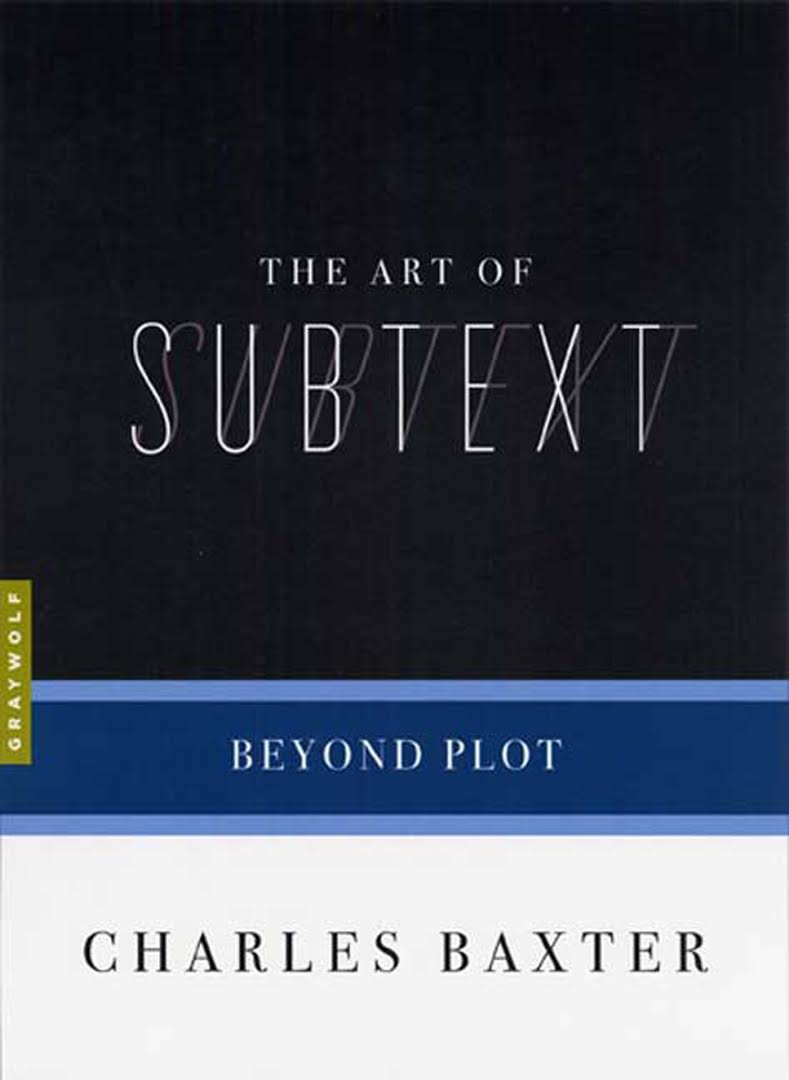
The Art of Subtext by Charles Baxter

the-art-of-subtextCharles Baxter is the editor of Graywolf Press’s The Art of series as well as the author of this installment. This is the second in the series that I’ve read (see The Art of History), and I’ll be reading two more this semester (Donald Revell’s The Art of Attention and Mary Karr’s The Art of Memoir).

The first thing to note about this book of writing craft advice is that it is strongly geared toward fiction. Where the others tend to cross genres (well, I suppose the Memoir one won’t), Baxter refers to fiction throughout, and takes his examples from the fiction of Dostoyevsky, Melville, Edward P. Jones and others. While this made for interesting reading, it did not suit my personal needs as a nonfiction writer very well. (I was disappointed, especially as excerpts from Baxter-edited The Business of Memory have appealed to me.) I was drawn to the topic of subtext because I aim for subtext, or subtle themes, in my own writing. Subtext means something a little different to Baxter in this book.

He calls it in his introduction “the unspoken soul-matter,” and divides his thoughts into 6 sections. “Staging” refers to dramatic placement of characters in scene (as in stage directions). “The subterranean” refers to the difference between what characters truly want, and what they say they want. This is an interesting concept to ponder for characters in nonfiction as well, although all of Baxter’s examples come from fiction. “Unheard melodies” inspects how fictional characters fail to pay attention: think about short attention spans and the way we “uh-huh” each other without really listening. This kind of ignored dialog, he argues, is a great place for subtext. “Inflections” and tonal shifts mark a movement from the literal to the suggestive; and he makes the point here that tone is sometimes everything. Example: the phrase “you’re really something” could be spoken in disgust or adulation. On the page, the reader needs tonal cues.

“Creating a scene” refers to the way that phrase is used in everyday life and not by writers: that is, not writing “a scene” (action taking place in time and space) but in the sense that arguing in public is called “making a scene.” Baxter asserts that fiction writers must have their characters make scenes in order to get their conflicts out into the open, or in other words, to pose the central conflict of their plot. Finally, he writes about “loss of face,” or the use (or choice not to use) characters’ literal faces to communicate through gesture or appearance. He makes a curious argument that the description of faces has fallen away in modern fiction writing, which is another interesting claim to investigate, although not one I’m particularly invested in at this time. (Please report back.)

My single favorite line of this book, and one I can easily take into my own work:

In truly wonderful writing, the author pays close attention to inattentiveness, in all its forms.

That one I will carry forward and ponder. Within it there may be an opportunity to ponder the differences (for craft purposes) between fiction and nonfiction in general.

In short, an involving little book of lit crit focusing on fiction, and thus not outside my interests; but not terribly useful for my own writing. Your mileage may vary.


Rating: 6 Chekhov stories.