“A Sketch of the Past” by Virginia Woolf

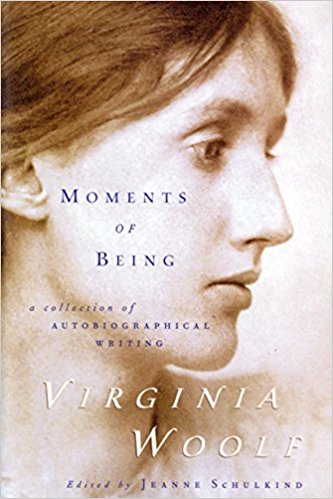
This essay, which I read from the collection Moments of Being, consists of nearly 100 pages of Woolf’s recollections of childhood, recorded journal-entry-style in 1939-40. It introduces Woolf’s concept of “moments of being” and of “non-being,” the latter being the cotton wool in between the important stuff of life/memory. Interesting for organization (or lack thereof); for the layering of time, then and now; and for Woolf’s list-making. It was also unfinished at the time of her death, and somewhat lacking in narrative structure. The editors of this collection make some points about it not being up to VW’s standards for publication, but as this is the first I’ve read of her work, I can’t comment on how not-up-to-standards I find it.

“A Sketch of the Past” is a series of memories of Woolf’s childhood, related when the author is nearly sixty. She begins by worrying over the format of these memoirs, then throwing up her hands to begin with “the first memory.” The form ends up being a sort of journal, with dated entries and a few comments on current events (the coming war). This layered-time effect allows commentary on both the past and the writing-present.

Woolf’s “moments of being” stand in contrast to what she calls “moments of non-being.” I understand these to be the memorable or remembered moments versus those not remembered, or not memorable–which are not necessarily the same thing. Woolf asks, “Why have I forgotten so many things that must have been, one would have thought, more memorable than what I do remember? … Often… I have been baffled by this same problem; that is, how to describe what I call in my private shorthand — ‘non-being.’ Every day includes much more non-being than being.” She likens non-being to cotton wool, or the everyday padding of what is remembered (or, what she wants to write about). She then goes on to call her moments of being “scaffolding in the background” of the real work of her storytelling: these are people, or characters. (The idea of moments of being, or characters, as the central work of storytelling is another concept for potential annotation.) “A Sketch of the Past” proceeds to study characters: Woolf’s mother, father, and a few siblings.

For school, I wrote an annotation on Woolf’s list-making. Several lengthy lists help to accrue either scenes, descriptions or themes in Woolf’s remembering. Certainly, details are part of how she enlivens her storytelling (the flowers on the mother’s dress and the yellow blinds in the nursery, both on the essay’s first page). Sometimes it is the solitary nature of a detail that gives it its power, as with Mr Wolstenholme, who “when he ate plum tart he spurted the juice through his nose so that it made a purple stain on his grey moustache”–it is the nature of this man that “he had only one characteristic,” she says, even as she names others. This cue to the singularity of this detail, along with its vibrant colors and specificity, strengthens it. But when such details are presented in list form, I find them compelling in new ways, greater than the sum of the listed parts.

At the sentence and paragraph level (or list level!) I found things to admire here. But a somewhat archaic style and lack of narrative arc, a certain rambling quality, made this essay hard for me to engage with. I’m not especially excited about this author, lauded though she be.

Final verdict? I am new to Woolf but at this point I find her inarguably skilled, but not terribly to my tastes at present.


Rating: 6 anemones.

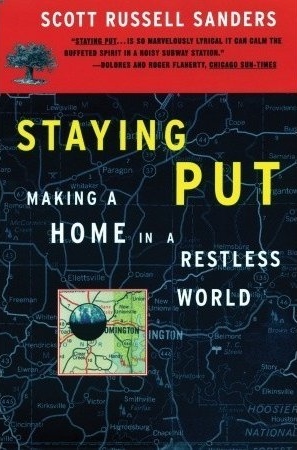
guest review: Staying Put by Scott Russell Sanders, from Pops

Here’s Pops (with a few of my comments throughout).

I recently finished this one, convinced by the title itself as well as your suggestion. In a voice familiar from your description in reviewing Writing From the Center (published just after this book), this is a collection of eight essays evoking the title’s theme, but linked by very personal stories grounded in Midwest roots in two linked places: his Northeast Ohio childhood & southern Indiana adulthood. Narrative lines here intertwine with those in essays published elsewhere, including “Buckeye.”

Generally your observations from Writing, tinged with ambivalence, apply here: variation in pacing & appeal; often intimate & reflective, sometimes tryingly so; repetitive, yet often just overlapping in thought; little here is profound, yet much resonates; and yes, a few essays stand out among the others. Why such disquiet in reading Sanders? Here’s one idea: he writes, with virtually no filters, of deeply personal thoughts & feelings; every detail cannot be as primary to me as it is to him. To glean from what he offers, one need be patient, appreciate such candor & courage, and have an affinity for his life’s odyssey. In the end, he won me over.

His book’s theme of committing heart & soul to a deeply-known place is familiar: Gary Snyder often used the title’s very words (though not mentioned as such by Sanders.) Wendell Berry has invoked Snyder’s words while advising, “stop somewhere, just stop.” Both writers’ sentiments are mentioned in these essays by other references. Stegner’s framing of “boomers & stickers” lurks in the background as I read here. Similarly, surely, for many other writers; Sanders savors recruiting a good number to his cause.

I want to comment briefly on four of these eight essays by reference first to a recent Sanders book. Earth Works (2012) is another gathering of selected essays; in that, it is more like Writing than the theme-based Staying Put, but with many more essays than Writing, of course spanning more of his life’s work. I will be seeking out this latest collection next. I find the essay form fits Sanders well; and a reader can take one at a time, at whatever pace necessary – a good way to digest Sanders.

I had noted two essays in Staying Put that I particularly liked; if I were to stretch that to four, it would match the same four selected in Earth Works (credit to me? or the editor? or both?).

You’re saying, I think, that four were selected from Staying for inclusion in Earth? And that they’re your favorite four from this collection?

In my list, “After the Flood” first stands out for its poignant child’s-eye witnessing of environmental tragedy, one of many life events that recur in his writings due to their persistent impact.

“Settling Down” (which is curiously – and appropriately – re-titled “Staying Put” in the collection) is where he explicitly expounds on the book’s theme, with consideration from multiple perspectives and assistance from those other noted writers.

“Wayland” is a wonderful survey of seven important boyhood lessons, each elicited by a specific physical childhood place as he visits each in adulthood, on a single walk and all within a quarter mile radius. (Teaser, but not spoiler, the seven lessons are: death, life, beasts, food, mind, sex & God.)

“House and Home” is a literal interpretation of the formulation place=home=house, as he describes connections to his house: physical, organic, spiritual, familial. For many, this would seem superficial, overly materialistic; he makes it quite something otherwise.

In contrast, my sentiments lean more towards a fifth essay, “The Force of Moving Water.” On a grand scale, he considers the physical place defined by the Ohio River watershed, which encompasses and connects his heritage in both Ohio & Indiana. (It also includes WV Wesleyan College, on the Buckhannon River, tributary of the Monongahela River, which feeds the Ohio.)

I am delighted to know that WVWC makes an appearance in this collection!

This essay suggests (confirmed so far in my reading of Sanders here & elsewhere) his persistence in using water as metaphor as well as essential element in knowing any place. Whether implicit or oblique, water, streams, watersheds arise for him in many contexts.

This doesn’t surprise me, Pops, given what I think is your special interest in watersheds generally.

I particularly appreciate his thorough study of the Ohio watershed, this recognition of understanding watershed as a vital dimension of “wide & deep” consideration of place. And it is a splendid demonstration of Sanders’ seriousness meditating on place, from myriad vantage points.

The other three Staying Put essays are: “Earth’s Body,” wherein he cogitates on his tortured obsession with both God and relentless bouts of depression. “Ground Notes,” which borders too closely on old-school “what is reality” rumination. “Telling the Holy” is a useful consideration of the power of stories, myth, religion; spiritual, primordial & necessary. (I should probably read that one again.)

Is he a “nature writer”? In the preface to Earth Works he provides a helpful answer:

I am sometimes asked if I am a “nature” writer, as if paying attention to our membership in the web of life were a specialized interest, like following sports or fashion or cuisine. What I am is an Earth writer: I’m interested in life on this planet—all life. Since I know most about my own species, I think mostly about human affairs, but I do so while seeking to understand how our kind arises from and affects the living world.

Sanders has numerous essays in Orion magazine; several are available online here; I read three of them:

“Stillness” – absorbed in self again: a wide-ranging tussle with privilege, conscience, God, spirituality, human scourge, family; emerging with optimism.

“Mind in the Forest” (also in Earth Works) – a writing retreat meditating in an Oregon old-growth research forest.

“Breaking the Spell of Money” – a largely predictable, thoroughly moral argument against capitalism from a well-meaning artist, self-declared “not an economist.” Enough said?

These last two essays convince me I like the younger, self-absorbed Sanders; the elder, in presuming to analyze the world for causes & solutions (especially economics!), disappoints too much.

Thanks, Pops, for as always a thoughtful and very thorough critique. I would like to read this one someday, although I don’t know if this is the semester. Your comments about the essay form are well taken–that some of us are suited to one format over another. He is maybe best suited to the essay, and best taken this way, too!

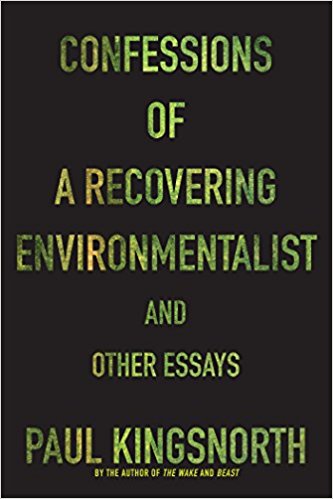
Confessions of a Recovering Environmentalist and Other Essays by Paul Kingsnorth

This disillusioned environmentalist’s thoughtful, poetic call to a different approach to action and way of thinking is both sobering and refreshing.


Paul Kingsnorth (The Wake; Beast), co-founder of the Dark Mountain Project writers’ network, has published impassioned essays, poetry and literature with an environmentalist perspective for decades. That perspective is changing, however, as environmental degradation continues and the green movement tends toward high-tech strategies and “sustainability” that Kingsnorth finds uninspired. Confessions of a Recovering Environmentalist and Other Essays is his answer to a changing world. These collected works are nearly all previously published, but together they offer a new outlook. Kingsnorth is grieving, angry and disillusioned, and his essays are by turns reflective and resolute.

“The story winding itself through this book is the breaking of the link between people and places, between the past and the present, between instinct and reason, and all the consequences that have ensued and will ensue.” As a writer, Kingsnorth is concerned with the ability of stories to change how we live, and with the ability to change our stories. “We imagine what it would be like to be this character, to live in this time, to be in this situation, and if we can’t do that well, our books won’t work. If we can do that well, why can’t we make the same imaginative leap and take ourselves out of our humanity?” One theme is a need for humans to see themselves as a single part of a larger system, rather than the controlling or most important factor. “The very fact that we have a word for ‘nature’ is evidence that we do not regard ourselves as part of it,” but, Kingsnorth argues, we should.

His writing can be fanciful and joyous as well as tormented. Kingsnorth writes with undeniable love: for the planet, for locations and histories, and for people. Confessions is centered in his native England but voices global concerns. Essays handle the role of technology in culture; the importance of people’s ties to place; the difficulty of embracing immigration and immigrants without losing local cultures; and the reasons for the decline of the environmental movement. While Kingsnorth writes with persuasive logic and authority on a variety of topics, he is perhaps most lyrically impressive when rooted in the local, physical world, for example when scything his hayfields in rural Ireland, or searching for carved green men in ancient Norman churches. Given his passion for place, this is unsurprising.

Neatly organized into three sections–Collapse, Withdrawal and Connection–and with an informing introduction and call-to-action epilogue, this collection serves well as an introduction to Kingsnorth’s philosophy and writing style. It also allows his more seasoned readers to chart his changing views. The overall effect is necessarily grim, but often remarkably uplifting as well. In a world on the brink of collapse, Kingsnorth offers humor, compassion, humility and wisdom.


This review originally ran in the June 30, 2017 issue of Shelf Awareness for the Book Trade. To subscribe, click here.


Rating: 8 bison.

Maximum Shelf: Empire Made: My Search for an Outlaw Uncle Who Vanished in British India by Kief Hillsbery

Maximum Shelf is the weekly Shelf Awareness feature focusing on an upcoming title we love and believe will be a great handselling opportunity for booksellers everywhere. The features are written by our editors and reviewers and the publisher has helped support the issue.

This review was published by Shelf Awareness on June 22, 2017.


Kief Hillsbery grew up with the legend of his great-grandfather’s great-uncle Nigel, who had “gone out to India” and never returned to his family’s home in Coventry, England. According to the many stories, he’d left the British East India Company abruptly and gone to live in Kathmandu; he’d been killed by a tiger; he’d been involved with shady dealings regarding a famous diamond. From childhood, Hillsbery always had “a clear sense that [the family] disapproved of Nigel and the vague notion that there was more to his story.”

In Empire Made: My Search for an Outlaw Uncle Who Vanished in British India, Hillsbery describes his decades-long, on-and-off exploration into Nigel’s life and death. It is an absorbing story, told with an eye for suspense and the odd, engrossing detail. Nigel’s story does not lack for weird and glittery hints; it takes a deft hand to explore them with interest and not sensationalism, but Hillsbery is up to the task. His lovely descriptions bring to life a country that is worlds of difference from Nigel’s English home. Sagar Island offers “houses like palaces, rising in their shining stucco masses from flowerbeds filled with imported English blooms on the undulating riverbank, their verandas spacious, their pillars lofty, their profiles Athenian.” Hillsbery is astonished to find a rhododendron forest just where his family’s stories placed one. “India,” he writes, “is full of surprises.”

Nigel set out for Calcutta in 1841 as a 20-year-old clerk for the East India Company. In 1975, Hillsbery was himself 20, headed for a college year abroad in Nepal, when his mother gifted him a sheaf of papers: all that remained of Uncle Nigel’s letters home, most incomplete and in various stages of decay. She wanted her son to be the first in the family to track down Nigel’s grave and pay his respects. The young man figured he would visit a cemetery or two and do his duty. But in fact he would embark upon years of research and travel through India, Pakistan, Afghanistan and Nepal.

Alternating chapters detail the author’s own travels and Nigel’s, the latter re-created using personal correspondence and official records from the 1840s. Necessarily, Empire Made also delves into British and Indian politics, and the nuanced racial and class-based prejudices and pressures that characterized the British East India Company for centuries. The background history that contextualizes this story can be convoluted, but Hillsbery wrestles this “historical quicksand” gamely, and his digressions enrich the sense of strange wonderment that characterizes this historical investigation. Readers will come away with a general sense of British-Indian relations, while focusing on the mystery of Nigel’s fate.

Hillsbery’s narrative neatly braids the threads of the two protagonists’ parallel travels. Nigel Halleck’s family background and education links into the narrator’s interest in mountaineering, and in Nepalese culture and language. With a distant idea about the enigma of a lost great-uncle, the young Hillsbery takes one and then another detour from his own travels to investigate a cemetery, a shrine, a memorial. He listens to the tales told by locals “with Chaucerian relish” of past visitors, and he learns to check Nigel’s letters as he travels, searching for references to each stop along his own way so that he can follow leads as they arise. This research on the move begins to yield new information, if only in hints.

Over the years and miles, Hillsbery uncovers a theory that Nigel was a deep-cover British secret agent; that he was connected to an important family, the Saddozais, by his close friendship with the Afghan prince Sa’adat ul-Mulk; that he was involved in some under-the-table dealings with the famous Koh-i-noor diamond. But beyond these dramatic stories, Hillsbery finds quieter details that link his own life story more closely to Nigel’s than he could have ever expected.

Empire Made nears its end when Hillsbery visits a seeress. Stumped by Nigel’s unexplained movements and his inexplicable retreat to a Hindu palace in Kathmandu, he submits to a friend’s recommendation to supernatural assistance: “Her rates were reasonable, and I could always write about it.” This woman’s cryptic statements, and Hillsbery’s later realizations about two pieces of information he’d uncovered, eventually help him to reach certain conclusions about Nigel’s life. These conclusions are not supernatural, but worldly. In the end, this epic story of travel, research, family mystery and centuries-long colonial effort ends with uncertainty; but Hillsbery’s voice in closing does find satisfaction in what he’s learned.


Rating: 7 rhododendrons.

Come back Friday for my interview with Kief Hillsbery.

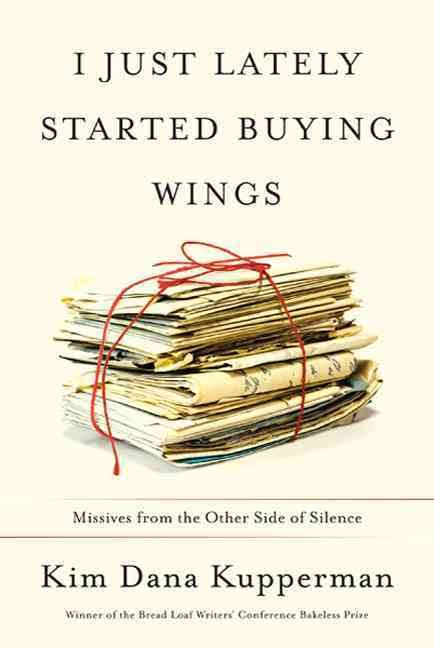
I Just Lately Started Buying Wings: Missives from the Other Side of Silence by Kim Dana Kupperman

Where I recall feeling both impressed and flummoxed by The Last of Her, this earlier essay collection feels more accessible to me. The Last of Her is a story about Kim’s mother (or about Kim’s investigating her mother), a single cohesive storyline – not that there aren’t other storylines as well! But I Just Lately Started Buying Wings is a collection that ranges widely in subject. Allowing each essay to tackle its own beast has a different result. Somehow I felt more comfortable with this book, more like I was able to grasp the whole. All of this sounds more like a criticism of The Last of Her than I want it to be; I enjoyed reading that book and am wowed by the writing and the organization within; it’s just that I didn’t finish feeling like I understood everything that went on. I enjoyed both reading experiences, but felt more settled, contained within this one. I wonder if reading them in the order they were published – this one first – would have helped.

I Just Lately Started Buying Wings is a lovely series of meditations. I want to call it comforting, which is a strange adjective to choose, since many of its subjects are uncomfortable or painful ones: deaths of family members, romantic and marital strife, domestic violence, nuclear fallout (literally), personal uncertainties. But Kim Kupperman’s approach to these is so easy to relate to, so honest and open, and so thoughtful. She made me feel supported as (I felt) we entered these tough places together.

I read the title essay, a very short one at just two pages, a year or so ago, when I was considering attending WVWC’s MFA program. (One of the toughest pieces of advice I got in considering programs was to read the work of faculty members. If each program has an average of 8 faculty and they’ve published an average of 3 books each, and I’m starting with a long list of 15 schools, I’m supposed to read 360 books? So a nice short essay here and there…) It stuck with me. First, the lovely title, “I Just Lately Started Buying Wings”… it has such a dreamy sound, so many figurative possibilities; but it turns out it’s a direct quotation, spoken by a woman applying the prosaic, literal meaning. She’s just recently started buying chicken wings; she used to stick to breasts and short thighs. This turn, from lyric to literal, is the kind of surprise I savor.

Not that the symbolic wing is ignored, though. In this collection, I found that wings were a major theme: “Wings over Moscow,” most obviously, deals with a number of wings (airplanes, birds), but other essays as well see dropped wings, grounded airplanes, a father compared to Daedalus, “the maker of wings.” In the closing essay, Kim’s mother leaves secret treasures for her young daughter to discover: a list of these items includes a moth wing, and a blackbird feather. Secrets or silence (as in the subtitle) form another leitmotif. Likewise the body, meaning the physical: Kim’s own, and the bodies of three immediate family members (mother, father, brother) she cared for after death. Lovers, and the women and children she tries to help at a shelter for victims of domestic violence. When she seeks her grandmother’s mysterious personal history,

I sense in this silence my grandmother’s decision to sever herself from a body politic she adored but could not bear. Perhaps it is from her that I inherited this yearning to return, which might explain why, when she died, I wanted so badly to go back to her homeland. I was coming into my body–breasts budding, hips widening–as her physical familiarity and its comfort ceased to exist.

Note the two different uses of ‘body,’ and think about the meanings of ‘bear,’ as in the “body politic she adored but could not bear”: think about a woman bearing children, which this grandmother did, by definition.

This kind of recurring theme or image defines the book as a whole, as well as nearly every individual essay. This is the kind of trick I am strongly drawn to (I’m remembering Eula Biss’s Notes from No Man’s Land). There is much to praise here, in sentence-level writing, as Kim shifts from the starkly sensual to the lyrical and back again. She has a razor-sharp eye for detail, an uncanny gift for noticing and recalling the physical world, something I’m not so great at. But what I’m most excited about, most wonder at, is the tying together of theme and image within and across essays. It never feels forced: these are the things that make sense together, and also they match.

Kim Kupperman clearly has several strengths. I think she must see the essay form as flexible and beautiful and serious. She observes the world with great attention. She is thoughtful, and opens herself to criticism (for example in the hospital scene when her father is dying and his survivors are fighting). She has an ear for language and an eye for parallels. I can’t wait to get to know her better: her writing, her editing (I’m looking forward to her small press’s anthology You), and hopefully her teaching.


Rating: 9 segments of orange.

reread: The Liars’ Club by Mary Karr

Shortened version: it was excellent and moving, again. (Original review here.)

I will repeat myself (from Wednesday’s review of The Art of Memoir) that one of Mary Karr’s greatest strengths is her voice. Her personality sings or laughs or screams off the page, vernacular and colorful, wise and confused, approachable and authentic and believable. Her story is wild. If it weren’t told in such convincing fashion and with such human wonder by its narrator–in other words, if I tried to tell you here about some of the things that happened to young Mary, less artfully–you wouldn’t believe it. But in this memoir, you do.

Karr grew up in a little east Texas coastal refinery town (here under a fictional name), with a short spell spent in Colorado. Her family was troubled, and gave the neighbors some entertainment (or opportunity for self-righteous head-shaking). But this is not a simple story of hardship and woe. The Karrs are also fiercely loving and loyal, with a capacity for humor. Karr’s narrative voice seeks answers and knows how to criticize, but she loves her flawed people; she’s not out to get them. (This is one of the key tips of The Art of Memoir: write out of love, not hate. Additionally, though this sounds even harder, “as Hubert Selby told Jerry Stahl, ‘If you’re writing about somebody you hate, do it with great love.'”)

From a craft perspective, I suppose I will start by examining the rich inner world Karr relates here, as for example on pages 148-157. In this eventful chapter, Karr’s mother creates a massive bonfire of most of her children’s–that is, Mary and her sister’s–belongings, before threatening their lives with a butcher knife. This scene is described in great detail, meticulously, so that it takes pages for moments to pass. Alongside the scene we get little Mary’s coping mechanism: her imagination supplying parallel events to explain or counter those she is witnessing. There is a backwards-looking perspective provided by the adult Mary writing these lines, but also much of young Mary’s real-time daydreaming. There are flashbacks. It’s an extraordinary sequence, and she uses a similar strategy elsewhere, in other such horrifying, dramatic, traumatic scenes. I know one reader who finds the lengthy, meticulous description of trauma difficult; but I think it’s actually a remarkable way to put us in the scene, as well as paint the child’s surreal experience. (Also, it’s difficult. But there is no way to read about rape that is not difficult. It should be difficult.)

My remarks here just scratch the surface of what The Liars’ Club has to offer. I’m a little confounded by the reviewers who didn’t love this memoir. The “best” criticism I saw was by a reader who believes that memoirs should teach a high moral lesson or reveal an important, famous person’s life. This book perhaps does neither, but I disagree with the premise; and so, thankfully, does Mary Karr.


Rating: 8 electric can openers.

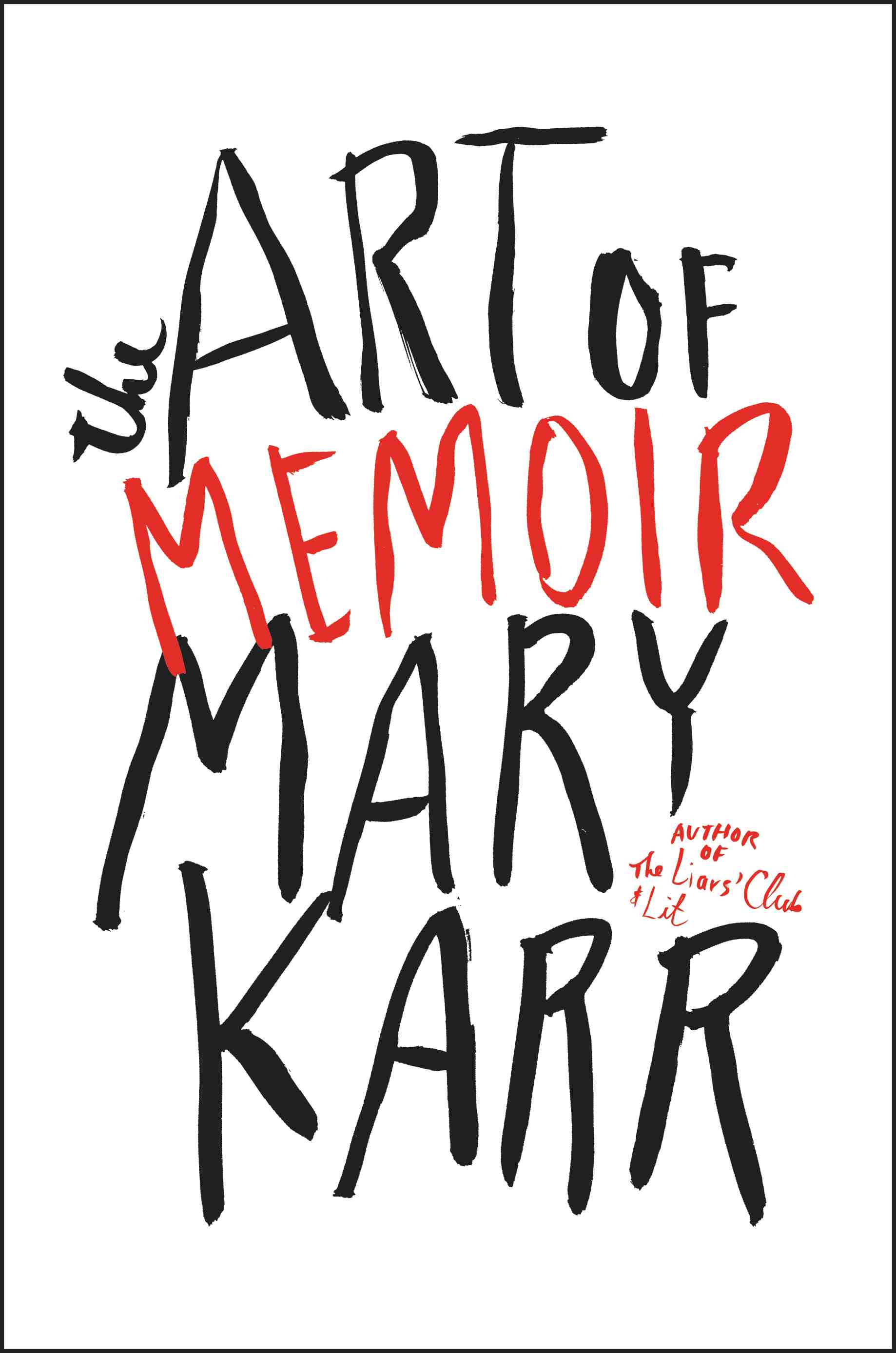
The Art of Memoir by Mary Karr

Another gem from Mary Karr. As a craft book, this one has it all (that is, all the things I like): a friendly, approachable, authentic-feeling voice; lots of references to other books with succinct, clear commentary; a balance between practical advice, appreciation, and commiseration; a humble, self-deprecating approach from a well-respected author. Also, I just really like Mary Karr.* Her on-the-page personality comes through so clearly and feels so much like someone I’d like to know. (Our hometowns, though very different, are less than 100 miles apart. My affinity for place makes me wonder how much this contributes to my feeling of kinship.)

The Art of Memoir is just over 200 pages long, including a 6-page, densely-packed reading list* (always exciting, and intimidating!). It begins with Karr’s “Caveat Emptor,” a disclaimer in which she writes, “no one elected me the boss of memoir.” One of the recurring concepts in this book is Karr’s reluctance to take up the mantle of expert; but she does acknowledge her “fifty-plus years of reading every memoir I could track down and thirty teaching the best one (plus getting paid to bang out three)”. She then takes us through a study of some of her favorite memoirists–Nabokov, Harry Crews, Maxine Hong Kingston, Kathryn Harrison, Michael Herr–and, with apologies (“if I didn’t have to pay out the wazoo to quote from better books than my own, I’d have way more Nabokov in here”), her own work. She offers chapters with titles like “Why Not to Write a Memoir” and “How to Choose a Detail,” and focuses on carnality (“sensory impressions, not sexual ones”), lies, individual talents, how to deal with loved ones, blind spots and false selves, exaggeration, and so much more. Unsurprisingly, she places early and heavy significance on the subject of voice, and there may be no writer more qualified. It’s one of the things Karr does best, in my opinion.

Perhaps for that reason, I was especially charmed at what she had to say about Harry Crews’ A Childhood: The Biography of a Place:

At the time I came across A Childhood, I was an academically uncredentialed former redneck Texan trying to pass myself off as a poet in hyperliterary Cambridge. Crews had lost time trying to hide his own cracker past, and then he’d written about that milieu in a book that would serve as my lodestar. How good it is, I can no longer gauge. But it helped to guide me out from my biggest psychological hidey-holes. Reading Crews, I found the courage to tell the stories I’d been amassing my whole life. I include so much of him here to underscore how mysterious a single influence can be if he shares a novice’s foibles. Were I a tattoo-getting individual, I’d owe him some fleshly real estate.

That kind of enthusiasm is catching, of course, and I was convinced to go straight to Crews; in fact, I had to put this book down to read that one (for reasons of school schedules). In case you missed my review of that book, here it is. And directly after, I turned back to Karr for a reread of The Liars’ Club. (Fresh review coming up on Friday.) I have yet to find my way to her acclaimed memoirs Cherry and Lit, but I think they’ll be on the list.

Like the best craft books, this one makes good reading in itself.* It’s not a manual. Karr’s personality on the page is worth spending time with, and she makes the appreciation of good writing more accessible. She writes for general readers (and warns them, when things are about to get technical, that they might skip the next few pages). There are also passages specifically for writers: a list of “old-school technologies for the stalled novice,” for example, that does not rely on writing exercises. In short: there is much to love here. Not least, Mary Karr herself.


Rating: 8 inner enemies.

*These are all things I could have written about Stephen King’s On Writing as well, and they would have been equally true. It’s no coincidence that I enjoyed both of these books. If you like one, do go find the other.

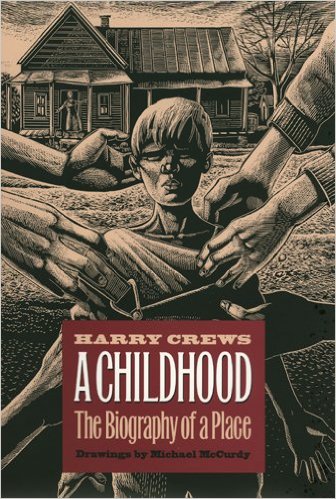
A Childhood: The Biography of a Place by Harry Crews

I’ve been hearing about this one for years, I think first in South Toward Home. While it was already on my semester reading list, I was prompted to put it next in line when I read in Mary Karr’s The Art of Memoir: “[A Childhood] is underrated–virtually unknown–except among the aficionados of the form.” So there. (My reading of The Art of Memoir was interrupted, so its review will follow this one. Preview: I like it.)

This is a memoir of a very short period, when the author is five and six years old, with just a few oblique references to his later life. During these two years, the child Crews becomes aware of himself in the world; he suffers serious injury and illness; his mother leaves his ‘father’ with her two sons, and after a few reunions, splits from him forever; and Crews learns that this was not his biological father, but the brother of that man, who is dead. In his reflections, what motivates the writing of this book is that Crews is haunted by the absence of his late biological father, and by a lack of ties to his home place of rural Georgia.

Both story and prose are tough, muscular, macho, unadorned, laden with violence and hardship; there are lovely lines concealed within, but Crews is most concerned with chronicling his scars. It is a raw and affecting book, and attempting a ‘biography of a place’ through a memoir of just two years is an intriguing strategy. I am fascinated by this idea, that two years of a child’s life can serve to profile a place.

I really appreciate Crews’s voice. This element (combined, obviously, with place and class) reminded me again and again of Rick Bragg. Bragg’s The Prince of Frogtown is on my reading list this semester as well; I hope I get to it in time. Of course I was also drawn (as with Sanders) to Crews’s preoccupation with place, where he’s from and what that means. Another kindred in this way, although his style (and the story he has to tell) differs greatly from my own. Crews is another author that plays with a fluid ‘truth’, which Mary Karr commented on as well: she forgives this favorite memoir because the more imaginative sections are obvious enough to pick out. Those are some of the sensational bits. But really, Crews lets his story stand for itself. His childhood will read as shocking to some of us; but it also reads as very real.


Rating: 8 slisures of grapefruit.

The Mighty Franks by Michael Frank

This memoir of family wounds and favoritism charts dark territory as the author searches for understanding.

the-mighty-franks

“‘My feeling for Mike is something out of the ordinary,’ I overhear my aunt say to my mother one day when I am eight years old… ‘I wish he were mine.'”

Michael Frank comes from an especially close-knit family: his mother’s brother married his father’s sister. He is devoted to his doubly related Aunt Hankie and Uncle Irving. The elder couple is childless, and so they “share” the younger couple’s three sons, of whom Mike is the eldest. The two households are neighbors in Laurel Canyon, in the Hollywood Hills. Both grandmothers live together at the foot of the canyon. It is all very cozy: Aunt Hankie calls them “the larky sevensome,” or “the Mighty Franks.”

And Mike is the luckiest, larkiest one of all, because he is Aunt Hank’s pet. They spend their free time together. She takes him antiquing, and sets out to teach him everything she knows. Hank (a nickname for Harriet) and Irving are successful Hollywood screenwriters, and they have the finest taste in architecture, art, literature, movies, music (nothing after Brahms) and manners. Hank has an overwhelming personality and strong opinions, and when she says that Mike has the eye, the artistic eye for the creative pursuits she prizes above all, he is naturally proud–and motivated.

The Mighty Franks is Michael Frank’s memoir of the relationship he shared with his forceful aunt. While he is favored, his two younger brothers are mostly ignored (Hank sniffs that one has the makings of a scientist, the other, an athlete). He is the modelling clay she plays with, until he begins to awaken to a world larger than Aunt Hank, and forms his own opinions and tastes. She sees this as rebellion, ingratitude or worse. As Mike grows up, Hank seems to break down and the Mighty Franks begin to fissure.

Frank moves between the child’s perspective of events as they unfold and a place of reflection. In writing this story, he seeks a better understanding of his aunt, the imperfect workings of his extended family and his own relationships within and outside it. Hank is firm about hierarchies: the Renaissance over the Middle Ages, Faulkner over Hemingway, Fred over Ginger, early Fellini over late. Similarly: Hank over her younger brother, both of them over their spouses, Mike over his brothers. And always Hank first.

The Mighty Franks is an immediate, gut-wrenching account of events that are often painful for young Mike. While not an easy story to take in, Frank’s ruminations offer some necessary distance. His tone is serious and his prose occasionally verbose, but the saga of this flawed family is deeply involving. Any hint of sensationalism is more than balanced by the psychological insights Frank eventually achieves.


This review originally ran in the April 11, 2017 issue of Shelf Awareness for the Book Trade. To subscribe, click here.


Rating: 6 period pieces.

The Chronology of Water by Lidia Yuknavitch

I gulped down The Chronology of Water like I was drunk on it.

This extraordinary memoir, fragmented and unchronological, charts the life of a former competitive swimmer who experienced many traumas: addiction, abuse, loss of a child, failed relationships, deaths. Water is the overarching metaphor, and references to water, swimming, drowning, and wetness are everywhere. Other recurring images or themes include twins/twinning, fire, hair, death, and sexuality. (Much sex.)

While Yuknavitch’s story is filled with headline-level events and excitements, her prose is every bit as compelling: poetic, rich with imagery and metaphor, but also often swinging back to a very conversational tone. Although the events of her story are terribly tragic, she offers hope, without ending with trite redemption. And she keeps her reader rapt.

As a student, I found this work interesting for both sentence-level prose style and overall organization. I made careful note of where the water/wet references and language sprang up: in fact, I highlighted all such words and phrases, making this the first book I’ve marked up since somebody last made me, in high school. Very few pages went without highlighting, and it was interesting to see where the page really lit up, and where it didn’t. I was also interested in how she uses neologisms, anthimeria and repetition to express a sense of wonder, discovery, and otherworldliness. These moods suit her subjects, for example, drug-induced states, sexual discovery, and extreme grief.

I don’t want to say too much. This is a startling work, and you should dip into it yourself.


Rating: 9 less than merry pranksters.