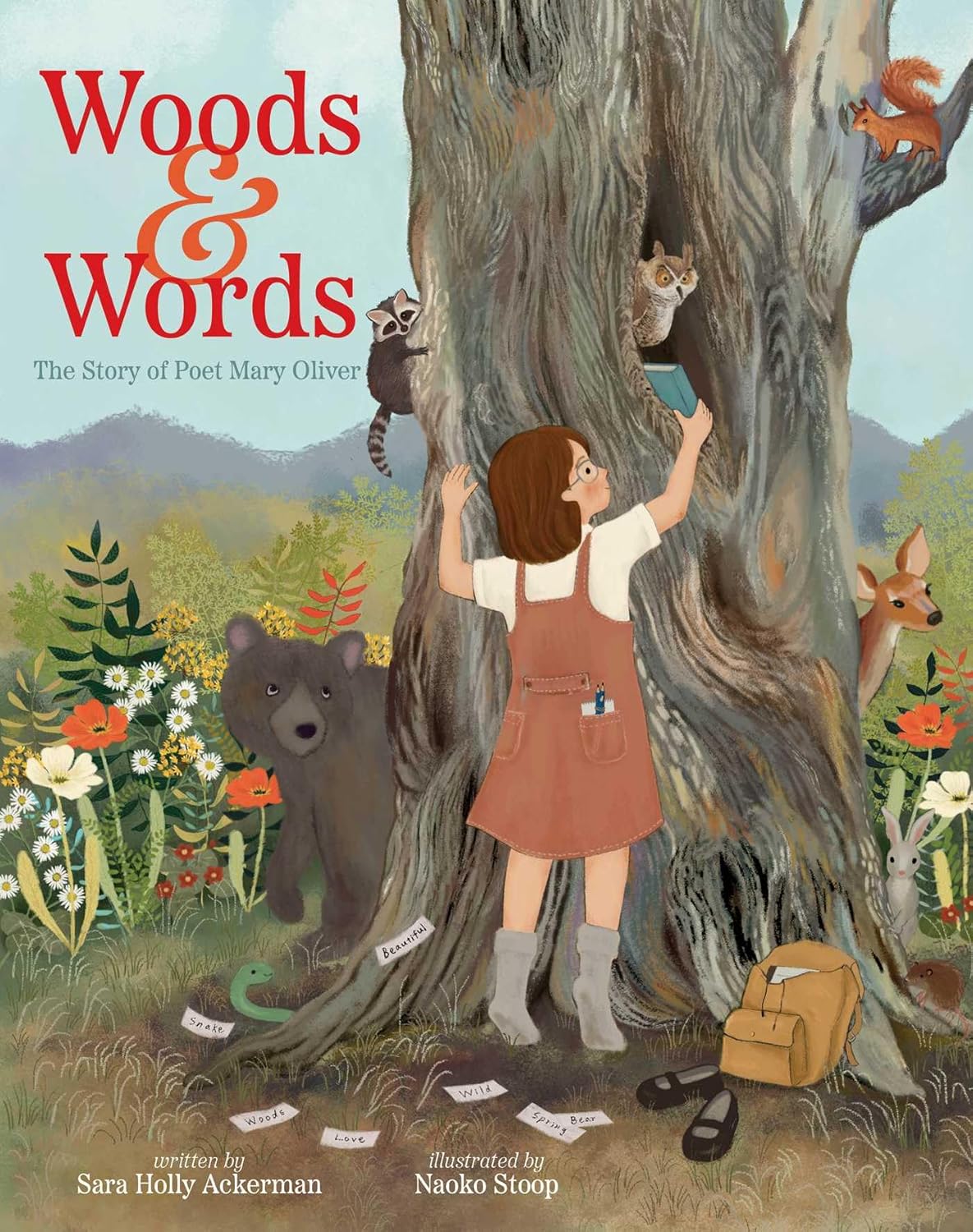
Woods & Words: The Story of Poet Mary Oliver by Sara Holly Ackerman, illus. by Naoko Stoop

I was sold on this book by my Shelf Awareness colleague’s review. I purchased it for some young friends who I think will enjoy it, but that was partly a reason to enjoy it myself first, before I passed it on.

This is a beautiful book, in its simple storytelling, its lovely sentiments and the values it communicates, and in the charming illustrations, full of plants and animals and sweetly expressive human faces. Rated for ages 4-8, it took only a few minutes to page through once, but will reward multiple and slower readings. I liked looking for the critters tucked away in the illustrations’ crevices, and reading through the words that trip and twist across the pages (outside of the narrative). I love that this story, which can be appreciated for its own sake, also introduces young readers to the life of Mary Oliver, an artist for whom mainstream “success” was not guaranteed. The Author’s Note notes that Mary Oliver’s home life, as a child, was “difficult.” She was a woman, she was queer, and she wrote poems that were defiantly “plain,” diverging from a tradition that makes poems less accessible to us regular people. This is what we love her for; but it presented some barriers in her acceptance by critics.

So, a beautifully rendered illustrated children’s book bringing the life of a great American poet to young people. An utter joy to read and look at, much like Oliver’s poetry. Strongly recommend for the kids in your life, and you will enjoy sharing it with them. More of this, please.


Rating: 9 shingles.

rerun: The Wet Engine: Exploring the Mad Wild Miracle of the Heart by Brian Doyle

I was going to tell you that I’ve been thinking about Brian Doyle lately, but I think that’s always so.

I do think about this essay collection a lot.

Please enjoy this review originally from late 2020 (book published in 2005).

I am back again with another Doyle, different this time but totally recognizably him.

Here are the classic Doyle elements of celebration and beauty, but amid so much pain and loss… and I have to admit, the loss of Doyle himself felt very present for me here. I continue to feel it as a significant loss to this world, both because we will get no more of his transcendent writing, and because he just seems to be the most beautiful, loving, joyful, talented person, and we don’t have enough of those; it still hurts me that we’ve lost him. And that was right under the surface of all of these essays for me, in a way that was less true of Chicago, because that book was fiction rather than nonfiction, and also because it is not quite so explicitly about life and death in the way that The Wet Engine is, so the pain was closer to the surface for me, if that tracks.

The wet engine is the heart, often but not always the human heart, and the reason Doyle focuses here is that one heart that is important to him is in danger. His son Liam (age nine at the time of writing) was born with three chambers in his heart rather than four. He had to have several open-heart surgeries when he was an infant, and so his father learned about how hearts work and he got to know some cardiologists and surgeons. And because this father was Brian Doyle, he also did some meditating on the metaphoric meanings of heart, on all the language we use (heartbreak, heartsick, hearts swelling and leaping and failing, hearts held in hands and worn on sleeves), and on mysticism and miracle and mystery and magic. He also does research: Liam’s doctor, Dr. Dave, is profiled in considerable detail, as is Dr. Dave’s wife, Linda, and his mother, Hope. (It is through Hope that we find ourselves in an internment camp – really, a concentration camp – for Japanese Americans during World War II, in Topaz, Utah. Hope was interned there as a teenager with her family for nearly three years; she graduated from high school there. “No, I am not bitter, she says. No. Bitter is no place to be. But I do not forget.”) Shorter profiles explore other doctors and pioneers in medicine and cardiology from around the world, from the early days of the science through the present (like Dr. Dave’s colleague Hagop Hovaguimian, who can never stop working because too many people need his help). The people who people this book come not only from throughout history but from all over the world, which is frequently fun and which reinforces the feeling of enormous scope that Doyle achieves. “The doctor to my left is from Australia. He speaks Australian, a smiling sunny language which takes me a minute to get the pace and rhythm of, but then we get along swell…”

The Wet Engine is a collection of linked essays that explore these and other topics: the humans involved with hearts and their stories; the nature and power of stories; the language and metaphor and soul of the heart, and its place in our mythologies; the science of the hearts of humans and other species; Liam’s own life story, and Doyle’s navigation of it as Liam’s father. Everywhere of course is Doyle’s distinctive voice and style, made up of long lists and emotional appeals and exuberance and vulnerability. There is also God here, and my regular readers know I don’t spend a lot of time reading about God, but Doyle can get away with anything: the tone of reverence is entirely appropriate here, and his explorations (“God is not a person. God is not an idea. God is the engine. God is the beat. We are distracted by the word God…”) I can easily follow. (Also I am reminded of Amy Leach.) And I appreciate that Doyle doesn’t choose just one religious or spiritual angle of approach, but that he’s interested in holiness in a multitude of traditions.

I think what I love most about this book is that it feels like it includes all the disciplines of study. There is theology, and hard science – medicine, zoology, even botany – history, social justice, the arts – music, and his own literary genius, including some superlative descriptive work and expressions of gratitude and pain. I’m pretty interested in interdisciplinarity these days, and I’m assigning my students readings that do this work, including a short passage from The Wet Engine. (Synchronicity: I’d just given them a Joseph Mitchell essay called “Goodbye, Shirley Temple,” and then read that Hope was interned at that camp with Shirley Temple’s gardener. What?? The world is a mystery.) And all of this in Doyle’s own wild style.

I cried a lot, but it’s such a beautiful, instructive book. At scarcely over 100 pages, it is one that would bear lots of study. Again I rave.


Special recognition to Matt Ferrence for making me aware of this book a few years ago, when he assigned “Joyas Volardores,” the sixth essay, for an MFA residency. That one still stands out. Thanks, Matt.


Rating: 9 knobby knees.

Personal Stereo by Rebecca Tuhus-Dubrow

The humble Walkman: “a machine for daydreaming.”

Another solid entry in the Object Lessons series. I enjoyed the examination of technology in culture, and the question of what makes something alarming, hot, obsolete, and cool again.

Rebecca Tuhus-Dubrow organizes Personal Stereo into three sections or chapters: ‘Novelty,’ ‘Norm,’ ‘Nostalgia.’ In the first, we learn about the origin of the Walkman (a term she mostly uses throughout, to mean most iterations of the thing, as Kleenex, Tupperware and Xerox stand in for off-brand versions) in postwar Japan. This means learning a bit about the origins of Sony, where various stories circulate about the Walkman’s genesis (one of Sony’s main characters apparently let it be known that he “quietly encouraged the proliferation” of these various accounts, which add to the product’s mystique). Meanwhile, a German-Brazilian claims at least parallel invention of the same concept, and he was eventually given a settlement from Sony. Complicating the legal issue is the question of whether the personal stereo constituted an invention at all, since it involved more simplification and miniaturization of preexisting technologies – removal of the recording element of a ‘tape recorder’ being key to the Walkman. The simplification bit will be relevant later in Tuhus-Dubrow’s study.

And then there was the Walkman, and the world was enraptured, in love, and enraged. What was very new was having music* personally delivered, right up against one’s earparts, according to one’s choice, in stereo, with what counted at the time as great, hifi quality. Users described the experience as dreamy, druglike. Critics did not like seeing people check out in public. There was the secrecy: what is she listening to? There was the rudeness: put on headphones and you telegraph that you don’t want to be approached! There were safety concerns: headphones were banned in some places while driving or crossing the street. And there was the larger question of social norms, of values, of the meaning of public space. Tuhus-Dubrow compares and contrasts the Walkman to the boombox (more public, loud, annoying, but also more obviously about sharing rather than checking out) and the cassette tape to the record, the CD, and the MP3. And then there is the Walkman vs. the iPod and then the smartphone, where the naysayers’ complaints about the Walkman become tenfold threats. Considering unitasker technologies against the modern smartphone: “A clock (or a record player or a Walkman) is like a charming pastry shop or produce stand, a clothing boutique or Parisian boulangerie. A smartphone is like Walmart.”

[*It wasn’t just music: consumers used their Walkmans as well for audiobooks and transcripts, exercise tapes and work, as Tuhus-Dubrow points out. But music was a big part of the impetus and the main use we all remember and think of, isn’t it?]

In ‘Nostalgia,’ Tuhus-Dubrow considers that word’s origins and the concept, then questions: why this item? (Confession: this reader had not realized there was quite so much modern excitement about the Walkman. I guess I knew the cassette tape was having a moment? For the curious, this book was published in 2017.) What confers value on a thing from the past? Partly, its associations with happy memories or better times; but that works best for those of us who experienced, and appreciated, the thing. There is much to the concept of simplification, that value of the unitasker. As much as the Walkman gave its users a sudden increase in choice, in control – whatever tape I want, wherever I go! – the iPod and then the smartphone have increased that to near infinity, and it turns out that we don’t actually want all the choices at any given moment. Also, one of those obvious-now-that-you-mention-it observations: “Technological nostalgia depends on obsolescence.” Sort of a supply/demand issue.

When the Object Lessons series gets it right, I find these little books so very satisfying. They are short enough (generally around 100 pages, or a little over) to read in a day (as I did). They offer a moderately deep dive into a thing I maybe hadn’t thought very hard about before. In the hands of the right author, even the mundane objects of the world – and this is very much the point of this series – offer opportunities to explore, study, and contemplate surprisingly diverse and often philosophical questions. Personal Stereo was a most worthwhile venture for this reader.


Rating: 7 mix tapes.

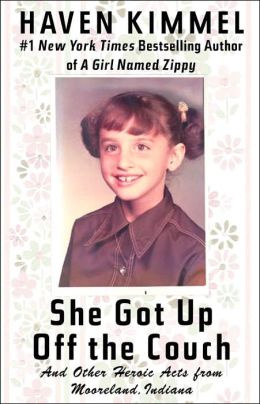
rerun: She Got Up Off the Couch by Haven Kimmel

I have never stopped thinking about this masterful character profile / biography / memoir / feat of creative nonfiction by Havel Kimmel, and I’m very pleased to share it with you here, again. There was also a reread post, from when I was doing my MFA, and even as I write these words, I wish I had time for a reread now. (I am, for the record, really enjoying TJ Klune’s latest, so no regrets there, and stay tuned. Here’s to authors we love who keeping writing new work.)

couchThis book follows A Girl Named Zippy, and I adore Kimmel’s explanation in her Preface: that she would definitely never write a sequel to Zippy, but that people kept on asking her if her mother ever got up off the couch; and here we are. This is an extension of that first memoir, then, with the focus being not on the girl called Zippy (Haven Kimmel herself) but on her mother, who in that first volume was a somewhat shapeless woman who mostly inhabited the couch and read a lot, talked on the phone, watched television, and didn’t worry too much about her children. This is told not unlovingly, but as fact. Zippy’s childhood is on balance awfully joyful and fun, and although a critical adult’s eye might point out lots of points of minor neglect, she clearly loves her family very much. This tone is continued in She Got Up Off the Couch. The family and each of its members is still, realistically, flawed, but lovable and well-loved. Kimmel’s brother is now mostly absent, with a family of his own; her sister marries and has two babies; her father finds work as a sheriff’s deputy (or similar job title); but her mother’s is the great change of this second memoir. This was, what, the late 1970’s I suppose, in a tiny Indiana town of a few hundred people. Zippy’s dad, Bob Jarvis, holds the keys: her mother Delonda doesn’t know how to drive. This will work as a fine metaphor (and indeed is part of the literal action), as Delonda calls a phone number on a television commercial to look into going to college. She wrangles a ride into the next town over for an entrance exam, which places her out of fully 40 hours of college credits. Under Bob’s clear disapproval – he says of the woman who takes Delonda to her test, “time was, a woman wouldn’t have gotten in a man’s marriage that way” – she persists in attending classes, studying, reading, talking to new people, and in 23 months, graduates summa cum laude – and continues on to graduate school. Eventually she earns a Master’s degree in English and becomes a high school teacher. This is all a stunning change. Along the way, to get to school and back, she learns how to drive and purchases a vehicle that is, in itself, a good joke.

She Got Up Off the Couch also follows the format of A Girl Named Zippy: chapters jump around, more as connected anecdotes than as clear narrative. Each chapter stands alone admirably as a hilarious or heartfelt – usually both – nugget of tears, joy, preadolescent confusion, and filial love. [In fact, as soon as I finish writing this review I’m off to read my favorite chapter out loud to Husband, if he’ll let me, while he smokes a brisket in the backyard. If you’re curious, it’s called “Treasure,” and is about a hippie college student hiking cross-country who camps out in the Jarvis backyard for a few days. It’s hilarious and heart-wrenching.] It’s a great structure, this anecdotal style. If I ever write my own mother’s biography, which I keep dreaming about, I have something similar in mind. Yes, there are odd characters that the reader of just one chapter would wrinkle her forehead at; but this is true of the whole book, too. Zippy has had an odd and happy life, and that’s exactly why we enjoy reading about it.

Zippy herself, naturally, also grows and changes in this book. Delonda is our star and makes the most life-changing journey. Kimmel writes in her preface, “I will never do anything half so grand or important,” and I know exactly what she means: the decision of Delonda and other women of her time who broke out of where they were told they belonged have done something for the women of my generation that we are now saved from having to do, if that makes any sense. It is something I’ve long felt about my own mother. But I was saying that Zippy continues to grow up: we see more of her engaging and eccentric friends, Rose and Julie Ann, and we meet a new friend, Jeanne Ann. And when she gets a nephew and then a niece, Zippy becomes hopelessly devoted. The blizzard that sweeps through when her niece is long overdue and panics the family is, again, funny and riveting at the same time.

I’ve now read everything that Haven Kimmel has written except for every single one of her blog posts, and that one children’s book. I hope she is getting to work right now on another book – fiction or non, more Haven Kimmel, stat.

I love it. Funny, true, humble, real.


Rating: 9 cherry-red polyester suits.

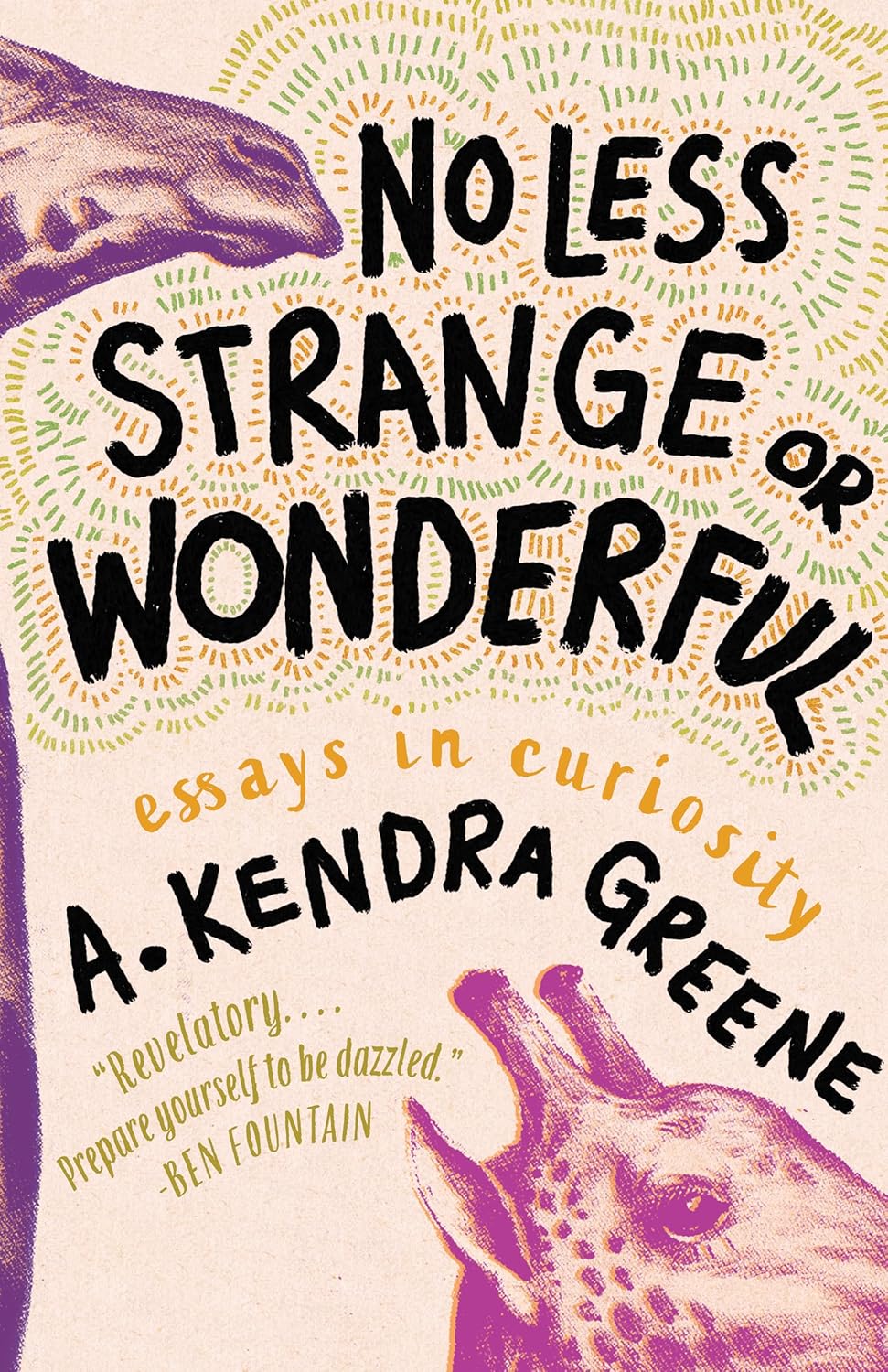
No Less Strange or Wonderful: Essays in Curiosity by A. Kendra Greene

Astonishingly imaginative, wise, and weird, the essays in this illustrated collection–featuring natural phenomena, children, death, and costuming–have the power to reshape the way one sees the world.


A. Kendra Greene (The Museum of Whales You Will Never See) offers a magical, mind-expanding selection of observations in No Less Strange or Wonderful: Essays in Curiosity. Greene employs a delightful, often childlike wonder in this collection about discovery–where she interacts with others, where humans interact with the rest of the world, and what might be made of all of it. Greene’s perspective is fresh and inventive, open to all possibilities, and the results are surprising and wondrous.

Greene’s essays vary in length and take place around the world. “Wild Chilean Baby Pears” considers a crime: in 1979, a museum visitor stole a specimen of the extinct ivory-billed woodpecker from the University of Iowa Museum of Natural History. Greene, who has been a museum visitor as well as a museum worker and a teacher, explores this act from several angles; unexpectedly, she empathizes deeply with the thief she calls “Visitor X.” “Until It Pops” details a dress made for the author out of balloons, and her experience of traveling to Chicago for Twist and Shout (the annual balloon twisters’ convention).

Brief and spellbinding, “The Two Times You Meet the Devil” describes encounters on a country road in Argentina and in a bookstore of unnamed location, respectively. “The more I think about it, the more I wonder how many times we have met, crossed paths at least, exchanged a look, and the devil has said nothing.” “The Sorcerer Has Gone to Italy” is about death, as well as rocks, valleys, turf houses, forgetting, stick-shift cars, whales, kayaks, summer staff, television, and metaphor. “People Lie to Giraffe” is about real giraffes (one in particular) as well as the likeness of a giraffe suggested by a photo of the author’s long arm and pinched fingers. It explores everything encompassed in a child’s imagination, how to make the world, and what it means to tell the truth or tell a story.

Greene is always present, participating in the action and dialogue, postulating philosophies and understandings. Greene is an artist in several media (book arts, photography, illustration), and a teacher as well as a writer; this collection is illuminated by her own illustrations and images. The scope of her essays (26 in total) is mesmerizing, her language glittering, and her ideas exuberant and profound. She says it best herself: “It is a thing the essay loves: to tend, carefully, painstakingly, to the fact of the world.” As for what we communicate with art: “everything resonant and whole and shining, all at once, perfect, every bell ringing, yes.” Yes.


This review originally ran in the January 27, 2025 issue of Shelf Awareness for the Book Trade. To subscribe, click here.


Rating: 9 sprays of bougainvillea.

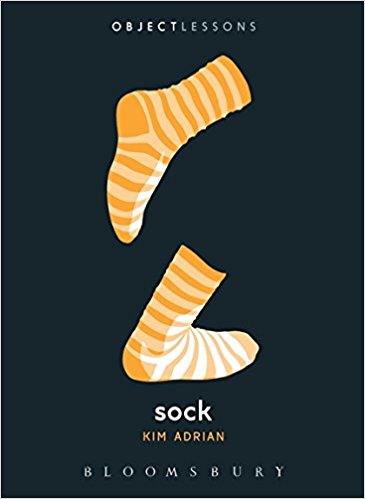
rerun: Sock by Kim Adrian

Friends, if I continue to have gaps in the week, do y’all like the rerun posts? Or should I just take some Mondays off?

Either way, as I buy myself a second set of electric socks for all my outdoor winter play!, please enjoy this reconsideration of a book I loved some years ago.
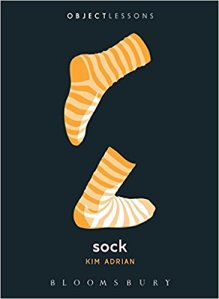
Sock! What a treat! I know I just posted some predictions for best books of the year, but we have a new contender. This was a wildly fun, engrossing little volume.

Sock is part of Bloomsbury’s Object Lessons series, which appeals to me for reasons I assume are obvious now, after this increasingly object-obsessive semester. When I found out about the series, I exercised restraint and purchased only three books: Sock, Hood, and Souvenir.

Kim Adrian’s task here was to write about the sock. What is a sock, what is its job in the world, where did it come from, what is its significance? You know, just the basics. It’s a remarkable ambition in the first place, for any object (others in the series include Burger, Shopping Mall, Eye Chart, Tree, Cigarette Lighter… as well as the less object-like Silence and Doctor). To quote one of the book’s blurbs:

The Object Lessons series achieves something very close to magic: the books take ordinary–even banal–objects and animate them with a rich history of invention, political struggle, science, and popular mythology. Filled with fascinating details and conveyed in sharp, accessible prose, the books make the everyday world come to life. Be warned: once you’ve read a few of these, you’ll start walking around your house, picking up random objects, and musing aloud: ‘I wonder what the story is behind this thing?’ (Steven Johnson, author of Where Good Ideas Come From and How We Got to Now.)

I couldn’t have said it better myself, so I didn’t.

So, the sock. Adrian’s table of contents offers an introduction and three sections: “Socks and evolution,” “Socks and desire,” “Socks and industry,” followed by a postscript: “Instructions for darning a sock.” (The back-of-book blurb begins, “Kim Adrian’s Sock is the darndest thing,” and that gave me FITS.) Adrian acknowledges the weirdness of her project. She can’t really account for her interest in socks, except that they are “intimate and essentially domestic,” and the domestic has always appealed to her. She usually writes about personal subjects, she tells us (“personal essays, memoir, that sort of thing”), and figured socks would fit in, because they are personal, in the sense that we wear them against our skin and they smell of us; but in fact this was a wildly wide-ranging research project. To paraphrase Johnson’s blurb, above, this book wanders through human anatomy and evolution, world history, politics, sex, and industry. If Adrian is fixated on domesticity, I am fascinated by trivia, such as (on page 9) the fact that we get our understanding of when humans first began wearing clothing from the study of lice. Textiles are perishable; but the evolution of specialized lice species, and their development into head lice, pubic lice, and body lice respectively, allows archaeologists to track textile development. This fact made me exclaim joyfully aloud, and I got to read the passage to a roomful of brewery employees. We were in a sensory class about the history of yeast species, so it’s all related, after all.

Adrian moves on to human anatomy and our unique position as vertically aligned bipedal creatures, its effect on our sexual practices and the way we walk, balance, the importance of the big toe, and much more. Skeletal structure has much to do with socks. Then there is the history, of course, of socks: from hay stuffed in a shoe-like cage, to woven foot wrappings, to fitted and knitted socks. She touches on the Industrial Revolution, delayed by Queen Elizabeth’s denial of a certain patent, which if granted, Adrian speculates, might have moved that Revolution up by some two centuries, and “what strange wormhole of alternate reality we might have tumbled down” in that case! Next we have sock and foot fetishes (the latter properly not a fetishism but a partialism), and sex; Jung and Freud, and the art of Egon Schiele, an Austrian Expressionist who left the feet off many human subjects but put socks on his trees. Finally, the sock industry takes us into concepts of fast fashion and slow fashion (a sort of throwback movement that depends on surpluses of both time and money). Here Adrian returns to an earlier concern with knitting socks, something she’s tried and not much succeeded at; she has great respect for those who do knit socks. Then the promised primer on darning.

All this in under 120 pages, and every moment of it was a delight to read, in Adrian’s mildly self-deprecating, often humorous, but absolutely serious-about-socks prose.

Some of my personal highlights on this wild ride included learning that Ned Ludd–he of the Luddite Rebellion–was a stocking maker, and started his movement by smashing two stocking frames in Nottingham. Did y’all know that? Also Adrian’s attention to words: ‘mundane’ (as in socks) comes from the French mondaine, or ‘of this world,’ and links us back to ‘pedestrian,’ as in Latin ped, as in foot. And ‘prosaic’ from ‘prose’ comes from Latin provorsus, which is pro– (forward) and vorsus (turned), as in oriented in forward-facing fashion, as in walking. Can’t make this stuff up, folks. Or, did you know that our feet possess even more nerve endings than our genitals?

I feel like I’ve written half as many words now as Adrian put into her whole book, this slim little marvel of trivia and attention to the overlooked. I am reminded of Mark Doty’s devout study of small details, his appreciation that “in still life the familiar is limned with an almost hallucinatory clarity, nothing glanced over or elided, nothing subordinate to the impression of the whole.” In other words, this book was a near-religious experience for me. I can’t wait to read more Object Lessons.

I can’t believe I’m doing it for the third time this year already, but here we are…


Rating: 10 stitches.

rerun: Dirt Work: An Education in the Woods by Christine Byl

Because I still talk about and think about Dirt Work, and because (I still can’t believe my good fortune) I now get to build trails for a living, it feels right to talk again about this transcendent book. I hope I get time to reread it someday. Original publication and review from 2013. For more, check out Lookout, which also got a 10 (and those are rare).

Christine Byl opens her memoir with the pleasant scene of herself and three fellow crew members, crusty and dirty, having a post-hitch beer at a small-town Montana bar. A young woman approaches and asks how she keeps up with the boys, one of whom volunteers that it’s all they can do to keep up with her.

She then backs up and tells the story of how she got there. Like many young women in our culture, Christine was expected and expecting to go to college, to do cerebral work and keep her hands (literally) clean; but a summer gig held her, and she reveled in physical challenges, in learning new things, in the mechanical world. Eventually she reveled in her hardening muscles and her expertise, in surprising men with her ax-work and in mentoring other young women coming up in the “matriarchy” of trail work (still predominately male) within Glacier National Park.

After six seasons in Glacier, alongside boyfriend and eventual husband Gabe (a delightful character: mostly off screen, but clearly a capable young man in his own right, and clearly happy to stay lovingly out of Christine’s way), she does return to graduate school, in Alaska. But during the summers she still works on building and maintaining trails, this time in Denali. Christine and Gabe come to love Alaska – yes, even the winters: there is a delightful passage arguing that the light summers are in some ways harder than the dark winters, and I made both my parents (recently moved from the Mexican to the Canadian border) read it. They settle a few miles outside the borders of Denali National Park, and Christine finds a balance between the cerebral – she gets an MFA in fiction, and writes this beautiful book; and the physical – she and Gabe now run their own independent trail-building company.

So many things to love in this book; where to begin? As a sometimes volunteer trailworker myself, I don’t pretend to know 2% of what Christine does; but I might know just enough to appreciate what she loves about it, and what a challenge it can be. I still haven’t mastered the efficient, all-day ax swing myself, but I’d like to. Also, I have a friend named Susan who I’ve written about before, who has a great deal in common with this author. (I briefly wondered if “Christine Byl” was a pseudonym.) Susan, like Christine and apparently like many trail workers, has an advanced degree but chooses to labor for a living; she’s a woman in what is clearly a man’s world, and is half of an independent trailbuilding company. I get the impression that while it’s hard work, Susan and her husband Ryan wouldn’t do anything different.

Christine writes beautifully about the phenomenon of choosing to do physical work when she could be keeping her hands soft. She writes about the well-intentioned questions her family asked, about when she was going to get a “real job”: she says that they have confused happiness with orthodoxy. (I can only imagine how many of us can sympathize with that concept!) She writes about the “sorority” of men in trailwork, and the way that pulls women together; she writes about the pride she feels when upending male expectations of her blonde head and small frame. As a writer, and clearly a gifted one, she structures this book as solidly as she would a bridge or retaining wall. Each of 6 chapters is represented by a tool (axe, rock bar, chainsaw, boat, skid steer, shovel), a location (North Fork, Sperry, Middle Fork, Cordova, Denali twice) and a locale (river, alpine, forest, coast, park, home). Within those chapters she roves and rambles, musing on natural phenomena, social relations, her own body and personality, strengths and shortcomings, and then returns to tool and place to ground herself. The structure of this book, then, is both well-anchored and floating, and I found that it worked very well.

I was charmed by Christine Byl’s honesty; her love of place; her range of experiences and understanding of two worlds, that of universities and that of woods; and of course her lovely writing. She’s hard as nails, with two hernia surgeries and a preference for outhouse over indoor plumbing. She’s brash and can tend towards a loud and dirty mouth (that makes two of us), but she’s got a soft core. I like her; I’d like to be her friend, and of course I’d really love to learn from her.


Rating: 10 pulaskis (my personal favorite trailwork tool).

So good.

rerun: The Warmth of Other Suns: The Epic Story of America’s Great Migration by Isabel Wilkerson (audio)

Now seems like a fine time to revisit Isabel Wilkerson’s excellent 2010 work, in my 2012 review here. (For later reads, also check out Caste and a corresponding interview I was lucky to get.)

I didn’t really know what this book was about when I picked it up – only that it was well-regarded. I’m so glad it found its way into my hands. Isabel Wilkerson has taken on a large-scale, ambitious subject here, and rendered it beautifully. And the audio reading by Robin Miles is lovely to boot.

The “great migration” in the subtitle refers to the movement of black Americans out of the South and into the northern and western United States in 1915-1975. Wilkerson starts from the very beginning, looking at the experiences of former slaves just after Emancipation in an impoverished region struggling to rebuild with a new order of things. The creation and expansion of Jim Crow laws designed to hold blacks down took time after the end of the Civil War to take effect. In the new caste system, former slaves and their descendants were unable to move up in the world and were in constant fear for their lives if they were to misstep around Southern whites. By 1915, they had begun to move out of the South, in what became a mass migration along lines so distinct that enclaves of blacks from specific towns and states were recreated in new locations.

Wilkerson shifts between two ways of studying the Great Migration. Sometimes she takes a broad view of history, in which she cites her own interviews (she states that she did over 1,200) with migrants and their descendants as well as a number of historical sources, to render the story of the Migration generally. And sometimes she follows the specific personal stories of three individuals who she interviewed at great length over a long period of time, traveling the country with them and becoming part of their lives. (In this respect, the journalist/author becoming part of the family of her subject, I was reminded of Rebecca Skloot’s amazing The Immortal Life of Henrietta Lacks.) George Swanson Starling moved from Eustis, Florida to New York City, later sending for his wife Inez to join him there. He had to leave Florida suddenly because a friend tipped him off that a lynch mob was coming for him; he had been involved in organizing his fellow citrus pickers to demand higher wages. Ida Mae Brandon Gladney moved with her husband George and their two children, with a third on the way, from Mississippi where they had been sharecroppers. They would eventually end up in Chicago, by way of Milwaukee. And Robert Joseph Pershing Foster was an ambitious surgeon and veteran from Monroe, Louisiana, with his heart set on Los Angeles. Known as Pershing in Monroe, he would resettle as Robert (or Bob, or Doc) in LA and send for his wife and daughters to join him there, where he built a new life in high society with the big house and booming practice he’d always wanted.

I found this shifting back and forth between the broad view and three personal histories extremely effective. Anecdotes from the lives of Southern blacks drove well home the misery of their bottom-rung status there; some of these stories are horrific, but important to show the desperation some migrants felt when they left their homes in the South. National trends played a role – for example, during WWII demand for Florida’s citrus was high while the supply of labor to pick the fruit was low, with everyone off at war, and this imbalance led to George Starling’s ability to demand higher wages. And the history of Chicago’s race relations and residential segregation puts Ida Mae Gladney’s home ownership into the proper perspective. You get the point. The history is well-documented and, I’m convinced, well-researched; and the personal stories make it all, well, personal. I was deeply involved with our three representative individuals by the end of the book and, yes, I cried.

I love that Wilkerson brought such a large-scale, important trend, that has had such huge effects on American history, to life the way she did. I also like that she examined the broad effects of the Great Migration, in terms of the cultures of both white and black residents of the North and the South, and took the time to show that black migrants were really far more like immigrant groups in history than like migrants within their own country. I recommend this book as part of a study of American history – but one need not be an academic to appreciate it. The story of the Great Migration is made accessible here, and I’m glad I know more about it now. This 19-disc audiobook (over 600 pages in print) went by easily. This is how I like to take my history lessons. Check it out.


Rating: 8 train rides north.

rerun: Soundings: The Story of the Remarkable Woman Who Mapped the Ocean Floor by Hali Felt

Please enjoy this time capsule from August of 2012.

I’m so glad I picked this book up (and bought it for the library where I work). It sounded like just the sort of thing I appreciate: a biography of a little-known historical figure who made an important contribution to the world as we know it but was herself forgotten. In this case, the “remarkable woman” of the subtitle is Marie Tharp, whose meticulous study and cartography of the ocean floor established the concept of plate tectonics that science now recognizes as fact, but was at best a blasphemous and ridiculous notion before Tharp came along. Her achievements, however, were minimized by a scientific culture in which women did not belong. This biography is additionally appealing to me for its mood: author Hali Felt takes a whimsical, dreamy, almost fanciful tone at times. She describes her own attraction to Tharp’s story (born in part of Felt’s mother’s, and her own, fascination with maps) and the relationship she felt to her subject. She dreams of Tharp coming to her to explain the mysterious and unspoken parts of her life. This book is nonfiction, but it’s honest, personally related, and warm.

There is also an enigmatic love story of sorts hiding within Soundings: Tharp’s career and life were both tied to a man named Bruce Heezen. Heezen was her coworker, then her technical superior; but they shared a partnership in work, in science, in discovery, and apparently in all things. It is known that they were a couple, although they never married and the details of this side of their relationship are very few.

Felt follows Tharp from her childhood with a science-minded father she adored, through her education in English, music, geology, and mathematics, and to her first job in the oil & gas industry (oh, how familiar to this Texas girl). But she was held back: this was the 1940’s, and women in science were mostly expected to make copies, compute numbers, and brew coffee. Eventually Tharp found her way to New York, to Columbia University and the Lamont Geological Observatory. This is where she would meet and work with Heezen and quietly make history.

The science in this book is very friendly and accessible to a general reading public; the story that Felt set out to tell is more that of a woman’s life and accomplishments despite the limitations of her society, than that of tectonic plates per se. For that matter, Felt shows that it was Marie’s combined backgrounds in art as well as science that made her perfectly suited to play the role she did in history. Her meticulous re-checkings of data and attention to detail were indispensable – but so was her interest in visually representing the data available in a way that would show the general public (not just academics) what she’d discovered. So her achievement was artistic as well as scientific. Soundings does make the science side clear, but doesn’t dwell, and is never dry. Rather, Marie Tharp comes to life: she is a precocious child; an ambitious, able, frustrated student; a dedicated scientist; a life partner; an eccentric aging woman caught up in her own past, campaigning to honor and preserve the legacy of her other half.

Hali Felt was honest about the role she plays in the story she relates. She begins in her Introduction by briefly describing her own attraction to maps, and then follows a chronological format, beginning with Tharp’s childhood and following her life, and eventually her death. And then Felt returns to the story: her discovery of Marie Tharp’s existence, her interest, her decision to follow that interest, her research, her relationships with the living descendents of Tharp and Heezen’s world (the “Tharpophiles”), and in the Acknowledgements at the end, she even hints at the process by which she came to write and publish this book. I found all of these Felt-related details interesting too.

In a word, this is a lovely biography, and the style and tone of it may be my favorite part.


Rating: 9 double-checkings of data.

I remember it fondly.

Life After Dead Pool: Lake Powell’s Last Days and the Rebirth of the Colorado River by Zak Podmore


With Life After Dead Pool: Lake Powell’s Last Days and the Rebirth of the Colorado River, investigative journalist Zak Podmore tackles a massive, complicated set of questions about western water management and the Glen Canyon Dam, the construction of which created a reservoir called Lake Powell. Arguably the most politically fraught and symbolic dam in the southwestern United States, Glen Canyon has long had its fans and detractors. The Millennium Drought, “an indefinite change in precipitation patterns” in the region, has “done three-quarters of the work toward draining Lake Powell already,” but this leaves numerous challenges: Indigenous people’s water rights, engineering and hydrology puzzles, the ecological implications for long-flooded lands freshly exposed to open air or buried under millions of acre-feet of sedimentation, and more.

Podmore acknowledges his own biases about the dam, which was in place before he was born. But he proceeds with copious and in-depth research into the many and complex issues it poses, considers what he learns with an open mind, and integrates hard science, cultural awareness, and competing viewpoints into an admirably accessible work of creative nonfiction. Podmore avoids binary options and magical thinking, and his study is richer for it. Included are surprisingly hopeful notes, such as the rapid recovery of native plants and ecosystems in newly exposed side canyons: “A canyon one hundred miles away, drowned for half a century, had restored itself in fewer than twenty years.” With narrative style and colorful characters, Podmore (Confluence) has composed a compelling, readable, and entertaining as well as educational text. Life After Dead Pool is superlative: important, insightful, and a pleasure to read.


This review originally ran in the August 30, 2024 issue of Shelf Awareness for Readers. To subscribe, click here, and you’ll receive two issues per week of book reviews and other bookish news.


Rating: 8 cans of beans.