A Sand County Almanac: With Essays on Conservation by Aldo Leopold

First, let me say a word about this edition. I requested A Sand County Almanac from my local public library, and took what they gave me. It was only by luck (or, more to the point, the wise purchasing decisions of said library) that I got this lovely anniversary edition, with introduction by Charles W. Schwartz and photographs by Michael Sewell. The introduction explains that Schwartz & Sewell spent time on Leopold’s ranch, the place where Leopold wrote, and that he wrote about; all the photographs were taken either on the ranch or in the surrounding environs (where Leopold wandered as well). If you can get a hold of this edition, by all means DO: the photos are to die for, and really add something to the text itself, and I found Schwartz’s introduction to be helpful in placing, and appreciating, Leopold’s work. I’m not completely clear on what’s included in every edition of the title ‘A Sand County Almanac‘, so please ‘scuse my ignorance, but this edition did include two essays following the twelve-month formatted almanac: “Marshland Elegy” and “The Land Ethic.” I’m not sure they’re included in every edition.

I was drawn to this book by its place in the genre of literary nature writings that I am recently enamored of; starting with Fire Season of course, which then led me through Edward Abbey and miscellaneous others. It was also recommended on the Gila National Forest’s recommended reading page (scroll to bottom), which I’ve been referencing in preparation for a trip there this summer.

Aldo Leopold was an pioneer in the conservation and restoration movement, early in the definition and creation of ecology or environmentalism. His Almanac belongs in line with the works of Muir, Thoreau, Rachel Carson, and Edward Abbey. This is a beautiful book. Leopold is among the best of his genre: he writes lyrically, passionately, bringing to life and recognition the smallest and most seemingly insignificant pieces of his world. There is humor, celebration, and thoughtful consideration and development of a philosophy for the burgeoning movement; Leopold is one of its fathers, without question (see Schwartz’s discussion in the introduction of how far his influence extends today). This book is filled with calls to action, as well as quiet, reverent praise and celebration of the minutest members of the natural world.

Leopold writes from his ranch in the “sand counties” of Wisconsin, where he dedicated himself on weekends to restoring the land and its inhabitants to their previous state of nature, before agriculture, cattle ranching, and industry encroached. Schwartz’s introduction emphasizes that Leopold’s great work on conservation and restoration is now perhaps best applicable to restoration, as “almost all the wilderness that can be saved has been saved. For the duration of our time on the planet – for whatever piece of eternity we have left here – restoration will be the great task” (Schwartz). Leopold was quite successful on the 120 acres under his care. “On the road to extinction, traffic travels both ways,” writes Schwartz, noting the repopulation of sandhill cranes in the state of Wisconsin since Leopold’s day.

The loving and thoughtful process Leopold undertook on this ranch is contemplated in this book, first in twelve month-chapters, January – December, in which he describes what he sees and discusses the significance of the passing seasons, the migrations of the sandhill cranes, the felling of “the good oak.” Thus the reader is let inside the process, not only of Leopold’s growing and maturing love for his world, but of the development of ecological philosophy. As Schwartz points out, the philosophy has continued to develop beyond Leopold’s understanding: for example, he overplanted pines on his land at the expense of other trees; he was an avid hunter, which habit would at least come under discussion today. But his legacy is palpable. Following the twelve-month almanac, in two essays, he further develops eco-philosophies, for example, the concept of the pyramid of life, in which he takes our well-known concept of food chains and ties these innumerable chains together into an infinitely complex pyramid.

I found much to appreciate in this book. Leopold is thoughtful, writes beautifully, poignantly, evocatively, makes me want to see and touch and smell the world he describes. Sewell’s accompanying photographs complete the experience; the only thing better would be to be there, myself. It is an important work; despite being more than 50 years old now, the philosophies Leopold develops are, heart-breakingly, more relevant than ever.

I’ll leave you with one of my favorite lines:

Books on nature seldom mention wind; they are written behind stoves.

Leopold has gotten out into the draft to bring back to us the sensation of movement. Read him!


Rating: 9 lovely drifting leaves.

The Monkey Wrench Gang by Edward Abbey

I fear this review won’t do this book justice. Maybe I’m just intimidated. But I read it on vacation and sadly took NO notes – nor do I usually, but it took me a little longer after reading to write the review, and those were hectic days. And it’s a significant book: one of Abbey’s two most famous books, that alongside the nonfiction Desert Solitaire really made his career and solidified his celebrity, as well as birthing the Earth First! organization and movement. If ever a book had a cult following, this is it.

The story follows four individuals. Seldom Seen Smith is a Jack Mormon with three wives in three small towns in Utah; they gave him his nickname for being rarely around any of their three households; he guides river raft trips down the Grand Canyon and generally camps out and around in the natural world more than he stays home. Bonnie Abbzug is a Bronx Jewish girl working out in Albuquerque for Dr. A.K. Sarvis, who when he is widowed takes refuge in Bonnie’s desirable arms. She is much younger and beautiful and very capable; she manages his medical practice as well as satiates his considerable sexual urges. As the book opens, Bonnie and Doc amuse themselves by cutting down billboards with a chainsaw. George Hayduke is a young, muscular, angry Green Beret Vietnam veteran who returned from war with nothing on his mind but the beautiful desert country he loved; upon finding it defiled by industry and roads, he wanders around in a murderous mood until happening upon the other three.

The four form a conflict-ridden union of semi-organized, anarchic environmental activists – stress on the “action” part. They destroy heavy machinery and blow up bridges and the like. The group’s greatest ambition is to take out Glen Canyon Dam and free the mighty Colorado River (and liberate Seldom Seen’s hometown, now underwater, of Hite, Utah). They have adventures and do battle with a small-town Search and Rescue team lead by the Church of Latter Day Saints’ Bishop Love, which is really just a posse of renegades angry at Seldom Seen and whose profits are tied up in the industry that the Monkey Wrench Gang is bent on destroying. There is gunplay; there is infighting; there is sex and camping and nature-praise. It’s rather glorious; The Monkey Wrench Gang is funny and doesn’t take itself too seriously, although its values (pro-nature, anti-development) are definitely heartfelt and poignantly expressed. It’s easy to see how this novel, published in 1975, led like-minded young people to try to live it out.

Common critiques are easily spotted. Most glaringly for me, Bonnie is a sex symbol. Doc is her lover despite being “old and bald and fat and impotent” (the first three are true, the forth patently not; there is reference to his “grand erection,” on which more in a minute) but Seldom Seen openly worships her (which is accepted by all) while Hayduke tries to resist his equally obvious desire. This dynamic is not PC, although I fear it is entirely realistic even today. Knowing just a little about Abbey (one biography, check), it is painfully obvious that Doc (and Hayduke, and Seldom Seen) live out various forms of Abbey’s own lust for vastly younger women (their thighs, their buttocks…) – see again Doc’s “grand erection” even when threatening impotence. This is clearly indulgent of the author’s lechery. But somehow I note that and carry on unoffended. To be fair, Doc is rather laughable. Further, the group is not PC in its attitudes towards American Indians (somewhere in here is the often quoted line “drunk as a Navajo”) or Mormons, continue the list from here. And these are not your average environmentalists; they eat a lot of meat and drive big cars and throw beer cans out the windows along the highway (another famous Abbeyism).

But it’s a hell of a story; I was totally involved, and what can I say, I buy into Abbey’s greatness and went right along with his self-indulgent fantasy. I wanted to see the Glen Canyon Dam come down, too. I wish there was more. Oh wait! Hayduke Lives! That’s gotta be next on the list.


Rating: 8 sticks of dynamite.

River in Ruin by Ray A. March

One American river’s well-researched journey from trickling stream to environmental disaster.


The Carmel River is barely a stream at its source, less than 40 miles long, and likely known only to the residents of its immediate surroundings. But it has a rich and telling history–from early Spanish explorers to its eventual place on the nonprofit environmental organization American Rivers’ top 10 list of Most Endangered Rivers in 1999. But the Carmel is especially important to journalist Ray March because he grew up nearby; with River in Ruin, he makes an excellent case for its story being an archetype of endangered rivers everywhere.

The paradise that is California’s Monterey Peninsula has attracted settlers since 1602, when Sebastian Vizcaino first discovered the Carmel River. Later, railroad magnates adopted the area as a site for profitable tourism, quickly followed by real estate speculators and the development of several small towns. The original Spanish mission and agriculture, followed by the later hotels, golf courses and townships all relied upon the Carmel for water, requiring the construction of dams and reservoirs and the flooding of idyllic valleys. Ecological implications abound: forest fires were exacerbated by a no-burn policy; the local steelhead population is nearly extinct. March details these and more consequences of local development while showing how the growth of the environmental movement nationwide has paralleled local awareness of the plight of the Carmel River and Monterey Peninsula. March’s treatment of the history, the politics and the personalities involved is heartfelt and personal; several times he consults diaries and includes individual stories (including his own), making the Carmel’s story resonate with his readers.


This review originally ran in the April 6, 2012 issue of Shelf Awareness for Readers. To subscribe, click here, and you’ll receive two issues per week of book reviews and other bookish fun!


Rating: 7 salmon.

on mountain lions

This is my memory of what happened.

In August of 1990 I was just past my 8th birthday, backpacking with my parents in the White River National Forest in Colorado. We made camp for the evening; it was still daylight. We were in a low, fairly clear area, with the land rising up around us; the grass was tall and golden-brown. I had wandered off by myself, I don’t remember why, and was wandering back toward camp when I looked up into the eyes of a creature I didn’t recognize. It was the size of our family dog, Eile, a Weimaraner. But its face was that of a cat. It was golden-brown, like the grass. It had paused mid-stride to gaze back at me. We were maybe 10-15 feet apart, and we both stopped and looked at each other for a few seconds. I wanted to make the moment last. I was always excited to see wildlife when we camped and backpacked; I remember being enchanted by marmots. Then the big cat walked off and I went back to camp. I told my father I had seen a new animal, and he asked me to describe it, and I told him the same description I’ve given here: the size of our dog, with the face of a cat, golden-brown. He was very excited and told me that I’d seen a mountain lion. I knew what a lion was and told him that wasn’t right, but later he found a picture of this different kind of lion, with no mane, and I recognized it. Yes, I’d seen a mountain lion. I remember my father being thrilled, but there was some note of alarm, too; I’d made it out of the experience fine, so there was no sense in being frightened (I think he told me that now that it knew we were there, it would stay away from us), but you might not send your eight-year-old off on such an encounter knowingly. I felt no fear, of course, not knowing anything but that this creature resembled my pets back home. Nothing scary about that. I’ve wondered if it simply wasn’t hungry, or if it recognized my innocence, my fearless curiosity, my lack of intention to do it any harm.

The above is my memory more than 20 years later, of course, and it may be faulty. It’s even possible that I remember the story as family lore rather than remembering the incident itself; but I don’t think that’s the case. I can picture the cat, and the dry grassy field.

Do my parents remember this experience the same way? It’s been a long time, and I was small. In fact, I had to look up the when-and-where using Pops’s travel log (thanks so much, Pops, for keeping one!). I was surprised at the date; I thought I was smaller than 8 when this happened. To which Pops says, “eight is still pretty small!”

They’ve shared their memories for us here.

Mom:

My memory is such that I doubt if I was there. I either remember the telling of the tale, or I remember telling the tale. The one thing that seems authentic is a flash of astonishment on your face. Maybe I saw you seeing something – and later heard what Hank actually saw, the mountain lion.

Dad:

I have a “clear” memory of it, which probably has a 50% chance of being accurate.

I don’t remember Karen being there so it will be interesting to see what she says. You and I were on a hike – who knows how far from our backpack-camp given your age. We were walking up over a slight rise when you made some exclamation – I don’t remember what. By the time I looked where you were looking, all I saw was a flash of tawny brown disappearing over the hill and/or into the brush. We were in relatively open, scrubby terrain – not in the woods. This was definitely mountain lion habitat – not bobcat or such.

I asked you to describe what you had seen, and it’s based on your description plus my furtive glimpse that I concluded it was a mountain lion. I remember not having any doubt, and emphasizing to you what a special observation it was. I have and would describe this to others as your sighting, not mine; without your description, I would not have been so sure. I might have reasoned that I probably just saw a deer (no tail flash tho’) or a coyote (no bushy tail tho’).

and then:

You thought you were ALONE?!!! Wow; that’s hutzpah – and how very irresponsible of your parents if true!

All of this came back to me recently in reading a few collections of Edward Abbey’s essays. In an essay entitled “Freedom and Wilderness, Wilderness and Freedom” (oft-quoted and reprinted; my version comes from The Journey Home), he describes his one encounter with a mountain lion. When he became aware of its presence, he was exhilarated, having wanted to meet a lion all his life (something I’d read in earlier essays). He felt fear, but also:

I felt what I always feel when I meet a large animal face to face in the wild: I felt a kind of affection and the crazy desire to communicate, to make some kind of emotional, even physical contact with the animal.

He tried to shake its hand. And if that sounds crazy, I ask you to go find a copy of this essay and read it all the way through. It’s only 11 pages long. And by the time he wants to shake this lion’s hand, I propose that you might be with him, searching for communion. I certainly was.

Abbey only had the one encounter, and in earlier essays I’ve read, he laments that fact; he waited for and sought that one encounter all his life. It makes me feel that much luckier that I got to see one, too.

Aside from the beauty and grace and rarity of the mountain lion, there’s a question growing out of this blog post about the nature of memory. That, too, reminds me of some recent reading: you may have noticed me raving lately about A Difficult Woman, the Lillian Hellman biography by Alice Kessler-Williams which – among many other things – examines the themes of memory and truth in Hellman’s life. I believe that our memories are fluid and unreliable. It may be that there is no absolutely true memory; it is my experience that people consistently share different memories of the same event. That being said, I think my father probably has it right; we were probably together. It seems more likely (because why would you let your 8-year-old wander around alone in mountain lion country), and I’m inclined to trust his memory which was then mature over mine which was then young… also, inflating my own role to a solo encounter feels like something a child’s memory might do. But it’s interesting to see these different memories, don’t you think?


Be advised: I’m out of town, so you’re viewing pre-scheduled posts until April 9. I love your comments and will respond when I return! But I’ll be out of touch for a bit. Thanks for stopping by!

Edward Abbey: A Life by James M. Cahalan

I appreciated Calahan’s biography of Ed Abbey. I found it the perfect next step in my increasing fascination of the man’s work, which (for me at least) is also necessarily a fascination with the man. As I’ve mused before, there is too much of the man in the work for one to possibly extricate them. And this book was just the thing for me. I learned a lot about Abbey, some of which you can find in that earlier post. Calahan’s angle on Abbey, if you will, seems to be the contradictions of the man – an angle I’m always ready to appreciate. In this case, he (Calahan) speaks often to the public figure Abbey created for himself and the often distinct private, “real” Abbey. And then there are those controversial aspects…

Abbey’s stance on immigration, for example. The public maligned him for being a racist after he spoke (and wrote) against allowing immigrants in from Mexico, which was perhaps an understandable response, but an overly simplistic one. In a nutshell, Abbey conceived his anti-immigration stance as an issue of economics, not of race; he stressed that he was against immigration of any kind of people from anywhere, including the internal migrations within the United States (easterners moving into his beloved west), which he conceded he could do nothing about. He had lots of Hispanic, Mexican, and Native American friends, and liked to visit Mexico. He also, though, wrote and spoke of the unpleasantness of Mexico and Latin America and stated that he didn’t want to live there (and neither, he pointed out, did most Latin Americans – meaning those immigrated to the US). I understand this stance perfectly and see how it could be a position without consideration of race: more people are bad for these precious and shrinking wild open spaces, regardless of their race. But it’s easy to see where he got beat up for this position, too, especially considering his reluctance to back down from controversy, to apologize or restate his position. Rather, he was inclined to bait his critics by making farcically backwards remarks.

Similarly, Abbey’s relationship with women was a complicated one. He repeatedly stated that they were the “better” sex, that he respected women and certainly that he loved them (as evidenced, in some sense, by his five wives and many extramarital relationships!). But there was that ludicrous letter he wrote to “Mizz” magazine, and all the cheating he did on his wives. He was supportive and helpful in the professional writing careers of a number of serious women (Terry Tempest Williams comes to mind, as I recently read her most recent work – the review should be out any time now). But even in his fifth and by far most successful marriage, he was firm in his wish for his wife to be a full-time mother to their children. Misogynist? Ah, I don’t quite think so; but his relationship with women was complicated.

And another example: Abbey repeatedly denied that he was a naturalist. I’ll let Cahalan himself speak here.

It is true that Abbey was not a naturalist in the scientific way that Rachel Carson or even Annie Dillard was qualified to be; he got mediocre grades in subjects such as zoology. Wendell Berry was right (and Nancy Abbey agreed) that Abbey’s real subject was himself – that as an author he was primarily an “autobiographer” more than an “environmentalist.” Yet Desert Solitaire and The Monkey Wrench Gang activated more than a generation’s worth of activists toward a radical new brand of direct action in defense of wilderness. While telling the story of himself and his friends, Abbey managed to change the world.

I share these observations on Abbey just to share some of what I’m learning about him. But back to the book review:

I like that Cahalan has a coherent approach to Abbey’s life here: the contradictory man, the public vs. private figure, the questions his life raises. Cahalan muses on these questions without authoritatively answering them, which is appropriate. These are questions without definitive answers. It is a sensitive biography, appears well-researched, and gave me just what I was looking for. I leave it thoughtful and curious about still more Abbey, but thoroughly satisfied (for now) in terms of biography. I recommend this work, and I still recommend all the Abbey you can find!


Rating: 7 women younger than the last.

book beginnings on Friday: To the Last Breath by Francis Slakey


Thanks to Rose City Reader for hosting this meme. To participate, share the first line or two of the book you are currently reading and, if you feel so moved, let us know what your first impressions were based on that first line.


My cover (which is an advanced reader’s edition; this book will be published May 1) has a first-person quotation rather than the one on the image at right (click to enlarge). It reads,

In 1997, I decided to scale the highest peak on every continent and surf every ocean. Over the next twelve years, I survived a storm atop Everest, an ambush by guerrillas, and a head-on collision in the high desert. But every escape from death brought me closer to life.

That is, of course, not your book beginning! The book starts:

I am out of balance. I hang dangerously off center but I’m oblivious, until some dim awareness of the world shakes me awake.

It begins full-on, with an adrenaline-charged event. I’m enjoying it so far. What are you reading this weekend?

This quotation comes from an uncorrected advance proof and is subject to change.

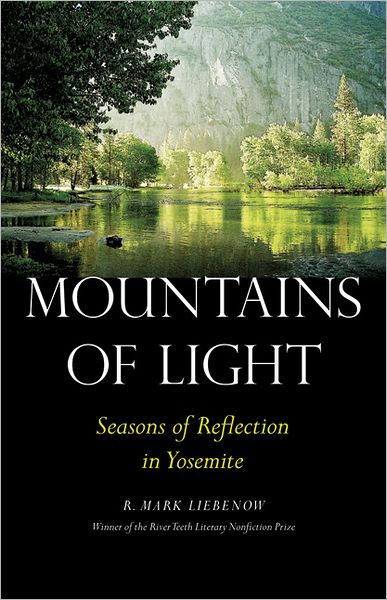
Mountains of Light by R. Mark Liebenow

A quiet, moving memoir of grief and recovery set in the Yosemite Valley.


When his wife of 18 years died, R. Mark Liebenow was overcome with grief. He sought relief by following in John Muir’s footsteps, consulting naturalists, historians, spiritual guides and artists along the way. Mountains of Light covers a year which he spends (in many short trips) in the Yosemite Valley, contemplating the natural world and the significance of death. He is “looking for the mystery of life,” he writes, “even if it can’t be solved but only hiked further into.”

Mountains of Light is lyrical and decidedly literary. Liebenow’s focus drifts: he describes a mountain vista, waxes mystical about the roles that insects and waterfalls and clouds play in the universe, quotes poetry (and Muir), confers with cutting-edge science and remembers his late wife. He includes morsels of history (particularly of Yosemite, from Native Americans through the Mariposa Battalion to the present) and catalogues plant and animal life. He considers various religious and spiritual understandings of nature and death and the mountains, mulling over his options for accepting his tragedy. The background for all this musing is dynamic, as Liebenow takes challenging hikes, explores, gets lost in the wilderness and watches his fellow campers and mountain climbers take still greater risks. The scenery changes drastically in four seasons, which Liebenow interprets metaphorically.

Part travelogue, part natural study and part memoir of grief, Mountains of Light is meditative, lovely, thought-provoking and, yes, sad–but worth it for the appreciation of this natural gem and the redemption it brings.


This review originally ran in the March 9, 2012 issue of Shelf Awareness for Readers. To subscribe, click here, and you’ll receive two issues per week of book reviews and other bookish fun!


Please note that this book makes a fine readalike for Fire Season or Edward Abbey’s Desert Solitaire. And look at that lovely cover, too!


Rating: 6 moments of contemplation.

book beginnings on Friday: Edward Abbey: A Life by James M. Cahalan

Thanks to Katy at A Few More Pages for hosting this meme. To participate, share the first line or two of the book you are currently reading and, if you feel so moved, let us know what your first impressions were based on that first line.

Today we’re taking a look at a biography of Edward Abbey.


The more Abbey I read, and love, the more I want to know about the man. Do you do this? My interest in an author of nonfiction invariably turns to the author himself (or herself). I’ve been looking for a few Abbey books, in this case. This was the biography I chose. I also have a copy on the way of Doug Peacock’s Walking It Off. Peacock was the inspiration for Abbey’s fictional character Hayduke, of The Monkey Wrench Gang, and his book is a reminiscence of their relationship. But that’s another post.

Cahalan’s biography of Abbey begins, in the introduction:

This is a book in which I seek to separate fact from fiction and reality from myth. At the outset, I have to tell readers that Edward Abbey was not born in Home, Pennsylvania; he resided in several other places before his family moved close to Home. And he never lived in Oracle, Arizona.

Already I’m learning things. I had already observed, as Cahalan continues, that Abbey claims a birth in Home and a late life and death in or near Oracle. These place-names are nicely symbolic, which has to have appealed to him, and his PO Box in Oracle helped to deflect some of the fans who pursued Abbey in his later years and who he (understandably, I think) wished to avoid. But who knew he fudged the truth so hard, and so early on, and in such relatively unimportant details? (There will be another post here soon about the friction between fact and nonfiction writings.)

I’m really excited about this biography, as I’m excited about Abbey in general and also debunking biographies in general. And I love that in the short introduction, Cahalan mentions Hemingway, riding bicycles, and the ill-fated trip through Big Bend with his then-fiance that Abbey writes about in The Journey Home – three things I love. 🙂

What are you reading this week? And are you excited?

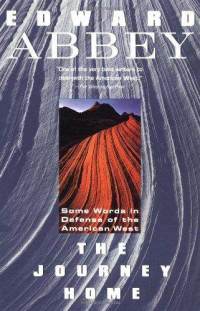
The Journey Home by Edward Abbey

This is why we read Ed Abbey. He has the power to make me laugh and cry within a few pages.

I cannot describe The Journey Home better than Abbey does himself: this book is a collection of “adversary essays and assays, polemics, visions and hallucinations… published piece by piece in various odd places from Audubon to the Vulgarian Digest” and “fragments of autobiography, journalistic battle debris, nightmares and daydreams, bits and butts of outdoors philosophizing” (from Abbey’s introduction). The subtitle is “Some Words in Defense of the American West.” It works very well in the ways he describes: it is indeed a defense of the American West (although as he puts it another way: “the idea of wilderness needs no defense. It only needs more defenders”). It is a lovely collection of some journalism, some hallucinations and dreamings, and some eloquent essays.

The introduction to The Journey Home is devoted to arguing why he is not a nature writer; he’s just a guy with a lot of experience in and love for nature, writing a memoir that naturally includes a lot of nature. I hope he would forgive me, were he still here, for saying: Abbey, you are a nature writer. Memoirs they may be (and watch out for his novels, too: I loved Fire on the Mountain; was disappointed by Black Sun which apparently he really loved; and am excited to crack open his best-known and arguably movement-starting The Monkey-Wrench Gang) but they are also some of the finest nature writing we’ve seen. His own arguments notwithstanding, Abbey absolutely belongs in the company of Thoreau and Muir. I recognize so much of what I, and modern authors and political thinkers and philosophers I admire, have thought and felt and written, in Abbey’s earlier work. He is important.

He is also so angry! He can be so funny, so flippant and casual (Husband and I both laughed til we cried over “Disorder and Early Sorrow”), but so angry, too. Rightfully so, of course, in detailing strip-mining operations and the destruction of the woods he played in as a kid. He is a contradiction; he reminds me very much of a much-loved friend who will recognize himself in this review. He throws beer cans out the window as he drives:

Rumbling along in my 1962 Dodge D-100, the last good truck Dodge ever made, I tossed my empty out the window and popped the top from another can of Schlitz. Littering the public highway? Of course I litter the public highway. Every chance I get. After all, it’s not the beer cans that are ugly; it’s the highway that is ugly. Beer cans are beautiful, and someday, when recycling becomes a serious enterprise, the government can put one million kids to work each summer picking up the cans I and others have thoughtfully stored along the roadways.

(from “The Second Rape of the West,” which deals not with beer cans on highways but strip-mining for coal, among other large-scale littering operations.)

…but is at the same time an ardent defender of wildness and nature, left alone. He advises a leave-no-trace approach to wilderness, packing out trash, dismantling fire rings, because after all, “the search and rescue team may be looking for you.” (That’s the wilderness, as opposed to the public highway.) He’s so incredibly (sadly) relevant today, only dated in some of the little details. He is poignantly hopeful; I regret the ways in which we’ve not lived up to his hopes in the few decades since he wrote. For example, our US Census in 2000 unfortunately showed our national population at 281,421,906 rather than the 250 million at which Abbey predicted we would “level off,” and we are now estimated at not quite 313 million.

Funny, angry, righteous, well-researched, poignant. A priceless glimpse into a fascinating, contradictory personality, and a moment in American time that will never be replicated. I want nothing more, after reading this book, than to go on one of his ill-conceived and poorly-planned backcountry trips with him. He makes me think – he makes me think in ways that we all desperately need to think, even more so today than when he wrote (original pub date 1977). I challenge you to read of his attempt to shake hands with a mountain lion (in “Freedom and Wilderness, Wilderness and Freedom”) and not get goosebumps.

In the end, this is a collection of essays and ramblings by a gifted author who loved our natural world, about small things as well as the big issues, like why we shouldn’t destroy what little of it we have left. I found it incredibly moving (again: I laughed and cried) and beautiful and can’t wait to read more Abbey. I only hope he’s right that

If man in his newfound power and vanity persists in the attempt to remake the planet in his own image, he will succeed only in destroying himself – not the planet. The earth will survive our most ingenious folly.

I’m afraid we’re going to push the point.

Fire on the Mountain by Edward Abbey

Oh my. I have difficulty beginning this review. I found this book very moving and beautiful. I’m glad to have found such joy in Edward Abbey this time around; I was disappointed in Black Sun, but I knew he had this in him.

Abbey tells us that this story was “inspired by an event that took place in our country not many years ago” but is fictional in its particulars. Billy Vogelin Starr has just arrived in southern New Mexico to spend another summer with his grandfather, on the ranch that has been in Grandfather’s family since the beginning. Billy is twelve, and he loves the land, the terrain, the work, the ranch, and his grandfather very much; they move something deep inside him. He only gets to be a cowboy for three months a year, but he takes this time seriously. He’s also very excited to see his friend Lee again; Lee is handsome, charismatic, a real cowboy, his grandfather’s best friend, and Billy’s hero. This year things are different, however; the United States government intends to take the Box V ranch away. The story is, they need it for national security. We’re fighting the Soviets, at least in theory and in spirit, and the land is needed for rocket testing (thus explaining the cover image, if you can see it that clearly). Grandfather’s response is that his land is not for sale. He was born here; his daddy died here, and he’ll die here, too. If he has to do battle to retain his right to his land, he’s willing. And of course, Billy wants to be right by Grandfather’s side.

A short book at under 200 pages, Fire on the Mountain is incredibly powerful. In few words – just like a cowboy – Abbey teaches his reader about old men like John Vogelin, whose tie to the land and to an older way of life is stubborn. The descriptions of the natural phenomena of Southern New Mexico are awesome, and I challenge you to resist respecting Grandfather’s final stand. Not for nothing is Abbey called (by Larry McMurtry) “the Thoreau of the American West.” This is a coming-of-age story for Billy Vogelin Starr, whose twelfth summer sees drama that will change his world forever; it’s also a lovely evocation of the beauty and power of nature, and the story of the classic, iconoclastic, Western loner resisting a world of change. An incredibly powerful and touching book, beautifully written, irresistible, exhibiting the greatness that I expect from Edward Abbey. More, please.