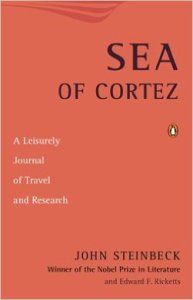
book beginnings on Friday: Sea of Cortez: A Leisurely Journal of Travel and Research by John Steinbeck and Edward F. Ricketts

Thanks to Rose City Reader for hosting this meme. To participate, share the first line or two of the book you are currently reading and, if you feel so moved, let us know what your first impressions were based on that first line.

sea of cortez

I am feeling good to have finally found time to open a big fat Steinbeck book I have had on my shelves for years (and yes, moved across the country with me). Coauthor Ed Ricketts was, among other things, the model for the character Doc in Steinbeck’s Cannery Row. That was my first Steinbeck, and I loved it, and thus that was my introduction to Ricketts. I have heard about their shared work of nonfiction for years, and spent some time myself on the Sea of Cortez, kayaking by day and sleeping on the beaches of Baja by night. So, much to look forward to here.

The very first lines paid off.

The design of a book is the pattern of a reality controlled and shaped by the mind of the writer. This is completely understood about poetry or fiction, but it is too seldom realized about books of fact. And yet the impulse which drives a man to poetry will send another man into the tide pools and force him to try to report what he finds there.

I have been studying creative nonfiction writing for a while now (aside from reading and appreciating it), so this concept really struck me. I knew I could count on Steinbeck. Now when will I find the time for East of Eden?

Teaser Tuesdays: Mink River by Brian Doyle

Teaser Tuesdays is a weekly bookish meme, hosted by MizB of Should Be Reading.

mink river

Totally unsurprisingly, I am thrilled to be back with Brian Doyle, this time in audio format. Mink River is like Martin Marten in that it examines a small town on the northern Pacific coast, and all its inhabitants, human and otherwise. Whimsical is a good word for Doyle, I think. I’m only a short way in but these lines struck me:

Of course, there are many other people in Neawanaka, so very many. Old and young and tall and short and hale and broken and weary and exuberant. So very many it would take a million years to tell a millionth of their lives, and we don’t have the time, worse luck, for their stories are riveting and glorious and searing. But ah, let us choose two…

I am convinced of this concept, that all creatures’ stories are worth telling, if only we could get to them, which we can’t, not all of them. And isn’t the idea well expressed here? Doyle still recommended.

book beginnings on Friday: The Rarest Bird in the World: The Search for the Nechisar Nightjar by Vernon R. L. Head

Thanks to Rose City Reader for hosting this meme. To participate, share the first line or two of the book you are currently reading and, if you feel so moved, let us know what your first impressions were based on that first line.

Today, a fanciful and wondering story of birdwatching in our strange world. It begins:
rarest bird

Eyes are for searching, and sometimes the search is for eyes in the night. I blinked, turning my cheeks to the dusty mud. Shapes slid before me, slicing like the shadows from a tent, stealing bits of shine.

It was an elemental evening in Ethiopia.

Among other things, I have enjoyed encountering places in this book – like Galveston Island State Park (where I have played since I was a baby, and where a dear friend works as park interpreter today), and Haleakala, a mountain in Hawaii that I have ridden a bicycle down (but not up). Stay tuned…

This quotation comes from an uncorrected advance proof and is subject to change.

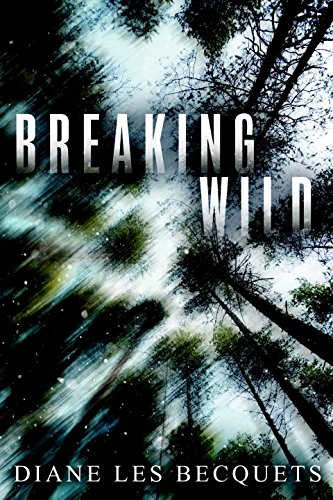
Maximum Shelf: Breaking Wild by Diane Les Becquets

Maximum Shelf is the weekly Shelf Awareness feature focusing on an upcoming title we love and believe will be a great handselling opportunity for booksellers everywhere. The features are written by our editors and reviewers and the publisher has helped support the issue.

This review was published by Shelf Awareness on December 9, 2015.
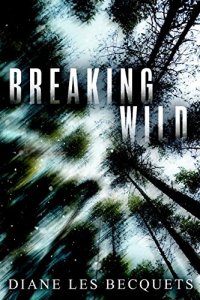

breaking wildBreaking Wild is the first adult novel by Diane Les Becquets, author of highly praised young adult novels including Season of Ice and The Stones of Mourning Creek. Carefully crafted characters and measured pacing define this tale of two women’s parallel personal journeys in the wilderness of northwestern Colorado.

Amy Raye Latour is a wife and mother, an accomplished outdoorswoman and a strong personality. She is on a camping and hunting trip with two male friends. The men have brought down elk with rifles, but Amy Raye hunts with a compound bow; she needs to get away from her companions to find the stillness and quiet required to get close enough to her prey. So she sneaks away from camp on their last morning, with only a light pack. When she doesn’t show up again that night, her friends call local authorities.

Pru Hathaway lives in the nearby town of Rio Mesa with her teenaged son, Joseph, and her dog, Kona. Pru is an archeological law enforcement ranger with the Bureau of Land Management; Kona is certified for search-and-rescue, including avalanche conditions. The sheriff, Colm McCormac, is a friend; when he gets the call about Amy Raye, he turns to Pru.

The personalities of the two women shape the novel: they are both more complicated than they seem on first meeting, and while they are very different, both have concealed and storied pasts. One of Les Becquets’s triumphs is the tantalizingly paced release of new information: about Pru’s personal history, about Amy Raye’s troubles and the tangled web of her life, any strand of which may be implicated in her disappearance. Similarly meticulous is the build-up to Pru and Amy Raye’s expected meeting. This is the story of a chase: Pru and Kona pursue Amy Raye through the backwoods, tracking her movements through drifting snow and rugged terrain, hoping to find her before she succumbs to a mountain lion or the harsh winter conditions. As one party makes a move, the other makes a corresponding move, and the pressure increases. Breaking Wild is not only a masterpiece of characterization, but a feat of taut anticipation and suspense.

Somewhat relieving this tension are flashback interludes to Pru’s and Amy Raye’s respective histories, and the personal dramas of the present timeline. Pru’s son, Joseph, although not entirely untroubled, is a sweet young man; he wonders if Pru and the sheriff–himself an intriguing minor character–should date. Amy Raye’s marriage is not without its cracks, a situation perhaps symbolized by the description of her hunting in the early pages: her husband prefers to shoot with a camera, and has asked her not to keep guns in the house. Thus she uses the compound bow instead, and it is this choice that causes her to leave camp alone in the first place.

Three sections–entitled “Bear,” “Cougar” and “Deer”–further shape the book; chapters within those sections alternate between Pru’s first-person perspective and a third-person view of Amy Raye’s experiences. This format is telling. The natural landscape of northwestern Colorado is a pivotal feature, the backdrop that sets the stakes for a spectacle of life and death, informing every detail, every decision made. Both Pru and Amy Raye repeatedly note the temperature and humidity level, the wind strength and direction, in judging where, when and if to travel. When Pru first tells Kona to “go find,” on page 36 of more than 300, the reader knows that Amy Raye will not be so easily located. From then on, animal life and nature’s rhythms are increasingly crucial to Amy Raye’s subsistence. Is she hunting, or being hunted? She has gone into the wild seeking something undefined: “In that moment she felt everything–life, death, the tangy sweet smell of pine, the freshness of the rain. It was the immensity of those feelings that drove her mad at times.”

While the niceties of backwoods survival are fully developed, the drama of the natural world is less central to the story than the human dramas. The travels of Amy Raye and Pru give them room to grow, and to ask and answer questions of how to love; what a healthy relationship looks like; the nature of addiction; and the meaning and forms of family and community. Indeed, part of what Amy Raye has gone into the woods to find is a connection to her past; Pru found solace in the outdoors when she suffered a personal tragedy. So the two threads of the story–family and community, natural wilderness–intertwine, just as the lives of two women do.

Les Becquets portrays a credible and compelling cast of characters, especially the two strong women at its center. Breaking Wild is a rare novel in its mastery of both plot and character, with deliberate rhythm, thrilling suspense and a striking backdrop. Its breathless momentum carries through to a dramatic conclusion.


Rating: 7 arrows.

Come back tomorrow for my interview with Les Becquets.

reread: Pieces of White Shell by Terry Tempest Williams

pieces of white shellThis memory from my childhood was every bit as good this time around. Terry Tempest Williams is a curator at the Utah Museum of Natural History in the early 1980’s, and in encountering Navajo people and their stories, she begins to learn her own natural history, her own and her (Mormon) culture’s connections to the earth, and how to find and tell stories herself. The tone is fanciful, but also grounded in the literal ground of her local environment in the Utah desert. In her first chapter, she shakes a small leather pouch out onto her desk and finds a sprig of sage; rocks, sand, and seeds; turquoise, obsidian, coral; pieces of white shell; yucca; a bouquet of feathers bound by yarn; coyote fur; a bone from Black Mountain; deerskin; wool; a potshard and some corn pollen; and the Storyteller, a clay figurine from Jemez. These objects, collected during her communion with people and place, form the chapters of her book. I’m not sure whether to call these stories or essays; they are both. There is an element of dreaminess: she is sure she heard the drums of the Anasazi, and tells of transforming into Flea to hide out and listen to the stories the animals tell on Black Mountain. These are not literal truths in the scientific world as we understand it. Does that make these stories fiction? Allegory? Spiritual journeys? I’ll leave it to you. I am not a spiritual person by any standard definition, but Terry Tempest Williams holds me in thrall. This book is still the one of hers that touches me most deeply.

I don’t know how many times I read this book as a child, but it clearly made a deep impression on me. Several lines echoed like I just read them yesterday, or like I’d copied them into countless margins and scrawled them in notebooks over the years. “How could I tell him the mind creates those things that exist. I couldn’t, and so I concentrated on birdlife to avoid a confrontation.” “No one culture has dominion over birdsong. We all share the same sky.” “If we all live, and continue to increase as we have done, the earth will soon be too small to hold us, and there will be no room for the cornfields” (says Coyote in one of the Navajo stories). And new lines jumped out at me on this reading. Because I’m working on processing my relationship with place: “Sometimes you have to disclaim your country and inhabit another before you can return to your own.” “Each of us harbors a homeland. The stories that are rooted there push themselves up like native grasses and crack the sidewalks.” Like all the best books, then, I’m continuing to discover it.

The stories Williams tells in each chapter of this book are from her life, living and working at the very four corners of the four corners states. A Utah Mormon, she gets to know the Navajo and their stories, and sees certain similarities between these two cultures which share a place. She explores Navajo stories and the storytelling tradition, the animals and plants and places they interact with, and uses these to map her own life; she explores story as tool for communication, history-building, and wise and respectful relationships with our earth, and its human and nonhuman inhabitants. In reading these stories, as a child, I was enchanted by the stories of animals like Coyote, Bear, and Badger, and characters like Monster Slayer and Child-of-the-Waters, who were twin sons born to Sun and Changing Woman. I learned about the flora and fauna of New Mexico and Utah deserts (quite exotic to me then, and now). In rereading the same stories as an adult, I get more of Williams’s search for answers about the world, about her family, her homeland, its significance, and her spiritual and cross-cultural questions. It is a rich experience.

My mother asks if this is a children’s book. I did first find it as a child and loved it then, in elementary school. Its origins in my family are unknown; I feel like it just appeared on a bookshelf. Someone must have bought it – for me specifically, it seems likely. I am an only child. But we don’t know. Neither of my parents remembers it. As it turns out, Pieces of White Shell is not marketed as a children’s book. But Williams worked with children (as well as adults) when she wrote it, and in the stories she tells. It is certainly accessible to a child, in its tone of wonderment and simple joy and careful observation.

This was published in 1984, and Refuge in 1991, and I can see some of the evolution. In Pieces of White Shell, Williams is still getting to know her world; in the later work, she more confidently moves in it and speaks of it, although she has retained her capacity for wonder (still alive and well in her recent retelling, The Story of My Heart). Refuge is also necessarily much sadder, as it studies personal loss while Pieces of White Shell takes pleasure in discovery.

Terry Tempest Williams was and is a remarkable, completely singular voice. “You always hear wings,” her family tells her in an anecdote in her prologue. I marvel, and I continue to learn from this deceptively simple grouping of stories. She is better known for other works but this is still my gold standard.


Rating: 9 coyotes.

Thunder & Lightning: Weather Past, Present, Future by Lauren Redniss

Superb illustrations accompany fascinating tidbits about weather and the world in this lovely, distinctive book.

thunder lightning

Lauren Redniss (Radioactive) offers a gorgeously rendered and singular piece of work with Thunder & Lightning: Weather Past, Present, Future. Her original artwork is stunning, dreamy and evocative, the perfect complement to facts about weather and carefully selected interview excerpts and quotations.

Redniss’s “Note on the Art” describes her media: copper plate photogravure etchings and photopolymer process prints, hand-colored, and a few drawings in oil pastel. She comments on the artistic tradition that inspired her: artist/scientists whose devotion to precision and accuracy have historically paired with “a sensation of strangeness, wonder, terror.” Her work is certainly worthy of that tradition; drawings of wildfires recall Picasso’s Guernica, and the chapter entitled “Sky” contains only striking illustrations and no text. These drawings are both otherworldly and very much of our world.

Redniss’s text, based on scientific research and cultural traditions, riffs on weather phenomena rather than offering a comprehensive study. Her chapters cover conditions (cold, rain, heat, fog) as well as concepts (dominion, war, profit), and span the planet and various peoples throughout history. She considers weather that has been blamed on witches or credited to gods; the use of cloud seeding as a weapon by the United States against Vietnam; and weather derivatives and insurance. Redniss’s subjects are quirky and entertaining; her chapter “Forecast” is as concerned with the Old Farmer’s Almanac as with the National Oceanic and Atmospheric Administration. That tone of marvel and whimsy, plus exquisite illustrations, make Thunder & Lightning both remarkably beautiful and pleasingly informative.


This review originally ran in the November 10, 2015 issue of Shelf Awareness for Readers. To subscribe, click here, and you’ll receive two issues per week of book reviews and other bookish fun!


Rating: 8 gorgeous interpretive hand-colored prints.

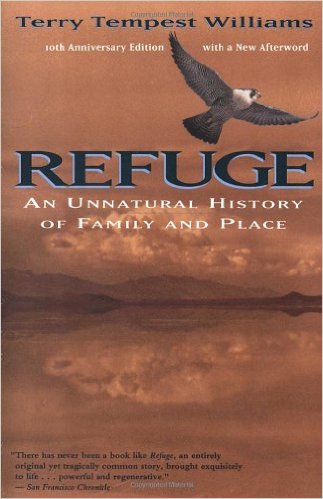
Refuge: An Unnatural History of Family and Place by Terry Tempest Williams

I am slowly, painfully discovering that my refuge is not found in my mother, my grandmother, or even the birds of Bear River. My refuge exists in my capacity to love. If I can learn to love death then I can begin to find refuge in change.

refugeWhen I read this book, I was continually reminded of the first Terry Tempest Williams book that I loved, as a child: Pieces of White Shell. I knew immediately that I would need to follow this book with a reread of that one. For me, Refuge is the more personal, more intimate, more grown-up and more exacting version of the kinds of things I found in Pieces of White Shell. I think I found this one more difficult, more thought-provoking and challenging; the other was both sparer, and offered clearer, more accessible comforts. Refuge is stripped, exposed pain. If there are balms for its wounds, they are more complex. Pieces of White Shell is metaphorical, symbolic, spiritual, seeking wisdom and humbly finding some of it; Refuge is bared emotions and loss. It is many birds. Each chapter is headed by the name of a bird – burrowing owls, killdeer, sanderlings, avocets and stilts, on and on – and by a level of Great Salt Lake.

Over the years in which the story of Refuge takes place, Great Salt Lake rises beyond its usual depths and boundaries. I learned in this reading that this Lake is shallow and covers a great area; therefore a few feet of rise can cover miles, and cause great destruction. Terry Tempest Williams saw her mother die of cancer as she saw her beloved Bear River Migratory Bird Refuge overtaken by saltwater, the birds displaced and many of them lost. In Refuge, she meditates on both losses and the relationship between them, how the Refuge offers refuge to her and to her mother, how they are linked – birds and women (clearly presaging her later When Women Were Birds), people and place (Terry’s Mormon family with the Great Basin and Utah), the cancer that runs in her family (“the clan of one-breasted women”) and their home (neighboring nuclear test sites).

Refuge involves nature, of course, and Terry educates us with precision about the birds she loves. It involves people, and society, and our interactions. It is beautifully written, with poetry, and with liberal gaps in which the reader may draw her own connections. Terry has an imaginative and generously interpretive mind, more so than mine.

The cancer process is not unlike the creative process. Ideas emerge slowly, quietly, invisibly at first. They are most often abnormal thoughts, thoughts that disrupt the quotidian, the accustomed. They divide and multiply, become invasive. With time, they congeal, consolidate, and make themselves conscious. An ideas surfaces and demands total attention. I take it from my body and give it away.

She finds wisdom in the world, as her mother and grandmother did; and of course, centrally, she finds refuge, which is not quite to say recovery or redemption, although those arguments can be made.

Terry Tempest Williams is a lovely writer. The story of her mother’s life and death, their relationship, and the difficulties and beauty of letting go, are all well accompanied by the pain and beauty of the migratory birds of the Great Basin that Terry knows well.


Rating: 7 phalaropes.

Teaser Tuesdays: Refuge by Terry Tempest Williams

Teaser Tuesdays is a weekly bookish meme, hosted by MizB of Should Be Reading.

I am pleased to have found the time, finally, to pick up more work by Terry Tempest Williams. Refuge is her well-regarded memoir of her mother’s life and death within the region of Great Salt Lake, in Utah.
refuge

Today I chose a few lines that not only tell succinctly what this book is about, but speak to me personally as I work through my own relationship to place.

Most of the women in my family are dead. Cancer. At thirty-four, I became the matriarch of my family. The losses I encountered at the Bear River Migratory Bird Refuge as Great Salt Lake was rising helped me to face the losses within my family. When most people had given up on the Refuge, saying the birds were gone, I was drawn further into its essence. In the same way that when someone is dying many retreat, I chose to stay.

I am, of course, very excited about this book, as Terry Tempest Williams consistently impresses me. I am also already planning to reread one I loved as a kid: Pieces of White Shell. So look out for that one to come.

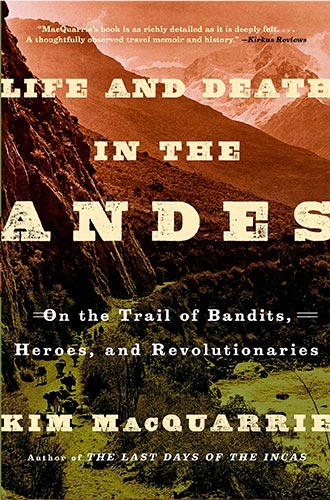
Teaser Tuesdays: Life and Death in the Andes by Kim MacQuarrie

Teaser Tuesdays is a weekly bookish meme, hosted by MizB of Should Be Reading.

I am loving Life and Death in the Andes. It’s a moderately fat book at nearly 400 pages, but never less than captivating in all its various stories. Stay tuned for my review to come in December.

andes

Today’s teaser is, of course, related to a sense of place.

“It is the fate of every voyager,” Darwin wrote later in his autobiography, “[that] when he has just discovered what object in any place is more particularly worthy of his attention, to be hurried from it.” Right now, however, Darwin was so upset he could hardly eat.

Why was Darwin so upset? It wasn’t seasickness, although his early days on the Beagle were beset by that complaint. No, he was dismayed to discover after the fact that he wasn’t such a professional naturalist, after all. Do pick up this engaging history to learn more!

This quotation comes from an uncorrected advance proof and is subject to change.

Maximum Shelf: The Annihilation of Nature: Human Extinction of Birds and Mammals by Gerardo Ceballos, Anne H. Ehrlich and Paul R. Ehrlich

Maximum Shelf is the weekly Shelf Awareness feature focusing on an upcoming title we love and believe will be a great handselling opportunity for booksellers everywhere. The features are written by our editors and reviewers and the publisher has helped support the issue.

This review was published by Shelf Awareness on September 23, 2015.


annihilation of nature
Three academic scientists–Anne H. Ehrlich and Paul R. Ehrlich of Stanford University and Gerardo Ceballos of National Autonomous University of Mexico–come together in a plea to halt Earth’s sixth mass extinction. The attractive, large-format The Annihilation of Nature: Human Extinction of Birds and Mammals contains original illustrations by Ding Li Yong and 83 color photographs to accompany the authors’ heartfelt arguments about the value of global and regional biodiversity and the danger of extinction that currently faces so many species.

As stated in the preface, the goals of this project are to share the dire conditions with the general public, and convince that audience of the relationship between the continuing health of these diverse species and human well-being. In pursuit of these objectives, the authors have chosen to highlight mammals and birds specifically, because they are visible, sympathetic and thus likely to appeal to human compassion. The Annihilation of Nature is plainly written, well-organized and filled with arresting images.

Ceballos, Ehrlich and Ehrlich begin by describing the incredible richness of Earth’s diverse forms of life, which they call a “legacy”–humanity’s duty to protect and appreciate. They outline the planet’s previous five waves of mass extinction and their natural causes, making the point that the present sixth event is different in that it is caused by human actions. The current time period is called by many scientists “the Anthropocene,” in which “a huge and growing human population has become the principal force shaping the biosphere (the surface shell of the planet’s land, oceans, and atmosphere, and the life they support).” To illustrate the interrelatedness of human actions with every natural system, basic concepts such as the food chain are reviewed. The bulk of the book is then devoted to four chapters on extinct birds, endangered birds, extinct mammals and endangered ones. A combination of illustrations and photographs brings the reader’s attention to the long-gone dodo and the passenger pigeon, and species in need of conservation like the Philippine monkey-eating eagle and the New Zealand kakapo (a nocturnal flightless bird). Extinct mammals include the baiji–a freshwater dolphin endemic to China, called the “goddess of the Yangtze”–and the Tasmanian tiger, a marsupial predator with several unique physical features including striped patterning and rearward-facing pouches on individuals of both sexes. Mammals in danger today include a variety of large species: whales, big cats (lion, tiger, cheetah), bears, apes, rhinoceros and elephants, joined by the small but scrappy Tasmanian devil.

All life forms in an ecosystem are intricately interconnected. When gray wolves were reintroduced to Yellowstone National Park, their impact was profound and widespread: elk populations came under control and trees such as aspen, willow and cottonwood began to recover. The health of the willow helped beavers to rebound and beavers in turn improved riparian conditions and contributed to healthy populations of fish, waterfowl, amphibians and reptiles, as well as regulating stream flow. Songbirds have returned to the park in greater numbers with its new tree growth. Smaller predators have declined in numbers, which in turn increases numbers of small prey and then of mid-level predators like foxes and bald eagles. All these benefits came from the reintroduction of one keystone predator.

Having shared the remarkable and evocative profiles of so many creatures, the authors make their central point in chapter 8, “Why It All Matters.” Here they lay out the many human-caused factors that contribute to species extinction and population extinction, including habitat destruction; chemical pollution and plastic debris; the introduction of non-native species and diseases; legal hunting and illegal poaching for meat or valued body parts such as tusks, horns and organs; and killing because of competition for food sources (the Sumatran orangutan, which vies with farmers for fruit) or because some species are seen as pests (crop-raiding Asian elephants) or predators of livestock (the gray wolf). Finally, climate change is deemed a major cause of ecological upheaval and extinction. If forced to choose a number-one factor, the authors name toxic pollutants, but climate change “may be the most threatening problem ever faced by humanity” and “climate change alone could be sufficient to finish the sixth great extinction now under way.”

Finally, Ceballos, Ehrlich and Ehrlich argue that biodiversity must be valued and protected for many reasons, from the aesthetic and ethical through the services they provide to the world’s ecosystems and to humans: dispersal of seeds, insect and pest control, pollination and the sanitation role of scavengers such as vultures. Keystone species are described as those with an outsized impact on their environment. In an impassioned final chapter, the authors touch on means to conserve threatened species, including the question of direct or personal action versus institutional change. They consider ethical questions, such as whether to allow limited sport hunting of African elephants to help fund their conservation, and end with a message of hope, despite the dire picture painted by most of the book. “If we could just adopt a global policy of humanely and fairly limiting the scale of the human enterprise, gradually reducing the population size of Homo sapiens, curtailing overconsumption by the rich (while increasing needed consumption by the poor), then we might leave some room for the natural systems all humanity depends on.”

The Annihilation of Nature shows a deft hand with the complexities of its subject, as when wind turbines–good for the reduction of fossil fuel use–turn out to threaten insectivorous bats and the endangered California condor, or in discussing the economic inefficiency of allowing a species to die off to the brink of extinction (or even paying subsidies to kill them, as with the black-tailed prairie dog) and then spending millions to conserve the same species. This is a beautifully produced, deeply moving, powerful story that communicates what it intended to, with great emotional impact.


Rating: 7 extant individuals.

Come back on Monday for my interview with Paul Ehrlich.