The Eyre Affair by Jasper Fforde (audio)

eyreaffairThe Eyre Affair is the first in the Thursday Next series of bookish mysteries by Jasper Fforde, and I am pleased to have discovered it. The alternate world inhabited by Thursday Next (our protagonist) is ingeniously imagined, fully realized, and great fun: centrally, books are very, very important, and justify an entire branch of law enforcement (which is, admittedly, sort of a stepchild in the law enforcement community, but we’ll take it). Extinct species have been recreated through genetic engineering: Thursday has a pet dodo bird named Pickwick. In a sobering parallel to reality, the Crimean War is ongoing; Thursday opposes it, having served, herself, and having lost her beloved brother in action. Wales is an independent republic. And on, but you get the picture: Fforde is a fine worldbuilder, and his is a world both hilarious and serious.

Thursday works as a LiteraTech, one of those book-police, and is still scarred by her experience in the Crimea, and the loss of her brother there. She remembers fondly her former fiancé, who lost a leg in the same battle, but can’t quite be with him, for reasons we have to learn as the book unfolds. Her father is a time traveler, put briefly, and we get occasional time-stopping visits from him which also color the alternative universe Thursday dwells in. She finds herself a villainous opponent in Acheron Hades, her former college professor and now professional criminal extraordinaire. He has special powers (appearing in various forms, impervious to gunshot wounds) and Thursday is uniquely able to combat him, although not without personal injury and great risk. Their conflict takes Thursday back to her hometown, where we meet her delightful inventor uncle Mycroft (he of the bookworms), and witness the (clearly inevitable) reunion with the former fiancé.

The genius of The Eyre Affair, in case I have not sufficiently made this point, is the world that Fforde creates. All the little details are charming, fun, and silly in the best possible way; the characters are likeable and real. Thursday’s trauma as a war veteran is believable and makes her a fuller character. Her uncle is sweetly flawed and fabulous. Only Landen, the former fiancé, might be a little saccharine; and this is the book’s only real shortcoming: where Fforde digresses into romance he tends to be a little too sweet. His skill is not particularly apparent in terms of plot. The mystery story is fine, passable, amusing – and the villain is deliciously evil, taking pleasure in evil for its own sake – an adequate vehicle for the characters and worldbuilding that are Fforde’s greatest strengths. The love story is a little bit pat, but who cares? Give me more Thursday Next, set in this outrageously entertaining alternate universe, and I will be happy. Oh, and audio reading by Susan Duerden is fun and perfect; I will be looking for her reading of the next book in the series as well.


Rating: 7 dodos.

Teaser Tuesdays: The Eyre Affair by Jasper Fforde

Teaser Tuesdays is a weekly bookish meme, hosted by MizB of Should Be Reading. Anyone can play along! Just open your current read to a random page and share a few sentences. Be careful not to include spoilers!

eyreaffair

Sorry. I know I just teased you with this one recently, but it’s simply too much fun. See:

He patted the large book that was the Prose Portal and looked at Mycroft’s genetically engineered bookworms. They were on rest & recuperation at present in their goldfish bowl; they had just digested a recent meal of prepositions and were happily farting out apostrophes and ampersands; the air was heavy with them.

How could I have passed up the meal of prepositions and the farting of apostrophes? I ask you. Great fun, this world of Thursday Next!

Happy reading in 2013, kids! Year-in-review post coming later on today.

The Black Box by Michael Connelly

Harry Bosch’s investigation into a 20-year-old murder linked to the Rodney King riots and the first Gulf War is set to a moody jazz soundtrack.

The Black Box, Michael Connelly’s 25th novel, comes 20 years after his first, The Black Echo, which introduced readers to Los Angeles detective Hieronymus (Harry) Bosch. These days, Bosch is working with the LAPD’s Open/Unsolved Unit, and he decides to pursue a 20-year-old case that was originally his: the murder of Danish photojournalist Anneke Jespersen during the 1992 riots. Bosch never got a chance to investigate thoroughly–but, as regular readers know, Bosch never gives up. As he pursues the reason Jespersen came to Los Angeles in the first place, he finds himself investigating war crimes dating back to Desert Storm. Searching for the “black box” that will reveal the recorded secrets of Jespersen’s murder, Bosch also lands (not unusually) on the wrong side of the police department’s leadership.

All the strengths that Connelly’s readers have come to expect are on display. He employs an expert sense of place in evoking a gritty, stark Los Angeles, and the mood of the novel is dark and brooding. The pacing is taut, the characters well developed. Bosch’s side interests in jazz artists like Art Pepper and baseball greats like Casey Stengel provide depth and layers to his personality. Series readers will enjoy the updates on ongoing story lines, as Bosch’s daughter, Madeline, continues to mature and his relationship with girlfriend Hannah struggles along. But like all Connelly’s atmospheric, fully realized novels, The Black Box can also be read as an entirely satisfying stand-alone mystery.


This review originally ran in the December 14, 2012 issue of Shelf Awareness for Readers. To subscribe, click here, and you’ll receive two issues per week of book reviews and other bookish fun!


Rating: 6 furrowed brows.

Teaser Tuesdays: The Eyre Affair by Jasper Fforde

Teaser Tuesdays is a weekly bookish meme, hosted by MizB of Should Be Reading. Anyone can play along! Just open your current read to a random page and share a few sentences. Be careful not to include spoilers!

For those unfamiliar with Jasper Fforde, he writes unique fantasy or alternate-reality mystery novels that take place in a world of books. I read his The Big Over Easy years ago, about the eyreaffairpushing of Humpty Dumpty over the wall; this is my first (and the first) of his Thursday Next series, in which a character by that name (yes, Thursday) works as a Literary Detective. Here’s a tease from the early pages:

…no one was taking any chances since a deranged individual had broken into Chawton, threatening to destroy all Jane Austen’s letters unless his frankly dull and uneven Austen biography was published.

What I think is charming about this story is the world in which books, and art, matter as much as anything does. It’s great fun for those of us who love books, to imagine a world that shares our value system. Also, because cloning and genetic engineering has come so far in Thursday’s alternate world, she has a pet dodo bird named Pickwick, and that’s pretty cute, too.

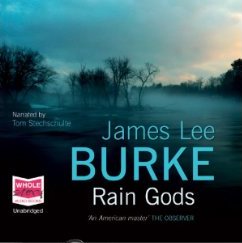
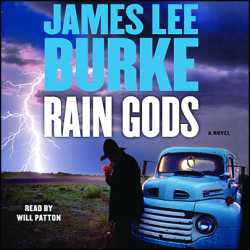
Rain Gods by James Lee Burke (audio)

raingodsJames Lee Burke is best known for his series of mysteries starring Detective Dave Robicheaux, who makes his home in New Iberia, Louisiana and whose adventures mostly take place there (or in New Orleans, or – in one case that I know of – in Montana). But he does write other books: I read a western a while back. Rain Gods is the first Burke I’ve read that stars Hackberry Holland, sheriff of a small Texas border town that I am pretty sure remains unnamed.

As the book opens, Hack has just discovered a shallow grave filled with illegal immigrants behind a church, and a young man named Pete Flores, a veteran of the war in Iraq, flees town with his girlfriend Vikki. They fear the team of professional criminals that were involved with the shooting, but the threads of the case are quickly so thoroughly intertwined that Pete himself doesn’t know who they’re running from. Between a New Orleans crime boss, a bumbling Texas strip club owner, a psychopathic hit man who thinks he’s the left hand of God, and a couple of young lackeys whose loyalties are yet to be tried, Hack and his deputy Pam Tibbs have their hands full in trying to solve the murder and protect Pete and Vikki. And they may still be working out the relationship they share, to boot.

As in any good mystery story, some subplots come out sooner than others. The man they call “Preacher,” who somehow thinks God is supportive of the mayhem he creates, is an enigma of pure evil; but he’s not the only one whose motives are unclear (or irrational). The romance that Pete and Vikki share is a welcome sweet note; and Hackberry’s storied past and accumulated guilt are a familiar but still satisfying facet. The fact that both Pete and Hack are still processing their experiences in war (Iraq and Korea, respectively) is a sobering note of reality that draws the two generations together effectively.

I don’t feel that Rain Gods is Burke’s finest work; I found it a little bit slow-paced. But it had all the hallmarks that I come to Burke for. Our hero is damaged and has committed great wrongs, but is essentially good. The setting is strongly evoked – and I liked it particularly, as the plot mostly takes place in West Texas borderlands, a location I’m fond of and fairly familiar with. And Preacher’s character is quite frightening – as he was intended to be.

The audio narration by Tom Stechschulte is excellent. I love the different voices he does – especially because there’s such a collection of characters featured here, with different accents and tones of voice that express emotions and pain and insanity. This audio format deserved a fine portrayal, and it got one.

I will be reading more James Lee Burke. But I may prioritize the Robicheaux novels.


Rating: 6 delusions.

Teaser Tuesdays: Rain Gods by James Lee Burke

Teaser Tuesdays is a weekly bookish meme, hosted by MizB of Should Be Reading. Anyone can play along! Just open your current read to a random page and share a few sentences. Be careful not to include spoilers!

raingods

James Lee Burke is always wonderful. Of all the attractive quotations to tease you with, I couldn’t resist this literary allusion…

Cassandra had been given knowledge of the future and simultaneously condemned to a lifetime of being disbelieved and rejected. The wearisome preoccupation of the elderly – namely, the conviction that they had already seen the show but could never pass on the lessons they had learned from it – was not unlike Cassandra’s burden, except the anger and bitterness of old people was not the stuff of Homeric epics.

…especially when fused with wistful musings on age and its trials.

What are you reading this week?

The Adventures of Sam Spade (audio)

Here’s an interesting one for you. I had to do a little research to figure out exactly what I have here, and I’m still unclear on a few issues. Please pardon my rather lengthy introductory remarks.

Sam Spade is a character created by Dashiell Hammett in The Maltese Falcon, which I have not read but very much want to. Dashiell Hammett shares some early pulp-classic mystery genre credit with Raymond Chandler, who I have read (just a little) and enjoyed; also, Hammett was partner to Lillian Hellman for some 30 years. “The Adventures of Sam Spade” was a radio series in the 1940’s through 1951, based on Hammett’s character, but I think that Hammett was uninvolved (or marginally involved) in the radio version. His name (says Wikipedia) was removed from the show when his association with the Communist Party became known.

This three-cd set presents six episodes of the radio show, “digitally remastered” and “including never-before-released episodes” – I take it to mean these are original recordings, then, although I haven’t been able to confirm that in my (casual) online research. They do include advertisements for Wildroot Creme Oil, a hair product that was the show’s sponsor. These advertisements are initially somewhat charming in being period pieces, but they are many, and like any advertisement, they get old. Again, this speaks to the authentic feel of the production.

So what about the stories? The six episodes are… “The Insomnia Caper” (1948), “Sam and the Psyche” (1946), “Love Letter” (1949), “The Overjord Caper” (1949), “The Bow Window Caper” (1947), and “The Charogagogmanchogagogchabuna-mungamog Caper” (1949). Howard Duff plays Sam Spade and Lurene Tuttle plays his secretary Effie. These are radio shows rather than your average audiobook, so they include sound effects – gunshots, breaking glass, revving engines, traffic noise – and not just reading of the stories; rather than a single narrator doing voices for different characters, various actors play each character. This is classic pulp stuff, and it’s great fun. There is a definite element of tongue-in-cheek (at least that’s my reading, I can’t speak to the original intent, and the 1940’s are pretty remote to me, but surely…?) in Sam’s character: he is the exemplar of the wise-cracking, hard-boiled, tough-guy detective.

Each story tends to involve a person hiring Sam as a PI, often against Sam’s own wishes: in “Love Letter”, he gets a love letter from a woman he doesn’t know and heads to the assigned meeting point to find himself immediately involved in a situation he’d rather have avoided. His clients are as dodgy as any other character in the story; and there is often a woman who tries to seduce (or seduces) Sam, as a means of distracting him from a plot. Howard Duff’s gruff playing of the role is a large part of the effective mood of these stories.

While the plot of each is formulaic and somewhat forgettable, and the characters are rather stock, that needn’t detract from the fun of these stories. Formulas are often successful and that’s why they’re repeated (think about Agatha Christie). As a regular listener to audiobooks, this radio format that came with multiple actors and sound effects was a refreshing change. The Adventures of Sam Spade is a little simplistic, and definitely easy listening, but great fun, and different from the usual fare.


Rating: 6 double crosses.

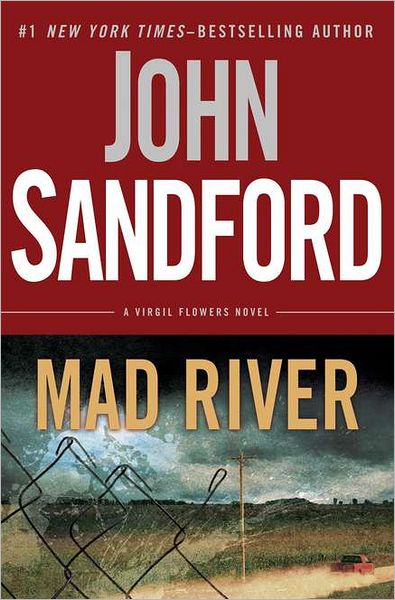
Mad River by John Sandford

A series of bloody murders in Minnesota’s farm country, and the supremely likable detective who will stop them.


John Sandford’s Mad River stars Virgil Flowers, a supporting character in Sandford’s Prey novels who graduated to his own series with 2007’s Dark of the Moon. This sixth installment stands capably alone; series readers will recognize certain characters, but the plot twists and building suspense require no backstory.

Flowers is an investigator for the Minnesota Bureau of Criminal Apprehension called out to the tiny farm town of Shinder to investigate a string of brutal murders, starting with a highway patrol officer. The spree is quickly connected to a trio of local youths, and as the tension mounts and the murders spread across the state, the challenge is to catch the killers before the vengeful local cops get to them. Flowers suspects there’s a connection to something even bigger and needs the killers taken alive.

The central plot is riveting, but strained relations within the law enforcement community, Flowers’s visits with his loving parents and his dalliance with an old flame provide further drama. The story’s travels around the state add local color: expanses of empty farm land make the killers nearly impossible to track. Perhaps the greatest strength of Mad River, though, lies in Flowers himself. It’s hard to think of a more balanced and genial investigative hero, yet he’s still able to keep cops and bad guys alike in line. The bulk of the mystery is revealed fairly early on, though the killers’ motivations and dynamic remain riveting until the final pages–and the ultimate question persists to the tantalizing end.


This review originally ran in the Oct. 12, 2012 issue of Shelf Awareness for Readers. To subscribe, click here, and you’ll receive two issues per week of book reviews and other bookish fun!


Rating: 6 small town cops.

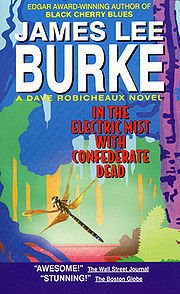
In the Electric Mist with Confederate Dead by James Lee Burke

As noted recently in my book beginning, Burke is an old favorite. Between this book’s title and its colorful cover, I felt especially drawn to it. The electric mist and the Confederate dead are some of the odder, more alluring moments in this story, too, but they are not its center.

Detective Dave Robicheaux is the star of Burke’s bestselling series. In this installment, he’s at home in New Iberia, a small community on the Gulf Coast of Louisiana. There’s a movie production in town, which brings with it various complications of the local scene: a group of gangsters come in from New Orleans; the Hollywood actors drive drunk and make trouble; several girls turn up dead in what looks like the work of a serial killer; and a body surfaces that relates to an event in Robicheaux’s own distant past. He continues to attend AA meetings and his alcoholism continues to be one of the sources of conflict in the story. There are some weird, almost paranormal forces at work – or are they just the manifestations of his alcoholism? – and that keeps things interesting and colorful.

This book shares certain themes with all Burke’s work, including racial injustice that persists in the South; a love of nature (and some outstanding, lovely writing conveying the natural beauties of south Louisiana); struggles with alcoholism; and corruption in positions of authority, manifested in the conflicts Robicheaux has with his workplace superiors. One of Burke’s greatest strengths, in my opinion, is the strong sense of place that he conveys with his lovely, lyrical writing. He waxes poetic about the beauty of nature; and both the natural setting and the cultural references evoke south Louisiana unmistakably. His stories, it seems, could be set nowhere else. (This is not true. Swan Peak is set in Montana and is equally successful. But my point about a strong sense of place stands.) While his plots are interesting and his mysteries do indeed keep the reader on her toes, Burke’s beautiful writing and obvious care for natural and cultural settings are the best and most unique parts of his work. I feel that his closest readalike author is Michael Connelly. Connelly’s writing is not nearly as lyrical, but his strong sense of Los Angeles, and Detective Bosch’s love for jazz and LA, and the dark, brooding mood both authors create, make them a matched pair in my view.

In the Electric Mist with Confederate Dead is vintage (1993), classic James Lee Burke, and thus strongly recommended.


Rating: 7 crawfish poboys.

book beginnings on Friday: In the Electric Mist with Confederate Dead by James Lee Burke

Thanks to Rose City Reader for hosting this meme. To participate, share the first line or two of the book you are currently reading and, if you feel so moved, let us know what your first impressions were based on that first line.

I felt like taking a break in between long-ish nonfiction reads (much as I enjoy those!), and James Lee Burke looked to be the perfect choice: high-quality, easy-reading fiction, tried and true entertainment, and thought-provoking to boot. He’s one of my longtime favorites, and yet somewhat strangely, I haven’t read anywhere near all his work. I’m all out of Michael Connelly and Lee Child until they write more; but there’s plenty of Burke out there I haven’t enjoyed yet, and (thank goodness) he’s still writing, too.

So here we are with In the Electric Mist with Confederate Dead (if that title doesn’t catch your eye I don’t know what will). It begins:

The sky had gone black at sunset, and the storm had churned inland from the Gulf and drenched New Iberia and littered East Main with leaves and tree branches from the long canopy of oaks that covered the street from the old brick post office to the drawbridge over Bayou Teche at the edge of town. The air was cool now, laced with light rain, heavy with the fecund smell of wet humus, night-blooming jasmine, roses, and new bamboo. I was about to stop my truck at Del’s and pick up three crawfish dinners to go when a lavender Cadillac fishtailed out of a side street, caromed off a curb, bounced a hubcap up on a sidewalk, and left long serpentine lines of tire prints through the glazed pools of yellow light from the street lamps.

What a lovely passage, and what an example of what Burke can do. He’s evoked a place, given us smells and colors and the feel of the air; this descriptive first paragraph is just dripping with local flavor. And that final sentence begins the action, too: what on earth is this lavender Cadillac up to? I’ll give you a hint: our narrator is a cop, and therefore likely to get involved.

Still loving James Lee Burke. And what are you reading this weekend?