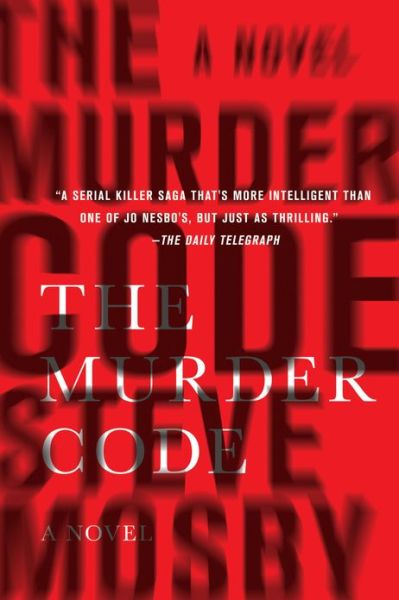
Teaser Tuesdays: The Murder Code by Steve Mosby

Teaser Tuesdays is a weekly bookish meme, hosted by MizB of Should Be Reading.

murder code

I wanted to share these few lines with you because they made me pause and wonder. The Murder Code is a thriller, and on the bloody side at that; but a line here and there hints at humanity, even romance.

Occasionally, it drives him to distraction, bu he also knows it is one of the things he would miss most about her if she was gone: that ultimately we love the rough edges of people more than the smooth surfaces.

And on the next page:

In such ways, he realises, do relationships grow over time. We begin by looking for perfection; we end up by loving flaws.

I found it remarkable that this author of hard-boiled gore also handles love so deftly. I’ve seen it done far less eloquently and realistically in this genre. And I had to stop and consider the truth of the statements.

Well done, Mosby. Stay tuned for my full review to come.

This quotation comes from an uncorrected advance proof and is subject to change.

did not finish: A Killing in the Hills by Julia Keller (audio)

killing in the hillsI made it less than 20% of the way through this audiobook (28 of 156 tracks, if you like to be precise), so on the one hand I should go easy on it, not having read it to completion (or even close). But on the other hand, the fact that I quit so early does indicate my feelings about it.

I read good things about this debut mystery novel – somewhere – but can’t add to those praises. The setting in the West Virginia hills (or mountains) was promising at the start, and I liked the idea of our small-town female prosecutor and her troubled past; likewise her friendly, almost filial relationship with the much older sheriff. But there the character development ended. Our prosecutor hero, Bell, turns rather flat, and her teenage daughter Carla is far worse: a cariacature of the worst kind of whiny teen girl, she speaks in overly-self-aware brattiness, as if she were her own psychoanalyst which – hello – obnoxious teenagers are not. Similarly, the early bad guy is so hideously ugly in every feature as to be a cartoon – how easy to identify bad guys if they all looked like this! And he somehow simultaneously is a stark idiot, and shares Carla’s preternatural self-awareness. The dialog felt like nails on a chalkboard. And so I gave it up. The mystery remains unsolved, for me, and that’s just fine.

Narrator Shannon McManus was sometimes amusing, but sometimes a little overly dramatic (although a certain amount of that falls to the author, for sure). Her rendition of Carla I found unbearable, but that’s squarely on Julia Keller; that’s how Carla was written, I fear.

I’m happy for those who enjoyed this novel, but I am not among them.


Is it fair to rate a book I read this little of? Probably not.

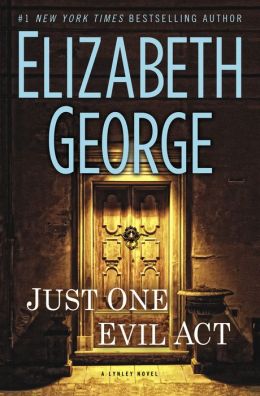
Just One Evil Act by Elizabeth George

evilElizabeth George’s 18th novel starring Detective Inspector Thomas Lynley and Detective Sergeant Barbara Havers of Scotland Yard will be published in mid-October of this year. This series dates back to 1988, and I was introduced to it by my mother; we have both been great fans.

Series readers will of course recognize the two familiar main characters, joined by the likeable Detective Constable Winston Nkata, sundry less sympathetic Scotland Yard superiors, and Barbara’s neighbors, Taymullah Azhar and his daughter Haddiyah. Simon St. James and his wife Deborah, sadly, barely cross the stage in this novel; and of course those readers who have been keeping up with the last 3-4 books in the series will know about the death of Lynley’s wife Helen, whom he is still grieving. As with most series, I think, an integral part of the reader’s enjoyment is in recognizing characters as old friends, and in that sense, it felt good to be back in the company of Lynley – upper class but down-to-earth, flawed and suffering, but trying to make a go of it with a new woman; and Havers – lower class and struggling all around, socially awkward, but devoted to Azhar and Haddiyah.

A brief plot introduction, and then I’ll avoid spoilers as this book is not yet published. Haddiyah’s mother Angelina is back on the scene just long enough to lull Azhar into complacency, and then she takes Haddiyah and runs. Azhar and Barbara together hire a private investigator to try to track the missing daughter, but his rights are limited: he was never listed on her birth certificate, never married her mother, and his paternity is unproven. Then Angelina turns up in Italy with a new beau, distraught that Haddiyah has been kidnapped from her. Naturally, Azhar is a subject; just as naturally, Barbara is committed to proving his innocence and bringing Haddiyah home.

From a thoroughly charming opening scene in which Lynley tries to charm his new girl by showing up at her roller derby match (!), we mostly stick with Barbara, who is at the zenith of her anti-authoritarianism. Consistently poorly-dressed and disrespectful, and usually described by her superiors as unprofessional, she outdoes herself here. While these are central tenets of Barbara’s character, her total flouting of law and order and disregard for keeping her own job in pursuit of Azhar and Haddiyah’s best interests gets a little outrageous. In prior books I felt that her devotion to the job was also an important part of her character; here, not so much. Her single-minded and, yes, stupid behaviors are at best an abrupt turn in her character’s development, and at worst, inconsistent with the Barbara we’ve come to love.

My criticisms continue. There is an utterly unbelievable beating; an unlikely mix-up of victims; and an indictment of prejudice which is nevertheless upheld, thus seeming to discredit the indictment in the first place. What had been a promising long-term relationship between well-loved characters, building in this series through many books, is thrown out the window in a flash – much like the sudden murder of Helen Lynley a few books ago, leading me to suspect that Elizabeth George enjoys wrenching some of her readers’ favorite characters away from them. Perhaps most infuriatingly, a promising beginning to a romance is left unresolved. This may be intended to keep us hanging on edge for the next book. However, all it did was make me mad. I actually, literally threw this book upon finishing it. (You can ask Husband.) I don’t think I’ve done that before. I’m no reader of romance novels, but I do enjoy a good, realistic, even sappy romantic thread in my thrillers or what have you. I have been teased and disappointed here, and I resent it. I had been doubting and hoping against doubt that George would pull this one through when she dropped the budding love affair, and I am now done with her.

Furthermore, I am not the only one to note that George’s books have been getting longer, and this, I believe, is her longest yet. That’s my awesome editor at the above link, noting that Just One Evil Act weighs in a good bit over 2 pounds. Now, page count is not always a problem – I would like to point to Stephen King’s outstanding 11/22/63 at 850 – but here, George could have written this plot up in 400 pages rather than more than 700, and I think it would have been better done. Her sentences, too, are overlong. Again, you know I have no inherent problem with long sentences. Take my word then when I say that George lost track of her editor in this work.

I regret this loss of a long-term love, but I don’t think I’ll be able to follow Havers and Lynley where they next tread.


Rating: 3 rambling plot threads.

Light of the World by James Lee Burke

Dave Robicheaux and Clete Purcel are joined by their daughters as they battle evil in the hills and valleys of Montana.

lightoftheworld
Light of the World, James Lee Burke’s 20th novel starring Louisiana detective Dave Robicheaux, returns to the Montana hill setting of 2008’s Swan Peak. Fans will be thrilled to find Robicheaux and Clete Purcel joined by their respective adult daughters in a hard-hitting, intense battle between good and evil. Burke’s writing is poetic–reverential in praise of natural beauty, contemplative of human nature–and invokes a strong sense of place. Clete, the rough-and-ready, hard-drinking, softhearted private investigator, is lovable as ever; Robicheaux is the flawed hero who has charmed us from the first, fighting his demons and protecting his clan.

Years ago, Dave’s daughter, Alafair, visited serial killer Asa Surette in prison to interview him for a book she never wrote. Instead, she published a condemning series of articles advocating the death penalty. Later, Surette was killed in a collision with a gasoline tanker. So why is he now lurking around the cabins in Big Sky Country where Robicheaux, Clete and their families are trying to relax? The evil in this powerful story of suspense has supernatural undertones, as wolves skulk in the woods above the ranch and planes fall out of the sky. Alafair teams up with Clete’s daughter, the reforming New Orleans hitwoman Gretchen Horowitz, and they make as remarkable a pair as their fathers. As the story unfolds, a rodeo cowboy who speaks in tongues, a serial killer who should be dead, ex-cons, rapists, bear traps and evil that dwells in caves in the hills all come together in perhaps the greatest showdown of Burke’s career.


This review originally ran in the July 30, 2013 issue of Shelf Awareness for Readers. To subscribe, click here, and you’ll receive two issues per week of book reviews and other bookish fun!


Rating: 8 howls.

Murders in the Rue Morgue by Edgar Allen Poe

Available as 11 pages in quite small type here.

I am 98% sure that I was led to this story by a mention in Judith Flanders’s The Invention of Murder. I’m always up for some Poe; he’s batting 1000 with me. I have a complete works volume on my shelves somewhere; maybe one of these days…

I’m pretty sure the reason I came to this story from the above book is that it is cited as one of the earliest mystery stories in literature, that is, in which a detective (in this case an amateur) puzzles through the clues to come to a conclusion of whodunit. It begins with a fairly lengthy (several long paragraphs) discussion of analytical powers, in which our narrator argues that whist or draughts are both more challenging intellectual games than chess. [I am not familiar with whist or draughts so can’t comment on that.] The point of all this rather cerebral discussion finally becomes clear: the narrator’s roommate, a Frenchman named Dupin, is an analytical genius. He can tell what the narrator is thinking. And he will solve… The Murders in the Rue Morgue.

by Daniel Urrabieta y Vierge [Public domain], via Wikimedia Commons (click to enlarge)

illustration by Daniel Urrabieta y Vierge, via Wikimedia Commons (click to enlarge)

In a tone and a climate I recognize from The Invention of Murder, we learn that a mother and daughter have been brutally killed in their home on the Rue Morgue. All the doors are locked from within, and a very large amount of cash has been left behind, spilled on the floor. The Parisian police are stumped. Dupin, however, reasons through what clues he finds – having been allowed special access to the crime scene, naturally – and comes to a very strange and improbable, but correct, conclusion. Occam’s Razor aside.

The strengths of this short story, as always with Poe, lie in its atmosphere: brooding, dark, melancholy, cerebral. The character of Dupin is not well-rounded or human, but that’s okay. He plays a role. Our narrator is there, Watson-style, to provide a foil for Dupin’s analysis. The solution to the mystery is most strange and enjoyable for its strangeness. Realism this is not.

An enjoyable quick read and a good early example of a genre I love. Well worth a few minutes.


Rating: 8 thick tresses of grey human hair.

The Fame Thief by Timothy Hallinan

Timothy Hallinan’s quirky thief/detective (last seen in Little Elvises) is forced to delve into long-past Hollywood scandals by a nonagenarian crime boss.

famethief
The Fame Thief is Timothy Hallinan’s third novel starring Junior Bender, a professional burglar with a second calling as a crook’s detective–because bad guys need their mysteries solved, too. Irwin Dressler, no less powerful a crime boss for his 93 years of age, hires Junior against his will for a strange 60-year-old case, the theft of a Hollywood actress’s most valuable asset: her fame.

Dolores La Marr was a kid from Scranton, scarcely beginning to make it big in 1940s Tinseltown, when her association with that era’s fashionable gangsters landed her in a nasty, full-color scandal. Strangely, no one but Dolly took the fall, and all these decades later, Dressler still wants to find out who set her up. Junior quickly learns that this mystery is not as dead as it seems, and that some dangers only increase with age.

The refreshingly unassuming Junior is a fun riff on the typical private investigator: his specialty–committing crimes, rather than solving them–brings him an unusual perspective. The elderly Dressler is a fabulous, deadpan wiseguy in “eye-agonizing” golf pants, backed up by two unusually domestic versions of the standard muscled goon. And Junior’s own domestic concerns–a teenage daughter, her jokester boyfriend, an ex-wife and a randy new girlfriend–fill out the eccentric, likable cast. Fast-paced action and a building body count pair nicely with humor in this series, bound to keep the reader coming back for more.


This review originally ran in the July 12, 2013 issue of Shelf Awareness for Readers. To subscribe, click here, and you’ll receive two issues per week of book reviews and other bookish fun!


Rating: 6 slow-speed car chases.

movie: The Long Goodbye (1973)

longgoodbyeThis 1973 film is based on the 1953 book by Raymond Chandler, which I read so long ago (and apparently pre-blog) that I don’t entirely trust my recollections. I’m pretty sure there are significant divergences in movie form from the plot of the book – what else is new.

Raymond Chandler’s 1940’s-50’s private detective hero, Philip Marlowe, has been updated here to fit into 1970’s Hollywood. In the opening scene, Marlowe is awakened by his cat, who insists on being fed at 3 in the morning; upon awakening, the first thing Marlowe does is light up a cigarette, an action we will see repeated ad nauseam. (Husband and I guesstimate that at least 50 cigarettes are smoked in this movie by Marlowe alone. The only times he’s not smoking are when he’s lighting up or in police custody.) He then heads to the 24-hour store for cat food. Still smoking.

and brownie mix, for the hippie neighbor girls

and brownie mix, for the hippie neighbor girls

Marlowe’s friend Lennox asks for a ride into Tijuana following some trouble with his wife; after performing this favor, the cops show up to inform Marlowe that Lennox had just killed his wife, an accusation that Marlowe does not believe. Likewise Lennox’s apparent suicide in Mexico a few days later. Meanwhile, Marlowe takes a case from a ritzy blonde wife of a temporarily missing alcoholic writer who is so Hemingway:
hem
This couple, the Wades, turn out to be tied up with the now-dead Lennoxes. Marlowe’s old-fashioned loyalty to his friend is poorly rewarded. He loses his cat. It’s a sad story.

Despite numerous plot changes from the novel (Wikipedia agrees), and the notable reset to 1970’s California, including violent gangsters and a young Arnold Schwarzenegger I had trouble recognizing, I thought this movie did faithfully reflect the iconic character of Philip Marlowe. I liked the humorous addition of the hippie neighbor girls (topless, with the candles and their yoga, a great distraction to Marlowe’s male visitors) and the (less humorous) gangsters, too. The ending in Mexico was the greatest divergence from the novel but I can appreciate it. Overall, a real win: this film keeps the spirit of the original and updates it somewhat, and great visuals and Marlowe’s pulpy, rough demeanor appropriately take center stage.


Rating: 8 portraits of James Madison.

Teaser Tuesdays: Holy Orders by Benjamin Black

Teaser Tuesdays is a weekly bookish meme, hosted by MizB of Should Be Reading. The idea is to open your current read to a random page and share a few sentences. And try not to include spoilers!

holyorders

This is Benjamin Black’s 6th novel in the series (beginning with Christine Falls) starring Dublin pathologist Quirke, a crusty, curmudgeonly Irishman if ever there were such a one. Take, for example, his reaction to the young new bartender at his usual. (This goes on for a long paragraph.)

He found particularly irritating the way the young man had of throwing up his chin and yanking his fake bow tie to the end of its elastic and letting it snap back with a sharp smack. No, as far as Quirke was concerned, Frankie was exactly what McGonagle’s did not need.

I am amused; although, to be clear, this is more of a dark, weary mystery than a lark. Stay tuned for the review to come closer to the publication date (late August).

This quotation comes from an uncorrected advance proof and is subject to change.

Claire DeWitt and the Bohemian Highway by Sara Gran

A singularly weird and drug-fueled private eye, not for the faint-hearted.

gran

Sara Gran’s Claire DeWitt and the Bohemian Highway gives us a refreshingly bizarre twist on the classic private investigator. Readers of Claire DeWitt and the City of the Dead will recognize Claire’s copious and indiscriminate drug use (she never fails to check a medicine cabinet and pocket the contents; she seeks dealers like she seeks clues) and her generally hard-bitten lifestyle. Similarly unconventional is her somewhat metaphysical style of detection, guided in part by a controversial dead French detective who speaks to Claire through his book.

When Claire’s ex-boyfriend Paul is murdered, and several of his valuable guitars go missing, his wife, Lydia, hires Claire to look into things. A simultaneous case involves a diminishing herd of miniature horses up in Marin County: Claire suspects they may be committing suicide. The action shifts from contemporary San Francisco, where Claire hunts Paul’s guitars and his killer, to the Brooklyn of Claire’s adolescence, where she and two friends once investigated a missing girl. One of those friends will later go missing herself; and the whispers of the missing Tracy, the dead Paul and the possibly suicidal miniature horses haunt Claire as she tries to keep it together and solve a murder through the haze of various uppers and downers.

Strange, distinctive characters are one of Gran’s greatest strengths, coupled with a strong sense of place and a gritty atmosphere of depravity and mysticism. Dark, classic PI adventures with an unprecedented zaniness mixed in make Claire DeWitt a rare reading experience.


This review originally ran in the June 25, 2013 issue of Shelf Awareness for Readers. To subscribe, click here, and you’ll receive two issues per week of book reviews and other bookish fun!


Rating: 8 bumps.

Teaser Tuesdays: Light of the World by James Lee Burke

Teaser Tuesdays is a weekly bookish meme, hosted by MizB of Should Be Reading. The idea is to open your current read to a random page and share a few sentences. And try not to include spoilers!

lightoftheworld

The new Robicheaux novel from James Lee Burke comes out in late July. I am loving it. He’s one of my favorites, although some of his books are better than others (what do we want, that’s true of most of our work, whatever it may be!), and the good news is: this one is wonderful. I had trouble choosing which lovely passage to share with you, but this one won out:

Most GIs hated Vietnam and its corruption and humid weather and the stink of buffalo feces in its rice paddies. Not Clete. The banyan and palm trees, the clouds of steam rising off a rainforest, the French colonial architecture, the neon-lit backstreet bars of Saigon, a sudden downpour clicking on clusters of philodendron and banana fronds in a courtyard, the sloe-eyed girls who beckoned from a balcony, an angelus bell ringing at 6 a.m., all of these things could have been postcards mailed to him from the city of his birth.

Isn’t that something. My mother points out that this will mean more to you if you’re familiar with serial character Clete Purcel, whose hometown is New Orleans. (Obviously.)

And in honor of Dave and Clete, I mixed myself a drink to accompany Light of the World: a riff on a mix that they both enjoy (Dave’s is virgin, I suspect Clete’s is not). Mine included Dr. Pepper, cherry moonshine, orange juice, and was garnished with a Twizzler. Sorry I didn’t take a picture for you!

This quotation comes from an uncorrected advance proof and is subject to change.