reread: the Murderbot series by Martha Wells

After my recent reread of All Systems Red, the first book in the series, I screamed through books 2-7 in less than two weeks. (Yes, that means I read System Collapse twice in under a month.) I’m not going to review them individually because I scarcely experienced them as such on this go. Also: not so much plot summary as praise.

I enjoyed these books the first time around, but found exponentially more pleasure in them this time around. First, having some background with the series allowed me to sink in more quickly and spend less time getting my footing. And second, I read books 2-7 back to back (with a few titles between 1 and 2), so they became a single narrative. As I mentioned just recently in re-reviewing All Systems Red, I am less a natural or ‘native’ reader of sci fi, and needed a little more time to adjust than some readers (Liz?) might. And Martha Wells has a tendency to begin her stories “in scene,” which is often advice writers get – begin already amid the action – and I think it can work very well, and does for Wells, but there is a risk or a cost in that it requires your reader to get on board rapidly. It’s only in this reread that I realize what a poor job this reader did of it the first time. Familiarity has been of great benefit to me here.

I also had the chance to see that Wells is very good at reminding her series readers of what’s happened before (or, less ideally, introducing a reader who’s begun mid-series to what is happening). This is very tricky: over-explain and you’ve taken the reader out of the book; under-explain and they’re lost. I think she has a deft hand at the quick aside that does that job neatly. (It helps that these books are billed as Murderbot’s diaries, so that it can address the reader directly and say things like “remember when this happened before?” pretty naturally.) I found on this read that each book builds really nicely on what’s come before, not just in plot elements and characters but in terms of worldbuilding. I don’t think I appreciated that the first time. I’m certain I missed a lot. I also just found it that much more pleasurable to immerse myself in Murderbot’s narrative voice, which is the greatest strength, I think, of the series: wry, deeply sarcastic, self-critical, wise, tortured, hilarious.

This revisiting was incredibly rewarding and delicious. I absolutely see why Liz keeps cycling through. I think I will do the same. I wonder how much more depth I’ll see on a third round.

These books are wise and insightful about social concepts and relationships. They are pathos-ridden and also very funny. Murderbot is a unique, odd, and surprisingly human creation; I could live in its head for much longer than these seven books, very happily. I strongly recommend the series to anybody who likes a good story and marvels at the weirdness of human behaviors. And if it doesn’t gel perfectly the first time, it might be worth a second attempt. If you love it the first time, it gets even better. Amazing.


Rating: 9 channels.

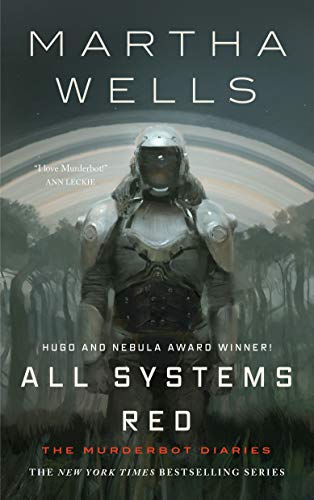
reread: All Systems Red by Martha Wells

I cannot believe I rated this a mere 7 on first go-round. That’s madness. It’s a brilliant book! I guess this is evidence of how slow I was to enter Murderbot’s world. Now that I’ve read seven Murderbot books, this one was far more accessible for me, and the rating has increased considerably. Liz listens to the audiobook version of this on repeat, and I get that now absolutely (although I’ve still never listened to the audio version).

This time I was all in from minute one, with a background understanding of the rules of Murderbot’s world, the constraints of being a construct, the confusions about what exactly it is, its lovably grumpy attitude toward humans and its preference for entertainment media. I think it’s a fairly unusual portrait of… this kind of life form… that an individual could be sort of lackadaisical, may I say even lazy, toward its *work* and genuinely want to be left alone to watch what you and I would call TV shows. In this first book, Murderbot is for the first time living and working with a group of humans who are open to its (if you will) humanity, and Murderbot does not know what to do with that. Some of the humans more than once call it “shy,” but that’s not entirely it; Murderbot is uncomfortable with being treated like a person that deserves respect and autonomy, because that’s a new experience. And this is compounded by its need to pretend its not such a person, because for its own safety it needs for no one to realize that it’s hacked its governor module and is operating according to its own wishes. So. “Yes, talk to Murderbot about its feelings. The idea was so painful I dropped to 97 percent efficiency. I’d rather climb back into Hostile One’s mouth.” (That voice is hysterically funny.)

I can’t get enough and am now in danger of ripping through the whole series all over again. I’m sure some readers (Liz?) accessed this much more easily on the first read, but boy, is this second one an improvement for this reader.


Rating: 9 little hoppers.

System Collapse by Martha Wells

Book 7 is, again, the most recent Murderbot book to date, but there are more on the way, we’re told, and thank goodness. This tip from Liz has been (yet again) a big winner. I took a big break between books 6 and 7 – pretty precisely three years, whew! but it wasn’t too bad to jump back in. I won’t say I recalled all the fine points of where we were and who the humans were, but I was close enough to follow along; I think I’m already a little liable, with sci fi in particular, to let some of the details of tech and even plot wash over me as I go with the general atmosphere, themes, and cleverness. The Murderbot Diaries are absolutely character-driven, with style (that is, chiefly, Murderbot’s unique, sarcastic voice and secretly-a-teddy-bear personality) carrying a good portion of the load as well. I’m way more here for Murderbot itself – its inner dialog, its anxieties and values and reluctant but absolute loyalties, its decision making and love for entertainment media – than anything that happens to it. Those events are only here to let Murderbot react and act and be its loveable self.

Murderbot is full of dryly funny observations about how inexplicable humans are. “Humans are great at imagining stuff. That’s why their media is so good.” “Not even humans know why humans do things.” It coins ‘argucussion’ for the argument/discussions its humans have. Upon conflict, one human says to Murderbot, “We should talk about this later,” and its internal narrative responds, “We probably should but we absolutely are not going to, not if I can help it.” Because Murderbot is as avoidant of its own emotions and trauma as any repressed, long-ignored, forced-to-be-self-reliant human. It is a very human SecUnit.

This edition, it is fair, may start a bit more mid-scene than usual even for Martha Wells (and this is a thing she does), and it’s been a while since I last knew where we were. Murderbot and its growing crew of beloved humans (it is reluctant to admit to this, of course, but we know it is true) and ART the sentient spaceship are in a tricky negotiation situation involving mistreated and rightfully suspicious colonists, evil corporation lackeys, and dangerous ancient aliens. There is action and fighting, and mysteriousness. Murderbot spends a fair amount of time pretending to be human, which is at least better than pretending to be a SecUnit that has not hacked its governor module (there’s a little bit of that as well). It has the opportunity to free other SecUnits, too, and that possibility and the other SecUnits’ reactions are promising for future books. I smell a sequel and I can’t wait.


Rating: 8 fictionalized documentaries!

“Home Habitat Range Niche Territory” by Martha Wells

What I loved most about this short Murderbot story is that it’s the first I’ve read that’s not from Murderbot’s point of view. For the first time, we view our hero through someone else’s eyes: those of Mensah, its friend and sort-of boss (protector? patron? owner?) for most of the series, so hers is a sympathetic, wryly humorous perspective, and loving. It’s the briefest glimpse of events, again: basically an excuse for SecUnit (aka Murderbot) and Mensah to interact, so that the latter can show us the former from a different angle. (It also provides just a hair of perspective on Mensah’s trauma.) Like last Friday’s story, it would serve as a pretty good intro to the series, although it’s more of an outlier. Again, it’s another treat of a small reentry into this world that I so appreciate.

I hope Martha Wells is off writing right now.


Rating: 8 free sessions.

Thanks for bearing with these short stories & reviews, folks – we’ll be back to whole books again soon.

“The Future of Work: Compulsory” by Martha Wells

A very short story, but a satisfying little fix for my need for Murderbot. And actually, this one would make an excellent introduction (and clearly is designed for those unfamiliar with the character, as it economically sums up the needed background in a way that is not at all awkward – no small feat). It’s just a very quick episode, and I think early in SecUnit’s governor-module-free life. It’s still working out how it feels and thinks, because “apparently getting free will after having 93 percent of your behavior controlled for your entire existence will do weird things to your impulse control.” Also, “What’s the hurry? I can always kill the humans after the next series ends.” Which is kind of perfect as an encapsulation: the humor, the darkness, and the entertainment addiction. I love it.

Real quick and easy; think about checking it out here.

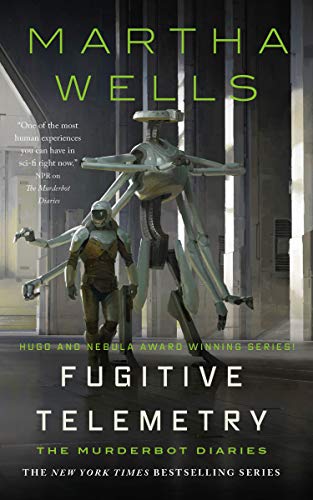
Fugitive Telemetry by Martha Wells

This is book six, the final to date, in the Murderbot Diaries series. I am very relieved to learn that there are three more books to come, because I am not done with this fascinating character.

Fugitive Telemetry takes place between Exit Strategy and Network Effect, and I was not prepared for this and really missed getting the next installment in the story as developed in the latter, but there’s still a lot to love here. Murderbot is living uneasily on Preservation Station, and there has been (gasp) a murder, which never happens here, and therefore the regular security forces aren’t really equipped for an investigation. Our favorite bot construct gets drafted (that is, asked nicely by Dr. Mensah) to help out, but (predictably) it doesn’t love working with the security forces, and the feeling is mutual. Murderbot has also been asked to not hack any systems, a promise I’m a little surprised it keeps; this hamstrings its investigative efforts somewhat, and takes us into the realm of more classic detective work. That’s the premise of an excellent review by NPR of this book, and indeed they’ve done so well with it that I’m linking you there in lieu of my own longer review. Check it out: “Murderbot meets Miss Marple in Fugitive Telementry.”

I love everything that happens here, but I remain anxious for a sequel to Network Effect. I want more Amena and more ART and more Murderbot in general. I’m just glad it’s happening.


Rating: 7 limbs.

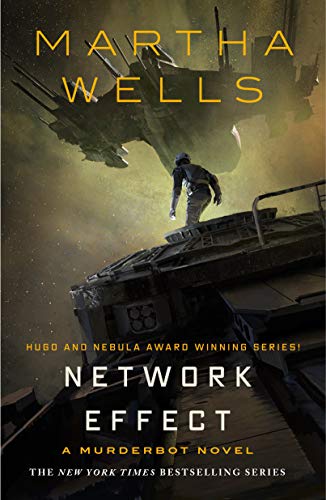
Network Effect by Martha Wells

I love the promo copy from Tor’s publishing page enough to let it kick off this review:

You know that feeling when you’re at work, and you’ve had enough of people, and then the boss walks in with yet another job that needs to be done right this second or the world will end, but all you want to do is go home and binge your favorite shows? And you’re a sentient murder machine programmed for destruction? Congratulations, you’re Murderbot.

Come for the pew-pew space battles, stay for the most relatable A.I. you’ll read this century.

I’m usually alone in my head, and that’s where 90 plus percent of my problems are.

When Murderbot’s human associates (not friends, never friends) are captured and another not-friend from its past requires urgent assistance, Murderbot must choose between inertia and drastic action.

Drastic action it is, then.

Here it is! This, the fifth in the Murderbot series, is a full-length novel, some 350 pages instead of 150-175. Wells delivers: this is everything that’s good about books one through four, but bigger and more of it. No, that’s not to be taken for granted. Sometimes the novelist can’t wrangle the short story or vice versa. But Murderbot is every bit as compelling for a novel as it was in novella form, and this scale offers more room for the plot (in both senses!) to grow in some excellent ways.

Murderbot is back on Preservation Station with its new …family? of humans. (It would never use that word, but I will.) It’s still working out its feelings about humans, and its own humans in particular, and trying to figure out where it fits into the world and the human society it’s presently allied with. It still doesn’t know what it wants out of life, which is one of the drawbacks of self-determination. And the human society, and the (real) human family, are still working out how Murderbot (or SecUnit, as they call it) fits in, too. Dr. Mensah, from book one, is Murderbot’s closest human friend, and also its patron (legally, in fact, its owner), and the two of them have a pretty good understanding, but not all of Dr. Mensah’s family has accepted the bot construct’s role. There are some tensions. Dr. Mensah has a teenaged daughter, Amena, who offers another set of challenges: Murderbot’s own eye-rolling attitude up against that of a teenaged human makes for some pleasing gentle conflict; and they share as well an earnest sweetness that they like to hide behind rough edges.

Murderbot and some of Dr. Mensah’s family and friends find themselves on a ship that gets kidnapped, basically, and taken through a wormhole… the space-science stuff can get a little away from me, but it’s okay. There’s a mystery; there are unknowns. There are bad guys – the corporates, as usual, but again unknowns as well, including possibly alien remnants. Murderbot is as usual (in its exasperated tone) having to try to save the day and keep everyone safe, even those who are dismissive of its abilities or foolhardy or otherwise frustrating. What’s gradually changing, though, is Murderbot’s relationships with these humans. It really cares; they care about it. Some of them even trust it.

Spoiler-free: the stakes rise when we begin to suspect that another character from a past novella is behind the kidnapping. Also! Near the end, a new character enters the scene who I am very excited about.

The character Murderbot remains the best part of these books, which is a fine strength to have, since these are the Murderbot Diaries and its first-person POV is the voice of the series. Our hero is sarcastic, bitter, both immature and ultra-competent; soft-hearted but outwardly prickly; it is simultaneously scornful of humans and (in the entertainment media series it so loves) sort of adores them. Its voice is often hilarious, self-deprecating and petty. “I wanted to pick it up and have an emotion over it like a stupid human.” “Target Two whispered something, which FacilitySys rendered as ‘What are you?’ I said, ‘I’m a Shut Up or Get Your Head Smashed.'” It’s interesting what it does and doesn’t know; it finds some words baffling, like foolproof (why isn’t it smartproof?), and gets anagram and acronym confused. When it has emotions, it sometimes has to go face a wall for a little while.

Murderbot still has trust issues, and who can blame it? Many of its humans are just now learning how bad things can be for a SecUnit. “(If there’d been a SecUnit in the colony, there probably would have been a compelling reason why it had to stay behind on the dying planet.) (I don’t actually believe that.) (Sometimes I believe that.)” It learns that “the organic parts of my brain were doing a lot more heavy lifting than I gave them credit for.” And it’s learning some significant lessons about trust and friendship (which will give it emotions).

Some reviewers see Murderbot as being possibly edging toward a romantic entanglement. I do not read it that way. But book six will take us where it will.

This was a really good installment in the series; I was very pleased to spend more time with our grumbly construct, and equally pleased to see Wells’s competence with the longer form. Psyched for book six; just sorry that that one is, to date, the last of the series.


Rating: 8 lines of code.

Exit Strategy by Martha Wells

Book four of the Murderbot Diaries is proceeding pretty much as I’d hoped. We’ve got some returning serial characters, and further development of the idea that bots are people, too. Check out that blurb from the front cover: “One of the most humane portraits of a nonhuman I’ve ever read” (from Annalee Newitz). I wholly agree, and think that that’s one of the great victories of this series. Murderbot is drily funny, self-deprecating, sarcastic, deeply feeling and resistant to the truths of its own emotional self, and who among us hasn’t wished we were a little more stoic, a time or two?

[Side note: something new has just occurred to me. I think Murderbot and Reacher have a few things in common. Both try to mind their own business, but both are helpless to resist helping dumb humans in need, even as they feel exasperation about it. Both have superhuman abilities, not only in physical fighting but in quick calculations on the fly and strategic thinking. (Only Murderbot has a good explanation for these qualities.) Both have a tendency to be delightfully deadpan. Both try to slip out into the night when things get wrapped up. They’re both sort of knights-errant, preferring not to hurt innocent bystanders but reasonably quick to upgrade (downgrade?) a person’s status to hostile as situations develop. These are qualities I appreciate, and I think there’s a definite parallel here that helps explain my love for both rogue elements.]

“Ship’s drones gathered to watch me, confused as to why I was going out the wrong door and beeping sadly about it.” Even the drones are given emotions: confused, sad. The idea of humanizing the nonhuman feels like a helpful step in rehumanizing each other, too. These books star a murderbot who is not human though it has ‘organic parts,’ and who is not legally recognized as a person in most of the worlds it travels in, but it has human friends from a world where bots and human/bot constructs are legally recognized. Can it even see itself living in this new way? In the midst of a fight to the death, our protagonist offers a deadly CombatBot the option to be free from outside control. “…dodging projectiles, it was hard to come up with a decent argument for free will. I’m not sure it would have worked on me, before my mass murder incident. I didn’t know what I wanted (I still didn’t know what I wanted) and when you’re told what to do every second of your existence, change is terrifying.” These are weighty questions, and Murderbot is an excellent guide to them: snarky, hard-shelled, but soft and melty on the inside.

I continue to love the thread in which Murderbot is an entertainment media addict, too. Aside from being unexpected and hilarious, as it was from the outset, it also offers opportunities to think about its future career options (recall I just recently noted its wisdom in critiquing narratives), as well as how stories and characters speak to us, and what they can stand in for. Here, a human friend asks Murderbot what the media does for it, why it loves its favorite show so much (that’s The Rise and Fall of Sanctuary Moon, which I sincerely hope will appear as a spinoff someday). This allows it to think about its own possible personhood, and empathy. There is a lot going on in this series of slim scifi novellas, a lot of reach. I am increasingly excited about the progress to come. (I am also feeling pleased with some of my own predictions.)

I hope Martha Wells is off somewhere writing more Murderbot right now. I expect to get through the last two books soon.


Rating: 8 hard currency cards.

Rogue Protocol by Martha Wells

Book three of the Murderbot Diaries keeps us right on track, and they’re so slim and easy to read, it takes willpower not to binge them. Our murderbot takes on a new name for this adventure, and a new self-designed mission; both of these are outside the normal range for murderbots (or SecUnits, for security units). But our SecUnit is special. In some ways, this episode resembles the last, in Artificial Condition: the murderbot hitches a ride, hoping to quietly take in some shows and maybe a little light reading and be left alone until arrival at the next place where it hopes to do a little research, solve a mystery. But it gets 1. recognized by a bot it didn’t anticipate and 2. tangled up in the plans and lives of a group of humans it regrets feeling something for, and therefore 3. roped into protecting them – like in its old life, but on its own terms.

The pattern here continues to develop an important point: bots and SecUnits are rather closer to being “people” than we are originally led to believe, meaning they have loyalties, feelings, and personalities. This allows for some ideas about liberties, responsibilities, and “human” rights (which in this world may need to apply to some beings that are not strictly human). It also makes me look forward to what is to come. Our murderbot (of the several names, now) will carry on, growing into its own. It will continue to meet more characters that will test its understanding of bots (etc.), and eventually I imagine it will have to redefine that understanding, as I am doing as reader. I can’t wait for more adventures. And I love the murderbot’s sense of humor and irony as much as ever.

Another fun twist in this novella was the murderbot – an avid consumer of serial entertainment shows, remember – forming some opinions about what would and wouldn’t make good entertainment feed narrative. I’d love to see it get into the writers’ room!

This was book three and there are only six; I’m already sad. One of these is a full-length novel, though? That will be fun!


Rating: 7 core samples.

Artificial Condition by Martha Wells

These Murderbot Diaries are going down way too easily; Martha Wells is not writing quickly enough! Wonderful fun. After book one, All Systems Red, it felt great to see our murderbot again, still addicted to entertainment media and wishing it could just be left alone to take in its favorite shows and not have to communicate with humans. (“I liked humans, I liked watching them on the entertainment feed, where they couldn’t interact with me. Where it was safe. For me and for them.”) There was never such a loveable, socially awkward creature. It’s the genius of this series that this protagonist is not human, but has all the personality and foibles we want in our favorite human characters. “When constructs were first developed, they were originally supposed to have a pre-sentient level of intelligence, like the dumber variety of bot. But you can’t put something as dumb as a hauler bot in charge of security for anything without spending even more money for expensive company-employed human supervisors. So they made us smarter. The anxiety and depression were side effects.” “I wish being a construct made me less irrational than the average human but you may have noticed this is not the case.”

In this installment, the murderbot has its own agenda for the first time ever, arranging for its own travel (only a little bit under false pretenses) and going looking for answers to a mystery it wants solved for its own sake. It runs into trouble when the research transport ship it hitches a ride with turns out to be a bit smarter and more sentient than our hero had bargained on. This is either going to be the murderbot’s first friend or next enemy. Also, to get onto the moon it’s headed for, it needs an employment pass, and so it needs employment, which (again) it’s never arranged for itself. This is how it ends up with another group of humans to care for, which raises some of the same concerns that it did in book one.

Where it took me a little while to get into All Systems Red, this one had me in its grasp from minute one (maybe because I understood the world I was stepping into). I’m smitten. These stories are short, funny, and moving. I want them all.


Rating: 8 facial expressions.