The Lacuna by Barbara Kingsolver (audio)

Another long review – sorry – but one of the best books I’ve read this year, so consider sticking it out with me. Or, go to the very bottom for my two-sentence review. 🙂 Many thanks.


Reviewing The Lacuna daunts me. How to capture the enormous world that is this book in a brief (readable) blog post? I have only read three other of her books (liked The Bean Trees and Animal Dreams; not so much The Poisonwood Bible; all pre-blog, unfortunately) but from what I know, this is by far her best. (Her own website calls it her “most accomplished novel”). It is a Big Thing.

I shall take this one step at a time. Plot summary. A young boy named Harrison William Shepherd is born in 1916 to an American father, a bean-counter for the government in Washington, D.C., and a Mexican mother, Salomé. He spends his childhood mostly in Mexico, with a brief interlude at a military school in the US, and ends up working in his teens for Diego Rivera and Frida Kahlo, first as Diego’s plaster mixer, then as a cook and secretary and Frida’s companion. When Lev Trotsky arrives as a political exile from Soviet Russia, he acts as secretary and cook to him, too, following Trotsky when he splits from the Riveras; he is at Trotsky’s side when he is assassinated. Shepherd (who goes by various names depending on who’s talking) never considers himself exactly an ideological follower of the communist cause, but his sympathies are naturally aligned with those of his famous employers, for whom he has great respect.

Following the assassination, he begins a new life in Asheville, North Carolina, becoming a famous author of novels set in ancient Mexico; but the trauma of Lev Trotsky’s bloody demise, Shepherd’s sexual orientation, and his extremely shy and self-effacing demeanor keep him isolated from an American world that feels foreign. He closely follows international politics through the second World War, the United States’ sudden reversal of regard for Stalin, and the Dies Committee (which contacted Trotsky when Shepherd was with him) becoming the House Unamerican Activities Committee – which eventually begins to investigate Shepherd himself. This turn of events shocks our protagonist, who sees himself as an insignificant and apolitical player, but whose new Jewish-New-Yorker lawyer is alarmed at the skeletons he hides in his closet: to the point, an association with the late Trotsky and the still-active Kahlo and Rivera. The Asheville era in Shepherd’s life yields new and likeable characters in the lawyer, Artie Gold, and Shepherd’s secretary-companion, Appalachian native Violet Brown. (I think Kingsolver had fun with these *colorful* names, ha.) The FBI’s investigation of Shepherd threatens to tear down the precariously balanced, agorophobic life that he has so carefully constructed in Asheville; and here I’ll stop. I liked the ending, despite its considerable sadness.

Violet Brown is an important part of the story in terms of format. The story is told almost entirely in Shepherd’s own voice. As presented, he wrote the first chapter of his memoir and then quit; this chapter opens the book, and then we get Mrs. Brown as “archivist” explaining the reversion to Shepherd’s journals starting at age 14. The rest of the book is pulled from these (fictional) journals, with interjections from our archivist here and there, as well as a number of newspaper and magazine articles (Kingsolver notes which are real articles at the beginning of the book for your reference; my impression without checking each one is that most are real) and assorted samples of Shepherd’s correspondence. It is a very interesting format, raising all kinds of questions about voice and the progression of voice. I wondered, upon that first shift from an already-published 30-year-old author’s writing to a 14-year-old’s journal, whether Kingsolver didn’t trust her audience to start off that way? But I ended up feeling that this shifting voice felt very real; I enjoyed it. Violet’s role in Shepherd’s life was ambiguous quite far into the story, which kept me wondering, in a good way.

Another aspect of format I must mention is the audio version I listened to – narrated by Kingsolver herself, and to great effect. I loved her work here; every character had a voice, an accent, a lilt, a manner of speaking, and these were important in a story peopled by Mexicans with various backgrounds, a cross-bordered Mexican-American confused about where he might belong, an Appalachian-hills woman who worked hard for her education, and a New York Jew. Shepherd’s speech cadence as performed by his creator was remarkable and memorable; it increased my enjoyment of this story. The only drawback to the audio format is that I am always driving, or washing dishes, or in the gym, etc., when I’m listening, and therefore failed to mark down for you any number of remarkable lines I would have liked to share.

I was completely drawn into Shepherd and his world. I found Frida Kahlo compelling, which I think is faithful to her real life. The Mexico Kingsolver paints is so real, so filled with sensory stimulation, and in some ways familiar – the foods I eat, the places I’ve visited – which I think always gets a positive reader reaction. And the linguistic nuance of a boy (and man) who speaks both his languages with an accent, who brings Spanish structures into English, was so authentic, I just ate it up. (Like Hemingway’s For Whom the Bell Tolls, one of my most favorite books ever.) And then the politics – the evocation of such a complex, rapidly changing, schizophrenic period in our history, through the Bolshevik Revolution, the Roaring Twenties, the Great Depression, Hoovervilles, WWII, Roosevelt’s death, HUAC… it was so very dense. I was reminded of Stephen King’s 11/22/63 (which is the more recent work), another novel set in real historical events that successfully evoked a vivid time and place; but The Lacuna built a bigger world, was more literary and flowery, and in my opinion was better (sorry, Stephen).

Part of this book’s fascination for me lay in its explanation of the hatred and fear of communism, Communism, and its various permutations and misunderstandings during an era before my birth. Kingsolver’s characters helped me work through some of my questions about this time and this perplexing, unreasonable fear; Shepherd shares my confusion, and the lawyer Artie Gold does a fair job of helping him think it through (as does Violet Brown, for that matter). Coming near on the heels of A Difficult Woman which I loved so much, and which raised so many questions for me, The Lacuna‘s further exploration of the anticommunist era and my reading of it was very timely.

I’m sorry I’ve gone on so long; it’s only out of my enthusiasm for this dense and complex story that brought me so many emotions and questions. In a few words, The Lacuna is beautifully constructed and beautifully written, a story about artists and the power of art, about Frida Kahlo and Lev Trotsky and American anticommunism. I highly recommend it.


Rating: a rare 10 Mexican murals.

The Monkey Wrench Gang by Edward Abbey

I fear this review won’t do this book justice. Maybe I’m just intimidated. But I read it on vacation and sadly took NO notes – nor do I usually, but it took me a little longer after reading to write the review, and those were hectic days. And it’s a significant book: one of Abbey’s two most famous books, that alongside the nonfiction Desert Solitaire really made his career and solidified his celebrity, as well as birthing the Earth First! organization and movement. If ever a book had a cult following, this is it.

The story follows four individuals. Seldom Seen Smith is a Jack Mormon with three wives in three small towns in Utah; they gave him his nickname for being rarely around any of their three households; he guides river raft trips down the Grand Canyon and generally camps out and around in the natural world more than he stays home. Bonnie Abbzug is a Bronx Jewish girl working out in Albuquerque for Dr. A.K. Sarvis, who when he is widowed takes refuge in Bonnie’s desirable arms. She is much younger and beautiful and very capable; she manages his medical practice as well as satiates his considerable sexual urges. As the book opens, Bonnie and Doc amuse themselves by cutting down billboards with a chainsaw. George Hayduke is a young, muscular, angry Green Beret Vietnam veteran who returned from war with nothing on his mind but the beautiful desert country he loved; upon finding it defiled by industry and roads, he wanders around in a murderous mood until happening upon the other three.

The four form a conflict-ridden union of semi-organized, anarchic environmental activists – stress on the “action” part. They destroy heavy machinery and blow up bridges and the like. The group’s greatest ambition is to take out Glen Canyon Dam and free the mighty Colorado River (and liberate Seldom Seen’s hometown, now underwater, of Hite, Utah). They have adventures and do battle with a small-town Search and Rescue team lead by the Church of Latter Day Saints’ Bishop Love, which is really just a posse of renegades angry at Seldom Seen and whose profits are tied up in the industry that the Monkey Wrench Gang is bent on destroying. There is gunplay; there is infighting; there is sex and camping and nature-praise. It’s rather glorious; The Monkey Wrench Gang is funny and doesn’t take itself too seriously, although its values (pro-nature, anti-development) are definitely heartfelt and poignantly expressed. It’s easy to see how this novel, published in 1975, led like-minded young people to try to live it out.

Common critiques are easily spotted. Most glaringly for me, Bonnie is a sex symbol. Doc is her lover despite being “old and bald and fat and impotent” (the first three are true, the forth patently not; there is reference to his “grand erection,” on which more in a minute) but Seldom Seen openly worships her (which is accepted by all) while Hayduke tries to resist his equally obvious desire. This dynamic is not PC, although I fear it is entirely realistic even today. Knowing just a little about Abbey (one biography, check), it is painfully obvious that Doc (and Hayduke, and Seldom Seen) live out various forms of Abbey’s own lust for vastly younger women (their thighs, their buttocks…) – see again Doc’s “grand erection” even when threatening impotence. This is clearly indulgent of the author’s lechery. But somehow I note that and carry on unoffended. To be fair, Doc is rather laughable. Further, the group is not PC in its attitudes towards American Indians (somewhere in here is the often quoted line “drunk as a Navajo”) or Mormons, continue the list from here. And these are not your average environmentalists; they eat a lot of meat and drive big cars and throw beer cans out the windows along the highway (another famous Abbeyism).

But it’s a hell of a story; I was totally involved, and what can I say, I buy into Abbey’s greatness and went right along with his self-indulgent fantasy. I wanted to see the Glen Canyon Dam come down, too. I wish there was more. Oh wait! Hayduke Lives! That’s gotta be next on the list.


Rating: 8 sticks of dynamite.

book beginnings on Friday: The Lacuna by Barbara Kingsolver


Thanks to Rose City Reader for hosting this meme. To participate, share the first line or two of the book you are currently reading and, if you feel so moved, let us know what your first impressions were based on that first line.

I’m listening to Kingsolver’s The Lacuna on audio. I loved her The Bean Trees and I think I loved Animal Dreams, but it’s hazy; The Poisonwood Bible really didn’t work for me (which, from my reading of other book blogs, appears to be a common reaction). But The Lacuna comes recommended from my mother, so here we go. It begins:

In the beginning were the howlers. They always commenced their bellowing in the first hour of dawn, just as the hem of the sky began to whiten.

The hem of the sky. Lovely. And what are you reading this weekend?


Be advised: I’m out of town, so you’re viewing pre-scheduled posts until April 9. I love your comments and will respond when I return! But I’ll be out of touch for a bit. Thanks for stopping by!

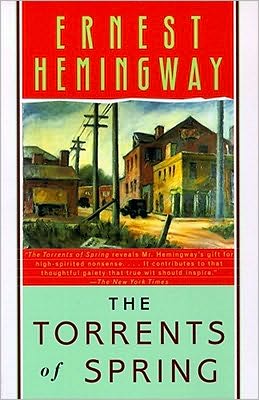
The Torrents of Spring by Ernest Hemingway

The Torrents of Springs has an interesting place in the Hemingway canon. It’s under 100 pages, but couldn’t be more different than the similarly short The Old Man and the Sea; the latter was a masterpiece, cost the author great effort, and won him a Pulitzer Prize, towards the end of his career. The former was early in his career and took him a matter of days to complete; it’s a work of parody and was intended to break Hemingway’s contract with publisher Boni and Liveright. The contract stated that B&L would publish the young up-and-coming’s first three novels unless one were rejected; in the case of rejection, the contract would be broken. Thus tricky Hemingway, who wanted to sign with Scribner’s, submitted this brief and, Hadley Hemingway’s word, “nasty” novella, had his contract broken, and carried on. The Torrents of Spring has never received much critical attention. It is accepted as it was presented: a lark, and not a particularly good-natured one. In my Hemingway studies, though, I wanted to see what it was about – perhaps all the more so because it has such a prickly reputation. (F. Scott Fitzgerald, the dissenter, apparently found it impressive.)

So I picked up this slim little book and read it in a day. It reads like a parody. (But I knew this going in. Hm. An unbiased reader I was not.) It’s a little ridiculous, consciously skipping over character development and explanations in favor of repetitious sentences.

In some ways it was the happiest year of his life. In other ways it was a nightmare. A hideous nightmare. In the end he grew to like it. In other ways he hated it. Before he knew it, a year had passed. He was still collaring pistons. But what strange things had happened in that year. Often he wondered about them.

But these strange things are not explained to me, “the reader.”

The author addresses “the reader” and asks for allowances to be made:

It is very hard to write this way… the author hopes the reader will realize this… I don’t want to rush the reader any… I only wish the reader could help me.

There is definitely a note of less-than-seriousness. It’s also simple, and less than proper in its treatment of certain minority groups (which latter fact is pretty standard for the time period).

If you think you hear Hemingway’s famous “voice” here, you’re not alone. However, I think I hear Sherwood Anderson‘s “voice” here, too. Anderson is one of the writers being parodied; but he also appears in an article years after the publication of The Torrents of Spring as Hemingway’s recommended reading, which is a little odd. But then, Hemingway did make a habit of pushing-and-pulling at his literary friends and rivals, who were too often the same people.

Oh, did you want to know what it was about? Plot is not this book’s strong point, but I’ll tell you briefly. Scripps O’Neil was married to a woman in Mancelona (Michigan), but she left him; he then journeys towards Chicago but ends up in Petoskey (also Michigan, and one of Hemingway’s haunts). Here he works in a pump factory and marries an elderly waitress with whom he quickly becomes disenchanted. His coworker at the factory, Yogi Johnson, who was in the war, worries about losing his interest in women; drinks with some Indians whose luck runs out; and regains his interest in women upon encountering a nude squaw. The plot is not the point; the point is the funny style.

I have to agree with the critics this time; this is not an important literary creation on the scale of Hemingway’s great works (like The Sun Also Rises, which like Torrents was published in 1926). But it’s amusing, and stylistically interesting. I wouldn’t go about freely recommending this to just any reader. I think you would want to be especially interested in Hemingway, or Anderson, or literary playfulness of their era, to appreciate it. If that’s not you – if you’re interested in exploring Hemingway generally – I can recommend much better books, and much better examples of his craft. The Sun Also Rises, For Whom the Bell Tolls, and The Old Man and the Sea are my favorite of his novels; A Farewell to Arms is well-respected as well; A Moveable Feast is a lovely memoir of Paris; and I find his short stories marvelous (and nice short entries to his style if you’re hesitant). The best I can say about The Torrents of Spring is that it will not take much of your time! And is mildly noteworthy as an anecdote of Hemingway’s career.


Rating: 3 underhanded compliments.

guest review: Running the Rift by Naomi Benaron, from Pops

I spotted this title when it was released (in January) and bought it for my Pops – he’ll explain why that was an obvious move, below – and he has graciously written us a review. I’m always glad to have his insightful and well-written book reviews! With no further ado, Pops.

I am a runner; and for more than 3 decades I have been casually collecting fiction having something to do with running. This is a very small niche; so you either can’t be too selective as a literary critic, or you end up with a very small collection. I am such a glutton for the subject that I have read through all levels of writing expertise top to bottom, usually finding “average” entertainment value – and usually centered on running, with a story woven in. All of which makes it pretty special to enjoy the occasional literary gem on this narrow bookshelf.

Even at first mention, the title Running the Rift had my attention. I needed no explanation to surmise the connection between running and the famed Rift valley in Africa. A quick notice of Barbara Kingsolver’s perky book cover endorsement (“culturally rich and completely engrossing”) and the Bellwether Prize for Fiction winner’s medal sharpened my interest. But none of this prepared me for what lies between the covers.

This is not a “book about running”; rather, it is the rare work of fine literature that features a boy who just happens to love running. (For that, I suspect we can thank an author who just happens to be a triathlete.) This is a love story: a love story within family, and about connections to physical and cultural place, more than the trite “love of country.” And it is a coming of age love story between adolescents. But it is so much more, because the story occurs in Rwanda in the 1990’s when that country was the scene of an unspeakable and terrible genocide committed by neighbor upon neighbor.

Rather than explore the colonial, political, economic and social roots of this fratricidal event in history, the story focuses on our main characters and their families, Tutsi and Hutu both, as their lives are torn by forces beyond their grasp. Accounts of the brutal killings are awful to read, as is the gradual approach to the event since we know what’s coming. But it is the richness of the characters, their love of life and family – and, yes, country – that carries us along.

Personally, I was also carried along by an appreciation that the story is based in history – a history we should know better, since these events were truly “unspeakable,” under-reported and poorly understood by much of the world. And of course I was captured by our main character, a boy who truly loves to run and manages to run through one of humankind’s worst moments into manhood and a promising future.

Thank you, Pops, for this lovely review; you’ve certainly convinced me of the value of this book. I’m so glad you liked it, too; I knew very little about it when it caught my eye but it sounds like my instinct was on target. 🙂

Because Pops asked for them, I’ve linked to some other reviews of the book for your reference.

The verdict appears to be a resounding “read this book now.” Thanks for sharing, Pops.

did not finish: Alice I Have Been by Melanie Benjamin

I got not quite halfway through Alice I Have Been. I was looking forward to this book; I liked the sound of it. As it turned out, though, I couldn’t get motivated to continue. I wasn’t hating it, I just wasn’t particularly enjoying it, wasn’t particularly engaged, and I have so many books waiting for my attention that I’m trying to be very open to DNF’s. And I didn’t want to keep reading this one; so I’ve moved on to something that might please me better.

I really had two main complaints.

One, I spoke too soon in last Friday’s book beginning. The child-narrator I said sounded believable quickly took a turn in the other direction. Young Alice seems especially quick to empathize with others in ways that I don’t think are realistic for a child her age. For example: receiving a compliment – realizing the giver of said compliment had made her feel special when she so needed to – wondering if he has anyone in his life to provide the same service to him – giving him an awkward and dishonest compliment – musing that “every person, no matter how old, how matter how odd, needed someone like that [to make them feel special] in their lives.” Does that sound like an 8-year-old to you? It does not, to me. Or again, marveling “at how one man could appear to be so different to so many people.” Or being concerned at whether the musicians at a festival had gotten a break for dinner. While these moments make Alice seem very sweet and thoughtful, they don’t ring true for such a young person. Children, I think, are naturally selfish; empathy is something we learn with age. Especially a privileged child like Alice (who unthinkingly accepts her mother’s convention of calling all maids Mary Anne) would be unlikely, I think, to be concerned about meal breaks for musicians of a lower social class.

Second, the subject matter was starting to wear on me. The thesis of Alice I Have Been up to the place where I quit (page 155, if you’re concerned, of 345 in my edition) seems to be that the child Alice was not only the muse but the beloved of the adult Charles Dodgson aka Lewis Carroll. As young as age 8 she adores him, and feels but cannot name a tingling sensation in his presence that later morphs into physical attraction. At 13 she initiates physical touching (totally tame, of course, but definitely inappropriate) and demands that he wait for her until they can be together – this will be when she is 15 and he 35, she thinks (and it appears that this would indeed have been socially acceptable). The short version of which I think is: Dodgson was a pedophile. He went all trembly and ecstatic in the proximity of this 8-year-old child. This was distasteful to me.

A few caveats to this second protest. First, because I didn’t finish this book, I don’t know how things turned out. It may be that Benjamin turns things around and I have a misconception which will never be corrected (because I won’t finish the book). I don’t know. But for my purposes here, I don’t care; I see what I see and I don’t like it. Second, I’m not afraid of reading about pedophiles. I’ve certainly read far worse (graphic, violent, sick) in thrillers, etc. and will do so again. But I didn’t like it here, it wasn’t what I was looking for, and I didn’t feel like reading any further, so I shan’t. That’s all.

A lot of people love this book and perhaps you do (or will) and I wish you all the enjoyment in the world; but in a few days’ investment I was not interested in finishing this book. I’m moving on to something I hope to enjoy more. Come back tomorrow and find out what in the next edition of Teaser Tuesdays. 🙂

book beginnings on Friday: Alice I Have Been by Melanie Benjamin

Thanks to Katy at A Few More Pages for hosting this meme. To participate, share the first line or two of the book you are currently reading and, if you feel so moved, let us know what your first impressions were based on that first line.

Charles Dodgson, who you know better as Lewis Carroll, based his Alice in Wonderland character on a real-life little girl he knew, named Alice Liddell. Alice I Have Been is the fictionalized life story of Alice Liddell. (That is, as I understand it, squarely fiction, although I can’t speak to where the line is drawn – especially not having read much of the book yet!) I have heard about this book for some time and am glad to finally be picking it up. It begins:

But oh my dear, I am tired of being Alice in Wonderland. Does it sound ungrateful? It is. Only I do get tired.

Makes sense to me; fame is tiresome, I’m told.

I am enjoying the tone of this book so far very much; the child-narrator we begin the book with feels very believable to me. My only concern at this point is the extent to which Dodgson feels like an icky child-groper! Tell me I’m wrong?

What are you reading this weekend?

Fire on the Mountain by Edward Abbey

Oh my. I have difficulty beginning this review. I found this book very moving and beautiful. I’m glad to have found such joy in Edward Abbey this time around; I was disappointed in Black Sun, but I knew he had this in him.

Abbey tells us that this story was “inspired by an event that took place in our country not many years ago” but is fictional in its particulars. Billy Vogelin Starr has just arrived in southern New Mexico to spend another summer with his grandfather, on the ranch that has been in Grandfather’s family since the beginning. Billy is twelve, and he loves the land, the terrain, the work, the ranch, and his grandfather very much; they move something deep inside him. He only gets to be a cowboy for three months a year, but he takes this time seriously. He’s also very excited to see his friend Lee again; Lee is handsome, charismatic, a real cowboy, his grandfather’s best friend, and Billy’s hero. This year things are different, however; the United States government intends to take the Box V ranch away. The story is, they need it for national security. We’re fighting the Soviets, at least in theory and in spirit, and the land is needed for rocket testing (thus explaining the cover image, if you can see it that clearly). Grandfather’s response is that his land is not for sale. He was born here; his daddy died here, and he’ll die here, too. If he has to do battle to retain his right to his land, he’s willing. And of course, Billy wants to be right by Grandfather’s side.

A short book at under 200 pages, Fire on the Mountain is incredibly powerful. In few words – just like a cowboy – Abbey teaches his reader about old men like John Vogelin, whose tie to the land and to an older way of life is stubborn. The descriptions of the natural phenomena of Southern New Mexico are awesome, and I challenge you to resist respecting Grandfather’s final stand. Not for nothing is Abbey called (by Larry McMurtry) “the Thoreau of the American West.” This is a coming-of-age story for Billy Vogelin Starr, whose twelfth summer sees drama that will change his world forever; it’s also a lovely evocation of the beauty and power of nature, and the story of the classic, iconoclastic, Western loner resisting a world of change. An incredibly powerful and touching book, beautifully written, irresistible, exhibiting the greatness that I expect from Edward Abbey. More, please.

The House on Mango Street by Sandra Cisneros

Another gift from my buddy Fil, and another hit! Fil says he hasn’t read this one yet, himself, and I say to him and to all of you: hurry up and read this slim but powerful book! My 25th anniversary edition includes an introduction entitled “A House of My Own” by Cisneros, which was gold; do find an edition with this intro, because it’s wonderful. I would say it was my favorite part of the book but I can’t relegate any other part to less-than-favorite.

So first, the introduction. (A bell rang for me as I opened this book, as I was reading A Room of One’s Own simultaneously.) Cisneros describes a former self, the woman pictured on the opening page, a young woman living in her own apartment in Chicago, after graduate school, working to become a writer. It’s a really lovely essay all on its own, describing some of the challenges that faced a young Latina writer and looking at that former self through her older, wiser eyes. It was beautiful. I cried a little, not because anything was too terribly sad (okay, there was that one bit), but because it was so well-done. And it served as a beautiful introduction, as it introduces the young woman who composed the short stories, the episodes, the anecdotes that make up The House on Mango Street, not yet knowing that they would become a book. Rather, she was working on her MFA thesis in poetry, so those fiction fragments (or “little-little stories”) were extracurricular, failed to fit into a known body of work. But oh, the book that they became…

The House on Mango Street is a collection of short stories, and I mean short – the longest run to 3-4 pages, most 1-2, some just a paragraph long. As a whole, they follow Esperanza (the narrator) through the first year of life at the first home her parents own, on Mango Street. It is not the home they aspired to and Esperanza doesn’t like it very much. She has a lot in common with Cisneros – the city, the time, and the ethnic background; but I know from “A House of My Own” that Esperanza is really a combination of Cisneros’s students, people she’s known and people she’s made up, and herself. There is a coming-of-age element, as well as a theme of home – what makes a home, what a person need from her home.

The stories are entrancing. The style is great, is dynamic; it’s both poetic and conversational. It’s not formal; sometimes a sentence runs on until it loses track of itself, but I’ve come away with the strong impression that every word was carefully chosen and exactly in its place. The economy of language reminded me of Hemingway, although I don’t suppose Cisneros gets compared to him very often, and I don’t mean to say that they’re very similar. Rather, they both seem to have very carefully created what looks like simple language but turns out to be poetry. (There is of course always the danger that I see Hemingway everywhere because I’m crazy about his work.)

The subject matter is mostly mundane and ordinary (a young girl’s life and disillusions, her disappointment that she has to wear old shoes with a new dress to a party) but also serious, weighty, and sad (because such things happen to a young girl, too). I only knew Sandra Cisernos by reputation before I picked up this book; that will have to change, because she’s amazing. It’s only about 100 pages long (including the introduction), a super-easy read, and so powerful. No excuse! Go get yourself a copy.

The Moon is Down by John Steinbeck (audio)

I don’t remember where I got the recommendation for Steinbeck’s The Moon is Down. As far as I can tell, it’s not one of his better-known works; I know and love his Of Mice and Men, Cannery Row, Travels with Charley, saw the movie East of Eden though I haven’t read it (yet!), also have The Grapes of Wrath on my radar. But this one I hadn’t heard much of. It was recommended to me (by someone) and I found the audio, and it’s just a short little thing on three cds, so it was easy to make time for. I do love Steinbeck’s style and subject matter, and this one is worthy of his high reputation.

Published in 1942, it handles the occupation of a small town in northern Europe by an army that has a lot in common with Hitler’s Germany, though it’s never named. There are references to “The Leader” and a war twenty years past that bears a resemblance to WWI.

This small coastal town is conquered with very little fanfare; 6 of the town’s 12 soldiers are killed, and it takes the people and the mayor a little while to realize what’s happened. The town is a center for coal production, which makes it an important possession, and the occupying force lodges its officers in the mayor’s house while managing coal production. Colonel Lancer has seen war before, and is weary of the tragic consequences of the orders he must carry out; he’d rather rule in peace and order, but the occupation quickly turns ugly. The local people learn to resist, and the occupiers live in fear. One memorable line occurs when one of the occupying officers – lonely for his homeland, friendly faces, and female attentions – wails at the senselessness and unpleasantness of their situation. “Flies conquer the flypaper!” he bitterly says of the occupation.

It’s been a while since I’ve read any Steinbeck, but I recognized his style. The prose is simple, yet moving. This is both a straightforward story of one fictional town’s experience, and an allegory and statement about the futility of war. I’m sure this short novel would make for extended discussion in an educational setting, and I wish I had a professor to help me pick it apart! But as a quick read for entertainment’s sake, too, it’s satisfying, if not happy.