Nothing to See Here by Kevin Wilson

Thanks to Liz for this one! I’ve had this on my shelf for a few… years? since she recommended it. I really enjoyed it. It was fun, and absurd, and sweet, and funny, and then quite poignant. Unique. I’m pleased.

Lillian comes from a life of not much money, love, or opportunity. She works hard for a scholarship to a fancy private school, where she makes one essential friend: Madison is from the kind of wealth where just almost literally anything is possible. They match each other’s weird, that one year. Then Madison gets busted with coke, and it’s all a bit foregone: Madison’s father pays off Lillian’s mother. Lillian takes the fall. She goes back to her depressed and depressing little life. Madison’s star continues to rise. When we meet Lillian, she’s working a series of shit jobs, pen-palling with Madison, who is now married to a senator, with a perfect little boy “who looked like an expensive teddy bear that had turned human.” Madison sends her $50 and tells her to come on down to Franklin, Tennessee “because she had an interesting job opportunity for me.” Lillian gets on a bus.

Senator Roberts was married before Madison. His ex-wife has just died. And left behind are his elder children, ten-year-old twins named Bessie and Roland. Lillian, who has no prior experience, expertise, or interest in childcare, is to take them on as charges. She has to keep them safe and relatively happy and oh yea, very private and low-key, because Senator Roberts is hoping to become Secretary of State in the near future, and the twins are a little different. They spontaneously combust. They are uninjured by this event, but their clothes burn off, as does everything around them. The Senator doesn’t need this kind of publicity.

And before Lillian can get used to limitless bacon sandwiches on demand (the Roberts estate employs a large staff, including an outstanding if weird chef named Mary), she is reinstalled in the guest house behind the mansion, which has been retrofitted to house small, recalcitrant fire children.

I love absurdism when it is reality-adjacent and also sweet and odd and fun, which this is, although it is also sad stuff. I love a literalization: the two children in Lillian’s care have been hurt by their life so far. They are a little damaged, slow to trust, quick to combust. Lillian is a bit that way, herself, but her combustion isn’t literal, where the twins’ is. Especially late in the story, Nothing to See Here gets to be about what it means to love someone, to choose to love someone and to take care of them. Lillian is not a parent, but she is as smitten and as wrecked as any parent, and as far at sea. “There was so much that I should have been doing, that I could have been doing, but not a fucking thing made sense to me. I just fed them, made them wash their hands, listened to whatever nonsense they wanted to tell me. I took care of them, you know?”

I should find some more Kevin Wilson. Outstanding.


Rating: 8 bounces.

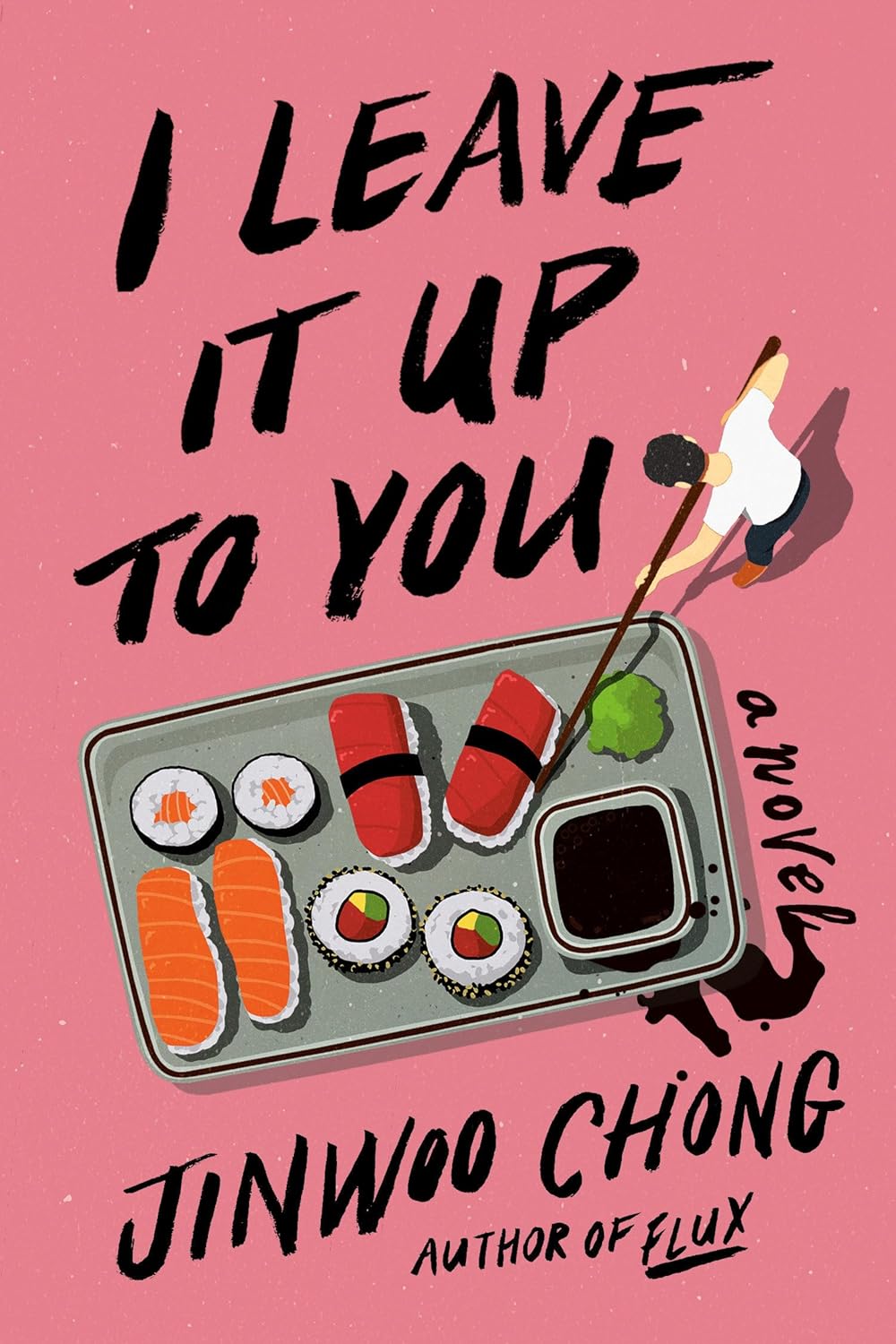
I Leave It Up to You by Jinwoo Chong

A young man wakes up from a coma and returns to the family, and the family sushi restaurant, that he’d left behind, with comical, heart-wrenching, hopeful results.

I Leave It Up to You by Jinwoo Chong (Flux) is a funny, bittersweet, heartwarming story about family, love, and making every minute count.

Readers first meet Jack Jr. in what he is slow to realize is a hospital room. He wakes up intubated and gagging. He’s confused about his whereabouts and circumstances, and he asks for his husband. His nurse is thrown into a full panic: Jack Jr. has been in a coma for 23 months and was not expected to regain consciousness.

No one will answer when he asks for his husband. Jack Jr. has missed his 30th birthday and the first 18 months or so of the Covid-19 pandemic. A few weeks into this remarkable recovery, he returns home, not to his Manhattan apartment, but to his father’s home in New Jersey. He goes back to the family business, a struggling Korean-Japanese sushi restaurant, which was once meant to be his life’s work and which he has not seen in 12 years. Jack Jr. has lost everything, and he finds himself in an unfamiliar, masked world. For much of the narrative, the old wounds he was avoiding–that he will now have to face–remain shrouded from the reader.

Jack Jr.’s kind and loving Appa (father) is a passionate sushi chef and workaholic; his Umma (mother) is private, reserved, and fiercely loyal; his especially estranged brother, James, is a recovering alcoholic with a dear wife and a new baby to join the teenaged nephew that Jack Jr. barely knows. Wise, gawky, 16-year-old Juno is perhaps the member of his family that Jack Jr. best connects with. And then there is Emil, formerly Jack Jr.’s nurse, and now potentially poised to become something more. Through these endearing characters, Jack Jr. considers that perhaps “there was more to loving something than smiling at it.”

In Jack Jr.’s first-person voice, these mysterious, painful new challenges are wrenching, but his love for his wacky family, and theirs for him, are unmistakable throughout. Alongside the flavors of carefully prepared nigiri, dak juk, soy, ponzu, and plenty of pork belly, humor and off-kilter love shine brightly in this tale of realizing what’s really important and making the most of one’s own time. The title of I Leave It Up to You refers to a translation of omakase, the Japanese dining tradition of asking for the chef’s choice, and also nods to the novel’s sweet attention to the care of self and others. While recovering from his physical injuries, Jack Jr. must also navigate old fractures with a family he hasn’t seen in years, let go of a relationship with no closure, and remain open to a surprisingly promising future. The story winds up delightfully warm and soothing, for all the bumps along the way.


This review originally ran in the January 31, 2025 issue of Shelf Awareness for the Book Trade. To subscribe, click here.


Rating: 8 bowls of juk.

A House for Miss Pauline by Diana McCaulay

Near her 100th birthday, a rural Jamaican woman faces the good works and wrongdoings of her own life and her island’s history in this richly written novel of vivid characters and big themes.

Diana McCaulay’s sixth novel, A House for Miss Pauline, features an indomitable 99-year-old woman in rural Jamaica, trying to reconcile rights and wrongs near the end of a long life. Miss Pauline exhibits a brave honesty that endears her to readers as she wrestles with not only her own actions but centuries of wrongdoings on an island steeped in sugar and slavery. Kingston native McCaulay (Gone to Drift) evokes a rich setting through the food, climate, and other details, such as her characters’ Jamaican patwa, which brings them to vibrant life.

Miss Pauline is less than a month away from her 100th birthday when the stones of her home begin to shiver, shake, whisper, and howl to her. She has lived in the village of Mason Hall in Jamaica’s St. Mary parish all her life, having borne two children with her beloved (long-dead) partner, had many friends and lovers, and been an elder to the town. The village is built largely of stone salvaged from a plantation big house Miss Pauline once discovered and designated for reuse in building her own home and many other structures.

In this literal and symbolic rebuilding, she led her community in reclaiming what had been stolen: land, human lives, freedom. She is certain now that the stones are prompting her to reckon with her own life’s work: community building, but also the unresolved disappearance of a white man who came to Mason Hall decades ago to challenge Miss Pauline for the ownership of her land. A House for Miss Pauline is a deeply captivating story of one complicated, admirable life and the nuanced history of Jamaica. It grapples with how people are connected to place, and how that plays a role in the concept of land ownership and responsibility. “Does the cotton tree judge her for what she did? Surely it has seen worse? How to evaluate crimes, one against the other?”

Miss Pauline turns first to her granddaughter in New York, and then enlists a local teen, Lamont, for help with the mysteries of the Internet and a smartphone. Lamont, who’s alone in life, will play a role beyond research assistant for the near-centenarian, prompting consideration of what constitutes family. In her attempts to establish the future of her home and her land, Miss Pauline will also face surprises about her own history: “Maybe you have to go into the past to make the present right. Maybe the long ago is demanding something of the here and now.” Thoughtful, defiant, and just, the frightened but fierce Miss Pauline is uncowed in the face of youth and change; she’s a hero for readers of all backgrounds.


This review originally ran in the January 17, 2025 issue of Shelf Awareness for the Book Trade. To subscribe, click here.


Rating: 7 panganat.

Margo’s Got Money Troubles by Rufi Thorpe

This book was an utter delight. I laughed and felt all the way through it and would follow Margo into her next chapters with enthusiasm.

Margo is a nineteen-year-old freshman at a junior college when we first meet her. She’s a bit directionless, studying English because she likes it, waitressing in her spare time. She’s been having an affair with her English professor, out of a sort of passive curiosity, not even because she particularly likes him (“this whole affair had seemed to be kind of his thing”), although she does like him praising her writing. When she finds out she’s pregnant, the professor (married with children) assumes she will have an abortion; so does her mother and her best friend from high school. Initially in contrarian reaction to those assumption, Margo refuses. She finds she wants her baby, and doesn’t care a bit that Mark (the professor, with whom she had sex just five times) doesn’t. After the birth of a son she names Bodhi, in short order, two of Margo’s three roommates move out, leaving her with a massive rent due, and she loses her job. Her mother refuses to babysit. She doesn’t know what to do. She leaves a voicemail for her father: formerly a pro wrestler, and since then a promoter/manager, married with five children, he’s been absent for much of Margo’s life, amiable and distantly loving but not much around (because work, and what Margo calls his real children). But in an unexpected turn, when she calls on him for help, Jinx shows up on Margo’s doorstep. Revealing that he is finally getting a divorce (something Margo’s mother wished and waited for for all these years–but now she’s recently engaged to a youth group leader…), Jinx moves in with Margo, helping to pay rent, caring for Bodhi like a pro, and quite by accident giving her an idea out of left field: Margo sets herself up an OnlyFans account. Things just get wackier from here.

This book is filled with characters. Jinx, the retired wrestler persona, is a study in contrasts: he fills his room with books, a ficus tree, and a sleeping bag, nothing else. He loves cleaning and cooking fancy meals. He is both inspired to violence and a calming, philosophical presence. Margo’s other remaining roommate, Suzie, is a LARP and cosplay enthusiast, and will turn out to be a great friend to Margo after a long stretch of cohabitating without getting to know each other. Everyone the reader meets could be a protagonist unto themselves.

But the reason Liz sent me to this book (with some hesitation) was the narrative voice, the set of points of view in which it’s written, and the literary references and styling. Margo was briefly an English student, remember? The novel is told in a really fun, tricky perspective: it moves between first and third person voices, but actually both are first person, because even when it’s in third person, Margo is there as the *writer* to say, I have to tell this in third person because I need the emotional distance, basically. So it’s a bit sneaky. Even better, there’s a scene from English class in which she makes the smart observation about a story they’ve read, in which the same tricky half-hidden first-posing-as-third-person voice is used. Meta, and clever, and probably not for every reader. I love it.

This is a story that surprises at every turn. It’s hilarious, it’s heartfelt, it’s deeply sweet, it can be upsetting; many of its details are sordid, but there remains a sense of stalwart pushing on. It’s a (perhaps) surprisingly wise story. Margo learns all kinds of big lessons: there are no heroes or villains; we’re all just muddling through; love may not conquer all but can do a lot. There’s no changing anyone; “they were like chess pieces: they moved how they moved. If you wanted to win, you couldn’t dwell on how you wished they’d move…” She grows. “I hadn’t expected infidelity to be about cuddling or drug addiction to be about eating Milky Ways.” Life throws what it throws, and these strong, wacky, loving characters carry on. It’s quite empowering, even if Margo’s predicament is not one we’d quite choose on purpose.

I loved every minute of this adventure. Thanks, Liz.


Rating: 8 tiny gossamer shreds of roast beef.

The Café with No Name by Robert Seethaler, trans. by Katy Derbyshire

A humble café in post-World War II Vienna serves as backdrop for all the large and small dramas of everyday life in this subtly scintillating novel.

The Café with No Name by Austrian writer Robert Seethaler (The Field; The Tobacconist) opens in 1966 Vienna. Robert Simon is 31 years old and about to embark upon the quiet dream of his lifetime. It’s his final day at the market where he’s worked for seven years, as he begins to clean out and shape up a long-empty café across the street. Simon is a solitary, steady, and kind man who was orphaned as a young child during the war and is now a reliable worker who keeps to himself. “For a while he worked as a glass clearer and brush boy in the Prater beer gardens, and perhaps it was there–as he roamed between the tables in search of empty glasses, chicken bones and cigarette stubs in the light of the coloured lanterns–that he first felt a nascent germ of yearning: to do something that would give his life a decisive affirmation. To one day stand behind the bar of his own establishment.” He realizes this modest ambition with the café on the edge of the bustling market, where Simon serves blue-collar workers like himself. He offers beer, wine, coffee, and raspberry soda; bread with drippings and gherkins; and a place of respite. He is soon joined by a single employee, a loner like himself. Mila, too, finds a home in the café with no name.

Seethaler’s tender novel follows Simon and his café for the 10 years that they operate, until a change in the building’s ownership pushes the small business out again. These years see Simon’s Vienna neighborhood rebuild from postwar austerity, its population and workforce swell and change, and cultural patterns begin to shift. The café is a microcosm of these evolutions.

The Café with No Name does not have a plot filled with action, conflict, and resolution; instead, it focuses on mundane details of life. “Simon couldn’t help smiling at the thought of all the lost souls who came together in his café every day.” An aging prizefighter, two older ladies who drink and chat in the afternoons, the cheese shop proprietor and her painter boyfriend, and Simon’s friend the butcher are among the regulars; they and others experience death and dismemberment, quiet violences, loss, and alcoholism, but also uplifting moments of humanity, friendship, and love. There are, remarkably, no villains in this novel, only people struggling against ordinary human challenges. While Seethaler’s characters face significant difficulties, the story never feels grim, but rather steadfast and even hopeful. Katy Derbyshire translates Seethaler’s prose from the German with calm delivery, charming descriptions, and understated humor. This lovely novel sweetly and simply emphasizes built family, resilience, and rebirth.


This review originally ran in the January 14, 2025 issue of Shelf Awareness for the Book Trade. To subscribe, click here.


Rating: 7 paintings.

The Garden by Nick Newman

This eerie, thought-provoking novel combines sisterly love and end-of-the-world horrors in an unforgettable pairing.

Nick Newman’s The Garden is a shape-shifting novel, an enigmatic fable that twists slowly into a more sinister dystopian narrative with a surprising turn at the end. The questions it asks and the hard truths its protagonists turn away from will keep readers intrigued.

Evelyn and her younger sister, Lily, have lived in the garden all their lives, more or less. They remember little from before, although in the early years there were parties, their father holding court, their mother overseeing. Then the people went away, and the gates were locked, as were the doors to the bulk of the sprawling house. The sisters live now out of the kitchen, which “still [feels] too large,” and in the garden, where they keep bees and a few aging chickens and grow vegetables, herbs, and flowers. Their mother’s handwritten almanac directs their daily work, which is getting harder as their bodies grow older, but the garden provides everything they need and nothing is expected to change–until it does.

The sisters haltingly identify the creature that appears in their kitchen, stealing their honey, as a boy. Aside from its sheer novelty, the situation is frightening. The boy is unknown and therefore unsafe, a curiosity and a threat. “You know what boys turn into, don’t you, Sissie?” Lily speculates, “He’s probably poisonous.” But Evelyn considers, “Boys did become men, Lily was right about that, but what her sister actually had in mind, she did not know. A cocoon, perhaps. A chrysalis… Evelyn could not deny a perverse desire to learn firsthand, to feed and water the grub and see what it might grow into.” As they wrestle with this new challenge in their long-immutable garden–perhaps less an Eden than a prison–the sisters find themselves facing new choices and turning against each other in new ways.

Newman’s gifts lie in the quiet accumulation of his novel’s unsettled atmosphere, its changeable nature. The garden provides food, sustenance, and floral beauty; it is also constantly threatened by dust storms capable of burying the known world. Readers know both more and less than Evelyn and Lily do, and knowledge and its absence are increasingly terrifying, especially as the sisters begin to confront long-buried secrets about their own past. The possible and the inexorable collide in this parable of change, which probes the promises and terrors of personal choice and portrays various approaches to possibility. “The vagueness of their mother’s threats had made a blank space… and only now was Evelyn realizing that she and her sister saw that blankness quite differently. It excited Lily. It terrified Evelyn.” The dystopia it represents may be more real than readers originally understand.


This review originally ran in the January 7, 2025 issue of Shelf Awareness for the Book Trade. To subscribe, click here.


Rating: 7 marigolds.

rerun: The Lacuna by Barbara Kingsolver (audio)

I know there have been a lot of these lately, friends; please bear with me, and know that I have a backlog of review still to come at the Shelf – I’m not slowly down, just having some funky timing. For whatever it might be worth, I do find it stimulating to revisit old standouts. Happy holidays! Year-in-review and best-of-the-year posts are coming!

Now, please enjoy this rave review from 2012.

Another long review – sorry – but one of the best books I’ve read this year, so consider sticking it out with me. Or, go to the very bottom for my two-sentence review. Many thanks.

Reviewing The Lacuna daunts me. How to capture the enormous world that is this book in a brief (readable) blog post? I have only read three other of her books* (liked The Bean Trees and Animal Dreams; not so much The Poisonwood Bible; all pre-blog, unfortunately) but from what I know, this is by far her best. (Her own website calls it her “most accomplished novel”). It is a Big Thing.

I shall take this one step at a time. Plot summary. A young boy named Harrison William Shepherd is born in 1916 to an American father, a bean-counter for the government in Washington, D.C., and a Mexican mother, Salomé. He spends his childhood mostly in Mexico, with a brief interlude at a military school in the US, and ends up working in his teens for Diego Rivera and Frida Kahlo, first as Diego’s plaster mixer, then as a cook and secretary and Frida’s companion. When Lev Trotsky arrives as a political exile from Soviet Russia, he acts as secretary and cook to him, too, following Trotsky when he splits from the Riveras; he is at Trotsky’s side when he is assassinated. Shepherd (who goes by various names depending on who’s talking) never considers himself exactly an ideological follower of the communist cause, but his sympathies are naturally aligned with those of his famous employers, for whom he has great respect.

Following the assassination, he begins a new life in Asheville, North Carolina, becoming a famous author of novels set in ancient Mexico; but the trauma of Lev Trotsky’s bloody demise, Shepherd’s sexual orientation, and his extremely shy and self-effacing demeanor keep him isolated from an American world that feels foreign. He closely follows international politics through the second World War, the United States’ sudden reversal of regard for Stalin, and the Dies Committee (which contacted Trotsky when Shepherd was with him) becoming the House Unamerican Activities Committee – which eventually begins to investigate Shepherd himself. This turn of events shocks our protagonist, who sees himself as an insignificant and apolitical player, but whose new Jewish-New-Yorker lawyer is alarmed at the skeletons he hides in his closet: to the point, an association with the late Trotsky and the still-active Kahlo and Rivera. The Asheville era in Shepherd’s life yields new and likeable characters in the lawyer, Artie Gold, and Shepherd’s secretary-companion, Appalachian native Violet Brown. (I think Kingsolver had fun with these *colorful* names, ha.) The FBI’s investigation of Shepherd threatens to tear down the precariously balanced, agorophobic life that he has so carefully constructed in Asheville; and here I’ll stop. I liked the ending, despite its considerable sadness.

Violet Brown is an important part of the story in terms of format. The story is told almost entirely in Shepherd’s own voice. As presented, he wrote the first chapter of his memoir and then quit; this chapter opens the book, and then we get Mrs. Brown as “archivist” explaining the reversion to Shepherd’s journals starting at age 14. The rest of the book is pulled from these (fictional) journals, with interjections from our archivist here and there, as well as a number of newspaper and magazine articles (Kingsolver notes which are real articles at the beginning of the book for your reference; my impression without checking each one is that most are real) and assorted samples of Shepherd’s correspondence. It is a very interesting format, raising all kinds of questions about voice and the progression of voice. I wondered, upon that first shift from an already-published 30-year-old author’s writing to a 14-year-old’s journal, whether Kingsolver didn’t trust her audience to start off that way? But I ended up feeling that this shifting voice felt very real; I enjoyed it. Violet’s role in Shepherd’s life was ambiguous quite far into the story, which kept me wondering, in a good way.

Another aspect of format I must mention is the audio version I listened to – narrated by Kingsolver herself, and to great effect. I loved her work here; every character had a voice, an accent, a lilt, a manner of speaking, and these were important in a story peopled by Mexicans with various backgrounds, a cross-bordered Mexican-American confused about where he might belong, an Appalachian-hills woman who worked hard for her education, and a New York Jew. Shepherd’s speech cadence as performed by his creator was remarkable and memorable; it increased my enjoyment of this story. The only drawback to the audio format is that I am always driving, or washing dishes, or in the gym, etc., when I’m listening, and therefore failed to mark down for you any number of remarkable lines I would have liked to share.

I was completely drawn into Shepherd and his world. I found Frida Kahlo compelling, which I think is faithful to her real life. The Mexico Kingsolver paints is so real, so filled with sensory stimulation, and in some ways familiar – the foods I eat, the places I’ve visited – which I think always gets a positive reader reaction. And the linguistic nuance of a boy (and man) who speaks both his languages with an accent, who brings Spanish structures into English, was so authentic, I just ate it up. (Like Hemingway’s For Whom the Bell Tolls, one of my most favorite books ever.) And then the politics – the evocation of such a complex, rapidly changing, schizophrenic period in our history, through the Bolshevik Revolution, the Roaring Twenties, the Great Depression, Hoovervilles, WWII, Roosevelt’s death, HUAC… it was so very dense. I was reminded of Stephen King’s 11/22/63 (which is the more recent work), another novel set in real historical events that successfully evoked a vivid time and place; but The Lacuna built a bigger world, was more literary and flowery, and in my opinion was better (sorry, Stephen).

Part of this book’s fascination for me lay in its explanation of the hatred and fear of communism, Communism, and its various permutations and misunderstandings during an era before my birth. Kingsolver’s characters helped me work through some of my questions about this time and this perplexing, unreasonable fear; Shepherd shares my confusion, and the lawyer Artie Gold does a fair job of helping him think it through (as does Violet Brown, for that matter). Coming near on the heels of A Difficult Woman which I loved so much, and which raised so many questions for me, The Lacuna’s further exploration of the anticommunist era and my reading of it was very timely.

I’m sorry I’ve gone on so long; it’s only out of my enthusiasm for this dense and complex story that brought me so many emotions and questions. In a few words, The Lacuna is beautifully constructed and beautifully written, a story about artists and the power of art, about Frida Kahlo and Lev Trotsky and American anticommunism. I highly recommend it.


Rating: a rare 10 Mexican murals.

*I have since read Flight Behavior and gave it a 10 as well! I have not read Demon Copperhead and don’t believe I will, but yes, I’ve heard.

A Perfect Day to Be Alone by Nanae Aoyama, trans. by Jesse Kirkwood

This award-winning novel in its first English translation follows a young woman rooming with a distant septuagenarian relative for a year, and the muted dramas of her coming-of-age.

Nanae Aoyama’s A Perfect Day to Be Alone, winner of Japan’s Akutagawa Prize and translated into English by Jesse Kirkwood, is a slim coming-of-age novel of understated beauty.

A young Japanese woman named Chizu moves to Tokyo when her mother goes to China for work; Chizu is to live with a distant relative she’s never met. “It was raining when I arrived at the house. The walls of my room were lined with cat photos.” Chizu is 20; Ginko is 71. Over the course of a year, they move quietly around each other in a small apartment overlooking a commuter train platform. Chizu is periodically impatient, even cruel, toward the older woman, who placidly knits, embroiders, cooks, and, when solicited, imparts advice. The two women establish a thin bond, and then Chizu moves on. This restrained novel follows the four seasons of their connection.

Chizu is a solitary person, without friendships or much success in relationships, nor is she close to her mother, whose emigration doesn’t affect her much. When she arrives at Ginko’s home, she reflects: “I hadn’t bothered introducing myself properly…. I wasn’t in the habit of going around declaring my name to people like that. Nor was I used to others actually calling me by it.” Her life has been passive: “I’d been told to come, so here I was.” She does not want to go to school and instead takes on a series of part-time jobs. She is curious about falling in love, especially when Ginko’s male companion becomes a regular visitor; she is often invited along on their outings. In this and other ways, Ginko proves the more generous member of their household. Chizu is initially dismissive of Ginko, but notes that she “was turning out to be surprisingly normal,” and that her friendship has something to offer.

These observations are made only very subtly, amid daily run-of-the-mill events, including the tiny dramas of Chizu’s workplaces, her forays into dating, and shared meals at the apartment by the rail line. Kirkwood translates Aoyama’s writing with subdued loveliness: “The train was approaching the bridge over the Yanase River. Its banks were lined with slender cherry trees, their branches still bare…. A watch on my wrist, pumps on my feet, a black handbag at my side. I watched a boy taking a brown dog for a run, the two of them tracing a line across the grey concrete.” A Perfect Day to Be Alone ends with less assured conclusiveness than its title implies, but in the spirit of the whole, it nods quietly toward positive change, or at least forward movement: “The train carried me onwards, to a station where someone was waiting.”


This review originally ran in the December 13, 2024 issue of Shelf Awareness for the Book Trade. To subscribe, click here.


Rating: 6 Jintan mints.

Live Fast by Brigitte Giraud, trans. by Cory Stockwell

Brigitte Giraud’s Prix Goncourt-winning Live Fast is a powerful and concise study of love, loss, and the small decisions and turning points that shape life and death.

Brigitte Giraud, the author of more than a dozen novels, won the 2022 Prix Goncourt for Vivre vite. Published in the U.S. under the title Live Fast, this is Giraud’s first book to be translated from French to English. The highly autobiographical novel examines the 1999 death of the narrator’s 41-year-old husband, Claude, in a motorcycle accident. She writes: “There was only one thing I was truly obsessed with, and I’d kept it secret so as not to frighten those around me… because after two or three years, it would have seemed suspicious if I’d persisted in trying to understand how the accident happened…. My brain had never stopped running wild.”

Brief, taut, and tortured, Live Fast begins as the narrator, Brigitte, sells the house she and Claude had been moving into at the time of his death 20 years earlier. Letting the house go is significant, but she has never let go of her confusion and despair over her loss. “The house is at the heart of what caused the accident,” she insists, then embarks on a list of hypotheticals, such as “If only I hadn’t wanted to sell the apartment,” “if only my mother hadn’t called my brother to tell him we had a garage,” “if only it had rained,” and on and on. These wishes form the novel’s chapter titles, and Brigitte compulsively dissects each point on a diagram about cause and effect that she’s been plotting for years.

In this way, as though she’s conducting an incisive postmortem accounting, Giraud analyzes the events that led up to Claude’s inexplicable death. Their family–Brigitte, Claude, and their eight-year-old son–were moving house. They got the keys early; they had access to a garage; Brigitte’s brother needed to store a motorcycle. Readers are treated to detailed descriptions of the Honda CBR900 Fireblade and Honda’s famed engineer Tadio Baba, as well as what song Claude may have chosen to end his final workday with. Giraud even postulates that had Stephen King died–rather than being seriously injured–when he was struck by a minivan in Maine three days before Claude’s accident, Claude might have been spared.

This is a novel about obsessive, repetitive investigation: “You rewind and then you rewind again. You become a specialist in causal relationships. You hunt down clues…. You want to know all there is to know about human nature, about the individual and collective springs from which events gush forth. You can’t tell if you’re a sociologist, a cop, or a writer. You go mad.” In examining these large and small, exceptional and mundane events, Giraud maps grief and yearning as much as the tragic death of a beloved husband and father. Cory Stockwell’s stark translation blends emotion and analysis in the voice of a woman as bereft as ever. Live Fast is a pained but lucid look at loss in its long term.


This review originally ran in the December 10, 2024 issue of Shelf Awareness for the Book Trade. To subscribe, click here.


Rating: 7 columns.

Maximum Shelf: Old School Indian by Aaron John Curtis

Maximum Shelf is the weekly Shelf Awareness feature focusing on an upcoming title we love and believe will be a great handselling opportunity for booksellers everywhere. The features are written by our editors and reviewers and the publisher has helped support the issue.

This review was published by Shelf Awareness on November 18, 2024.


Old School Indian by Aaron John Curtis is an engrossing trip cross-country and through time with an unusual protagonist-and-narrator duo, who together explore family, culture, history, identity, health and healing, community and connection. With serious situations and heartbreaking turns, this debut novel is both thought-provoking and hilarious.

When readers meet Abraham John Jacobs (Abe), he stands half dressed in his great-uncle’s trailer on the reservation where he was born and raised. He’s 43 years old, ill with a yet-undiagnosed malady, and he’s reluctantly agreed to let Uncle Budge try a healing. “If Rheumatologist Weisberg hadn’t canceled his appointment the day before he was supposed to finally get a diagnosis, Abe would probably still be in Miami, trying to decide which Halloween parties to attend.” Budge is an aging former alcoholic with a Butthole Surfers t-shirt stretched across a big belly; his spiritualist mystique fits in between more pedestrian concerns. “Not everythin’ we’re put here to do feels great,” he points out.

Abe has flown in for this visit, or recuperation, minus his wife, Alex, with whom relations aren’t so strong at the moment. The narrator, Dominick Deer Woods (whose identity won’t be clear for some time, and who is given to direct addresses to the reader), acknowledges that “Abraham Jacobs might not sound like an ‘Indian’ name, but you’ve got the hardcore Catholic first name and the surname of what used to be the biggest landowners on Ahkwesáhsne. So if you’re in the know, then you know the name Abraham Jacobs is rez as hell, cuz.” Feisty, bold, and brimming with voice, Dominick enriches this account at every turn.

This latter-day Abe, in Ahkwesáhsne in 2016 with the yet-to-be-diagnosed autoimmune disorder, anchors the novel’s present timeline, which is interspersed with flashbacks to the story of Abe’s life up to this point. Dominick relates Abe’s childhood and teenaged years in less detail, but focuses in earnest when he leaves the rez to attend Syracuse University, where he immediately meets Alex, a larger-than-life, sparkling, Miami-born, blonde musical theater major with whom he will be permanently infatuated. With Alex, Abe moves from Syracuse to Virginia to Miami, enjoys an expansive and mostly fulfilling sex life with a multiplicity of partners of all genders, performs at open mic nights as a budding poet, and eventually marries. Alex has been a regular on the rez for Thanksgiving holidays (a high point for the Ahkwesáhsne Kanien’kehá:ka, who white folks know as Mohawk Indians, and, yes, Dominick gets the irony) for decades. But he will take his time revealing why she’s not here.

At the rez, Abe gets sicker. The lesions on his lower legs look terrible but feel okay; his joints look fine but cause him excruciating pain. His medical team back in Miami is slow with a diagnosis, but when it comes, it’s grim. His faith in Uncle Budge’s healing increases with his pain, desperation, and reluctant observation of the older man’s wisdom. Lying on the carpet to be massaged is one thing; a much harder part of the process involves Abe examining his relationship with his family and the reservation community. The situation with Alex–still at home in Miami while Abe deteriorates up north–continues to decline. Unexpected help may yet be on the way.

Dominick Deer Woods brings intriguing dimensions to this novel. He is “your proud narrator,” while Abe is “our humble protagonist.” He reviews that Abraham Jacobs is “a Native name but that doesn’t make it an Indian name. Dominick Deer Woods, though? You could light a peace pipe with it.” Dominick in these and other respects exists in contrast to Abe. Where Abe is serious, hesitant, and out of touch with Ahkwesáhsne, Dominick is hard-hitting, informed, playful, angry, and very funny. He offers an interplay, a not-quite-literal dialogue, throwing Abe into relief, helping to illustrate and define him. He also offers poetry, and one of the most electrifying descriptions of writing poetry that readers are likely ever to come across.

Abe’s life and Dominick’s smart observations of it present a nuanced investigation of family (by both blood and marriage) and several layers of identity: what it means to be Ahkwesáhsne Kanien’kehá:ka (or, if you must, Mohawk); to be from the rez, on the rez, off the rez; and to navigate American history and modern cultural tropes. Old School Indian is concerned with gaps and distances: between the reservation and Syracuse, between Syracuse and Miami, between Abe and Alex, between Abe and his family back on the rez, between Abe and Dominick. As middle-aged Abe confronts difficult truths about himself, his body, and his relationships, he will consider how he wants to move through the world in large and small ways: in poetry, in love, in health. Dominick observes about a teenaged band that plays on the reservation, “No gig… will be as well-received as this one, since the reality of them will always be chasing listeners’ memories. But they have tonight, and they play and sing like the world is ending tomorrow.” Abe may yet do the same, and he and readers will be better for it.


Rating: 8 gingham sheets.

Come back Monday for my interview with Curtis.