Another Brooklyn by Jacqueline Woodson

A vibrant, emotive coming-of-age novel explores friendship and its pitfalls in a changing world.
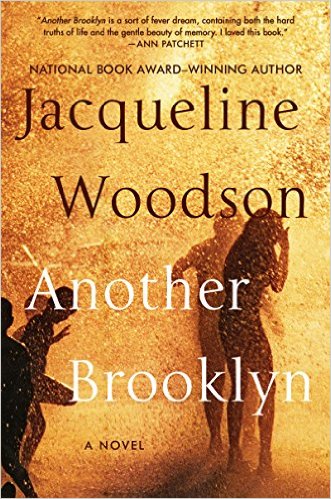
another brooklyn

Another Brooklyn is Jacqueline Woodson’s (Brown Girl Dreaming) first adult novel in 20 years. Powerfully moving and lyrical, it demonstrates her expertise beyond the children’s and young adult literature for which she is known.

“For a long time, my mother wasn’t dead yet.” This first line presents the powerful narrative voice of August, an adult reminiscing about her Brooklyn upbringing. Chapter 2 flashes back to the summer of 1973, when she was eight years old, and the novel follows chronologically from there. August and her little brother, recently relocated from Tennessee following a murky family tragedy, adjust slowly to city life. August watches a group of three girlfriends from her painted-shut, third-floor apartment window; she longs to be with them and eventually integrates herself, building an intensely close foursome. The girls share the mysteries, miseries and conquests of puberty–though their fate is hinted at by the opening chapter.

Another Brooklyn visits iconic moments in culture and history: damaged Vietnam veterans, white residents fleeing Brooklyn, the influence of the Nation of Islam in the neighborhood and in August’s single-parent household, the city-wide blackout of 1977. The city offers hope to four beautiful, talented, intelligent girls, and threatens them with men in dark alleys and the limiting judgments of others. Afros, cornrows and hijabs mark fashions in time. But despite these vibrant, evocative framing elements, this is essentially a coming-of-age story in which a child comes to face the hard edges of reality, both particular and universal. Woodson’s eye for detail and ear for poetry result in a novel both brief and profound.


This review originally ran in the August 12, 2016 issue of Shelf Awareness for Readers. To subscribe, click here, and you’ll receive two issues per week of book reviews and other bookish news.


Rating: 7 pickled pig’s feet.

A Wife of Noble Character by Yvonne Georgina Puig

Set in contemporary Houston, Tex., this fresh riff on The House of Mirth addresses the same questions of class and feminism, although in its own way.

wife of noble character

In Yvonne Georgina Puig’s A Wife of Noble Character, Vivienne Cally comes from Houston, Tex., high society, but her value is fading: 30 years old, unmarried and living with a coldly distant aunt, she possesses no wealth to speak of. Preston Duffin is an architecture graduate student from a different but adjacent class of people; the two have known each other all their lives. Despite her traditional upbringing, Vivienne is refreshingly spirited and skeptical, and Preston’s challenges to the life she knows intrigue her. He is attracted in turn not only to her beauty, but also to her similarly questioning attitude. Because the novel’s perspective shifts between the two, readers know what neither Vivienne nor Preston does as they are mutually drawn together, mystified and intimidated.

Plot progression would be accelerated if the characters would only talk to one another, but neither of them have the ability to speak honestly. Meanwhile, Vivienne’s society affairs–bridal and baby showers, lunches, mani-pedis–and her increasing struggle to maintain the façade of effortless wealth provide both heartrending pathos and entertainment, as the scene shifts from Houston to Paris, where Vivienne attempts a professional career as an art consultant, and back. Lavish details evoke the fashion and humidity of an expertly rendered setting, and Puig’s characters can be both silly and profoundly recognizable. With allusions to Edith Wharton’s The House of Mirth, and sensitive criticisms and clever details, A Wife of Noble Character is both fun and intelligent, much like its heroine.


This review originally ran in the August 9, 2016 issue of Shelf Awareness for Readers. To subscribe, click here, and you’ll receive two issues per week of book reviews and other bookish news.


Rating: 8 pedicures.

Women Lovers, or The Third Woman by Natalie Clifford Barney, ed. and trans. by Chelsea Ray

A sprightly, autobiographical 1926 novel of a Belle Époque lesbian love triangle, written in French by an American and appearing in English for the first time.

woman lovers

The works of Natalie Clifford Barney, an American who lived in Paris and wrote in French, are little known, and her 1926 autobiographical novel Amants féminins was published for the first time only in 2013. Woman Lovers, or The Third Woman is the first English translation.

A scholarly introduction by Melanie C. Hawthorne and a translator’s essay by Chelsea Ray place this work in the context of modernism and evolving gender definitions while detailing Barney’s biography. These introductory materials are revealing and absorbing in their own right, if a little dry in their academic tone. The novel, however, leaps energetically to life.

Barney’s protagonist N., who stands in for the author, believes in love among women as an ideal of pleasure and friendship. “Friendship is simply love without pleasure!” she declares. “Love is heavy for two to carry, and happiness is monotonous.” With a new lover, M., she establishes an “association” by which the two women will comfort those in romantic distress by sharing their affections. When she brings such a woman into her relationship with M., however, N. is unexpectedly left out, jealous and hurt.

Barney is perhaps best known for her aphorisms, and she uses such pithy fragments as well as screenplay-style dialogue, mock journal entries, a combination of first- and third-person perspectives and even drawings to tell her story. Woman Lovers, while brief, is thus a noteworthy and historically significant piece of experimental literature, queer theory and a captivating roman à clef all at once.


This review originally ran in the July 29, 2016 issue of Shelf Awareness for Readers. To subscribe, click here, and you’ll receive two issues per week of book reviews and other bookish news.


Rating: 7 chestnuts.

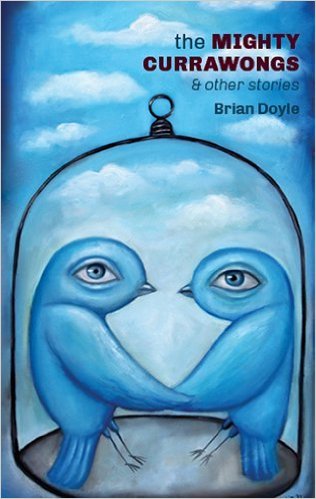
Teaser Tuesdays: The Mighty Currawongs and other stories by Brian Doyle

Teaser Tuesdays is a weekly bookish meme, hosted by MizB of Books and a Beat.

Teaser

Brian Doyle on books! Obviously you need this in your Tuesday.

mighty currawongs
From the story called “Elson Habib, Playing Black, Ponders the End Game”:

…one only needs a hundred books, my boy; the trick is to choose carefully which books are your companions; many people simply accumulate books and do not read them, whereas a discriminating soul has fewer books in toto but swims in them regularly; and the best books bear rereading, for somehow they always contain surprises and lessons you did not notice in previous readings. It is possible that some very good books continue to write themselves after they are published, perhaps working with their companions on the shelf, which is why I rearrange them twice a year, so as to provide them with new stimuli. Who is to say that they do not communicate among themselves, in ways only they know?

There is a whole blog post hidden in here about book ownership: how many, how stored, how arranged, how loved, how many read vs. unread. Incidentally, I am preparing for another cross-country move, so packing & choosing books again. Today, I don’t want to muck up Doyle’s lovely words. That blog post will come (and you will be asked about your own habits!).

But for today, go back and reread those lines, above. Happy reading.


This quotation comes from an uncorrected advance proof and is subject to change.

book beginnings on Friday: A Wife of Noble Character by Yvonne Georgina Puig

book beginnings

Thanks to Rose City Reader for hosting this meme. To participate, share the first line or two of the book you are currently reading and, if you feel so moved, let us know what your first impressions were based on that first line.

I am having a blast with this novel set in modern-day Houston’s high society, loosely based on Edith Wharton’s The House of Mirth.

wife of noble character

I will share with you the first lines of the book, as well. But for starters, I couldn’t resist quoting here, because just look at the opening epigraph and its original author, you guys:

I learned two things growing up in Texas.

1: God loves you, and you’re going to burn in hell forever.

2: Sex is the dirtiest and most dangerous thing you can possibly do, so save it for someone you love.

–Molly Ivins

My mother loves Molly Ivins. I was glad to see her here.

The opening lines of the novel itself are a little calmer:

Preston noticed her immediately. He always did.

But never fear. This is a book that will keep you turning the pages.

Stick around.

This quotation comes from an uncorrected advance proof and is subject to change.

Teaser Tuesdays: Women Lovers, or The Third Woman by Natalie Clifford Barney, ed. and trans. by Chelsea Ray

Teaser Tuesdays is a weekly bookish meme, hosted by MizB of Books and a Beat.

Teaser

woman lovers
This was a fun, thought-provoking one: short, and simultaneously animated (if one were to read the novel alone, for enjoyment) and dense (if one were to read all the introductory materials and take an academic stance).

I couldn’t choose, so here are two teasers.

First, to outline pithily the opinion of our protagonist (a thin veil for the author herself):

(Couples) were the first bourgeois!

So boring!

Or more dramatically:

Chopped into bits, our feelings were still twitching, even though they were deprived of the very thing that gave them life.

I love the imagery: feelings not only made physical, but made to physically suffer.

Keep your eyes open for Women Lovers.


This quotation comes from an uncorrected advance proof and is subject to change.

Paraíso by Gordon Chaplin

Set in Mexican “Paradise,” this moody novel combines fantasy, noir and the complexities of every form of love.

paraiso

Paraíso is an atmospheric novel both realistic and rooted in fantasy, traveling from New York City to Baja, Mexico, and exploring the nuances of love in all its forms. Gordon Chaplin (Joyride) offers a cast of whimsical, imperfect, loveable characters that readers will not soon forget.

As children, they were almost preternaturally close. Their mother named them Peter and Wendy, perhaps an early sign of something odd in family undercurrents. As teenagers, they stole the family minivan and ran for Mexico, but they never made it, apprehended instead at the very point Huck Finn and Jim aimed for.

These episodes are visited in flashbacks, from a present in which Peter and Wendy have been estranged for a decade, over a mysterious family secret. Wendy has finally made it to the little Mexican town of Paraíso, on the Baja peninsula, where she finds herself at the intersection of love and peril. Peter fled New York City after the towers fell, seeking his lost sister. They circle one another as Paraíso nears its conclusion, joined by charismatic associates, friends and lovers. These include Wendy’s best friend, who has been the siblings’ go-between for years; a sinister half-Mexican auto mechanic; an artista from Mexico City; and a teenage girl Peter mentors at work. The momentum of this expertly paced noir fairy tale increases as it nears its denouement.

Gorgeous, vivid scenery and fascinating people enrich a story that is both eccentric and universal: how to love and how to handle betrayal.


This review originally ran in the July 5, 2016 issue of Shelf Awareness for Readers. To subscribe, click here, and you’ll receive two issues per week of book reviews and other bookish news.


Rating: 7 letters.

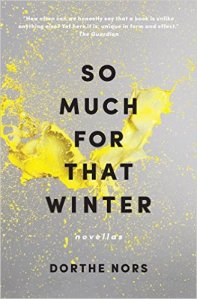
So Much for That Winter by Dorthe Nors, trans. by Misha Hoekstra

Experimental in form, these two novellas explore everyday frustrations in love and art.

so much for that winter

Two novellas by Dorthe Nors (Karate Chop) compose So Much for That Winter, translated by Misha Hoekstra from the Danish. They are as stark and unusual in form as they are bleak in mood. The first is “Minna Needs Rehearsal Space,” which is told entirely in declarative sentences, each on its own line. They range from the mundane to the philosophical: “People love wistful pop”; “Hope is a roe deer on a bluff.” This austere narrative style reveals a more complex story, about a woman who has suffered a breakup and seeks space–literal and figurative–for her work as an avant-garde composer. She hides away in her apartment, daydreams a relationship with Ingmar Bergman, and flees to an island she hopes will mend her.

“Days” follows, formed of numbered lists that make up the days of a woman’s life: a diary of sorts. The unnamed character is a frustrated writer, also with a relationship recently ended. Her days are inordinately filled with walks in cemeteries and lots of ice cream. Again the prosaic details blend with moments of poetry: “2. Sorted laundry, two piles, Tuesday”; “But the one who writes must dare to stand with her fledglings stuck to her fingers and surrender them in showers of spittle and roses.”

The result of these startling, experimental novellas is both somber and playful, the themes of romantic disappointment and creative blocks heightened by the minimalist style. So Much for That Winter is a compelling investigation of form and emotion.


This review originally ran in the June 21, 2016 issue of Shelf Awareness for Readers. To subscribe, click here, and you’ll receive two issues per week of book reviews and other bookish news.


Rating: 7 bike rides.

Seed by Michael Edelson

Disclosure: I received a free copy in exchange for this honest review.


seedWhat can I say? I’m impressed. Thank you, Andy, for recommending, and thank you to the author for passing this book along.

Seed stars Alex Meyers, a soldier stationed in modern-day California, where he trains the soldiers who deploy to Iraq and Afganistan. His life is routine, until the morning he wakes up in a plastic pod of sorts, stocked with clothes that fit, and surrounded by other people equally confused about how they got here. And just where is “here,” anyway? Each resident of this odd new world has been provided with the tools of his or her trade: medical tools for the doctor, and – chillingly – an armory for Alex. Obvious questions arise. Who kidnapped Alex and the others and marooned them here, and why? And is the invisible barrier there to keep them in, or to keep something else out?

Alex’s early reaction is contentment at an unexpected vacation. This place kind of resembles Hawaii, in fact. But it doesn’t take long for the sinister to creep in, at the same time that a romantic interest surfaces. Alex is a soldier, trained to obey, and not accustomed to a leadership role. But he finds that there are things, people, and values in his new environment that are worth defending.

This is a racing plot. I put the book down just once, to keep an appointment, and then raced through to the finish without coming up for air. Whatever its imperfections – and there are a few – it is a rare and special book that grabs me that irresistibly.

Seed‘s characters evoke the reader’s emotions, as Andy said in his review. But the strength of that emotional attachment comes more from the strength of plot, than any genius of characterization; characters are a little stiff, a little good-or-bad. No matter; they suffice. Dialog is likewise sort of indifferent.

But the pacing, momentum and intrigue of this plot is outrageous. I found it quite inventive and suspenseful; also as Andy noted, twists keep it from feeling formulaic. A third time like Andy, I am not normally a reader in this genre, which is, what? Military, dystopian? With a hint of romance? But any reader who enjoys plot-driven, adrenaline-filled novels should be well pleased.

Michael Edelson self-published this, his first novel, and “the industry” tends to look askance at such efforts. But this is a feat. I enjoyed every minute and was sorry when it ended. Congratulations, Mr. Edelson. If you care to revisit the world of Seed in a sequel, I’ll buy it.


Rating: 7 cups of nutrient powder.

book beginnings on Friday: Seed by Michael Edelson

Thanks to Rose City Reader for hosting this meme. To participate, share the first line or two of the book you are currently reading and, if you feel so moved, let us know what your first impressions were based on that first line.

seed

I am finally getting around to reading Seed myself – so sorry for the delay! – after my favorite bartender reviewed it so long ago. Full disclosure: I took this free copy in exchange for my honest review, with friend Andy as intermediary. I do not, however, know the author myself.

I’m loving it! Check out these first lines.

Alex was killed at 11:43 AM. Not quite lunchtime, but close enough. He was stepping out of his armored personnel carrier when a string of pops erupted from the crest of a nearby hill, accompanied by a cloud of dust raised by muzzle blasts. His MILES gear started to buzz, indicating a hit, and Alex lay down on the ground and waited for the end of the engagement.

And then I didn’t look up for another 80 pages. It’s got great momentum. Stick around!