Cygnet by Season Butler

An island of elderly separatists and one teenaged girl face essential human angst in this remarkable debut novel.

Cygnet is a powerful, poignant, smart debut novel by Season Butler. Her protagonist, known only as Kid, lives on an island otherwise populated entirely by elderly separatists. Ten miles off the coast of New Hampshire, Swan Island’s inhabitants call themselves Swans, and they want nothing to do with the rest of the world, which they call the Bad Place. Seventeen-year-old Kid has no business there, but her parents abandoned her with her grandmother, who has since died. Now she works part time for one of the residents, digitizing and editing photographs, home videos and the woman’s children’s diaries: “I’ve given her real breasts, grateful children, a husband whose eyes never wandered…. I’ll be up here forever, fixing Mrs. Tyburn’s memory.” She spends her lunch breaks with an Alzheimer’s patient, who has no memories to fix.

Swan Island is slowly crumbling into the sea, with Kid’s grandmother’s house set to go first: her backyard shrinks by the day, and Kid hates and fears the ocean, its relentless “waves that never tire of the same old dance moves. The cliff and the ocean, a mosh pit of two.” The Swans are always going on about how you can view the sea from anywhere on their island; she doesn’t see the appeal. With few exceptions, the Swans are cruelly frank about their displeasure at her presence, her very existence. She is desperate for her parents to return for her, but over the course of the story, the reader understands how unlikely this is. Memories and flashbacks touch briefly on their drug addiction and neglect, and hint at past traumas.

Cygnet covers a brief period of time on Swan, in Kid’s first-person voice. Her thoughts are true to those of an unhappy teenager: “I’m such an idiot” is a refrain; she disparages her own strange stream of consciousness. The prose style ranges widely from this (realistic) awkwardness to inspired lyricism. For such a young person, Kid has a surprisingly clear and sympathetic view of the Swans, appreciates their beauty and their choice to segregate from the Bad Place. She wishes her choices were so clear. On her 18th birthday, she bakes herself a birthday cake, using her mother’s remembered instructions; it comes out with a “perfect crumb” but she finds she’s no longer hungry: “I… take it outside, plate and all, and throw it off the stupid cliff.”

At the intersection of teen angst and sobering end-of-life realities, Cygnet contains some powerfully depressing material. But Kid’s disarming voice and unlikely will to push forward save this novel from doom and gloom. Kid and the Swans have more in common than they think–age and youth being more alike than either perhaps accepts–and Butler’s conception of this particular world-within-a-world is easy to lose oneself in. With the house literally falling out from under her, Kid will have to face her own future, create it for herself. By the end, this feels like a situation we all have in common.


This review originally ran in the May 23, 2019 issue of Shelf Awareness for the Book Trade. To subscribe, click here.


Rating: 8 nickels.

A Tale for the Time Being by Ruth Ozeki (audio)

A time being is someone who lives in time, and that means you, and me, and every one of us who is, or was, or ever will be.

My mother gave me this audiobook for my birthday. With her own print copy ready, we set out to read together. She had already very much enjoyed the audiobook. Now I’ve finished, and she hasn’t yet, so we haven’t done our final debrief together; but we have discussed as we’ve leapfrogged down the middle.

A Tale for the Time Being is unusual in a few delightful, fresh ways. The opening voice is that of Nao, a sixteen-year-old girl living in Tokyo. (In this time-obsessed novel, you can bet her name is a meaningful homonym.) Nao is Japanese but has lived most of her life in Sunnyvale, California, and the recent move to Tokyo has been very hard on her. She is the victim of criminal bullying at school, and has decided to end her life, but before she does, she wants to record the amazing life of her great-grandmother Jiko, a Buddhist nun and radical anarchist feminist. She sets out to do this in a diary. The diary is being read by Ruth, a novelist living on Canada’s west coast on a remote island with her husband Oliver and their cat, named Schrodinger but more commonly called Pest, or Pesto. (Ruth’s life matches that of author Ruth Ozeki suspiciously closely.) Ruth found the diary and a few other artifacts, well-wrapped in a barnacle-encrusted ziploc bag, on a beach near her home: the beach near Jap Ranch, as she calls it, her own Japanese heritage giving her the right and motivating her to remember the mistreatment of her people during World War II in these parts. (Oliver, who is of German heritage, cannot call it Jap Ranch.)

The story is told in alternating sections, in Ruth’s present and in Nao’s diary-recorded recent past, and then supplemented by other artifacts: documents found with the diary, and Ruth’s email correspondance as she begins searching for Nao in the present. There are several voices, then. And in several senses: there is the narrative first-person voice of Nao in her diary; Ruth’s perspective, told in third person; and then there are the voices as recorded in this audiobook. The author reads her book herself, which I love, and she does a lovely job of performing her set of characters. Oliver is stoic, a man of intellect and not emotion. Ruth is pensive; their neighbor Muriel is a bit nasal-y, and a bit annoying anyway. Nao is whimsical and impatient, sometimes immature and sometimes resignedly dour: a teenager indeed. The audio performance is absolutely perfect. It’s always comforting knowing we’re hearing the voices the author does.

The story expands and swells like a less well-packaged diary would have done in the ocean waters… We learn about Nao’s family, her depressed and defeated father, her no-nonsense mother, the deeply loveable Jiko, and more. It turns out that there is a thread of suicidal thoughts in her family: her father makes several suicide attempts, which they do not talk about; and his uncle, Nao’s great-uncle, died as a kamikaze pilot in WWII. Call that a reluctant suicide, perhaps. Three generations, then, dealing with tendencies to suicide in very different ways and originating in very different places. Meanwhile, Ruth’s family includes a now-dead mother who had Alzheimer’s but experienced a relatively sweet decline; Oliver is a decidedly quirky but, I felt, very likeable guy. He is a self-taught naturalist seeking to replant a preserve on their island so as to weather climate change. Even Pesto the cat plays an important role.

As the title indicates, this is a story about time, about moments, about whether we control the past or the future or even the present. As in the quotation that heads this review, the phrase “time being” takes on a new meaning here, in Nao’s dreamlike, imaginative ruminations. Ruth and Nao are both distant and very close together; the question of how far or near takes on a mystical quality, as Ruth worries if she is going crazy (or developing her mother’s disease – a worry I’ve seen in people I know too). Under Oliver’s wise guidance, even quantum physics comes into play late in the book, where I got quite lost but I think (hope) that I followed the ideas, the feeling of mystery and wonder.

Ruth Ozeki is a remarkable writer. This tale is multi-layered: mental health, the bendiness of time and space, linguistics (Japanese and English and also French, the bendiness of language, too), literature, and the love and personalities of animals… there is something here for everyone. For example, I thought of my father every time Oliver worries over the trees he’s planted in the preserve. Technically, the species he’s chosen violate the covenant of the trust because they are not native to the region; but he’s planted them for the climate-changing future, when species move north, and he’s put great thought into his choices, and the idea of destroying them is indeed heart-breaking. This issue is glancing within the book, but clearly opens up into something large and thought-provoking and timely – qualities that apply to every aspect of A Tale for the Time Being. Add to all of this Ozeki’s pitch-perfect performance, and I can scarcely recommend this audiobook highly enough.

And speaking of bendiness, consider the similarities between the author Ruth and the character Ruth. Of course I have 100 questions about their boundary lines. And what of Nao’s washed-up diary? What is its real-world equivalent? There are some mind-expanding puzzles here to be sure. It’s delicious.

Note: Ozeki (as herself) comments at the end that the print version includes footnotes, illustrations, annotations, and appendices. She appreciates the audio version very much for some reasons – she writes for musicality and sound, and loves its immediacy – and the print for others. Hopefully my mother, who is finishing the print version now, will have some thoughts to share with us about those differences. I suspect audio first, followed by print, is the right order.

If you love cats, trees, or people; if you’re interested in history and legacy, the power of words, or the questions posed by the passing of time – then this delightful, expansive novel is for you.


Rating: 9 crows.

The Plover by Brian Doyle (audio)

And no thinking on this trip, either, he said to the gull floating over the stern. No recriminations and ruminations. No logs and journals and literary pretensions neither. Thinking can only, like the boat, proceed forward.

Thank goodness for Brian Doyle. I had been in a bit of a blue funk and looked for something cheerful to pick me up; a Brian Doyle novel was just the thing, I thought, and I was right.

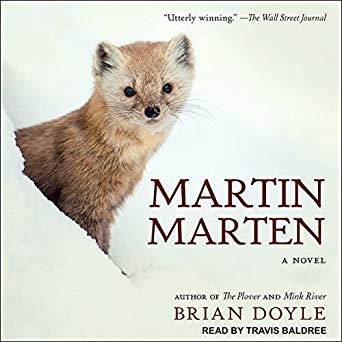
Based on Martin Marten and Mink River, I foolishly thought the plover in this story would be an actual plover – a bird. Ha! No, the Plover is a boat. (And to be fair, the protagonist of Mink River turned out to be a crow.) Classically, for Doyle, we open with epigraphs: from Robert Louis Stevenson, George Harrison, and Annie Dillard. (Perfect.) Then we plunge right in and meet our protagonist, an eccentric fellow (aren’t they all) named Declan O’Donnell. An Irishman (read here with an accent) who hails from the Oregon coast and a fractured family, he’s invested himself totally in a small trawler he calls the Plover for perfect reasons. He’s “edited” her by, among other things, fitting a small mast and sails; and he heads off from Oregon, intending “west and then west.”

Declan is explicitly trying to escape humankind and all their “emotional complications… expectations and illusions… analysis and explications.” But of course, he is immediately joined (page 1) by a gull, to whom he holds forth at length: we already suspect he enjoys having the company. And the comedy of the book is in all the passengers he takes on: the narrative tells us that the census reaches over one thousand, if we count barnacles, but it also at one point reaches seven human beings. Declan is in fact a more social creature than he aspires to be, and that’s the central storyline here: Macmillan’s blurb calls it “the story of a cold man melting,” and I think that’s not too far off, although I might amend to call it the melting of a man who tried to be cold. Declan has had some trauma in his life, and his reaction is to try and shut himself off. He fails, and that’s one of the joys of this book.

There are so many joys, although also much trauma. Declan’s best friend, Piko, is one of Doyle’s exuberant characters – “he had legally changed his name for a while to an adjective, he played the flügelhorn in a jazz band that deliberately played only such events as weddings between Lutherans and Presbyterians and baptisms of babies named for animals, and he had once flensed a whale by himself, over the course of three weeks, on the beach, living in a tiny blue tent about the high tide line. He was one of those guys who seemed electrified by everyone and everything, the kind of guy who totally lit up when he saw a sparrow-hawk helicoptering over a corn shock, the kind of guy who liked every kid he ever met and every kid liked him… But he had been wounded by a storm, this guy, his little daughter hit by a bus driver when she was five years old waiting for the kindergarten bus, and his light was dimmed.” Pippa, the daughter, cannot move except for a possibly meaningless fluttering of her hands; she cannot speak except to make possibly meaningless squeaks and coos that sound like bird sounds. But she has a rich inner life. (Spoiler: Piko and Pippa will become passengers and crew on the Plover.) Both Piko and Pippa are very Doylesque characters: peculiar, delightful, brimming, wounded. There are more of these in the book – a Doyle novel is made of such characters. Again: just what I needed.

So Declan explores the world, becoming increasingly reluctant to set foot on land. He cares for his boat and weathers storms. He picks up passengers and rails against their very presence, but still they come on. He and his growing crew-family have a conflict with another ship and its ill-intending captain, but everything comes out well in the end. As the small, green, red-sailed Plover swells in population, tensions rise, but so does the incidence of miracles. Doyle is unafraid to take his whimsical characters to the brink of death and then snatch them, in unlikely fashion, back. Once you’ve made peace with this inclination (and I have), it’s great fun.

Declan is a devoted reader of the Irish author and orator Edmund Burke, who is much quoted here, along with a reference or two to Robert Louis Stevenson (upon whom Doyle would base a later book). Through these outside voices, through Declan’s own and the wise voices of his friends and comrades (including one very quirky minister for fisheries and marine resources and foreign affairs), The Plover is a novel of philosophy as well as the story of one plucky little boat and its captain.

David Drummond’s reading feels perfect to me. I love the many different voices, accents, rhythms he plays. Pippa’s exuberance, Declan’s grumpy Irish lilt, the minister’s volubility and interesting speech patterns, and so much more. (Somebody should write a paper on the minister’s word coinages.) A good narrator makes all the difference, and I’m so glad we got a good one here.

Doyle’s usual strengths are all present. Characters and story are brimming and bubbling with good cheer even in the face of significant and imaginative tragedy. Sentences are often long, convoluted, and performative of their content. Details are numerous and precise and bizarre. Nothing has changed; this man is a near-perfect novelist, for this reader. I’m still so sad he’s gone.


Rating: 8 crucial silences between notes.

Lanny by Max Porter

This novel about family, the power of the woods and the creative spirit, centered on a special young boy, will charm any reader.

Following his decorated first novel, Grief Is the Thing with Feathers, Max Porter again takes his reader into a weird and magical world with Lanny. Similarly short, lyric and mysterious, this touching story is partner but not sequel.

Lanny’s mum and dad have moved to a village not far from London, “fewer than fifty redbrick cottages, a pub, a church.” Lanny’s dad commutes into the city while his mum works on writing her murder thriller. Lanny goes to school and plays in the woods, singing, fairy-like and joyful; he is “young and ancient all at once, a mirror and a key,” “stinking of pine trees and other nice things.” He “says strange and wonderful things, mumblings, puzzling things for a child to say.” There is also an old man in the village named Pete, an artist who works with natural materials and was once famous in London. He describes himself as a “miserable solitary bastard” but is actually caring and sensitive; he becomes the closest friend Lanny’s family has in town.

And then there is Dead Papa Toothwort, a legend and an enigma, tied up in trees and leaves and related to the green men carved in old churches in this part of the world. When the book opens, he is waking “from his standing nap an acre wide.” As a force, it is unclear whether Dead Papa Toothwort is good or evil; he is associated with death as well as seasonal renewal. “He wants to kill things, so he sings… his grin takes a sticky hour.” “He loves it when a lamb gets stuck being born.” And he is obsessed with Lanny.

The whole village, in a way, revolves around Lanny–especially after misfortune strikes. His dad feels overwhelmed by his son’s specialness (“What or who is supposed to manage and regulate Lanny and his gifts? Oh f*ck, it’s us”); his needs are simpler, related to work, food and sex. The boy’s mum is closer to Lanny’s dreamworld, “the type of person who is that little bit more akin to the weather than most.” After agreeing to give him art lessons, Pete finds a surprising new friend in the young boy. The rest of the human population follows this preoccupation–and always there is Dead Papa Toothwort, listening.

What begins as a sweet revolution of three adult lives (mum, dad, Pete) around the boy turns sinister in the novel’s second of three parts; resolution comes in the third. Often a stream-of-consciousness style leaves the reader a bit off-kilter, but this is suited to Lanny’s dreamlike setting: trust in the story will be rewarded. Porter’s prose is undeniably gorgeous. “Mile-wide slabs of rain romp across the valley… palette-knife smears of bad weather rush past.” These elements in combination are every bit as imaginative, compelling and magical as Lanny himself.


This review originally ran in the April 25, 2019 issue of Shelf Awareness for the Book Trade. To subscribe, click here.


Rating: 8 mutterings.

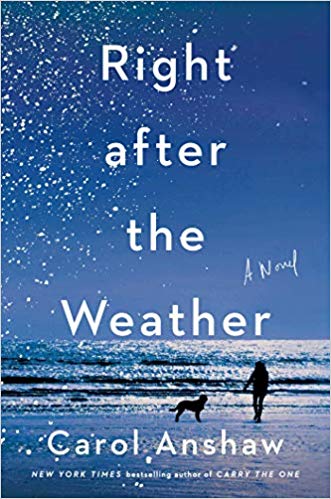
Galley Love of the Week: Right After the Weather by Carol Anshaw

Be among the first to read Right After the Weather by Carol Anshaw, a Shelf Awareness Galley Love of the Week. Presented on Mondays, GLOW selects books that have not yet been discovered by booksellers and librarians, identifying the ones that will be important hand-selling titles in a future season.

Carol Anshaw’s Right After the Weather is, as her editor, Trish Todd, writes, “a real literary event”: taut pacing, delightful and delightfully weird characters, and a mighty shock inflicted upon its readers midway through. Protagonist Cate barely makes ends meet as a set designer waiting to make it big; surrounded by eccentric friends and lovers, she will capture your heart, and just maybe, keep it all together. Todd says, “Anshaw is a master of characterization, and I love meeting her flawed but recognizable and lovable characters. Her books are short, but they are like snapshots of an entire zeitgeist.” Hilarity, pathos, loads of quirks and a wry, behind-the-scenes look at the theater combine for an unforgettable experience.

Galley Love of the Week, or GLOW, is a feature from Shelf Awareness. This edition ran here.

Soon the Light Will Be Perfect by Dave Patterson

This sensitive debut novel about everything that can go wrong as one grows up will touch any reader who remembers being 12 and beset by the world.

Dave Patterson’s first novel, Soon the Light Will Be Perfect, is a rough-edged coming-of-age story. Set in a poverty-stricken Vermont community at the beginning of “the desert war,” it spotlights a family in crisis within a town in despair.

The narrator is a 12-year-old boy. Along with his older brother, father and mother, he remains nameless, although more peripheral characters have proper names. As the story opens, the family has recently moved out of the trailer park–an important social step up–and they have given away their old kitchen table in an act of charity. The father is supposed to be building a new one, but this project serves as a metaphor for larger troubles. Getting the new kitchen table finished and perfect will prove daunting. In the first chapters, the family’s troubles ratchet rapidly from an overpopulation of pet cats to the mother’s cancer diagnosis.

The 15-year-old brother gets a girlfriend and distances himself from the narrator, although the boys still smoke weed together in the garage, where the kitchen-table project progresses slowly. This is a devout Catholic family, and guilt plagues the young narrator, whose burgeoning sexual interests, for example, give him trouble. Struggles with faith are central to the book. The father’s work in a weapons factory seems secured by the advent of war, a fact that the narrator has trouble reconciling with Christian teachings. His mother’s suffering at the hands of cancer, chemotherapy and radiation seems senseless. He remains committed to religion, despite these conflicts and his obsession with women’s underwear. A new girl his own age from the trailer park provides further conflicts between what he feels and what he thinks he ought to feel.

While Patterson’s gift for description brings beauty to this novel, the tone is bleak. The father labors helplessly: “In the garage the saw screams in the ceremony of my father’s self-destruction.” The sick mother delivers food to those needier than herself but also covers up a small crime, as her younger son sneaks cigarettes and self-flagellates. Amid the narrator’s crisis of faith, even the priest turns away from church. Certain plot turns and characterizations may tend toward cliché, but Patterson’s striking writing and attention to detail rescue his book from that realm. To put it another way, clichés are formed from the broadest truths of life, and Patterson aims to approach those overarching truths–perhaps why his protagonists go unnamed.

Soon the Light Will Be Perfect is an ambitious work about what it is to be young and facing problems that challenge the most capable adult. At its end, much remains unresolved, just as in life, but readers will recognize just how true that ending rings.


This review originally ran in the March 22, 2019 issue of Shelf Awareness for the Book Trade. To subscribe, click here.


Rating: 6 junked cars.

The Gulf by Belle Boggs

Where a failing writer, ill-conceived for-profit education and the American political divide come together, the result is both funny and feeling.

The Gulf by Belle Boggs (The Art of Waiting) is a hilarious, pitiable, thoughtful first novel not to be missed. A rare combination of silliness and poignancy, with momentum and compassion, this is a story for every reader, but especially for struggling writers.

Marianne is desperately underemployed and about to lose her apartment in Brooklyn, N.Y., and her poetry manuscript has been long stalled. Eric, her best friend and ex-fiancé, has an annoyingly good job teaching overseas, as he works to complete the second novel in his two-book contract. When he calls from the United Arab Emirates with a business offer, Marianne wants to say no, but she has no other option.

Eric has inherited an aging motel on Florida’s Gulf Coast, and wants to realize an old college joke of Marianne’s: a low-residency writing school for Christian writers. Marianne, a liberal atheist, soon finds herself in business with Eric, his venture capitalist brother, Mark, and their silent partner, great-aunt Frances. Ensconced in the crumbling motel with occasional hurricanes passing through, Marianne doesn’t precisely want to fleece the applicants sending in embarrassing manuscripts, but she certainly could use the money.

What follows is part hilarity: Marianne and Eric flub their Bible references and flirt with hooking back up; the earnest students have no idea how a writing workshop is supposed to work; and the down-and-out instructors (all the Genesis Inspirational Writing Ranch can attract, or afford) prove eccentrically dysfunctional in various ways. It’s part pathos: as real as Marianne’s struggle to complete her own manuscript is the troubled calling of Janine, poet, home economics teacher, mother of two, who writes about Terri Schiavo. Mark lands a big investor that specializes in for-profit education for the Christian market, but their intervention quickly upsets everyone involved. Marianne finds herself, against all odds, rooting for her students–those right-wing nuts she once laughed at. As the biggest storm of the year approaches the ramshackle Ranch, she’ll have to make a stand.

Boggs’s gifts are many. The Gulf‘s plot is inspired, even accounting for the arguable overabundance of novels about MFA program shenanigans. Perhaps the greatest genius is in her characters: Marianne, Eric, the writing instructor who can’t remember anyone’s name, the hotelier next door, Janine and the former R&B superstar now banking on an autobiographical novel to make his comeback. Each of these is perfectly developed and flawed just enough to be lovable, if hapless. The book hums along with fitting momentum, so that when the storm hits, the reader is entirely invested in this well-meaning but ill-fated crew. Redemption is a risky ambition, especially with inspirational writing, but Boggs pulls it off with The Gulf‘s denouement. This is a novel of keen comedy, insight and empathy.


This review originally ran in the March 8, 2019 issue of Shelf Awareness for the Book Trade. To subscribe, click here.


Rating: 8 applications.

Sugar Run by Mesha Maren

Disclosure: Mesha is a visiting faculty member at my MFA program and a friend.


Sugar Run has been getting a lot of press, and it’s well deserved. This is an astonishing novel.

Jodi was seventeen years old when she was sentenced to life in prison. Eighteen years later, she is surprised to find herself paroled. She never thought this would happen, even as the lawyers and appeals pressed forward around her. Now she steps out the gates and is surprised to see that she’s been surrounded by mountains all these years in Georgia – mountains she couldn’t see, but that make her feel just that much closer to the mountains of her West Virginia home.

Jodi heads south before going home, though, to track down a boy she should have helped all those years before. She is surprised to find him transformed into a man she does not recognize; if time stood still for Jodi in prison, it hasn’t for the rest of the world. In short order, Jodi collects as well as a partial family in crisis; as she drives a new friend’s Chevette into rural West Virginia and up the mountain she calls home, the life and hopes she’s building may already be falling apart.

In flashback sections, we learn as well about the past, chiefly the buildup to the crime that got Jodi life in prison as a minor. The cast of characters is not small: Jodi’s mother, father, beloved grandmother, and younger twin brothers; Paula, a woman important to Jodi in her youth, along with her parents and brother; Jodi’s new friend Miranda, estranged from her pop singer husband, with three young sons and a coterie of associates; and the inhabitants of the West Virginia hilltop Jodi returns to, from fracking workers to activists and the locals she’s known all her life – or at least for its first seventeen years.

It’s a remarkable story. For one thing, the lives of Appalachian lesbian women are not much seen in literature, and women in prisons are somewhat underrepresented as well. (Mesha teaches writing in a women’s prison, so she has the research to back up that element.) But equally importantly, as a plot, it rips. From Jodi to Miranda, from past to present, the reader is kept totally absorbed (I would like to thank Mesha for getting me through six hours in the waiting room of an auto shop). It’s a fully realized world to fall into.

I also appreciated the strong sense of place. Jodi is deeply committed to her late grandmother’s cabin and property on a hilltop threatened by extractive industry: a classic West Virginia story, in a way, but one thoroughly fleshed out and real here. The place itself is described as carefully as the characters are. I realize that I’m portraying this book as both character- and plot-driven; it is also about the sentences, which weave and wend and take their time painting pictures as much as moving either plot or characterization along. Pacing-wise, it might be mid-range. The plot has momentum and keeps me turning pages; but the sentences take time for beauty.

This is a fine and multi-faceted novel, and I love it. Congrats, Mesha.


Rating: 8 hands.

Sea Monsters by Chloe Aridjis

A disenchanted teenager in 1980s Mexico City runs away from home hoping to find Ukrainian dwarfs on a Oaxacan beach in this lovely, surreal novel.

Sea Monsters by Chloe Aridjis (Books of Clouds, Asunder) is a dreamy, wandering tale of teenage ennui and searching, and the pull of the sea.

Luisa is 17 and bored with school, her parents and her classmates (nearly all of whom have bodyguards waiting outside their elite Mexico City international school, which Luisa attends on scholarship). Her interests include her best friend Julián, who lives above a restaurant, and his stereo, as well as her French teacher’s encouragements and the books he lends her. And thanks to her professor father’s storytelling, Luisa is fascinated by shipwrecks. Perhaps this is partly why she is so taken in by the newspaper headline: “Ukrainian Dwarfs on the Run.” It is suggested that these escapees from the circus have headed to the beaches of Oaxaca, and for Luisa, they become crossed in her mind with a sort of hidden treasure: something to seek.

There is a boy, too. “I didn’t even particularly like him at first; intrigued would be a better word. He was a sliver of black slicing through the so-called calm of the morning.” Tomás Román: even the syllables of his name have power. “He had been a snag in the composition, somehow inserting himself in the picture in a way the others had not.” Luisa has trouble understanding his pull on her, but as it resembles the pull of the Ukrainian dwarfs at the beach, she follows the impulse, and boards a bus with Tomás for the coast.

Because it is 1988, a soundtrack of Depeche Mode, Siouxsie and the Banshees, the Cure and Joy Division back up Luisa’s surreal travels. Her attention drifts between the immediate present–where she observes dogs and waves with as close an eye as she does people–and an interior world populated by French poetry, ancient shipwrecks and imagined worlds. She makes up lives for the people she encounters, daydreams about the magic powers of a city billboard and a man she meets on the beach. She styles him a merman. “But that was the problem with mysterious people,” she tells him, “once you spend time with them they’re not so mysterious after all, and as [she] said this the merman smiled as if promising, no matter what, to remain a mystery.”

As Luisa dreams away her days in a little village called Zipolite, a community of hippies, nudists and beachcombers, her father searches for her. And he will have some of the best stories to tell by the end of this weird, captivating novel. Aridjis’s prose is well suited to this kind of story: her sentences are luminescent and imagistic, expressing Luisa’s tendency to fancy: a great marble horse “[chooses] the sea, and was there to this day, the horse that gave them the slip, galloping along endless banks of seabed, kicking up whole paragraphs of sand.” The plot of Sea Monsters is somewhat quiet, Luisa spending much of her time inside her own head, but Aridjis’s style makes this an absolute pleasure even when nothing is happening.


This review originally ran in the January 3, 2019 issue of Shelf Awareness for the Book Trade. To subscribe, click here.


Rating: 6 hammocks.

Everything Under by Daisy Johnson

This surreal, riverine, gender-bending retelling of Oedipus Rex will fascinate and fire the imagination.

Shortlisted for the 2018 Man Booker Prize, Everything Under is a dreamy, twisty-turning tale set in modern Oxford but calling on mythology and upturning societal norms. Daisy Johnson’s first novel (following the story collection Fen) requires its readers to wonder and follow along for a while before its connections begin to form, but the payoff for that patience is well rewarded.

“The places we are born come back.” At the novel’s opening, Gretel is a lexicographer who mostly keeps to herself, caught up in her mysterious past: “I’d always understood that the past did not die just because we wanted it to.” She lives in a remote cottage with her mother, Sarah, whom she has recently found and brought home. Then time shifts, and for much of the book the reader sees Gretel’s unusual childhood, and the long stretch of adulthood during which she searched for her missing mother.

Gretel grows up living with Sarah on a river, in a houseboat that never moves. They forage for food and remain apart from society: “River people aren’t like other people. You won’t see the police down here.” They make up their own language, words that make sense only to them. It is a watery world of shifting gender identities and slippery, changing rules. Gretel is shaped by self-sufficiency, words, fluidity and a fear: something under the water called the Bonak. When she is 16, her mother disappears, leaving Gretel to take care of herself.

In the flashback chapters, an enigmatic third character appears. “What happened to Marcus?” Gretel asks her mother, in the later timeline when they live together again, the older woman having lost her memory and the words that mattered so much. But it takes many more pages to reveal who Marcus is.

Many chapters are named for settings: repeatedly, “The River,” where Gretel grew up; “The Cottage,” where she lives as an adult; and “The Hunt,” when she was actively searching for Sarah. In those chapters on “The Hunt,” Gretel explores the countryside near the river, visiting a couple who lost their teenaged daughter years ago. She meets a failed prophetess, collects a stray dog and excavates her memories. This action is every bit as wandering, confused, seeking and amnesiac as Gretel herself.

This is a complex plot with profound themes: a monster under the water, the shape of fear itself; the importance of language; the death grip of the past; fate versus free will; flexible gender identities; unanswered questions. Everything Under remakes the ancient Greek myth of Oedipus, with its prophecy that will be fulfilled, no matter how strangely it must twist. Johnson’s singular, hallucinatory storytelling is well up to her book’s ambitious form. The result is spellbinding.


This review originally ran in the October 29, 2018 issue of Shelf Awareness for the Book Trade. To subscribe, click here.


Rating: 7 rolls of cling wrap.