No Son of Mine by Jonathan Corcoran

Disclosure: Jon has taught as guest faculty in my MFA program. I admire his work and he is a dear friend.


Also, I am teasing you about a book that will not be published for months (April 1 of this year, no foolin’), but I’ll repost then to remind you.

Now on to the show.


I found this memoir remarkable. It encompasses much in terms of its time span and the bigger events in the world, and Jon accomplishes something special by being raw and vulnerable, and never self-indulgent. I think the struggles he portrays here will offer something to any reader, because we are all struggling to navigate even the closest of relationships. I am impressed by the writing in terms of that larger storytelling and meaning-making, as well as line by line.

Corcoran grew up in a small town in West Virginia that is just a few minutes’ drive from where I live now. (It’s always a little exciting to read a place written well that you personally know, and I did enjoy that part here. Elkins is not perfect, but I think this author has handled it with respect for both positive and negative qualities.) As a gay kid, he suffered in the town, in the evangelical church his family attended, and in his family itself. He did some secretive explorations of sexuality in West Virginia (not too dissimilar, I think, from those in The Rope Swing, which is however fiction), but did not live as an openly gay man until he left for college at Brown University. Coming from poverty, Brown was both a great accomplishment and a shock: a wider world, but rarified, and Jon was a foreigner to many of his peers and professors there. It’s at Brown that he met Sam.

In his second year at Brown, Jon is in Portland, Maine, with his boyfriend, Sam, meeting Sam’s family for the first time. It’s his twentieth birthday when his mother calls, seething with what she’s discovered. Jon confirms that he is gay. “You are no longer my son,” she says, and she hangs up. This leaves him traumatized, trying to finish college with no financial or emotional or any other kind of support, with no family, and no options, surrounded by Ivy League administrators whose understanding of what all this means is so poor that he is advised to take a year off and travel. His mother spends the next six months calling in the early morning and waking him up to tell him he will die of AIDS or go to hell, or both.

Jon and his mother spend years–fifteen years, the rest of her life–being estranged and trying again, having massive, blow-up fights and years of silence, and abuse and toxicity and cautious attempts at peace and acceptance. Her bad behavior is horribly, shockingly bad. But tangled up with the bad is the fact that this is his mother, his caretaker, whom he has loved, and who still (somewhere, twistedly) loves him, and misses him when they are on the outs. It’s a level of trauma that’s hard to fathom if you haven’t lived it. But as a narrator, he does a good job of describing its effects, including a mistrust of memory and various physical ailments. It also poses some challenges for his relationship with Sam, which will continue until they eventually marry, and into the present.

This is a memoir of trying to reconcile a parent that the narrator loves, his memories of her and of his hometown, with the pain inflicted at the hands of that same person (and place). It’s all a puzzle, to question the causes, to wonder how much forgiveness is due to such a figure. It’s a memoir that is also an assay, both a personal narrative and an exploration of ideas. “…some part of my brain is perpetually trying to explain her actions, to find the root cause for them, and what this really comes dangerously close to is the notion that her actions have an excuse, that if I searched hard and long enough the hurt and pain she caused me can be written away. But she hurt more, a voice says, and I don’t doubt that. So here I am, operating the world’s worst justice system from the recesses of my brain.” “I do not know how to balance all the pain she caused with all the pain she felt.”

There’s a lot to appreciate here, and a lot of wisdom that I think will help just about anybody. Not to say answers, but wise observations about one man’s experience. Most of us are wrestling with difficult, tangled-up relationships where abuse and love meet; many of us are struggling with what to take and what to leave about a family or a place. “I hear her laugh, hear the crinkle of her dyed-blonde hair. I rub her cracked feet, feel her hand on my back. I smell her nicotine fingers. There is her cup of Lipton tea in the little ceramic mug that is white with flowers around the brim. I taste the milky black tea. And I say, I don’t want to lose this all. I don’t want to lose what made me.” There is also some lovely writing here. If the story itself is often difficult, there’s a remarkable amount of grace, beauty, and hope. I think it’s a book for anybody and everybody. Thank you, Jon, for sharing so much in a way that feels both raw and wide-open, and careful and thoughtful. I’m awed.


Rating: 9 paper bags.

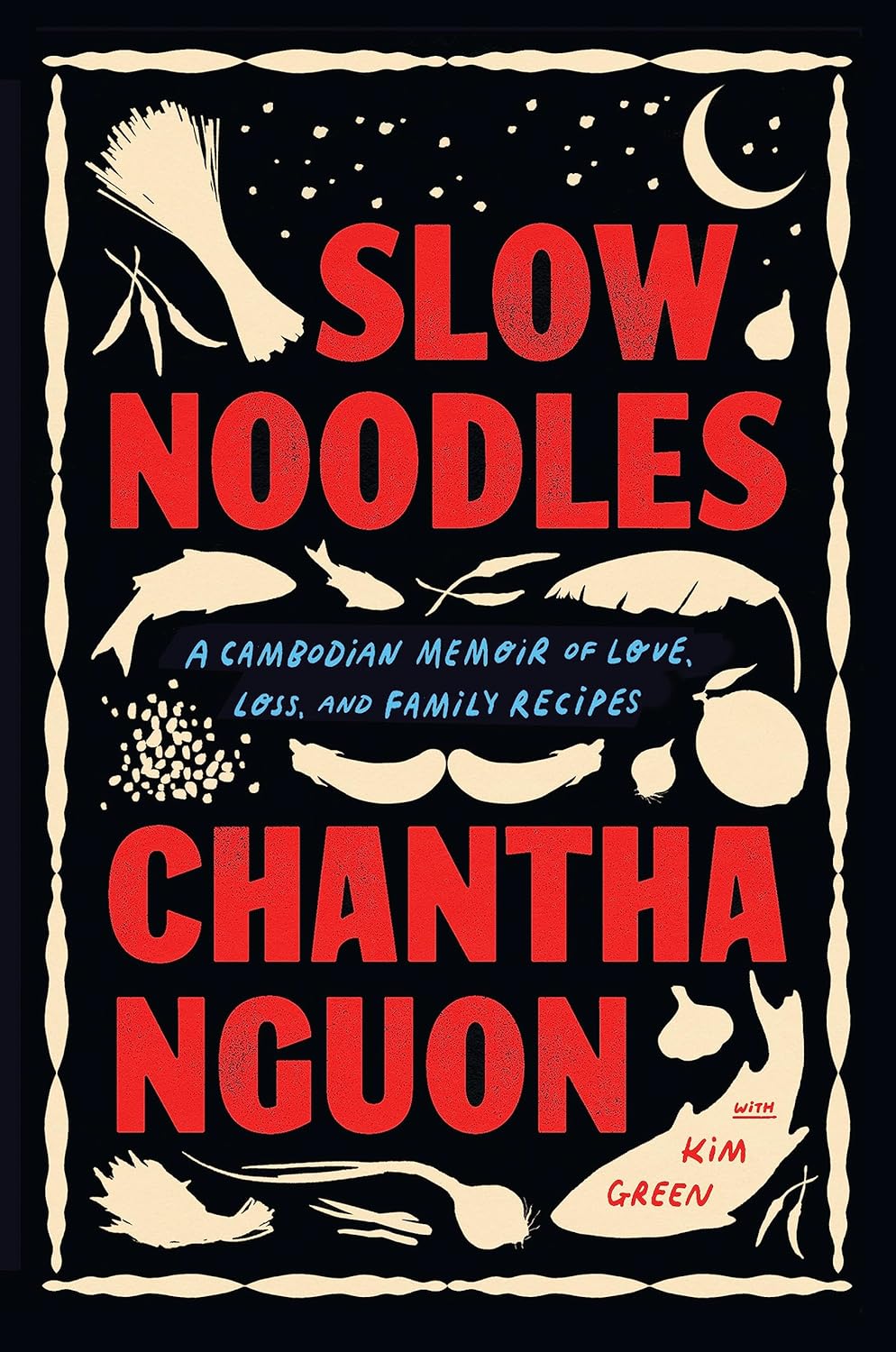
Slow Noodles: A Cambodian Memoir of Love, Loss, and Family Recipes by Chantha Nguon & Kim Green

This memoir of food, family, feminism, and Cambodian history, which includes enticing cookbook-quality recipes, is breathtaking in its emotional resonance and lovely writing.

Slow Noodles: A Cambodian Memoir of Love, Loss, and Family Recipes tells a story that is, by turns, heart-wrenching, inspiring, harrowing, and mouthwatering. Chantha Nguon’s memoir, written with Kim Green, encompasses both world history and an intimate personal account. Nguon, born the youngest child in a comfortable family in Cambodia’s Battambang, had nine years of soft living and good eating before Pol Pot reset time to Year Zero in the 1970s. Moving first to Saigon, where she weathered the end of the Vietnam War, and then escaping as a refugee into Thailand, Nguon gradually lost everyone she loved, ending with her mother’s death when Nguon was 23. She was a food-focused young child with a mother who took cooking very seriously; she became a young refugee in peril of starvation. For Nguon, rationing or missing entirely the most basic of ingredients is not only a literal life-or-death issue but also symbolically life-altering. With the loss of her family and, to some extent, her culture, she views herself as a repository of recipes, culinary knowledge, memories, pain, and strength.

Food metaphors enrich this book, which sparkles with poignant, deeply lovely writing: “The green-fresh fragrance of young rice is as lovely and fleeting as childhood itself.” Nguon’s mother “taught [her] the art of rebelling as quietly as a whisper of silk.” Twenty-two recipes learned from Nguon’s beloved mother, or developed throughout her own accomplished cooking life, are included, with clear instructions and helpful notes on ingredients (and accompanied by a glossary for potentially unfamiliar terms). These are joined by cleverly figurative recipes, such as the recipe for silken rebellion, which begins: “Find the pockets of freedom available to you. Exploit loopholes.”

By the end of the story, Nguon has transformed into an impressive woman, acting as her husband’s equal (a radical concept, encouraged by her quietly rebellious mother) and a fierce advocate for social change. Nguon, who becomes a staunch feminist, eventually undertakes medical and humanitarian work with AIDS patients and sex workers, fights for education and independence for Cambodian women, and with her husband, founds the Stung Treng Women’s Development Center in rural Cambodia.

Nguon’s titular noodles contribute enormous metaphorical meaning. In her childhood household, slow and proper cooking was prioritized (“my mother despised the flavor of shortcuts”). In Thai refugee camps and in the Cambodian jungle, instant noodles became a prized delicacy. And by the memoir’s end, this thoughtful narrator has integrated these experiences, valuing both the careful preparation of fine foods and the stark relief of basic nutrition. Slow Noodles is a rare gem of a story, gorgeously written, humble and stirring, and packed with tempting recipes.


This review originally ran in the December 14, 2023 issue of Shelf Awareness for the Book Trade. To subscribe, click here.


Rating: 9 silk threads.

Heavy: An American Memoir by Kiese Laymon

Kiese Laymon’s Heavy is everything they say it is. I’ll start with some adjectives from Roxane Gay’s front-cover blurb: “astonishing. Difficult. Intense. Layered.” Some books – well-regarded, reviewed by smarter, better-qualified folks than me – are hard to write about. I can only add my voice to the chorus.

I think I’d already begun hearing about Laymon when I read an essay of his in Oxford American, which featured (if I remember) Outkast and his Grandmama. I was impressed then and I knew I needed to read this; I’m just sorry it’s taken me this long.

Laymon comes from Missisippi, raised by his mother and grandmother with infrequent contact with his father. He comes from financial insecurity, and a black* American experience that knows it is wildly insecure in the face of white America. His mother and father are both politically minded, and he has plenty of exposure to questions about race and racial (in)justice, but no exposure to the kinds of questions that bother him from a young age: questions about gender and sexuality and safety, consent, bodies, sexual violence, physical health, eating, economic insecurity, housing discrimination, memory, honesty and lies. He has to pursue these questions himself, and while Heavy is the story of his coming-of-age, it’s much more about figuring out how to interact with some of those questions. Truthfulness, bodies, relationships. How to love responsibly, as he puts it.

*I am following his use of the little-b black here even though that’s a change for me.

I did not want to write to you. I wanted to write a lie. I did not want to write honestly about black lies, black thighs, black loves, black laughs, black foods, black addictions, black stretch marks, black dollars, black words, black abuses, black blues, black belly buttons, black wins, black beens, black bends, black consent, black parents, or black children. I did not want to write about us. I wanted to write an American memoir.

That’s his first paragraph. The book is written in the second person to a specific reader: his mother. The narrator and his mother love each other hard, but there is a lot of harm in their love. The reader gets to see young Kiese grow up, from age eleven or so (it jumps around a bit) to an adult professor earning tenure (in traumatizing fashion) at Vassar College. He keeps his reader up to date on body weight, as he tries to cope with his pain by eating his way up to 319 pounds and then by punishing his body with exercise and anorexia down to 150-something pounds. “I knew, and worried, about how much I weighed and exactly how much money I had every day of my life since I was eleven years old.” The title is not only about body weight, although that’s certainly part of it. It’s about the heaviness of life and responsibility. “To white folk and the police, you will always be huge no matter how skinny you are,” his mother tells him.

I love how carefully he cares about words. His mother pushed him to speak a certain way, to keep him safe: no contractions when talking to white people and police. But he defends the unique language that he and his friends use in school, rebelling in their majority-white eighth grade year by using speech patterns that make sense differently. His mother, an academic, has pushed his writing and revision since childhood, but he’s choosing a different language than the one she pushes. “I realized telling the truth was way different from finding the truth, and finding the truth had everything to do with revisiting and rearranging words. Revisiting and rearranging words didn’t only require vocabulary; it required will, and maybe courage.” WHEW. This book begins and ends with short sections titled respectively ‘Been’ and ‘Bend.’ He writes at the beginning, in ‘Been,’ to his mother: “I am writing a different book to you because books, for better and worse, are how we got here, and I am afraid of speaking any of this to your face.” There’s something powerful in writing down what’s that hard to say.

Heavy is artful, lyric, deathly serious, loving, stark. When Laymon becomes a young professor, he catalogs the ways in which he fails his students, and it’s absolutely raw and horrifying, and therefore brave. (I and most of us have failed worse.) It’s radical, in both senses, and I’m going to have to keep thinking about it. I didn’t do this book justice here. Go read it.


Rating: 8 miles.

Dear Sister: A Memoir of Secrets, Survival, and Unbreakable Bonds by Michelle Horton

The heartbreaking story of a woman incarcerated for killing her abuser, told by her sister, highlights systemic wrongs and the resilience of a family in trauma.

Dear Sister: A Memoir of Secrets, Survival, and Unbreakable Bonds is a harrowing story, a call to action, and a love letter between sisters.

In their 20s, Michelle Horton and her sister, Nikki, were very close, working together to raise Nikki’s two children and Horton’s son. Horton thought she knew everything about her sister’s life, and so was entirely caught off guard by the emergency call. Her niece and nephew’s father was dead. Nikki had killed him. He had been abusing her horrifically for years, and many members of the community had known it, had been working actively to get Nikki out. Horton was told to come and pick up her sister’s children, ages two and four, immediately.

In the months and years that followed, Horton’s life was consumed by the work of single-parenting three children while raising money for her sister’s legal defense, becoming an amateur expert on criminal law and the psychology of abuse, and advocating for survivors’ rights. The high-profile 2019 case of Nikki Addimando resulted in her conviction of second-degree murder and a sentence of 19 years to life in prison. Despite extensive evidence, the judge concluded that Nikki was not a victim of abuse.

Horton’s narrative (with supporting evidence) is available elsewhere, but she additionally brings to her memoir a close, personal account of Nikki’s trauma and that of the three children involved, the deep connection between sisters, and the continuing failure of the legal system adequately to handle abuse victims when they appear as criminal defendants. Horton delves into the sisters’ childhood, including earlier instances of abuse, and the culture in which so many–including the author–failed to recognize the signs of Nikki’s suffering. Keeping silent about her abuse did not serve Nikki in the end, but Horton observes that other victims will not be encouraged by Nikki’s experience to speak up.

The stories Horton relates are heartbreaking. She does not shy away from graphic descriptions of the brutal abuse Nikki experienced, which some readers will find difficult to read. These details do not feel gratuitous, but rather central to the painful but necessary account Horton offers. Her concern extends beyond her own family, to other victims of intimate partner violence who enter the justice system as criminals. Dear Sister is not only Horton’s story and Nikki’s story, but also an urgent appeal for reform. Heartfelt, disturbing, but ultimately hopeful, this memoir is an important part of an ongoing conversation, and a tribute to sisterhood.


This review originally ran in the November 20, 2023 issue of Shelf Awareness for the Book Trade. To subscribe, click here.


Rating: 7 half-tubes of toothpaste.

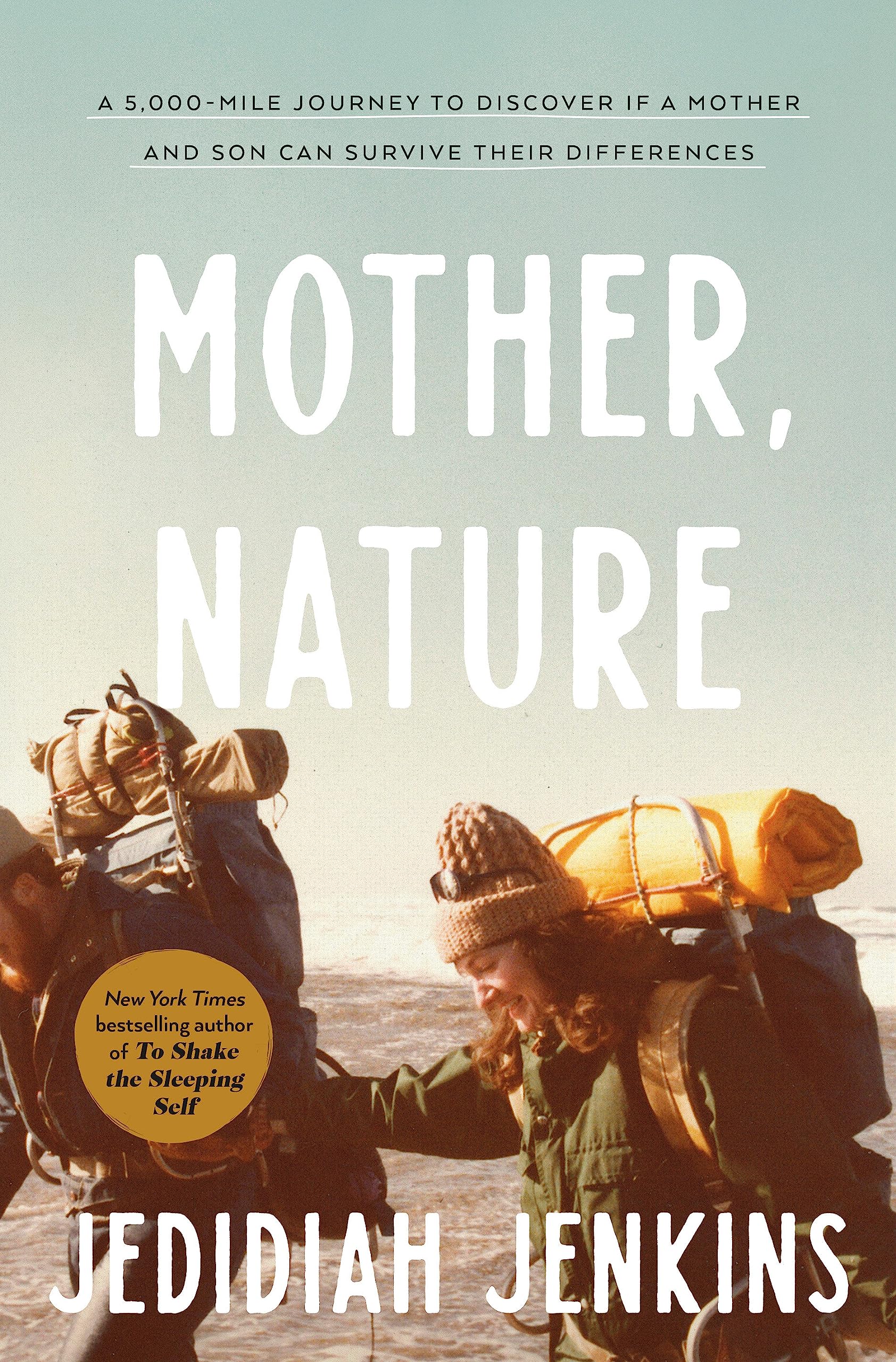
Mother, Nature: A 5,000-Mile Journey to Discover if a Mother and Son Can Survive Their Differences by Jedidiah Jenkins

A loving but troubled mother-son relationship takes center stage during a great American road trip in this reflective memoir about family.

In Mother, Nature: A 5,000-Mile Journey to Discover if a Mother and Son Can Survive Their Differences, Jedidiah Jenkins (Like Streams to the Ocean) presents both a literal and psychological voyage–and an investigation into family and tolerance.

Jenkins, nearing his 40th year, is troubled by his relationship with his mother: loving but fractured by her inability to accept his identity as a gay man. In November 2021, following the Covid lockdown, he undertakes a trip with her that he hopes will help them address their disagreements. The same journey will allow reconsideration of an aspect of her life that Jenkins paid little attention to. In the 1970s, his parents, Peter and Barbara Jenkins, walked across the United States, as famously documented in a series of books (including A Walk Across America and The Walk West) and National Geographic articles. As mother and son retrace those steps by car, Jedidiah wishes to learn more about his mother and her worldview; see the countryside and strengthen their relationship; and perhaps, finally, bring her to terms with his identity.

In driving from Tennessee to New Orleans and cross-country to the Oregon coast, Jedidiah (who lives in Los Angeles) and Barbara (whose best friends come from her Nashville Bible study group) struggle with what to listen to in the car–she likes Glenn Beck, and he likes NPR–what to eat, how to pray. Eventually, they will discuss the question that’s been weighing on the son’s mind: “Would you come to my wedding if I married a man?” Barbara’s conservative political and religious beliefs pose an obstacle to the love and acceptance that he craves from her. Their attempt to bridge such a divide feels relevant in polarizing times; the challenges faced by this loving but fundamentally diverging mother and son may resonate with many families.

Jenkins’s prose is unadorned, but his reflections are elemental ones about family and the static and changing aspects of relationships: “a mother’s influence is difficult to excise. It is not like the scorching sun. You cannot shade yourself from it. It is more enveloping and inescapable, like the air you need to survive.” By the memoir’s end, much is unresolved about the lives still in motion, but Jenkins has found his own peace, and learned a bit about the landscapes of his home country and his family background. Mother, Nature, a loving ode, suggests that the questions will continue to present themselves and that the journey toward discovery is worthwhile.


This review originally ran in the September 11, 2023 issue of Shelf Awareness for the Book Trade. To subscribe, click here.


Rating: 6 baby elephants.

Soil: The Story of a Black Mother’s Garden by Camille T. Dungy

Whether a plot in a yard or pots in a window, every politically engaged person should have a garden. By politically engaged, I mean everyone with a vested interest in the direction the people on this planet take in relationship to others.

This is the best book I’ve read this year.

Soil has an appropriate subtitle, succinctly naming some of the most important elements of what it offers. Camille Dungy is Black, a woman, a mother, and she is determined to grow a garden in the backyard of the home she moves to with husband Ray and daughter Callie in 2013. Their new home is in Fort Collins, Colorado, an overwhelming white city in an overwhelmingly white state*, which is also Dungy’s home state. “Black people are, and always have been, planted everywhere in this country.” They come from California, where Callie was born; Ray is from New York.

Dungy, a respected poet and academic, comes to Fort Collins to teach at Colorado State University. She has always appreciated gardens, gardening, flowers; she comes from gardeners. As a Black person, and as a woman, she has no choice but to track the unjust and frightening trends in the world around her. As a mother, she must balance her work life – her entire life – against the needs of a child. These intersections of identity define the experience she describes in this book, which is a memoir of gardening, as a Black mother, in Fort Collins, in the United States, in a time that includes the 2016 election, the COVID pandemic, numerous murders of Black Americans by police and vigilantes, climate change and environmental degradation, and increasing wildfires in the American West. These are a few of her concerns. In the same sense that every space is political and every person with an interest in humanity’s direction is politically engaged… of course gardening is about race. Everything is about race. “One thing always leads into another here,” she writes, but that’s everywhere, too.

I see this book as a braided essay, in chapters. Dungy chronicles her life, and snippets of Ray’s and of Callie’s, mostly in terms of her garden; but gardening is inextricable from the history of Fort Collins, of Colorado, of the country, of Black Americans. She interrogates history and also literature, particularly nature writing, whose tradition is overwhelmingly white, nearly as overwhelmingly male, and largely free of domestic details, as in, do any of these people ever do laundry? Did you know John Muir had a wife and kids? “What folly to separate the urgent life will of the hollyhock outside my door from the other lives, the family, I hold dear. My life demands a radically domestic ecological thought.” Annie Dillard receives special attention, as does poet Anne Spencer. Dungy writes about the fear her family feels on the night of the 2016 election, and the fear they feel–achingly, that her young child feels–when they hear yet another story like that of Elijah McClain, a 23-year-old Black man who was killed by police in Aurora, Colorado in 2019. It’s all interconnected.

The craft of Dungy’s braid is exquisite, and her points are razor-sharp, wise, true. Because she’s a poet, her writing is obviously strong, too, lyric and imagistic and color-saturated and lovely. She wields metaphor to great effect. “Some large part of gardening, like some large part of living, is figuring out what to cut and when.” It’s just an all-around beautiful book. It made me cry, and it made me pause; it wasn’t always joyful, because nothing true is. Whew.

“I am no angel,” writes Dungy, about her own failure to live flawlessly with regards to “build[ing] a more equitable and sustainable world.” Nobody’s getting it exactly right, but we should still try. Similarly, she wrestles with being a gardener and nature lover when there’s so much she doesn’t know–but she’s learning. “When I told Ray I didn’t know the proper name for the broken digging tool, he didn’t laugh at me. He accepted the fact that I am still and always learning.” (This is one of the attributes I love most in a human: to be still and always learning. Also, there are some sweet notes about a good marriage in this book, too.)

On the simplest literal level, I loved Dungy’s writing about her garden. She works to reclaim the yard of the house they purchase from sedately manicured garden plots, lots of lawn, and river rocks over plasticized landscaping fabric. The aim is to restore more native plants and those that will be drought-resistant, pollinator-friendly, and friendlier to more wildlife in general. These are goals I share in principle, at my own little house, but in practice I’m pretty daunted by the work involved. I do not love the work of gardening nearly as much as Dungy does, and she is honest about how much work it is. I wish I were more like her, in this respect and others. It’s inspirational.

Thank you, Liz, for the recommendation. Like its lovely dust cover and endpapers (I had to go back and tell Liz, who listened to the audiobook, to get a print copy!), this is just a gorgeous book.


Rating: 10 blooms.

*84.5% and 86% “white alone,” respectively, according to the 2022 US Census Bureau QuickFacts sheets for city and state.

Burnt: A Memoir of Fighting Fire by Clare Frank

This exceptional memoir shows wide emotional range in spanning the complexities of firefighting and fire prevention in California and the American West, gender issues, family, work, love, and loss.

Clare Frank’s Burnt: A Memoir of Fighting Fire is a heart-racing, heartfelt story that will make readers laugh, cry, and consider what matters most in life. The author is an indomitable character, from self-supporting teen through a decades-long career in California firefighting (beginning in 1982, when women were few and generally viewed askance), with impressive achievements in her career and personal life. Frank’s memoir is packed not only with adrenaline but with sensitivity, thoughtfulness, and creativity. Beware the impulse to race through these 300-plus pages in a single sitting.

After talking her unorthodox parents into emancipating her at 16, Frank becomes a firefighter at 17 (faced with an age requirement of 18, she simply leaves her birthdate blank on the employment form). Despite being “the youngest, shortest, and lightest person in an academy for the brawniest of professions,” she is indefatigable: stubborn, hardworking, short-fused, and tenacious, earning nicknames like Flipper, Tiger, and Poindexter–as well as degrees in fire administration, law, and creative writing–along the way. Frank rises through the firefighting ranks in her 33-year career (with a five-year doctor-mandated medical break), finishing with the lofty position of State Chief of Fire Protection, six ranks above captain, the highest she once thought she would be willing to attain. She works on structure fires and wildfires, in small firehouses and large ones, in the field and in positions of leadership, on labor and legal issues, prevention, forestry, and more, across the behemoth California Department of Forestry and Fire Protection, aka Cal Fire (the largest fire department in the state).

While she does meditate on firefighting’s gender issues, her response to the question for much of her career is encapsulated in an anecdote: “While I pulled hose through tangled manzanita, the reporter jammed a microphone in my face and yelled, ‘What’s it feel like to be a female on the line?’ I yelled back, ‘The same as it feels for the guys, except I have chee-chees.’ ” She hoped that if she ignored what made her different, everyone else would as well–a strategy that worked frequently but not always.

Frank is a renegade overachiever in all areas: athletic, career, and (after a late return to the classroom) academic. Her writing is not merely serviceable, but thoughtfully constructed; her memoir’s sections are labeled for stages of fire development: ignition, sustained heat, free burn, growth, full development, and decay. Fire is present in every aspect of Frank’s life and work, including writing, but this always feels natural rather than effortful. By the end of this memorable book, readers will reconsider fire policy as well as family, risk, and hard work. With thrilling momentum and a heat of its own, Burnt is a sensation and an inspiration.


This review originally ran in the April 27, 2023 issue of Shelf Awareness for the Book Trade. To subscribe, click here.


Rating: 9 bird’s nests.

The Same River Twice by Chris Offutt

First book I’ve read in the new year and it is a big winner. I read Offutt’s No Heroes some years ago, and I have a few clear memories of it – and I gave it an 8 – but I have to say it’s faded some since then. This one, I think, will be different. From the first pages he had me nodding along in recognition and agreement, when I wasn’t laughing til my sides split. This is a remarkable book in several ways.

For one thing, as an example of craft and structure in memoir, I appreciated the format: alternate chapters switch between two timelines, one (the narrator’s present) in which his wife is pregnant (with the courtship & marriage compressed at the start), and an earlier one in which the younger man leaves his home in the eastern Kentucky hills and travels for more than a decade around the country as an itinerant, not to say bum, short-term laborer and modestly aspiring artist. In the end, this is a memoir of becoming a father. The younger Offutt’s travels, bumbles, attempts at self-destruction eventually make him the man (for better or worse) who meets Rita, marries, and enters on purpose but somewhat reluctantly into the pregnancy that defines the narrative present. When the two timelines meet at the book’s end there is, again, heavy compression, rushing us through Rita-to-pregnancy; I can sense some readers protesting at that rush, but I think it suits the scope of this book. True memoirists have at least several memoirs in them; there’s a piece of Bernard Cooper wisdom on this topic. The Same River Twice is about Offutt becoming a father within himself. It’s not so much about Rita, who in these pages is a lovely and likeable person but mostly remains off-page.

In his roamings of the country, Offutt recalls Blue Highways (maybe even On the Road) but with perhaps more angst – or at least angst that felt more familiar to my own – and definitely more laughs. I could hardly breathe at Offutt’s first couple of sexual encounters, and his adventures in the Florida swamp had me pretty riveted. This is some of the best humor writing I’ve seen in some time.

And on the other hand, in the later timeline, a more mature and serious-voiced narrator (who nonetheless self-deprecates) walks alone in the floodplain woods near his and Rita’s rental home on a dirt road on the Iowa River. This man is contemplative and highly observant of the natural world. He’s struggling with pending fatherhood; he always wanted children but felt less ready than Rita. She worried about her age, while he worried that he still lacked stable employment (he’s trying to sell his writing) and general responsible adulthood. When Rita becomes pregnant, he feels pride, relief, and happiness that she is happy; he feels terrified of the responsibility, and selfishly (he’d say) sorry to lose his freedom. He’s afraid he’ll damage his child; his father has always said he comes from a long line of bad fathers. Fear, in fact, is paramount. “I fear the loss of independence although I didn’t do so well alone.” He’s on a journey to learn about pregnancy and babies, partly through library books and an ill-fated hospital-based Lamaze class, but also via walks in the woods, where he watches the natural world cycle through life and death. Seamlessly integrated facts about biology and natural and human history add to his musings. If the earlier hapless-bum episodes are woeful and hilarious, the older man is quietly thoughtful and wise (even if he denies it). I thought there were some fascinating observations about what it means to be a parent. (I am not a parent. I did call up a few friends to discuss their experiences.)

Let me also note, I found Offutt because of my connection to writing in Appalachia. Relatively little of this book is set there: we see young Offutt leave as a teen, with two brief returns (one for recuperation from injury, one under great duress for his brother’s wedding); otherwise he is all over the country or settling in Iowa. But eastern Kentucky looms throughout; it’s what he’s escaping and it continues to define him, most obviously in the accent that other people feel marks him as a type.

Where I’m from, the foothills of southern Appalachia are humped like a kicked rug, full of steep furrows. Families live scattered among the ridges and hollows in tiny communities containing no formal elements save a post office… Our hills are the most isolated area of America, the subject of countless doctoral theses. It’s an odd sensation to read about yourself as counterpart to the aborigine or Eskimo*. If VISTA wasn’t bothering us, some clown was running around the hills with a tape recorder. Strangers told us we spoke Elizabethan English, that we were contemporary ancestors to everyone else. They told us the correct way to pronounce “Appalachia,” as if we didn’t know where we’d been living for the past three hundred years.

This is a narrator who then travels to, of all places, Manhattan, where he has to relearn how to walk to accommodate the traffic of other people doing the same thing near him. After some hours on a bench watching New Yorkers walk near each other, he concludes his stride is too long and regular for the environment; the locals use quick, short steps, like dancing. “As long as I concentrated, everything was jake, but the minute my attention wavered, my gait lengthened and someone’s legs entangled with mine.”

Offutt makes repeated references to Kentucky’s Daniel Boone and explorer-to-America Christopher Columbus, as he styles himself also an explorer and a frontiersman, but without the aggrandizement that implies. “Two hundred years back, someone asked Boone if he had ever been lost. He answered no, but that he’d once been bewildered for three days. I knew exactly how he felt.” On returning home for the brother’s wedding: “After Columbus’s third trip across the sea, he was brought home in manacles and chains. I knew how he felt.” The aspiring-writer Offutt is a funny thread: he journals compulsively, copiously, but despite defining himself as a poet for a long stretch, writes no poetry. (He also decides to be a painter and a screenwriter at different points without actually producing any art.) I loved this bit:

My adherence to the jounal slid into a strange realm where I viewed my immediate interactions as a form of living diary. If riding a bicycle through a snowstorm sounded like good material for the journal, I borrowed a bike in a blizzard. The actual ride didn’t matter. What I did was try to observe myself as carefully as possible, while simultaneously imagining myself writing everything down later.

If that doesn’t sound like a social media obsession before its time, I don’t know what does.

Offutt is a gorgeous writer of prose. The subject matter – family dynamics and stress, the natural world, travel and restlessness, the meaning of life, place and particularly Appalachia, the angst of trying to be a writer – certainly speaks to me. An entire chapter is devoted to the importance of names (a special interest of mine). But the writing is notable for its own sake. Check out this metaphor-to-simile turn: “The sky was a gray flannel blanket like a watercolor background with too much paint.” And metaphor plus anthimeria: “The riverbank is a crouching porcupine, bare tree limbs quilling the sky.” This is probably my favorite travels-in-America chronicle yet, and I’ve read a few. I’ll be thinking about this one.


Rating: 9 tracks.

*this book was published in 1993.

H Is for Hawk by Helen Macdonald

Apologies for the very long review that follows, but I just loved this book so much.


Originally published in 2014, H Is for Hawk is a blend of memoir, nature writing and literary musings – a work of creative nonfiction that sounds made for me, in fact. Why did it take me so long? I have heard about this book for all these years but for some reason held off. Maybe it was simply the perversity of resisting reading something that sounds so obviously right. (Why do we do this??) Recently I read something (can’t remember what!) that prompted me to finally get into this book, and I’m sorry it took me so long. This is, indeed, a perfect book for me. It’s likely to wind up the best of the year; I’m putting it alongside Fire Season and Things That Are.

Helen Macdonald is a research fellow at Cambridge University when her father dies suddenly. She has also been a passionate lifelong falconer. One bird she’d never worked with before was the goshawk, a famously difficult bird to train and fly. But after her father’s death – reeling with grief – she feels the need to give this challenge a go. While navigating grief and struggling with her new goshawk, she comes across an old book: T.H. White’s The Goshawk, which she read (along with so many other bird and animal books) as a child, and found fault with then. Revisiting it, she still finds much that troubles her about White’s bungled, amateur efforts with his own gos (he knew a fraction of what Macdonald does when he entered unwisely into the fray), but also finds a kindred in suffering. The book that eventually comes out of this process, H Is for Hawk, is a braid of three threads: the author’s staggering grief at losing her beloved father; her time with the hawk she will eventually call Mabel; and her study of T.H. White’s life, falconry, and philosophies.

She blends these threads beautifully, moving smoothly between them in ways that always feel natural. The woman who is training the hawk is also the woman mourning her father, moving in a dream state through a world that no longer makes sense; in rereading The Goshawk she naturally reflects on her own falconry and her own gos, and on her childhood (when she first read the book) and therefore on her early relationship with her parents, and therefore on her father again – it’s all circular; it’s all linked. Macdonald must also consider the unhappy life of White (whom you may recognize as the author of The Once and Future King and others), a problematic figure in his political leanings, who wrestled with his own sexuality. I’m still describing Macdonald’s subject matter; but the seamless weaving of memoir, grief, falconry, literature, and history is just part of the charm. It’s her writing, and her stark, honest portrayal of the mad human experience, that shines.

It’s an astonishingly crafted book, too. I marveled, for example, at how it opens. Check out the first half of the first paragraph:

Forty-five minutes north-east of Cambridge is a landscape I’ve come to love very much indeed. It’s where wet fen gives way to parched sand. It’s a land of twisted pine trees, burned-out cars, shotgun-peppered road signs and US Air Force bases. There are ghosts here: houses crumble inside numbered blocks of pine forestry. There are spaces built for air-delivered nukes inside grassy tumuli behind twelve-foot fences, tattoo parlours and US Air Force golf courses. In spring it’s a riot of noise: constant plane traffic, gas-guns over pea fields, woodlarks and jet engines. It’s called the Brecklands – the broken lands – and it’s where I ended up that morning, seven years ago, in early spring, on a trip I hadn’t planned at all.

And then the way the first chapter ends, after describing a piece of reindeer moss picked up on that trip.

Three weeks later, it was the reindeer moss I was looking at when my mother called and told me my father was dead.

There’s something very neat and circular about this chapter and how it establishes the interconnection between the natural world, and the narrator’s walk looking for goshawks, with the loss of her father. When I read this first chapter, I had little feeling for the shape of the whole book; I was impressed at the time with what that opening and closing promised, and fulfilled. I felt it was a great start. Now that I’ve finished the book, I can see what a *perfect* opening it was, and the promises it makes and fulfills for the whole.

I feel that Macdonald views and portrays her subjects in fresh and new ways. Her father’s death (by natural causes) she experiences as if it were a violence or a natural disaster, with all the power and senselessness of weather. I appreciate the way she describes Mabel, her own goshawk – and other birds, but especially Mabel – the attention and detail with which she evokes the complications of color and feathers. “Formidable talons, wicked, curved black beak, sleek, café-au-lait front streaked thickly with cocoa-coloured teardrops, looking for all the world like some cappuccino samurai.” Indeed, part of what I loved so much about those opening sentences of the first chapter was the level of detail. She’s concerned as well with class and gender in the world of falconry and beyond; she muses on her awkward childhood (and her dear, tolerant parents), and racism and fascism in both historic and contemporary Britain. The best books, I think, open up like this. Falconry and the loss of a beloved parent lead naturally to British colonial history, and why not?

This is absolutely in part a book about the grieving process, descriptive rather than prescriptive. It reminds me strongly of Didion’s The Year of Magical Thinking, which also conjures the muddy, dreamy, drugged madness of grief. But I felt far closer to Macdonald’s narrator than I ever did to Didion’s. I just like Helen better (sorry, Joan). She successfully defamiliarizes her own world by becoming (it seems) part hawk. Part of the training process involves holing up together, falconer and hawk, in the quiet and the dark, to bond and establish trust; when they must emerge, the narrator finds the outside world as strange as the hawk does. “She watches a woman throwing a ball to her dog on the grass, and I watch too, as baffled by what she’s doing as the hawk is. I stare at traffic lights before I remember what they are. Bicycles are spinning mysteries of glittering metal.” This seems a necessary part of Helen’s grieving, but it nearly breaks her, too. “The day-book that records White’s long, lost battle with Gos is not simply about his hawk,” writes Helen, and we sense that she knows the same is true of her book.

This is a masterpiece of writing about the natural world and the points where the wild and the human are the same. It’s a masterpiece of lovely writing, period. It’s a feeling and singular evocation of grief, which I understand to be experienced differently in each instance. It’s a thoughtful consideration of many intersecting threads about the human experience and history, including some of our thorniest issues. The narrator is hard on herself but also winds up with some healing, and some hopeful outlooks – I could see this being a difficult but finally therapeutic read for someone suffering a great loss. It’s a gorgeous and profound piece of literature, the kind I had to pause frequently (at least after every chapter, sometimes within them – and they’re short chapters generally) to let sink in, to take breaks. It will stick with me for a long time.


Rating: 10 drawings.

rerun/reread: Have You Seen Marie? by Sandra Cisneros, illus. by Ester Hernández

I’ll call this one in part a rerun post, since it started that way. But I did reread the book as well, and in a different format. We’ll start with the original review, which ran in 2014.

What a lovely, lovely book. Fans of Sandra Cisneros, don’t be put off by the sometimes-classification of this short fable as a children’s book. Cisneros says in an afterword that she certainly never thought of it that way; she intended it for adults, and I can confirm that it works that way, very well.

This is a short, dreamy, poetic tale of a woman, the narrator, who has just lost her mother; a visiting friend (“I was the only person Rosalind knew in all of Texas”) has lost her cat, Marie. Together, the two women go walking the streets of San Antonio, distributing fliers and asking folks the title question: Have you seen Marie?

The voice and rhythms and lyrical style that I remember from The House on Mango Street are vibrantly present here. The women ask dogs, cats and squirrels as well as people about the missing Marie, and their reactions are noted, and charmingly represented as being every bit as important as the people’s. On the surface, this is the story of searching for Marie; but it is also the story of Cisneros losing her beloved mother, feeling like an orphan in her own middle age, and gradually coming to understand that “love does not die.”

As I mentioned, Cisneros is careful to point out that this was not meant to be a story for children, but rather one for adults, with the idea of helping others like herself deal with experiences like hers: losing a parent, or a loved one. I am very (very) glad and relieved that I don’t seem to facing this experience now, or soon; but I imagine that this book would indeed help. I appreciate its soothing musical tone and gently loving, inspired advice and creative understanding of death, what it means, the grieving process. It is a tender tale. Cisneros is inventive and calming and this is a beautiful, moving story about family and friendship. I highly recommend it, for anyone.

This audio version is read by the author, and so beautifully; I love her lilt; it’s perfect. I want to very much recommend this version (in both English and Spanish in one edition – one cd of each). But then, the print copy is illustrated by Ester Hernández, and Cisneros is clearly very pleased with that aspect. Hearing her speak about their collaborative efforts on the illustrations (Hernandez came to visit & tour Cisneros’s San Antonio; she calls it documentary-style) made me regret missing the print. So there you are. Both, perhaps?? I think I will go out and get myself a copy of the book, too.


Rating: 10 trees along the San Antonio River.

I did indeed buy the print book, and what I had in mind, in part, was to have it on hand when a friend needed it. That’s taken some years, but I turned to it just recently here with a friend in mind who’d lost a parent, and whose children had therefore lost a grandparent. I picked it up to check it for age-appropriateness for those kids. My conclusion is that it is “safe” for young kids – nothing harrowing about the grief, in fact only gentle reminders that the narrator (the Cisneros character) has lost her mom. It behaves like a children’s picture book: the illustrations are as lovely as I’d imagined, and it relies on refrains and simple language. My only hesitation for kids would be that it’s longer than a typical bedtime story. I did pass it on to my friend with that caution. Maybe it takes a couple of nights to read; maybe it’s for the elder child and not the younger. I also hope my friend will try it on his own first, if only for his own, personal benefit.

It’s also true that I’ve lost somebody close to me recently, too, and I was touched and moved all over again by Cisneros’s small, apparently simple book. Especially the author’s note caught me this time, because it offers a way of thinking about grief that I find charming and, I think, useful. I was also pleased by the cultural flavor of Cisneros’s San Antonio neighborhood. I love that taste of home. And since my original review, I’ve lived near San Antonio, and become a little familiar with its neighborhoods. This was an added bonus. There are a few Spanish-language words sprinkled in, but even with no knowledge of the language, I think any reader will be fine to follow along using context clues.

I am still recommending this book highly, for adults, and with some caution for children as well. I’m sticking with my original rating, and I’m glad I got such a timely chance to revisit.