Maximum Shelf: The Weight of Blood by Laura McHugh

Maximum Shelf is the weekly Shelf Awareness feature focusing on an upcoming title we love and believe will be a great handselling opportunity for booksellers everywhere. The features are written by our editors and reviewers and the publisher has helped support the issue.

This review was published by Shelf Awareness on January 15, 2014.


weight of blood

“That Cheri Stoddard was found at all was the thing that set people on edge, even more so than the condition of her body.” So opens Laura McHugh’s delightfully and darkly disturbing debut novel, The Weight of Blood. The town of Henbane is agitated because it is so good at keepings its secrets–and bodies are so easy to hide in the twisted, wooded Ozark Mountains.

The story begins with the first-person perspective of 18-year-old Lucy Dane. Lucy has it pretty good: she has a reliable best friend, a loving relationship with her father, and neighbors who make up an extended family of sorts. And she’s just begun working in her uncle’s store, where she gets to rub elbows with the sexy Daniel. But Lucy is troubled by the disappearance of her sort-of friend Cheri, a developmentally disabled schoolmate whose freshly dead body was only recently discovered–a year after she went missing. She’s also still troubled by the unexplained disappearance of her mother, Lila, who walked out of the house carrying a handgun and nothing else when Lucy was a year old.

The perspective then shifts to that of Lila herself as a young woman, newcomer to the Danes’ hometown of Henbane. Henbane is almost a character unto itself, insular, suspicious and largely unmarked by passing time. For a fee, residents can avoid a “city burial” (embalmment and the involvement of the authorities) in favor of a private grave-digging service. And the local lawyer will advise you not to trust local police until you find out who’s related to whom. It is anything but a friendly destination for a damaged teenager like Lila, who immediately runs up against the Dane brothers: the older Crete, who runs several businesses including a farm and a store, and his little brother, Carl, who becomes her husband before she turns 19. Superstitions have her labeled a witch before she’s unpacked her few belongings.

Through Lila’s eyes, the reader will find out slightly more about her background than Lucy knows, but Lila works hard to remain a mystery to both the reader and Henbane locals, including Carl. The perspectives continue to alternate. While Lucy keeps the reader up to date on current goings-on, it is through Lila that we begin to learn the ugly secrets that Henbane keeps. Other characters, too, get occasional chapters told from their point of view (in omniscient third person; only Lila and Lucy get first-person treatment), and one of the strengths of The Weight of Blood is that its engaging, complex, fully wrought characters extend beyond its protagonists. Lucy’s best friend, Bess, and Bess’s mother, Gabby (who was, in turn, best friend to Lila); Carl and Crete; the love interest, Daniel; a surrogate grandmother; and a local drug dealer all get sensitive handling and character development. But it is the measured building of tension and the careful doling out of hints of evil that star, as Lucy’s coming-of-age experience brings the classic bildungsroman to meet the gritty thriller.

While helping Daniel clean out an old trailer belonging to her uncle, Lucy discovers a clue: a lost item that she knows used to belong to Cheri, because Lucy gave it to her. Next, Bess overhears a reference that she shouldn’t have. With Daniel’s cautious support, Lucy begins to look into Cheri’s death, and the matter of where she spent that unaccounted-for year. But, of course, in a town this small, where everyone recognizes headlights and knows where a particular truck might be heading, investigations are dangerous. Like her mother before her, Lucy is told outright that it would be risky to go to the police for help. And as she probes the question of Cheri’s fate, and finds it apparently linked to her mother’s, Lucy will be disturbed at how close her inquiries lead her to home.

Carl and Crete, the Dane brothers, are heir not only to the off-the-books grave-digging business, the combined local grocery store and restaurant, and various secrets, but also to mental illness and corruption. As its title suggests, The Weight of Blood is concerned with the strength of our bonds to our family, and the tension between biological ties of blood and the families we choose for ourselves. In a remarkably convincing portrayal of young adulthood, Lucy allows McHugh to explore themes of loyalty: where it’s owed, and to what extremes.

The atmosphere McHugh evokes in this masterful debut is wonderfully spooky, exemplifying Southern noir with a backwoods mountain twist and a matter-of-fact willingness to bury its dead out back and walk away. Taut pacing, lively suspense and atmosphere are the strongest points of a novel that also has an engaging plot and beautifully built, sympathetic characters to its credit. For fans of dark, suspenseful, well-structured thrillers, The Weight of Blood is a delicious and nail-biting treat.


Rating: 7 baby possums.

Come back tomorrow for my interview with McHugh!

Maximum Shelf author interview: Sue Monk Kidd

Following yesterday’s review of The Invention of Wings, then, here’s the gracious Sue Monk Kidd!


Sue Monk Kidd: Inhabiting the Past

Sue Monk Kidd was born and raised in Georgia and now lives in Southwest Florida with her husband, Sandy, and their black lab, Lily. Since her first publication in 1988, she has written fiction, nonfiction and memoir; The Invention of Wings is her first work of historical fiction. Kidd’s bestselling books include The Secret Life of Bees, The Mermaid Chair and, as co-author with her daughter Ann Kidd Taylor, Traveling with Pomegranates. Kidd is very active on Twitter.

photo: Roland Scarpa

photo: Roland Scarpa


How much research did you do on the real Grimké sisters?

Well, I began reading about the Grimké sisters and I could hardly stop. I was inspired to write the novel because I discovered them at Judy Chicago’s Dinner Party exhibit in New York, and I came home very excited and began to read about their lives. And that went on for months. I suppose I did full-time research for about six months before I began writing, and then I wrote for three and a half years, during which I was still doing a lot of research. I would sit in front of the computer, inventing and writing, and suddenly I would have to get up and figure out what kind of mourning dress widows wore in 1819. Or what were the emancipation laws in South Carolina at that time. It was constant, ongoing research. And it wasn’t just reading books; I made trips to the Library of Congress, the Smithsonian, the New York Historical Society–and of course a lot of places in Charleston. That was a primary site for me, and a lot of organizations were helpful.

Did you enjoy that research?

I loved it so much that I had to make myself stop and start writing. I think a writer can get lost in her research if she’s not careful! There’s a point where you just have to put it aside and begin writing. I was very concerned that I get that era right. I wanted it to be as authentic as I could make it, rich with details, and I wanted the reader to be plunged into a real world. So I needed to gather a lot of information, and I really had fun doing it.

How important is historical accuracy in fiction, and how faithfully does this novel stick to the historical record?

That is such a large question for any author of historical fiction. In this case, I was not only writing about a time and place that existed, but I decided to populate the book with real historical figures. As this was my first book of historical fiction, it was a learning curve for me. I started off so enamored with Sarah Grimké’s history, just in reverence for her life and her history and that of her sister, too, that it was very hard to deviate from that historical script. It took me a long time to come to a place where I understood that there was Sarah Grimké, the historical figure, and then there was Sarah Grimké, my character. And I’m not a biographer, and I’m not a historian; I’m a novelist. I had to come home to that again, because I was so caught by her history. I would say that I wrote the truth of Sarah’s life as much as I possibly could, and I think that anyone who reads the novel will find her life rendered there pretty closely. But my goal, I realized, was to serve the story itself, and that meant that I had to deviate some. It meant that I had to invent; it meant that I had to find Sarah in my own imagination as well as in history, and that was really crucial. The moment that I was able to let go and do that, she became alive for me in this book.

How did you make the decision to write this story in two voices?

When I began I was inspired to write the story of Sarah Grimké, and that was as far as I got. I knew I wanted to write her story in first person, because I love the intimacy of that first-person voice. I feel like I can inhabit her and her mind and her heart, and I love seeing the world through her eyes. I love the closeness of that and what it allows me to do, to get into her inner life. But as I began reading about the history, it became very quickly apparent to me that I could not just tell her story without telling the story of an enslaved character. It seemed that in order for this whole time and place to be fully fleshed out, I needed to enter the lives of two characters. So as I was reading about Sarah’s childhood I discovered she had been given what she called a waiting maid, when she was somewhere around 11 years old. This waiting maid was named Hetty, and Sarah taught Hetty to read, and then Hetty died soon after that, as a young person. That’s everything I knew about her life. But the moment I read about her I knew that this was the character, and that I could have this close relationship between them that’s also a complicated, difficult relationship, and I could talk about both worlds. Now, it was daunting to me to do this, to be honest, because writing first person from the standpoint of an enslaved female character is pretty far flung for me. So that was sort of my literary sky dive, I guess! But it was apparent to me that that’s what I needed to do, to tell both stories.

Sarah left plenty of detail to history, including many writings in her own voice, while Hetty barely existed at all on the record. Was it freeing to write Hetty, in comparison?

It was absolutely freeing. Maybe the biggest surprise in writing this novel for me was that Hetty’s voice was more accessible, that it came to me more easily. This I did not expect. I thought it might be the opposite, actually. I think it was because Sarah came with this big historical script, and we knew basically nothing about Hetty. So I had this broad imaginary canvas to fill in. It freed me, I think, just to be able to explore and to just let her talk–and she would talk! I mean she would just talk, talk, talk to me.

Hetty’s mother, Charlotte, is a rich personality who keeps her secrets. Does she have a historical counterpart? Where did you find her?

There was a little seed of something that kind of helped me to create her character. When I was reading the slave narratives I came upon one sort of secondhand story: one woman was speaking about her time in slavery, and referred to someone named Sukie, who was apparently a very defiant, unusual woman. She told a story about how Sukie resisted her master’s advances and pushed him into–I think it was a hot pot of lye soap or something like that–and he was burned, and for that she was sold. And she remained very defiant to the very end. Something about that ignited this idea in me, and I wanted to be sure that Charlotte was someone who could protest and resist and who was concerned about her own self-possession, who had this spirit of insurrection and even subversion. I think it’s important to offer images of enslaved women who are not just victims. We’ve had far too much of that, I think. I wanted to show women who were not just victims, certainly not in their minds. They were in a struggle to be human, self-possessed, to fight back and to show this kind of defiance and resistance. In that regard, the slave narratives were evocative for me of the kind of character that I tried to bring to Charlotte.

Do you have a favorite character? Or one with whom you especially identify?

Oh, it’s always hard for an author to say which character is her favorite! It’s like picking between your children! As a writer, I feel like you have to love all your characters, even the so-called misbehaving ones. But having said that, it’s true, your heart gravitates to your characters in special ways. I remember reading something Alice Walker said that I referenced recently. She spoke about writing about her mother in literature, and she said, my mother was all over my heart, so why shouldn’t she be in literature? And I just loved that line! I thought, that’s how I feel about Handful. She’s just all over my heart. And every day that I wrote, I had this very special feeling about her. I love Handful’s great hope, and the way she used irony and wit to deal with things.

Sarah’s big struggle, at least in my novel, was to find her voice. I literally gave her a speech impediment, which the historical records say she did not have, but I have this idea that writing a novel is really about taking a bad situation and making it worse! Sarah had difficulty speaking in public, but she didn’t have an impediment, so I sort of enhanced it and made it a little worse. That’s one example of how I deviated from the record to serve the story. Her journey was to find her inner voice and to be able to articulate her truth in the world, and I identify with that–I think many people identify with that.

What have you read and loved lately?

Well, I just made this long transatlantic flight, and I hauled books on board instead of my iPad! I don’t know what that says about me. I read three Edith Wharton novels that I had not read before, and I hate to admit that I hadn’t read these; but I guess we all have classics that we’ve not read and we’re ashamed to admit we’ve not read until we finally do! Those were The House of Mirth, The Custom of the Country and The Age of Innocence, and I thought–what took me so long? And then I read Delia Ephron’s Sister Mother Husband Dog: Etc., which I just loved. The other book I read recently was Dear Life by Alice Munro. All wonderful books. There are so many and so little time! That’s what’s so great about a nine-hour flight, you know.


This interview originally ran on December 18, 2013 as a Shelf Awareness special issue. To subscribe, click here, and you’ll receive two issues per week of book reviews and other bookish fun!

Maximum Shelf: The Invention of Wings by Sue Monk Kidd

Maximum Shelf is the weekly Shelf Awareness feature focusing on an upcoming title we love and believe will be a great handselling opportunity for booksellers everywhere. The features are written by our editors and reviewers and the publisher has helped support the issue.

This review was published by Shelf Awareness on December 18, 2013.


invention of wings
The Invention of Wings opens in 1803, on Sarah Grimké’s 11th birthday. To mark the occasion, her mother gives her an unwanted birthday gift: the awkwardly beribboned 10-year-old Hetty Grimké–Sarah’s very own slave. Sarah is repulsed and tries to free Hetty that very night with a document she draws up herself, but it isn’t that easy for the child of one of Charleston, S.C.’s first families. The two girls grow into womanhood bound together but separated by the chasm of their very different circumstances.

Sue Monk Kidd, author of The Secret Life of Bees and co-author of Traveling with Pomegranates, chooses to tell this story in first person and to alternate between the voices of Hetty and Sarah–one of many masterful choices that make The Invention of Wings a remarkable read. The name “Hetty” was given by her owners; Hetty is called Handful by her mother, Charlotte, to whom she is devoted. One of the novel’s richest characters, Charlotte tells her daughter only parts of her own past: stories of Handful’s father, who never saw his daughter’s face, and of Charlotte’s own mother, who was brought to Charleston and slavery from Africa when she was a small girl. Charlotte teaches Handful to sew, to make very fine clothes and quilts. This artistry earns them both a relatively privileged place in the household and, importantly, provides a means of recording stories among slaves, for whom literacy was illegal. Charlotte sews her daughter a story quilt, appliqueing squares that tell of her life’s greatest events. This rich storytelling tradition is described in Handful’s passionate voice, which both contrasts with and matches Sarah’s, also passionate, as she experiences limitations of a different sort. An intelligent child encouraged by a father and brother to read books, she harbors dreams of becoming a barrister, which are inevitably dashed against Charleston’s expectations of a young lady. Her inclination to teach slave children to read is likewise reviled, although she succeeds in secret with Handful. Over the years, the two girls share confidences across a wary divide, but guilt and resentment present obstacles to their friendship.

When the girls are still very young, Charlotte extracts a promise from Sarah: that she will free Handful one day. This promise haunts Sarah, who will eventually journey north to escape her stifling family and the peculiar institution she despises. She meets a Quaker man, whose own peculiar religion at first repels her but comes to fascinate and draw her in; this new alliance shapes Sarah’s more independent adult life, and distances her from Handful, who necessarily remains in Charleston. Along with her indubitable younger sister, Nina, Sarah will finally become a renowned (and infamous) activist for abolition and women’s rights. Overcoming a speech impediment that is a literal portrayal of her difficulty articulating her desires, she will slowly, painfully create the independent existence she has always craved. Handful’s fate will, of course, be rather different.

The Invention of Wings is a novel based on fact: the Grimké sisters were real-life abolitionists, and are joined in the historical record by a number of other characters in this novel, including Denmark Vesey, a free black man executed for planning a slave uprising; Lucretia Mott, a Quaker activist for women’s rights and abolition; and Sarah Mapps Douglass, a free black activist and educator. Hetty Grimké, however, left tantalizingly scarce facts: she was given as a gift to Sarah, but disappears shortly thereafter from the historical record. And Charlotte is entirely Kidd’s creation, an intriguing and complex character who tempts the worst of slavery’s brutalities in her search for something better for herself and her family.

Sue Monk Kidd portrays the parallel lives of her two protagonists in sensitive and touching sketches. Readers of her earlier work will recognize strong, sympathetic characters and deft use of nuance. The heart-wrenching nature of Sarah and Handful’s stories lies in the complexity of their relationship: they tend toward friendship, but Sarah’s guilt and Handful’s natural resentment–as when Sarah claims to know how she feels–may prove too wide a gap to bridge. And slave traditions such as the story quilt add a layer of detail informed by Kidd’s extensive research, as well as an emotional depth for Handful and Charlotte.

The Invention of Wings ambitiously tackles a swath of issues, including feminism, abolition, religion, activism and relationships between races and genders. This subject matter might be heavy under another hand, but the historical record of Sarah Grimké’s remarkable life and Kidd’s strengths in narrative and in rendering relationships make for a story that is both thought-provoking and engrossing. Strong female characters, solid roots in history, and the compelling lives of two women the reader deeply cares about make The Invention of Wings a thoughtful, moving tale that ends on a hopeful note.


Rating: 7 squares.

The Invention of Wings was just chosen as Oprah’s new Book Club 2.0 pick. Kidd commented: “I’m thrilled and honored that Oprah Winfrey chose my novel as her new book club selection. After researching and writing The Invention of Wings for the past four years, I can’t tell you how exciting it is to launch the novel with Oprah’s Book Club 2.0.”

Come back tomorrow for my interview with Sue!

Maximum Shelf author interview: Koren Zailckas

This interview was published by Shelf Awareness here in an abridged format due to space constraints. This is the full interview.

Following Monday’s review of Mother, Mother, then, here’s the lovely Koren Zailckas!


Koren Zailckas: On Mothers

Koren Zailckas is the author of two memoirs, Smashed and Fury, and lives in New York’s Hudson Valley with her husband and three children. Mother, Mother is her first novel. She recently tweeted: “33 with 3 books and 3 kids. #birthdaysymmetry.”

Where did you get the idea for this distressing mother figure?

korenI really wanted to challenge the cultural assumption that all mothers are inherently selfless. We’re living in an era of baby-bump obsession, in a don’t-speak-badly-of-your-momma culture. Read an Angelina Jolie profile or watch TLC and you’d think women enter delivery rooms as laboring heffalumps and exit as Battista Salvi’s Madonna and Child. But the word “mother” isn’t synonymous with Mother Theresa, and having a child doesn’t make a woman a mom any more than owning a paintbrush makes her Frida Kahlo.

This idea that all mothers are naturally patient, forgiving and self-sacrificing isn’t just sappy-sweet, it’s callous. It’s dangerous. It discounts experiences by those of us who were raised by women whose genetics and early life traumas permanently altered their brains and made them incapable of empathy.

Here’s the sick truth: Some mothers aren’t naturals. I’d always suspected that as a kid, but I learned it for certain when I moved from Brooklyn to the Catskills. Last lambing season, I was in a New Paltz knitting supply shop, surrounded by beautiful, hand-dyed yarn, when the farmer clomped inside in rubber overalls and announced her sad morning. “The ewes gave birth last night,” she said, darkly. “And two of them just weren’t naturals. They left their newborns to freeze to death on the side of the barn.” Some mothers, no matter how well intentioned, just can’t see their kids as anything other than tools, hindrances or extensions of themselves. Other mothers can’t consider their children at all.

Mother, Mother’s Josephine Hurst isn’t just a critical or controlling mom. She’s a narcissistic mother, and she’s in good company. Loads of women–one out of ten Americans, according to new studies–have Narcissistic Personality Disorder, which many shrinks consider untreatable. Medication rarely helps. Therapy doesn’t do much either.

I hope Josephine will give shivers of recognition to anyone out who grew up with a narcissistic mother. I hope those readers will recognize her neediness, her manipulative nature, her grandiose sense of self-importance, her tendency to play favorites between her children and pit her family against one another, and I hope they seek some small comfort in it. Maybe that sounds crazy, but I really mean it. I hope Josephine puts a name–NPD–to longstanding patterns of maternal chaos. I hope some readers have a light-bulb “this is a syndrome!” moment. (You see: also in the narcissistic mother’s repertoire is “gaslighting.” They’re great at making their victims doubt themselves and question what’s real.)

As for those lucky folks who grew up with the mother of Mother’s Day Cards, I hope Mother, Mother gives them at least a glimmer of the fear that resides in the hearts of kids like Will Hurst. As humans, we are born utterly helpless–dependent on our mothers much longer than any other species on Earth. If mothers are our first teachers, then having a narcissistic mother teaches you that the world is a fucking terrifying place, where the rules change constantly and punishment is the only constant.

You wrote two memoirs before this novel. Was this your first try at fiction?

Yep, this was my first attempt at fiction. Mother, Mother brought me back to Smashed in that way. Smashed was my first prose. Before that, I’d only poetry and interoffice memos.

And how was it different?

mother motherFiction required a lot more restraint than memoir. By design, memoir is an exercise in over-sharing. You’re giving the reader way too much information to begin with, confiding things you wouldn’t tell to just the casual stranger while you’re waiting side-by-side for a bus: “Warm today, isn’t it?… Let me tell you about that time I staggered, drunk, lost and naked down the halls of a fraternity.” You wouldn’t do that. No emotionally healthy person would do that.

I think I gravitated to memoir because I had my fair share of damage. I grew up in a family a lot like the Hursts, where you weren’t allowed to express emotion, speak openly, talk about why your mom is a radically different person in public, talk about why Dad lives in another state for weeks and months at a time. You bottle all that stuff up over a long period of time and it eventually just explodes all over some poor, unsuspecting victim, no matter who they are, no matter how briefly you’ve happened to know them. I think, to begin with, I wrote Smashed and Fury because I was suffering from what Zbignew Herbert called “suffocation from formlessness.” I was smothering under the weight of all the memories I hadn’t put into words. When I was finally ready to name those experiences (addiction, anger over ongoing family dysfunction) the stories came out, fast, in reams.

In my memoirs, I’ve always tried to best to be as self-aware as I can. To own my shadows. To be ten-times harder on myself than I am on anyone else in the story. But no matter how you slice it, it’s still exhibitionistic. It’s still a bit like being a trench-coat flasher: “Here I am, all at once! Here are my stories! I know they’re flabby in some parts, but I can’t change them–they’re real!”

Maybe the cheap analogy would be: fiction feels like a strip tease. But it’s more than that. Fiction feels like real intimacy. Especially when it comes to psychological thrillers, suspense stuff. You reveal things slowly to the reader, over the course of your time together. Not every character has to be hyper self-aware all the time, owning every character flaw, aware of their deeper motivations. You can gently fold in a hint, here and there. Teaspoon of backstory. Foreshadowing, to taste.

I still find that really difficult from time to time. My husband’s pet name for me is “Spoiler Alert.” He always tells me I say way too much when I’m making movie or book recommendations. My brother-in-law will never forgive me for ruining the grand finale of The Sopranos for him.

I might well have told you how the Hursts end up in Mother, Mother’s first chapter were it not for my long-suffering editor. She probably has carpal tunnel from all the times she went back to the manuscript to slash out obvious clues.

Did you do research into Asperger’s syndrome in order to get it exactly as right as you got it? Did any other aspects of this novel require research?

I did a little bit of research. But mostly, I manifested Will’s Aspergers in a way I could relate to.

Will’s intense focus, his “Aspie interest,” is language. He’s like a collector of rare and precious objects, and in this case, those objects are unusual and arcane words. Autotonsorialist: one who cuts their own hair. Misodoctakleidist: someone who hates practicing piano. Awkwardness ensues whenever Will uses them in spoken conversation, but he just can’t help himself. He’s addicted.

Over the course of Mother, Mother, I think Will’s relationship to language changes. Words stop being a mode of connection. Instead, they become more like trophies, accolades. He trots them out to impress, intimidate or prove his worth. It’s a really narcissistic use of language. It worsens Will’s social functioning, heightens his loneliness and drives him deeper inside himself.

Aspergers? Maybe. The side effect of a dysfunctional family? Possibly. Or maybe, for Will, it really is a burgeoning writer thing. As a writer, you spend so much time alone, trying to think of funny and fresh ways to describe every day things. Then, when it’s time to go out into public, you forget that you don’t have to agonize over word choices. When you’re chatting about weather with your neighbors at the farm stand, you can just say, “It’s pouring.” People look at you funny when you go all Du Maurier and say, “Can you believe this lashing, pitiless rain?”

Two of your main characters share similar experiences but head in very different directions towards the end. Did they always go that way, or did you have to go along for the ride to learn the fates of your characters?

I think I knew from the first word that Violet and Will had very divergent ideas about their family. Any therapist will tell you, siblings can be raised by the exact same people and still have totally different mothers and fathers.

This is especially true in narcissistic families, where the narcissist picks one kid to be the golden child (the person who earns added prestige for the narcissist) and another to be the scapegoat (the person the narcissist projects her own negative self-image onto).

In the Hurst’s case, I think Will is quite genuine in his confusion over his sister. He doesn’t have any clue why Violet’s so angry. Her drug use, her rebelliousness… It seems really irrational to him, especially with his mother right there in his ear, telling him, “Your sister’s crazy.”

And for her part, Violet doesn’t understand why Will is so fearful and reserved. He seems to have his mother’s unconditional approval. Josephine’s love seems to come so naturally to him.

With that dynamic in place, I think I did go along for the ride. When I began, I didn’t quite know what would happen to Will or Violet.

Will, in particular, shocked the hell out of me. It was kind of thrilling to watch him unfold. Especially because he’s at this very pivotal year. He’s twelve when the book begins and really on the brink of adolescence. A transformation happens. One I never saw coming.

Transformations fascinate me, especially where psychology is concerned. That’s what everyone who’s hooked on psychology wants to know: How does change occur? How do good people turn evil? Or, how do kids grow up?

Can you tell me how there came to be humor in such a very dark book? How would you characterize your style of humor?

I suppose I’ve always had a touch of gallows humor. That self-lacerating, inverted kind. Also, a bit of that bone-dry, stuff-your-feelings, British humor too. (Maybe that’s why I married an Englishman.) Also factor in a little bit of defeatist attitude. I’ve always related to that George Bernard Shaw quote: “If you can’t get rid of the family skeleton, you might as well make it dance.”

I’m glad you think this book is funny. I think it’s really important for dark, scary books to be funny. Every few pages, I really wanted there to be at least a restorative chuckle, something to lighten the mood from jet-black to slate.

I think the biggest laughs in life are usually tinged with relief. They’re a kind of collective, hissing sigh: “Wheew, look at us, joking about this really delicate, uncomfortable, offensive topic! We’re really skating on thin ice here, aren’t we? But it’s fun! Hold my hand. Did that sound like a crack?”

Some of the creepiest ladies in the history of literature are also the funniest. Shirley Jackson is fucking hilarious. I wish she were still around today, if not only so her mommy-memoirs could be optioned for a self-starring reality show. Take Life Among the Savages… Beginning each morning with the very real fear that you will slip on a Matchbox car or doll’s broken arm and break your neck on the stairs is morbidly priceless.

In my experience, once you become a mother everything is doubly terrifying and laughable. It only seems natural to mix the two together. (Although, that could just be the sleep deprivation talking.)

The dual first-person perspectives are very unsettling (in a good way). How did you choose that format?

I think sheer panic drove me to tell the story from two perspectives. When I first started thinking about fiction, many years ago, I told Crown’s Molly Stern, “I’m going to write a first-person, one-perspective novel.” Just like that. All fresh-faced bravado. Molly wasn’t discouraging, but she reminded me just how tricky that is. It’s hard to keep the plot constantly pounding when you have just one protagonist.

Initially, with Mother, Mother, I thought (quite cowardly) that I’d hedge my bets between Will and Violet. I thought: double the characters, double the action. Never a dull moment. From there, it became a much more strategic, much more about how “family,” as a concept, is a bit like “car crash.” Everyone experiences it from a different perspective. So why not let the reader get two points of view on the Hursts?

Since you came from writing memoirs, I wonder how present you are in Mother, Mother. Did you have to fight putting yourself in this book, or was it a relief?

I think there are snippets of myself and my childhood all over this book. That said, the Hursts are a prime example of writing what you know, then taking it to a level that is psycho-extreme.

For instance, I always felt like my mom was a little possessive of me when I was a kid, and I tried to go to friend’s houses as opposed to bringing them home to mine, where my mom talked down to them and slated them behind their backs. I was in my thirties when I got a Facebook message from a woman I used to play with when I was seven. “I was sooo afraid of your mom!” She wrote. “She used to call us brats and hooligans. We were only allowed one juice box no matter how thirsty we were!” I think I sort of exorcised some of that in Mother, Mother, and took it to a scarier extreme. I mean, Josephine homeschools Will because she’s so keen to have him to herself.

I’ve been reading Eric Booth’s The Everyday Work of Art, and he has a great line about how the word “art” in its infancy was a word that meant “to put things together.” And the process of writing Mother, Mother really felt like that. Marrying personal experience to the psychological profile of narcissistic mothers. Piecing together recurring nightmares with irrational fears, Frankenstein-ing in ordinary scenes from a modern, American, family life.

You know, it was a relief. I feel like doctors should prescribe thriller-writing to anyone with anxiety or PTSD. You get to be in charge of your fear. And of course, you get to change the outcome. In real-life dysfunctional families, roles shift, but there’s not much change.

What have you read and loved lately?

This is really the golden age of women’s psychological fiction, and for the past few years I’ve been gobbling up everything by Tana French, Gillian Flynn, Laura Lippman, Megan Abbott, Kelly Braffet. It’s just too exciting to look away.

That said, I have three children under four, so I’ve also have Mo Willems on heavy rotation. That’s my life at the moment: Murder and The Pigeon Finds a Hot Dog.


Don’t you just love how very funny she is? Thanks, Koren, for taking the time to share so much with us. I certainly enjoyed it!


This interview originally ran on June 26, 2013 as a Shelf Awareness special issue. To subscribe, click here, and you’ll receive two issues per week of book reviews and other bookish fun!

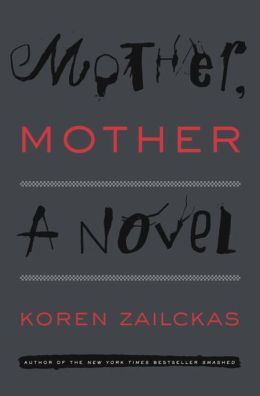
Maximum Shelf: Mother, Mother by Koren Zailckas

Maximum Shelf is the weekly Shelf Awareness feature focusing on an upcoming title we love and believe will be a great handselling opportunity for booksellers everywhere. The features are written by our editors and reviewers and the publisher has helped support the issue.

This review was published by Shelf Awareness on June 26, 2013.


mother mother
Mother, Mother opens on a quiet Saturday morning in a small town north of New York City. A young boy wakes up with his mother standing over him, waiting to start their day. He is a little odd–we soon learn he’s been recently diagnosed with Asperger’s syndrome and epilepsy–and his mother seems to be wound a little tight, but she’s also concerned and loving. Next, the perspective shifts to that of his older sister, a rebellious teen who has just been placed in a local mental hospital. The father is cheating. The eldest daughter ran away with a boyfriend several years ago.

These are the perceptions presented in the first few pages of Koren Zailckas’s startling debut novel. Do you believe everything you’ve just read?

As the story of the Hurst family unfolds, the reader will learn to question every “fact” exhibited. The youngest child, Will, and the middle daughter, Violet, continue to trade off the first-person relating of their family drama. One is on the autism spectrum and the other is drug-addled; thus the reader has to parse not one unreliable narrator but two. Will both loves his mother and fears her, and is constantly struggling to determine what exactly it is she wants so that he can please her. He is home-schooled, because of the Asperger’s: Is this the cause or the effect of their unusually close relationship? Josephine, the titular mother, starts off coldly Stepford-like and quickly takes a turn toward chilling. Violet, who has been observing Sallekhana (a form of Jainist ritual starvation), recently took psychedelic morning glory seeds and came home to her family out of her mind, hallucinating and violent. Now Josephine is adamantly opposed to Violet coming home from the hospital, ostensibly because of the threat she poses to her little brother. The absent eldest daughter, Rose, remains ghostlike and disembodied for most of the book. Her past is enigmatic and her current location unknown–but unexpectedly, she writes to Violet in the hospital, after years of silence. And while their father, Douglas, is physically present, he has problems of his own that make him self-centered and ineffectual.

Much of Mother, Mother‘s mystery revolves around the night when Violet, in a haze induced by near starvation coupled with the psychedelic seeds, brandished a knife at her family, harming Will. A drunken Douglas drove her to the psych ward. But as it turns out, neither Will nor Violet has a clear memory of what happened on that night. Then Child Protective Services enters the scene, in the form of a case worker surprisingly sympathetic to Violet. This engages Josephine’s protective instincts, and the reader must struggle alongside CPS to discern the truth about where–or from whom–Will suffered his injuries. From the start, the reader is kept off-balance by Will and Violet’s constantly shifting, conflicting, inconsistent narratives. Josephine’s contributions, which come in dialogue form through Will or Violet’s observations, only serve to muddy the waters. From the start, the reader senses that something is amiss, but will have to puzzle for a time over which of these troubled characters to trust.

As the action unfolds, Violet remains institutionalized, but the details of the night in question begin to reveal themselves. Will and Violet both begin to regain their memories, but they continue to interpret those recollections in very different ways. Even as the source of the true evil begins to become clear, the reader is kept guessing as to everyone’s final fates until the closing pages, and the surprises keep coming until the very end.

Koren Zailckas is the bestselling author of two memoirs, Smashed and Fury. Her first attempt at fiction will not disappoint her fans, as she continues to exhibit a nuanced understanding of psychological drama, combined with a wry tone that brings surprising humor to such an unnerving story. Zailckas reveals and conceals fact and rumor in this complex tale with deliciously deceitful cleverness: readers should beware the seemingly straightforward narrative as told by Will and Violet. Take, for example, Will’s placement on the autistic spectrum. In some ways, it is very apt: his obsession with obscure, little-known vocabulary words will of course charm the booklover; but on the other hand, he is awfully good at reading emotions.

Mother, Mother is unsettling, even frightening, and perhaps what makes its atmosphere so successfully compelling is that it is so very domestic and ordinary. The Hursts not only appear outwardly normal, they may be our role models–the perfect family next door. What Zailckas has accomplished is most disturbing because it is so close to home.


Rating: 7 not-so-loving looks.

Come back tomorrow for my interview with Zailckas!

What The World’s Strongest Librarian is Reading

Following up on my review of Josh Hanagarne’s new book, The World’s Strongest Librarian, and my interview of the man himself: this section didn’t get printed in Shelf Awareness but I thought my readers might be interested. I certainly was! For one thing, The Black Count is on my list.

So, from our interview conversation: What the World’ Strongest Librarian is Reading.


Josh says, “I read a book almost every day. Because I can’t sleep. It’s really hard for me to go to sleep with the tics, so that’s one of the silver linings, that I get to read so much. I shouldn’t say I read a book every day, but I finish a book almost every day. I read everything from juvenile books to big giant books that I’ll finish after eight days of reading.”

What good books have you read lately?

Truth in Advertising by John Kenney. It has never been this fun to be cynical. Kenney was an insider in advertising and copyrighting in New York, and it is just the most brutal look at the superficial world of advertising, and the storytelling – I really want everybody to go read it.

The Black Count: Glory, Revolution, Betrayal, and the Real Count of Monte Cristo by Tom Reiss is about Alexander Dumas’ father, who was the basis for The Count of Monte Cristo. He was a black man during the Napoleonic campaigns, and he rose to great power in a time when the world and the military were definitely ruled by whites. He winds up being imprisoned for something like 20 years, and the whole time he’s in prison his jailer is trying to poison him. Then it turns into this incredible story, if anything more swashbuckling and gigantic than The Three Musketeers or The Count of Monte Cristo. It’s a crash course in the Napoleonic campaigns that doesn’t feel like a history book. It’s just a wonderful book, the wildest adventure story.

I have been rereading Mark Twain, which I always am.

I just read a University Press book, Conversations with David Foster Wallace, that was quite good. Very theory-intensive, which I don’t enjoy so much anymore, but really good since I’m a fan of Wallace’s.

I just read The Liar’s Club by Mary Karr again.

And, The Twits by Roald Dahl. I just read that with Max. Max is finally old enough to want Roald Dahl. And that has made me happier than anything.”


See more of Josh’s book reviews and related and unrelated writings at his blog, The World’s Strongest Librarian.

Maximum Shelf author interview: Josh Hanagarne

Following yesterday’s review of Josh Hanagarne’s new book, The World’s Strongest Librarian, here’s my interview with the man himself.


Josh Hanagarne: The World’s Strongest Librarian Writes

Josh Hanagarne is from Moab, Utah, and lives with his wife, Janette, and son, Max, in Salt Lake City, where he works at the beautiful main branch of the SLC Public Library. His memoir, The World’s Strongest Librarian, touches on the bizarrely various pieces of his life: his struggles with Tourette Syndrome; his journey to becoming a husband and a father; his love affair with books and libraries that would eventually lead to a career; an obsession with the gym that became a penchant for tearing phone books and full decks of cards; and a less-than-smooth lifelong relationship with the Mormon Church, where he still finds family and friends but less faith than he once held.

worldsstrongest

Your book includes a lot of personal and painful history that belongs not only to you but to your wife and family as well. What was the process for sharing those personal details?

It was hard. During the first draft I didn’t think too much about how people were going to react. When I started going through on the second draft, I started showing things to Janette or to my mom and asking, is this accurate? Is this something you’re okay with having in here? Sometimes it was, sometimes it wasn’t. Whenever anybody was mildly uncomfortable with something, I just took it out–nothing of real consequence. I guess when you write a memoir, you choose which periods of your life you’re going to represent, and then you choose which episodes best represent those periods. If you’re a normal person, sometimes that means you’ll look good and sometimes it means you’ll look bad. So that wasn’t fun, but it was honest, I think, without being tedious and self-flagellating.

I’ve always used humor kind of in self-defense, because I knew if I could make people laugh I could make them focus on something other than my tics. I think this book is kind of sad, and I think a lot of humor is rooted in something sad. I believe Kurt Vonnegut and Mark Twain both talked towards the ends of their lives about having various forms of irony fatigue, because humor was mainly a self-defensive tool for them. I think in any book where you get to pick and choose what you put in, the sadder stuff’s going to get sadder, and the funny stuff’s probably going to get funnier.

You’ve included Dewey classification numbers under each chapter heading. Do you think this resonates with the general population, or mostly just librarians?

I don’t know. I think most people, even if they don’t get it, will probably be intrigued. Some people have pointed out that they don’t all work out exactly the way capital-“L” Librarians think they should, to which I will just say, the numbers do exactly what I want them to do. I think it’s eye-catching. I didn’t necessarily think of it as being gimmicky, because it really does tie in thematically with each chapter. What I really like about it is that you can kind of see what’s coming and yet sometimes not have any clue how one thing will lead to the next.

Tell us about the process of writing this book: When did you write? Were you still working at the library?

This is probably going to disappoint a lot of aspiring writers who put off writing until they have hours of free time every day, but I don’t think I ever sat down and wrote for more than 15 minutes at a time. I just can’t; the tics won’t let me. I wrote whenever I could. I’d guess I rarely wrote more than half an hour total in a day. I do write really fast. I found out that, at least now, I’m the sort of writer who has to make a gigantic mess and then clean it up, because if I start trying to anticipate all the editorial questions on the fly, I just freeze up and I don’t get anything done. So I wrote a lot more to get to this book than I probably could have, if I were another writer. I wrote the first draft totally on my own and then I sent it to my editor, and things had just been going so well that I kind of assumed, yeah, my first draft is surely anyone else’s fourth or fifth. Then my editor sent it back and said, you’ve got to get rid of 120 pages. We can’t even talk yet. Fix this. Which was a great lesson to learn, and not an easy one. But editing was really kind of fun, because Megan [Newman] is really the right editor for me. I think it took three total drafts between us, but about eight on my part. I learned that it takes a hideous amount of work to appear spontaneous. But it was a lot of fun. The shortest way to answer your question is: I wrote every day, I only wrote for a few minutes at a time, and I just kept going. A big part of it is being willing to show up.

Was the writing process cathartic for you?

If this book hadn’t come about, I think I’d probably still be going through the motions in church, trying not to make waves. The ideas I’ve gotten from church have everything to do with my relationship to my body, and the explanations I thought I owed for my life. In writing the book, I realized, I’m actually going to have to deal with this. So I got into the sticky situation of writing a book about how much I love my family and yet gently distancing myself from the church, knowing that that would be painful for my family. That was the biggest catharsis: realizing that I was going to have to deal with that shift in faith. Spending so much time thinking about that, and trying to word it correctly, is what taught me what I actually do think about it all.

Would you say that you had a message or even a cause to communicate with this book, related to Tourette’s, or libraries, or anything else?

I’m not much of a crusader. But when I go speak to groups of people with disabilities, or their parents, or special educators, the reaction I get is so humbling and overwhelming. If people I speak to are actually getting out of this story what they tell me they are, I knew I really needed to do this book as well as I can. So that it can go be me in all the places I can’t be. There’s definitely no downside to spreading the word about Tourette’s. This story seems to inspire some people without me ever needing to claim I can inspire anyone. As far as libraries, obviously this whole book is my love letter to books and libraries. That’s not necessarily what I intended, but for me to write about myself honestly, that’s the only thing that could have happened.

What do you most want people to know about you that’s not in your book?

To entertain my son occasionally in the morning when I put my pants on, I will hold them up at about waist height and I will try to jump into my pants. So I jump all the way up in the air and tuck my knees in and if I do it right, my feet come through the pants and I’m dressed. And if it goes wrong it goes really badly wrong. And about one of every 10 times I can put my pants on this way. Once in a while. You know, one out of 10 might be optimistic.


This interview originally ran on April 9, 2013 as a Shelf Awareness special issue. To subscribe, click here, and you’ll receive two issues per week of book reviews and other bookish fun!

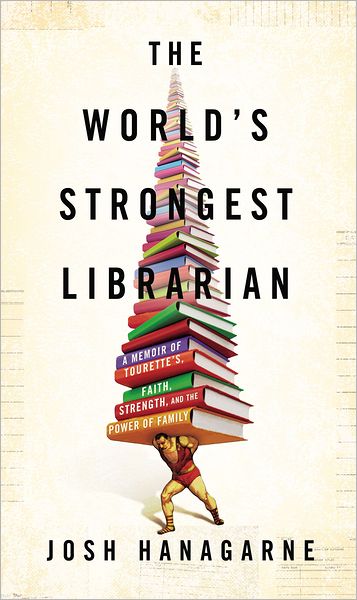
Maximum Shelf: The World’s Strongest Librarian by Josh Hanagarne

Maximum Shelf is the weekly Shelf Awareness feature focusing on an upcoming title we love and believe will be a great handselling opportunity for booksellers everywhere. The features are written by our editors and reviewers and the publisher has helped support the issue.

My editor recently asked me if I’d like to put together my first Maximum Shelf for them, and said she had just the book in mind for me: The World’s Strongest Librarian: A Memoir of Tourette’s, Faith, Strength, and the Power of Family, by Josh Hanagarne. (My father found this a hilarious expression of what my editor thinks of me. I’ll let you work that one out. I haven’t.) I was thrilled; and I loved the book. Because this would make for an extra long blog post, I’ve split the Max Shelf issue into two posts for you, so please enjoy my review today and my interview with the gracious & funny Josh tomorrow.


worldsstrongest

Josh Hanagarne, blogger at The World’s Strongest Librarian, “might be the only person whose first three-hundred-pound bench press was accompanied by the Recorded Books production of Don Quixote.” This is just one of his remarkable singularities. A gentle giant who tears phone books for fun, at 6’7″ he tends to catch the eye at the Salt Lake City Public Library, even when his Tourette Syndrome is not acting up. His memoir explores these contradictions and oddities, and his remarkable journey from idyllic childhood to painfully jerky young adulthood to a contented family and work life.

Hanagarne had a happy childhood, beloved by his mother, an incorrigible prankster and devout Mormon, and his devoted, irreverent bear of a father. He grew up in libraries, a passionate bookworm disturbed only by the tics that began in first grade but would go undiagnosed until high school (although his father suspected Tourette’s from the beginning). By young adulthood, they were not only embarrassing but violent and debilitating. He would eventually suffer a hernia from the force of his involuntary shouting tics, and his larger movements resulted in injury to himself and chaos in his immediate surroundings. After high school he spent years trying numerous cures, in and out of college, working various jobs and struggling with depression. Lifting weights at the gym stilled the tics somewhat, and for a while he got regular Botox injections in his vocal cords to quiet the shouts and whoops. During that time he met and married a lovely Mormon folklorist named Janette. For the first eight months of marriage, he couldn’t speak to her above a whisper.

Although deeply in love, the atmosphere of Josh and Janette’s story early in their marriage remains clouded. For years they try to get pregnant. Janette suffers two miscarriages and they are harshly rejected by the Mormon Church as adoptive parents. Josh continues to tussle with Tourette’s. For a short time, he finds a position as assistant special educator quite satisfying, not least because his tics become unremarkable in a room full of special needs. But he soon leaves that job, because he seeks challenge: crucially, he aspires to overcome Tourette’s, to beat his tics into submission. Pondering what might present the greatest challenge to a man who can’t keep quiet, Josh is drawn to the quietest place he knows, a place that has always offered succor and delight. He gets a job as a clerk in the library and begins a master’s program in library science. And a key piece of marital bliss is finally achieved when Janette delivers a healthy baby boy named Max.

Josh continues to battle Tourette’s in the gym, discovers kettlebell lifting along the way, and makes a new friend in Adam Glass, a former Air Force tech sergeant and strongman: he bends wrenches and horseshoes and tears decks of cards and phone books. Josh’s story takes an inspiring turn as the twitchy librarian and the foul-mouthed strongman gradually develop a friendship; as Adam helps Josh build strength, together they also begin to understand and subdue the tics. He finds Adam a little strange, and the explanation for his social awkwardness is also what makes him the perfect mentor for overcoming Tourette’s: Adam is autistic.

The adult Josh Hanagarne who relates his story is content and stable, happily married, thrilled to be a father to four-year-old Max, and working full-time at the Salt Lake City Public Library. As he relates his stranger-than-fiction story, he intersperses present-day anecdotes from a workplace that he wryly notes is rife with strange and occasionally smelly patrons and events. He muses eloquently and powerfully about the role of libraries in society, and their future possibilities. Throughout his life and this book, Josh struggles with his Mormon faith, as he sets off on the expected mission and faces myriad challenges in school, work, marriage and parenthood. In telling a story about family, church and Tourette Syndrome, he always circles back to libraries and to books, in many charming literary references. And always central to Josh’s story is his love of family. From his loving parents and exceptionally close siblings through the clear delight Josh finds in marriage and fatherhood, he stresses the inestimable gift of a loving family.

Josh’s memoir is thoughtful, heartfelt, often hilarious– and unsparingly honest. He is not proud of every moment in his own past, but he shares nonetheless. The image of the man today who wrote this book and who works in a large branch of a public library in a large city is that of a serious yet funny, mature, loving family man, and this image is only partly at odds with the earlier, less secure young man we come to know in these pages. The younger Josh was unsure and unstable, and the author is more comfortable in his own skin. But both have tics, and stories to tell.


This review originally ran on April 9, 2013 as a Shelf Awareness special issue. To subscribe, click here, and you’ll receive two issues per week of book reviews and other bookish fun!


Rating: 9 minutes of calm.

Tomorrow: I interview The World’s Strongest Librarian.