Maximum Shelf: The Goddess of Small Victories by Yannick Grannec, trans. by Willard Wood

Maximum Shelf is the weekly Shelf Awareness feature focusing on an upcoming title we love and believe will be a great handselling opportunity for booksellers everywhere. The features are written by our editors and reviewers and the publisher has helped support the issue.

This review was published by Shelf Awareness on August 6, 2014.


small

Kurt Gödel was a mathematician, logician and philosopher, best known for his incompleteness theorem, and often referred to as one of the greatest logicians since Aristotle. Born in Austria in 1906, he immigrated to the United States in 1940 to escape Hitler’s growing power and to pursue his scholarly work. Plagued by mental illness but also highly accomplished in his field, he would easily make an interesting subject to pursue. But Yannick Grannec’s first novel, The Goddess of Small Victories, is not about Kurt Gödel; it is about his wife, Adele.

Adele was six years older than Kurt, and was employed as a dancer at a cabaret when they met in 1927. They were a couple for more than a decade (during which time she nursed him through several rounds of institutionalization) before they married, with the continuing disapproval of his family. Adele would face rejection and isolation in the academic community as well, particularly when the couple finally settled at Princeton, where he worked at the Princeton Institute for Advanced Study (IAS).

These details are a matter of historical record. Grannec’s foray into fiction begins with her other protagonist: it is 1980, Gödel has recently died of anorexia, and Anna Roth, an employee at the IAS, has been tasked with recovering Gödel’s archives from his widow. Adele lives in a nursing home, and continues to hold a grudge against the academic establishment that shunned her; she is known to be a prickly old woman, and at first lives up to her reputation. But she sees something she recognizes in Anna, the daughter of two egomaniacal Princeton professors, who never felt that she fit into that society, being a more timid sort. Gradually, as Anna makes regular visits to the nursing home, the two women begin to open up to one another. Adele calls it a trade: she’ll tell her story if Anna tells hers. Chapters of The Goddess of Small Victories alternate between a third-person view of Anna’s visits to Adele in 1980, and a first-person telling of Adele’s story as it happened chronologically, beginning in 1928.

In this way, “the younger woman” (as Anna is often labeled) gets to visit Adele’s past worlds: Vienna in the 1930’s, postwar Princeton, McCarthyism, the Cold War; the difficulties of being an immigrant with poor English, the thrill of close friendship with Einstein and other luminaries and, centrally, the challenge of marriage to a tortured genius. Gödel is concerned with the infinite, but unable to handle the minutiae of his life: he is a consistently and increasingly troubled man–gifted, but also cold and demanding. He suffers from depression and paranoia, starves himself, meticulously tracks his body temperature and bowel activity, and refuses to see anyone outside a small circle that includes Einstein, Oskar Morgenstern, Robert Oppenheimer and their wives. He harangues his friends with conspiracy theories and an insistent rehashing of his unpopular notions. These few individuals naturally compose Adele’s entire social world, as well. Gödel tests Adele mightily, but in the end her love persists, as does her belief in infinity (a popular topic in the Gödel marriage and within their intellectual circle).

In exchange, Adele enjoys hearing about Anna’s life, though it has been marked by broken relationships and fear. The elder woman is outspoken, where the younger is reticent; Adele is enlivened by the challenge of spicing up Anna’s professional and love lives. Anna, as it turns out, has had a gifted-but-troubled mathematician in her own life as well. As the book and the women’s relationship unfold, the reader’s perspective moves more deeply inside Adele’s head, hearing her more intimate thoughts and becoming privy to her fears and insecurities, which increase as she ages and her marriage disappoints her. Anna and Adele make a journey together, and soon Gödel’s archives are no longer the point (except for Anna’s employer).

In an author’s note at the end, Grannec succinctly outlines which parts of the story are historically confirmed, which are relatively safe conjectures, and which she has created. Sticklers for historical accuracy should be satisfied. The translation from French to English by Willard Wood is smooth, establishing appropriate voices for the two different protagonists, and creating the evolving atmospheres of nervousness, fear and, eventually, desperation that characterize the Gödel household.

In the end, The Goddess of Small Victories delicately evokes both Adele’s varied experiences, in historical context, and also Anna’s more circumscribed life, which leaves room for future decision-making. While light is shed on the life and work of Kurt Gödel, he takes a backseat to his dynamic wife in Grannec’s compassionate telling. The finer technical details of Gödel’s work are outlined in narrative form, as Gödel reluctantly tries to tutor Adele, or discusses theories of philosophy with Einstein and the others. (Grannec also inserts footnotes regularly to offer further explanation, or to attribute quotations.) These mathematical and philosophical dialogues, the reader is reminded, are oversimplified; but they are enough to either whet the appetite, or impress upon one the magnitude of Gödel’s genius. The stars of this story, however, are two strong and intriguing women, who are stronger together.


Rating: 8 chocolates.

Come back tomorrow for my interview with Grannec!

Maximum Shelf author interview: Michael Pitre

Following yesterday’s review of Fives and Twenty-Fives, here’s Michael Pitre: At Our Most Human.

pitreMichael Pitre is a graduate of Louisiana State University, where he was a double major in history and creative writing. In 2002, he joined the U.S. Marine Corps. He deployed twice to Iraq and attained the rank of captain before leaving the service in 2010 to get his M.B.A. at Loyola University. Pitre lives in New Orleans with his wife. Fives and Twenty-Fives is his first novel.

This novel handles a great deal of trauma, and one assumes you experienced similar trauma during your military service. Was your writing process cathartic, or painful?

My experiences in Iraq were pedestrian compared to those endured by the characters in this story. It’s a book about people I knew and, in some cases, friends for whom I could have done more. That’s the hidden pain of veterans, I think. We always remember the moments when we weren’t brave, occasions when we didn’t measure up, and days when we didn’t give our best.

Catharsis came from a desire to do right by my friends. There were times when I knew exactly what would happen at the end of a paragraph, and I didn’t want to finish it. Yes, it was painful. Had this book been easy to write, it would not have told a true story.

You point out that this is not a memoir, but you have a great deal in common with Lieutenant Donovan. Were the boundaries between fact and fiction always clear to you as you wrote this book? Did those boundaries turn out as you’d intended?

Early on, I was hyper-focused on maintaining a bright line between fact and fiction. Again, I set out to write a story that would honor the people I knew, and I’d hoped to avoid autobiographical details entirely. Of course, writing is a process. What crept into Donovan’s character from my own experiences were mostly his feelings of inadequacy as an officer, and the awkwardness of being a young veteran in graduate school where classmates ask you to tell stories they aren’t prepared to hear.

Are there any misconceptions about the war in Iraq that you felt you had to guard against?

I was eager to shun misconceptions about war in general, particularly when it came to glamour and gallantry. War is work. For the average U.S. service member in Iraq, it was filthy and exhausting, absurd and terrifying, repetitive and boring. That’s why I chose road repair as the principal mission of Donovan and his Marines. It wasn’t a sexy gig, but I don’t know of another task in Iraq that was more dangerous or more necessary.

On the home front, I was wary of the giving the impression that Iraq War veterans are damaged goods. The young men and women who fill the ranks of the U.S. military are devoted professionals.

Though the characters in this story are struggling to reintegrate to civilian life, they aren’t giving up, they aren’t blaming anyone, and they aren’t victims. They’re working through their problems, and in the end, they’re doing it together.

Who is the hero of this story? Or, your hero?

All three narrators are young men placed in impossible circumstances, and none of them come away clean. Even Donovan, who’s all but bestowed with the formal title of hero, knows the truth about himself. The title becomes his burden.

The closest thing this story has to a hero is Sergeant Gomez. I’ve known a few Marines like her. I’d say they’re my heroes.

I’m so glad you said that. She is so much more than the “token female” that she might have been in lesser hands. Her presence as the only woman in the platoon felt very natural. Does your experience bear out her ease in this story?

The short answer is yes, it’s perfectly normal for a female sergeant like Gomez to run a road repair crew. Most Marines wouldn’t give it a second thought. Female service members have been fully integrated into occupational specialties such as military police, combat engineers and logistics for well over two decades, and these groups have spent as much time on the roads of Iraq and Afghanistan as anyone.

In fact, as the American experience in Iraq wore on, female service members became highly valued for cultural reasons. To avoid inflaming the population, male Marines were forbidden to search Iraqi women at security checkpoints. So, a task force of female Marines was assembled, trained in search techniques and deployed to check points throughout western Iraq. This ad hoc solution was eventually formalized into a program called “Lioness,” in which every battalion in theater had to answer its “Lioness tax” by surrendering a number of female Marines for the duration of a deployment.

Lioness was so successful that the program was copied and expanded into Afghanistan. Infantry patrols were reinforced with Female Engagement Teams composed of six to 10 female Marines. While the grunts dealt with the Afghan men outside, the female Marines would take off their helmets, go into the houses and develop relationships with the Afghan wives, mothers and daughters.

I served in Iraq alongside a female sergeant named Sally Saalman, who was perhaps the most feared and respected Marine in our battalion. She’d served on a forerunner of Lioness in 2005, and had been badly wounded in a suicide attack that killed six service members, three male and three female. (Read more about that event here.)

That was her first deployment. We met on her third. When Saalman raised her voice, everyone around would shut the f*** up and listen.

When and why did you decide to switch voices between your three main characters?

From the beginning, I knew the story would require three different perspectives and that one had to be Iraqi. It’s a long-ignored truth of war that warriors often suffer least. This is especially true in counter-insurgency, where the civilian population is the battlefield. The Iraqi people were the mission. I felt that not representing their experience with its own, distinct voice would’ve been narcissistic.

As for Donovan and Pleasant, I thought it important to show how some veterans have opportunities opened for them by their service, while others are left all but ruined by it.

Did you set out to write a book with a message or moral, or is this simply the story that you held inside yourself as a novelist?

I didn’t set out to write a book with a message or a moral. This really was just a story I had to tell. But along the way, as the character of Dodge became very real to me, I stumbled across the idea of people finding each other in their shared frailty. We’re at our most human when we can recognize our dread, and our weakness, in others.

For those who presume they have nothing in common with a kid from Baghdad, I’d hope that they finish this book having discovered that they have everything in common with him.


This interview originally ran on July 23, 2014 as a Shelf Awareness special issue. To subscribe, click here, and you’ll receive two issues per week of book reviews and other bookish fun!

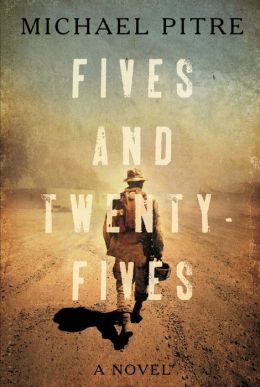
Maximum Shelf: Fives and Twenty-Fives by Michael Pitre

Maximum Shelf is the weekly Shelf Awareness feature focusing on an upcoming title we love and believe will be a great handselling opportunity for booksellers everywhere. The features are written by our editors and reviewers and the publisher has helped support the issue.

This review was published by Shelf Awareness on July 23, 2014.


fives and twenty

When a road repair convoy stops to check for roadside bombs, their first duty is to scan five meters in all directions from within the vehicle. A bomb inside this perimeter can penetrate the vehicle’s armor and kill everyone inside. Once five meters are cleared, scouts step outside and sweep an area 25 yards in every direction, before the convoy can move forward. These are the defining dimensions of a road repair platoon’s daily work. Filling potholes in Iraq means clearing bombs.

Michael Pitre’s debut novel, Fives and Twenty-Fives, follows three men from a road repair platoon in Iraq through their lives after their service has ended, alternating among their first-person voices. In disjointed chronology, the story switches between the present, when each man has either returned home or tried to create a new one, and their far more vivid past, in the Iraqi war zone.

Lieutenant Donovan is the platoon’s leader, although he knows he relies overmuch on his highly competent sergeant and corporal. Both his rank and his natural reserve inhibit Donovan’s relationships with the men and women assigned to him. “A real southern college boy, the Lieutenant. Like he was on his way to an outdoor jam band festival one day, took a wrong turn, and somehow ended up in the Marines.” Corpsman Lester “Doc” Pleasant is from the wrong side of the tracks, but discovers a gift for medical work. The platoon’s losses, which he is meant to prevent, hit him hard. Their “terp,” or local-native interpreter, is a Baghdadi university student code-named Dodge (“a dependable car”), who carries a copy of The Adventures of Huckleberry Finn in his back pocket, filled with copious marginalia in both Arabic and English. He is assigned to Donovan’s platoon but not allowed to talk with the Americans about his past–not that he wants to. In the aftermath of their war, the reader watches these three men try to navigate a world that no longer makes sense to them or of them.

In a post-Katrina New Orleans (and vomit-soaked French Quarter) as stark as the wartime Iraqi desert, Donovan goes back to school to pursue a business degree, but his professors don’t feel that officer training should exempt him from coursework in “leadership dynamics and business ethics.” He struggles to find relevance in school and work, and is haunted by the fates of the men and women of his platoon. Doc returns home to Houma, Louisiana, his military service having failed to offer the opportunity he sought. He can’t stop worrying about his father working out in the shed late at night, and still carries his trauma bag everywhere he goes. Dodge is lost to his American friends, his postwar experience known only to the reader.

In flashbacks, the reader witnesses these men and others in their day-to-day work in Iraq: repairing potholes, each and every one of which reliably contains an IED; trying to keep the roads safe for military and civilian travel; balancing humanity against the ugly work of war; and riding out the senselessness of military politics. Relationships grow and fade. Their homes seem very far away, and are rarely mentioned. One exception is Donovan’s phone call to his parents on his birthday, an effort that costs him dearly. Additional members of the platoon are revealed only in these flashbacks. The strong characters of Corporal Zahn and uber-capable Sergeant Gomez, for example, don’t get first-person treatment; the reader has to work a little harder to puzzle out the endings to their stories, with an increasing sense of foreboding.

Meanwhile, in the present-tense sections, Donovan struggles with the social interactions required by work, school and the possibility of dating. He is hailed as a military hero but holds himself responsible for a range of less salutary personal postwar outcomes. Doc is back at the oil-change place where he worked in high school, his society consisting of a father he can hardly speak to and two friends in a band in New Orleans. Dodge inhabits a precarious position in Tunisia, a society teetering at the brink of violent protests and social upheaval; his pleas to come to the United States have been denied.

These young people come home from a deeply traumatic foreign war to a society totally unprepared to understand them. When Doc ventures out with a girl to see the fireworks on New Year’s Eve, he reacts badly to the sounds of explosions and lashes out, wanting to protect those around him; but his companions, who barely know him, judge him to be unstable. Donovan carefully avoids playing the part of the “stereotypical brooding vet.” The experiences of Donovan, Doc and Dodge are heartwrenching in both theaters; it is Pitre’s greatest feat that they remain viscerally real people, not black-and-white cut-outs. From the perspective of his characters, there are perhaps no heroes here.

The quiet pathos of war, its aftermath and the individuals affected by it, and the inability of a tone-deaf society to relate to them, is rendered with poignancy and stark honesty in Fives and Twenty-Fives. Readers will be floored by Pitre’s spare literary style, the authenticity of each of his characters’ three different voices, and those mesmerizing characters themselves, who are not perfect but demand our compassion for their very reality. The story of Fives and Twenty-Fives is sometimes difficult to abide, but is also necessary; we are lucky to have such a fine voice as Pitre’s to tell it.


Rating: 9 potholes.

Come back tomorrow for my interview with Pitre.

Maximum Shelf author interview: Marja Mills

Following yesterday’s review of The Mockingbird Next Door, here’s Marja Mills: Making Acquaintances.


Marja Mills is a former reporter and feature writer for the Chicago Tribune, where she was part of the staff that won a Pulitzer Prize for a 2001 series about O’Hare airport entitled “Gateway to Gridlock.” The Mockingbird Next Door is her first book.

Mills was born and raised in Madison, Wis. She is a 1985 graduate of Georgetown University’s School of Foreign Service; a lifelong interest in other cultures led to studies in Paraguay, Spain and Sweden. Mills lives in downtown Chicago and often spends time in Madison and her father’s hometown of Black River Falls, Wis. (pop. 3,500).

marja

Did you have preconceived notions of what Nelle Harper Lee would be like? In what ways did she surprise you?

I didn’t know what to expect. I thought she might be quiet and reserved. Not so. She was gregarious much of the time, and witty. She loved to laugh. When she was telling a story that especially amused her, she’d take her glasses off, tip her head back and just laugh until she could finish what she was saying.

Nelle and her sister Alice–an attorney she calls “Atticus in a Skirt”–loved to get in Nelle’s Buick and explore the back roads. I’d read that the home she shared with Alice when Nelle wasn’t in New York was more modest than one might expect for an attorney and an author of her remarkable and enduring popularity. That was true. They lived simply, didn’t care about material things and had an eclectic group of good friends, from a Methodist minister and a librarian to a hairdresser and a bank president and his wife. Most were retired but still very active.

What about the Southern culture you encountered, in general? Any surprises there?

Being from the Midwest, I was surprised how many words in common usage in Alabama were new to me. Things such as mashing buttons instead of pushing them. Or using a buggy at the Winn Dixie instead of a grocery cart. That was a source of entertainment for the Lees and their friends: watching me learn local expressions. My favorite is an old-fashioned one that Nelle taught me: “journey proud.” It’s the excitement and apprehension before a trip that makes it hard to sleep.

How would you describe Harper Lee as you later came to know her?

My first day living next door in Monroeville, she left a note inviting me to dinner. That touched me. Soon she was calling to have afternoon coffee together, often at McDonald’s.

And of course you can’t know Nelle without knowing her sister Alice. Their lives were entwined and yet quite different, as were their personalities. Miss Alice, as she is known, is 15 years older than Nelle and there was another sister and a brother between them. As I wrote in the book, “even at their ages, it was clear Alice was the steady, responsible older sister, and Nelle Harper the spirited, spontaneous younger one.”

Both gave generously to the Methodist church and various charities. Nelle had been donating large sums, quietly and behind the scenes, for many years. As their Methodist minister friend, Tom Butts, said, she educated many people who had no idea she was their benefactor.

In what ways, if any, do you identify with Harper and Alice Lee?

They got lost in books as children, pulled into another world where you’re not just reading words on the page but living in the story, walking around in it. I was that way, too. Nelle’s eyes would dance, 70 years later, when she talked about being absorbed in the adventures of the Rover Boys.

Aside from many hours spent talking with Nelle and Alice, what research was involved for this book?

Some of the most valuable and enjoyable research I did was around kitchen tables and on porches, interviewing Lee friends and family. There were people I needed to talk to “while they still had their marbles,” as Alice put it. Or “while they’re still above ground,” as Nelle said. These were leisurely interviews but overall there was a sense of urgency, too, that if their stories about the town and the Lees weren’t preserved they would go with them to the grave.

Books were part of the research, too, naturally. I have rows and rows of them at home. Many of the titles were recommended by the Lees, with Alabama history and Southern fiction being two major categories. I enjoyed memoirs by Horton Foote, the playwright who adapted To Kill a Mockingbird for the film, and Wayne Flynt, the Alabama historian.

What was different about the writing process for this book, compared to your past experience as a journalist?

I had the opportunity to really get to know the people and the place I was writing about, to let them reveal themselves over time. That’s a luxury most journalists don’t have. Nelle and Alice did things on their own terms and on their own time. The way this experience unfolded gradually was more compatible with that that. “You let the river run,” was the way Rev. Butts put it.

You allude to the Lees’ approving what went in the book and what didn’t. How much were you asked to hold back?

Not as much as I expected. Much of what they said that was off the record was to spare the feelings of a friend or relative. When I lived next door, we talked about some of the things they especially wanted in the book. They resented Truman Capote’s characterization of their mother, for example. Both sisters described her as a gentle soul. I went over with them stories I wanted to share as well. I was ready to do much more of that but their approach was “use your own judgment.”

Has Nelle or Alice read this book? Any comment from them?

Because of their age and health–neither is able to live at home anymore–I don’t know that they’ll be able to read it but I think they’d enjoy reliving some of the adventures we had together. Age and diminished vision do take their toll. I’ve wondered sometimes how many books each has read in her lifetime. A staggering number; both were avid readers since childhood. Even in her 90s, Alice often had four books going at once. She told me about the time she and Nelle decided they would donate some of their books to the Methodist church.

Nelle set her jaw and tried to keep up her determination to part with some of the books. But then she would have second thoughts and retrieve them from the boxes they were trying to fill. Alice was no better. For all their generosity over the decades, books were hard to give away, even for their church. The evidence of that was the rising tide of books in their house. They had all shapes and sizes of bookcases, crammed where they could find space, and it still wasn’t enough.

In your book you make it clear that the Lees supported this project, but there was some press in 2011 regarding a statement from them indicating the opposite. Can you help us understand these conflicting reports?

I asked Alice Lee about it. Nelle was not living at home; she had a serious stroke in 2007. Alice issued a statement. She said that the first statement had gone out without her knowledge and did not represent her feelings or those of her sister. As far as I know, that put the matter to rest.


This interview originally ran on June 25, 2014 as a Shelf Awareness special issue. To subscribe, click here, and you’ll receive two issues per week of book reviews and other bookish fun!

Maximum Shelf: The Mockingbird Next Door by Marja Mills

Maximum Shelf is the weekly Shelf Awareness feature focusing on an upcoming title we love and believe will be a great handselling opportunity for booksellers everywhere. The features are written by our editors and reviewers and the publisher has helped support the issue.

This review was published by Shelf Awareness on June 25, 2014.


mockingbird

Published in 1960, To Kill a Mockingbird spent nearly two years on bestseller lists and won the Pulitzer Prize in 1961. Since then, its impact has been lasting and widespread: Atticus Finch, Scout, Jem and Dill, and Boo Radley are well-known names today, and the novel is still taught (and targeted for removal) in many high schools nationwide. With its themes of racial injustice, gender roles, mental illness, addiction, and class differences–and its remarkable ability to bring humor and compassion to such somber subjects–To Kill a Mockingbird has become an American classic. Its equally famously author, Harper Lee (full name Nelle Harper Lee, Nelle to her friends), is notoriously private. She stopped giving interviews just a few years after the publication of her only novel. Lee’s relationship with Truman Capote has also attracted longstanding interest. The two grew up next-door neighbors, exercising their imaginations and storytelling talents on one another. Lee assisted Capote’s Kansas research project that became In Cold Blood; Capote is rumored to have contributed to Lee’s Mockingbird, but this rumor has always been hotly denied by Lee (and Capote himself never made such a claim).

Over 40 years after the publication of her masterpiece, Nelle Harper Lee continued to quietly reside in the small Alabama town that inspired it, splitting her time between Monroeville, where her elder sister, Alice, still practices law, and New York City. In 2001, a Chicago Tribune reporter named Marja Mills was assigned to seek out an interview. Knowing Lee’s standing policy, Mills nevertheless traveled to Alabama, filed her request and toured the town for a day or two. She dutifully knocked on the door of Alice and Nelle Harper Lee’s home–and was floored when the elder sister opened the door and invited her in.

The development of trust and friendship between Mills and the Lee sisters took time, but even in those first minutes, the relationship was nearly unprecedented. Alice, the more methodical and steady sister, was first to open up. She set up interviews for Mills with the Lees’ friends and acquaintances, calling ahead to let them know it was okay to talk to the journalist, and what was acceptable to share. Nelle was known to those friends as being more mercurial; but eventually she, too, came around to the younger woman, who was cautious and respectful in approaching the famously cagey writer. Remarkably, Mills does not seem to have begun with any special interest in To Kill a Mockingbird or its author; but as a journalist, she was naturally attracted by the story. In the spirit of The Immortal Life of Henrietta Lacks, Mills then immersed herself in a community that was only just willing to allow her access, and built trust haltingly, but eventually with great success.

Alice was in her 90s, Nelle in her 70s, when the three women become friends. But what could have been a problematic age gap was minimized by Mills’s own chronic health condition, which both helps her identify with the older women, and gives her the dubious gift of leave from full-time work. Eventually, she expressed a tentative interest in moving to Monroeville; the Lees encouraged the idea, and she moved in next door to them. What was by then a close, rich friendship continued to develop: on a daily basis, Mills shared morning coffee with Nelle, drove the countryside, fed the local geese and ducks with the sisters (who kept close tabs on their numbers, and worried over missing goslings), and socialized with the Lees’ close-knit and protective group of friends. This included accompanying Nelle to the Southern society events that made the reticent author nervous.

Alice is the keeper of Lee family lore, with a famously accurate memory. Mills’s research is equally concerned with each of the two sisters, and involves their friends as well. The project that became The Mockingbird Next Door was conceived fairly early in the relationship, and in Mills’s telling, Alice and Nelle are willing supporters; they went over her notes together, marking what was to be included and what was to be redacted. (Readers are left wondering how much fell into the latter category.)

The Mockingbird Next Door offers no big reveals, no shocking secrets about the life of Nelle Harper Lee, except perhaps that she is not a hermit or an incorrigible curmudgeon. Rather, she is a kind, down-to-earth woman, a voracious reader, loyal to her sister and friends–who simply prefers that her life not be such a public performance as was that of her famous former next-door neighbor. Told charmingly in the Lees’ southern drawl and with the affection and closeness that the story reveals, The Mockingbird Next Door is quietly admiring and satisfyingly intimate, and will captivate not only fans of Lee’s great American novel, but fans of real people living modest lives in small-town Alabama, or anywhere.


Rating: 7 cups of coffee.

Come back tomorrow for my interview with Mills!

Maximum Shelf author interview: Terry Hayes

Following Wednesday’s review of I Am Pilgrim, here’s Terry Hayes: On Breadth of Scope.


Terry Hayes was born in Brighton, England, migrated to Australia as a child, was based in New York as foreign correspondent at 21, and produced a current affairs radio program before moving to Los Angeles to work as a screenwriter. He has written numerous screenplays and mini-series, and has received two international Emmy nominations. His credits have included Payback with Mel Gibson, From Hell with Johnny Depp and Vertical Limit with Chris O’Donnell. I Am Pilgrim is his first novel. He lives in Switzerland with his wife, Kristen, and their four children.

photo: Kristen Hayes

photo: Kristen Hayes

I Am Pilgrim travels through many complex spheres in numerous countries. How much research was required for this book? How did you go about it, and did you enjoy that part of the creative process?

The short answer is: an enormous amount of research. When I started I had no idea just how challenging it would be–which was probably just as well, otherwise I might not have even started. I did have a couple of advantages. With the exception of Afghanistan and Saudi Arabia, I had either lived in, or visited for extended periods, all of the countries where the plot takes place. The race against time criss-crosses continents, and ranges from the Lower East Side of Manhattan to Damascus in Syria, from Santorini in the Greek islands to a Bulgarian border post. My own wanderings lessened the research load and, I hope, allowed me to bring the novelist’s eye for detail to those locales. The second advantage I had was that I had once been a journalist and foreign correspondent, so I am accustomed to efficient and focused research and interviews. I approached the material as if I was a journalist on assignment–I admitted to myself I had a lot to learn. The one thing that I found the most difficult was the science. The plot involves a lot of biological detail, and I wanted that to be as accurate as possible. When I was at high school, several of my science teachers told me that I was very lucky I was good at English and history! Still, I have an enormous curiosity and am happy to read and interview widely, so I eventually managed to wrestle that part of the subject to the ground.

In a practical sense, it would not have been possible without the Internet. Such a vast array of information, so readily accessible, I believe is changing the nature of writing, especially of something like an international spy thriller. You can find out exactly how public beheadings are conducted in Saudi Arabia, how much a gene sequencing machine costs on eBay, or many of the latest tradecraft habits of covert intelligence agents operating in hostile territory. It gives an enormous grounding to the rest of the research. I did enjoy it, most of the time. I am lucky to have an overwhelming curiosity and a pretty good memory, so the research, whether it was about the Islamic faith or the design of a Roman coliseum called the “Theatre of Death,” was really a great experience. Of course, I worried that I had made a mistake–which I am sure I probably have–but I reminded myself that the book was not a documentary. It was, beyond everything else, a work of fiction.

You have created an extraordinarily intricate plot, with lots of characters and lots of detail. Can you tell us a little about the note-taking, outlining or whatever method you used to keep everything straight?

This is the type of book I have always loved–big, epic stories that you can really lose yourself in. The ones that affect you in a very emotional way and also, hopefully, teach you something on the journey. That was the sort of novel I tried to write. Part of that ambition was to interweave a major plot with a number of subplots and somehow try to make it all “of one piece.” Basically, how I did it was to keep telling myself the story. Or, better still, telling it to my wife on long car rides! I think, by the end, she was glad to hear the last of Pilgrim. Of course, you have to have some major stepping stones, or turning points, along the way. The biggest of these was the ending. Whether it is a screenplay, a piece of journalism, or the novel–I have always had to know how it was going to finish. So, once I had an idea of the character and an ending, I could start to embellish it. “Okay,” I would ask myself. “Where do we meet him?” “Why is he there?” “What does he want, what is his objective?” On and on and on. Slowly, the blanks would start to get filled in, and in order to do that, you have to have Pilgrim–or whatever his real name is–interact with other people. It’s funny, but you don’t forget a good run of events in the story, or ideas of how to do it. Bad ideas don’t last a single sleep. Time after time, I would start at the beginning again and tell myself (or my long-suffering wife) the story. When the detail became too much, I started to make notes and, naturally, I had to do that while I was researching the more difficult sections of the story–the things like the biology of viruses or the exact methods used in waterboarding. As the story grew, I started to use what people in movies call “beat-sheets”–one-line notes detailing each “beat” of the story, each significant development of the plot or important moment for a character. Toward the end, the problem became finding the exact research note I knew I had made months earlier. “I know I wrote that down somewhere….”

In the past, you have written in a number of formats, including screenplays, television and journalism. How was writing this novel familiar, and in what ways was it new and challenging?

Well, it is all story-telling. Whether it is a feature article for a newspaper or a screenplay for an action movie, you are always trying to take the reader–or viewer–through a sequence of steps, or events, which are believable and arresting. There is always that struggle to find the right word, the memorable phrase, the clearest way of expressing something. So those things were extremely familiar. The major difference is that in writing movies or long-form TV, the script is part of a manufacturing process–it is a step along the way to creating the finished episode or movie. In a novel, it is the finished article. So the pressure on crafting the words and paragraphs is that much greater. Sometimes a little paralysing! The other major difference is that in movies or TV you can’t tell the audience what a character is thinking–you have to rely on the actor to try and convey that. Of course, in a novel those internal thought processes are easily conveyed, so it is much easier to explain why a character follows a certain course of action. After years of writing for the screen, I found that completely liberating. I loved having the ability to say in the novel “He thought such and such… so he did this and this.” Because you can’t do those internal thoughts in a screenplay, I always think writing a movie is like fighting with one hand tied behind your back: it’s a real skill, but it sure makes things hard.

Pilgrim, like many of fiction’s most compelling heroes, struggles with his own past and demons. If anything he becomes more human, and less perfect, as the novel develops. Did he develop this way for you, too?

Yes, he sure did. I think it’s a little like life itself–the more you get to know somebody, the more you learn about their flaws and the wounds they carry. It doesn’t mean you like them any less; to the contrary, you often end up admiring them even more. So it was with Pilgrim. Most of us, I think, are damaged in some way, but Pilgrim–as you point out, like so many heroes in fiction–is more damaged than most. On one level, the novel is about him confronting and dealing with those issues and demons from his past–a different sort of pilgrimage, I guess. Despite his failings, despite his flaws, he never gives in. He knows that he has to endure an enormous amount of anguish and pain, but he finds the courage and resolve to see his mission through to the end. The fact that he is prepared, if necessary, to sacrifice himself in the pursuit of something far more important than himself makes him a true hero, in my mind. There seems to be a prevalent view, especially in movies, that heroes should have some sort of super-powers. I don’t agree. I think it is the very human things, faults and failings included, that make a true hero. Especially if he or she can overcome them and show us what great courage and commitment really mean.

And then there’s your antihero, the Saracen, who is Pilgrim’s genius-counterpart but approaching total evil. Do you think of them as two sides of the same coin?

They have so many things in common–especially an anguished childhood–that I certainly see them like that. If this were Star Wars, I would say one turned to the dark side, the other to the light. Although born on completely opposite sides of the earth, they both experienced the death of a parent in horrific circumstances, they are both extremely intelligent, have undertaken medical degrees, and are loners, complete outsiders in the world. They both go on a great journey, a pilgrimage, where the fate of people and nations hangs in the balance. At one stage Pilgrim describes his adversary as a “ghost”–spectral, hidden and barely glimpsed–but Pilgrim could just as easily be describing himself. These two men, who have spent all their lives living in the shadows–one hell-bent on cataclysmic revenge, the other a covert intelligence agent–move ever closer to each other. When they finally step out of the shadows and meet in a place called the Theatre of Death, their battle relies more on intelligence than it does on weapons. It is an epic struggle between two men trying to outsmart each other. In order to do that, they have to know an enormous amount about each other. I have always thought that, because of his own background and experiences, Pilgrim understands his adversary better than any man on earth.

What do you have in mind next? Avoiding spoilers, of course: is there room for a sequel here?

Well, in my fevered mind, Pilgrim was always the first part of a trilogy. On the last page of the last novel we discover what his real name is, and I don’t think it is giving away too much to say that he walks up the front steps of a house and we know that he has found safe harbor at last. As you can probably tell, I have the next two books outlined–which I had to do in order to set up a lot of things in the first novel that I would pay off in the later volumes. However, as I was not certain if I Am Pilgrim would meet with any success, I did not want to launch into writing the second volume if nobody had read the first! Therefore I am in the midst of writing a book tentatively called The Year of the Locust, which is another thriller, partly set in the intelligence world. It also involves “just over the horizon” science and pits a man and his wife against seemingly impossible odds. I like the story very much and, as much as is possible while wrestling with words every day, I am really enjoying it. I hope, when it is finished, other people will feel the same!


This interview originally ran on May 27, 2014 as a Shelf Awareness special issue. To subscribe, click here, and you’ll receive two issues per week of book reviews and other bookish fun!

Maximum Shelf: I Am Pilgrim by Terry Hayes

Maximum Shelf is the weekly Shelf Awareness feature focusing on an upcoming title we love and believe will be a great handselling opportunity for booksellers everywhere. The features are written by our editors and reviewers and the publisher has helped support the issue.

This review was published by Shelf Awareness on May 27, 2014.


I am pilgrimA woman is found dead in a ratty New York City hotel. Despite the outward hallmarks of a “simple” murder–one motivated by rage, sex or money–it quickly becomes clear that this is an intelligent and carefully planned crime. The room is awash in sulfuric acid, and the victim has been stripped of her face, fingerprints and teeth. A powerful antiseptic has been used to destroy all DNA on the scene. Detectives link the crime to a borrowed library book about investigations, written by one of the world’s best professional investigators, a man who doesn’t officially exist. The author of that book happens to be present at the crime scene: he is the unnamed narrator of I Am Pilgrim, an intricately plotted thriller of global proportions, and the debut novel by screenwriter Terry Hayes.

Hayes has made an inspired choice in selecting an unnamed narrator to tell this story–information can be meted out methodically, with all the oblique references and foreshadowing one might expect from a secret agent. We learn from the man who eventually consents to the code name “Pilgrim” that he has a complicated past in many cities and countries around the world, including the small Turkish town of Bodrum, which is improbably linked to the murdered woman in New York City. When detectives learn that the hotel room in question had been occupied since the morning of September 11, 2001, more questions are raised–who checks in to a NYC hotel on that morning?–and international implications begin to be theorized. Pilgrim planned to be on hand at the scene only as a consultant, to assist his friend, NYPD homicide detective Ben Bradley. But perhaps he belongs there after all.

As it turns outs, the nameless murder victim in New York City is the least of Pilgrim’s concerns.

On the other side of the world, years ago, a young boy watched his father’s beheading at the hands of the Saudi Arabian government. That boy has grown up to become a mujahid and go to war in Afghanistan against the Soviets, and has now taken on a false Lebanese identity while hatching a grand plan to take down the “far enemy,” the Western world as embodied by the United States. This unnamed man is nicknamed “the Saracen,” as our narrator is called Pilgrim, and the central plot of I Am Pilgrim is the buildup to their final standoff.

A retired chief of the most secret intelligence agency in the United States, Pilgrim is called in by the President himself after three bodies with various nationalities are found, scorched and disintegrating, in a grave of quicklime in a deserted village in the Afghani desert. The Saracen has been hard at work for decades. No crude airplane hijackings for him: the destruction of the Western world will require brilliance, finesse and absolutely thorough preparation. With his test run in the desert complete, he’s ready for the biggest scheme of all. And as good at his job as Pilgrim is, the Saracen is his match.

The coincidence of Pilgrim’s presence in the N.Y.C. hotel room will ease his transition back to full-time work on a seemingly unrelated assignment, and he reenters the underground world easily enough. Disguised as just another FBI agent, he’s sent to Turkey, ostensibly to investigate the suspicious death of a young American billionaire there. In reality, he’s hunting the Saracen. One of the many successes of I Am Pilgrim is that within 600-plus pages of mysteries within mysteries, a plethora of subplots all link together smoothly. In seeking the Saracen, Pilgrim hopes for no less than to save the world, but he is also concerned with his cover mysteries, including the death of the American billionaire in Turkey–despite local investigators having ruled it accidental, and having tried to close the case–and the murder of the still-anonymous woman in the shabby hotel in New York.

Within this elaborately plotted thriller of international espionage, Hayes inserts a charmingly detailed past and personal story for Pilgrim and his supporting characters, including Detective Ben Bradley and the U.S. director of national intelligence, who is nicknamed the Whisperer. (Hayes has a fondness for aliases.) Pilgrim’s childhood, Bradley’s heroism and modesty, and the Whisperer’s rise through the ranks of secret government agencies are realistic and enthralling. I Am Pilgrim not only circumnavigates the globe but also reveals an appreciation for and study of fine art, and references world history in building its background. In these ways, whimsy and realism are advanced in parallel by the rich context, strong characters and framing elements Hayes employs.

This debut novel is lengthy, but uses every line to full effect; the page count is necessary to pursue the involved and involving story Hayes has planned. Fully wrought characters and an ambitious, but impeccably designed plot are unfurled at a breakneck pace; the reader’s only problem will be finding time to race through I Am Pilgrim in as few sittings as possible.


Rating: 8 doses.

Come back for my interview with Hayes later this week!

Maximum Shelf author interview: Chevy Stevens

Following yesterday’s review of That Night, here’s Chevy Stevens: Listening to Her Own Voice.


Chevy Stevens grew up on a ranch on Canada’s Vancouver Island and still lives on the island with her husband and daughter. When she’s not working on her next book, she’s camping and canoeing with her family in the local mountains. Her debut, Still Missing, won the International Thriller Writers Award for Best First Novel. That Night is her fourth novel.

unnamedThis is your fourth novel. Is it getting easier, or harder?

I really enjoyed writing That Night, and even though it still had some challenges–as each book does–it was the fastest I’ve ever written a novel. It was a different experience for me in many ways, however, because I was pregnant when I started writing the book. I had a wonderful amount of energy and focus (love those pregnancy hormones!), and also the burning desire to get as much completed as possible before the baby arrived. I was a few days short of finishing my first draft when she decided to make her appearance. The rest was finished after she was born.

I think with each book you learn more and you grow as a writer so you learn to recognize weaknesses early, and to question things sooner. I’ve also learned how to listen to my inner voice more when I have doubts about a plotline or a character. I think with each book I’m beginning to understand my own style more, what works for me, where my voice resonates the most, and what my fans also enjoy the best about my writing. Hopefully I can keep giving them that.

You got the idea for your debut, Still Missing, in which a realtor is abducted from an open house, while working as a real estate agent yourself. Where do your subsequent creepy-terrifying plot concepts come from? Do you scare yourself with these stories?

Never Knowing was the result of a conversation I had with my editor, a “what if” premise, which grew into a story. In Always Watching, I wanted to write about Nadine, the therapist in my first two novels, and I was intrigued by the debate about repressed memories and also the subject of cults. The cult in that book is inspired by a hippie commune that lived in Shawnigan Lake in the ’70s.

That Night grew from an idea I had while watching a true story on television about a man who served years for his girlfriend’s sister’s murder. I also “saw” Toni in my mind and wanted to write about her.

Sometimes certain scenes in the books do scare me quite a bit. Essentially, I am telling myself the story first, so if I don’t feel anything, then it’s not strong enough. There are some moments in the current book I’m working on that are truly terrifying and made my own heart pound when I wrote them.

Did you have to research the prison system?

I did quite a bit of research for That Night. There seemed to be more information available about the American prison system than the Canadian, so I had to work hard to uncover some sources willing to talk to me. Because of the sensitive nature of the information they shared, they asked to remain private. I read everything I could find–online articles, books, memoirs, and watched both documentaries and numerous episodes of Lockup.

Shauna and her gang are so mean, it’s just boggling. Do they come from life–yours or anyone’s–or are they a grotesque fantasy?

I think we all remember “mean girls” in high school, but they are also a product of what I learned during my research. I read books on teen bullies and how girls can be especially vicious, often cutting another girl out of their circle, or simply deciding they don’t like someone and then making their life hell. There have been many documented real-life cases where bullying has gotten completely out of hand, with deadly consequences. Sadly, a few young girls have even taken their own lives because they can’t cope with the constant harassment. The worst part to me is that parents are often unaware of what’s happening to their children at school.

Toni’s voice is convincingly teenaged in the passages set in her early life, and more grown-up in the post-prison passages. Did you make a conscious effort to vary her voice? Was it difficult to switch gears?

I don’t think it was conscious. Writing is a bit like acting sometimes, you go into the character. So when I was writing Toni’s teenage years, I felt like a teenager, with a teenager’s concerns and thoughts and hopes and dreams. Then, when Toni was older and released from prison, I wrote from a different mindset, imagining how it would feel to be in that situation, how it would shape you, harden you, how angry you would be at the system for failing you.

Are you already at work on your next book, and can you share anything about it with us? All your books so far are stand-alones; any interest in the idea of a sequel?

Yes, I am close to finishing my fifth novel. I’m not ready to share the title just yet. It’s a superstition of mine that the book has to be finished first. But I will share that it’s another standalone about three sisters who escape a terrible situation and go on the run, only to get caught in an even worse nightmare.

I haven’t wanted to write a sequel to any of my books at this point because I’ve usually put the characters through quite a bit, and it doesn’t feel fair to keep ruining their lives.


This interview originally ran on April 30, 2014 as a Shelf Awareness special issue. To subscribe, click here, and you’ll receive two issues per week of book reviews and other bookish fun!

Maximum Shelf: That Night by Chevy Stevens

Maximum Shelf is the weekly Shelf Awareness feature focusing on an upcoming title we love and believe will be a great handselling opportunity for booksellers everywhere. The features are written by our editors and reviewers and the publisher has helped support the issue.

This review was published by Shelf Awareness on April 30, 2014.


that nightIn the small town of Campbell River on Vancouver Island in the late 1990s, Toni Murphy can’t wait to graduate from high school. Her parents are totally hassling her: they disapprove of her boyfriend, Ryan; her mom is controlling and angry; her father has become distant. A group of popular girls at school is determined to make her life miserable, and her too-perfect little sister, Nicole, has recently started hanging out with those very girls. Toni and Ryan intend to save a little money, get an apartment together and, eventually, leave town for good. Things are a bit rough at home, but they have a plan, and they are so close….

Then, one night, Nicole is killed. Toni and Ryan are convicted of her murder and sent to prison.

Nicole’s killer–or killers–not only took the life of their victim, but effectively Toni and Ryan’s as well, and the young love they shared: once out on parole they will never be allowed contact again. Toni and Nicole’s parents’ lives are ruined as well. Their mother holds onto her rage against her elder daughter, and their father’s indecision about whom to support ends up supporting no one.

Seventeen years later, Toni is being processed out of prison and into a halfway house when we meet her in the opening lines of That Night, the fourth novel by Chevy Stevens (Still Missing). She is frightened and unsure of how she’ll readjust to the outside world. It was so painful on the inside–being separated from Ryan and everything she knew–that the only way she could cope was to shut down. She stopped writing to Ryan in the men’s prison, asked her father to stop visiting and got into a lot of fights. Now that she’s out, her fellow parolees at the halfway house want to continue with violence, and Ryan wants to renew contact. He’s intent upon solving the crime they’ve been convicted of, but violating the parole conditions that forbid contact could land both of them back in prison; anyway, Toni feels the best way to move on is to put Nicole’s murder behind her. In returning to her hometown, however, she finds that no one else is ready to do that. Her mother is still furious, believing Toni killed her little sister; her father is still unsure whose side he’s on; it’s nearly impossible for an ex-con to get work, and even harder for her to keep it. And Toni’s high school nemeses, Shauna and her henchwomen, are still around, and still have a bone to pick. She makes just one friend: a rescue pit bull named Captain.

Slowly, Toni begins to settle in. Back in Campbell River, she goes to work at the Fish Shack, where she waited tables in high school–now they keep her (and her prison tattoos) hidden away in the kitchen. She lives with Captain on a small boat and checks in with her parole officer daily. Toni has now experienced severe bullying, incarceration and an egregious failure of the criminal justice system; at 34 years old, she’d like to just be left alone to put together whatever life she can. She doesn’t visit her parents, but she does see Ryan hanging around the marina where she lives. He’s pushing ahead in investigating Nicole’s death, against Toni’s advice, and he has his eyes on the girls who picked on her in high school–Shauna and her clique testified against Ryan and Toni at the trial, and Ryan wants to know why. What really happened that night? As Ryan’s investigations approach the truth, the events of 17 years ago feel very recent indeed; Toni may be in danger–and she may not be the only one.

That Night shifts back and forth between the events of 1996, when Toni’s teenaged world fell apart, and the present, with Toni newly released from prison and struggling to rebuild her life. Both are told in first person by Toni herself, although in two subtly different voices: that of the rebellious teen with short-term concerns and long-term dreams, and that of the ex-con whose hard-won and carefully constructed defense system is still brittle. This nonlinear style highlights Toni’s sense of confused and harried apprehension, of disruption. Flashbacks allow the reader to visit Toni behind bars, and these scenes, too, are evocative and disturbing.

Stevens matches the success of her previous novels with character-driven drama and a clear commitment to the particular nuances of her Vancouver Island setting. A strong sense of foreboding and a thoroughly compelling plot keeps her reader guessing, while a hint of romance broadens the appeal. Toni’s gritty, emotional, traumatized persona is both gripping and sympathetic. Foreshadowing and terrifying suspense are riveting in Stevens’s sure hands; readers will want to keep all the lights on as That Night moves into its final acceleration.


Rating: 6 dog walks.

Come back tomorrow for my interview with Stevens!

Maximum Shelf author interview: Lily King

Following yesterday’s review of Euphoria, here’s Lily King.

Lily King grew up in Manchester, Mass. She received her B.A. in English Literature from the University of North Carolina at Chapel Hill, and her M.A. in Creative Writing from Syracuse University. She has taught English and creative writing at several universities and high schools in the U.S. and abroad. Her three previous novels are The Pleasing Hour, The English Teacher and Father of The Rain. Her short fiction has appeared in literary magazines including Ploughshares and Glimmer Train, as well as in several anthologies. King is the recipient of a MacDowell Fellowship and the Whiting and PEN/Hemingway Awards, among others. She lives with her husband and children in Maine.

photo credit: Laura Lewis

photo credit: Laura Lewis


Presumably even this “loosely based” work required research into the field of anthropology and Mead’s life. Did you have any background to begin with? Did you enjoy this research?

It required a ton of research and no, I had zero background in anthropology or ethnology, not even one anthropology course in college! Like many writers, though, I have always felt like an extremely amateur and untrained anthropologist in the world, observing the huge, crazy mysteries of human behavior and writing it all down in novels.

On the one hand, you enjoy the research because it’s not writing, which is much harder, but on the other hand you miss writing miserably and feel like a part of you is dead. I had so much to learn before I could start, but because I always knew the book would be fiction, I didn’t want to get too attached to any one detail or fact. I read a lot of books at a squint, taking notes but always letting my imagination in on it, writing more notes on what could happen than what did happen, but at the same time trying to absorb all the information in some visceral way so that it felt like personal experience I could draw from when I started writing. And it was hard to know when to start writing. There was always, always more to read, more to learn. When I finally decided it was time, the research loomed over me. But once I wrote the first scene, I felt it become my story, and all that information became useful, not threatening.

What makes Margaret Mead such a good subject for this work? And when did you know you wanted to write about her?

I stumbled into the novel by reading a biography of Margaret Mead nine years ago and coming across this one short chapter about when she was way up this river in Papua New Guinea with her second husband and she met her third. She fell in love hard and fast in this completely isolated environment. She believed in an open marriage, what she called “polygamy,” and her husband did not, but she was very honest about her feelings and the whole thing, combined with the heat and mosquitoes and malarial fevers, was just a wild mess. So of course I thought, what a fantastic novel that would make. For a long time I didn’t believe that I would actually write it. But I kept going out and getting books about them and by them and taking notes and getting ideas while at the same time thinking: I cannot write this novel. I cannot write a novel about a love triangle between anthropologists in Papua New Guinea in 1933. It was preposterous. But I couldn’t seem to stop myself, either.

How did the writing of Euphoria differ from your three previous novels?

With the first three, I was able to just start writing. Each of them required a little detour to the library for something, but usually not until I was deep in, after the first draft had been written. But for this one I didn’t even write a sentence for a year after I got the idea. I was working on my novel Father of the Rain while reading everything I could get my hands on about Margaret Mead and Gregory Bateson and Reo Fortune. And when I got that first sentence–four sentences, actually–in a coffee shop, I didn’t write anything else for several more years. That little cluster of sentences, though, helped me feel I could write the rest someday. They are the words that open the book still and are not much changed from when I scribbled them down at the back of a notebook in that coffee shop. That was very different. With the other books, once I got the first sentences I kept going for fear the initial vision would cloud over and vanish.

Euphoria is told in first person by Bankson, who is the outsider in his own tale. This gives the reader a somewhat restrained perspective. How did you decide to tell it this way? Did you toy with giving Nell her own voice?

That’s an excellent question. The plan all along was for it to be told from Nell’s point of view. It was supposed to be her story entirely. And it did start that way. But after I wrote the first chapter, I realized I needed the reader to feel what was going on with Bankson, the man she is about to meet and fall in love with, so I wrote that next chapter from his perspective. It surprised me how much closer I was able to get to him, and so quickly, how I was able to get inside him in a way that I was not inside her. This is something that all the planning and plotting of a book can’t anticipate. I knew I was a bit in love with him even before I started writing, so I thought it would be so easy to write from Nell’s perspective about falling for him. I just never expected to identify with him so closely, sort of fuse with him. But once I did, I realized it was his story. I denied this for a while, actually, and tried to write the book from all three points of view, but apart from Nell’s journal entries, Bankson claimed the whole thing in the end.

How important is historical accuracy in fiction? How faithfully does your novel follow the historical record?

Fiction is called fiction for a reason. While I used what I read about a particular moment in the life of Margaret Mead as a springboard, I felt absolutely no allegiance to historical accuracy when it didn’t work within the story I was trying to tell. Some of Euphoria is historically accurate, but not because I forced it to be, just because those elements were useful to me. They inspired me. I love history and I love reading about history and I treasure what little I know about our past on this earth, but a novel is not where I go for facts. A novel is where I want to feel the truth. Sometimes you need facts to get at the truth; more often you need your own voice and vision.


This interview originally ran on April 23, 2014 as a Shelf Awareness special issue. To subscribe, click here, and you’ll receive two issues per week of book reviews and other bookish fun!