






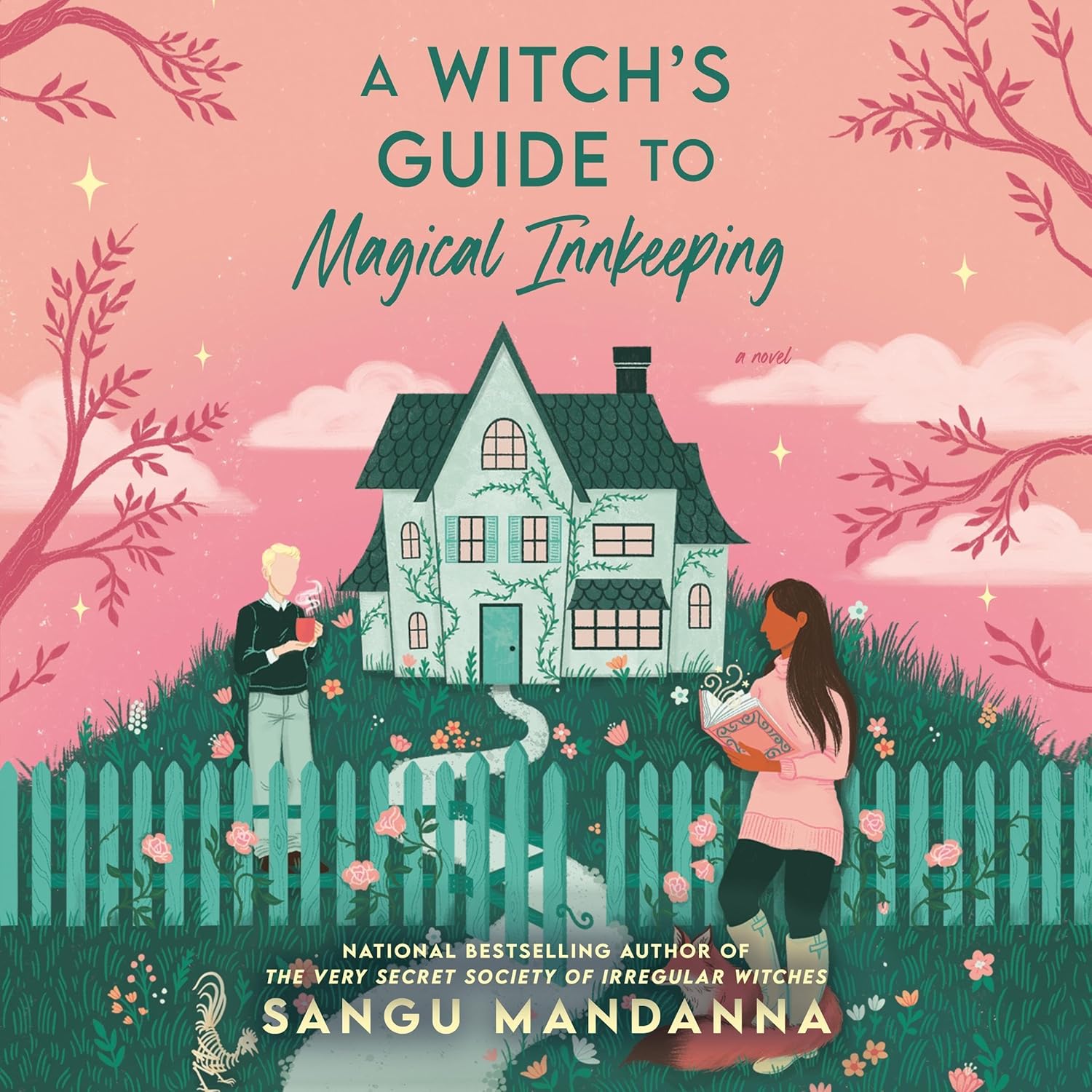
 Loving everything I’ve read by Sangu Mandanna, but **especially** The Very Secret Society of Irregular Witches, I was delighted to hear about this new one on audio. Thanks, Liz!
This is quite in the spirit of that other title, with themes of family, love, belonging, finding one’s own tribe, and owning one’s own strengths, weaknesses, and specialties. When we meet her, Sera Swan is a teenaged witch in training. More or less abandoned by her parents, she lives with her much beloved great aunt Jasmine at the Batty Hole Inn, which they run together. They have recently been joined by a witch in fox’s clothing (she is trapped in a fox’s body after a spell gone wrong) named Clemmie. When Jasmine dies in the garden, Clemmie gives Sera the spell to resurrect her, which Sera quickly does. She is probably the most powerful witch in all of Britain – despite being a girl, and still young, and most upsettingly to those in charge, a half-Icelandic, half-Indian, nonwhite person (the British Guild of Sorcery being as stodgy and, yes, racist as we might expect it to be). Jasmine is indeed brought back to life, along with (accidentally) her long-dead pet rooster, Roo-Roo, a mere rooster skeleton but avidly underfoot. But this great powerful spell has cost Sera virtually all of her magical power. This is devastating, because Sera loves her magic. Because the resurrection spell was not strictly legal, Sera has been exiled from the Guild to boot. (None of this is especially spoiler-y as it all takes place in the first few pages.)
Fast forward, and an adult Sera remains at Jasmine’s side, managing the Batty Hole Inn with much frustration, creative cursing, and precious little magic. She still mourns what she has lost, and thinks constantly about how to regain her power. But she is lucky to have Aunt Jasmine, for one – and Roo-Roo – and a motley crew of other residents: there is Nicholas, an awkward young man who thinks himself a knight, complete with shining armor and a very real sword; Matilda, a grumpy older woman who loves to garden (badly) and has become close to Jasmine; Sera’s cousin Theo, another young witch whose immediate family has abdicated; and still Clemmie, still a grumpy, meddling fox-witch. One of Sera’s spells from back before she lost her powers still protects the inn from those who wish harm, but reveals it especially to those in need of its particular kind of succor, which is how Sera has found herself surrounded by such loveable, messy eccentrics. And then a new addition to Batty Hole arrives. Luke has long been at odd angles to the Guild, but finds meaningful work in academic research if he keeps his head down; but his younger sister Posie is not so under-the-radar. At nine years old, she is a powerful witch and also autistic, which means she is not inclined to follow rules, including the all-important one about not letting mainstream society find out about magic. Luke is running out of options to keep his dear sister safe; they are quite on the run when they arrive at Batty Hole. The refugees only mean to stay a short while, but the two magical children, Theo and Posie, do well together, and Luke and Sera (onetime misfit magical children themselves) may have assistance to offer each other in turn. The newcomers fit neatly into the inn’s batty little family. Sera might even get her magic back – but at what cost?
Sera had always been good at fortitude. Fortitude was her friend. She had fortituded her way through undependable parents, megalomaniac mentors, scheming foxes, the death of a loved one, the resurrection of said loved one, the loss of her magic, and quite a large number of fiascos big and small since then. Unfortunately, she and fortitude seemed to have now parted ways, because Sera, glaring fearsomely at an empty glass teapot, was at her wits’ end.
So. There is a lovely built family of oddballs, finding ways to relate to each other on nontraditional terms. There is the trick of finding where we each fit in, and caring for children – and adults – who are different, but not less than. There are many kinds of love, including familial and romantic (and just a little sex), and at every stage of life. There is awe and magic, and there are bad guys and one battle in particular. There are absolutely laugh-out-loud lines, and Nicholas’s loveable but quite silly jousting. It’s extremely sweet, but I brought a sweet tooth to this cozy fantasy tale about community and gumption. Samara MacLaren’s narration was fun and expressive (and great points for so many accents) – perfect. I am 100% all in for Sangu Mandanna.
Filed under: book reviews | Tagged: romance, fantasy, audio, race, Liz, LGBTQ, family | Leave a comment »




 pagesofjulia