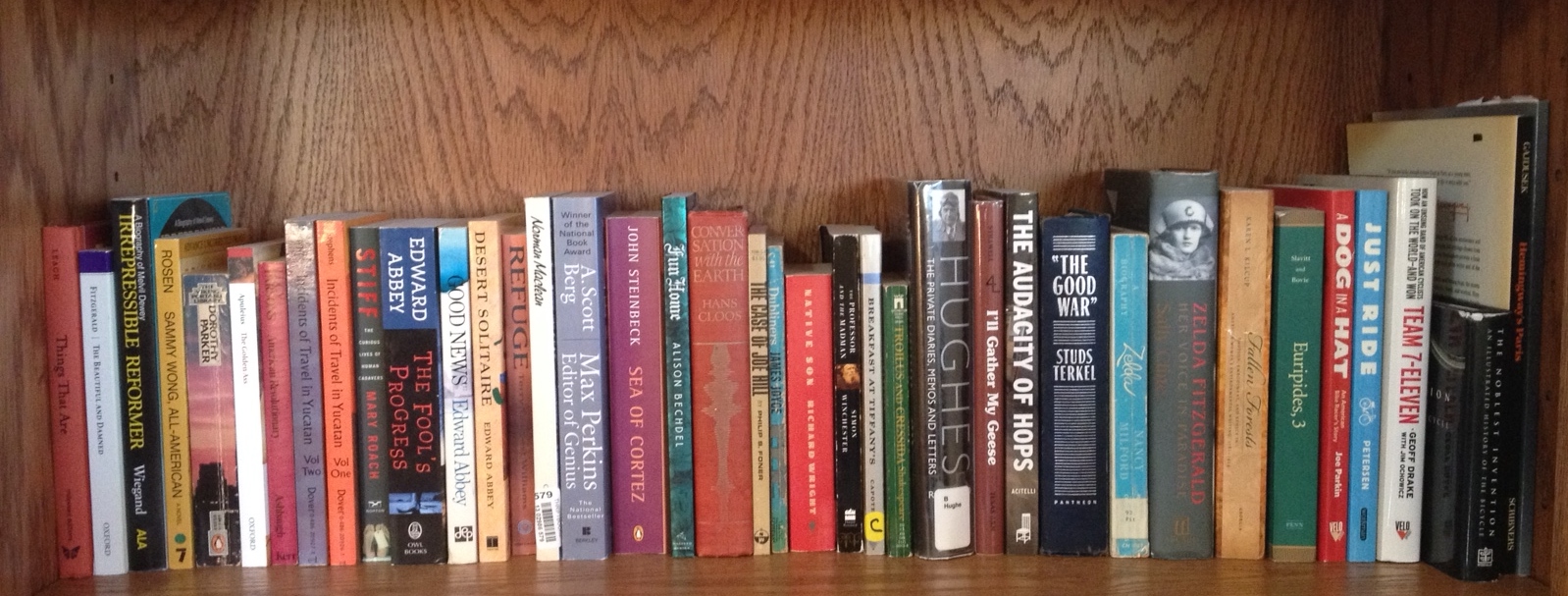
best of 2015: year’s end

My year-in-review post will be up tomorrow, of course, as usual. But first, as the year ends, I always like to review the very BEST books I read in the last year. As ever, these were not necessarily published in 2015 (although many were).

Those that received a rating of 10:

Those that received a rating of 9:

There were, as always, lots of 8’s. I won’t list them all here for fear of exhausting you, although a search on this page for “Rating: 8” should take you there, if you’re that interested. I need to note just a few here, though. Honorable mention goes to Paul Kingsnorth’s strange and singular debut novel, The Wake. I can’t stop thinking about Wallace Stegner’s The Big Rock Candy Mountain. And, cheers to Rick Bragg, whose name appears twice on the lists above.

What did YOU read this year that’s blown you away?

still grasping for a definition of “classics”: a list

I get an excellent email, five days per week, from A.Word.A.Day. Occasionally there is an ad, and I think I’ve seen this one before, but was just recently interested enough to click through. “Listen to the 100 Greatest Books of All Time,” it cries! Well, you know my question: what on earth are the 100 greatest books of all time?? (I’ve wondered before.) I always have to refer back to that BBC list. I think it’s fun to look at what rates, and how it changes. Of course we shall never all agree. But listing books we love is an inherent pleasure, I think. As I’ve done before, I’ve marked up this list:

Bold = I’ve read it
Underlined = I’ve started the book, but never finished
neither = I haven’t picked it up.

The Adventures of Tom Sawyer, Mark Twain
Romeo and Juliet, William Shakespeare
The Wonderful Wizard of Oz, Frank Baum
Alice’s Adventures in Wonderland, Lewis Carroll
The Adventures of Sherlock Holmes, Arthur Conan Doyle
The Legend of Sleepy Hollow, Washington Irving
Walden, Henry David Thoreau
The War of the Worlds, H.G. Wells
The Phantom of the Opera, Gaston Leroux
The Raven, Edgar Allan Poe
A Christmas Carol, Charles Dickens
The Red Badge of Courage, Stephen Crane
Macbeth, William Shakespeare
The Odyssey, Homer
The Call of the Wild, Jack London
The Tale of Peter Rabbit, Beatrix Potter
The Tell-Tale Heart, Edgar Allan Poe
The Princess and the Pea, Hans Christian Andersen
White Fang, Jack London
The Scarlet Letter, Nathaniel Hawthorne
Oedipus Rex, Sophocles
Frankenstein, Mary Shelley
Paradise Lost, John Milton
The Time Machine, H.G. Wells
Tarzan of the Apes, Edgar Rice Burroughs
Through the Looking Glass, Lewis Carroll
Daisy Miller, Henry James
The Gift of the Magi, O. Henry
Young Goodman Brown, Nathaniel Hawthorne
Beowulf, unknown
The Tale of Benjamin Bunny, Beatrix Potter
A Portrait of the Artist as a Young Man, James Joyce
The Return of the Native, Thomas Hardy
Babbitt, Sinclair Lewis
The Prince, Niccolò Machiavelli
The Turn of the Screw, Henry James
The Art of War, Sun Tzu
The Masque of Red Death, Edgar Allan Poe
The Indiscreet Letter, Eleanor Hallowell Abbott
Adrift in New York, Horatio Alger, Jr.
Anne of Green Gables, Lucy Maud Montgomery
King Lear, William Shakespeare
The Ransom of Red Chief, O. Henry
The Inferno, Dante Alighieri
Just So Stories, Rudyard Kipling
The Pit and the Pendulum, Edgar Allan Poe
The Thirty-Nine Steps, John Buchan
The Importance of Being Earnest, Oscar Wilde
A Prisoner of Morro, Upton Sinclair
Euthyphro, Plato
Moby Dick, Herman Melville
A Tale of Two Cities, Charles Dickens
Pride and Prejudice, Jane Austen
Little Women, Louisa May Alcott
Gulliver’s Travels, Jonathan Swift
Treasure Island, Robert Louis Stevenson
Julius Caesar, William Shakespeare
Wuthering Heights, Emily Bronte
The Curious Case of Benjamin Button, F. Scott Fitzgerald
Robinson Crusoe, Daniel Defoe
A Room with a View, E.M. Forster
Rip Van Winkle, Washington Irving
Black Beauty, Anna Sewell
Peter Pan, J.M. Barrie
Around the World in 80 Days, Jules Verne
Hamlet, William Shakespeare
The Metamorphosis, Franz Kafka
The Voyages of Doctor Dolittle, Hugh Lofting
The Prince and the Pauper, Mark Twain
The Jungle Book, Rudyard Kipling
A Haunted House, Virginia Woolf
A Midsummer Night’s Dream, William Shakespeare
The Last of the Mohicans, James Fenimore Cooper
The Emperor’s New Clothes, Hans Christian Andersen
Heart of Darkness, Joseph Conrad
Beyond Good and Evil, Friedrich Nietzsche
A Modest Proposal, Jonathan Swift
The Fall of the House of Usher, Edgar Allan Poe
The Strange Case of Dr. Jekyll & Mr. Hyde, Robert Louis Stevenson
Othello, William Shakespeare
The Song of Hiawatha, Henry Wadsworth Longfellow
Common Sense, Thomas Paine
Much Ado About Nothing, William Shakespeare
The Man Who Would be King, Rudyard Kipling
The Purloined Letter, Edgar Allan Poe
Candide, Voltaire
Politics, Aristotle
In Defense of Women, H.L. Mencken
McTeague, Frank Norris
Ben-Hur: A Tale of the Christ, Lew Wallace
The Apology of Socrates, Plato
A Letter Concerning Toleration, John Locke
A Doll’s House, Henrik Ibsen
The Five White Mice, Stephen Crane
An Occurrence at Owl Creek Bridge, Ambrose Bierce
Siddhartha, Hermann Hesse
O Pioneers!, Willa Cather
The Idyl of Red Gulch, Bret Harte
Ethan Frome, Edith Wharton
Maggie: A Girl of the Streets, Stephen Crane

I’m surprised to see the blocks of books I have or haven’t read showing up together, rather than sort of equally dispersed down the list. I wonder what ordered these selections and what that means.

It quickly becomes clear that this list employs a heavy cultural bias toward the usual Dead White Guys (hat tip to an excellent blog by that name). Of 100 books, only 12 are by women (11 different women, with Beatrix Potter’s delightful anthropomorphizing children’s books represented twice). At a glance, I’m pretty sure that none of these authors are living. And overwhelmingly Western: Twain, Dickens, Shakespeare, Poe, Crane, Kipling and Stevenson all recur; Sun Tzu is the only non-Western name of the bunch. Plenty of Greeks, no Romans. Only one Fitzgerald (but no Gatsby!), and no Hemingway: and yes, you know I’m biased, but really I think few of the anointed minds who rate “great literature” – academics, professors, professional writers and reviewers – would leave Hemingway off a list of Greats. He’s not for everyone, but I think his talent and achievements are relatively inarguable. He won both a Pulitzer and a Nobel. Actually, that would be another interesting way to look at this list: to cross-check it with prizewinners. Hm.

I’m not overwhelmed by the originality or diversity of this list.

You’ll notice I took the liberty of linking to my reviews, where I’ve written them. These are relatively few, I think because I read many “classics” in school, which is to say pre-blog. There is also a large overlap between this list and the Great Illustrated Classics I remember as a kid (and yes, I gave myself credit for a few I know only from that format [very few], just as an indication of my familiarity with the story). They were my introduction to many classics: Huck Finn, Tom Sawyer, A Journey to the Center of the Earth, 1,000 Leagues Under the Sea, Around the World in 80 Days, Oliver Twist, Treasure Island, Frankenstein, The Call of the Wild, White Fang, Gulliver’s Travels, The Invisible Man (Wells, not Ellison), The Swiss Family Robinson. Some of these I would later read in their unabridged versions, but some, not. I treasured those books. I don’t know what happened to them.

I researched this series later, as a professional librarian, and was dismayed at their reputation. It left me wondering what misconceptions I have, what I missed. Of course the very definition of abridgment is missing things, but these are said to be especially extreme. Here I am with my whole experience of Oliver Twist defined by those illustrations I can still see clearly in my mind: the orphan as interpreted by Great Illustrated Classics had lovely, long eyelashes. On the other hand, I happily read many of the same stories in their full and unabridged versions later on. And I recommend doing so.

The “100 best books of all time” list appears to have been compiled with Dead White Guys in mind, and by more or less the same folks who chose the Great Illustrated Classics. These, at least, are unabridged. And, hey, they’ve got a point: at $99, this is indeed a hell of a deal for all these books pre-loaded onto a player for you. But just don’t forget to survey some women and writers of color and those born in the last 100 years or so, too. There is always my list in progress if you need some tips.

best of 2015, to date

I’ve had several requests lately for recommended reads, and I always try to have those ready for my friends & readers! As you know, I’ll always do an end-of-year best-of list, but maybe it’s time for an interim selection. Not all of these will make the final 2015 list, I’m sure, but some will: my first entry is still the only 10 rating I’ve given this year. Now with a few annotations… click the links for the full review, and in the cases where it hasn’t yet posted, I’ll do my best to come back and add those links when they become available.

This is a fairly varied list, which I always feel good about: something for everyone, I hope.

Best of 2015 to date! Thanks for caring, y’all.

  • Martin Marten, Brian Doyle – fiction. A novel of two young creatures, a boy and a marten, showcasing outrageously fine writing and a unique sensitivity to the fact that we humans are not the only ones living and breathing on this planet.
  • Of Things Gone Astray, Janina Matthewson – fiction. A whimsical novel of lost things and what they mean, and the stories of the people who lose them, and sometimes find them again.
  • Travels in Vermeer, Michael White – nonfiction. A lyrical memoir of recovery and art appreciation; the best writing about the visual arts that I’ve encountered.
  • Hammer Head: The Making of a Carpenter, Nina MacLaughlin – nonfiction. Memoir of a young female carpenter, about everything entailed in that life, and the balance between the mental and the physical.
  • The Light of the World, Elizabeth Alexander – nonfiction. Memoir of loss of a beloved husband by an excellent poet; lovely glimpses of global cultures.
  • Bird by Bird, Anne Lamott – nonfiction. Writing advice and wit from a respected mind, with a fun and singular voice.
  • Mislaid, Nell Zink – fiction. Quirky novel of mixed-up relationships with a strong sense of place (set in the South).
  • Wondering Who You Are, Sonya Lea – nonfiction. Memoir of a spouse’s traumatic brain injury: sex, love, art, identity.
  • Station Eleven*, Emily St. John Mandel – fiction. Imaginative post-apocalyptic novel of a traveling symphony and Shakespeare theatre company in a changed United States. Emphasis on character and story rather than sensationalism of collapse.
  • Old Heart, Peter Ferry – fiction. Brief, sweet, feeling novel of old age and end-of-life autonomy with impulses toward romance, but not an idealized version.
  • The Elements of Style, Strunk & White – nonfiction. Still an outstanding style guide, and surprising funny, enjoyable reading.
  • The Anger Meridian, Kaylie Jones – fiction. Novel of a traumatized widow seeking direction in vividly evoked San Miguel de Allende, with a little puzzle for the reader to work out.
  • Coming of Age at the End of Days, Alice LaPlante – fiction. Somewhat distressing, compelling novel well summarized by its title.
  • The Writing Life*, Annie Dillard – nonfiction. Lovely essays about Dillard’s writing life: glimpses into places and experiences and challenges.
  • South Toward Home, Margaret Eby – nonfiction. A review of one Alabama woman’s literary icons that resonated especially with me.
  • Dakota, Kathleen Norris – nonfiction. Lovely evocations of sense of place in essay form.
  • My Southern Journey, Rick Bragg – nonfiction. Funny, moving, evocative, beautifully crafted, very short true stories from the Deep South.

(* are audiobooks.)

Honorable mention goes as well to Paul Kingsnorth’s singular debut novel, The Wake, which tells a great story, a historical post-apocalypse set in England following the Norman Invasion. Kingsnorth makes the gutsy decision to tell the story in a modified version of Old English, making it quite hard to read: I fear he will lose readers by challenging them so greatly, but really, it’s a worthwhile book if you can struggle through. It gets better after 50 pages, I promise!

If you try any of these fine books out, I’d love to hear what you think. Thanks!

2014: A Year in Review

I’ve reviewed a few years now (2013; 2012; 2011), so we can do some comparisons.

Of the 135 books I read in 2014…

  • 44% were nonfiction (45% last year)
  • 44% were by female authors (48% last year)
  • of the 75 novels I read, 33% were historical fiction, 20% were mysteries or thrillers, 24% were miscellaneous fiction, and 15% were fantasy. (Last year 37% were mysteries, 10% were historical fiction and the rest included classics and misc.)
  • only 13% were audiobooks. (23% last year)
  • 20% of the books I read came from the library, and a whopping 71% were review copies; the few remainders were either ones I already owned or were gifts. (Last year, 35% of the books I read came from the library, 43% were review copies, and 14% came from my personal collection.)
  • I read 135 books this year, compared to 116 last year.

For the very *best* books I’ve read this year, see New Year’s Eve’s post.

How have my reading habits changed? Well, perhaps the biggest change is in all those books I read for review, over 70%. I did this on purpose, as part of my plan to quit my day job and move across the country (!). This trend will likely continue in the foreseeable future. It’s been a little tiring at a few moments, but overall is nothing I regret: I mostly get to read and review really good books, and I still love my job. I do regret the books I haven’t read yet, though. Currently begging for attention, for example, are Hemingway’s True at First Light and The Fifth Column; the remainder of Snyder’s Practice of the Wild; a fuller version of Leopold’s A Sand County Almanac; and all these:

(click to enlarge)

(click to enlarge)


(and more). Sigh.

Also, you’ll see that I listened to fewer audiobooks. I spent my working year of 2014 taking the train to work rather than driving (hooray!), which let me read or listen; I can only guess that accounted for a lot of this change. I quit my job in October, too, which has left me with almost no audiobook time: just cleaning & gym time, is about it, since I don’t spend any time commuting any more. I miss my audiobooks, and have so many good ones loaded, too. I guess I should put in more gym time? New Year’s resolutions…

And, my fiction choices seem to have moved away from mystery/thrillers, in favor of historical fiction. I can’t quite explain the shift to hist fict, but I have made a conscious effort to read fewer mysteries. Aside from the outstanding ones (ahem), they can all begin to really sound alike.

What about you? How has 2014 stood up to your reading years in the past; and what do you foresee in the near future?

Whatever that may be, I wish you a happy new year, and happy reading!

best of 2014: year’s end

My year-in-review post is coming, but first, as the year ends, let’s take a look at the very BEST books I read in 2014. As usual, these were not necessarily published in 2014 (although several were).

(* are audiobooks.)

Those that received a rating of 10:

Those that received a rating of 9:

There were lots of 8s, too – it’s been a great year. I had a very hard time choosing a short list of examples for you, so please be satisfied with The Drunken Botanist*, Euphoria, Wayfaring Stranger, The Fish in the Forest, Smoke Gets In Your Eyes, The Kind Worth Killing (by Peter Swanson, review to come)…

What did YOU read this year that’s blown you away?

on children’s books

In another episode of synchronicity, I was already going to write this post (for reasons below), when Shelf Awareness shared this item of “book candy”: 10 Children’s Books That Made Us, tagline “these beloved images and words defined the boomer generation.” Let’s be clear: I am not a boomer, but the child of boomers. So I was a little surprised to see that I grew up with all 10 of the books listed. Part of article author Linda Bernstein’s point was that boomer children loved these books enough to share them with their children, of course, so I can’t be all surprised. But still… I thought I was a Goodnight Moon baby, not that my mother was. Still fresh for me, you see. In fact, it was first published in 1947 – who knew? I guess that’s one definition of a classic: timelessness. I know there are new children’s books for every generation, and I know some of them are excellent (I’ve heard. I’m not a big reader of kid’s books myself), but I do hope that new parents are still turning to such geniuses as Dr. Seuss and Maurice Sendak for their children’s reading development and enjoyment.

But back to our regularly scheduled programming.

In reading Great Bear Wild by Ian McAllister (excellent!! but wait for my review at Shelf Awareness to learn more), I was charmed by discussion of the unique, complex, and surprisingly human-like social structures of wolves. This resonated with me because I remember clearly reading (and rereading) Julie of the Wolves, a kid’s “chapter book” by Jean Craighead George, and a Newbery Medal winner. Here is my plot summary, strictly from memory, so feel free to double-check me… a young girl (~13 years) escapes a forced marriage in an Alaska village into the tundra on her own. She has a few basic survival tools & skills, but of course finds herself in trouble in the winter, until she is adopted by a pack of wolves – not without her own efforts at observing them, mimicking their gestures of submission, and begging for food and help. They save her. And the reader learns a good deal about wolf packs.

This got me thinking about others in the category (children’s “chapter books”) that I loved, that I read and reread, and that helped form my love of reading. As a child, I read lots of books – lots! – but this is the list of those that still come to my mind, fondly, today.

  • Eva by Peter Dickinson
  • Enchantress from the Stars by Sylvia Engdahl
  • Island of the Blue Dolphins by Scott O’Dell
  • The Borrowers series by Mary Norton
  • Laura Ingalls Wilder’s Little House books
  • of course, The Outsiders by S.E. Hinton
  • Susan Cooper’s The Dark is Rising series
  • Beverly Cleary’s Ramona books
  • The Westing Game by Ellen Raskin
  • The Brothers Lionheart by Astrid Lindgren
  • Hatchet (and others) by Gary Paulsen
  • Number the Stars by Lois Lowry
  • Summer of My German Soldier by Bette Greene

(Perhaps unsurprisingly, when I browsed the list of Newbery Medal winners, I found several of these titles there.)

What do you remember fondly from your childhood? Do they still resonate with you today?

to date: best books of 2014

I was trying to hold off til the end of this calendar year, but I’ve been asked several times recently for book recommendations, and have sent this list privately to a few friends. So why not share? Below you will find the best books I’ve read this year, so far. Hopefully there will be more in these last few months!

Some reviews haven’t even posted yet, but here you are, getting a sneak peek at my ratings.

Those that received a rating of 10:

Those that received a rating of 9:

* = audiobooks.

There have been lots of 8s, too, including for example the latest from Stephen King and James Lee Burke; this lovely novel; a little literary history (oh and here’s another); some plants*; and two that are still to come: We Make Beer, and Older, Faster, Stronger.

What have you read so far this year that’s blown you away?

the best of scientific nonfiction

In yesterday’s post, Pops shared with me a list of good fiction-about-science, as presented by author Kirk Smith. As part of that same conversation, Pops asked for my favorite scientific fiction – with “good” science being part of the criteria. Well, unsurprisingly, I didn’t have a lot to offer in that regard. I haven’t tended towards scientific fiction much (nor traditional sci fi); my fiction tends to be mysteries, historical fiction, literary fiction, or increasingly, fantasy; there is always a variety, but I’ve been short on science. I did come up with a few. But I did far better in recommending some really great nonfiction that is scientific in nature: both “good” science, and well written, enjoyable, accessible, good reading. He asked for those two lists, so I’m happy to share them here.

Some great fiction about science:

By Lisa Genova: Love Anthony and Left Neglected, but especially Still Alice. Genova has degrees in biopsychology and neuroscience (the latter a PhD from Harvard, ahem), so one expects that her novels about women and families, in which someone in the family (usually the woman) suffers a neurological disorder or disease, are scientifically accurate. I love that they are scientifically detailed and yet extraordinarily enjoyable novels, too.

Flight Behavior by Barbara Kingsolver: you can read my review, and also note that Kirk Smith and I both recommend this one; in a nutshell, Kingsolver teaches science in the most charmingly accessible of packages, the one and only Dr. Ovid Byron. You must read this; or better, you must hear the audio, because the accents are amazing. (Read by the author, a woman of many talents.)

Madeline L’Engle’s series: A Wrinkle In Time, A Wind in the Door, etc. I hesitate here, because the science begins in reality and then moves outside it (see: farandolae), so I’m not sure it qualifies. But kids’ books – about science – with a female protagonist. Good stuff.

Some great nonfiction about science:

My review hasn’t published yet, but it will any day now, and I’ll come back and edit this post: A Garden of Marvels by Ruth Kassinger is an outstanding, fun, and informative look at the history of botany, really from the birth of botany as a science (relatively recent, since we didn’t think plants were all that important as a subject of study for many centuries). It’s extremely accessible and well written, even funny. One of my recent favorites!

On a Farther Shore, William Souder’s recent biography of Rachel Carson, is for me a classic example of science made reader-friendly and socially important. It doesn’t hurt that I find Carson a fascinating & important figure, and admittedly, this is more biography than science; but I think it qualifies for this list, especially considering Pops’s comments yesterday about the representation of women in literature & science (and literature about science).

Einstein, the biography by Walter Isaacson, was mentioned in Kirk Smith’s talk apparently as being “challenging,” and I wouldn’t disagree entirely, but no knowledge of physics is prerequisite – and I didn’t get all the physics Isaacson described, either, but that was no requirement for enjoying Einstein’s story.

Unfortunately, I read The Immortal Life of Henrietta Lacks by Rebecca Skloot before I really began blogging. (I made a few posts on it early on: here, here, and here, but none qualify as a review.) So I can only say, looking back, that as with On a Farther Shore, science is made not only comprehensible, but oh so important and relevant for our past, present and future; not to mention the glaring & compelling social commentary. This is a great book (and one I gave away for World Book Night a few years ago).

Pilgrim at Tinker Creek by Annie Dillard (my review in parts one and two) is fascinating, varied, lyrical, fun, and whimsical. Both poetry and science. And the oddest chunks of science, too. Do check out some here and here.

River in Ruin by Ray A. March is a loving, informed but readable discussion of exactly what the title says.

Also pre-blog, I read My Stroke of Insight by Jill Bolte Taylor, and it made a major impact on me. I had only recently recovered from a brain injury (from a bike wreck and yes I was wearing my helmet), and reading this book by a neuroanatomist about her stroke & recovery helped me understand my own brain better. She’s a scientist, so she has the “good” science, but she’s also a human being with a personal story to tell, and she tells it well.

When we talk about science writing, though, **the grand prize** has to go to Hali Felt for Soundings. How did I rate that book only a 9? In my memory, it should be a 10. Again with the added benefit of handling women in science and the special challenges they face, Felt tells the story of Marie Tharp’s life and scientific breakthroughs with sensitivity, insight, and yes, science.

Bonus: just the other day this review posted at Shelf Awareness (by my friend Katie at Cakes, Tea and Dreams). I haven’t read the book, but I think it sounds delightful: Trespassing on Einstein’s Lawn: A Father, a Daughter, the Meaning of Nothing, and the Beginning of Everything, by Amanda Gefter.


That’s all I have today, Pops, but it ought to get you started! I’m pretty sure you’d put McKibben on this list; any others to share? Anybody?

the best of scientific fiction, from Pops

Not to be confused with traditional science fiction (although I have something for you on that topic, as well) – today’s is a quasi-guest post from Pops, who is excited to share about a recent author talk event he attended. The presenter was Kirk Smith, speaking on Lab Lit: Putting Real Science Into Fiction. Pops’s report:

I attended the Lab Lit program tonight. And I signed you up to review a book. Well, sorta. We should talk.

So, to review: Kirk Smith is an old-guy Seattle author with a passion for fiction about “realistic scientists doing realistic science” – ideally where the science is the central story, not ancillary. He has high standards for credibility and likes writers who can really “get inside the head” of scientist-protagonists. Eventually he became frustrated that satisfying examples were so rare, and resolved to write his own version.

This is sort of a special interest of my father’s. He’s been interested in several scientific issues over the last few years, and often disappointed in their presentation by the finest minds in the field – scientific minds being, unfortunately, often unable to communicate what they know clearly to the rest of us. The big exception being Bill McKibben (who I reviewed recently: Oil and Honey). This is a paraphrase of my father – hope I got that about right, Pops.

It was interesting; simply an avid, insightful reader sharing a niche passion; nothing topical like climate change & how to communicate science, though I would have enjoyed that too.

He spent 45 minutes talking knowledgeably about all the books on the attached handout [see below], and 15 minutes reading from & talking about his book (an ode to Einstein, with a female character). He lauded Isaacson’s Einstein, the only overlap I detect with your reviews (you get credit for enjoying a “challenging read!”). He recommends Einstein in Love.

Not true, Pops! I reviewed not only Einstein but also Flight Behavior, which I loved.

[His passion for this niche reminds me of my own for running fiction; of course he reads other forms! I get it.]

You are onto something here. As you said in your first paragraph, Smith “likes writers who can really ‘get inside the head’ of scientist-protagonists,” and I think that’s exactly what you like about running books: sharing an experience with the protagonist, recognizing the unique and awesome thing that is being a runner – or a scientist. Or (to digress), I suspect that Susan Vreeland gets accurately inside the head of an artist, in her Clara and Mr. Tiffany or The Forest Lover, both of which I loved. However, not being much of an artist, I can’t entirely attest.

You’ll see he covered non-fiction and biographies as well as other forms; he also has his own web site where he blogs & reviews, and recommends the LabLit site (by one of the authors) that inspired the terminology. He has corresponded with several of the authors on the list.

I came home with a free UK-only-available copy of The Falling Sky by Pippa Goldschmidt. One of us is committed to reviewing it by Feb 15, before its spring USA release. Call me.

Of course by the time I called, he had already started reading this book, which is fine because I have plenty of deadlines in the next two weeks without this one (!), which would require cross-country shipping to get to me, too! But I’m next in line for it when he’s done (so I have a more relaxed schedule to read it on), and his review will be cross-posted here when complete. Hooray! Guest reviews!

And for those who are curious about Smith’s reading list – I know I was! I’m sharing here the handout he shared at this book event, with Pops’s annotations on it (how lucky we are), and hoping that the wise and magnanimous Kirk Smith will not consider this a copyright violation too egregious. :-/ Seriously, thank you Kirk for the info; and readers, do check out his website here.

(click to enlarge)

(click to enlarge)


An addendum from Pops:

First, I noticed his top three fictions are all by female authors with female protagonists; then he eventually acknowledged the fact himself, in passing; then his reading (of his own novel) revealed the female protagonist in his own novel; and in response to a question explained (superficially I thought) why she is his stand-in for a fictional Einstein; and with a follow up question, finally spoke briefly but incisively about the challenge for girls & women in math & science fields to gain grudging credibility & respect.

So, one wonders: are the women appearing in his list (authors & characters both) a factor of his own selection, or if one did an “objective” survey of the landscape, would we see the same? An outbreak of women expressing a new voice? (In literature, or science, or both?)

Such fodder for future expression!

Such fodder indeed! I have no idea how to answer your questions, of course – possibly Smith could speak to these? (It would have been a great line of questioning to pursue on the spot with the audience! It sounds like he wasn’t anxious to head in this direction – of social commentary – on his own. But I understand how it took a day or two to get these thoughts, and thus this line of questioning, straightened out in your own head.) The pessimist (or realist?) in me doubts that there is a general and widespread trend toward a women’s majority in science & literature! Although for the most part we are increasingly represented, hm? That’s just a guess from me, though.

2013: A Year in Review

It’s always nice to look back, especially when we can do it fondly; and I’m getting better at spending my reading time enjoyably, and putting down books I don’t enjoy. I’ve reviewed a few years now (2012; 2011), so we can do some comparisons.

Of the 116 books I read in 2013…

  • 45% were nonfiction (51% last year)
  • 48% were by female authors (32% last year)
  • of the 64 novels I read, 37% were mysteries or thrillers, 10% were historical fiction and only 6% were classics. The rest were a smattering of adventure, drama, fantasy, horror, short stories, and humor. (Last year 31% were mysteries, 27% were historical fiction and 23% were classics.)
  • 23% were audiobooks. (25% last year)
  • 35% of the books I read came from the library, a whopping 43% were review copies, and 14% came from my personal collection; the remaining few were books I was loaned, books I purchased, or (those treasured few) books I was given as gifts. (Last year, 40% of the books I read came from the library, 32% were review copies, and 28% came from my personal collection.)
  • I read 116 books this year, compared to 126 last year.

For the very *best* books I’ve read this year, see New Year’s Eve’s post.

So, how have my reading habits changed? I’m a little surprised at some of my observations here, which helps me justify how very nerdy it is to run these numbers! I am pleased to see that I’m reading a little more equitably between authors’ genders. I seem to have slightly reversed my fiction/nonfiction trend – last year NF had a bare majority, this year it swung the other way a bit, but I’m still nearly half and half. I’m certainly pleased to be reading that much nonfiction, and I wouldn’t want to slip too far below the halfway point, but I also recall a definite moment in the fall of 2013 when I felt that I needed a break from nonfiction.

Within the fiction I read, there is a noticeable trend toward mystery/thriller holding a large plurality, and a drop in classics. I regret that drop in classics somewhat. I wonder if the also noticeable increase in books I read for review has something to do with this. On the other hand, I don’t feel that I need to be too concerned. I bet next year will change again.

Audiobooks held steady at about 1/4 of my reading life, which seems about right. However, a new thing happening in my life in 2014 is – oh my gosh can you believe it – they finally opened up the new light rail line that runs between my home and work!! This is very exciting, and may mean that I find more time for reading print and spend less time listening to audio. So far, however, this is not the case: I’m in the middle of a delightful Stephen King audiobook and don’t want to put it down once I board the train. So, we shall see.

I read slightly fewer books than last year – a decrease of 8%, as long as I have this calculator out – and am perfectly content ascribing that to reading several longer books this year.

What does the future hold? Who knows? I’m feeling contented, and disinclined to make plans or promises. Rather, I want to keep enjoying my reading. I think that’s the most important thing, and if that suddenly means romance novels, or histories of the first World War, or reading much more or much less (none of these seems likely…), then so be it.

What about you? Any reading resolutions? Or, how was your 2013 in books?