Growing Up Twice: Shaping a Future by Reliving My Past by Aaron Kirk Douglas

A raw, honest, and inspirational memoir about a young man growing into his own while mentoring another.

growing up twice

Growing Up Twice is Aaron Kirk Douglas’s memoir about acting as a Big Brother to an at-risk teen named Rico and how their interactions moved him to rethink his own upbringing. The sometimes unpolished language does not detract from a story that is powerful and heartfelt, and certain to appeal to a wide variety of audiences.

…Click here to read the full review.


This review was published on March 23, 2016 by ForeWord Reviews.

clarion 3 star


My rating: 6 Frisbees.

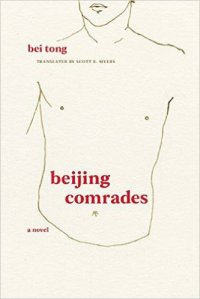
Beijing Comrades by Bei Tong, trans. by Scott E. Myers

A passionate, troubled love affair between two men is set in a time of cultural upheaval, in late 20th-century China.

beijing comrades

Translator Scott E. Myers’s introduction to Beijing Comrades is itself an engrossing story: the tale was originally serialized online, and the author–listed here as Bei Tong, elsewhere as Beijing Comrade, Miss Wang and other names–remains anonymous; Myers does not know Bei’s gender. This is the first English translation and the third version of the novel to be published, combining two previous publications and a new manuscript by Bei with an expanded story and explicit sexual detail.

Beijing Comrades is about Handong, a privileged, successful, egotistical businessman, and Lan Yu, a younger man of modest circumstances. When Lan Yu arrives in Beijing as a student, Handong immediately takes him as a lover. The older man had been accustomed to myriad sexual conquests of both men and women, defined by psychological domination and materialism, but this liaison is different, eventually coming to dominate both men’s lives. Over the years, Handong and Lan Yu strain to reconcile their relationship with a culture in upheaval: late 1980s China, experimenting with capitalism, approaching the Tian’anmen Square protests, increasingly materialistic and anti-gay.

While the dialogue is stylistically inconsistent, reminding readers of the fact of translation, the emotions of the story reinforce its realism. First-person narrator Handong is not always a likable character: he is cynical, profit-driven, fickle in love and often cruel. But these flaws make him credible, and even increase the impact of both men’s anguish.

Beijing Comrades is an important entry in the Chinese historical record as well as a moving, erotic and emotional novel.


This review originally ran in the March 25, 2016 issue of Shelf Awareness for Readers. To subscribe, click here, and you’ll receive two issues per week of book reviews and other bookish news.


Rating: 7 dinners out.

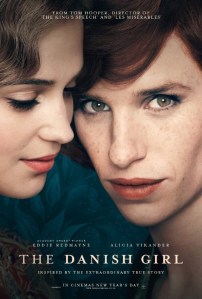
movie: The Danish Girl (2015)

This review is spoiler-free. The movie does contain a surprise, so be careful what you read elsewhere.


danish girlThe Danish Girl is a film based on a novel of the same name by David Ebershoff, which is based on a true historical figure. That figure was born Einar Magnus Andreas Wegener, married a woman named Gerda and made a living as a successful painter. But when Gerda asks Einar to pose for one of her paintings in place of a female model who’s running late, the moment is eye-opening. Einar in fact has always held a secret identification as a woman, now named Lili. From this time on, she has come to stay. Lili Elba was one of the first people to undergo sex reassignment surgery (or gender confirmation surgery, a phrase I like).

Gerda and Lili live in Copenhagen at the beginning of their story, and move to Paris when Gerda’s own career as a painter takes off. I found it not insignificant that Gerda’s time to shine coincides with Lili’s time of upheaval; Gerda too struggles with the timing. This is of course not the only problem Gerda has in adjusting to her new circumstances: she loved her husband, and as represented onscreen, their marriage was happy, healthy and loving. Not without some complaint and tears, then, but Gerda does in the end support Lili’s needs and her journey. This in itself is a lovely story: love conquers all.

The move indeed gives a rosy portrait overall, of this relationship and of Lili’s experience, her strength and bravery. It was beautifully done: the acting is exquisite, by both Alicia Vikander as Gerda and Eddie Redmayne as Lili. And I enjoyed the setting in time (1920’s-30’s) and place, although I’m not overly qualified to judge its realism. But I suspect things were not quite so picturesque in the real version. And of course there’s a lot of history that we don’t have access to, I’m sure. (The story [I suppose this means in turn Ebershoff’s novel] is based on Lili’s memoir, Man Into Woman, which is a great start.) In other words, it’s a movie.

But a very good movie, with a fascinating and culturally significant story, outstanding visuals – the paintings, the galleries, and Redmayne’s transformation into a lovely woman. The acting is tops. I found it dreamy and am glad I saw it. If you go see it, too – and you should – do avoid reading about this film or Lili Elbe’s life; I think it was worthwhile to discover it this way, spoiler-free, if you will.


Rating: 8 poses.

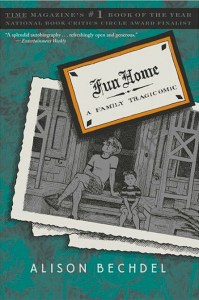
Fun Home: A Family Tragicomic by Alison Bechdel

fun homeFun Home won awards and got more attention than Bechdel’s later Are You My Mother?, which I loved, so this was an obvious choice and yes, I will add my praise to the chorus.

This is a memoir centering around Bechdel’s father Bruce, her own discovery that she is a lesbian and her coming out to her parents, which is immediately followed by the discovery that her father is gay, too, shortly before he kills himself just weeks later. (The evidence is inconclusive, but she makes a good argument for her conviction, that it was suicide.) The title is a reference to the family business, which is a small-town funeral home that they call ‘Fun Home.’ That’s a lot, right? It is also a memoir in graphic form, and I am crazy about Bechdel’s technique, which combines dialog (speech boxes for the characters in her panels) with a voiceover-style narrative in different boxes that sort of caption those same panels. It’s astonishing how much can be communicated in pictorial form.

Despite the often heavy subject matter, Bechdel is often laugh-out-loud funny, while also taking her material seriously. She beautifully evokes the absurdity of many different elements of her story. Bruce is a passionate restorer of historic homes, down to all the details, the bizarrely frothy, lacy, heavy decor. This is both hilarious and pathological. He “treated his furniture like children, and his children like furniture.” Bechdel and her father are most intimate when they share books and reading (note that this is an intimacy with decided remove). Bruce works as an English teacher as well as a funeral director; and two thematic elements of the book are death and books. Bechdel is best able to understand and characterize her parents when viewing them through the lens of literature: her father as Icarus, then Daedalus, then a character from Fitzgerald; her mother one from Henry James. “I employ these allusions to James and Fitzgerald not only as descriptive devices, but because my parents are most real to me in fictional terms.” On the other end of the cultural spectrum, as a child Bechdel confused her family with the Addams family.

The reader has a different experience of the story than she does, because we find out earlier than she does the big reveal – that her father has had relationships with men and boys. But she still has us share in mixed feelings of relief, shock, perplexity.

The story is weird, fascinating, and moving; Bechdel has a gimlet eye for the psychological struggle in each chapter of it; the structure of this book – the disordered chronology and release of facts – is a smart puzzle. But the art is what completes the perfection: I’m still reeling from, and trying to comprehend, how precisely she uses visual images (with those careful text additions) to communicate. I can’t adequately articulate it, but this is a special, a uniquely wonderful way to tell a uniquely interesting story. One to study.


Rating: 9 books, of course.

Trans/Portraits: Voices From Transgender Communities by Jackson Wright Shultz

Trans/Portraits collects diverse, first-person stories of transgender experience and their contexts.

trans portraits

In his introduction to Trans/Portraits: Voices from Transgender Communities, Jackson Wright Shultz argues that while transgender experiences are increasingly present in academic writings and pop culture, the voices of transgender individuals remain largely absent from those portrayals. He works to correct this absence in discussions with 34 people who identify along a spectrum of genders.

As Shultz observes, no two of them use the same terminology to refer to themselves. Kelly came out as a girl at age 12, and was able to take puberty-suppressing medications and, later, hormones. Olivia transitioned when she was 43, and is a minister with the United Church of Christ. Alexander is asexual. Natalie is a police officer, and gives sensitivity training to departments around the state. Russ performs Deaf poetry in hir spare time (and uses the gender-neutral pronouns “ze” and “hir”).

Trans/Portraits suggests that the transgender experience cannot be encapsulated in any one story. The individuals Shultz talks with have undergone various forms of transition, using hormones, surgery, both or neither. Shultz asks them about vocabulary and pronoun use; finding support in communities; intersectional identities, for example race, gender, socioeconomics and (dis)ability; seeking basic safety and medical care; and activism. The theme is diversity: of lifestyle, of desired outcomes, of identity and personality. Shultz’s collection of first-person voices offers a fascinating and eye-opening view of transgender individuals and communities that will aid healthcare and education professionals, anyone with questions about gender and the general public. The uplifting message is that these are simply people, as sympathetic, interesting and varied as any other.


This review originally ran in the October 13, 2015 issue of Shelf Awareness for Readers. To subscribe, click here, and you’ll receive two issues per week of book reviews and other bookish fun!


Rating: 7 different ways to look at it.

Mislaid by Nell Zink

A Southern comedy of errors starring a broken family stretched across social classes.

mislaid

At the start of Nell Zink’s delightfully odd first novel, Mislaid, Peggy is a lesbian teenager in 1960s Virginia heading off to Stillwater College, a remote women’s school, where she plans to sow her oats with all those other young ladies and become a famous playwright. Instead, she begins a strangely lusty affair with one of the few male faculty members, Lee Fleming, a famous poet hidden away at Stillwater by his wealthy and proper Virginia family because he is gay. Their misguided, mismatched affair quickly results in a pregnancy and marriage. After 10 years, Peggy finds herself miserable, acting as servant to Lee’s obnoxiously pretentious literary house guests while he engages in infidelities and general disrespect. She runs away, taking their three-year-old daughter and leaving their nine-year-old son, Byrdie.

Because Lee has also threatened to have her committed, Peggy goes into hiding. She conveniently acquires a birth certificate from a recently deceased African American child to rechristen her white-blonde daughter as Karen Brown, herself as Meg. They squat in a condemned house in abject poverty, making a new life, but the oddest part is that “Karen and Meg Brown” on their paperwork are black. “Maybe you have to be from the South to get your head around blond black people,” writes Zink, but Meg and Karen, white as they are, do pass.

A decade later, when Karen enters the University of Virginia on a minority scholarship as a freshman, Byrdie is a senior there and the two finally meet. The ensuing drama of confused identities drips of both tragedy and hilarity, as family dynamics and literary ambitions propel a broad cast of quirky, complex, lovable characters into odd scenarios. Meg has mixed herself up in some illegal dealings in her years as a single mom and met some interesting folks. Karen’s boyfriend and his family are equally zany and winning. Zink pulls no punches in portraying Virginia’s mores and peculiarities. Mislaid‘s pathos is charmingly funny, and a sentimental streak softens the sarcasm.

With its distinctively Southern setting and bizarre range of sincere men and women making their way in a weird world, Zink’s novel captivates from the very first page. Readers may be tempted to blaze through this slim book in a single sitting. Comic, sympathetic, heartbreaking and outrageous, Mislaid is a wonderful, raucous book with everything of life in it.


This review originally ran in the May 12, 2015 issue of Shelf Awareness for the Book Trade. To subscribe, click here.


Rating: 9 BLT’s.

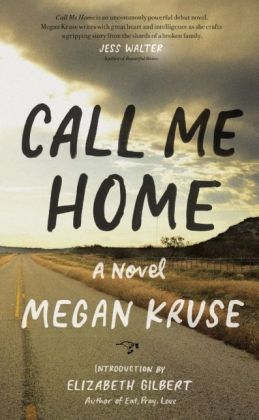
Call Me Home by Megan Kruse

A family story, in multiple voices, of pain and love and the journey to safety.

call me home

In her debut novel Call Me Home, Megan Kruse undertakes sprawling topics including guilt, sex, domestic violence and the complicated love of siblings, parents, children and lovers, in settings across the United States. These ambitious themes and clearly wrought characters are gorgeously rendered in feeling prose.

Amy moved from small-town Texas to small-town Washington state as an 18-year-old newlywed, before he began to beat her. The action of Call Me Home begins years later, alternatingly told in the third-person perspectives of Amy and her son Jackson, and first person by Jackson’s little sister Lydia. Amy tries to leave with her children, repeatedly, but to permanently escape her abusive husband she has to choose just one child to save. Eighteen-year-old Jackson finds himself on the streets of Portland, Oregon before taking work on a construction crew in Idaho. Amy and Lydia hide out at a shelter in New Mexico, then find their way to Amy’s hometown, where 13-year-old Lydia meets her grandmother for the first time. Flashbacks throughout the narrative also portray Amy’s marriage and abuse and the children’s early lives.

Call Me Home offers lovely descriptions of natural settings in Washington, Idaho and Texas, but central are the powerful themes and ugly realities of domestic violence, Jackson’s challenges as a gay teen navigating unfamiliar streets and country, and the shared and unique traumas of Amy, Lydia and Jackson. Kruse’s evocative, often lyrical language serves her subjects well, so that what results is not unleavened pain but painful beauty, even hope.


This review originally ran in the March 10, 2015 issue of Shelf Awareness for Readers. To subscribe, click here, and you’ll receive two issues per week of book reviews and other bookish fun!


Rating: 8 garbage bags.

Untangling the Knot: Queer Voices on Marriage, Relationships & Identity, edited by Carter Sickels

An incisive and enlightening examination of same-sex marriage within the wider context of LGBTQ needs.

untangling

Untangling the Knot: Queer Voices on Marriage, Relationships and Identity assembles pieces from diverse contributors, college professors and blue-collar workers, some established writers and some never before published. Edited by Carter Sickels (The Evening Hour), these extremely sharp essays offer a startling array of perspectives on the fight for same-sex marriage in the United States, rendering a deceptively simple concept–that the needs of the LGBTQ community range far beyond marriage–fully and feelingly. Published as the Supreme Court agrees to hear arguments about same-sex marriage on a nationwide level, Untangling the Knot is profoundly eye opening, even for readers well informed on the subject.

Essays cover the reasons why marriage is important to some members of LGBTQ communities, addressing questions of medical decision-making, finances and insurance, child rearing, equality. Others protest what Ben Anderson-Nathe calls a “rhetoric of sameness”: the argument for marriage rights based on the idea that queer families are just like straight ones. Jeanne Cordova illustrates why choosing a single issue is damning for a movement. Joseph Nicholas DeFilippis writes that the continuing assumption that marriage is the highest form of family does a disservice bigger than the queer community, affecting straight people as well. Several contributors argue against legal rights, benefits and protections being tied to marriage at all. Some suggest better uses for organizational resources: homelessness, health care, anti-discrimination, and aid to trans people, the poor and queer people of color.

With Sickels’s synthesizing introduction, these sympathetic, well-informed essays show that the fight for same-sex marriage is deeply complex and only one issue in the fight for inclusiveness and equality.


This review originally ran in the March 3, 2015 issue of Shelf Awareness for Readers. To subscribe, click here, and you’ll receive two issues per week of book reviews and other bookish fun!


Rating: 8 nontraditional arrangements.

book beginnings on Friday: Untangling the Knot, edited by Carter Sickels

Thanks to Rose City Reader for hosting this meme. To participate, share the first line or two of the book you are currently reading and, if you feel so moved, let us know what your first impressions were based on that first line.

untangling

This is an essay collection, Queer Voices on Marriage, Relationships and Gender. I found it quite eye-opening and recommend it highly. From the introduction by editor Carter Sickels, a beginning for you:

I’m writing this the day after Oregon has legalized gay marriage, and I can’t stop looking at the pictures of people lined up at the courthouse or listening to the interviews of couples who’ve been waiting for this moment for ten, twenty, thirty years. Today, Portland is a city of celebration.

There is a ‘but’ coming, though. Stick around: it is interesting and enlightening.

This quotation comes from an uncorrected advance proof and is subject to change.

Body Counts: A Memoir of Politics, Sex, AIDS, and Survival by Sean Strub

Sean Strub’s earnest, evocative memoir of political activism, coming out and the AIDS epidemic will appeal to diverse readers.

bodycounts

Seventeen-year-old Sean Strub left Iowa City in 1976 to attend Georgetown University and–more importantly for his future–to become an elevator operator at the Capitol Building. He worked to meet as many powerful figures as possible, with his own political career in mind, yet he was haunted by a secret he feared would make him unelectable: he was attracted to men.

Three years later, the colorful, growing gay community of New York City encouraged the aspiring politico to begin to explore his own sexuality and acknowledge it as a permanent feature in his life. As an increasingly “out” gay man, he shifted his focus away from the idea of running for office and became a committed activist in the pursuit of gay rights. Strub’s second passion and skill was for entrepreneurship, and he eventually started up an impressive number of companies, including direct-mail ventures and publications that supported his causes.

In the early 1980s, “gay cancer,” eventually known as AIDS, was suddenly everywhere. Strub couldn’t attend every funeral and memorial service, he writes, but he always made sickbed visits; sometimes he walked the halls of a hospital without a specific friend in mind, reading names on rooms, sure he’d find people who needed him.

Strub had known he was HIV-positive since 1985, when he was given a prognosis of “maybe” two years, but his partner Michael died with no warning, not even getting sick first. The need for AIDS activism to push for quicker access to new drugs and fight discrimination naturally dominated Strub’s attention in the years following his diagnosis and Michael’s death.

In Body Counts, Strub relates the joys and struggles of learning self-love, political aspirations and disillusions, activism and relationships with countless men and women he loves, with cameo appearances by Tennessee Williams, Bobby Kennedy, Gore Vidal and Bill Clinton (among others). Body Counts is a powerfully moving personal memoir with the added value of a fine and feeling primer on the history of gay culture and AIDS in the United States. Strub’s subject matter could have been morbidly tragic, but he retains a sense of humor and celebration, honoring the dead with love and hope. Now an AIDS survivor for nearly 30 years, Strub notes that he is on his way to matching, in same-sex weddings, the number of funerals he attended in the 1980s and ’90s.


This review originally ran in the December 13, 2013 issue of Shelf Awareness for the Book Trade. To subscribe, click here.


Rating: 8 mailings.