movie: Brokeback Mountain (2005)

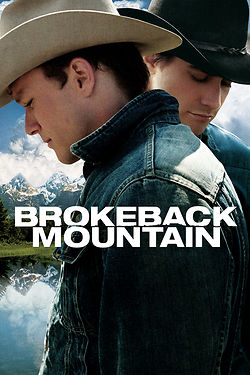
I just recently rewatched this movie, which I saw when it first came out, and appreciated. I’m quite blown away. This is masterful understatement. Emotions run fast and deep; Jack Twist and Ennis Del Mar are men’s men in a classic sense, macho, physical, and (in Ennis’s case) of few words; they are also lovers. There is a rough physicality to their affection, as in the scene when Jack shows up at Ennis’s apartment after four years apart. It’s a deeply sexy, sensual movie, perhaps more movingly so because of how different this love and sex is from what we’re accustomed to seeing in romance movies.

And it’s a very romantic movie, in several senses. For one thing, there is the romantic relationship at its center; but there’s also the romanticism of ranching and rodeoing and the gorgeous scenery and harsh weather of the Montana mountains. (Heath Ledger and Jake Gyllenhaal are gorgeous, too.) I think the power of the film is in part in the overturning of expectations about romance (in both those meanings) and about who we expect Jack and Ennis to be. To put a point on it, we don’t expect cowboys to be gay, and we don’t expect gay men to be rough-and-tumble, macho-masculine cowboys. Those are stereotypes, and Brokeback Mountain is here to dispel them. But that makes it sound didactic when in fact it’s anything but that: it’s deeply beautiful, starkly painful, and at every point feels true.

I have dim memories of enjoying the Annie Proulx story this movie is based on, but perhaps because I saw the movie first, my standard remains this cinematic, visceral, visual version.

I could watch this movie over and over again.


Rating: 10 hats.

movie: The Watermelon Woman (1997)

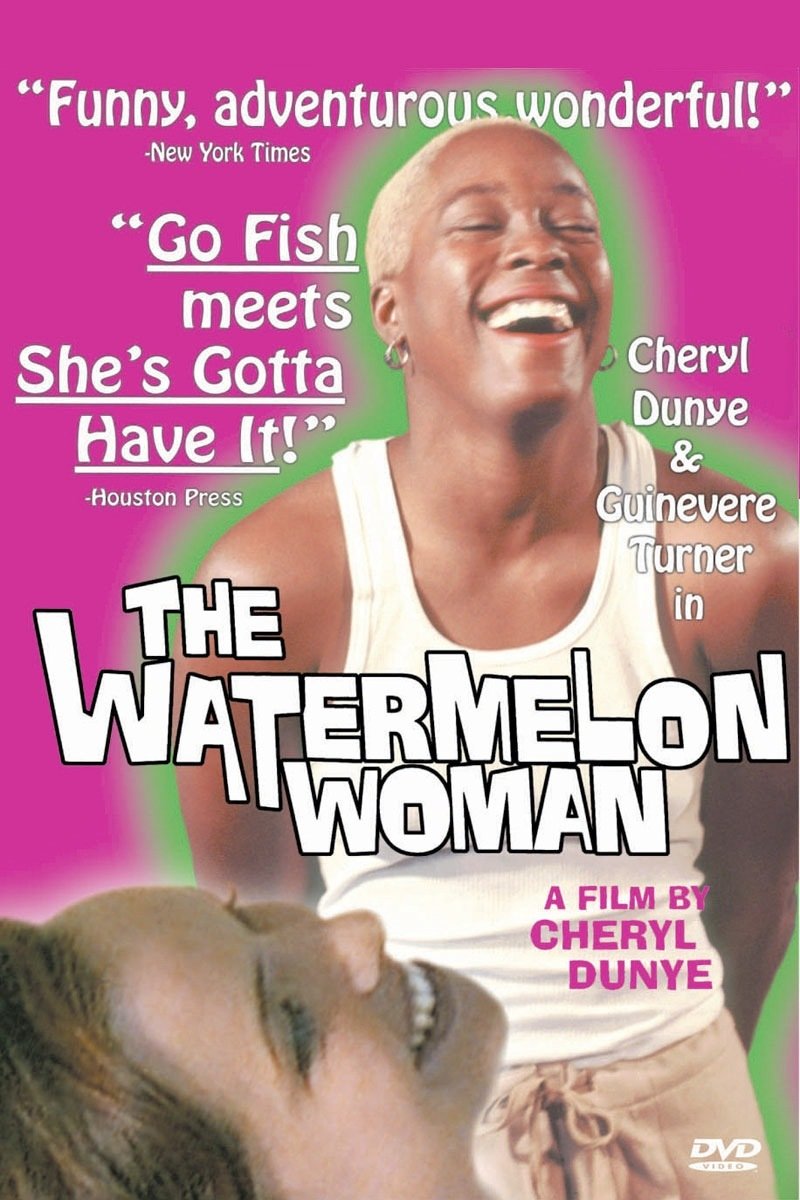
This 1997 film is an autobiographical mock-umentary in which filmmaker Cheryl Dunye stars as “Cheryl,” more or less herself: a young Black lesbian working in a video store with her buddy Tamara, and working as well on a film project which documents her research into the identity of a historic Black female actor known in credits only as “the Watermelon Woman.” This actor played the “mammy” or kitchen/maid/”help” roles that were most of the available work for Black women of her time, the 1930s. Cheryl learns that this woman luckily lived in Philadelphia, where Cheryl also lives; she finds people who knew her; the research goes fairly well. At the same time, Cheryl meets and begins a romance with Diana – who is white, which causes friction with Tamara. Two plotlines, then: finding the Watermelon Woman, and navigating romance and relationships across race lines.

On the one hand, as some testy reviewers have pointed out, the script can be a little stilted, and the acting falters; a few lines are fumbled, and I wish they’d reshot those scenes. The research plotline, in particular, is overly simplistic: two friends drive from Philly to New York to get into a special lesbian archive (acronym C.L.I.T.) and are in and out in five minutes! The research is too easy, too quick. But, it’s all in service of a message, right? The film is all-around dated – but it’s over 20 years old, so, fair enough. Those reviewers who criticized jumpy camerawork just missed the message, though: it’s presented as hand-shot by relative amateurs, you guys. Remember Blair Witch Project?

On the other hand, this project is sweet, heartfelt, and in pursuit of the kinds of social work I’m absolutely behind. It was funny, and earnest. I kind of loved it.

Just before closing credits, the screen reads: “Sometimes you have to create your own history. The Watermelon Woman is fiction. Cheryl Dunye, 1996.” IMDB quotes her further: “The Watermelon Woman came from the real lack of any information about the lesbian and film history of African-American women. Since it wasn’t happening, I invented it.” In other words, the outlines of this story may well be true, but in the absence of even a sketchy “watermelon woman” to investigate, Dunye has allowed a fictional one to stand in for those lost to history. I dig this way of dealing with absence.

Poo-poo to the crabby critics. An imperfect but fine film.


Rating: 6 photographs.

Angry Queer Somali Boy: A Complicated Memoir by Mohamed Abdulkarim Ali

An angry queer Somali boy navigates race, family and sexual discovery in a series of countries before writing this startling, incisive memoir of pain and resilience.

Mohamed Abdulkarim Ali was born in Mogadishu, Somalia, in the mid-1980s; he was stolen away from his home at age four by his father, a stranger to the young boy. With his stepmother and several new siblings, the young Ali lived for a time in the United Arab Emirates and in various cities in the Netherlands. When he was in high school, the disjointed family relocated again to Toronto, where Ali still lives, writing Angry Queer Somali Boy: A Complicated Memoir from a homeless shelter.

The traumas start early, with the national distresses of Somalia represented by Ali’s socialist grandparents and his mostly absent businessman father. “I saw him as a philistine, but he was in tune with the flow of history, unlike his parents.” Ali’s stepmother and stepsisters are violently abusive toward him and toward each other: the genital mutilation the girls endure happens off-screen but nevertheless forms a visceral, horrific scene in a chapter titled “Torn Desert Flowers.”

Ali suffers in the increasingly white countries he is moved to, as an immigrant, foreigner, African–“since the words for African and slave are interchangeable in Arabic, my schoolmates thought hurting me was their holy right.” Bullied at school, he must also deal with discovering his sexuality in an immigrant Muslim family disinclined to accept a gay son. Eventually, his coping mechanisms for these and other difficulties will include addictions to Valium and alcohol. Later, en route to an arranged marriage in Somalia that he will manage to avoid, Ali spends time in London, a place he finds “more alive” than Toronto and where museums are free.

His book is filled with suffering, but Ali avoids self-pity with his matter-of-fact reportorial style and the odd, acerbic interjection. His focus is global as well as personal, as he considers Somali history, colorism within nonwhite communities, the way one marginalized group can abuse another and observed trends in racism, homophobia and xenophobia. Among the pain are poetic, searing images, like the white teacher who hands out sugar cane to accompany a story about Barbados, “to taste the sweetness that had claimed so many black lives…. Armed with the taste of sugar cane, I made my way to the library.”

This is a memoir of raw agony and uncomfortable histories, told in a style alternately lyric and stark. Ali’s life experience has ranged widely, geographically and otherwise, and the stories he shares here are both particular and universal truths. Angry Queer Somali Boy is painful but recommended reading for anyone hoping to look directly at this world.


This review originally ran in the August 30, 2019 issue of Shelf Awareness for the Book Trade. To subscribe, click here.


Rating: 7 sticks.

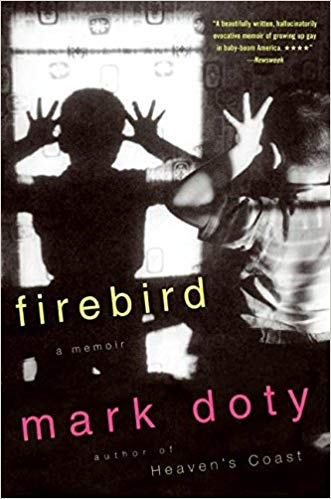
Firebird by Mark Doty

It has taken me far too long to branch out in the world of Doty, having read Still Life With Oysters and Lemon at least six times by now. Well, I’ve got three more of his memoirs on my shelf and will rectify this. I may even venture into his poetry. Who knows.

Firebird is the second of his three memoirs (which list excludes Still Life), and focuses on his childhood: in an nutshell, a gay kid’s coming-of-age in a turbulent and troubled family that moved around a lot. From Tennessee to Tucson, Florida to California and back again, Mark’s family followed his father’s profession as an Army engineer. His mother eventually slides into alcoholism. His older sister leaves home in her teens to escape her own difficulties with their parents; she will wind up a single mother of three and later go to prison. Mark, after a traumatic haircut against his will, attempts suicide and confesses for the first time, to a nurse at the hospital, that he is gay. These are the troubled-family highlights, but Firebird does not rely on its sensational headlines for effect. It’s as much about art and beauty, the way these can overhaul pain and save his life, as it is about any particular painful story.

Doty excels at calling forth the beauty of the desert around Tucson, which his mother so loves, a Georgia O’Keefe landscape of color and contrast; her art–his mother’s–which brought her to life, and the entrance into a world of art that she gave him.
I was pleased to see so many echoes between this book and Still Life. I love the way Doty questions, turns back on himself: “Does he mean… Or no–does he meant it this way… But there are two lenses… Is that the point?” And his focus on “the resonant object,” which I absolutely recognize. The book’s prelude, “Perspective Box,” feels pulled directly out of that other book I have so loved. Firebird is as full of things as I could want; it fits right into what I love about his art.

I can’t wait to read more.


Rating: 8 complicated, studded walls.

shorts by Cather; Sandor; Wheeler; Irving; Chesnutt; Maren; and Bourne of National Geographic (and links followed, etc.)

Whew, a long one today – sorry, folks, but I’ve been reading.

Because I’m not busy enough (ha) I’ve been reading a few short prose pieces here and there. Some of the following come from the Library of America’s Story of the Week (an email you can sign up for for free, if you have tons of free time or are a glutton like me). One I found languishing in a file on my computer. The internet, and friends’ referrals, account for the rest.


Willa Cather’s “A Death in the Desert” was a Story of the Week, viewable here. I found it a moving story, but much more so with the context included, about Cather’s devotion to a composer who died young. As the Library of America points out, the fact that this story was published in three versions, each subsequently edited and shortened, makes it an excellent opportunity to study editing for length (if you were to go find all three). There’s something Victorian in the manners and fainting emotions in the story that is less compelling and relateable for me personally, though. I’m glad to have learned a bit more about Cather, but it’s not my favorite thing I’ve read this month.


Marjorie Sandor’s “Rhapsody in Green,” however, blows my mind. (This was the one found on my hard drive. Originally published by The Georgia Review and viewable here, if you sign up for a free account.) It is a very brief lyric essay about, yes, the color green. Sandor evokes so much via this color, and her search for an unachievable shade: color, we might think, is a visual element, but she uses touch, smell, and taste as well. On its face about this color she can’t find, this essay is also a glancing view of the narrator’s life story, at least in a few relationships and geographical locations. There are four references (in less than three pages) to a time “I fell in love when I shouldn’t have.” It is a brave and risky move to so emphasize an event that she never explains further. As we writing students say, this one would have been destroyed in workshop. But I love it, this level of tantalization, and her bold implication that no, we don’t need to know any more about it than that. There are also two references to “a/my friend who puts up with such eccentricities.” I love this epithet, this characterization, and in both cases – this, and the “fell in love when I shouldn’t have” – I appreciate the use of an intentional echo to good effect. Also, nothing I’ve said here begins to get at the loveliness, the lyricism and sensual intimacy, of Sandor’s writing. Do go check this one out.


Disclosure: Dave Wheeler is my editor at Shelf Awareness, and a friend.

I have done a poor job of keeping up with Dave’s work, and recently returned to see what I’d missed, particularly in his essays, which impress me so. I am gradually catching up now – you can see his published essays here (and more in other links on that page). And I love a lot of what Dave writes: I appreciate the short, dreamy, feeling quality of “Science for Boys”, and the inquiring mind exposed in “Death and Its Museum”. But I think my favorite essays of those I’ve read so far deal with art, and how Dave takes it in. “Two Men Kissing” and “Some Holy Ghost” each offers so much, and I’ve forwarded them to many friends.

Today, I am very pleased by “A Moment Spins on the Axis of You: The Fourth Dimension of Yayoi Kusama’s ‘Infinity Mirrors'”. Here Dave encounters Kasuma’s installation, in particular, and the grand scale of its claimed subject. But even more than the named artwork, he considers what it means to wait – for art, for anything – and what contribution waiting, or time, or the audience experience, may offer. I appreciate his voice: he speaks with authority about his own experiences, but with a humbleness as regards the world of art criticism; he can be playful even as we feel he is serious. And of course I recognize myself when he writes, “As a lifelong reader, I have cultivated a sharp sense of when I can quit a book without worrying that I have missed something of importance. As a wide-eyed novice to visual arts, I am less assured.” I think I feel something like the same thing when I try to see my own reactions to visual art: I don’t even know what I don’t know.

Perhaps recognizing myself in Dave is part of recognizing Dave, someone I know personally and enjoy talking to, however infrequently we get around to it. And maybe that enjoyment is inextricable from my appreciating his writing. Maybe you want to help me test this: go check out Dave’s work and let me know what you think.

Good, right?


Washington Irving’s “Rip Van Winkle”, another Story of the Week, was engaging enough in its descriptive power; I was interested in getting a better grasp on one of those legends that’s in our collective consciousness whether we’ve read it or not (I don’t believe I had). The misogyny in the treatment of Dame Van Winkle, and the cursory treatment of all the women in the story (none of whom, if memory serves, had names), rankled. I’m not sorry I took the time, but it wasn’t a highlight, or anything.


Charles W. Chesnutt’s “The Bouquet”, on the other hand, was both lovely and harrowing. (I went ahead and followed this link to a Wiley Cash article in Salon, where he argues for Chesnutt as genius, and I don’t disagree.) If you want to feel gutted by our national heritage where race is concerned – well, none of us does, but I feel it’s important we don’t look away, either – give this short story a try. It has a surface on which it can act as a sweetly sad and simple tale, but its depths are significant.


Disclosure: Mesha Maren regularly serves as guest faculty at West Virginia Wesleyan College in my alma mater MFA program. I consider her a friend.

I was deeply impressed with Mesha’s recent essay in Oxford American, titled “West Virginia in Transition”. She moved away as a young, closeted, queer woman, and upon moving back, she investigates the experiences of her counterparts: queer youth growing up twenty years later in her own hometown. She muses on the ways in which their lives are different and the ways in which they’re similar. It’s a story that’s important to me, because both queer communities and Appalachian ones are much on my mind. I’m glad topics like this are getting bandwidth. But also, as anyone who knows Mesha’s work will expect, it’s a gorgeously written story. “The way these ridges and hollows both cradle and cleave.” Beautifully done, and highly recommended.


Finally, my father sent me a link to this story from National Geographic: “Clotilda, ‘last American slave ship,’ discovered in Alabama.” Joel K. Bourne, Jr. brings us up to date on the recent confirmation that Clotilda has been identified where she was burned and scuttled in the Mississippi Delta after a voyage spurred by a wealthy white man’s bet that he could import slaves from Africa more than 50 years after such imports became illegal. In 1860, 109 men, women, and children survived the voyage into Mobile and were then sold into slavery. Part of what’s unique about this group of abducted Africans is that late date: Clotilda’s survivors lived long enough in some cases to be interviewed on film. They founded Africatown on the edge of Mobile, and their some of descendants live there today. When I passed through Mobile this spring, I missed Africatown. But, unknowing, I stayed in Meaher State Park, which is named after a wealthy white family, including the man who made the bet.

I found this article, accompanied by pictures and video, moving. I think it’s an important story to read and consider today. I also followed several links, like this one offering a list of destinations to visit for African American history and culture. I found a few of these on my travels this year; I’ve added to rest to my itinerary.


There is always something to keep our minds busy. I just feel lucky to have the time to follow these leads. What have you read lately?

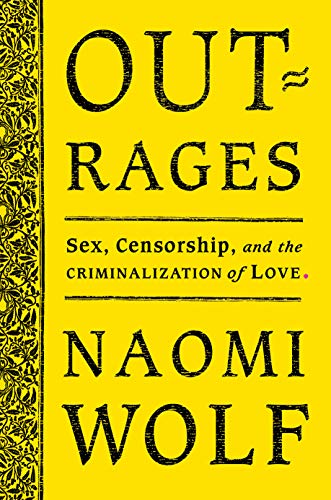
Outrages: Sex, Censorship, and the Criminalization of Love by Naomi Wolf

**Please see the bottom of this post for why this book will not be published after all…**


Naomi Wolf examines poetry as social resistance and its ability to free its readers and its writers, the origins of homophobia and the battle against censorship in this gripping and vital history.

With Outrages: Sex, Censorship, and the Criminalization of Love, Naomi Wolf tackles the history of legislation against homosexuality in the United Kingdom through the poetry, essays and life of a man her readers have probably never heard of: John Addington Symonds. This book harnesses the electric power of Walt Whitman’s Leaves of Grass, the righteous energy of first-wave feminism and the terror of criminalized identities, in a style accessible to general readers. As the fight for LGBTQ rights continues, this book is as relevant as it is compelling.

Symonds (1840-1893) had the bad luck to come of age as a gay man just as Great Britain’s legal system turned against men who loved men. He was a writer in a time of obscenity laws. And despite the grave danger–sodomy for a time was punishable by death–he kept writing. “This is one reason why Symonds’s story, in the context of the history of censorship and the history of homosexuality, is so remarkable. The man just would not be silenced.” On top of copious publications, Symonds left behind a trove of “secret poems,” and a memoir that would not be published until nearly 130 years after his death.

While Symonds is not Wolf’s central subject, he provides inspiration and continuity for a larger story, and his life provides the book’s timeline. It opens with Symonds’s youth and the 1855 publication of Leaves of Grass. Then it follows London’s war against literal filth (human excrement in the streets, cholera, typhus) and the invention of the crime of obscenity (framed in parallel to that other filth, with its infectious properties), legislation of female bodies and what Wolf calls the laboratory of empire: Britain tried out increasingly stringent policies in its colonies before bringing them home. Wolf maps out the relationship between feminists’ campaigns for marital and property rights and the new idea that male-male love was “disgusting” or “unnatural”: “When women targeted the sexually abusive practices of heterosexual men, the outcome was a backlash by the heterosexual male establishment,” or distraction techniques directed at gay men.

Meanwhile, writers and artists sought each other out clandestinely, using coded language and referring to the ancient Greeks, as censorship laws “had an immediate dampening effect on literature.” Finally, Wolf tracks what she sees as a generational progression: Whitman influencing Symonds and then Oscar Wilde, who served two years’ hard labor for “gross indecency.” The book ends with Symonds’s death and his legacy, the writings he published in his lifetime and those he left behind for a future society ready to receive them.

Wolf’s style is easy to read, and her research is authoritative: this book is in part adapted from more academic work on the subject, and some of the most captivating scenes involve primary sources in the archives. Outrages is not only an important history with lessons for the present, but also an engagingly told story. The instructive life of Symonds is for any reader who cares about history, civil rights or the power of poetry.


This review originally ran in the May 17, 2019 issue of Shelf Awareness for the Book Trade. To subscribe, click here.


Rating: 7 notations to OMIT.

…and, speaking of omissions! Between my review of this book and its publication, there has been some uproar. I decided to post this review as it originally ran, and then to include a few links for your further reading.

“Naomi Wolf’s Outrages Postponed, Recalled” (from Shelf Awareness)

“Naomi Wolf’s Career of Blunders Continues in ‘Outrages’” (from The New York Times)

As it turns out, this book will not be available anytime soon.

In a nutshell, Wolf was first caught in a simple error (live on BBC radio: you can listen here) that played an important role in her book; but as the Times writer goes on to say (quite a bit more vehemently than the BBC radio host, historian Matthew Sweet), Wolf has a history of playing fast and loose with the facts.

I’m taking this in as you are, folks. What a wild ride. Vigilance on all our parts; and it’s good to read the adjacent articles as they come out, especially if you’re going to allow a book to shape your worldview…

Sugar Run by Mesha Maren

Disclosure: Mesha is a visiting faculty member at my MFA program and a friend.


Sugar Run has been getting a lot of press, and it’s well deserved. This is an astonishing novel.

Jodi was seventeen years old when she was sentenced to life in prison. Eighteen years later, she is surprised to find herself paroled. She never thought this would happen, even as the lawyers and appeals pressed forward around her. Now she steps out the gates and is surprised to see that she’s been surrounded by mountains all these years in Georgia – mountains she couldn’t see, but that make her feel just that much closer to the mountains of her West Virginia home.

Jodi heads south before going home, though, to track down a boy she should have helped all those years before. She is surprised to find him transformed into a man she does not recognize; if time stood still for Jodi in prison, it hasn’t for the rest of the world. In short order, Jodi collects as well as a partial family in crisis; as she drives a new friend’s Chevette into rural West Virginia and up the mountain she calls home, the life and hopes she’s building may already be falling apart.

In flashback sections, we learn as well about the past, chiefly the buildup to the crime that got Jodi life in prison as a minor. The cast of characters is not small: Jodi’s mother, father, beloved grandmother, and younger twin brothers; Paula, a woman important to Jodi in her youth, along with her parents and brother; Jodi’s new friend Miranda, estranged from her pop singer husband, with three young sons and a coterie of associates; and the inhabitants of the West Virginia hilltop Jodi returns to, from fracking workers to activists and the locals she’s known all her life – or at least for its first seventeen years.

It’s a remarkable story. For one thing, the lives of Appalachian lesbian women are not much seen in literature, and women in prisons are somewhat underrepresented as well. (Mesha teaches writing in a women’s prison, so she has the research to back up that element.) But equally importantly, as a plot, it rips. From Jodi to Miranda, from past to present, the reader is kept totally absorbed (I would like to thank Mesha for getting me through six hours in the waiting room of an auto shop). It’s a fully realized world to fall into.

I also appreciated the strong sense of place. Jodi is deeply committed to her late grandmother’s cabin and property on a hilltop threatened by extractive industry: a classic West Virginia story, in a way, but one thoroughly fleshed out and real here. The place itself is described as carefully as the characters are. I realize that I’m portraying this book as both character- and plot-driven; it is also about the sentences, which weave and wend and take their time painting pictures as much as moving either plot or characterization along. Pacing-wise, it might be mid-range. The plot has momentum and keeps me turning pages; but the sentences take time for beauty.

This is a fine and multi-faceted novel, and I love it. Congrats, Mesha.


Rating: 8 hands.

When Brooklyn Was Queer by Hugh Ryan

Thorough research, engaging storytelling, fascinating stories and a history of obscurity make this investigation of queer Brooklyn a compelling, essential read.

When Brooklyn Was Queer achieves everything one could want in a history: meticulous research, easy-reading narrative, fascinating small events within significant larger ones, and personal interest. Hugh Ryan, founder of the Pop-Up Museum of Queer History, investigates a very specific slice of history all but erased by prejudice and the passing of time.

The idea of Brooklyn, N.Y., having a significant queer history surprises many present residents, but Ryan cracks open what looks like a blank slate and finds richness there, beginning with the 1855 publication of Walt Whitman’s Leaves of Grass. Whitman represents an early association with Brooklyn and with white men who have sex with men (people of color and queer women did not appear in the historical record yet). From here, Ryan covers periods of growing visibility through turn-of-the-century newspapers and the theater; the rise in criminalization and persecution of queers in the 1910s; and the quick expansion of both the queer scene and Brooklyn at large in the 1920s.

The Depression, the end of Prohibition and the Hays movie code brought new strictures on a vibrant world of bars and cruising venues. Mobilization for World War II offered great opportunities for queer people, as men joined the armed forces and women went to work in factories and shipyards like the Brooklyn Navy Yard. Following the war, a societal move toward conservatism, the suburbanization of New York City and the shutdown of Brooklyn’s waterfront lead to what Ryan calls “the great erasure” of queer community and history.

When Brooklyn Was Queer considers the lives and contributions of well-known artists like Hart Crane, Marianne Moore and Truman Capote, and numerous lesser-known performers, businesspeople and blue-collar workers. Painstaking research and attention to detail highlight the richness and mystery of stories that have been largely hidden until now. Ryan is careful to point out the challenges of this kind of research. During many of the years covered here, homosexuality as a concept was unknown: a man could have sex with men but be “normal,” or he could be a “pervert,” based solely on appearance or mannerism. Vocabularies for such identities were at first nonexistent and varied over time. And much of the information collected about queer people in history is deeply problematic, recorded by hostile and prejudiced organizations, and presumably with limited cooperation by the people being studied. Finally, Ryan is sensitive to the intersecting limitations faced by women and people of color.

Only in his introduction and epilogue does Ryan share his personal connection to these stories, his own history in Brooklyn and his heartfelt desire for this history to be told. While the rest of his book takes the style of traditional history writings (no “I” pronoun), he reaches out in the final lines: “I look forward to having a future where we can also have a past, and I look forward to creating it with you.” Having been engrossed in these pages, his reader feels that same connection and hopefulness.


This review originally ran in the January 31, 2019 issue of Shelf Awareness for the Book Trade. To subscribe, click here.


Rating: 8 windows.

movie: Rent: Filmed Live on Broadway (2008)

I first saw Rent when I was in high school. My dad and I traveled to New York City to investigate that city among a few others where we thought I might go to college. He got us tickets to see Rent at the Nederlander Theatre on Broadway. I already knew that I loved musical theatre at that time, but this production really changed something for me. It was the first time that I cried at a stage production or at any piece of art other than a book. The subject matter felt especially meaningful and timely for me, as I had friends still discovering their sexuality and coming out to their parents. It was an event that resonated. I immediately bought the soundtrack and it still makes me cry today, twenty years later.

The friends I am visiting with now expressed an interest, and so we rented this version: a live taping of the final performance of the Broadway production, after a twelve-year run. The actors are almost entirely different (every major role was filled by a different actor in this version, from the one I saw). And I guess I had really invested in the first cast; but I have to say, this one was admirably close to the original, so even someone like me was able to be open to the new. Most cast members were very close in physical details as well as in talent; I was able to settle into this production and feel at home.

It’s still everything I remember, after all these years. Musical theatre does tend toward the theatrical (go figure) expression of emotions, but for the few moments of somewhat self-conscious hand-wringing that I might skip, there is such raw power… and the singing and dancing is amazing. I still find this play to be full of all the love, drama, angst, grief, rage, and passion I found there in the first place. It made me cry, again.

As a production, too, I think it works well – that is, both as a stage production (filmed live, with audience and applause) and as a cinecast. Unlike The Wiz and more like National Theatre Live, the camera angles varied and moved around, working for perspective and providing close-ups as appropriate. I don’t recall noticing that the cinematography in itself was extraordinary (as I often do with NT Live), but it was plenty serviceable. Since the chance to see Broadway’s version of Rent has passed, I’d strongly recommend this version.

It’s interesting to think about the extent to which an experience like this is about that original experience. I was probably 16 years old (maybe 17, but I think 16) sitting in the upper rows of the Nederlander Theatre, far from the stage. The words and lyrics and music and dramatic portrayals, the singing and dancing and kissing, took me so powerfully. I’ll never forget; I’ll also never have the same experience again, but every time I hear a song from Rent or see another production (even the 2005 movie, which I remember finding a disappointment), it refers to that original experience just enough to tap into some of those emotions. Still gets me.

In contrast, I have a friend and fellow writer who strongly dislikes Rent. He calls it a singing telegram to AIDS. Dave’s a few years younger than me, and I believe has never seen it live. I’d like to dismiss his opinion on these counts, but think I should give him a little more credit than that. Dave’s also a gay man, and some part of me feels I should defer to his opinion as being a part of a certain demographic – the play is about the AIDS crisis and has more queer characters than cis-het ones. (Another part of me knows that my own opinion & tastes remain worthwhile here.) At any rate I find it interesting, since I respect Dave’s approach to art and we often share interests and tastes. I wonder if he had gotten to see the play live at age 16 how it would have affected him… Then again, maybe the concern is that this is too serious an issue to get all song-and-dance about. That would be a position worth considering.

Local issues aside, Rent remains an important part of my personal understanding of art and value. I’m still hooked. Keep singing.


Rating: 8 samples that won’t delay, for its value in my personal mythology.

If You Knew Then What I Know Now by Ryan Van Meter

Another beautiful recommendation by Jeremy Jones. Thank you, Jeremy. And thank you Jessie for cuing me to watch this one for its organization. Jessie has not read the book, but she knew that organization of an essay collection is what I need right now and she somehow knew this was the right fit. (Trust in Jeremy, perhaps? What a fascinating, beautiful world.)

This is an essay collection about the narrator’s finding out that he is gay and eventually living as a gay man. These linked essays appear in almost perfectly chronological order, and the bulk of them take place in childhood or young adulthood (while he’s still living at home). The discovery and coming-out processes took time for this individual, and those twenty-three years (I think) therefore take up most of the book. A few essays cover his adult life after coming out; one essay (although a long one) covers an eight-year relationship, which is his first, and this is one of my favorite essays.

These pieces are nicely linked and ordered, with sensible transitions and little repeated information. Each essay within itself tends to feature repeated images or symbolism that work well to make a point, to come to a conclusion–if anything, perhaps a hair more neatly than I’d prefer, but these points are always clear, and maybe that’s the side to err on. As a collection, it’s a beautiful profile of the narrator and a life, tender and thoughtful, and admirably fair to the flawed but loved parents.

I had a few favorites, of course. The opening piece, “First,” is lovely, and I remember it – I assume Jeremy sent it to me during our semester of working together, because I don’t know where else it would have come from. It’s a quick scene, riding in the car as a small boy, and an early (anti-gay) lesson given by his mother. This is a perfect capsule: scene, scrap of dialog, reflection, and back out again. The final line of the essay reads, “We all just sit and wait and watch our own views of the road–the parents see what is ahead of us while the only thing I can look at is what we have just left behind.” Van Meter is really good at final lines. This is one that I’d say approaches the too-neat conclusion, but doesn’t quite go there. Instead, it’s a perfect summing up and cue to the reader of the meaning of this painful scene we’ve just witnessed. It inspires a sigh, a murmur of recognition.

While most essays feature narrative storytelling, with their points subtly made in the narrator’s reflection, one essay was different. “To Bear, To Carry: Notes on ‘Faggot'” is much more an assaying essay, with the narrator musing on a particular nasty word, its etymology and uses and effects in history and in his own life. There are anecdotes, but the essay concentrates on a concept and not a story. While I loved the storytelling style throughout, I thought this essay was both well-written and well-executed, and well placed in the collection. It is the one, I think, that comes out of chronological order–but that’s appropriate because it’s not nearly so rooted in the chronology of the writer’s life. It showcases a different kind of writing skill, and zooms out to give the reader a different perspective on his life. It cues us to a more zoomed-out view of that life, too: from here on the essays will cover much more time compressed in each one. Childhood has ended and adulthood has fully begun. From here, the narrator is no longer struggling to know that he is gay and come out, and begin his life; now he is living.

I think my clear-favorite essay is the one that follows. “The Goldfish History” is one of the longest in the collection, and it’s the one that compresses that eight-year relationship, using as vehicle a pet goldfish. We learn about the narrator’s best friend and that relationship, which has its troubles over the years in question. We meet the first real boyfriend and follow their romance and break-up. Through it all it is the goldfish that holds the threads together and in some very real ways, the people as well. While every essay in this collection has something to teach and much to admire, this is the one I most climbed inside of and loved.

Very readable (in one sitting, in fact, and what a relief following Goldbarth) and highly recommended, for its individual essays and for its organization overall. A tender, heartfelt, generous, brave portrayal of finding one’s way. As sometimes happens when we read personal essays, I feel like I want to be friends with the man who wrote these words.


Rating: 7 stilt-walkers.