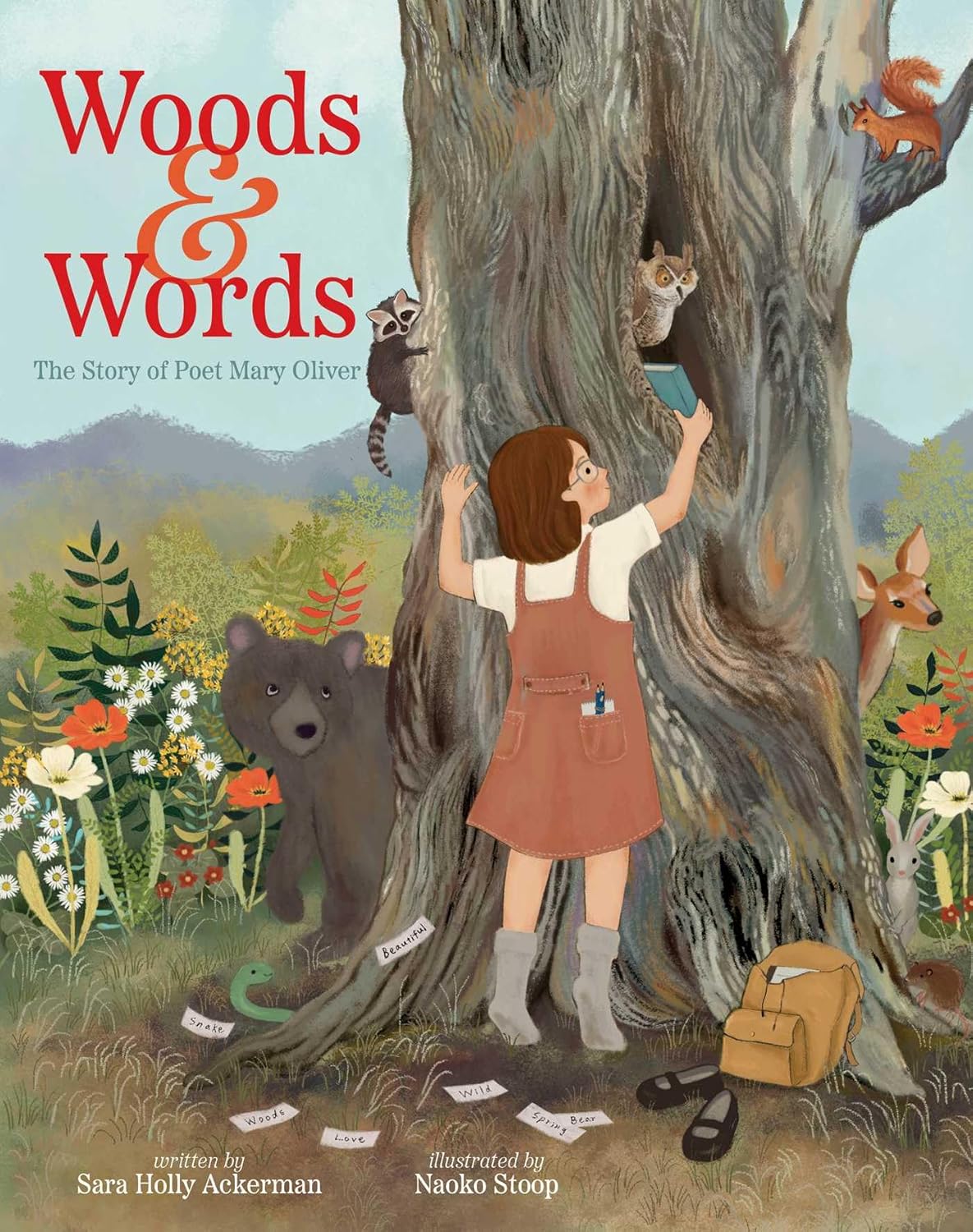
Woods & Words: The Story of Poet Mary Oliver by Sara Holly Ackerman, illus. by Naoko Stoop

I was sold on this book by my Shelf Awareness colleague’s review. I purchased it for some young friends who I think will enjoy it, but that was partly a reason to enjoy it myself first, before I passed it on.

This is a beautiful book, in its simple storytelling, its lovely sentiments and the values it communicates, and in the charming illustrations, full of plants and animals and sweetly expressive human faces. Rated for ages 4-8, it took only a few minutes to page through once, but will reward multiple and slower readings. I liked looking for the critters tucked away in the illustrations’ crevices, and reading through the words that trip and twist across the pages (outside of the narrative). I love that this story, which can be appreciated for its own sake, also introduces young readers to the life of Mary Oliver, an artist for whom mainstream “success” was not guaranteed. The Author’s Note notes that Mary Oliver’s home life, as a child, was “difficult.” She was a woman, she was queer, and she wrote poems that were defiantly “plain,” diverging from a tradition that makes poems less accessible to us regular people. This is what we love her for; but it presented some barriers in her acceptance by critics.

So, a beautifully rendered illustrated children’s book bringing the life of a great American poet to young people. An utter joy to read and look at, much like Oliver’s poetry. Strongly recommend for the kids in your life, and you will enjoy sharing it with them. More of this, please.


Rating: 9 shingles.

rerun: Honeycomb by Joanne M. Harris, illus. by Charles Vess

I’m still thinking about this one with some longing. Maybe it’s time to dip back in. Can I tempt you, or me?

Fairy tales for grown-ups, allegories, visions and horrors: these gorgeously illustrated linked stories are guaranteed to transport.

With Honeycomb, the prolific Joanne M. Harris (Chocolat; Peaches for Father Francis), who has written fantasy, historical fiction, suspense, cookbooks and more, offers an enchanting collection of darkly delightful, imaginative fairy tales and parables of the modern world. (These stories began as a series on Twitter.) Illustrator Charles Vess (Stardust; Sandman) brings to life Harris’s Silken Folk, “weavers of glamours, spinners of tales… whom some call the Faërie, and some the First, and some the Keepers of Stories,” in richly detailed images.

In the world of Honeycomb, the Sightless Folk (regular humans) unwittingly often share space with the numerous and diverse Silken. “There are many doors between the worlds of the Faërie and the Folk. Some look like doors; or windows; or books. Some are in Dream; others, in Death.” These 100 stories form a whole that is magical, fanciful, enchanting and occasionally nightmarish. Some center on single-appearance characters, and some characters are revisited, but all belong to the same universe. “Dream is a river that runs through Nine Worlds, and Death is only one of them.” In special moments, “all Worlds were linked, like the cells of an intricate honeycomb, making a pattern that stretched beyond even Death; even Dream,” and the stories are likewise linked cells.

Some act as allegories, as in “The Wolves and the Dogs,” in which the Sheep elect a Wolf to protect them because at least he is honest. In “The Traveller,” the titular character passes quickly by many delights in pursuit of his destination, which turns out less impressive than he’d hoped. “Clockwork” is a horrifying tale in which a husband rebuilds his wife piece by piece. “The Bookworm Princess,” on the other hand, ends with deep satisfaction. There is the Clockwork Princess and the watchmaker’s boy; a girl who travels with a clockwork tiger; and a mistrustful puppeteer who manifests what he fears. A recurring farmyard is packed with colorful animal characters–a troublesome piglet, a petulant pullet–and allegory, Orwellian and otherwise. The connecting character is the Lacewing King, whom readers meet at his birth in “The Midwife” and follow for hundreds of years, as the fate of Worlds hangs in the balance. “There are many different ways to reach the River Dream. One is Sleep; one is Desire; but the greatest of all is Story….”

Completely engrossing, exquisitely inventive, brilliantly illustrated and thought-provoking, Honeycomb is a world, or Worlds, to get lost in. “Some of these tales have stings attached. But then, of course, that’s bees for you.”


This review originally ran in the May 3, 2021 issue of Shelf Awareness for the Book Trade. To subscribe, click here.


Rating: 9 candied cockroaches.

Hookers and Blow Save Christmas written & illus. by Munty C. Pepin

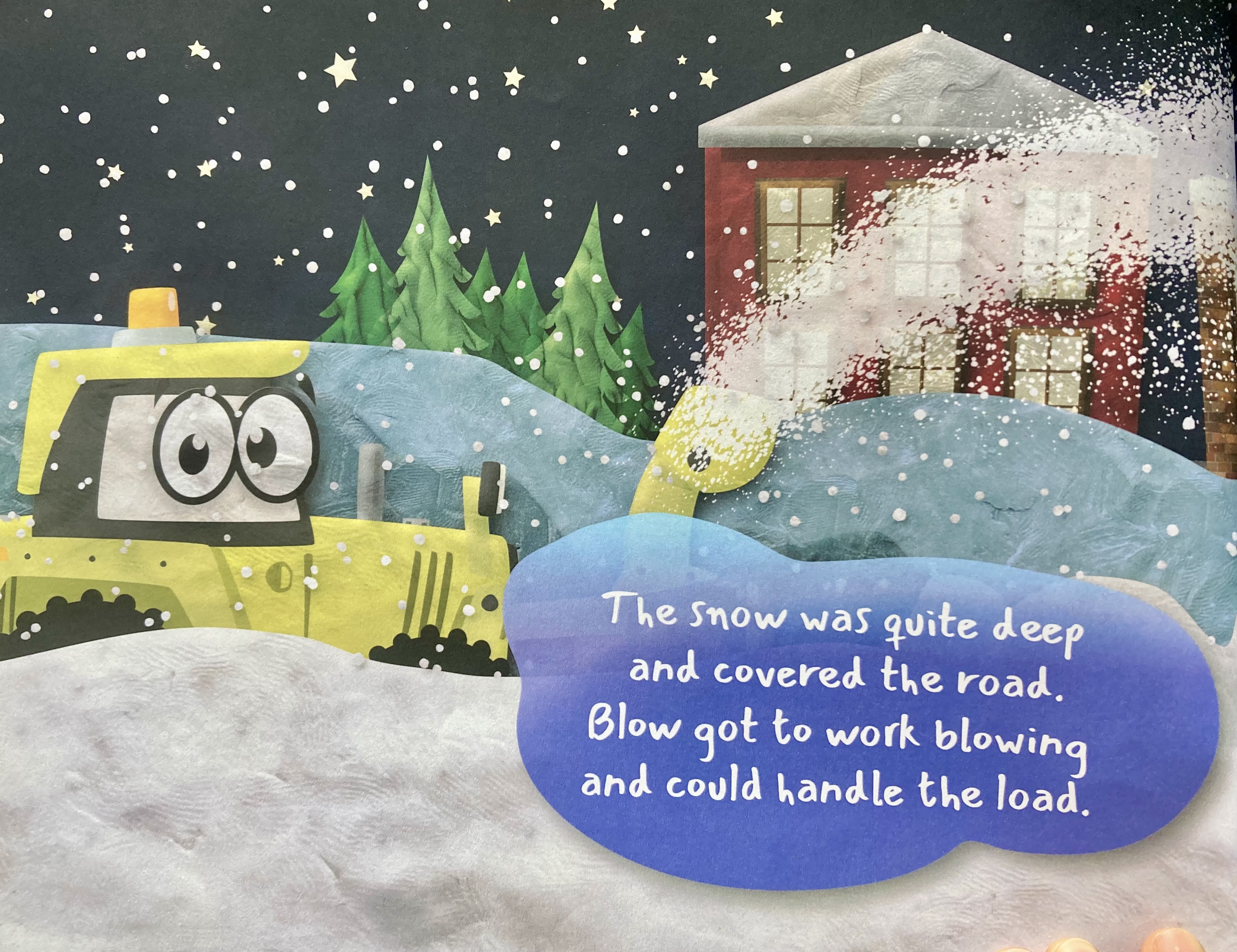
Tom Transport is stuck in a snowdrift with all the presents for the town Christmas party and it’s up to Hookers and Blow to save the day… and the party!

This is a super fun kids’ book. Bear with me. My friend JJ loaned me this for humor’s sake – he got it as a gift when his kids (probably just one at that point) were little. You have already noted the heavy irreverence. It’s actually not only great laughs for the grown-ups, but a perfectly sweet story for kids young enough to miss the joke that is obvious to the bigger kids among us. There are the odd off-color moments throughout –

but also a wholesome story about a snowblower and a wrecker pulling the 18-wheeler into town in time to save the community’s holiday event. All’s well that ends well. I had a fabulous time with this one, reading it aloud (even alone!) for the rhyme and meter, and we all had a great time at a bike shop Christmas party together too. Fun for later: if you’re into that sort of thing, search Amazon for Pepin’s name and you’ll find plenty of similar titles. I can’t speak for the wholesomeness of any of those, yet.

Happy holidays and thanks for the silly times, JJ.


Rating: 7 gifts.

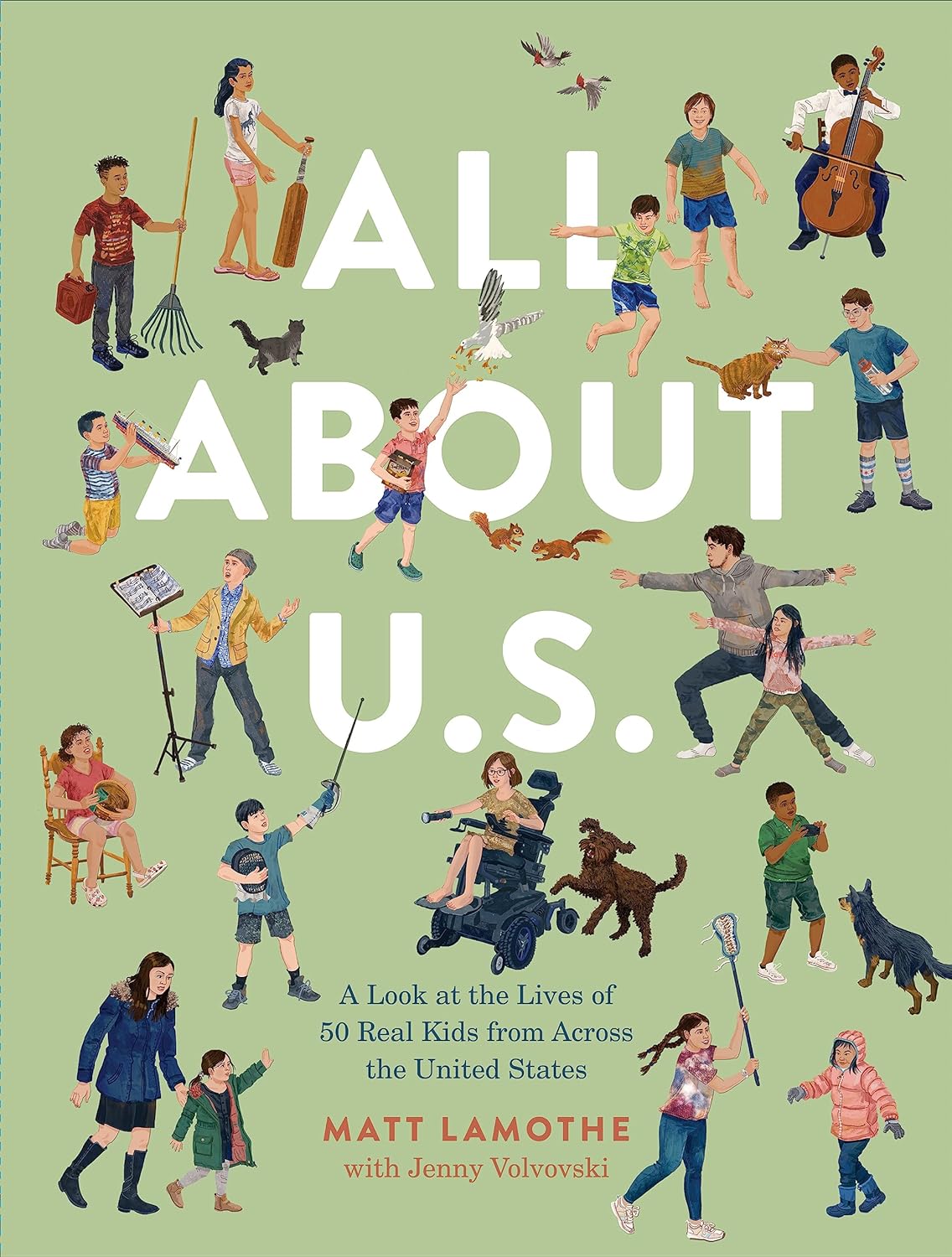
All About U.S.: A Look at the Lives of 50 Real Kids from Across the United States by Matt Lamothe & Jenny Volvovski, illus. by Matt Lamothe

I loved the look of this large-format illustrated book for kids (and their adults!), and preordered it for a couple of my favorite kids, sisters ages 8 and 12. The book is labeled as serving ages 8-12, so I figured that would be perfect. And naturally I had to take a look first.

I love the concept. From the authors of This Is How We Do It comes this glimpse into the lives of 50 kids, one apiece from the 50 states. Author/illustrator Lamothe and author/designer Volvovski took great pains to closely approximate the demographics of the country as a whole in choosing the kids and families they feature here: sections on Process and Demographics at the end of the book detail those elements, in writing that will skew toward the older end of the book’s projected age range and/or serve adults best. The 50 families in the book match national stats in religion, family type, structure and size, gender identities, school and home types, annual family income, national origin of parents and guardians, sexual orientation of parents and guardians, and more, quite closely. “The biggest demographic discrepancy in the book is the overrepresentation of multiracial kids. However, the race/ethnicity of their parents and guardians more closely matches the demographics of the country. According to Pew, the number of Americans who identify as more than one race almost doubled between 2010 and 2020 [when work began on the book]. As this trend seems likely to continue, we feel it is important to show how multiracial families balance their cultures and traditions.” This struck me as solid reasoning. I’m also comfortable with slight overrepresentation of traditionally underrepresented groups.

The bulk of the book is the kids themselves. Each gets either a single page or a two-page spread (of which most of the space is illustration; my impression is that the written stories are equal in size) in this large-format book. A beautiful, engaging, full-color, detailed illustration accompanies a brief written profile of a child, ages 5-11, in the context of their family and home. Generally, parents’ or guardians’ jobs or interests are mentioned, as well as siblings and pets, but the kid in question gets the most focus, via their hobbies, tastes, favorites foods and toys, activities, etc. I love the charming images as (yes) illustrations of what is described in print. I can easily see the sisters I’m giving this book to enjoying the combination of images with text; I expect the older sis to have an easier time with the reading part.

Clearly the enormous diversity of the kids and families featured here is a big part of the appeal. I really enjoyed how varied these lives appear. There are many skin tones, religions, family structures and styles; there are kids with mental and physical health differences and those who have faced major life challenges. Some are rural and some are urban (a demographic element apparently not tracked). I’m pretty sure that each story includes at least one direct quotation, so that the kids’ voices come through. Across all their differences, they all sound stimulated by the chance to talk about their own lives.

And these are real kids. Near the front of the book is a spread with each child’s illustrated head shot; near the back, a similar spread of photographs of the same kids. A few source images are included there as well, like landscape views, and descriptions of how this research was completed (many hours of video calls, online questionnaires, photographs and video tours). I especially appreciate how detailed are the illustrations, and liked reading that each family was consulted in back-and-forth correspondence on both the illustrations and the text before publication.

I was on the lookout for stereotypes. (I did note the authors’ acknowledgment that no one family could represent an entire state.) With such attention paid to demographic data, I feel good about the overall portrait of the country; but what does it look like to choose a single kid/family to stand for New York or Texas? Heavens. I of course turned first to the two states I know best, Texas and West Virginia. In Texas, Noah lives with a large family who enjoy traveling to Big Bend (yes!) from what might be San Antonio. In West Virginia, Jade raises prize-winning steers at his rural home. These are individual stories, woven into a tapestry with plenty of diversity in it.

All in all, it’s a beautiful book that I think will yield some great conversation, and I feel great about giving it to my young friends.


Rating: 8 windows.

The Wheel of the Year: An Illustrated Guide to Nature’s Rhythms by Fiona Cook, illus. by Jessica Roux

This beautiful book sold itself as soon as I walked into the art shop where it lived near the front door on display. I was absolutely ready for a treatment of cycles in the natural world as celebrated by human cultures, with gorgeously rendered art and suggested activities. I bought it in January, and all year have been reading the relevant sections at the appropriate times; I’m reviewing this book just after summer solstice, so haven’t made it all the way through yet, but I feel confident in my impressions.

The Wheel of the Year is geared toward younger readers with its introductory notes on safety (“always have an adult around… when you’re using the stove, oven, or knives”), but its offerings are for anybody. “Magic is real,” we are told. We are looking to find and recognize magic, and “just because something can be explained by science doesn’t mean it’s not also magical.” “The Earth and the Sun do a dance that turns the Wheel of the Year… there’s a rhythm to the seasons, and forming a relationship with your home and its inhabitants is true magic.” It’s definitely directed at kids (“Can you convince your grown-up to join you in sleeping outside, too?”), but works just as well for us young-at-heart, and I’m going to say it’s fun to think about convincing “my grown-up” to do any of this with me.

Following some brief remarks to this effect, we’re taking through the wheel of the year with its eight spokes: two equinoxes, two solstices, and four interstitial markers: beltane, lúnasa, samhain, and imbolc. The wheel is essentially pagan, “used by people who follow a nature-based spiritual path.” This guide surveys a number of cultures from around the world and different points in history, noting commonalities in how people recognize certain times of the year. As I began reading, I turned ahead to the moment in time I was living: imbolc, in early February, when various people observe Candelaria, Brigid’s Day, Carnival, the Lunar New Year, Groundhog Day, and more. I read about ways to get out and observe the changing world, how to make maple syrup, seasonal rituals and items for the imbolc altar, craft projects, and more. The glossary is pleasingly wide-ranging, with terms like cosmos and crepuscular, mycelium and solidarity.

The summer solstice is another rich one, and perhaps unsurprisingly, longer than some chapters. I love the positive messaging about being oneself: “Life, in its many forms, is expressing itself fearlessly in the world around you. Animals and plants wear their brightest colors, whether in fur, feather, fruit, or flower. You can do the same!” (Details follow.) I love the activities, rituals – each date has a ritual bath on offer; for midsummer we consider rose petals and coconut milk – and items to collect for an altar. It’s just lovely, wholesome stuff, celebrating and respecting the world around us.

I feel like my life has been improved by paying a little closer attention to moon phases, seasonal change, and solstices and equinoxes. A book like this is such a perfect fit, and such a genuine pleasure to read and touch and look at, with its large hardback format and beautiful art on thick pages. Check out those endpapers:

Highly recommend.


Rating: 9 tulips.

Junia, The Book Mule of Troublesome Creek by Kim Michele Richardson, illus. by David C. Gardner

Well, I was sure I’d been sold on this book by one of my talented colleagues at Shelf Awareness, but I cannot find that review. Somebody sold me on it, and I’d credit them if I could, because it was a solid recommendation.

Junia is an absolute delight. Aimed at readers aged 4-8, it’s a sweet picture book in simple but fun prose, starring the mule Junia that some readers will know from 2019’s successful novel The Book Woman of Troublesome Creek. Junia and her Book Woman travel the hills and hollers of eastern Kentucky during the Great Depression as part of that state’s Pack Horse Librarian project, under the WPA. (The books are fiction but strongly rooted in fact; Richardson is a recognized researcher of this unusual bit of history.) The book follows them for a single day of environmental and climactic hardships, including encounters with wildlife and a narrow miss when a bridge washes away. They visit diverse households and communities, delivering reading material and having amiable interactions with readers. The relationship between Junia and her Book Woman is loving; it’s an all-around wholesome story.

There is alliteration, fun onomatopoeia, and perfectly wonderful illustrations that reward a close look: note the identifiable rhododendron, the child with the paper airplane and a book called Flight, and a faraway fire tower that we’ll approach on later pages. The visual style is sort of soft-edged but quite detailed, with a bit of whimsy, and lots of personality for the starring mule. I love the regional, historical focus, and I feel it strikes a lovely balance between entertaining and readable, and educational. The book’s text is followed by an Author’s Note with “real” facts and historical photographs, so the young reader (perhaps with extra help in this section) can get a bit more enrichment out of it, and quite painlessly, I think.

I did buy this book with a particular reader in mind, who is eight years old, and I thought of her several times as I read: I know her dad will tickle her with his own “soft whiskered muzzle” as Junia does to her favorite little readers, and I know they’ll enjoy the farts. This quick read was really fun for me – I’m glad I stepped out of my usual zone to check it out. I guess I’ll try the Book Woman novel next!


Rating: 8 shiny red apples.

The Giant Golden Book of Biology: An Introduction to the Science of Life by Gerald Ames and Rose Wyler, illus. by Charles Harper

My mother got me this lovely book for the illustrations of Charley Harper, who it turns out was a native of the place I now call home, Upshur County, West Virginia. She tells me he was also a chief illustrator for Ranger Rick magazine. I remember the magazine well, but I’m not sure Harper’s illustrations ring a bell there. They are certainly lovely.

This is an entry-level science book for kids. The foreword, by Harvard biology professor George Wald, claims it isn’t ‘just’ a child’s book, which is true in that I also enjoyed it; but the text has a clear audience in mind. Concepts are plainly presented, although the authors (a married couple) don’t shy away from rather complex ones, such as the work of various scientists to classify living things or run experiments to figure out the principles of dominant versus recessive genes. Content ranges throughout the science of life: small and large living things; microscopes; air, food, fluids, building blocks of cells and protoplasm; growth, sex, and mating; genes; the theory of evolution, the origins of life and development from sea to land and from single-celled to more complex beings; the possibility of life on other planets. It takes us all the way to “the problem of how the earth began”!

I was supposed to be here for the illustrations! but found the text distracting because it was interesting and (I think) surprisingly well-written. Also, despite publication in the 1960s, it didn’t feel terribly dated to me. It does persist in referring to ‘man’ or ‘mankind’ and the ‘he’ pronoun; that’s an out-of-date set of usages. It also leaves us with this very hopeful idea… “Before explorers set off for other worlds, biologists must solve these problems of life in space. And they will be solved, thanks to growing knowledge about life on one remarkable planet, the earth.” Strikes me as awfully optimistic.

I noticed a few spellings that are out of favor now, or Britishisms: ameba for amoeba and oesophagus for esophagus. Also, admittedly, I am not at the cutting edge of science and may have missed something, but I have the general (layperson’s) perspective that not much has changed in our understanding of science at this elementary level. I’m impressed on the whole.

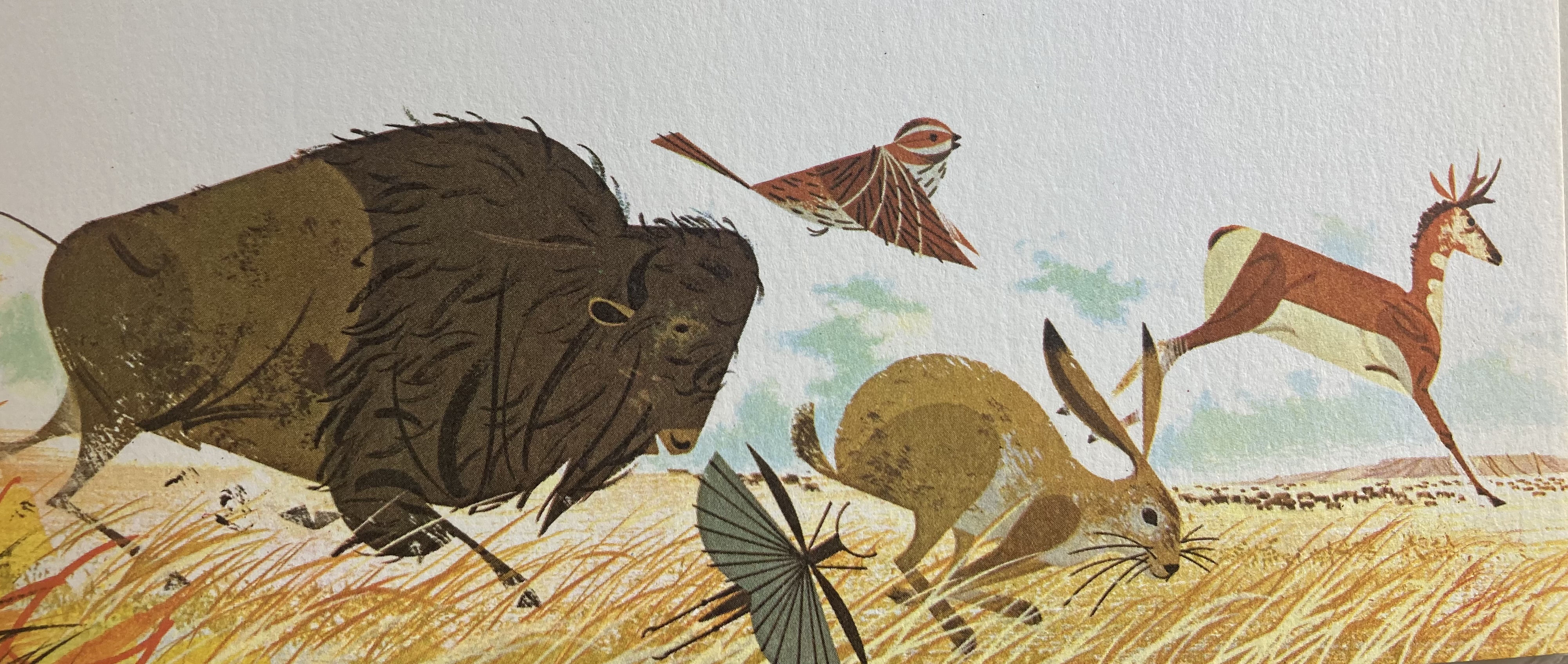
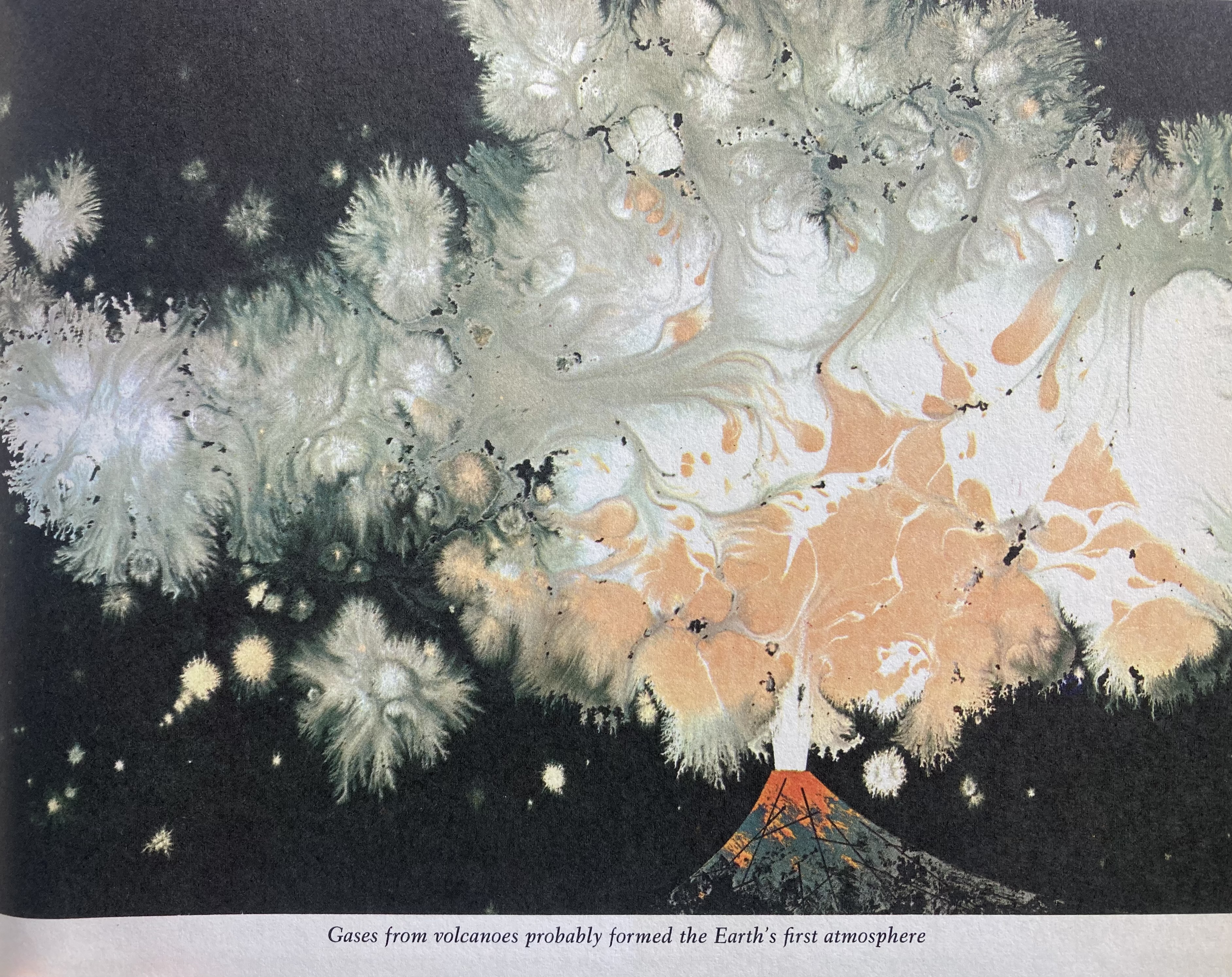
But what we’re really here for: those pictures. I really did appreciate Charley Harper’s illustrations, and from this relaxed-pace read* and the other Harper work I’ve looked at with Mom recently, I’ve definitely come to recognize his distinctive, often geometric style. I’ve pulled out a few of my favorite images here for your enjoyment. (Click to enlarge.)

I am amused at this creeper version of Darwin

*I took my time with this one, not least because it is an older book, rather precious, I think expensive? and visually lovely. I didn’t take it with me on any of my recent travels and was careful around food. Especially since I’ve been traveling a fair amount lately, it took me a long while to get through this book, but that felt good.

Final verdict? Definitely recommend for the visual art; still passable for the science. Thanks, Mom.


Rating: 8 cowbird eggs.

Odder by Katherine Applegate, illus. by Charles Santoso

I fell in love with this book as reviewed by a colleague of mine at Shelf Awareness (here), and bought it for the six- and ten-year-old sisters who are my friends. But when it arrived I couldn’t let it go and so I read it first.

It’s every bit as delightful as it sounds in the above review, and I’m so glad I picked it up, and glad that I have young friends to inspire me. I loved the storytelling style: easy-reading, brief, free verse poems that speak plainly but also with lyricism (Odder’s front paws when she was just a pup were “dream-busy / small and soft as / a toddler’s mittens”). I loved Odder, of course, her name and her personality and frank responses to the world. What do I know about sea otters? but this story and characterization felt true to the natural world, and at the same time, offered many lessons applicable to other life forms. “Why simply dive when she could dazzle?” The ocean isn’t about morality, and there are no villains here; after a shark attack, Odder doesn’t blame the shark. “She’s seen enough to know / that this is how life is, / and this is how death comes.” (Spoiler alert: death has not come for Odder yet.) There are some excellent how-to poems: “how to rescue a stranded otter” offers important points about not rushing in; there are two versions of “how to say goodbye to an otter,” for both humans and otters. There’s a neat little poem called “keystones” that teach the meaning of ‘keystone species’ succinctly, which is a fine example of how Odder gives both naturalist lessons and broader ones.

I’m charmed, and so happy I spent some time with this book. Definitely recommend.


Rating: 9 clams.

Fantastic Mr. Fox by Roald Dahl

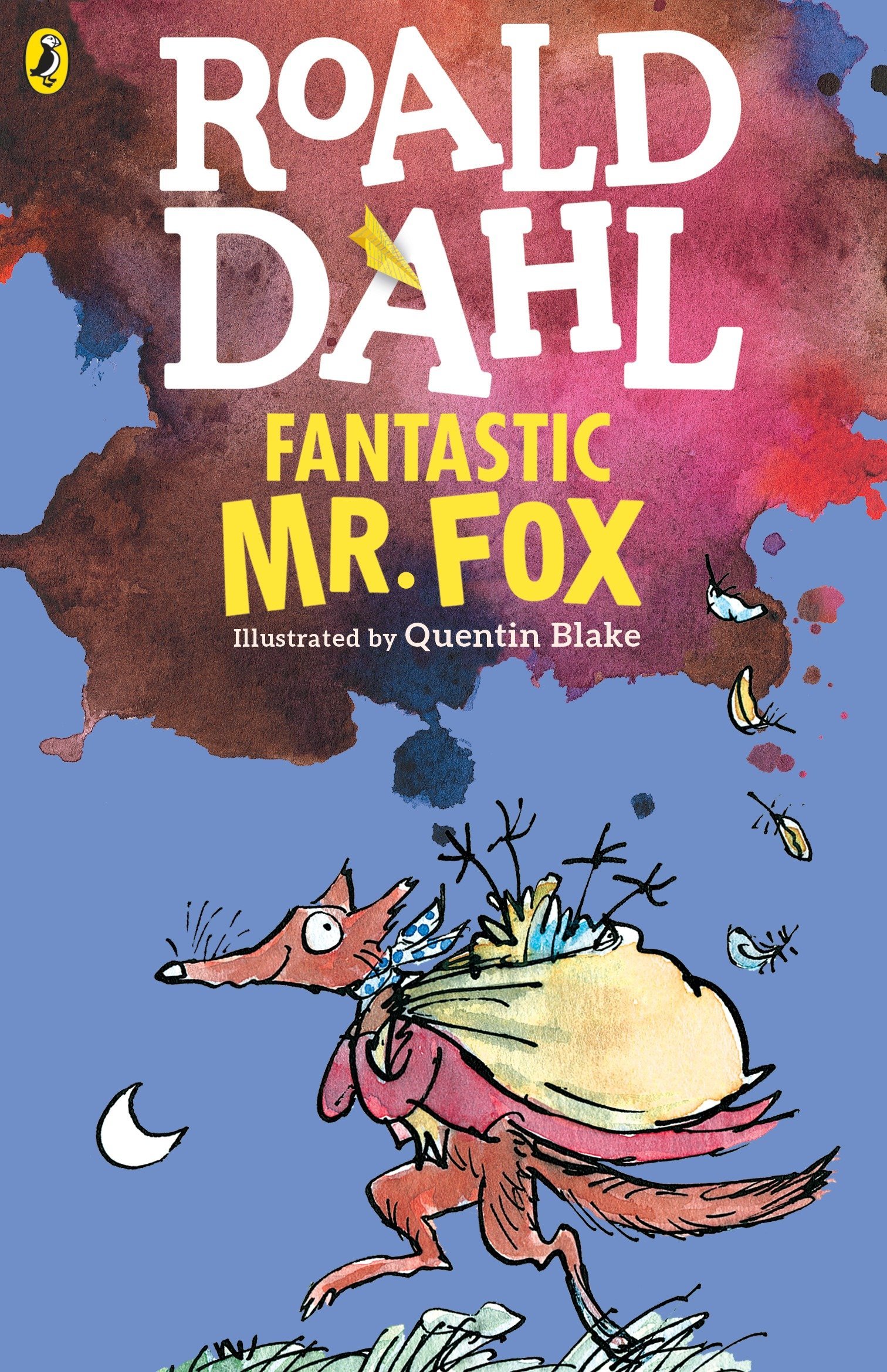
This randomly appeared in my mailbox, and it was a perfectly lovely revisiting of some iconic features of one of my all-time favorite authors. We’re missing one familiar element, which is childhood–instead we root for the clever Mr. Fox, his loving wife Mrs. Fox, and four Small Foxes. Our antagonists are appropriately comical and ridiculous: Farmers Boggis, Bunce, and Bean, whose farms respectively produce chickens, ducks and geese, and turkeys and apples. (Bean, the turkey-and-apple farmer, exists entirely on very strong cider.) The wealthy ruling class has too much but still begrudges Mr. Fox the odd poultry to feed his family. Mr. Fox’s wit is generally enough to keep him out of trouble, until the mean farmers band together and trap his family in their den under siege; then our hero will have to turn twice as crafty to save the day, not only for the Fox family but for the other digging critters of the neighborhood (the families Badger, Mole, Rabbit, and Weasel). There is tension and suspense and a final joyous comeuppance for the bad guys. There is a moral lesson: when Badger worries about stealing, Mr. Fox retorts, “My dear old furry frump… do you know anyone in the whole world who wouldn’t swipe a few chickens if his children were starving to death?” Who, indeed? There are also illustrations by Quentin Blake, whose visions of Dahl’s work have always defined my experience of this author, so that’s perfect.

Thanks, Pops. You were right. This was a treat.


Rating: 8 carrots.

rerun/reread: Have You Seen Marie? by Sandra Cisneros, illus. by Ester Hernández

I’ll call this one in part a rerun post, since it started that way. But I did reread the book as well, and in a different format. We’ll start with the original review, which ran in 2014.

What a lovely, lovely book. Fans of Sandra Cisneros, don’t be put off by the sometimes-classification of this short fable as a children’s book. Cisneros says in an afterword that she certainly never thought of it that way; she intended it for adults, and I can confirm that it works that way, very well.

This is a short, dreamy, poetic tale of a woman, the narrator, who has just lost her mother; a visiting friend (“I was the only person Rosalind knew in all of Texas”) has lost her cat, Marie. Together, the two women go walking the streets of San Antonio, distributing fliers and asking folks the title question: Have you seen Marie?

The voice and rhythms and lyrical style that I remember from The House on Mango Street are vibrantly present here. The women ask dogs, cats and squirrels as well as people about the missing Marie, and their reactions are noted, and charmingly represented as being every bit as important as the people’s. On the surface, this is the story of searching for Marie; but it is also the story of Cisneros losing her beloved mother, feeling like an orphan in her own middle age, and gradually coming to understand that “love does not die.”

As I mentioned, Cisneros is careful to point out that this was not meant to be a story for children, but rather one for adults, with the idea of helping others like herself deal with experiences like hers: losing a parent, or a loved one. I am very (very) glad and relieved that I don’t seem to facing this experience now, or soon; but I imagine that this book would indeed help. I appreciate its soothing musical tone and gently loving, inspired advice and creative understanding of death, what it means, the grieving process. It is a tender tale. Cisneros is inventive and calming and this is a beautiful, moving story about family and friendship. I highly recommend it, for anyone.

This audio version is read by the author, and so beautifully; I love her lilt; it’s perfect. I want to very much recommend this version (in both English and Spanish in one edition – one cd of each). But then, the print copy is illustrated by Ester Hernández, and Cisneros is clearly very pleased with that aspect. Hearing her speak about their collaborative efforts on the illustrations (Hernandez came to visit & tour Cisneros’s San Antonio; she calls it documentary-style) made me regret missing the print. So there you are. Both, perhaps?? I think I will go out and get myself a copy of the book, too.


Rating: 10 trees along the San Antonio River.

I did indeed buy the print book, and what I had in mind, in part, was to have it on hand when a friend needed it. That’s taken some years, but I turned to it just recently here with a friend in mind who’d lost a parent, and whose children had therefore lost a grandparent. I picked it up to check it for age-appropriateness for those kids. My conclusion is that it is “safe” for young kids – nothing harrowing about the grief, in fact only gentle reminders that the narrator (the Cisneros character) has lost her mom. It behaves like a children’s picture book: the illustrations are as lovely as I’d imagined, and it relies on refrains and simple language. My only hesitation for kids would be that it’s longer than a typical bedtime story. I did pass it on to my friend with that caution. Maybe it takes a couple of nights to read; maybe it’s for the elder child and not the younger. I also hope my friend will try it on his own first, if only for his own, personal benefit.

It’s also true that I’ve lost somebody close to me recently, too, and I was touched and moved all over again by Cisneros’s small, apparently simple book. Especially the author’s note caught me this time, because it offers a way of thinking about grief that I find charming and, I think, useful. I was also pleased by the cultural flavor of Cisneros’s San Antonio neighborhood. I love that taste of home. And since my original review, I’ve lived near San Antonio, and become a little familiar with its neighborhoods. This was an added bonus. There are a few Spanish-language words sprinkled in, but even with no knowledge of the language, I think any reader will be fine to follow along using context clues.

I am still recommending this book highly, for adults, and with some caution for children as well. I’m sticking with my original rating, and I’m glad I got such a timely chance to revisit.