



biographies of parallel lives: Rachel Carson and Marie Tharp; and beyond

Remember when I raved about Soundings, the biography of the woman who mapped the ocean floor? I was enchanted in part by the style in which author Hali Felt evoked her subject, Marie Tharp, as a personality as well as a historical figure. I was also fascinated by the unique persona of Tharp herself, and her role as a woman in science in the 1940’s, 50’s, and 60’s.
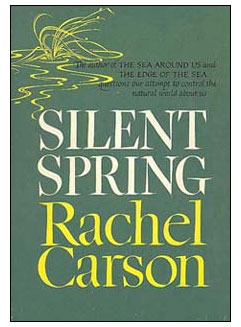
And now I’m very pleased to have picked up a new biography entitled On a Farther Shore, by William Souder, about Rachel Carson, for the 50th anniversary of the publication of her groundbreaking book. Silent Spring exposed the tragic truth, that the widely used pesticide DDT was killing not only bugs, but birds and myriad other wildlife, and even humans. Carson is credited with playing a major role in the birth of the environmentalist movement.

These two biographies employ very different styles. Felt is a visible character in the story she tells, of Tharp’s life through the lens of Felt’s research experience, while Souder’s work so far tracks like a traditional biography, with the author invisible. But their subjects share a few obvious similarities. Both were women on the margins of scientific communities that weren’t entirely prepared to let them in, and they were more or less contemporaries (Tharp was born 13 years later than Carson). Both challenged the gender barrier and accepted understandings of their fields. I recognized these parallels when I began reading On a Farther Shore.

But I wasn’t prepared for the confluences and coincidences that came fast and thick in the opening chapters. (I’m only about 50 pages in, so this is far from a final review of Souder’s work. Although I do like it so far!) For one thing, forgive my ignorance: I knew about Silent Spring (I read it when I was a kid), but had not known that prior to that most famous of her books, Carson had been a well-loved and bestselling author of literary writings about the ocean. So, number one: both women were fascinated with the sea. And then came a comparison of Silent Spring, with its unprecedented exposure of an industry that would later be legislated and regulated largely because of the book itself, to one of my all time favorites: Upton Sinclair’s The Jungle. Next I learned that Carson grew up scarcely an hour’s drive away from where Edward Abbey would grow up 20 years her junior. That is a hell of a coincidence.

As I joyfully made these connections (which I know will continue, because our world is all interconnected), I mused. I remember feeling, in middle school, even in high school, that certain subjects were “work,” were chores, weren’t fun, didn’t feel like they were teaching me things I’d need to know or care to know later in life. I liked English but had less use for history. And I also remember when this changed for me, and when learning for its own sake became something I felt passionately about. The light-bulb moment was related to the interconnectedness of all things. That history, biology, political science, and literature were all the same story; that nothing happens in a vacuum, just as Gertrude Stein, mentor and friend to my main man Ernest Hemingway, was a student at the Marine Biological Laboratory in Woods Hole, Massachusetts just a few decades ahead of Rachel Carson. I don’t know about the rest of you, but learning that the world is interdisciplinary and that contemporary figureheads from a variety of textbooks lived in the same world – that Einstein’s life work and philosophy was deeply influenced by his observation of German militarism culminating in Hitler’s rise to power, that the reclusive Harper Lee and the effervescent Truman Capote were buddies, that Mark Twain and the much-younger Helen Keller were close – has been the turning point for me in appreciating so much more reading and learning than I did even 10 years ago.

Recognizing these connections has led to myriad new directions in my own reading. Some of them have been in fiction (I’ve read Gertrude Stein because of her relationship with Hemingway), and many have been nonfiction. In general, I would definitely credit this larger observation with my ever-growing appreciation of nonfiction. I’m sometimes saddened to hear from people who don’t like nonfiction, because they’re missing so much. I suspect they just haven’t met the right style of nonfiction yet; but maybe, too, they haven’t had that light-bulb moment that did it for me.

Does anybody else share this feeling that everything being connected make the world a fascinating place? Has it influenced your reading habits?

The Invisible Line: Three American Families and the Secret Journey from Black to White by Daniel Sharfstein

I recently read Isabel Wilkerson’s very impressive The Warmth of Other Suns, about the migration of black Americans out of the south throughout the 20th century. And then I immediately read Henry Wiencek’s Master of the Mountain, about Thomas Jefferson and the more than 600 slaves he owned throughout his life, and his treatment of them. (That review will post closer to the book’s publication date in mid-October.) This was a neat coincidence, and had me on a roll, thinking about slavery in the United States and the aftermath for freed slaves and their descendants; so I moved smoothly on to The Invisible Line, in which Daniel Sharfstein follows the transitions made by three families from being seen as black to being seen as white. It raises some interesting questions about the lines we draw and our tendency to think of race as having sharp corners and firm divides.

The mixed-race men and women Sharfstein tracks and studies in this book include “colored aristocrats” in Oberlin, Ohio and Washington, D.C. who hold public office, practice law, and exercise great influence on local politics. They also include back-woods residents of Appalachia whose lifestyles resemble those of hundreds of years ago, and Confederate soldiers and commissioned officers. Sharfstein follows these families to the present day, when their descendents represent a great range of professions, levels of education, and lifestyles. Some are more aware of their heritage than others, and they have different reactions to being accused of having “black blood.” Their experiences raise a number of interesting questions. It seems that it’s always been easy to view race as having cut-and-dried boundaries; but this book makes it equally clear that nothing could be further from accurate.

I liked that, like The Warmth of Other Suns, this book followed three individual stories – in this case, three families rather than three individuals, because it spans more than a lifetime. Again, this approach made the subject personal. It allowed Sharfstein to show the diversity of ways in which the process under discussion – the crossing of the color line – took place, and the diversity of ways the protagonists saw their own lives. The three families here represent different starting and finishing points in geography and in social and economic standing; and they represent different understandings of their own pasts. The book opens with a very powerful short scene involving a present-day white man who confesses to being a racist, and then discovers in his genealogy research that, what do you know, his own great-grandfather was a black man, a former slave.

My impression of The Invisible Line is that it includes solid research, and I thought it fairly and thoughtfully tackled this subject – one that has not been well-examined, or at least that I was not much aware of. I liked the personal element of the individual families. It made me think about some things I hadn’t considered before: how intertwined we all are, for one thing, and – not for the first time – how sad are certain elements of our national history. This was an excellent follow-up to my recent reading, and I recommend it if you’re interested in the subject matter.


Rating: 6 branches on the family tree.

Einstein: His Life and Universe by Walter Isaacson (audio)

A.Word.A.Day recently sent me, among other valuable tidbits, a quotation that perfectly describes Einstein (thought I, being in the middle of his biography):

A harmless hilarity and a buoyant cheerfulness are not infrequent concomitants of genius; and we are never more deceived than when we mistake gravity for greatness, solemnity for science, and pomposity for erudition.– Charles Caleb Colton; Lacon: or Many Things in Few Words; Longmans; 1837. Quoted by A.Word.A.Day, August 31, 2012.

And here’s the poster child for that very thought: hilarity and cheerfulness (among other qualities) combined in one of the geniuses of the modern era.

Walter Isaacson is a well-respected biographer. (His other works include biographies of Kissinger, Ben Franklin, and most recently Steve Jobs.) This well-regarded biography of Einstein appears to be very well-researched and thorough, and I thought the audio narration by Edward Herrmann was well-done and well-suited.

What I liked best about this book was its characterization of Einstein, the charmingly rumpled, distracted, unique genius with the twinkling eyes and the mad wild hair who rode a bicycle. There were times I didn’t like Einstein, too: in the course of separating from and later divorcing his wife, he didn’t treat his two sons very well. It felt like he expected them to behave like little adults – or perhaps more accurately, he behaved like a child. He wasn’t entirely sweet to his wife, either, which is of course common in divorces but no less charming for that. But Isaacson’s portrayal of of Einstein’s mental style was lovely to read: how he thought in pictures, in objects in action, in “thought experiments” and not in words; the way his aversion to authority and accepted truths freed him to think such outlandish thoughts that he revolutionized science; these are the singularities that made Einstein Einstein, and that was an important lesson to take away. Also, it was fun to read the story of his life with the advantage of hindsight – that this is Einstein we’re talking about here – and see all the rejections and belittlings he underwent, and sort of chortle at the irony. (Correction of a well-known myth: Einstein did not, in fact, fail math. He did rather well. However, there was that teacher that said he would “never amount to much.” That part is true.)

I observe that my decision not to pursue a subject like theoretical physics was a very, very good decision. I can follow all sorts of things, grasp all sorts of concepts, but not this. My eyes glazed over within moments of the science-talk beginning (dangerous for driving). I positively cannot “get” Einstein, and I’m comfortable with that. But it made this book a little more difficult than I would have liked, because the book is rather science-heavy. I think there are different ways to do this job, of writing a biography of a scientific figure, or other science-based nonfiction. I think of Soundings or even The Immortal Life of Henrietta Lacks, both lovely narrative works about science and people that treated the people more heavily, and in more depth, than they did the science. The science was there, present (necessarily), and well explained, made accessible by explanation, but the people shown brighter. That worked for me. Here, in Einstein, it was Einstein himself that I was most interested in, and I liked it when his personality, his public image, his family dealings, etc. were at the forefront. Isaacson lost me entirely and quickly every time he wandered into physics and relativity. One way is not better or worse, but different; and it’s clear which style I prefer for my scientific nonfiction.

That said, the man played a starring role, and I believe Isaacson’s intention was to put in the science needed to place Einstein in context. I learned a lot about Einstein, I was entertained by his foibles and eccentricities (the not wearing of the socks! oh my), I was charmed. I was provoked to contemplate some of the troubling moments in world history that Einstein witnessed and participated in (Germany in the 1930’s, fascism, McCarthyism, the atom bomb, on and on). In a nutshell, Isaacson captures well the humanity of Einstein: his charm, his flaws, and his genius, all in one. This biography is moving, entertaining, and very informative. If you’re so inclined, you might even learn some physics from it. 🙂 I can see why Isaacson’s stock as a biographer is high, and I forgive him for baffling me here and there.


Rating: 7 quanta.

Teaser Tuesdays: The Invisible Line by Daniel Sharfstein

Teaser Tuesdays is a weekly bookish meme, hosted by MizB of Should Be Reading. Anyone can play along! Just open your current read to a random page and share a few sentences. Be careful not to include spoilers!

I’m reading an impressive work of nonfiction today; but for my teaser I’ve chosen an especially *fun* quotation for you. It’s not entirely indicative of this book’s content, but it’s such a neat picture of another sort of writing that I couldn’t resist.

His plays were a garish parade of socialites, bounders, frauds, thieves, and gold diggers. Unhappy husbands tried to hang themselves. Long-lost lovers were reunited. The embraces were always “passionate,” the kisses unfailingly “violent.” A pistol placed on the mantel on page six was fired by page thirteen.

Isn’t that precious? Just a few sentences but I think it perfectly communicates exactly the sort of plays this man wrote!

And what are you reading today?

The Warmth of Other Suns: The Epic Story of America’s Great Migration by Isabel Wilkerson (audio)

I didn’t really know what this book was about when I picked it up – only that it was well-regarded. I’m so glad it found its way into my hands. Isabel Wilkerson has taken on a large-scale, ambitious subject here, and rendered it beautifully. And the audio reading by Robin Miles is lovely to boot.

The “great migration” in the subtitle refers to the movement of black Americans out of the South and into the northern and western United States in 1915-1975. Wilkerson starts from the very beginning, looking at the experiences of former slaves just after Emancipation in an impoverished region struggling to rebuild with a new order of things. The creation and expansion of Jim Crow laws designed to hold blacks down took time after the end of the Civil War to take effect. In the new caste system, former slaves and their descendents were unable to move up in the world and were in constant fear for their lives if they were to misstep around Southern whites. By 1915, they had begun to move out of the South, in what became a mass migration along lines so distinct that enclaves of blacks from specific towns and states were recreated in new locations.

Wilkerson shifts between two ways of studying the Great Migration. Sometimes she takes a broad view of history, in which she cites her own interviews (she states that she did over 1,200) with migrants and their descendents as well as a number of historical sources, to render the story of the Migration generally. And sometimes she follows the specific personal stories of three individuals who she interviewed at great length over a long period of time, traveling the country with them and becoming part of their lives. (In this respect, the journalist/author becoming part of the family of her subject, I was reminded of Rebecca Skloot’s amazing The Immortal Life of Henrietta Lacks.) George Swanson Starling moved from Eustis, Florida to New York City, later sending for his wife Inez to join him there. He had to leave Florida suddenly because a friend tipped him off that a lynch mob was coming for him; he had been involved in organizing his fellow citrus pickers to demand higher wages. Ida Mae Brandon Gladney moved with her husband George and their two children, with a third on the way, from Mississippi where they had been sharecroppers. They would eventually end up in Chicago, by way of Milwaukee. And Robert Joseph Pershing Foster was an ambitious surgeon and veteran from Monroe, Louisiana, with his heart set on Los Angeles. Known as Pershing in Monroe, he would resettle as Robert (or Bob, or Doc) in LA and send for his wife and daughters to join him there, where he built a new life in high society with the big house and booming practice he’d always wanted.

I found this shifting back and forth between the broad view and three personal histories extremely effective. Anecdotes from the lives of Southern blacks drove well home the misery of their bottom-rung status there; some of these stories are horrific, but important to show the desperation some migrants felt when they left their homes in the South. National trends played a role – for example, during WWII demand for Florida’s citrus was high while the supply of labor to pick the fruit was low, with everyone off at war, and this imbalance led to George Starling’s ability to demand higher wages. And the history of Chicago’s race relations and residential segregation puts Ida Mae Gladney’s home ownership into the proper perspective. You get the point. The history is well-documented and, I’m convinced, well-researched; and the personal stories make it all, well, personal. I was deeply involved with our three representative individuals by the end of the book and, yes, I cried.

I love that Wilkerson brought such a large-scale, important trend, that has had such huge effects on American history, to life the way she did. I also like that she examined the broad effects of the Great Migration, in terms of the cultures of both white and black residents of the North and the South, and took the time to show that black migrants were really far more like immigrant groups in history than like migrants within their own country. I recommend this book as part of a study of American history – but one need not be an academic to appreciate it. The story of the Great Migration is made accessible here, and I’m glad I know more about it now. This 19-disc audiobook (over 600 pages in print) went by easily. This is how I like to take my history lessons. Check it out.


Rating: 8 train rides north.

Soundings: The Story of the Remarkable Woman Who Mapped the Ocean Floor by Hali Felt

I’m so glad I picked this book up (and bought it for the library where I work). It sounded like just the sort of thing I appreciate: a biography of a little-known historical figure who made an important contribution to the world as we know it but was herself forgotten. In this case, the “remarkable woman” of the subtitle is Marie Tharp, whose meticulous study and cartography of the ocean floor established the concept of plate tectonics that science now recognizes as fact, but was at best a blasphemous and ridiculous notion before Tharp came along. Her achievements, however, were minimized by a scientific culture in which women did not belong. This biography is additionally appealing to me for its mood: author Hali Felt takes a whimsical, dreamy, almost fanciful tone at times. She describes her own attraction to Tharp’s story (born in part of Felt’s mother’s, and her own, fascination with maps) and the relationship she felt to her subject. She dreams of Tharp coming to her to explain the mysterious and unspoken parts of her life. This book is nonfiction, but it’s honest, personally related, and warm.

There is also an enigmatic love story of sorts hiding within Soundings: Tharp’s career and life were both tied to a man named Bruce Heezen. Heezen was her coworker, then her technical superior; but they shared a partnership in work, in science, in discovery, and apparently in all things. It is known that they were a couple, although they never married and the details of this side of their relationship are very few.

Felt follows Tharp from her childhood with a science-minded father she adored, through her education in English, music, geology, and mathematics, and to her first job in the oil & gas industry (oh, how familiar to this Texas girl). But she was held back: this was the 1940’s, and women in science were mostly expected to make copies, compute numbers, and brew coffee. Eventually Tharp found her way to New York, to Columbia University and the Lamont Geological Observatory. This is where she would meet and work with Heezen and quietly make history.

The science in this book is very friendly and accessible to a general reading public; the story that Felt set out to tell is more that of a woman’s life and accomplishments despite the limitations of her society, than that of tectonic plates per se. For that matter, Felt shows that it was Marie’s combined backgrounds in art as well as science that made her perfectly suited to play the role she did in history. Her meticulous re-checkings of data and attention to detail were indispensable – but so was her interest in visually representing the data available in a way that would show the general public (not just academics) what she’d discovered. So her achievement was artistic as well as scientific. Soundings does make the science side clear, but doesn’t dwell, and is never dry. Rather, Marie Tharp comes to life: she is a precocious child; an ambitious, able, frustrated student; a dedicated scientist; a life partner; an eccentric aging woman caught up in her own past, campaigning to honor and preserve the legacy of her other half.

Hali Felt was honest about the role she plays in the story she relates. She begins in her Introduction by briefly describing her own attraction to maps, and then follows a chronological format, beginning with Tharp’s childhood and following her life, and eventually her death. And then Felt returns to the story: her discovery of Marie Tharp’s existence, her interest, her decision to follow that interest, her research, her relationships with the living descendents of Tharp and Heezen’s world (the “Tharpophiles”), and in the Acknowledgements at the end, she even hints at the process by which she came to write and publish this book. I found all of these Felt-related details interesting too.

In a word, this is a lovely biography, and the style and tone of it may be my favorite part.


Rating: 9 double-checkings of data.

Teaser Tuesdays: The Warmth of Other Suns by Isabel Wilkerson

Teaser Tuesdays is a weekly bookish meme, hosted by MizB of Should Be Reading. Anyone can play along! Just open your current read to a random page and share a few sentences. Be careful not to include spoilers!

I think we’ve all heard a lot about this bestselling work of nonfiction; I’m going to end up adding my voice to those recommending it, and I can say that Robin Miles’s narration of the audiobook is worthwhile as well. Check out this piece of writing:

From Louisiana, he followed the hyphens in the road that blurred together toward a faraway place, bridging unrelated things as hyphens do. Alone in the car, he had close to two thousand miles of curving road in front of him, farther than farmworker emigrants leaving Guatemala for Texas, not to mention Tijuana for California, where a wind from the south could blow a Mexican clothesline over the border.

Aren’t the hyphens lovely? And I appreciate the geographical detail, that these migrants within their own country traveled further than the international ones we hear so much about. This makes me think of an experience I had at the Rio Grande down at the Texas-Mexico border. I hope you’ll indulge me…

I was down in & around Big Bend National and State Parks with friends, mountain biking and checking out the hot springs. We visited one hot springs right on the Rio Grande, and the enterprising Mexicans across the river had set up a little honor-system sale of arty crafts: they had set out scorpions twisted out of wire and the like on a rock, with prices labeled, and we were to leave our money behind (I was told) and they would paddle over after dark to retrieve it. We looked across the river, some 15 feet, and saw people in the trees watching us back. This drove home to me how small, how subtle is the physical border between two political states, and made me marvel at the huge difference our governments expect us to see between someone born on one side of this little trickling dirty stream of a river, and someone born on the other. It seems like an cruelly arbitrary way to decide who gets what advantages in life. I had to conclude that if I were born on the “wrong” side and thought I saw opportunity on the other, I too would wade across. What’s a little muddy water, anyway? That image, of the tiny Rio Grande as border, was recalled to me by Wilkerson’s point about the wind blowing a clothesline across.

I’ve been distracted. Call this a teaser of the feelings and musings that Wilkerson has evoked in just the first few tracks of this lovely (audio)book. I recommend her.

And what are you reading this week?

The Perfect Storm by Sebastian Junger (audio)

In October 1991, a number of factors converged to create a storm of inconceivable strength off the Massachusetts coast. Vessels large and small struggled in its path, and a few didn’t make it out. Sebastian Junger follows a few of the men, women and boats involved in this remarkable work of nonfiction. He begins by introducing us to Bobby Shatford and his girlfriend Chris, and their town of Gloucester, Mass. Bobby and Chris wake up hungover – Bobby has a black eye – and drive around town, visiting with friends and Bobby’s mother Ethel, bartender at the Crow’s Nest, and making final arrangements for Bobby’s departure on the Andrea Gail, a small fishing boat with a crew of six. We then follow Bobby’s path and that of his fellow fishermen: the two men who get funny feelings and refuse to sail with the Andrea Gail, and the five who join him on her for an intended 4-week fishing trip. We track their fishing, the decisions made by their captain Billy Tyne, the radio communications between Tyne and other fishing boat captains. We watch the storm approach, checking in with meteorologists and getting quick lessons in storm formation, and we visit other boats as well, including the Satori, a 32-foot sailboat, and the Eishin Maru, a Japanese longliner, both fated to have complications and exciting moments. We also get to know two rescue crews, made up of Air National Guard pararescue jumpers and Coast Guard rescue swimmers. I won’t give too much away (although, all of this being a matter of historical record, it’s out there), but not all of the characters introduced survive the storm.

That’s about all I want to say about the events detailed here; you can find out more by reading the book yourself (or listening to the audio, as I did – more on that in a bit), which I highly recommend. And here’s why. This is an incredibly adrenaline-pumping adventure tale. There are sad endings for some of the men and women involved, yes, but there is also great heroism, amazing skin-of-your-teeth survival, drama, even a love story or two mixed in. The human interest, in other words, is huge. For excitement, really, could you ask for more than rescue swimmers jumping out of a helicopter into the storm of the century to rescue men and women from sinking ships or from the open ocean? I submit that you could not.

In addition, the story is told in a unique way. Junger jumps subjects throughout: we meet a few characters in Gloucester, then we review the fishing history of the town of Gloucester, then we study up on commercial fishing for a bit, back to the characters… eventually we get lessons in meteorology, the physics of boat building, wave formation, and what exactly happens when a person drowns. As I wrote before, Junger is fairly strict and journalistic in following the facts. Where parts of the story he tells are unknown, he doesn’t claim to know, but he does interview people who have been through similar scenarios and survived; so we get an educated estimation of what the players might have been through, while making nothing up. It’s a method I respect; I found it both dramatic and fully-wrought, and reliable.

The audiobook I listened to is excellent, too. Read by Richard M. Davidson, it has all the taut, tense action it needs without ever feeling over-dramatized. And as a bonus, it includes a recording of the author speaking about the making of the book. This flows like his-side-only of an interview; I imagined someone in between asking specific question. Like the foreword, I found this a substantial addition. At the time of the storm, in 1991, Junger was working as a high climber, taking trees down for a tree company, and selling freelance magazine articles for a living. The storm inspired him, and he wrote a chapter about it, initially for a book he conceived about various dangerous jobs: the commercial fishermen of Gloucester would have been joined by loggers, smokejumpers, forest-fire fighters and the like. But his agent landed him a deal for a whole book about “the perfect storm” – whereupon Junger became anxious. How would he fill a whole book with just the storm? he wondered. (I loved hearing the author, in his own voice, discuss his nerves! And the whole process, really.) So he decided to follow all the sub-plots and related topics he could, to flesh it out, and this is why we are treated to the lessons in weather, boats, the fishing industry, etc. What struck me about this is that it is a rather Moby-Dick method, and ironically, while that classic work of fiction is notoriously difficult to read (come on, even its fans admit this, right?), this work of nonfiction – even though readers often fear nonfiction will be dry or cumbersome – flowed delightfully and effortlessly. Those subplots mightily enriched the whole. Even the questions left unanswered, about the fates of those who disappeared and whose remains were never found, Junger turns to advantage. As he says, because he investigated the experiences of others who lived through similar situations, we get a richer, more layered story than had he interviewed a sole surviving fisherman.

Sorry for another long review! (Usually this means I really liked the book.) In a nutshell: moving, emotional, adrenalizing, scientific, faithful, thrilling! Check it out.


Rating: 8 swordfish.

EDIT: I also reviewed the movie, here.

City of Ravens: London, the Tower and Its Famous Birds by Boria Sax

A bird’s-eye view of the Tower of London’s famous raven residents and their role in history and myth.


The Tower of London combines commercial tourism, history and myth in a single site, and its iconic ravens are a part of all three functions. Legend has it that when the ravens leave the Tower, Britain will fall. Boria Sax’s City of Ravens blends a highly readable narrative style with academic research into Britain’s history, the study of birds and Sax’s own interest in animal-human relationships. Sax examines the ravens’ changing significance in London’s imagination, from being harbingers of death and doom as they fed off the bodies of those executed at the Tower to being heralded as guardians of Britain’s Empire–likely due to their role, during the Blitz, of warning of incoming bombs.

Sax’s research largely dispels the popular belief that ravens had been pets at the Tower since medieval times, and he is ambivalent about the accuracy of the historical raven record. After highlighting a few individual ravens’ personal histories, he finishes by considering the ecological questions raised by the captive birds whose wild counterparts have begun to repopulate London, weighing the options for protecting both the ravens and their mythical standing.

These musings, admittedly conjectural at times, draw on diverse resources including newspaper archives, popular literature, early tourist guides to the Tower and other historical sources–as well as fictional accounts. Part history, part deconstruction of myth, part bird study, always lovingly respectful of the birds themselves, City of Ravens is a whimsical, entertaining and informative journey into London legend.


This review originally ran in the July 13, 2012 issue of Shelf Awareness for Readers. To subscribe, click here, and you’ll receive two issues per week of book reviews and other bookish fun!


Rating: 5 wings.

Houston Beer: A Heady History of Brewing in the Bayou City by Ronnie Crocker

If you know anything about me, you should realize that Houston + beer = I will read your book. I am so enthused about my hometown, and about beer, and about my hometown beer (that is experiencing a huge boom as we speak – more on that to come, obviously), that all you would have to do to gain my undivided attention is write a book about Houston + beer. Even poorly written and sloppy. Luckily, I can say that this book goes a step further and does it properly.

Ronnie Crocker writes for the Houston Chronicle, and blogs for same under the name Beer, TX. His book is slim – under 150 pages – but not lightweight; he did his research, and uncovers new details about the history of beer in Houston. This is a surprisingly undersung (and under-researched) topic, apparently.

Beginning with the beginnings of the city (see my earlier teaser), Crocker studies us as a drinking city, and those who have served our thirst. Like many cities in this country, we had something of a boom going before Prohibition, and struggled to make a comeback after that failed experiment. We were a Bud town for a while, and Anheuser-Busch (in its new InBev-conglomerate form) still brews in Houston today, to the tune of …so many millions of barrels that it boggles the mind, and I can’t hold numbers that big in my head. [For more on the AB-InBev merger, check out my review of the excellent Dethroning the King.] Fast forward still more, and we’re seeing a veritable, and delightful, renaissance: the long-standing Saint Arnold Brewing Company (hey, seriously, 18 years is a long time in this business in these parts) joined by a promising handful of new brewers. My favorite is Karbach, of course, but I give a head-nod to Southern Star, No Label, and Buffalo Bayou, too. And I’m still anxiously awaiting the announcement that Yard Sale is in business!

Crocker’s book is admittedly reluctant to criticize; it leans towards the positive, even approaching boosterism. And it ends strangely, with an exhortation to support (i.e. buy from) your locals. But I’m with him! I, too, am excited about Houston beer. So, perhaps Houston Beer isn’t impartial journalism – but it’s an invaluable, unique history. I found it enjoyable, just what I wanted and no, never poorly written or relying on my devotion to the subject to keep me engaged. And it was great fun to see a number of people I know pictured, as a bonus!


Rating: 5 pints.