book beginnings on Friday: The Red Queen by Philippa Gregory

Thanks to Rose City Reader for hosting this meme. To participate, share the first line or two of the book you are currently reading and, if you feel so moved, let us know what your first impressions were based on that first line.

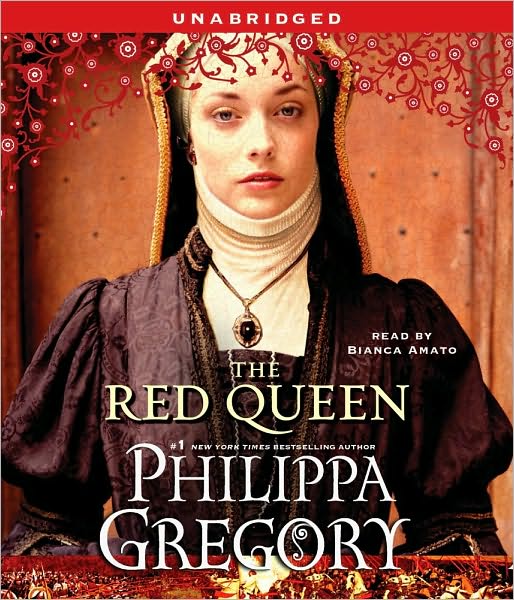
This is a bit of a guilty pleasure for me, but in the lighter area of historical fiction: Philippa Gregory! We begin…

The light of the open sky is brilliant after the darkness of the inner rooms. I blink and hear the roar of many voices. But this is not my army calling for me, this whisper growing to a rumble is not their roar of attack, the drumming of their swords on shields.

I am intrigued so far.

And what are you reading this weekend?

guest review: Out Stealing Horses by Per Petterson, trans. by Anne Born – from Pops

Pops joins us again! You can see other contributions from my dad here. He says he wrote this one just to get me interested in reading it myself. 🙂 It’s on the stack, Pops. Thanks for the review!


This is one of the better books I have read in a very long time. I hesitate to use words like “spectacular!” because it’s not that kind of book. Rather, it is quite simply unique, heartwarming, insightful, and a joy to experience. I could also cite this book’s bestselling credentials (from 2005), and its broad acclaim in reviews – but let’s face it, that doesn’t always count for much.

I am also reluctant to describe what the “story” is, because in fact a summary may in itself sound spare and unremarkable – and spoil the real value here. What’s special is the way the story is told and how it is revealed, the author’s voice and the narrative structure he uses. This is a reading experience; I found myself rereading a paragraph to “taste” it anew each time: the content, the style, the implications. I liked the mood his tale creates – relaxed and thoughtful; the endearing characters, and the story’s sense of place.

Trond Sander is 67 years old as the 20th century is coming to a close and he has just moved into a small Norwegian cabin in the woods for his remaining life. In his first person narrative, we gain glimpses of his life from two perspectives: first, as he reflects while establishing a simple routine around the cabin, in the little village, on walks with his dog. His reflection also takes us back to a few formative years of his youth during & just after the German occupation of Norway, and key events that happened then.

His story unfolds in pieces between these times separated by 50 years. The narrative pace varies, sometimes relaxing and melancholy in short and simple sentences, then sometimes without warning winding up into a rush of action, revelation or redirection all in one long continuous sentence that had me holding my breath by the end. I quickly gave up any temptation to decipher “where is this story going?” – quickly I became deeply invested in the journey, it was so delicious; the destination mattered little.

And in fact, there is no conclusion, or closure, or any such catharsis. Against a simple but rich background, we learn a lot about the man, his life, his influences – and are left to contemplate the rest. Similarly, the narrative style leaves ample “work” for the reader to understand, appreciate, interpret. At the risk of confusing my point, in this way I was reminded of John le Carré – which in my sense is high praise; I love such work.

Finally, a word about the translation from Norwegian. I am always intrigued by wondering what a story was like in its original language. It seems the burden of good translation is great, and the results may be anywhere from great to disappointing; the translator essentially becomes a co-author. I don’t know Norwegian; I can only assume that such distinctive narrative style is from the author, and that its wonderful success in English reflects a skilled and faithful translation. Kudos to Anne Born for that. And, just so we get the author’s name right: Per is like “par” and Petter rhymes with “letter.”

Thanks for those final pronunciation tips. We don’t always know when we read, do we.

Well, I’m talked into it. Lovely review, Pops. Thanks for contributing!

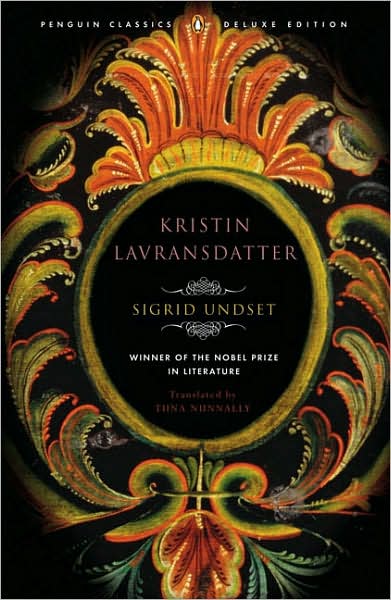
Kristin Lavransdatter: The Wife by Sigrid Undset (trans. Tiina Nunnally)

Kristin Lavransdatter is a trilogy, comprised of The Wreath, The Wife, and The Cross. Here is book two; book one was reviewed here.


SPOILERS FOLLOW.

In The Wreath, we met Kristin as a child, watched her grow into a lovely young lady, and saw her lose her virtue out of wedlock to the dashing Erlend, break off an engagement with her father’s favored choice Simon, and finally, after much familial discord, succeed in marrying Erlend – while carrying his child, unknown to anyone. The Wife, naturally, follows her role as Erlend’s bride and mother to his children. All is not smooth sailing for the couple: first, in a literal sense, as Kristin is miserable on her first ocean voyage to her new home, pregnant and horribly seasick.

She has a very difficult delivery of her first son – who turns out to be the first of no less than seven sons. She and Erlend find themselves distancing almost immediately. When they were lovers, they shared a passion that was, if anything, increased by their shared sin. As I said in my review of The Wreath, Catholicism plays a weighty role. After her marriage, Kristin turns to God and religion all the more, seeking redemption for her betrayal of her father (in the sense that her father’s honor was compromised in her premarital affair). Erlend has a brother, Gunnulf, who is a holy man, and Kristin immediately becomes close to him.

Between the production of babies (the first five in under five years) and her ever-increasing piety (which involves fasting and self-deprivation), Kristin is unavailable to Erlend when he had hoped to have her as a companion nearly full-time; he has to travel on political & military business, and wants her at his side, but she is unwilling if not unable, fearing seasickness and not wishing to leave her babies. In addition, there is the added stress of Erlend’s two bastard children from an earlier liaison: the boy, Orm, warms to Kristin, but the elder Margret remains a source of conflict. Further tension is born of Erlend’s irresponsibility with his property. He is wasteful and profligate, politically less than astute – although his charm takes him further than he would otherwise have gone – and almost entirely faithful to Kristin (which, frankly, is better than I expected of him).

In the end, his risky politics get him into trouble with the young king, and he is imprisoned. Meanwhile, Kristin’s former betrothed, Simon, has married her younger sister Ramborg – more at Ramborg’s insistence than out of his own interest. Both Kristin’s parents have died. When Erlend is arrested, Simon is her closest male kinsman, and provides her with the support she needs; she does not realize he still loves her. Thanks to Simon’s interceding, Erlend’s life is spared, but his property is forfeited.

This was a fairly lengthy book at some 400 pages, but still felt easy to read. For all the friction in Erlend and Kristin’s marriage, they still love each other. When it comes down to it, they always turn back to one another, even after (for example) Erlend has an affair with another married woman purely to get back at Kristin when he feels slighted. I am a little surprised, and impressed at the strength of their relationship. I find it a little inexplicable, as I look back at this book, that I have found it as engrossing as I have. The somber, serious weight of Kristin’s piety is not something I especially identify with. But yes, I am heading into book three, The Cross, with enthusiasm. I wonder what good can come of Kristin’s family now that they’ve lost their tenuous grasp on Erlend’s shrinking estate. And I’m not sure that Simon will continue to be content with being Kristin’s brother-in-law. Stay tuned…


Rating: 5 pagesofjulia.

Loving Frank by Nancy Horan (audio)

I don’t know why I didn’t expect much of this book. Where did I get the idea that it was a fluffy love story? Not so. This is the fictional tale of Mamah Borthwick’s extramarital affair with architect Frank Lloyd Wright. Mamah really lived, and she really had an affair with FLW; but her story here is fictionalized. Another of those sticky questions of historical fiction: where is the boundary between fact and fict? Horan includes a nice author’s note at the end (probably my favorite way of handling this question) and gives some details about where she began using her imagination. History has not taken great note of Mamah Borthwick; most of the information available to her was about FLW.

This is a lovely story, well told. Several different threads are explored that I found interesting. Frank Lloyd Wright himself, and his art and architecture (subjects I had not explored previously) are outlined, along with his Oak Park celebrity and the birth of his “organic architecture.” Mamah is involved in the women’s movement, for suffrage and equal pay and general independence and equality. I especially loved the scenes where she picks up a book, and attends a lecture given, by the Swedish feminist author Ellen Key. Mamah is so moved, considers the topics so well – she is an intellectual and an artist herself, you see. She takes on a mid-life career translating Key’s work (again, this is true to history), and I found the depiction of translation, and Mamah’s own writing as well, to be a really rich part of her story. This is far from being a book about Frank Lloyd Wright. It is a book about love, and morals, and the dilemma of being married to one man and loving another. Mamah and Frank have nine children between them. Imagine that: nine children! There is also the issue of their reputations being irreparably damaged in the national media.

Frank and Mamah are fellow residents of Oak Park, Illinois (suburb of Chicago, and hometown of Ernest Hemingway, who was a small boy during the events of this book) when Mamah and her husband hire the local celebrity to build them a new home. There is chemistry immediately, although it takes a few years for the affair to begin. As their own marriages begin to fall apart, Mamah leaves Oak Park and takes her children with her to visit an old friend in Colorado, eventually leaving her children for her husband to collect, and meeting up with Frank for a tour in Europe. Their relationship blossoms and takes form as they travel, experiencing the world, getting to know one another more openly; it is here that Mamah meets Ellen Key, whose philosophies are hugely important in the couple’s worldview and feelings about their own actions. Frank has left a wife and six children; Mamah has left her children as well, and we can imagine how the world more than a century ago viewed a mother abandoning her children.

The two will eventually move to the Wisconsin valley that has been home to Frank’s family for generations, where he builds for Mamah the home called Taliesin. They are plagued by public disapproval, and the continuing unhappiness of various family members. But they also find the local community eventually supportive. And then there is the big event. Mamah’s story concludes with a shocking final episode that comes out of the history books, so let me say: if you don’t already know what happens, you might consider letting Horan surprise you. It is not a happy ending. But I feel that Horan handles it with great dignity.

I was reminded time and time again of another lovely work of historical fiction, Susan Vreeland’s Clara and Mr. Tiffany. These books are both about women who really lived but are marginalized in history, allowing two authors to write their stories, fictionalized, from research; both were involved (in different ways) with far more historically well-known men; both involve art and art appreciation; both are beautifully written, exploring emotions, and the issues of women’s role in art and in society at more or less the same time in history. I find myself noting these read-alike relationships, and sometimes worry that I may be seen as lowering one or the other of these books by comparing them to others, like I’m calling them less original. I am not. Both of these books are beautiful and original; just allow me to say that if you like one you may like the other.

I loved this book from start to finish. Horan, and narrator Joyce Bean, immersed me completely in the time and the many places of Mamah’s story. I cared very much about all the characters. The events of Frank and Mamah’s lives – bittersweet, shocking, loving, touching, tragic, hopeful, all of them – came fully to life. I really enjoyed getting to know these interesting people, even when they were not at their best. I am charmed, and impressed.


Rating: 8 translated lines.

Teaser Tuesdays: Loving Frank by Nancy Horan

Teaser Tuesdays is a weekly bookish meme, hosted by MizB of Should Be Reading. Anyone can play along! Just open your current read to a random page and share a few sentences. Be careful not to include spoilers!

I am mightily enjoying this novel about the woman who loved Frank Lloyd Wright even though they were both married to other people. I chose this teaser today because I liked the sentiment. Hope you enjoy…

“Forgive my bluntness, but leaving a boring man for a stimulating one is only interesting for a while. In time, you are back where you started: still wanting. Better to find your own backbone, the strong thing in you.”

Good advice, no?

And what are you reading this week?

book beginnings on Friday: Loving Frank by Nancy Horan

Thanks to Rose City Reader for hosting this meme. To participate, share the first line or two of the book you are currently reading and, if you feel so moved, let us know what your first impressions were based on that first line.


I am listening to Nancy Horan’s Loving Frank on audio, and loving it. It is the fictionalized story of the real-life woman named Mamah Borthwick, who had an affair with Frank Lloyd Wright. Most of the book is in third person, but it begins with a rare piece of first-person narrative told in Mamah’s voice:

It was Edwin who wanted to build a new house. I didn’t mind the old Queen Anne on Oak Park Avenue.

…and that says quite a bit, I think. Oak Park Avenue, for me, evokes Hemingway, whose hometown was Oak Park, Illinois; he grew up a few years behind the beginning of FLW’s career and aware of his work around town, so with my past reading of multiple Hemingway biographies, I feel comfortable with the setting already. And saying that it was Edwin who wanted the new house – when we know that the speaker ended up having an illicit affair with the architect – is rather telling, don’t you think? I call those a weighty first two lines.

Hope your reading weekend is looking fine!

Touch by Alexi Zentner (audio)

I didn’t know what this was about when I started it. I know I got this recommendation from somewhere – possibly another book blog – but the source is lost to me now. (Thank you, whoever you are.) So I went in absolutely cold, which is sometimes a really fun way to do things.

It turned out to be a great book, and a great audio version. Our narrator, Stephen, begins the story reminiscing about his childhood in Sawgamet, a fictional British Columbia town, growing up with his mother, father, and sister, and quickly leading into the tragic accident that claims half their family. Then we go back even further, to visit his paternal grandfather, Jeannot, who founded the town. It gradually becomes clear that Stephen has returned to Sawgamet after several decades’ absence, bringing along his own wife and children, to sit at his mother’s deathbed. I’m not sure if we ever learned who his intended audience is in this reminiscence, whether he’s working on a memoir or leaving a story behind for anyone in particular, but he does directly address the reader from time to time. He muses quietly, lovingly, contemplatively, on the experiences of three generations of his family scraping their livings from the bitterly cold winters and dark woods surrounding the town.

Jeannot founded Sawgamet with a gold rush, finding first one and then a second large chunk of gold, with panners and miners following on his heels; but his gold-luck ran out and he quickly turned to logging, which industry outlasted the gold by many years. The young Jeannot takes a wife and their child will become Stephen’s father, Pierre, but Pierre is but a babe when the first tragedies hit their family. No spoilers here, but my, it is a brutal place, where people are sometimes snowbound for months on end, and the woods offer not only gold, and lumber, but also a supernatural element of danger, fear, insecurity. By the time Stephen is born, gold is a distant memory and the town is employed by logging, which has its own obvious expiration date.

The story, switching between the lives of Jeannot, Pierre, and Stephen, is beautifully told, and the narrator of this audiobook, Norman Dietz, performs wonderfully. There is a wondering quality – appropriate, since much is recalled through the eyes of a very young Stephen – that makes the lyrical language feel lovely and dreamlike. The setting was quite exotic and fantastic for me, a Texas native with limited experience with snow; the cold that is described here is literally beyond my imagination. Make no mistake, there are scary, disturbing, dark moments. But there is also love, romantic as well as a loyal familial love. There is death, but also redemption and reunion. I didn’t know what I was getting myself into, but I’m so glad I did. I highly recommend this book. It is evocative, beautiful, loving, quietly disturbing and engrossing; and I recommend this audio version, as well.


Rating: 8 trees felled.

Kristin Lavransdatter: The Wreath by Sigrid Undset (trans. Tiina Nunnally)

Kristin Lavransdatter is a trilogy, comprised of The Wreath, The Wife, and The Cross. My copy is all in one volume, in a new translation, that came highly recommended from Erin Blakemore of The Heroine’s Bookshelf (my review of her book here; my interview of Erin here). As that single volume runs nearly 1200 pages, I thought you might permit me three book reviews. 🙂 Here is book one.


SPOILERS FOLLOW.

This book opens with a little bit of scene-setting; we first meet the parents of our title character Kristin, Lavrans and Ragnfrid (how you pronounce that, I have no idea), and learn about their properties and inheritances. That is telling in itself. It is Norway in the 1300’s, and Kristin’s circumstances and options will be in large part decided by her parents’ situation. She is a charming little girl, very close to her father, distant from her mother, who is serious and melancholy after losing three sons in infancy. Kristin lives in a small world, defined by the valley surrounding her family’s farm, and has a sweet life, despite her mother’s dampening nature, because her relationship with her father is quite fulfilling. They are an extremely pious family, fasting and observing rituals more than their peers, no small thing in a seriously Catholic community. Ragnfrid has a second daughter, who also lives out of infancy, and is even more physically beautiful and admired than Kristin; but an accident nearly kills her when she is around five years old, and leaves her permanently crippled and ill. Ragnfrid’s emotional state descends still further. There will eventually be a third daughter, treated rather as an afterthought and not highly valued, in Ragnfrid’s grief at the fate of her three dead sons and injured daughter (one wonders why she doesn’t take more comfort in Kristin’s health). Ragnfrid feels guilty, as if her sins are punishing her children: the familiar Catholic guilt.

When Kristin is 15, she is betrothed to a young man, Simon, she does not know well but seems a suitable match and to whom she has no real objections, at first. But she is young and pretty, and things are complicated: first, a servant boy she’s grown up with declares his love, which tweaks her heartstrings. It does not seem likely that she feels “true love”, at that age and triggered by his own declaration, but it causes her first doubts about marrying Simon. There is a nasty episode involving a clandestine meeting with the servant, Arne; Kristin narrowly escaping rape at the hands of another man; and Arne’s death, which ends up implicating Kristin as possibly possibly having slept with her attacker, which is made no easier by the fact she’d kept the attempted rape a secret. Her reputation receives its first bruises, and this is a society where a young lady’s reputation cannot afford dark spots.

Kristin goes off to live in a convent for a year before marrying Simon, hoping to work through the trauma of Arne’s death and the almost-rape. And here things get even more sordid, because she meets another man with a bad reputation (in another time and place he would most definitely be called a rake). One thing leads to another (use your imagination) and although it takes years and much heartbreak and dishonor and dishonesty, Kristin is able to break her betrothal to Simon and marry Erlend. When they marry, she is secretly pregnant. And the first book ends.

The religious implications weigh heavier as this book proceeds. The breaking of the betrothal, the premarital sex, and the lying to her parents, Simon, and the world in general that these feats, require are very problematic. Despite all her sinning, Kristin is a religious woman, and she suffers inside for her sins. Her parents are enormously religious, and her father does a bit of freaking out over the entire Erland situation. Lavrans was close to Simon, liked him very much for a son-in-law, and has difficulty being anywhere near Erland, who he does not like and does not trust to keep his daughter secure. Lavrans seems to fear subconsciously that Kristin may have slept with Erlend, but he won’t allow anyone else to put this theory forward. At the end of the book, he doesn’t know about the pregnancy; but the timing is far enough off that it is inevitable that he will know she was pregnant before she was married (barring miscarriage or, I don’t know, Kristin hiding a baby somehow from… everyone?). I don’t know if it’s necessary to point this out, but premarital sex is a serious thing in this society.

This reading flew by. I love the medieval Norway that Undset paints. The early part, when Kristin is a small girl, and we get an intimate picture of her life on the farm and her relationship with her father, might be my favorite; I love the simplicity and the evocation of another time. I am not a great appreciator of religion, and Lavrans’s version is a particularly cumbersome one, but these are good, simple, virtuous people, and that is easy to appreciate. As Kristin becomes a teenager and begins to encounter *boys*, she becomes very recognizable: her interest in her new betrothed, Simon, and then Arne’s sudden appearance in a new light, and then meeting the dashing Erlend, would work just as believably in modern-day junior high or high school. But I found her a little exasperating. This, too, is recognizable; her flightiness and poor decision making are highly realistic. I wasn’t always entirely pleased with her. But I remain invested. As she marries, hiding her pregnancy from her decidedly oblivious new husband, and gets ready to move to a different part of the country, I am wholeheartedly along for the ride.

I knew nothing coming into this book (other than a tagline that went something like, “epic trilogy of woman’s life in ancient Norway”) and have no idea what is to come. The religion comes on a little stronger than I typically want in my reading, but I’m involved with Kristin and I shall continue. Stay tuned for reviews of the next two books.


A note on translation: this translation came recommended to me specifically; I was told earlier ones were poor, and it turns out that my father tried to read one of those and found it unreadable. Tiina Nunnally’s translation won the PEN/Book-of-the-Month Club Translation Prize and is lovely. (Perhaps I should mention that Sigrid Undset won a Nobel Prize in Literature, before Nunnally’s help! I wonder if the prize committee read her books in Norwegian??) In other words, use this translation and no other, and thank you, Tiina, for bringing this book back to life. We’ll see if Pops wants to try again when I’m done with my copy.


Rating: 5 rosaries.

The Prestige by Christopher Priest (audio)

I felt confident in choosing this audiobook because – while I can’t remember who recommended it – I recall that two sources I respected (book blogs, I think) both praised it around the same time. Safe, I thought. Well, I am reminded again: we cannot all like the same things.

The Prestige opens with a first-person narrator named Andrew, embarking on a trip to cover a story for his newspaper job which he finds generally uninteresting. Andrew is adopted, and cares nothing for the truth of his birth family except for the all-consuming feeling he has that he has a twin. What he has managed to learn about his birth parents indicates that there was no twin, but he feels the presence of that other person too strongly to entertain any other explanation. So he arrives in search of the newspaper story – and if this already sounds disjointed, then right ho, that’s how I found it too – and what do you know, the story he’s pursuing turns out to be related to the mystery of his family’s past. Apparently Andrew’s great-grandfather was a magician, one of the very best in Britain and in the world, and his nemesis – the other greatest magician in Britain and in the world – was the great-grandfather of this young woman from whom he finds himself sitting across a table. In pursuit of, um, a newspaper story. But there is no story, really it’s about getting these two together.

And then the story of Andrew (and Kate, the young lady descended from the other magician) breaks off, and we are treated to the diary of Alfred Borden, Andrew’s predecessor. Now the story of Borden’s life, magical career, and lifelong enmity with the Great Danton is presented from Borden’s point of view; after which we break off and view the corresponding histories from the Great Danton’s perspective, via his own diaries. Finally we come back around to Andrew’s narrative.

The overarching mystery of the book is the question of how each of these magicians performs his great iconic stage act. The two illusions are similar, but apparently are performed in different ways, which are not made clear to us until the final few chapters. It is an interesting mystery, and frankly it is that that kept me going until the end of this book. Andrew, and his desire to discover the truth about the mysterious twin, interested me. But the flashback stories (in diary form) of the rival magicians really failed to compel me, and dragged on too slowly. The mysteries of the magic trick, and of the questionable twin, I must confess were so engrossing that I wanted to continue and learn the truth. But the path there was more frustrating in its pace than enjoyably anticipatory, and I cannot give this book much of an endorsement. I was interested enough in the overall story to finish the book, but almost constantly impatient to get to the big reveal. And, worse, I was disappointed in the big reveal; but no more should be said about that in case you check it out yourself. I suppose you’re unlikely to do so on my recommendation! But I assure you there are positive reviews out there.

I wonder if it wasn’t the frame element of stage magic that failed to grab me. I don’t find myself particularly interested. (Despite all the excitement over The Night Circus, I am unlikely to pick that one up.) The pacing was a lot of what did this one in for me, and the personalities of the two magicians, Borden and Danton: they weren’t terribly sympathetic or likeable. I was frustrated and exasperated with them for most of the book. What can I say, this review has descended into a litany of complaints. Sometimes they don’t work for us. Better luck in the next book, yes?


Rating: 3 magic tricks.

A Visitor’s Guide to the Ancient Olympics by Neil Faulkner

What an odd mix of genres this book is. It sets itself up as a travel guide: eat here, sleep here, don’t forget to pack this – but to a destination that would require time travel. As Faulkner says in his introduction, this is necessarily (by its fantastical nature!) not an entirely academic book; but he does have an academic background, and rather than wildly making things up, he does follow history & research. He just uses his imagination where it makes sense to do so, and in a way that makes sense: he makes educated guesses. (As he points out in the intro, again, he has to pick a day for each event; it is unrealistic that a guide to an Olympic festival would be unable to say when the footraces would be held.) So, note my tags for this post: travel guide; sports; historical fiction; nonfiction. It is a puzzle. A uniquely styled book.

And an enjoyable one, too. At just under 250 pages, it’s an easy read. The sections are short. There is an emphasis for most of the book on ancient Greek culture in general, and on what the Olympic Games represent in that culture (in a nutshell: this is a religious festival; sport is merely a form of religious ritual). The sport itself comes in only late in the book, and I confess that this was a slight disappointment to me: that section of the book that describes the athletic contests was very interesting to me and I wanted more of the same. But the detail on ancient Greece was intriguing, too; I have an interest in ancient Greek mythology & literature, and there were plenty of references that I was pleased to connect.

This book is probably most successful as a travel guide, which is a little awkward since as much as one might wish to, it is in fact impossible to attend the Olympic Games of 388 BC. Faulkner does a good job of elucidating the issues a person would face in attending these Games if she could. Again in a nutshell: there is no lodging, transport is difficult to arrange and expensive, food is odd and limited, and the Olympic Village would be teeming with refuse, stink, and insect activity. It would be hard to see the events on display as there are no stands; spectators 100,000 strong merely shove each other around for a view. In other words, he might have talked me out of the trip if I were planning on it. As a view into the life of ancient Greeks and especially the role of professional athletes in their society, this book was informative and fascinating. Its unique format, too, added special interest. I am bemused and intrigued. Recommended, but probably for a fairly distinct audience. I was well entertained, with my intersecting interests in sport and ancient Greece, and my tolerance for an odd format.


I read an uncorrected advance proof.

Rating: 6 events.