The Other Typist by Suzanne Rindell (audio)

typistThis book reminds me very much of Rules of Civility by Amor Towles, with similarities extending to the audio narration, as well. And considering how much I loved that book, and narration, this is a high compliment. They share a setting in New York City early in the 20th century (in this case, Prohibition era), a concentration on class differences, a slinky sensual tone, and an appreciation for the finer things in life. The final shared characteristic is a major plot twist late in the book, here subtly foreshadowed from early on. And that is where I struggle a little with this review: I don’t want to spoil the surprise for you, because it makes the book. Read on safely; I’ll be careful.

Meet Rose Baker, our narrator. She was raised in a Catholic orphanage and now works as a typist in a precinct office of the New York Police Department. The book opens with a discussion of the controversy surrounding young women working as typists at all, let alone in the “rough” environs Rose inhabits: she frequently witnesses and transcribes the confessions of murderers and rapists (gasp). That opening passage helps establish the setting, along with a following reference to the Volstead Act (which prohibited alcohol in the United States).

And now, meet Odalie Lazare, the “other typist.” There were already two typists besides Rose at the precinct, but Odalie is a different sort. Glamorous, seductive, and strangely well-off for someone who would work as a police department typist, Rose is bewitched from the first. The two become “bosom friends,” and Rose becomes… devoted? obsessed? It all depends upon your definitions, of course.

Suzanne Rindell’s construction and development of Rose Baker as an unreliable narrator is delicious. We know Rose for a great many pages as a sober, morally upright young lady and professional; she describes Odalie’s entrance into her life with a sense of foreboding, but with no clue as to what has happened between them. And then there is the first, very brief, reference to Rose’s doctor. Later, there is another flashing reference to the “incident.” Thus, our sober and reliable narrator is undermined, but just so swiftly and for just a moment – did we even see it at all? And I’m left, as the reader, wondering about this incident and why Rose needs a doctor; and then I’m back in Rose’s story, seeing her as the responsible character again. It is a masterful building of tension and questions; I ate it up.

One of the many strengths of this story is in its strong sense of time and place. Prohibition New York is colorful; one can hear and smell and taste its flavors. I will have to leave it to another, older reader to speak to its authenticity, but I am certainly convinced. The writing style, and Gretchen Mol’s reading style, contribute to the feel of an earlier time; sentences are a little long and formal, in a way that just creates more atmosphere.

Rindell’s fine sense of pacing, the doling out of detail and prolepsis, is adept. It is not everyday that I am this drawn in and enchanted by a story; I couldn’t wait to hear what would happen next; I was guessing and second-guessing. As a thriller, The Other Typist evoked some of Tana French’s best work (as here).

Although I was captivated by the swirling mists of speakeasies and Odalie’s wily ways as the femme fatale, I think my favorite part of this experience was the buildup to the big reveal, and the mystery left therein. The Other Typist was a pleasurable rush and romp, and has left me wanting more of Suzanne Rindell’s magic. Reader Gretchen Mol was perfect and not to be missed: do find this one on audio if you can.


Rating: 8 champagne cocktails.

Teaser Tuesdays: The Other Typist by Suzanne Rindell

Teaser Tuesdays is a weekly bookish meme, hosted by MizB of Should Be Reading. The idea is to open your current read to a random page and share a few sentences. And try not to include spoilers!

typist

I have discovered an awesome new book on audio that I want you to know about. Set in 1920’s New York City, The Other Typist‘s first-person narrator is Rose Baker, an orphan employed as (yes) a typist at a precinct police department. She is entranced by a new hire named Odalie, who exerts a magnetic pull on everyone, it seems, but most especially Rose herself. Here’s your teaser:

She was never once rebuffed, and the man – I say man here generically, because there were several – invariably introduced himself and reached into his pocket to fish out a lighter and a replacement cigarette, while Odalie puffed on her pilfered prize and regarded the gentleman with a sly, delighted expression, as if to suggest nothing he could pull out of his pocket could sufficiently replace the unique and spectacular treasure she had just stolen.

I just love this line, read masterfully by Gretchen Mol, with its subtly suggestive reference to what a generic man might pull out of his pocket to impress Odalie. She, the other typist, is a classic, manipulative femme fatale; but then again, there are some unanswered questions to ask about our narrator Rose, too. And that’s the kind of set-up I like. Stay tuned…

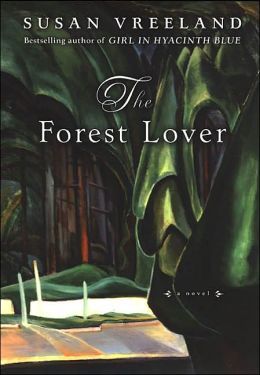
The Forest Lover by Susan Vreeland

forestloverWhat a lovely book. I recently read and enjoyed Scott Elliot’s Temple Grove enough that I attended to his “Note on Sources,” and requested several from my local library. This was one of those – aided by my enjoyment of Vreeland’s Girl in Hyacinth Blue and Clara and Mr. Tiffany.

Like those two of her books, this is historical fiction dealing with a female artist. [Also think of Tracy Chevalier’s Girl With a Pearl Earring.] The three historical periods, geographic locations, and women in question are quite diverse, but there is a very clear thread connecting them all as female, artists, and historical; I appreciate that showing of diversity in her subjects and also of a singleminded interest. I am safely a Vreeland fan now. Fairly naturally, considering that they deal with female artists of earlier times, her books also address women’s struggle for independence.

Emily Carr, like the subject of Clara and Mr. Tiffany, is a real-life historical figure about whom we don’t know everything; this is a fictionalization of her life. She was born in British Columbia in 1871 to British parents. She showed an inclination for sketching and painting early on, which hobby was encouraged by her father at first, but he expected her to grow out of it in favor of more womanly pursuits (like marriage), and she didn’t. We meet Emily or “Millie” when she’s struggling to make ends meet and trying not to depend too much on the trust fund she shares with 4 sisters, teaching art for a living and befriending local Native Canadian Indians. The sisters mostly do not approve this association. Her favorite subjects are natural scenery and native people and their lifestyles; she travels to islands and outposts for these subjects; again, this is not appreciated by her family. She does enjoy some good female companionship, though: Sophie is an Indian woman and fellow artist (a basketmaker) who befriends her in broken English; Jessica is a less adept painter but rather saucy lady friend; Alice is her “good” and friendly sister; and after Emily musters the courage to travel to Paris to study the “new” art (see below), she meets fellow painter Fanny, a New Zealander and kindred soul.

To give you an idea of the Paris of Emily’s experience, as a moment in time, I share these lines.

“Van Gogh’s been in his grave for twenty years, Cezanne for four, yet art collectors still don’t buy them, and despise what’s new now.”

“What is new now?”

“Their offspring. Léger, Picasso, Braque, Matisse, Modigliani, Derain, Rouault. Many directions.”

Momentous times, then!

Back in Canada, Emily ages as we watch her struggle with art and life. She wants desperately to represent the native people’s lives and art, and the powerful forest surrounding her. Or, as she comes to learn, she wants to more than represent or copy: she wants to communicate what these things make her feel. Her study in Paris under various teachers advances her practice, but still doesn’t get her there. We follow Emily through a series of lifestyles and decisions that form a crooked path but ultimately continue to move her toward a higher form of the art and communication she desires.

There is one man who begins to be a love interest for Emily; but as the title implies, she finds herself unable (for various reasons) to participate in physical, person-to-person, romantic or sexual love with this man. She is not the forest’s lover in a carnal sense – this book is not that weird. And Emily does continue to relate to people. Jessica and her sisters, and most importantly Sophie, retain a hold on her heart; and she forms a new (platonic) relationship with a damaged white man who understands Indians better than whites. But in a very real way, her relationship with the natural world is the most magnetic in her life.

I often observe that I like an author’s earlier (or lesser known) work better than the later. (I hope this is not just me being contrary. I don’t think I do it on purpose.) In this case, though, I think my favorite of her books is still her most recent, Clara and Mr. Tiffany. The earlier two I’ve read are both wonderful; but I sometimes felt this showed its earlier origins. It is occasionally less graceful. While she is mostly “on,” there are some awkward phrases, too. Observe these two single sentences, on two facing pages. I find one smoothly appealing, and the other a bit effortful.

Emily felt as if smelly white scum had eked out her pores.

versus

A breeze shifted the ends of foliage, like the tips of fingers moving.

Do you make the same observation I do? (Which one is which?)

Criticisms aside, though, this novel is far more graceful than not; and while I could pick apart lines like the one above, the sum of its parts is glorious. Vreeland’s greatest strengths are those I recognize from her other books. She understands art, and the artist’s struggle to get it just right. She addresses women’s issues compassionately as a natural part of the story of one woman in history. And unique to this work, the natural world and its beauty, value, power, importance, and scale play a deservingly large role.

Another success for Susan Vreeland.


Rating: 8 smears of viridian.

The Lost Summer of Louisa May Alcott by Kelly O’Connor McNees (audio)

louisaThis is a fictionalization of one season in the life of Louisa May Alcott, author most famously of Little Women. Louisa and her family are very like her famous fictional creations in many ways. The eldest daughter, Anna, clearly models for Meg of LW; then there’s Louisa/Jo, then Lizzie/Beth, and then Amy/May. Louisa’s mother Abba does go by Marmee, as in the book; the first glaring departure from Alcott’s novel in her real life is that her father, Bronson, is not away at war. Instead, Bronson was a transcendentalist scholar and friend to the likes of Thoreau and Emerson, disinclined to work for a living (being principally opposed, you see); he founded a Utopian commune in which his family lived for a time, and otherwise they scrimped, borrowed, and got by how they could. [I know this is confusing: I am writing a review of a fictional book, about a real-life woman, who wrote a fictional book, about her real-life family. So far, in these bare details I’ve named, I am referring to the real-life Alcotts as well as the Alcotts represented in Kelly O’Connor McNees’ novel.]

In The Lost Summer of Louisa May Alcott, McNees sets the six Alcotts in Walpole, New Hampshire, living for the summer in a home that belongs to relatives, because they are poor and hungry and have to go where they can. The premise is that Louisa May Alcott – in real-life a confirmed spinster – had a brief love affair that summer that informed the rest of her life. History yields no indication that such an affair took place, so this is where the fiction begins.

The plot is simple and uninteresting, certainly not the strength of this book. The family is new to Walpole; Anna has recently decided that she is interested in getting married (as any good girl of her era would be) and works to make herself presentable to the town’s young men. Louisa is, as ever, hot-headed, passionate, interested mostly in her writing, and does not intend to marry because it would disrupt her freedom (to write, and otherwise). She is firmly a feminist, and deeply interested in her father’s friends Emerson and Thoreau, and in a new book of poetry called Leaves of Grass by somebody named Walt Whitman. Lizzie is sickly and fussed over. May is obnoxiously free from the privation that the rest of the family feels; Marmee is rather frustrated with her lot in life; and Bronson is thoroughly exasperating in his refusal to get realistic and provide for his family. Anna meets a boy. And Louisa meets a boy, and in stock romance-novel style, finds him unbearable right up until she falls in love with him. They are thwarted.

The strengths of The Lost Summer are in its subjects: lovers of Little Women will be charmed by the fictional-real-life models for Meg, Jo, Beth and Amy. The setting is rather charming, as well, and Joseph Singer (Louisa’s love interest) is likeable. But unlike the characters in Little Women, Anna, Louisa, Lizzie and May are underdeveloped. To be fair, it is a shorter book, and spans a much briefer time than its more famous model, so perhaps this should be excused. But I’m not really that forgiving, as I’ve seen masterful character development in mere pages (see: short story masters like Hemingway and de Maupassant). To be further fair, I’m not a fan of romance novels. (Maybe I should never have picked this book up?) That said, I was impatient with the plot line that had Louisa grumpy toward this man she simultaneously felt pulled towards – she went weak in the knees, etc., etc. – and then suddenly sick with love. It’s just too familiar, ho hum. And finally, too many of these characters were unlikeable (May, Bronson, even Marmee; Louisa for her bullheadedness; minor characters Margaret and Catherine, ugh!) for my tastes. I sort of felt that this story had misplaced its heroine.

Of some interest was the opportunity that McNees took to outline Louisa’s feminism and her limited options. I confess I did buy into the romance enough to wish that Joseph and Louisa could be together – could marry, or simply cohabitat – which latter option I realize is my modern-woman’s solution, and wasn’t really available to Louisa at all. Louisa talks and thinks through their options and what they would mean to her: how, for example, marriage would mean endless drudgery and housework for her, and the loss of her ability to write. This is a message that needed communicating, and I found it interesting and instructive to consider the limited options of a woman of this era. So a few points were regained here. However, these musings were only thinly veiled as dialogue or internal thoughts of the characters; I felt I could see McNees holding the strings.

For a quick, superficial, comfortable visit with the beloved Alcotts, come on in to Lost Summer; but if you’re looking for more, look elsewhere.

Audio edition was fine but unremarkable.


Rating: 4 oh-so-important ribbons.

Inés of My Soul by Isabel Allende (audio)

inesIsabel Allende is mostly a well-respected name to me; I had only read her Daughter of Fortune before this one, and found it interesting and enjoyable, but it doesn’t seem to stand out in my memory. (It’s been years.) I picked up Inés of My Soul as I pick up at least half my audiobooks: opportunistically. Because audio is not as plentiful as hardcopy, I take what I can find, in the library or from friends & family. This one came from my mother, and I’m glad I happened upon it, because I found it fascinating and entertaining.

Inés of My Soul is the story of the founding of Chile, told first-person by Inés de Suárez, a real historical figure; or perhaps more accurately it is the life story of Inés, inextricably tied with the founding of Chile, which she (at least in the novel) considers her life’s work. This is a work of historical fiction; Inés really lived but we don’t know everything about her, so Allende necessarily fills in the gaps.

Inés was born in Extremadura, in Spain, in 1507. She married Juan de Mélaga for love (or for lust), but their marriage was troubled; their fiery sexual passion also led to fierce fights, and they failed to conceive the child Inés wanted, and Juan eventually sailed for the New World in search of gold and fortune. She follows, not out of love for her husband – that was mostly dead – but because, as a “widow of the New World,” her horizons in Extremadura were extremely limited, and she sought adventure just as Juan did. Inés travels around Peru, making her living as she did in Spain: sewing clothes and cooking her famous empanadas, which she is careful to provide to the hungry as well as her paying customers. After learning that Juan is dead, she is plagued by men who desire her, and who intend to have her by any means, with or without her consent; and she picks up a housekeeper who will become a lifelong friend & helpmate, Catalina, an Indian woman skilled in healing and with the power to see the future. Catalina foretells an important man to come into Inés’s life and recognizes him when he does: Pedro de Valdivia, a fellow native of Extremadura and a soldier from a long line of soldiers. Their relationship is full of fire and chemistry, as was her initial time with Juan de Mélaga, but will mature into a deeply loving and cooperative partnership. They will never marry, because Pedro has a wife, Marina, back in Spain, and all three are Catholic.

Pedro and Inés travel together to Chile, an area still unconquered by Europeans and especially intimidating because of an earlier failed attempt. They have a small but mostly loyal cadre of soldiers with them and intend to be the founders of a new country there. As partners they fight the Indians and establish the city of Santiago and several more small towns; they live through good times and bad. There is a fascinating subplot involving a young Indian boy who joins their settlement, which I will leave mostly untouched for the sake of spoilers. After ten years of loving cohabitation, during which Inés contributes substantially to the successful founding of Santiago, even in combat against the Indians, Pedro throws her aside. He has grown from the strong & cooperative man she loved into an aging, arrogant, cruel, unhealthy ruler, but his rejection still hurts. Inés then takes a second husband: Rodrigo de Quiroga, a captain in Pedro’s army and a good man with whom she finds another beautifully healthy and loving relationship, also raising his daughter Isabel, to whom this story is narrated.

Inés of My Soul is the diary of an elderly Inés who wants to record her fascinating and important life for the sake of posterity. She is sad that she never conceived a child, but loves her stepdaughter very much and chides her lovingly throughout this narration. She writes more than half of it herself, but by the end is dictating to Isabel, as her age catches up with her; she says she sees death coming very soon, and is not sad, as she looks forward to joining Rodrigo, her final love of 30 years, recently dead.

Again, this is a story of the conquest and founding of Chile, complete with scenes of battle, heroism, victory, glory, and gold. There is plenty of statement on the evils of colonialism: Inés praises the natives of Chile, respects their choice to fight to the death rather than be enslaved, and notes their strengths. She also laments the unnecessary cruelties of the conquerors, including her Pedro. But it is also very much a love story. Inés has three loves in her life, and I think she is lucky (and considers herself so) to have shared passions with three very different men. While not terribly explicit, there is sex, told in an appropriately heated, sensual tone, with some acknowledgment of Isabel’s presumed discomfort where her father is concerned. (Inés also offers to give Isabel advice, in case the latter’s husband proves overly eager or otherwise fails to give pleasure.)

There are obvious links to Like Water for Chocolate, in the fiery, sensual telling of lust, passion, and fine food in the voice of a strong Latina woman, and in Inés’s implicit feminism when she declares her own place in history and her substantial contributions to the new country of Chile. This is an engrossing tale of a woman’s life, and a country’s birth, intertwined. I loved both Inés – a passionate and strong woman – and the history of Chile. Having grown up in mid-south Texas, I have long had an appreciation of Spanish-speaking cultures; I am most familiar with Mexico but have always been interested in traveling further south too. Chile was on my list – it’s so far away and therefore feels exotic and remote – but now it’s an even higher priority. And reading this fictionalized history of the founding of conquered Chile makes me more interested in its history, too. I did do a little Wikipedia reading on Inés de Suárez, the historical figure, enough to know that she was indeed lover to Pedro de Valdivia and involved in the conquest.

Finally, I cannot stress enough the pleasurable experience of listening to this narrator, Blair Brown, tell this story in a musical, lyrical, emotive, accented voice; there is no other way to enjoy it. Allende renders nuanced, very real characters in a lovely tone (aside from the lovely reading Brown gives); she makes a bloody history of conquest appropriately ambiguous; and the remarkable achievement of blending love and passion with war and subjugation is riveting. I highly recommend this story, and I highly recommend Brown’s reading of it.


Rating: 9 empanadas.

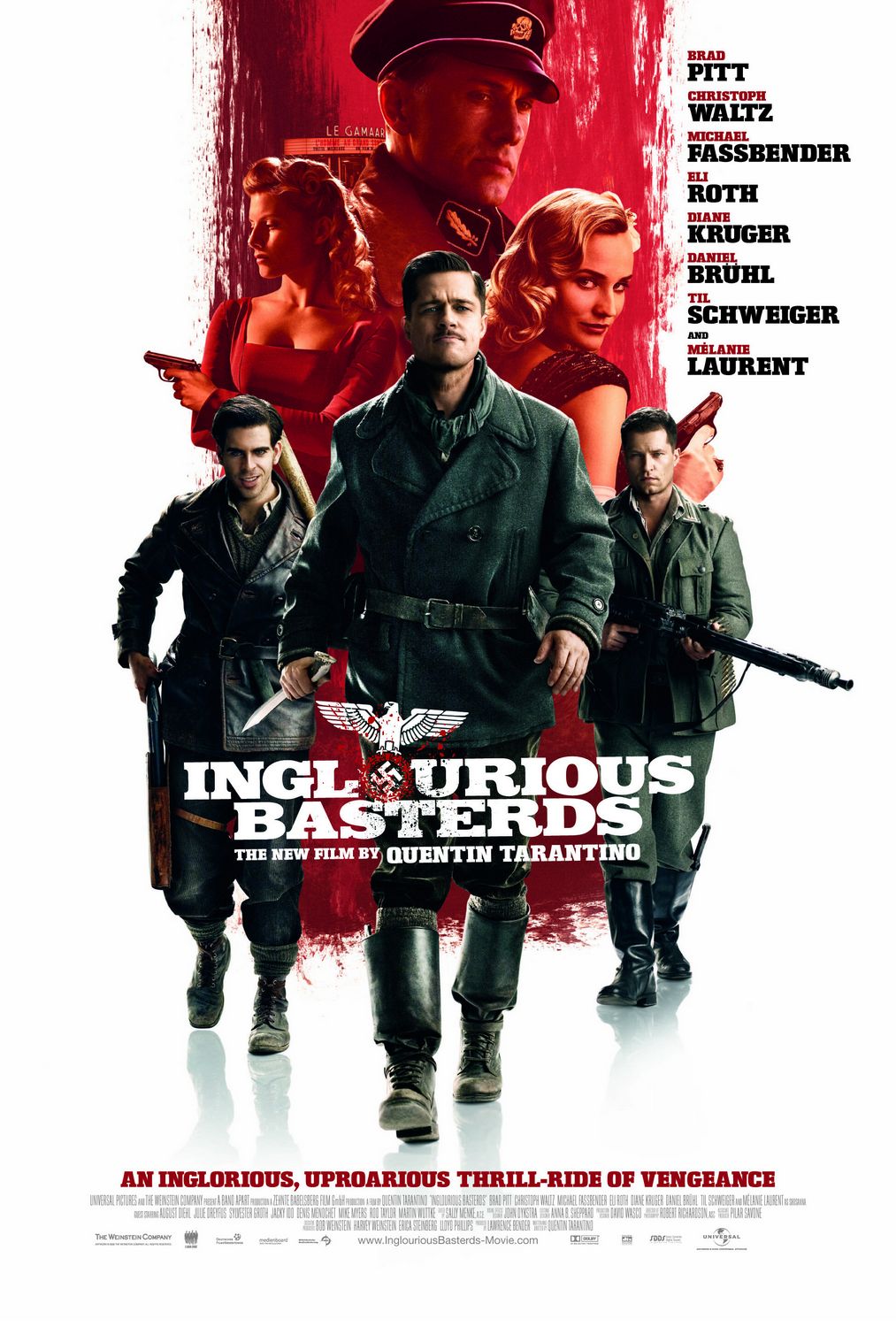
movie: Inglourious Basterds (2009)

inglouriousYes, spellcheck, that is how you spell this movie title.

It’s movie week here at pagesofjulia, isn’t it? Funny how that happens. Inglourious Basterds is another Tarantino film, from 2009, an alternate-history of World War II starring Brad Pitt as the heavily-Southern-accented leader of an American military team called the “Basterds,” and Christoph Waltz (who was positively outstanding in Django Unchained) as an S.S. leader named Landa. In this telling, the Basterds put together a plot to kill Hitler; but they’re racing a young Jewish woman named Shosanna (played beautifully by the lovely Mélanie Laurent), whose family was killed several years earlier by the “Jew Hunter” Landa. Shosanna is being courted by a young Nazi war hero, but her hatred (obviously) still burns hot, and she takes advantage of an unlooked-for opportunity to plan her own assassination of Hitler & the Nazi leadership.

In my opinion, this is not Tarantino’s best work. There are the requisite bloody scenes and over-the-top clever dialogue – the latter normally a fantastical element I enjoy, but here it kind of fell flat for me. Shosanna’s character is lovely and I felt that she could have been a little better explored. Landa’s character was also eye-catchingly evil. Maybe I just don’t like Brad Pitt, but the Basterds were less interesting than they should have been; maybe a little more character development there. The two parallel plots to kill Hitler could also have been more deeply mapped out for me. The whole thing lacked depth and interest for me, especially compared with Tarantino’s fine work in other films. [My favorites include Pulp Fiction, Natural Born Killers, and my personal favorite, True Romance, which Tarantino wrote but did not direct. Both Kill Bill‘s were great, and Django Unchained was outstanding as well.]

Perhaps I am not entirely sold on the beauty of a farcical WWII history in Tarantino style. Why would that be, when I appreciated the Tarantino treatment of slavery so much? I don’t know. I credit incomplete character development and a storyline that tried to accomplish too much without delving deeply enough into any of its plots. Sadly, not up to Tarantino’s standards in my book.


Rating: 4 scalpings.

On the plus side, I’m celebrating today’s over-Hallmarked, under-romantic holiday with Tarantino, and that makes me feel good. Happy Valentine’s Day!

Abraham Lincoln: Vampire Hunter by Seth Grahame-Smith (audio)

Abraham Lincoln: Vampire Hunter is an alternative history with fantasy/paranormal elements thrown in. It reexamines Abraham Lincoln’s life, his presidency, and the American Civil War, with a twist: the US is overrun with vampires, mostly unknown to the public, who are secretly pulling the strings that shape Abe’s life, the institution of slavery, and war. The book opens with a charming sequence in which a would-be novelist in a small town on the Hudson Valley meets a new resident and gets a book idea from him. The foreboding sense in the idyllic setting reminded me of Stephen King, which is a compliment.

It is a rather fascinating concept. I had my doubts at first – again, the whole vampires-in-pop-fiction trend gave me pause; it’s not a trend I have bought into in the past. But as soon as I began the book, I was drawn in. So full points for intriguing me early on. I loved the parts about Abe’s early life; the atmosphere, the mood of tension, of Abe’s efforts against long odds, his determination in the face of tragedy, are all well executed.

But I think the middle section of the book dragged on far too long; it’s a great concept that Grahame-Smith indulged in for too many pages. All of which is to say, it probably made a great movie! That may be the proper format.

Another concern: I had some misgivings about the use of vampires to explain some of the evils in our national history. Slavery, secession, civil war, all belong to vampires in this book (with a quick mention of WWII’s genocide apparently coming from the same source). While Grahame-Smith struck me as careful to always treat these heavy topics with due sobriety, it still makes me a little uneasy to play with them in this way. Slavery and civil war are unsettling, terrifying, gruesome, disturbing enough in fact; it rather feels like diminishing their somber import to make them the fictional playthings of entertainment in this way, no matter how carefully treated. And again, the tone of this book is serious and in always respectful. But I’m just not entirely sure. It gives me pause.

Late in the book, I really missed our narrator of the beginning section: the writer, that is, who is approached by the mysterious stranger and given the lost diaries of Abraham Lincoln. The quick sketch of small-town life and the birth of this novel was a definite strength, and I regret that we never returned to that early narrator at the end of the book. I was looking forward to revisiting him.

So I have my criticisms, as you can see; but I really did enjoy this audiobook, and never considered putting it down. I think Grahame-Smith could have executed his rather genius story concept in less space: my audio ran to 9 CDs, and he could have kept it under 6, in my opinion. But again, this only makes me more interested in the movie version. Apparently the screenplay is written by Grahame-Smith as well, which is a good sign; and hopefully that format will push for a little more condensed action, which the book could have used as well. Call this a rare case where I am excited for the movie after reading the book.

The audio narration by Scott Holst was good. He emphasizes mood as a narrator should; he varied the voices of his characters a little, was not overly theatrical, but lent atmosphere where it belonged.

As always when I read historical fiction, I found myself contemplating the line where fact meets fiction. In this case, I’m sad to say (and it’s far too often that I’m sad to say this!) I don’t know the subject well enough to judge for myself; but here are a few notes of interest. At the end of my audiobook is a short interview with the author, in which I learned: first, that he was in fact quite purposefully following the aforementioned trend of vampires in pop fiction; and secondly, that he had great respect for his subject and did a fair amount of research. Now, this is a subjective measure (and he’s judging himself, which makes the judgment even more subjective), but I still find it encouraging. Finally, he mentioned a particular source of nonfiction inspiration: Doris Kearns Goodwin’s Team of Rivals, which I have in my iPod just waiting my attentions. And that was the most encouraging detail of all. 🙂


Rating: 6 fangs.

Teaser Tuesdays: Abraham Lincoln: Vampire Hunter by Seth Grahame-Smith

Teaser Tuesdays is a weekly bookish meme, hosted by MizB of Should Be Reading. Anyone can play along! Just open your current read to a random page and share a few sentences. Be careful not to include spoilers!

I confess I thought this looked a little silly. Maybe it’s the whole vampires-in-pop-fiction trend? But I confess, I like it. And there’s a movie, you know… Here’s a teaser.

I shouted after him: “Why haven’t you killed me!” His answer came calmly from the next room. “Some people, Abraham, are just too interesting to kill.”

And maybe that’s how the book is striking me, too. Too interesting to kill. 🙂

What are you reading this week? Do share.

Rules of Civility by Amor Towles (audio)

I have one to proselytize for, friends. Rules of Civility will certainly make the list of the greatest books I discovered in 2012.

The book opens with the story’s narrator, Katey, and her husband Val at an art opening in 1966. A few pages set the scene and the style of this book – and oh, the style! – before we’re whisked back into Katey’s reminiscences, beginning just a few hours before the new year of 1938 will be rung in. She and her best-friend-and-roommate, Eve, are out on the town, and they meet a man who buys them champagne for the toast at midnight. And then we follow Katey through the year.

Katey’s life changes a great deal in 1938, in all its aspects: career, home life, relationships, love, aspirations, her understanding of herself and of her world. I don’t want to mention any more of the plot, because I found such joy in discovering its twists myself, and you should too.

This book has many strengths. Its story is interesting: a single year, 1938, in the life of an ambitious young woman in New York City. And there are such surprises that I dropped my chin on my chest more than once. But the plot alone would not have made the book what it is. The characters are strong as well: Katey is pretty fabulous, as are a number of others. But neither is this the shining facet that draws the eye. I think the real victory is in the writing. You may have noticed (and I hope you’ve forgiven me) that I used not one but three teasers to whet your interest (here and here). It’s very evocative: I could see, hear, smell the New York City described; and further, I felt all the emotions Towles wrote. Driving to and from work and listening to this story (and Rebecca Lowman’s masterful, perfect narration), I arrived at my destination confident and optimistic, hopeful for the future, downcast, flabbergasted, or whatever that chapter called for. It was one of those very rare books that engaged me completely, made me lie awake at night worrying, wishing for certain events to transpire, caring deeply about fictional characters. It was amazing. And of course I have no great understanding of 1938 New York City; but Towles (and Lowman) have me utterly convinced that it sounded and looked and smelled and tasted exactly as described here.

And while I’m praising the writing, the style with which Katey’s voice comes alive, I must praise the reading of this audio version as well. Lowman has a frank, languid tone that feels precisely right for Katey; I love that she slows down. Her pacing is sometimes indolent and sometimes despairing, but it always adds to the sense of nostalgia in the beautiful piece of art that is Rules of Civility.

Oh, and it’s worth adding too that Katey is a reader, and literary references abound, which enriches the overall effect considerably for me and perhaps for you too.

Without having given away much plot, then, I assure you that the setting, the sense of style, and the writing on display in Rules of Civility are all remarkable. This will definitely be one of the best books I read this year, and the audio version is superb. Run out and get a copy.


Rating: 9 martinis.

Teaser Tuesdays: triple-dipping from Rules of Civility by Amor Towles

Teaser Tuesdays is a weekly bookish meme, hosted by MizB of Should Be Reading. Anyone can play along! Just open your current read to a random page and share a few sentences. Be careful not to include spoilers!

Forgive me, friends! I am having too much fun with Rules of Civility not to quote from it for a second week in a row – and twice today. (See last week’s teaser here.) It was too hard to get it down to even these three teasers, I could have done more…

First for today, a bookstore-lover’s teaser.

…I stepped into a used bookshop a few doors from the salon. The shop was aptly named Calypso’s. It was a little sunlit storefront with narrow aisles and crooked shelves and a shuffling proprietor who looked like he’d been marooned on MacDougal Street for 50 years. He returned my greeting reluctantly and gestured at the books with an annoyed wave as if to say, “Peruse, if you must.” I picked an aisle at random and walked far enough into it that I would be out of his line of sight. The shelves held highfalutin books with broken spines and ragged covers – the usual second-hand bohemian fare. In this aisle there were biographies, letters and other works of historical nonfiction. At first it seemed as if they had been stuffed on the shelves willy-nilly, since neither the authors nor the subjects appeared to be in alphabetical order. Until I realized that they had been shelved chronologically. Of course they had!

Author Amor Towles has graciously shared still more about Calypso’s on the “Baedeker” section of his website. Hover over #8 to read about this little real-life bookstore, including references to a few of my favorite literary figures. Not to mention the allusions built into the Calypso’s name, and Towles’s used of the verb “marooned”…

And nextly, how about a little linguistic confusion:

In front of me, a broad-shouldered man with the twang of an oil-producing state was trying to communicate with the maitre d’, an impeccably groomed Chinaman in a tuxedo. Though both men could travel the normal distance from their accents to the neutral ear of the educated New Yorker, they were finding the distance between their respective homelands difficult to traverse.

I love this image (not to mention the coy use of “oil-producing state”).

Review coming soon, but as you can see, I’m smitten.