Animal Farm by George Orwell

animal farmOn my way out the door headed for the airport, I realized at the last minute that I might not have enough reading material for a medium-long flight to Seattle. I’m so glad I grabbed this slim volume – the closest appropriately-sized book to hand, off my TBR shelf. I did indeed finish the one book and start and finish this one on that flight; and I enjoyed it very much and found it thought-provoking.

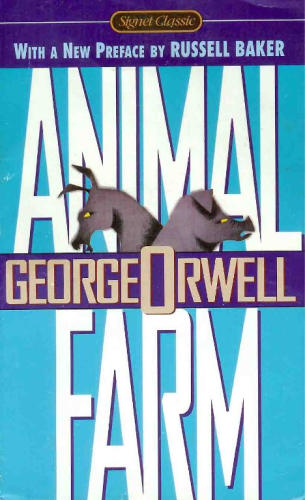
Animal Farm is a classic, chilling allegory from the author of 1984, whose voice I most definitely recognized in this earlier novel. My 50th anniversary edition, from Signet Classic in 1996 (pictured), includes a preface by Russell Baker (new in 1996) and a 1954 introduction by C. M. Woodhouse of The Times Literary Supplement. I found these starting pieces noteworthy. I know a little about Orwell, have read 1984 several times, and am familiar with other early dystopian novels like Brave New World, which Baker refers to (he calls these authors pessimists), so I had a little background. Interestingly, Baker makes the very optimistic statement that the pessimists were wrong, that our current leaders (in 1996) did not resemble dictators, that technology has been a liberating force. I think there is some validity to the last argument; but there is plenty of room to criticize the power of the state today, and I find Baker a trifle breezy in his reassurances. To be fair, he is right to point out that the state has turned out to be less efficient than Orwell feared: drones and wiretaps today do not approach the effectiveness of Big Brother in 1984. At least, that’s what we think… I don’t consider myself a conspiracy theorist, but I’m not particularly optimistic about the virtues of our government leaders.

Woodhouse’s introduction is more straightforwardly academic in its analysis of Animal Farm as literature and in culture and politics, and of Orwell as an artist. He considers him a prose poet, in fact. This article was informative and critical but still accessible, and I recommend it. (I recommend Baker’s preface, too, but with salt.) The most useful part, for me, was the specific placement of Animal Farm in time: it was published in August of 1945, the same month as the bombings of Hiroshima and Nagasaki, but Orwell had begun writing it in 1943, following his disquieting experience in the Spanish Civil War in the late 1930’s. As a criticism of Stalin’s Soviet Union, Animal Farm was not particularly welcome in the Britain of the early 1940’s.

And now the novel itself. Orwell (or rather Eric Blair, who used a pen name) calls it a fairy story; but I find the allegory blaring through loud and clear. Mr. Jones is a drunken farmer who does not always treat his farm animals with great respect or tenderness. An elder statesman of a pig (no, literally) makes a speech shortly before his death in which he predicts to his fellow four-legged residents an uprising of the animals against the people. This prediction will be carried out by the animals of Manor Farm: they kick Mr. Jones off, rename their property Animal Farm, and begin working for themselves, cooperatively. Aside from the anthropomorphism of the animals, it’s a straightforward and absolutely real tale. The pigs are the smartest – are in charge – assisted by the dogs; horses & a donkey are thinkers as well, while the birds and the sheep are followers. They come up with a list of Seven Commandments: no animal shall wear clothes, no animal shall sleep in a bed, etc. and finishing with “All animals are equal.” They make committees and call one another “comrade.” Two pigs, Snowball and Napoleon, struggle for power; Snowball is a better speaker, but Napoleon marshals the power of a few big, strong, brainwashed dogs, and eventually runs Snowball off the farm. The pigs begin to relish their power and to take advantage. Gradually, the rules of Animal Farm change; the Seven Commandments are amended (“no animal shall sleep in a bed with sheets”), but because very few of the subjects are literate, the pigs in charge have little trouble changing history too. Thus, it’s not that the state has changed its policies; these have always been the policies of the state. This is precisely the case in 1984 as well, where

Oceania was at war with Eurasias: therefore Oceania had always been at war with Eurasia. The enemy of the moment always represented absolute evil, and it followed that any past of future agreement with him was impossible.

Chilling, I say!

Also, credit Animal Farm with the oft-quoted amendment to the final Commandment: “All Animals Are Equal. But Some Animals Are More Equal Than Others.”

This is a short book, just over 100 pages, and easily read in just a part of my flight. And in the “fairy story” about the animals on the farm, it’s fairly straightforward, too. But the underlying message, which doesn’t lie so far beneath the surface at all, is terrifying – and also fairly straightforward, in fact. From a historical perspective, that almost makes it that much more frightening, that these things really happened, right under people’s eyes, and not so long ago either. It’s disconcerting how easily people can be convinced to disbelieve their own minds and memories.

I continue to be a fan of Orwell, of both 1984 and Animal Farm, and despite Baker’s characterization of Orwell and Huxley as “pessimists”, I think these are important books to read today. (To be fair, he agrees: “Orwell left us a lesson about the human contribution to political terror that will always be as up-to-date as next year’s election.”) Also, the writing is pretty wonderful.

Shivers! And go read!


Rating: 9 readjusted rations.

book beginnings on Friday: Shirley by Susan Scarf Merrell

Thanks to Rose City Reader for hosting this meme. To participate, share the first line or two of the book you are currently reading and, if you feel so moved, let us know what your first impressions were based on that first line.

shirley

This is a new novel about Shirley Jackson, styled after that author’s own creepy-crawly work. It begins:

“You have green eyes,” she said. I handed her my end of the fitted sheet and she tucked the corners deftly together, folded again to make a smooth square, her knob-knuckled fingers making quick work of a task I’d never had to do. Bed-making I knew too well, but, oh, the luxury of a second set of sheets!

“No,” I said. “My eyes are blue.”

How’s that for a spooky beginning? Coupled with that cover – good stuff!

This quotation comes from an uncorrected advance proof and is subject to change.

Maximum Shelf: Euphoria by Lily King

Maximum Shelf is the weekly Shelf Awareness feature focusing on an upcoming title we love and believe will be a great handselling opportunity for booksellers everywhere. The features are written by our editors and reviewers and the publisher has helped support the issue.

This review was published by Shelf Awareness on April 23, 2014.

euphoriaLily King (Father of the Rain) renders three young anthropologists in 1930s’ New Guinea with nuance, tenderness and charming ambiguity in Euphoria. King draws on the life of Margaret Mead and her relationships with her second and third husbands (Reo Fortune and Gregory Bateson, respectively), but the novel is only loosely based on their lives and work.

Nell Stone is an American, and has recently written a book that is receiving much attention for its controversial subject matter: the sex lives of children in the Solomon Islands. She is an up-and-coming young anthropologist being talked about around the world; when we meet her, she is just emerging from a year and a half in the field in New Guinea, alongside her husband, Fen. Fen is Australian, overbearing and decidedly threatened by Nell’s success, as fame and glory as an anthropologist have so far eluded him.

When Nell and Fen come out of the field, at a party they meet fellow anthropologist Andrew Bankson. He is fresh off a failed suicide attempt, haunted by the deaths of his two brothers and unable to find himself in either his native England or the tribal communities he studies. Bankson is lonely and attracted to the couple, and suggests that he establish them with unstudied “natives” nearby his own fieldwork; he wants to keep them as his friends and neighbors.

The three form an unlikely triangle of mixed alliances. Nell and Fen, for all their disharmony, share a history and an intimacy the loner Bankson can’t pierce. But Nell and Bankson achieve a singular connection of the minds: they inspire each other, each stimulating the other’s best work. With Fen’s sensitivity over and resentment of Nell’s talents, this is a dangerous but intoxicating symbiosis, a cerebral union that is sensual and nearly sexual. Bankson is, in fact, rather in love with both Nell and Fen. The two men establish their own bonds as well, when Fen nurses Bankson through a malarial fever. It is a love triangle, but also an intellectual one, and shadows the perceptions of each anthropologist about the tribes they live amongst. They already have very different approaches: Nell has loved, ever since she was a small child, exploring other worlds so that she can come back and tell her family, friends and now colleagues about her adventures; for her, the joy is in the description and the homecoming, but she also has a knack for integrating herself into a new culture. Fen, it seems, would rather become a tribesman than study or write about the tribes. Bankson struggles to participate, but is more inclined to observation–his background is in the natural sciences. As he writes, “I was raised on Science as other people are raised on God, or gods, or the crocodile.”

Lily King makes an interesting decision in choosing Bankson as her narrator, as he is the most isolated of the three, spending much of his energy in observing not only the tribal peoples he is meant to study, but also Nell and Fen. That the story of these three characters is told from the perspective of his outsider status means that the reader, too, is forever peeking in and around corners, hoping for more information. Nell’s voice is heard through journal entries eventually sent to Bankson by another old friend and possible love interest of Nell’s, but she remains tantalizingly difficult to access. The tension of this desire to know Nell better is central to Euphoria, for Bankson and for the reader.

King raises broader questions as well, as each anthropologist’s individual approach to his or her work is troubling in its own way. The tribal communities of the fictional Kiona, Mumbanyo, and Tam peoples invite consideration about the fields and methods of anthropology and ethnology. The Tam women, who do the trading and the artistry in their community, inspire Nell’s growing ideas about traditional gender roles, a stance that (predictably) does not sit well with the irritable Fen. Margaret Mead is known not only for her writings and work in anthropology, but also as a feminist thinker; in King’s hands, the Tam culture inspires the beginning of Nell’s own feminist development. As Bankson gravitates toward Nell’s empathetic and involved relationship with the Tam, Fen is planning a serious cultural crime, which will precipitate the final denouement. (The life stories of Nell, Fen and Bankson are quite different from their historical counterparts Mead, Fortune and Bateson, so there are no spoilers for readers familiar with that history.)

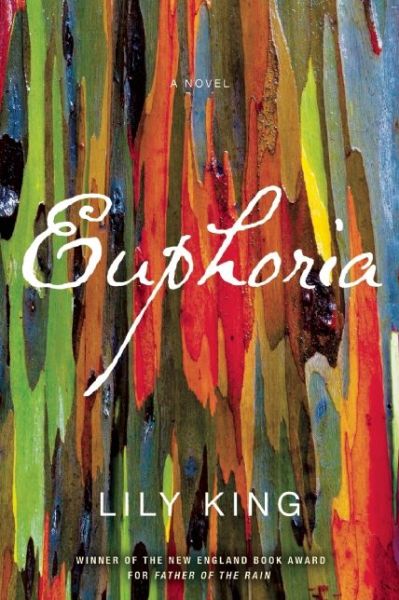
Euphoria is a masterpiece of dreamy, lyrical, sensuous writing and evocation of a sometimes frighteningly exotic New Guinea. Readers can expect to be enchanted by the setting, inspired by the free-spirited Nell, challenged by the question of respectful participant observation, angered by certain of the characters’ actions and teased by the sexual tension. As a bonus, the beautiful cover of Euphoria features the striking rainbow gum tree that figures in the plot of this remarkable novel.


Rating: 8 books.

Come back tomorrow for my interview with King!

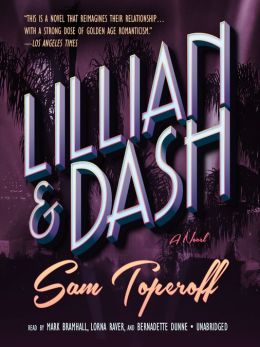
Lillian & Dash by Sam Toperoff (audio)

lillian&dashEvery since reading A Difficult Woman, I have recognized Lillian Hellman as a fascinatingly complex & ambiguous character, clearly a “difficult woman” and therefore a kindred on some level. A fellow traveler, you might say. I have read very little Dashiell Hammett (just a few short pieces), but I respect his contribution to a genre I love, and I hope to get around to more one day. Furthermore, Hellman is a counterpart to Dorothy Parker, another spunky female wit I have enjoyed reading and reading about. So then, it should be clear why I was interested in this novel about the Hellman and Hammett love affair, which lasted several decades (during which they remained married to other people) and bears on the literary and political events of their time.

This audio version is narrated by three different readers (Mark Bramhall, Lorna Raver, and Bernadette Dunne), an effect I very much liked. One reads Lillian’s (or more often, Lily’s) first-person parts, one reads Hammett’s, and the third is the third-person narrator of the story. It begins with the pair’s first meeting, and follows them through his novels and screenwriting successes, his radio shows, and his later difficulties working and prodigious drinking; her plays and movies, both wild successes and disappointments; her years as a farmer, and both their testimonies before the House Un-American Activities Committee. Both refused to cooperate with HUAC, and both paid dearly; Hammett went to prison at age 58, and tried to drink himself to death when he got out, while Hellman lost her farm, just for starters.

I can’t speak to how precisely this book follows the factual history of these two lives (I don’t know where my copy of A Difficult Woman is), but I don’t really care. This was a great story, heartfelt and heartbreaking, about two delightfully irreverent and vibrant personalities. Their voices felt very real and accurate to me, and HUAC pissed me off all over again. I promised myself once more that I would finally get around to reading one of Hellman’s plays. Hold me to it.

A love story with mysteries & politics mixed up in it, written in the impeccably wry and witty voices of Hellman and Hammett, in a beautifully performed audio edition – I couldn’t ask for more, although I will ask for another. What’s next, Sam Toperoff?


Rating: 8 bottles of champagne.

Teaser Tuesdays: Lillian & Dash by Sam Toperoff

Teaser Tuesdays is a weekly bookish meme, hosted by MizB of Should Be Reading.

lillian&dash

I am really loving this treat: a glimpse into the lives (fictionally rendered here) of Lillian Hellman and Dashiell Hammett, in their irresistible, funny, dry voices. Here, from inside Hellman’s head:

Store detectives. Hammett once held such a job, briefly. He quit. He identified too closely with the shoplifters.

Of course he did, dear.

Do check out Lillian & Dash; it’s great fun, and this audio edition is tops.

guest review: A Scots Quair by Lewis Grassic Gibbon, from Pops

Thank you, Pops, for sharing another recommended read. I remember hearing about this one several months ago!

Truly a classic of Scottish literature, A Scots Quair is a fictional trilogy written in 1932. I am totally enthralled; it is proletarian rustic history, romance of the earth, real-time anti-war essay, epic of Scotland’s industrial emergence, Victorian romance, visionary social observation, heartfelt conservationist ecology, salt-of-the-earth characters, staggering timeless relevance, Gaelic heart, linguistic challenge, lyrical poetic voice. Simply amazing. There are also striking cultural & spiritual similarities with the Pacific Northwest, and I’m not just talking cold & rain!

This was a “recommended” book discovered in planning for our 2010 trip to Scotland, which I loved and it certainly contributed to my appreciation and devotion here after such long delay. I wrote most of this summary after reading only book one, and it rings true as I finish the set two months since beginning the journey.

My paperback is printed in painfully small print; that combined with the blend of colloquial Gaelic & unfamiliar sentence structure to present a long learning curve before I fell into its flow and grew to cherish its voice. It took me a while to squeeze this commitment into a busy time, but after that tentative beginning I never wavered; the story was a reliable companion and ultimately I rued reaching the end.

Lewis Grassic Gibbon is the author. He writes of the period in which he lived: the dawning of the 20th century in Scotland up until publication in the 30s. The helpful 1986 Introduction by scholar David Kerr Cameron notes: “Sadly, Gibbon died aged only thirty-four, in 1935, almost as he completed the trilogy that would be his outstanding achievement, already aware of the fate of his beloved peasant folk but hardly realizing how important he himself would become.”

The story observes the course of change during this time in northeast Scotland by following Chris Guthrie from her birth to death, divided into three formative periods & locales in her life. The characters flowing in and out are countless, yet so many become familiar & cherished. Tragedies of the time are ever-present, as is a rich appreciation of nuance and humor in those lives. I am struck again by the wonder of a female character portrayed so compellingly by a male author.

This is one for all time, and I thirst to find some of it’s legacy in other forms…

Teaser Tuesdays: Out Stealing Horses by Per Petterson

Teaser Tuesdays is a weekly bookish meme, hosted by MizB of Should Be Reading.

out stealing horses

I am enjoying this audiobook on Pops’s recommendation; recall his review here. And I am enjoying, particularly a little joke like this one, in which author Petterson has his narrator note a very strange coincidence and then comment that he does not appreciate it when novelists put such strange coincidences in their books, since they are so unbelievable. It takes humor as well as guts for a novelist to poke at himself in this way! Here is the line that follows…

It may be all very well in Dickens, but when you read Dickens you’re reading a long ballad from a vanished world, where everything has to come together in the end like an equation, where the balance of what was once disturbed must be restored so that the gods can smile again.

A Dickens reference is always welcome as well; and I think this is a fine way of describing Dickens, as coming from a vanished world. It does feel that way sometimes, and perhaps recognizing his work in this way could help us enjoy him.

Well done, Pops. I will carry on.

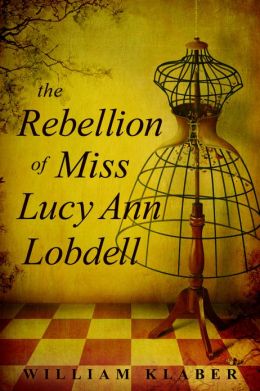
The Rebellion of Miss Lucy Ann Lobdell by William Klaber

rebellion lucy annI am absolutely charmed by Lucy Ann Lobdell.

The backstory to this novel is an attractive little plot in itself. Journalist moves into an old farmhouse in upstate New York. Years later, he sits down with a local historian and hears the story of Lucy Ann Lobdell, who inhabited the area and is even linked to journalist’s own farmhouse. The aging local historian has searched and searched for Lucy’s memoir but never found it; he is now too tired to pursue her story further, but hands over his significant research to the younger journalist to follow. Journalist is likewise unable to find the memoir; but sensing the power in Lucy’s story, he writes it in novel form instead. And here it is.

Backtrack a little over 100 years. Lucy Ann Lobdell has had a difficult youth, and is entirely frustrated by the lack of options for women in the mid-1800’s, especially a young woman like herself with a daughter and whose no-good husband has run off on her. She runs away from home, leaving her daughter behind with her disapproving family, to put on men’s clothing and seek work as a man. Lucy works as a man can work (earning what a man can earn – and this references a problem that is somewhat ameliorated, but not solved, today) and lives independently – choosing her own company, holding her own hours, answering to no one. And thus she learns how much she has gained, and vows not to return to womanhood, where she will be manhandled, abused, underpaid, and never allowed to make her own choices. She dreams of having her daughter join her own day in her new life, but worries over what form that might take. What might she, as Joseph Lobdell (a name borrowed from her grandfather), be to the young Helen? Not a father; an uncle, perhaps?

Klaber’s novel, told in Joseph’s own first person voice, follows him as he works different jobs in different towns, moving around, facing various challenges. He’ll repeatedly be found out. He will eventually marry a woman named Marie – not the first with whom he’s had a romantic connection, but the first who has known his secret. Marie will accompany him through some of his roughest times, when he suffers from some form of mental illness. Of course, his conservative contemporaries will ascribe this to his sexuality, sexual preference, sexual identity – none of which terms were available to Joseph in the late 1800’s.

Here you see that I have switched pronouns; I’d like to note the brief statement that author Klaber makes, that “just which of the modern labels of sexual orientation or gender should be applied to the historic Lucy is something I will leave for others.” He notes that he honors Lucy/Joseph’s person journey. This strikes me as an appropriate stance for him to take. Such labels are fluid, and as none were open to “the historic Lucy,” I think we should take her as she presents herself. Of course, Klaber’s presentation of her or him are not her or his own; but we take what we have.

It’s easy to see what a an easy character Lucy can be to commiserate with. She is high-spirited, refuses to accept society’s limitations on her sex, and instead demands more. Her struggles are very sympathetic; not that it’s easy today, to figure out one’s sexual identity or sexuality, but how much more difficult in her time, with no role models or examples of what she might be. (Klaber cites one historian who claims the first use of “lesbian” in its current meaning was in reference to Lucy.) A theme running through her life, as told here, is the question of the extent to which she is a woman, or a man; only late in life she will come across the writings of Margaret Fuller, who proposes that we are all on a continuum between the two. Naturally Lucy/Joseph appreciates this concept.

We would like to know a little more accurately what happened to the historic Lucy/Joseph. Lacking that option, I’m glad Klaber chose to share with us as he could. He does invent dialogue, and it’s not clear to me how much of this might have come from the historical record. So as always with historical fiction, take a grain of salt. But her story is told feelingly. And as you know, I always have a weakness for women in history fighting uphill battles; her obscurity makes her rather more interesting still.

I’m glad I accepted this copy for review.


Rating: 7 wolves.

Full disclosure: I received my copy of this book from a publicist in exchange for my honest review.

A Burnable Book by Bruce Holsinger

A medieval scholar takes a fictional turn in 14th-century London, in a story full of murder, literature, politics and intrigue.

burnable book

A young prostitute watches horrified from the bushes as a woman is beaten to death–then looks down at the book in her hands, placed there by the victim moments before. A London “fixer” and minor poet named Gower is asked by his friend Geoffrey Chaucer to track a missing book. The court surrounding the new and untested King Richard II worries over the new games of playing cards and a book rumored to contain a series of verses circulating London regarding the deaths of kings past and present. This one book that troubles bawdyhouse prostitutes, the royal court, bureaucrats, poets and criminals holds potentially great consequences for England’s future. It is treasonous, a “burnable book.”

Bruce Holsinger, a prolific and respected medieval scholar, turns his hand to fiction with A Burnable Book. His academic background makes him well suited to render diverse settings in 14th-century London, from the Southwark stews to the grand halls of Westminster. The young woman murdered outside the city walls is only the first victim, and Gower is not the only one searching for the book in question, for scruples are scarce when the stakes are so high: England’s royal command itself is under threat. Murder mystery, political intrigue and the engaging world of Chaucer’s London are brought to life with a cast of complex, sympathetic characters who are far removed from and yet also familiar to our modern world. Holsinger’s expertise with medieval times is put to good use in a thriller filled with suspense and literary taste.


This review originally ran in the February 25, 2014 issue of Shelf Awareness for Readers. To subscribe, click here, and you’ll receive two issues per week of book reviews and other bookish fun!


Rating: 7 quatrains.

Wake by Anna Hope

With expertly written characters and a convincing melancholy tone, Anna Hope brings the aftermath of World War I to life through the lives of three English women.

wake

Anna Hope’s debut novel, Wake, follows three English women over a span of five days in 1920, building toward the two-year anniversary of Armistice Day and the end of World War I.

Hettie works in London as a dance instructor, paid by the dance to twirl with strangers, many of whom are missing limbs. She struggles to support herself as well as her irritable, aging mother and a brother who has not worked–or hardly spoken–since the war’s end. The festive, exotic dance hall where she works presents an interplay between light and dark, and Hettie’s forays with a more fortunate friend to a breathtaking speakeasy emphasize class differences. There, she meets a handsome, wealthy young man who intrigues her, but the distance from which he regards the world seems unconquerable.

Evelyn handles veterans’ pension complaints, a thankless job that keeps fresh the wound left by her boyfriend’s death in France. Asked every day to consider the fates of damaged young men, her bitterness grows. She used to be close to her brother, an officer, but he has not been the same since he returned.

And Ada is nearly mad, haunted by her son, whose death “of his wounds” has never been properly explained to her. Her loving husband feels that he has lost a wife as well as a son. When a young man appears on her doorstep and speaks her son’s name, Ada is staggered; this event threatens to precipitate her descent into mental illness.

Woven among the three women’s stories are brief views of military exhumation of unidentified bodies, candidates for the unknown soldier who will be reburied and honored on the anniversary of Armistice Day. These scenes establish and emphasize a gray, cold backdrop to the lives of Hettie, Evelyn and Ada.

Hope’s strengths lie in nuance and atmosphere, as she gently and subtly reminds the reader of humanity under the worst of conditions. The pervading mood of the novel is reinforced by poverty, an inability to talk about past trauma and the presence of countless maimed and begging young men. As the lives of her three protagonists come together and the unknown soldier nears his final grave, Wake’s deeply moving, ultimately universal story speaks evocatively across nearly a century.


This review originally ran in the February 7, 2014 issue of Shelf Awareness for the Book Trade. To subscribe, click here.


Rating: 7 dances.