Mrs. Hemingway by Naomi Wood (audio)

A randomly selected audio treat recently returned me to the world of Ernest Hemingway, whom I have not read for years now, but who I feel as strongly about as ever.

This is a novel about the Missuses Hemingway: Hadley, Pauline, Martha, and Mary. Therefore it begins in Antibes, France (with flashbacks to Paris and Chicago, where Hadley and Hemingway met), and follows the strangely morphing family to Key West, Cuba, Spain, London, and Idaho. Chapters are told from the point of view of each Mrs. Hemingway in turn. These are third-person perspectives, but very close.

How to sum up this story I feel I know so well? Hadley Richardson is the first wife. Older than Hemingway, she had resigned herself to spinsterhood and is called ‘homely.’ Their marriage was most innocent, since another hadn’t ended to allow for it. They had a baby, Bumby; they lived together in Paris, dirt poor and very happy – these years are later mythologized by Hemingway in such terms. Next comes Pauline Pfeiffer, or Fife, a wealthy socialite who inserted herself into the Hemingway marriage, as a close friend to Hadley as well as to Hem; she made a concerted effort to win him, which she did. This breaking point opens the novel: Hadley gives Hem a tearful ultimatum, and then issues her conditions for divorce. She wants him and Fife to spend 100 days apart to decide if they’re really serious. Then she lifts the requirement, out of sympathy for the lovers’ plight.

Fife was Hem’s longest-lasting wife. They had two sons, Patrick and Gregory, and settled in Key West. Fife’s section also opens near its end: Hemingway returns from Spain, where he’s been covering the Spanish Civil War, and alternates between treating Fife better than ever, and sort of teasing her with his new mistress, Marty. Fife is the only one of his divorces to really fight to keep him, beg him to stay. She loses, and the two are never on excellent terms again. Cue Marty, or Martha Gellhorn, herself an accomplished war correspondent: Hemingway’s problem with her is her independence, her own writerly accomplishments, her refusal to wait at home for him. They have been apart for some time when she shows up in Madrid to find him and break it off, only to learn he’s taken a lover, Mary. This upsets Marty briefly, but then the two women meet and team up in taking care of him. His drinking and self-sabotage are worsening, and Marty is relieved to pass him on to the next wife.

Mary Welsh was there at the end, when he shot himself with both barrels of a shotgun in their home in Ketchum, Idaho, and much of her section of the book takes place after his death, as she tries to sort through papers and her own grief. Here Mary receives a final visit from a most interesting secondary character, one whom Naomi Wood invented: Harry Cuzzemano, a collector/dealer of books and literary ephemera, who has harassed all four wives for papers and especially, the famous briefcase Hadley lost at the Gare de Lyon. (If you don’t know, go look up this most fascinating mystery in the Hemingway legend.) The final meeting with Harry is part of the final wrapping-up, which is a little odd (he has been peripheral throughout) and a little appropriate (he has been a through-line, and in making his own final peace, he helps Mary find hers). The last moments involve Mary’s coming to terms with the fact that Hemingway was not the fatal victim of a gun accident, as she’s been claiming. I can only imagine how difficult this must be. There was plenty of evidence in support of a suicide – his mental health in the last years of his life, several suicide attempts, forensic evidence – but how hard it still must be.

Mrs. Hemingway was an enjoyable read (listen) for me. Each of these four women is evoked in her own fashion. I loved feeling steeped in Hemingway again, after too long. These stories were familiar, although the particulars were often new. Kate Reading (great name), who narrates the audiobook, did a good job: I did not think of her a bit, which is the ideal, meaning that her role as reader kind of disappeared for me and I felt I was receiving the book unadulterated. I see that Naomi Wood spent time with letters and papers written by each of these women, and I feel good about her fictionalized but faithful representations.

As a gentle criticism, I guess I would say that this still felt like a book about the man, more than about the women. Maybe that’s the only way to go, with such a massively larger-than-life male lead; at least three of the wives were most famous for being just that, and it seems Hemingway had this effect on women (and men, too), that everything becomes about him. They all four loved him in their own ways. They all kept in touch in their own ways, or didn’t: Hadley and Hem remained chums; Pauline was an antagonist, but a co-parent, so some contact was necessary; Marty and he never spoke after their divorce. I appreciated how they kept in touch with each other, too (or didn’t), including the friendship between Mary and Hadley, the first and last wives, whose relationship was largely a collaboration on how to best care for the man they’d all shared. There’s something deeply creepy about this polygamous-feeling string of women. But it’s true to life, as far as I can tell. (As an aside, I’ve always wondered what my relationship with Hem would have been, if we’d been alive at the same time. Would I have been able to resist his prodigious charms, and see what a cad he was?)

This is a book of high emotions, love and devotion and anger and betrayal and rejection. Looking over that last paragraph, I don’t think I mean to criticize, after all. I think the Hemingway focus is accurate. He’s what these women have in common. If it’s a little less than feminist and empowering to be so mad for this flawed man, so be it: it’s what happened. I am glad that Wood gave each woman her own time and her own personality. I’m glad to be with the flawed man again, myself. I’m very glad I read this book. It was sweet and harrowing, and engulfing. Recommended.


Rating: 7 shallow white bowls.

The Underground Railroad by Colson Whitehead

I so enjoyed seeing Colson Whitehead speak at TSU almost a year ago – it seems a little strange it’s taken me this long to get to this one!

The Underground Railroad is compelling, a story with momentum and imagination. I had forgotten that the underground railroad would turn out, in this book, as a literal railroad that runs underground: that was a fun surprise to experience. “Fun” is not precisely the right word for this book, though. It’s about slavery and the quest for freedom; there is little here that is light or fun.

The protagonist is Cora, a young enslaved woman who makes a run for it with a young man, Caesar, who she doesn’t know very well. It begins with a little prefacing history, of Cora’s grandmother and mother before her. Her mother escaped the Georgia plantation where she and Cora were born, never to be seen again. The ghost of that woman hangs over Cora’s decisions and her feelings about those around her.

Cora travels, with and without Caesar, through several states via the underground rails. We see the details of various stations on the railroad: this one beautified and furnished, this one bare, a statement about the hard work required to dig survival out of rock and earth. Cora asks, who built the railroad? And the response: “Who built anything in this country?”

Cora will continue to wonder about the hidden hands who contribute to the quest for a better life, even as that life eludes her in her travels. This is not particularly a story of redemption or of happily-ever-after. Each time Cora survives a brutal and shocking turn of events, she loses those she cares about, and cynically revises her hopes: how stupid (she thinks) she was to think it could get better. The places she gets to know along the way could be viewed as archetypes (remember from Whitehead’s talk that I heard something like this idea): the place where no Black person is suffered to live, where the streets are lined with hanging corpses; the place where life appears secure only on the surface; the place where all can contribute according to their abilities. These steps along the way are instructive. But the book does not necessarily end on a hopeful note.

There’s a bit here of something I watch out for in books like this, historical fiction featuring ordinary or marginalized people: Cora perhaps holds a bit more far-reaching wisdom of the world than someone with her life experience might be expected to have. For example, she observes slave labor replaced by cheap Irish immigrant labor, and muses that as the Irish supply runs out or goes out of fashion, another poor country will send its emigrants to form the next wave. This speculation about the poor countries of the world seems like a lot for a woman who’s lived her life on a Georgia plantation to come up with. It’s a clear temptation, especially with benefit of hindsight, to invest one’s apparently “ordinary” characters with special knowledge and wisdom.

I appreciated the range of characters. Most of the book is told from Cora’s perspective, but short interspersed chapters come from the points of view of secondary characters, including racist white ones. I imagine those chapters in particular might have been hard to right, but also interesting to write, and they enrich the book by complicating things. Not that the evil slavecatcher gets much sympathy; but hearing his inner thoughts makes him more real, more believable, and therefore more frightening. Complication, in literature, is always good.

I believe I expected this book to be magical realism, and I’m not entirely sure that’s my impression after reading it. There’s nothing here (that I noticed) that couldn’t happen in our real and non-magical world. The literal underground railroad would be a feat of engineering and supplies, but not strictly impossible. The good and bad luck (if we can call it that) Cora and others face certainly seems fantastical, but is in line with the well-documented true stories of enslaved people. That said, it was a vibrant, rich way of telling the story of slavery and struggle: one we’ve heard/read before but clearly aren’t done with. The railroad part was fascinating, nicely told. The characters were always intriguing. I think pacing may be the great feat of this book: I scarcely was able to look away once I was in it. Thank you, Colson Whitehead.


Rating: 7 stations.

Midnight: Three Women at the Hour of Reckoning by Victoria Shorr

Well-researched, perceptive writing results in a gripping triptych of the inner lives of Jane Austen, Mary Shelley and Joan of Arc.

In Midnight: Three Women at the Hour of Reckoning, Victoria Shorr’s (Backlands) remarkable literary voice illuminates the lives of three famous women. Jane Austen, Mary Shelley and Joan of Arc are each seen standing at respective thresholds in these well-researched fictionalizations, their extraordinary lives given immediacy and power and even–despite what we already know–suspense.

At 27, Jane Austen is practically an old maid by her society’s standards. Along with her unmarried sister and parents (who have given up home and livelihood for one of their sons), Jane travels from one relative’s home to another, essentially homeless, and without hope of the one salvation expected for a woman of her class: marriage. Her witty writings have entertained only her immediate family. And then, a near miracle: the younger brother of dear friends proposes. Jane agonizes through the night, but decides she cannot marry for less than love, like the best of her heroines. Instead she carries on a life of privation, quiet embarrassments and the masterful writing of the classics we love her for today.

Mary Wollstonecraft Godwin was 16 when she met Percy Bysshe Shelley on a street corner at 4 a.m., to run away to a life of adventure and art and pain. We meet her on a beach at 24, after the deaths of two children, pacing the shore where Shelley has sailed away. He was due back days ago, and now Mary reviews her choices. Might she have been happy if she’d never met Shelley?

Readers find Joan of Arc on the platform beneath the stake where she is to be burned, in the moment when terror strikes her and she renounces her saints and her cause, hoping to avoid death. Over the next week in prison, she relives her triumphs and her faith, then dies at the stake after all. It is a brief interlude in her life, but an enormous one for the reader, who feels in this extended flashback all the intensity she’s lived. Would her life have been better if she had stayed home to mind her sheep in Lorraine? If she’d turned back from Reims, and not pushed, prideful, for Paris? Shorr sets up an interesting interplay between Joan of Arc, the confident hero, and Girl X, as the woman who renounced her beliefs on the platform thinks of herself. The dialogue between the two carries on until the end, when Joan burns.

Each of these women faces a choice early in her narrative; then the consequences unfold. Shorr’s prose is incisive, thoughtful and personal, deeply exploring the interior lives of her characters. Fans of Austen, Shelley and Joan, as well as fans of rich inner lives in historical fiction, will be riveted.


This review originally ran in the February 1, 2019 issue of Shelf Awareness for the Book Trade. To subscribe, click here.


Rating: 7 spurs to action.

The Silence of the Girls by Pat Barker

This retelling of the Trojan War by one of the women on the side of defeat is essential, and essentially human.

The Iliad is the story of the Trojan War told by the victors, and by men. At long last, another perspective is offered, in Booker Prize-winner Pat Barker’s The Silence of the Girls. Briseis was queen of a city near Troy and, after it fell to the Greeks, she was given as prize of honor to Achilles. After Apollo compelled him to forfeit a concubine, Agamemnon took Briseis for his own. This indignity inspires Achilles’s famous sulk, which begins the Iliad.

In the tradition of Margaret Atwood’s Penelopiad, The Silence of the Girls is a much-needed retelling. Where men sing of honor and glory, women experience a different war. They are controlled by men: by their fathers and husbands, and then by their captors. Briseis is beautiful and royal; she hates her new status as concubine, but sees the far worse treatment of the “common women” who sleep under the Greeks’ huts, with their dogs, and are used by any man who pleases. She is clever and gives nuanced portraits of many characters in the Greek encampment below Troy’s walls. She is proud, angered by the indignities of slavery. One of the book’s themes is the question of authorship: she knows that it is Achilles’s story that the world will hear, but she searches for her own within narratives of men and war.

Strong, beautiful Achilles is cold, but stops short of cruelty. Gentle Patroclus eventually befriends Briseis. Ajax, Agamemnon, Odysseus and Nestor are profiled; but equally important are the other slave women. Briseis has friends, allies and antagonists among them, but always considers their struggles. For example, Ajax’s concubine is one of several women who recommend pregnancy above all other strategies. Briseis does not love her captors. But one of her revelations involves how the Trojans will survive, in the end: the sons of the Greeks will remember the Trojan lullabies their captive mothers sang to them.

The Silence of the Girls, like the classic it’s modeled on, is an epic. Briseis’s uncertain situation brings tension and momentum. At just 300 pages, this novel feels much bigger than it is, but is never heavy. Even with the atrocities, violence and loss it portrays, the protagonist’s thoughtful, compassionate point of view emphasizes humanity. It would be too much to say she weighs both sides of an issue evenly; she is loyal to her family and angry with her captors, but she also sees the tragedy in ranks of young Greek boys killed.

This mature, reflective narrative manages the cataloging of Homer’s telling (how many tripods offered, how many bowls of wine mixed), but with a grace and an interest in individual people that is fresh and novel. Barker uses metaphor and animal imagery deftly. Her prose flows easily, like storytelling between friends. It’s an absolute pleasure to read for any devoted fan of the Iliad, but equally accessible to those new to the Trojan story; indeed, The Silence of the Girls might make the perfect entry.


This review originally ran in the August 9, 2018 issue of Shelf Awareness for the Book Trade. To subscribe, click here.


Rating: 8 waves.

guest review: The 53rd Parallel by Carl Nordgren, from Pops

Pops is back with a review of a book from a series that, I confess, I’d largely forgotten about. Thanks for the reminder!

Once again I must thank you belatedly for a book recommendation.

You gave me Worlds Between from your advanced reader stash some years ago. Ah, the circuitous route we take to the books we actually read, out of the millions out there. When I had researched the series (why not start at the beginning?) I found there was just the one, earlier; so I waited. But oops, it’s not in the library. I finally got around to requesting an ILL copy, which arrived a couple weeks ago from a suburban Denver library.

As much as your review describes the benefits found in that first book, The 53rd Parallel is far better in all respects. It is longer (300 pages) but still dense with character and story, like the first. With it, his first novel, Nordgren applied a more leisurely pace that much more fully develops the wide cast of characters (some dropped in the second). Even Hemingway is introduced, as an icon, an aspiration, the ultimate guest for the fish camp if they could make a go of it. (John Wayne is their first, failed attempt at celebrity marketing, in book one.)

Also more fully developed are the ‘parallels’ between Irish and Ojibway history and culture (which share the 53rd parallel of latitude). Shared history: mainly in continued persecution by the English; culture: mainly in their appreciation of dreams and the ambiguous power of myths. The latter, with the challenge of honoring equally both ‘reality’ and myth, is capably and gracefully done. I was absolutely enraptured by book one, constantly amazed at the power of simple telling of a magical story. Sadly, I was a bit disappointed by the rush to conclusion in book two. (I say ‘conclusion’ – but he claims to be working on book three, still yet to be announced.)

The brief first chapter introduces the Ojibway icon This Man, in the 1700s; his ghost is an important presence throughout, but is neglected in the second book. Early narrative is set amidst 1930’s Ireland, with poverty and social dysfunction born of English oppression, generations-old. Brian’s dark past is a torture to read; he is a frustrated hothead and severe child abuser, and is never as fully redeemed for me as the author’s attempt suggests. We observe as each of his three children cope and mature (or not), each in their own way. Maureen is a hugely powerful character (meant both literally and figuratively); for me she, not Brian, carries the narrative thread connecting all pieces. [Spoiler follows; highlight white text to read] I was betrayed and stunned when she is killed in book two; how could Nordgren do that to her?!! The dark world of the IRA, with its own conflicted and tortured history, is introduced early on and lends appropriate complexity, useful context for events in book two.

We also come to know three generations of Ojibway people and history, and understand how significant it is when Brian is adopted as son of Joe Loon, immediately blessing the fish camp with seven generations of family (all of whom are ‘present’). One of Brian’s Ojibway nephews is abused at Indian School, and later sacrifices his life to ensure the camp’s success. Simon, another nephew, is tasked by Joe Loon to learn the white man’s ways to provide intelligence for the tribe; seeing ‘our’ world through his eyes is poignant. I was so impressed with Nordgren’s thoughtful treatment of the Ojibway people and story, reflecting the author’s own immersive experience in their culture. Those passages alone made these books a worthwhile indulgence; Maureen’s story added to the bounty.

So good cross-cultural work–although I always wonder, how well can we judge, if we’re not from the culture being featured?

I am glad for this reminder. Thanks for bringing it back full-circle. I’ll expect you back again for book three, if and when!

West by Carys Davies

A mule breeder heads west to search out a mythic beast while his daughter struggles quietly at home in this tale of fantasy, hope and risk.

In the newspaper, Cy Bellman reads of bones pulled from the Kentucky mud–enormous, ancient bones, belonging to some mythic creature taller than the tallest trees. Grieving his lost wife, he is now transported: he all but stops eating and sleeping, too disturbed to give his full attention to his work as a breeder of mules, or to his 10-year-old daughter, Bess. He can’t help but go in search of the beasts that have so captured his imagination, and leaves Bess and their small farm in rural Pennsylvania in the care of his hard-edged sister, Julie, with the occasional help of an odd neighbor, Elmer. With some weapons, trinkets for trade and a new stovepipe hat, Bellman travels west, toward the wild frontier.

West is Carys Davies’s first novel (though she’s published two short story collections, The Redemption of Galen Pike and Some New Ambush), and it is an epic tale of early 19th-century adventure in a small package. With fewer than 200 pages, its scale is nonetheless mighty, conjuring both history and fable. Davies’s simple, conversational prose stays out of the way of her gripping plot.

Julie and the town’s citizens think Bellman a fool at best. Bess, however, adores her father, and is heartbroken to be left alone with no books or pleasures, only a motley bunch of mules; her dead mother’s gold ring is hidden away by her unloving aunt. In her father’s absence, she makes up charms for his good luck: “if she made it from the pump to the house without slopping a drop of water over the lip of the bucket, it meant he was in good health.” She takes long walks with her favorite mule, until Elmer’s awkward attentions to the deserted household become too alarming, and she shuts herself up inside.

Meanwhile, Bellman wanders the wild countryside, farther and farther south and west, first alone and then with an unlucky Shawnee boy named Old Woman from a Distance for his guide. Bellman’s dreams of the enormous creatures grow vivid, and then less so, as his distance and time away from home increase. He promised Bess he would be gone two years at the most, but as her 12th birthday approaches, his grip on both his promise and his quest look doubtful.

West is a novel about family commitments, small-town agitations and the irresistible, fanatic pull of the unknown. Bellman is either enchanted or suffering a good old-fashioned midlife crisis. Davies writes of small fates: hopeful young Bess, bitter Julie, the enigma of slovenly Elmer, and Old Woman from a Distance, with a troubled past of his own.

This quick, compelling read will please lovers of historical fiction, legendary quests and stories of humble familial devotion. It may prove as hard for Bellman to find happiness at home as to find the monstrous “animal incognitum” he seeks. Readers, however, are the richer for his efforts.


This review originally ran in the April 3, 2018 issue of Shelf Awareness for the Book Trade. To subscribe, click here.


Rating: 7 incognita.

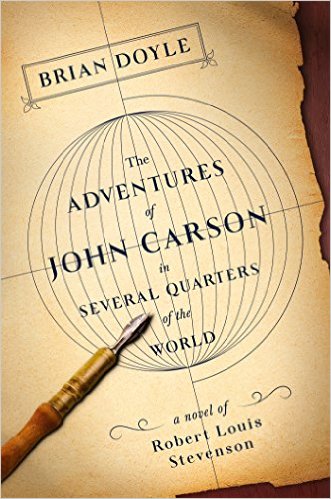
The Adventures of John Carson in Several Quarters of the World: A Novel of Robert Louis Stevenson by Brian Doyle

With enthusiasm and verve, in the style his fans love, Brian Doyle re-creates a novel Robert Louis Stevenson intended to write.

john-carson

In a novel with layers of authors, Brian Doyle (The Mighty Currawongs; Martin Marten) honors the art of storytelling. The Adventures of John Carson in Several Quarters of the World is firmly based in fact: Robert Louis Stevenson boarded for some months at the home of Mrs. Carson in San Francisco while waiting to marry his love, Fanny. He conceived of a novel based on the tales of his landlady’s husband, but never wrote it. Doyle imagines what stories Mr. Carson might have told, and the style in which Stevenson might have written them. Doyle calls upon other published accounts of Carson’s and Stevenson’s acquaintances, including Mark Twain and scientist Alfred Russel Wallace.

In Doyle’s imagination, Stevenson sits by the fire with Mr. Carson as the latter recounts his voyages around the world as a seaman and his experience as a Union solider in the Civil War. This talented storyteller takes Stevenson (and Doyle’s reader) through the jungles of Borneo, over the rocky hills of Irish islands, from coast to coast of Canada in winter, to Australia’s Sydney Harbor and to the battlefield at Gettysburg. Mrs. Carson turns out to be as fine a narrator as her husband, and both have a knack for ending on a cliffhanger just as dinner is ready. As he recounts the Carsons’ feats, Stevenson also explores the sights, smells and steep hills of 1880 San Francisco, and touches on his romance with Fanny Osbourne, herself a worthy, headstrong character.

Doyle’s characteristic prose style is effusive, wry, highly descriptive and always passionate about his subjects. Throughout this story of stories runs a thread of commentary on the value and nuances of the storytelling art. Stevenson constantly refers to his ambition and makes notes for future works: “Hyde would be a lovely name for a character,” he muses, and imagines a novel in which a “sudden shocking kidnapping would set the prose to sprinting.” In several passages, Doyle-as-Stevenson extols the power of storytelling, the universal need for tales of adventure, the urgency of getting them out–he even worries what the “disconsolate reviewers” might say. Readers hungry for more stories-upon-stories will delight in Doyle’s “Afterword” and “Thanks & Notes,” which are filled with recommendations for further reading (what he calls “homework”).

Stevenson’s rollicking zest for adventure blends happily and seamlessly with Doyle’s unrestrained love of words and life. Adventures offers daring exploits, romance and emotional highs and lows, but perhaps most of all, a celebration of stories. Doyle’s signature style expresses this joyousness perfectly.


This review originally ran in the March 2, 2017 issue of Shelf Awareness for the Book Trade. To subscribe, click here.


Rating: 8 stories, of course.

Human Acts by Han Kang, trans. by Deborah Smith

South Koreans struggle to comprehend a 1980 uprising and the violence that follows.

human-acts

Human Acts is the second novel by Han Kang (The Vegetarian) to be translated into English. An introduction by translator Deborah Smith provides valuable context for this meandering book, which uses a dreamy atmosphere to explore the violence of a 1980 student uprising in South Korea.

Kang approaches the horrifying events of the Gwangju uprising obliquely. She doesn’t shy away from the shocking details–indeed, the novel opens with a young boy taking a brief respite from his work cleaning and caring for an overflow of unidentified dead bodies in a converted government office. But instead of spotlighting this violence, Kang focuses on the lives of individuals, beginning with Dong-ho, the boy caring for the dead, and then rotating through the views of those around him. First-, second- and third-person perspectives reinforce the feeling of circling the center of this event. After Dong-ho, the reader meets his best friend, shot dead in the streets; the two young women he works with; and his grieving mother. In a state of massive unrest, violence and terror, these characters appear dazed. Others look back over the decades that follow, including an editor wearily battling censorship and former prisoners struggling with old trauma. This range of voices, their sense of shock and unreality, along with the title, explore the possibilities of humanity: human acts can be variously brave, selfish, gentle and cruel.

Human Acts is a remarkable novel, at once lyrical, dreamlike and horrific. Smith’s succinct introduction is an excellent aid in understanding both Kang’s message and her artistry.


This review originally ran in the February 3, 2017 issue of Shelf Awareness for Readers. To subscribe, click here, and you’ll receive two issues per week of book reviews and other bookish news.


Rating: 7 bodies.

Maximum Shelf: The Chilbury Ladies’ Choir by Jennifer Ryan

Maximum Shelf is the weekly Shelf Awareness feature focusing on an upcoming title we love and believe will be a great handselling opportunity for booksellers everywhere. The features are written by our editors and reviewers and the publisher has helped support the issue.

This review was published by Shelf Awareness on January 10, 2017.


chilbury-ladies-choir

Jennifer Ryan’s first novel, The Chilbury Ladies’ Choir, takes on a wide range of the human experience through the lives and voices of the women of the village of Chilbury, in the south of England, at the beginning of World War II.

The immersion in small-town life opens with Mrs. Tilling’s journal entry of Tuesday, 26th March, 1940. Mrs. Tilling is a timid, good-hearted, churchgoing lady, a widow whose only son is about to be sent to France to fight. The occasion of this journal entry is the funeral for young Commander Edmund Winthrop. This funeral is to be the last appearance of the village choir, as, according to the Vicar, “all our male voices have gone to war.”

In addition to Mrs. Tilling, the reader is introduced to a cast of characters in turn, each of whom speak in the form of letters and diary entries. Miss Edwina Paltry is the town’s sly midwife, who in letters to her sister reveals herself to be secretly pursuing a fortune by any means: “I’ve been offered the most unscrupulous deal you’ll ever believe!” Kitty Winthrop is the 13-year-old sister to the lost Commander. Between her violently abusive father and distracted, pregnant mother, Kitty is left to her own devices to worry about boys, war and her hoped-for career as a professional singer, all of which she records in her diary. Her older sister Venetia, at 18, is a wildly boy-crazy beauty, and in letters to her friend Angela in London, recounts her difficulties in seducing the handsome new artist in town, Mr. Slater.

In these personal documents we learn that a new music teacher has arrived from London. “Her name is Miss Primrose Trent, but she told us to call her Prim, which is funny as she’s not prim at all but frightfully unkempt.” The lovably misnamed Prim doesn’t see why a choir needs male voices, and promptly calls practices again. The Chilbury Ladies’ Choir meets some resistance, some grumblings about tradition, but as the war proceeds, the women learn to lean on one another. Eventually the choir becomes a central institution in the town, providing material as well as moral support, and a theatre for personal growth.

After Mrs. Tilling’s son leaves to fight, she takes in a boarder, Colonel Mallard, who is working from a nearby base. Living with a stranger is a great challenge for her, but one of several she rises to as war comes to England. Venetia wins Mr. Slater, but experiences a life-changing accident. Kitty takes a position of leadership in the choir and suffers a massive disappointment. Miss Paltry’s plans go awry, and the town sees several new births, but also tragedy. The Germans bomb the English shore. The novel concludes in September, but these are an eventful few months.

Occasional other voices join in to complete the picture, including the rare diary entry from Silvie, a 10-year-old Czech Jewish refugee billeted with the chaotic Winthrop household, and a few letters from Colonel Mallard to his sister. But it is the perspectives of Mrs. Tilling, Venetia, Kitty and Edwina Paltry that define the novel’s path. Encompassed in these experiences is all of life: love, hope, despair, loss, petty disagreements and great sacrifices. The Chilbury ladies learn to expand their horizons and their abilities, build new relationships and stand up for themselves.

The various first-person voices vary subtly, but distinctly. Mrs. Tilling has a deep commitment to propriety and loyalty; Miss Paltry is unafraid to crow over her rivals; Venetia’s boy troubles are apt to take over her world. Kitty’s 13-year-old diary is perfectly wrought: she peppers it with lists (“why everyone’s getting married in a hurry”; “things I know for sure”), and persistently subscribes to patent fantasies, but also soberly reports the news of her larger world. On her list titled “what will happen if we get taken over by the Nazis,” this obstinate teen notes, “they’ll imprison or shoot anyone who doesn’t do what they say.”

The epistolary form works nicely to establish intimacy, giving the reader a behind-the-scenes perspective and a feeling of being deeply engaged with Chilbury. The overlapping points of view offer the opportunity to make up one’s own mind who to believe, and to piece together a fuller picture of events when the characters try to keep secrets. Poignancy is abundant, with Silvie fully aware of her precarious status, and Mrs. Tilling desperately worrying over the life of her son. There are moments of humor, too: life cannot help but go on, even as the Germans fly overhead.

The Chilbury Ladies’ Choir offers a world of emotions, experiences and characters in a tiny village, over a few months in 1940. Anxious Mrs. Tilling, devious Miss Paltry and the ever-evolving sisters Venetia and Kitty represent a wealth of possible reactions to an event bigger than themselves. In their variously sweet, mischievous, aggrieved and hopeful letters and journals, these ladies bring home the impact of world war. And in a village deprived of its men, they show that women can pull together and do anything that needs doing. The Chilbury Ladies’ Choir is an inspirational, sometimes sad, tale, and Jennifer Ryan puts it together with style.


Rating: 6 envelopes.

Come back next week for my interview with Jennifer Ryan.

The Evening Road by Laird Hunt

Two women from different sides of the tracks explore rural Indiana on a single night that is both allegory and starkly real.
evening-road

The Evening Road by Laird Hunt (Neverhome) meanders the backcountry roads of rural Indiana on a hot and troubled night, exploring human ugliness and the lives of two remarkable women.

Ottie Lee Henshaw is a red-haired beauty, eternally exasperated with her ill-kempt husband, Dale, and pursued by her randy boss, Bud. She finds it easier to let Bud do “a fair amount of arm action and heavy breathing and pawing of my hair” than to fight him off. With a sharp tongue, a good appetite and a mind of her own, Ottie Lee does all right, even if she doesn’t look very respectable to the town gossips. On this summer afternoon in 1920, Bud comes in excited by the prospect of driving to the neighboring town of Marvel to attend the “show”: a promised lynching. Ottie Lee sets off with Bud, Dale and others; with a shifting cast of companions, she’ll spend the rest of a long, sweltering night trying to get to Marvel.

Ottie Lee’s adventures take up the first half of this novel before her counterpart, Calla Destry, appears. Calla is a light-skinned woman from the black side of town who faces her hard, violent world with stark defiance: she is inclined to head straight into Marvel to break the lynching’s intended victims out of jail, while her family and community runs the other way, lest they become victims themselves. It soon becomes clear that Calla’s real aim is to find the man who has promised her a new beginning. But her wanderings parallel Ottie Lee’s, and the two soon become more closely involved than either realizes.

The halves of this story are told in the first-person perspectives of these two women, and both are strong vernacular voices that bring flavor and color to their narratives. Hunt turns a phrase nimbly: a dirty parlor “looked like it had been soaked in water then spread in mayonnaise and left to turn,” and a courting man notes, “You think that’s the wind in the maples, but it’s not the wind. It’s the universe twitching.” This folksy layer of romance and redolence characterizes Ottie Lee and Calla as much as anything else does; their memorable voices and the close, heady setting of these backwoods make The Evening Road darkly compelling. A dreaminess comes and goes as Calla hallucinates in the heat and a friend of Ottie Lee’s talks to angels. The crime at the center of their story is a reality, of course, but remains a pivot point rather than the focus: the point is not the destination, but rather the winding roads that these women take to get there, their decisions and the secrets they keep along the way.

The Evening Road is a sad and raucous story, ugly and beautiful at once, evocatively starring two very different women.


This review originally ran in the December 23, 2016 issue of Shelf Awareness for the Book Trade. To subscribe, click here.


Rating: 7 jars.