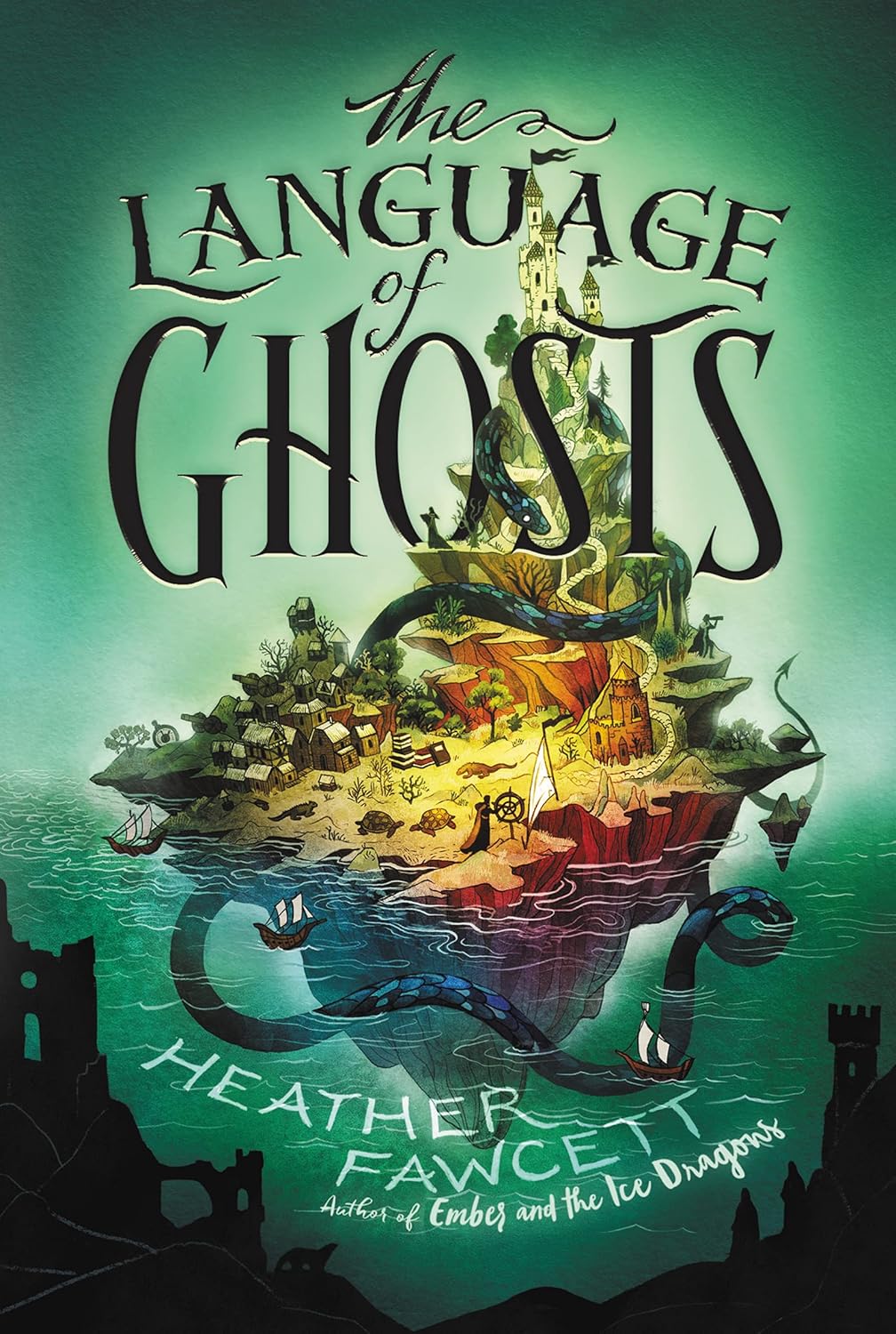
The Language of Ghosts by Heather Fawcett

With this, I have read all of Fawcett’s published books (although I do have Agnes Aubert’s Mystical Cat Shelter on preorder). Sad day.

The Language of Ghosts, offered for middle grade readers, continues to please. In the opening pages, young Noa is sorely grieving the recent death of her mother, queen of Florean. Her brother Julian is newly crowned king although just a teenager. Florean is an archipelago nation, long ruled by the Marchena family of which Julian is now the eldest. The Marchenas are all magicians, and Julian, like his mother, is a dark mage: this means that instead of speaking just one magical language (like most magicians in their realm), they have multiple languages. Julian is completely unique in that he can speak all nine. The Princess Noa, at eleven, is unique among the Marchenas for having no magic at all. In this opening scene, we find her dashing out of the banquet hall in tears at the presentation of their late mother’s favorite dessert (raspberry sundae). Hiding with her emotions in her closet that night, Noa is able to avoid the assassins who come to kill her and her little sister, five-year-old Mite; together the three siblings escape a violent coup in a small fishing boat and set up housekeeping on a new island. Whew.

Fast forward two years. Julian, a powerful magician but with very little think-first instinct, strategy, or perhaps even common sense, is much assisted by his younger sister Noa, who has no magic but lots of strategy, planning, and organizational skill. Cataloging, listing, and mapping are among her passions. Young Mite has two interests: insects and getting dirty. Well, and food. Operating as a king-in-exile with a small but important following, Julian both relies on Noa’s talents and also tends to discount her. Mite follows her around endlessly. The reader might surmise that the smallest Marchena has been through some trauma and finds constant contact with a sibling comforting; Noa is just annoyed.

Julian has enchanted the island of Astrae so that it moves, like a large ship, piloted by his loyal former-pirate captain Kell. They’ve been roaming the seas, taking back Florean one island at a time, but under constant threat by the usurper king, Xavier. Noa, the star of this story, is hard at work on two missions: to get her brother back on the throne where he belongs. And, privately, to prevent the dark magic he wields from turning him to darkness. The Marchenas discover that Xavier is on the hunt for a weapon that could take Julian down: one or more lost magical languages. Our young royal siblings know that they must get there first. Imagine everyone’s surprise when it turns out that, of all people, previously non-magical Noa is the only one who can speak the language of death. She is herself split between puffed-out pride at her new power, and a desperate desire to speak to her mother again. And to save Julian and the Florean kingdom, of course.

The Language of Ghosts showcases Fawcett’s best features. These are three rather ‘normal’ siblings, underneath all the magical and royal trappings: they have three distinct personalities and sets of skills and interests, and are experiencing different phases of childhood. They clash constantly but love each other dearly. Meanwhile, they dwell in a world that emphasizes Fawcett’s imaginative powers, with magical languages, dragons, illusions, sea monsters, betrayals, intrigue, and a wide array of wonderful cakes. Noa is engaged in learning some of the most important lessons of growing up, including the idea that even when we want the best for our loved ones, we can’t control them. I love the nuance Fawcett gives her young characters. Like the others, this is a book that manages to be funny and silly, heartfelt, harrowing, and wholesome. I would follow this author anywhere.


Rating: 8 mouthfuls of octopus pie (throwback to The Islands of Elsewhere).

The Islands of Elsewhere by Heather Fawcett

Another sweet, feel-good, funny, wholesome, middle-grade book by Heather Fawcett. I believe I have just one left in this age range, after which (if she’s not published more!) I’ll have to return to the Emily Wilde series to get my fill, and refresh my memory on how Fawcett matures her characters (and subject matters) for adult readers. I’m really enjoying just swimming in her imagination.

The Islands of Elsewhere stars the three Snolly sisters, but especially the middle sister, Bee. Eldest Hattie likes math, money, and being bossy; youngest Plum never stops moving, likes all sports, and generally teams up with Hattie, especially in their shared love of witches, fairies, and all things magic. Plum prefers to wear a costume, always: some of them store-bought Halloween costumes, many handmade by their loving Mom, who works for and performs in the theatre. And then there’s Bee, who appreciates science, especially botany, and is ever annoyed by her sisters’ belief in dreamy magical nonsense. Their toddler brother Dore rounds out the small family. Dad is mostly off-screen, but he and his girlfriend get along great with Mom, and he’ll be picking up the sisters for a camping trip in a few weeks’ time.

But first, Mom and the four kids are off to stay with Granddaddy at his home on the beach. They haven’t been there in a long time – Bee was too young to remember the last time. The sisters are delighted to arrive and discover that he lives right on the ocean! And his property includes an island – no, three islands! Fairy Island, Little Fairy, and Ghost come with some fascinating, even sinister stories in the little community of Misty Cove. The girls will have plenty to keep them busy: Hattie is practicing for a sandcastle contest that she intends to win (with a grand prize of one hundred and seventy five dollars!), Bee’s collecting new specimens of leaves and flowers, and Plum finds costume inspiration in the new setting: she wants to be a seal next, among other things. But there’s also a sadder reason for their visit. Beloved Granddaddy, an accomplished surfer and prolific and inventive baker of chocolate chip cookies, is having trouble with his memory. Mom is afraid he may not be able to live on his own for much longer.

The girls hatch a plan. If they can find the hidden treasure rumored to have been hidden away by their great-great-grandmother – an actual pirate – maybe they can afford to all live with Granddaddy from now on. The Snolly sisters must band together to search the fabled islands, and deal with octopuses, surly islanders, and the possible ghost of a witch along the way.

I loved the family dynamics here, which are nontraditional in some ways but always loving and positive. I loved the sibling relationships, and the earnest attempt to save the day. I loved Granddaddy’s quest for the perfect chocolate chip cookie, which includes everything from gum drops to Halloween candy to pumpkin pie, and maybe even octopus? It’s just all good clean fun, but not so clean as to be stuffy. In between heavier reads, I will take Fawcett’s younger-reader offerings any day. I hope she’s still hard at work. Hugs to Bee and the rest.


Rating: 7 unexpected ingredients.

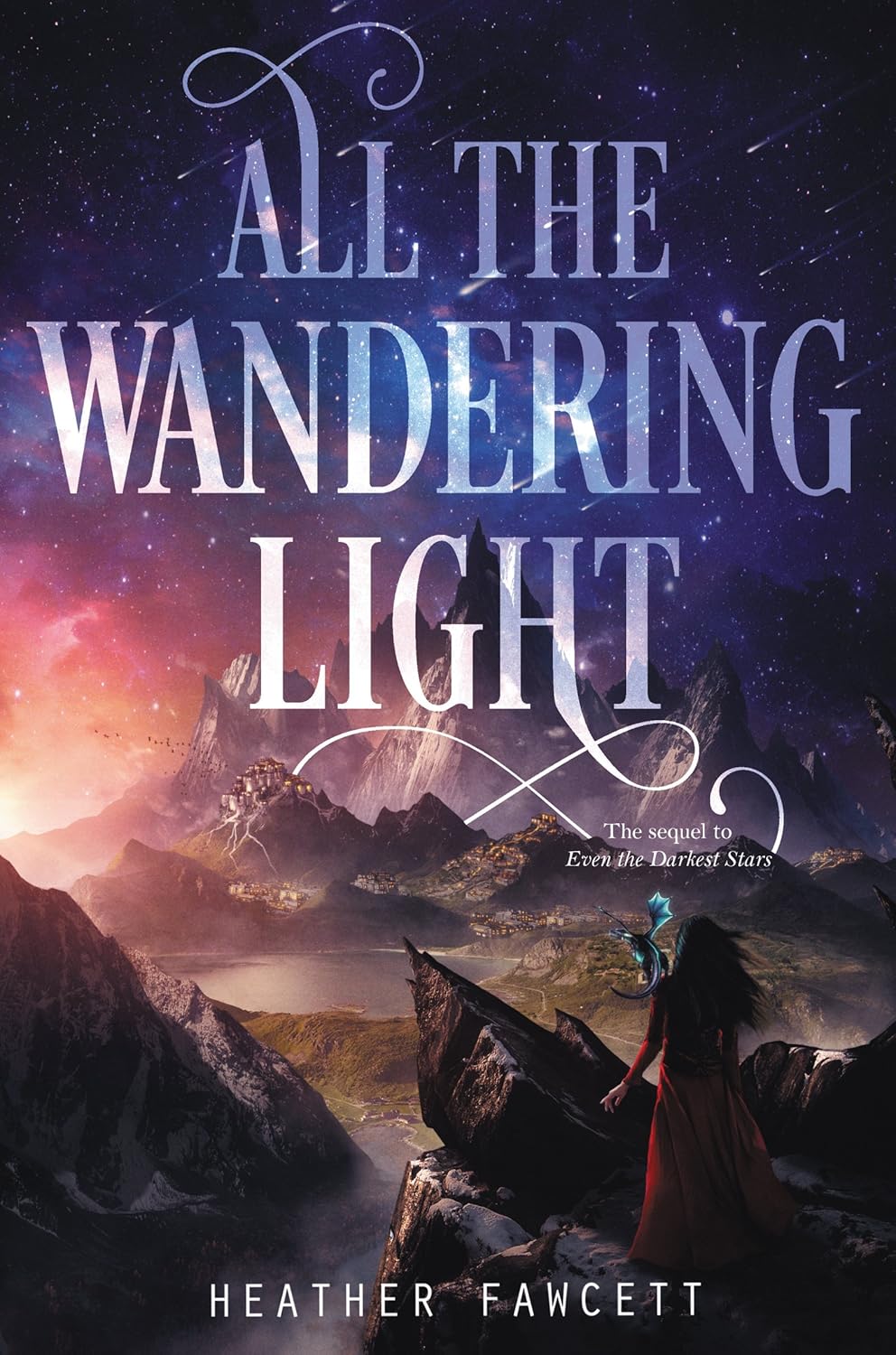
All the Wandering Light by Heather Fawcett

This one follows Even the Darkest Stars, with similar darkness, coming-of-age growth and learning and complication, and love. As is my usual practice, this review will contain spoilers for that previous book but not for this one.

So, on with the spoilers: at the end of book one, we had been hit with the shocking news that River himself was secretly a witch, and therefore obviously (to Kamzin and those of her world) a natural enemy. He has broken the binding spell that stole the witches’ power generations ago, and now their powers are restored, and the Empire is in danger. We learn quickly, though, that River is not so much motivated by wanting to overthrow or hurt anybody; rather, he wanted the freedom of possessing the powers he was born to. He wants to be himself. But by releasing all witches, he has enabled those who have crueler goals than he does, including revenge. His brother Esha intends to be the next emperor of the witches, and desires power enough to destroy the humans’ Empire, including Kamzin and everyone she loves.

In similar fashion to book one, a race is on, this time to get to a fallen star that is said to offer unimaginable power to whomever wields it: the human Emperor or the witch one. Kamzin travels with her friend Tem, her sister Lusha (and the two sisters offer nearly infinite messy siblinghood), and for part of the way, Mara, who was once a member of River’s crew. In the other camp, River reluctantly, even half-heartedly, helps his brothers. The plot of the book follows these two groups, centered on our protagonist, Kamzin–angry and hurt at her betrayal by the magnetic River, who had been a bit of a romantic interest–and her counterpart, River himself, who is likewise confused at the way the world reshapes around him and the power struggles that involve him even without interesting him much. This conflict will build to affect (again) the very fate of the world, and hinge upon the ability of the humans, in particular, to reconsider old prejudices.

Along the way, the part of this book that I struggled most with was the detail in some of the fighting or conflict scenes. Maybe it’s just this reader, for whom the fighting (in its minutia) will never be the most interesting part of the story. But especially with the ethereal, ghostly sort of enemy (and other only-halfway-there monsters), the shadowplay violence is a bit abstract, and doesn’t hold my attention well enough to sustain the way some of those scenes dragged on. I got a bit impatient. I think where Fawcett excels is, yes, worldbuilding, but most of all relationships: the way people (or witches, or stars!) interact and communicate and treat each other. And/or, this is where I’m most engaged with any story. There was lots to love here, just a little that I wished moved a bit more quickly. It’s worth noting that the two books in this duology were Fawcett’s first two. It’s clear to me that she’s improved from here.

I have just two more middle grade books of hers to read and then we have to wait for her to write more. Fawcett remains one of my favorite authors of the last year or two, so I hope she’s hard at work!


Rating: 7 beautiful ball gowns (what?!).

A Galaxy of Whales by Heather Fawcett

I needed this little break in between heavier reads, and I love knowing I can turn to Heather Fawcett to scratch that itch. A Galaxy of Whales is offered for readers ages 8-12, and features 11-year-old Fern, who is having a difficult summer. Her best friend Ivy has been pulling away from her, spending more time with other friends. Her family’s business, Worthwhale Tours, is in some trouble. Their main rivals, Whale of Fortune, are also their next-door neighbors, the Roys; and 11-year-old Jasper Roy is especially annoying to Fern. Her one-year-older brother Hamish is always buried in a Space Dragons book – also annoying. Worst of all, Fern still misses her father. “Maybe if your dad had died three years and two months ago, you shouldn’t be sad enough to cry anymore.” She’s not sure.

Then she learns about the youth wildlife photography contest. It’s perfect: if she wins, her photo will be on the front page of the paper. It might be enough to win Ivy back. The prize money could help the family business. She could defeat Jasper, who wants to enter the contest as well, despite not being into photography at all. And photography is absolutely Fern’s thing – the thing she shared with her father, whose camera and gear she takes with her everywhere, who taught her everything she knows. She has to win.

Just off Fern’s little Pacific Northwest town of Goose Beach, on the Salish Sea, there is a famed pod of endangered killer whales that she knows is just the right subject for her award-winning shot. But they’re hard to track, and time is running out. Fern tries to work together with Ivy, who is clearly not all that interested. She tries to work with Hamish, who is decidedly indoorsy, not a natural wildlife photography assistant. Finally, she resorts to working with Jasper, the enemy – unless he’s becoming her new best friend.

In this momentous summer between fifth and sixth grades, Fern learns a lot about family, friendship, whales, astronomy, and how to continue to navigate grief. A Galaxy of Whales offers these lessons organically and sweetly, in just the sort of package I was looking for: wholesome and loving.


Rating: 8 ice cream sandwiches.

The School Between Winter and Fairyland by Heather Fawcett

Can’t get enough Heather Fawcett; I’m powering through her books for younger readers. This is offered to ages 8-12. Autumn Malog is twelve years old when we meet her. She serves as a beastkeeper for the Inglenook School for young magicians, as the Malogs always have. It is a humble role, and she’s a little wistful for the magicians’ cloaks and privileges and learning, but you can’t change what you come from. And anyway, she’s far more concerned about her twin brother, Winter, who has been missing for nearly a year now, presumed dead by everyone but Autumn. She has always been able to feel Winter and his whereabouts; she can’t tell where he is now, but she is sure that he still is. “Nobody believed her, and she couldn’t really blame them. It sounded far-fetched even to her. So, rather than trying to convince anyone, she set about gathering evidence.” Autumn is no-nonsense like that. Better to get it done than to muck about. She is burdened with three useless older brothers, and the family is rounded out by Gran, even more no-nonsense than Autumn, unsentimental, but gifted in her care of the monsters that the family keeps safe and healthy for Inglenook.

Then Autumn encounters Cai Morrigan, one of Inglenook’s most famous students ever. Just twelve years old, he is prophesied to save their kingdom from the Hollow Dragon. But he is less impressive up close than his reputation would have it; and he shares with Autumn his great secret: he is terrified of dragons, to the point of fainting within dozens of yards of them. He asks for her help, and Autumn in turn asks him to help her find Winter. These two quests will bond the two young people, and offer bigger, more existential challenges than either anticipates.

I love this wholesome story about toughness, finding one’s tribe, and when to accept and when to push back against the limitations life proposes. It is also about friendship as well as familial love. And fanciful monsters, and plucky heroes, and the call of the forest. All good things, compellingly told. I will continue to live in Fawcett worlds as long as she creates them.


Rating: 7 slices of seabread.

The Grace of Wild Things by Heather Fawcett

Another hit by Fawcett; I’ve just checked to be sure that *all* of her books are either here or on their way to me.

The Grace of Wild Things is based on Anne of Green Gables, loosely enough that all of its parts move freely, but with enough connection to be recognizable if you know the original. Of course, no knowledge of the earlier classic is required here, and I think Fawcett’s telling will be more accessible to modern young readers, and possibly younger ones. As much as I love Montgomery’s original, I suspect her writing style would be a little harder for my favorite rising eighth grader to take in. This book is absolutely headed to her bookshelf next.

We meet twelve-year-old Grace as she gazes out of the dark woods at the witch’s cottage. Accompanied by her crow friend, Windweaver, she has made a remarkable overland journey to get here, despite hearing about the witch’s evils (including cooking children in her oven and eating them, à la “Hansel and Gretel”). Grace has spent her life at an orphanage featuring no great abuse but a pattern of rejection, loneliness, friendlessness, and a lack of appreciation for her unique qualities, which include talking too much, a love of poetry (shared by Windweaver), an excess of imagination, and oh yes, magic. She is here to apprentice herself to the witch and try to find a home and a life where she can be accepted for who she is.

The first day’s cycle is rough: the witch pretends to welcome her, throws her in the oven and tries to roast her, then, thwarted, rejects her once again: “tomorrow you will go back to that orphanage, if I have to drag you there by your hair.” Grace decides she’d rather be eaten. And she really did love the witch’s cottage, and the perfect little bedroom there that she’d hoped to call her own. But in a combination of cleverness, determination, and dumb luck – or is it magic? – she meets a fairy and saves his life, and impresses the witch with a gift sufficiently that the witch agrees to let Grace attempt a challenge. If Grace can cast every spell in the witch’s first grimoire, from her own childhood, before a venerable cherry tree blooms the next spring, she will become the witch’s apprentice. If she fails, she will give up her magic to the witch. This also means losing Windweaver, her only friend in the world, who the witch says is Grace’s familiar: she never realized.

What else is there to do? Grace agrees. But there are 100 1/2 spells in the grimoire – the last one is incomplete – and they appear increasingly impossible to her untrained eye. (The witch refuses to help.) Luckily, our plucky protagonist quickly makes a friend, Sareena, a clever, no-nonsense neighbor girl who pledges lifelong loyalty. The fairy boy she’d saved, Rum, is bound to come at Grace’s command for three years, the deal they’d cut; but he also insulted her and she desires never to speak to him again. (Some readers will recognize the reworked Diana and Gilbert.) As the always-game Sareena and the increasingly devoted Rum dedicate themselves to helping Grace gather the impossible ingredients for the witch’s spells (a piece of the moon, a pitcher of midnight, three left footprints of a deer, a day lasting twenty-five hours), their little group grows, until Grace is overwhelmed by kindness and friendship. Even the prickly old witch softens slightly, and more disturbingly, sickens. When an outside force threatens their idyllic cottage and garden in what locals have long known to be the witch’s woods, Grace may have even bigger problems than the grimoire. But her powers are growing, too.

Anne-with-an-e is definitely alive and well here, with the imagination, the verbosity, the flair for drama, the questions, the enthusiasm and the emotions. “I never thought witches would be so leaky,” Sareena says of Grace’s disconcerting habit of expressing feelings through tears. We’ve identified Diana and Gilbert; the raspberry cordial episode is reworked, more magically, and that of saving Sareena’s beloved younger sister. The witch makes a fine Marilla, grumpy but secretly charmed by her unwanted orphan girl; she even has a brother, although he’s a bit less corporeal than Matthew was. Prince Edward Island remains the setting, and I am inclined to trust (but did not fact-check) that the many botanical details and spell ingredients are appropriate.

But Grace is also a lovely invention. She struggles with wanting to do good in the world while embracing her true identity and powers, which she takes for granted must be associated with evil. She feels gratitude and loyalty to the witch who gave her a home, even though she can see the witch’s wrongdoings (although we also benefit from learning more about her long and adventurous life). She learns the big lessons. “…the witch had said in one of her few helpful moments that many spells had more than one use. Since then, Grace had come to think of magic like poetry–a poem, after all, could mean more than one thing, or mean different things to different people.” Upon achieving a spell for wisdom: “Being wise, apparently, was not knowing a lot of things, but knowing all the things you didn’t know. It was dreadful. She felt very sorry for all the wise people of the world.” And of course, she has every bit as much gumption and potential as Anne Shirley ever did.

I am devoted to this author. Loved every page, can’t get enough.


Rating: 9 buckets of ice cream.

Even the Darkest Stars by Heather Fawcett

I just went ahead and followed Ember and the Ice Dragons with another Fawcett book for younger readers. This one is a bit darker than that; I see that Ember is catagorized as middle-grade where this one is young adult, for what that’s worth.

Even the Darkest Stars is set in a magical-world version of the Himalayas, with yaks and butter tea and very high, very cold mountain climbing. But a parallel world to our own, in which an emperor rules over a huge region, keeping everyone safe from the witches of a bygone time. Our protagonist is Kamzin, a teenaged girl in the village of Azmiri, which is far from the emperor’s Three Cities. Her father is the village Elder; her mother was a great explorer in service to the emperor, but she’s been dead for years. Her older sister Lusha will be the next Elder. She studies astrology. As the younger daughter, Kamzin’s fate is to be the village’s next shaman. She is apprenticed to the current shaman, but is a poor student. Instead, Kamzin has always felt a strong pull to travel, to climb, to run, to map, to explore. When the emperor’s Royal Explorer, the famous River Shara, comes to the backwater of Azmiri, Kamzin knows she must stop at nothing to become a part of whatever has brought him here.

And after some brief intrigue and machinations, we wind up with a race. Lusha, the obnoxious older sister, takes to the road with one of River’s own retinue, aiming to beat the Royal Explorer himself to the top of Raksha – the highest mountain in the world, never climbed by a human, which defeated even Kamzin and Lusha’s late mother. Kamzin succeeds in joining up with the great River Shara, a handsome young man – younger than she’d expected – whom she finds bewitching. Also in their small party is Kamzin’s best friend, Tem, a far more accomplished (though untrained) shaman. And a stowaway: Kamzin’s familiar is a fox (or foxlike critter) named Ragtooth. They share a close bond but also he is apt to bite her. Oh and there are dragons: they are more tangential here than in the last book, but your standard ‘house dragon’ will eat just about anything remotely edible and in response, their bellies put out light. So an alternative to a lantern is to feed your scraps to a dragon. Part pet, part appliance, sometimes a nuisance. It’s quite fun. There’s a lot that is fun in this imaginative world… but also, Kamzin’s world and everyone she loves is in grave danger. It takes a while for the true nature of River’s quest to Raksha to be revealed, but once it is, the stakes couldn’t be higher.

This is a compelling story, populated by mystery, magic, fun creatures, breathtaking landscapes, true friendship, the germ of romance, and a tortured coming-of-age made harder by the possible end of the world. There is also great adventure, death-defying climbs, races for fun and for life-or-death… bit of a Princess Bride list there. My favorite part is that it ends with a clear nod to a sequel, which I’ll have my hands on in a day or so. But yes, also darker than Ember. More bad things happen here, and more is at stake. I may not hand it off to the thirteen-year-old yet. But I am so in for book two.


Rating: 7 sour apples.

Ember and the Ice Dragons by Heather Fawcett

For all the girl scientists, whether human or dragon.

I was deeply sad to have finished the last (so far!) of Heather Fawcett’s adult books, so I dipped into her back catalog of books for younger readers. Alongside Woods & Words, I am so pleased to have this one to pass along to a young person I love. (This one is for an older sister, age 13, as in love with dragons as ever. Woods & Words is for both sisters together.) Heather Fawcett, young adult fantasy, plus dragons for a friend in particular – all wins.

When we meet Ember St. George, she is twelve years old. She has just set her father’s office on fire, accidentally, again. It’s not Ember’s fault – she is a fire dragon, whom her (human, adoptive) father rescued fresh out of the egg, immediately after her biological (dragon) parents were killed by dragon hunters. Lionel St. George, an academic and a magician, cast a spell to turn her into a human girl. She still has her wings, though they are invisible, which can make it awkward to move in crowds. And she sometimes accidentally bursts into flames. She’s afraid of hurting someone, especially Lionel, who is a good and loving father. And so, in the opening pages, she contrives to move from the London university where she has always lived to a research station in Antarctica with an aunt she has never met. [It is believed that sunlight and heat contribute to the spontaneous combustion. Also, fewer people to hurt with the flames in Antarctica.]

This is how, before we’ve known Ember for long, we follow her on an ocean journey and into an unknown environment. At the research station, Ember must attend school for the first time, with a handful of other children. She has always avoided children, finding them strange – she is not precisely one herself, remember, but she must pretend; almost no one knows she is actually a dragon – and has never gone to school. (Instead, her eccentric father lets her read what she pleases, and discusses it with her. Theirs is a world divided into mostly-antagonistic schools of Magic and Science, and Ember most wants to be a biologist.) There is a humorous exchange over a certain novel concept:

“You’re going to go back inside and do your homework.”

Ember was surprised. “Why would I do that?”

Aunt Myra stared. “Haven’t you been doing your homework?”

“No.” Madame Rousseau had told them to read a chapter a day of a strange book about two children who had rhyming conversations with various animals that looked as if they’d been drawn by someone who’d never seen one. It was the most ghastly thing Ember had ever read. She had felt sorry for Madame Rousseau, who couldn’t have seen many books if she thought something like that was worth reading. Ember hadn’t been aware that this ‘homework’ was mandatory. When she didn’t like something her father gave her to read, she simply told him so, and they had a lively debate about it.

In her new home, Ember befriends some unusual penguins, explores the beautiful, icy surrounds (cold does not bother her, for reasons that might be obvious – fire dragon), and makes her first human-child friend, not entirely by choice. The attentions of a mathematical genius, Nisha, perplex Ember at first, but she finds a friend is a nice thing to have. Nisha’s friendship includes another, with a mysterious, pale, quiet boy named Moss, an orphan whose background is unknown.

Next, Ember discovers that Antarctica is home to the Winterglass Hunt, a royal expedition to kill rare ice dragons for their valuable, jewel-like scales. Ember is outraged, and schemes to join the hunt so as to sabotage it from within. She is very lucky to have her friends, who insist upon accompanying her, as it turns out that the many dangers she encounters will require their assistance.

The world of Ember and the Ice Dragons is fascinating and (this being Fawcett) well-constructed with internal logic, which I appreciate. The story is entirely wholesome, with its strong girls and women, solid friendships, and life lessons. Ember’s secret dragonhood, and Moss’s existential mystery, offer meditations on what it is to be different, and what identity can mean.

Both Moss and Nisha felt alone, even though they weren’t – they weren’t the last of the their kind, after all, and Nisha had both her parents. She decided eventually that there must be different kinds of alone, just as there were different species of lantern fish.

Enchanting, absorbing, entertaining, positive, and fun. I swear Fawcett left room for a sequel; my greatest complaint about this book is that there isn’t one yet.


Rating: 8 riddles.

Emily Wilde’s Compendium of Lost Tales by Heather Fawcett

This is book 3 in a series, and this review contains spoilers for the first two books.


What I love about the world of Emily Wilde is, first, the imaginative nature of this world and character. Emily Wilde is an academic scholar in the field of dryadology, or the study of faeries; but if that sounds dreamy, check again. Emily is capable of being lost in thought, yes, but those thoughts are generally dry, serious, and certainly research-based. She has an avid, academic passion for her field of study. She has read it all, and will be affronted to discover any theory or study that she’s unfamiliar with. She has no time for sentiment or romance (in either sense); when we first met her, in book one, she didn’t really have friends, other than her companion Shadow, who is a Black Hound (a fae creature) glamoured to look like a very large, intimidating black dog to regular humans. Emily and Shadow live in a regular-human world with decent access to the fae world, if you know where to look. She lives for her work.

In books one and two, we saw her social life expand somewhat, although not without growing pains. She has made friends, however uncomfortable she may be with that fact, and she has a love: formerly an academic colleague with whom she did not get along (one of those enemies-to-lovers tropes), Wendell has turned out to be a long-lost faerie prince, which explains why he seems so lazily disinclined to academic work. Emily had long suspected he faked his work, and this has been proven correct: he’d been skating by on what he knew of faeries by other means. They have a sweet relationship, clearly based in genuine mutual regard, although only one of them is much capable of romance, and it’s not Emily.

Here in book three, Wendell has been returned to his realm, and become a faerie king, by the surprising work of a mortal – Emily herself – in overthrowing the evil queen, Wendell’s stepmother, who had murdered much of his family as other potential heirs. Faeries, it turns out, are quite murderous types, especially those of Wendell’s realm. So in this installment, Emily navigates becoming a sort of queen consort (they haven’t technically married yet, solely because of her cold feet), living full-time in the faerie world (she likes to study them but they don’t necessarily make her feel comfortable), and seeing dear Shadow become frail in his old age. The part of this she’s most excited about is the opportunity for study; she sees research questions and papers she might write all around her. (“If Wendell’s stepmother has us slain before I have a chance to contribute to the scholarly debate, I will be very disappointed.”) She feels only dread at the glamourous and magical queenly gowns she is given, and likewise the other trappings of court. Luckily for Emily (?), nothing ever goes smoothly in Fae, and there will be problems to solve. With research! of course.

So. First, what I love is the imagination at work in this worldbuilding, which is satisfyingly thorough. The various kinds and functions of faeries, and their intrigues and class divisions, are all fascinating in themselves. Second, what I love is Emily’s character and voice. These books are told as Emily’s journals, complete with the (sometimes slightly awkward, but they do feel believable) explanations for how, in the middle of great danger and adventure, she has come to be writing journals entries. (Answer: writing is how she processes and self-soothes, and, research über alles; these notes could become a paper or conference presentation! Once we get to know Emily, this actually checks out.) Getting to hear these adventures in her own voice emphasizes Emily’s droll character. She never really gets over her sense of awkwardness at how much she loves Wendell; the bits she glosses over (sex) are as telling as those she sinks deeply into (footnotes!) – also, Heather Fawcett has been a YA and middle-grades author prior to this series, so keeping the sex off-screen and vague is probably a comfort zone. These books are just really fun, and wholesome even when they get a bit gruesome. It is comforting to see that even when terrible things happen they can be undone.

I was genuinely very sad when I finished this book, which I fear is the last in an intended trilogy. I need there to be more from this delightful author. I guess I’ll do some YA reading soon.

On the other hand, this book (which ends in a library) does leave room for a sequel. Fawcett! We could have more Emily!

Do recommend.


Rating: 8 ornate, bespoke notebooks.

Emily Wilde’s Map of the Otherlands by Heather Fawcett

This is book 2 in a series, following Emily Wilde’s Encyclopaedia of Faeries.


This review contains spoilers for book 1.


Having wrapped up adventures in Hrafnsvik, Emily has returned to Cambridge and a more comfortable *tenured* position there. Her nineteen-year-old niece, Ariadne, has arrived on the scene as a student, as Emily’s self-appointed assistant, and as a fan and annoyance. Wendell remains nearby, also a fan: his proposal (from near the end of book 1) remains an open question. Now we know his own courtly-faerie identity, it also transpires that would-be assassins have begun to hound him, to reduce his threat to a distant and fearsome fae crown. Meanwhile, an antagonistic department head (ha) is also hounding Wendell and Emily both, seemingly out of some combination of suspicion about their academic integrity and a sense of late-career threat. Obviously, then (that is sarcasm), the whole troop winds up traveling together – Emily, Wendell, Ariadne, and the grumpy Dr. Farris Rose – to a tiny village in the Alps where a controversial dryadologist named Danielle de Grey disappeared some 50 years ago.

This returns readers to a little-populated setting Fawcett clearly favors. Not quite a closed room, the village and surrounding natural world still offer a useful limitation on outside distractions. Compared to Hrafnsvik from the last book, the residents of St. Liesl play a smaller role in this novel’s cast. It keeps that character list neat: Emily (still curmudgeonly, genius, deeply socially awkward, and more caring than she’d like us to know), Wendell (hedonistic, lazy, compulsively neat, and in love), Ariadne (enthusiastic and committed, but oh, young), and Rose (who may have something to offer, if he could get past his own unpleasantness), as well as the famed de Grey and the lovelorn scholar who has chased her, in turn, into misty faerie worlds. With this limited cast, Fawcett does well with humor and the tension Emily feels about her good friend and would-be lover. The fae creatures she studies continue to be a diverse and diverting bit of world-building. Action and development occasionally felt a bit rushed to me, more than I remember from book 1, but it was still a good time, and this is a book with momentum, that motivates the reader to stay up for just one or two more chapters. Also, I’m still pleased by the mild snark about academia, and the quirk of Emily’s character that she’s always thinking about what a good paper or conference presentation her current adventure will make, no matter how dire as it happens. I’m in for book 3.


Rating: 7 carrots.