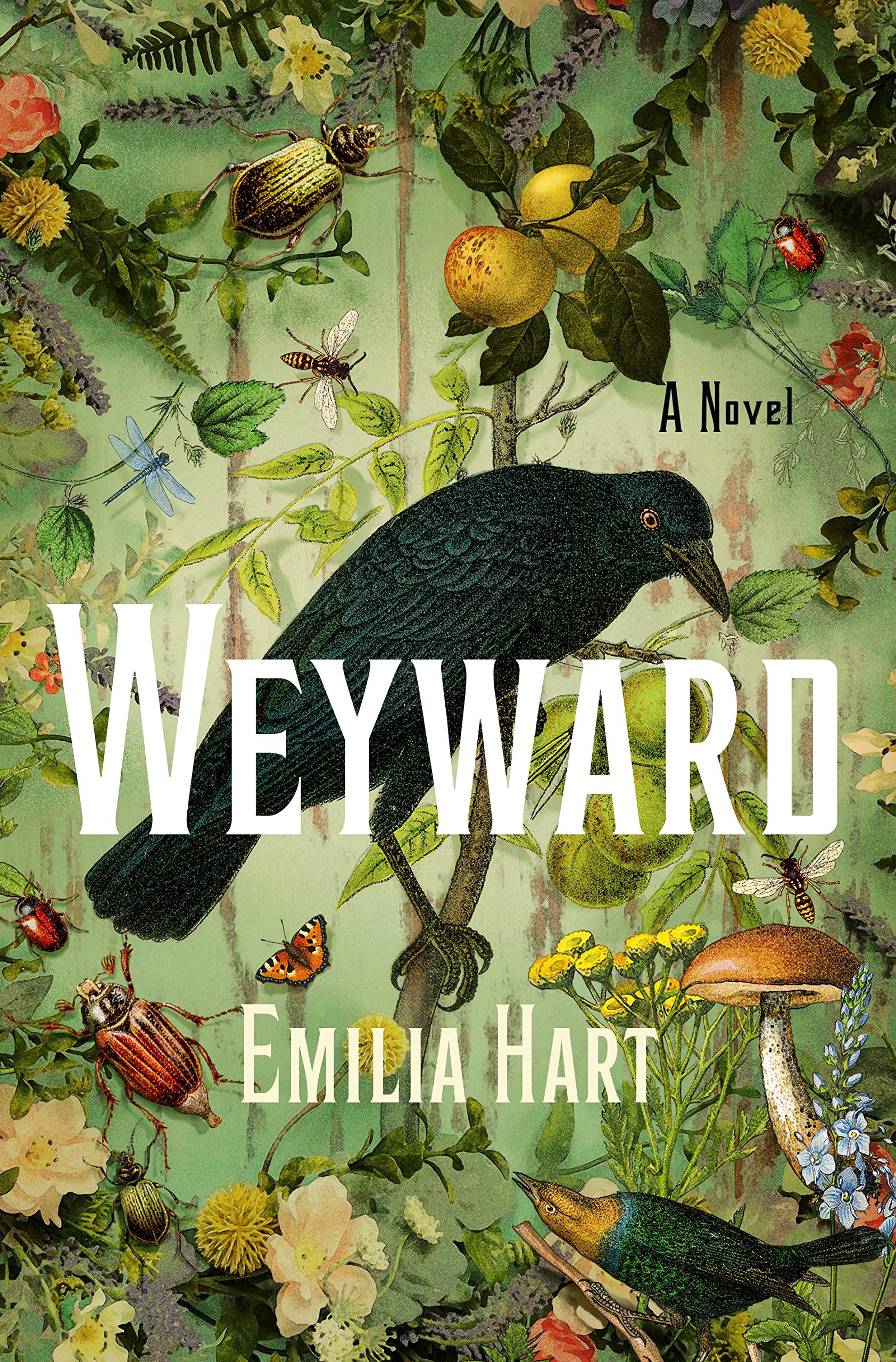
Weyward by Emilia Hart

The stories of three imperiled protagonists across centuries connect in this suspenseful, magical debut about the power of women and the natural world.

Emilia Hart’s first novel, Weyward, glows and glimmers with hidden powers, thrills and danger, a close connection with nature and between women across time. Three distinct stories eventually link to form a larger tale about strength, resilience and love.

Altha goes on trial for witchcraft in the English countryside in 1619. In 2019 London, Kate attempts to escape an abusive partner while harboring a significant secret. And at a grand estate in 1942, teenaged Violet struggles against the limitations of her father’s strict household rules, consumed by an unladylike love for trees, insects and other natural wonders. In alternating chapters, each of these stories deepens. Altha, the daughter of a healer, tries her best to follow in her beloved late mother’s footsteps, helping her neighbors and causing no harm, while dodging the increasingly avid witch-hunters of her time. Locked in a Lancaster dungeon, Altha does what she can to protect herself. Kate flees the city undetected, holing up in a cottage inherited from a great-aunt she hardly knew, but her safety there is tenuous as she plans for an uncertain future. Violet is a tenacious and spirited 16-year-old, but powerless as she is imprisoned in her father’s world; she dreams of becoming a biologist or an entomologist, but cannot even visit the local village. Men in the Weyward world, in all three timelines, are sources of power and abuse, not kindness, but Violet’s loyal brother forms a notable exception.

Each woman must learn about and come to terms with her powers and her connections to the natural world. Violet is passionately entwined with a particular beech tree, with damselflies and weasels, but no one will even tell her her mother’s name, let alone the family history that she senses casts a shadow on her life. Having lost her father at a young age in a curious accident, Kate lives in fear of the birds and insects that most call to her. Altha is reluctant to exercise her full powers, having promised her mother she would be careful. But, she says, “I had begun to suspect that nature, to us, was as much a life force as the very air we breathed.”

Hart expertly weaves together disparate but connected storylines, with leaves and butterfly cocoons and a mountain stream. Her protagonists are strong, but hard beset by the forces around them, even across centuries. Her prose sparkles with wonder and simmers with danger. Weyward‘s atmosphere is compelling, as each plot thread offers suspense. With a momentum of its own, this debut draws readers inexorably to a glorious conclusion that celebrates connectedness and the power of women and nature.


This review originally ran in the February 2, 2023 issue of Shelf Awareness for the Book Trade. To subscribe, click here.


Rating: 7 feathers.

Stone Blind by Natalie Haynes

Natalie Haynes splendidly showcases classical scholarship, witty humor and an appreciation for nuance in this reframing of the story of Medusa.

With Stone Blind, Natalie Haynes (A Thousand Ships; Pandora’s Jar) brings her authoritative expertise in Greek myths to bear on Medusa, whose story is fresh and surprising in this telling. Haynes is both a scholar of the classics and a stand-up comic, and that combination is brilliantly evident in this sardonic, darkly funny adaptation.

Stone Blind combines several threads familiar to fans of Greek mythology, although readers need no previous knowledge to follow along. Zeus, king of the gods on Olympus, philanders and bickers with his wife, Hera; this narrative will witness Athene’s birth and a battle between gods and giants, among other Olympian events. Medusa is delivered as an infant mortal to the two elder Gorgons who will be her sisters–in this version, they are monsters only in their unusual appearance, and they care for their fragile mortal sister with great tenderness. As a young woman, Medusa is raped by Poseidon in Athene’s temple. The goddess is so offended by this sacrilege that she punishes the victim, replacing Medusa’s hair with snakes and bestowing her most famous attribute: the ability to turn any living creature to stone by eye contact. In a third thread, the demigod Perseus comes of age as a bumbling incompetent: self-serving, lazy, whining, unnecessarily violent. And Andromeda, legendary beauty and princess of Ethiopia, is cursed to death by her mother Cassiope’s hubris.

These threads come together in complex ways when gods are offended and angered and play out their dramas with mortal pawns. Traditional storytelling has cast Perseus as a hero and Medusa as a monster, but Haynes does not concur: “The hero isn’t the one who’s kind or brave or loyal. Sometimes–not always, but sometimes–he is monstrous. And the monster? Who is she?”

“Who decides what is a monster?” Medusa’s sister asks. To which Medusa responds: “I don’t know…. Men, I suppose.”

Haynes’s genius lies not only in her subtle recasting of this story–with an emphasis on who assigns roles and draws conclusions–but in her dryly scathing humor. Her gods are (even more than usual) immature, selfish and often silly. Athene is “delighted with herself” for the simplest of observations about humanity; she burst forth from Zeus’s head fully formed, but not necessarily with the emotional maturity or world knowledge her physical perfection would imply. Poseidon’s bluster and Zeus’s carelessness of his children are exaggerated. Perseus is a dolt, impervious to learning the lessons of his (mis)adventures. Haynes writes in many voices: those of olive trees, Medusa’s snakes-for-hair, a crow, the gods and mortals that make up this twisting tale. A surprising ending caps off her truly delightful and novel version of a very old story.


This review originally ran in the January 6, 2023 issue of Shelf Awareness for the Book Trade. To subscribe, click here.


Rating: 8 birds.

Peaces by Helen Oyeyemi

For this review I created a new tag, Oyeyemi, to represent my continuing confusion about how to categorize her mysterious novels. I was tempted to call it ‘mystery’ but I’ll settle for ‘puzzle,’ with suspense and speculative elements, a contemporary/magical setting and absolutely its own set of rules. My enjoyment outweighed my bemusement – not that the latter prevents the former but it can make it a little harder. I am charmed and perplexed. I’ll do my best here.

Our narrator for most of the novel is Otto. He’s on a train with his partner Xavier. They are taking a honeymoon but not really because they are not married. They are traveling with their pet mongoose, Árpád XXX (as in the roman numerals), who is descended from a long line of mongooses called Árpád who have been companions to Otto’s family. The train is a former tea smuggling train with a most unusual full-time resident, its owner, Ava Kapoor, who receives copious hate mail for her family’s past crimes. She is an heiress set to inherit under unusual terms which have led her to live on her train, served by a staff consisting of her girlfriend and a sterner woman with more sinister outside employment… She also keeps a pet mongoose (naturally?!) and plays a theremin. So far I’m just listing weird elements, right? That’s part of the point. There are invisible people, or people who may or may not actually exist, and who may or may not be the same person. And it is on this weird train – whose most unusual cars possess (of course) strange traits – that the partnered Otto and Xavier discover they may have some history in common that they didn’t know about, not only with each other but with Ava Kapoor.

It was a raucous adventure and a puzzle whose solution I’m still not sure of. I enjoyed the locked-room aspect of the train as setting (very Agatha Christie), and the mongooses, and the eccentric old aunt character (who sends our non-honeymooners on their trip), and the questions about art and pursuing one’s creative processes. It is, I think, about that concept of “being seen.” I am all the way off balance about the whole thing but still intrigued by Helen Oyeyemi’s singular mind. I don’t know what to tell you at all; your mileage may vary.


Rating: 8 letters.

Galatea by Madeline Miller

Although I found Circe less mind-blowing than I did The Song of Achilles, I will still follow Madeline Miller anywhere. I was very excited about this new book, which is labeled as a short story, but packaged as a freestanding little hardback. The story is very short – just 50 pages plus an afterword.

50 little tiny pages

According to Wikipedia, “Galatea is a name popularly applied to the statue carved of ivory by Pygmalion of Cyprus, which then came to life in Greek mythology.” In Ovid’s version of the myth, in Metamorphoses (which Miller indicates is “almost solely” her source for this work), she does not have a name. Pygmalion is a sculptor so horrified by real, live women that he can only be happy with the ivory statue of one he creates for himself, in perfection and perfect, chaste silence; he prays to Venus for her to come alive, and she does, to bear him a child but (in Ovid’s telling) to remain silent and modest. (Delightfully, and disturbingly, in the poem “Pygmalion’s Bride” by Carol Ann Duffy in The World’s Wife, she defeats his sexual advances by pretending to reciprocate them.)

Here, Miller gives us Galatea’s first-person voice from the hospital room where she is institutionalized, imprisoned, on Pygmalion’s orders. He visits in order to fetishize and rape her. Having born him a daughter and seen how limited their child’s life will be with such a domineering, misogynistic father, Galatea has tried to escape him and save her daughter, but so far failed. When he tells her what his latest project is, however, she tries again.

In Miller’s writing, Galatea’s voice is lyrical and grim. “The door closed, and the room swelled around me like a bruise.” She handles her husband’s abuses with an impassive stoicism that reads as strength rather than stoniness, because she feels strongly toward her daughter (and hides well her disgust with Pygmalion). She is brave, clever, and grandly terrible, worth of Greek myth and the empowerment we want for her. This is a brief but powerful triumphant retelling of an upsetting myth. Miller is awesome and I will preorder anything she writes. Go read it now.


Rating: 8 cups of tea.

Maximum Shelf: Clytemnestra by Costanza Casati

Maximum Shelf is the weekly Shelf Awareness feature focusing on an upcoming title we love and believe will be a great handselling opportunity for booksellers everywhere. The features are written by our editors and reviewers and the publisher has helped support the issue.

This review was published by Shelf Awareness on November 15, 2022.


“Kings are brilliant / mighty / godlike // Queens are deadly / shameless / accursed.” Such has been the literary fate of Clytemnestra–adulteress, wife and murderer of Agamemnon in the Ancient Greek canon. Costanza Casati’s debut, Clytemnestra, is a dynamic retelling of the story of the much-maligned Spartan princess, sister of Helen, queen of Mycenae, mother of Iphigenia, Electra and Orestes (and others). Aeschylus, Homer and Euripides generally portray Clytemnestra in a negative light, but Casati’s reframing–from her title character’s point of view–emphasizes the difficult circumstances that challenged a strong-willed woman in a time and place that did not reward such a quality. Clytemnestra is a masterpiece of justified rage on the protagonist’s part, and a subtly subversive revision of a story many readers know from a different perspective. She will be called ruthless, merciless, “cruel queen and unfaithful wife,” but viewed from another angle, Clytemnestra fights honorably for her own well-being and for that of the people she loves.

The events of Clytemnestra’s life are not much rearranged here. As a princess in the Spartan court, she is trained as a warrior and huntress, surrounded by violence and death even in her privilege to sit in the megaron with her father, King Tyndareus, where they hear the villagers’ requests. This upbringing emphasizes martial training, physical skill, obedience and the ability to suffer. Her first marriage, to Tantalus, was for love and was a meeting of minds, but it ended in murder and betrayal, and with a forced second marriage to the Mycenaean king, Agamemnon, whose brother Menelaus in parallel marries Helen. Clytemnestra’s later lover, the traitor Aegisthus, is a complicated, enigmatic character in his own right. This proud queen, treated as a pawn in political power struggles, wrestles to keep her dignity in the Mycenaean court under the brutalities of her husband, but never loses her sense of herself as a warrior and a survivor. The events of this novel close where Aeschylus’s Agamemnon opens, thereby gifting a complex backstory to a woman often portrayed as villain.

Clytemnestra dips its toes as well into the stories of the queen’s famous family members: her brothers Castor and Polydeuces, boxers and horsebreakers; her sister, Helen, whose legendary beauty led to the Trojan War; her mother, Leda, who was seduced by Zeus in the form of a swan (or was she raped?). Her children include Tantalus’s unnamed infant son; Iphigenia, sacrificed at Aulis to summon wind for the Greek ships on their way to Troy; and Electra and Orestes, whose stories expand only after these pages close. This Clytemnestra is very close and loyal to her siblings; family ties for better and for worse shape her decisions all her life, even at great distances. For instance, meeting a new face, she thinks of her siblings: “Helen would have charmed him with her beauty and subtle cleverness, softening him until he opened like a peach. Castor would have mocked him, pricked him with words like needles, until he talked.” Clytemnestra’s cousin is Penelope, eventually famous as Odysseus’s queen and faithful wife, in marked contrast to the Clytemnestra in traditional representations; here, again, the reader sees a new and complex side of a familiar character, as she is courted by the cunning Ithacan king.

The gods in this version are mere myth, not actors in real events; Clytemnestra, like her mother, is skeptical, even scornful of the gods and their followers. She understands that kings and not queens rule in her world, but she continues to demand the respect she deserves even when it’s unlikely she will get it, and consistently calls out the rapes and attempted rapes that often go unmarked in the courts and villages of both Sparta and Mycenae. This retelling is a deepening of Clytemnestra’s story and her character. Helen, her beloved sister, likewise grows more multifaceted in Casati’s nuanced novel, but the beautiful one is not gifted with physical prowess or the confidence of the fierier Clytemnestra: “Clytemnestra dances for herself; Helen dances for others.” Timandra, one of their younger sisters, is fierce like Clytemnestra, but with a different burden in their strict society. These female leads are glittering, glowering, admirable and sympathetic, and the result will reignite (or ignite) readers’ interest in the stories of ancient Greece and emphasize their relevance in any time.

Clytemnestra is a stunning, standout contribution to the growing genre of modern treatments of the Greek myths. Casati brings both a solid grounding in the canon and imaginative venturing into the inner workings of a woman who has long been famous but little understood. Her writing is gorgeously descriptive and emotive: “She thinks of those white flowers blooming against the rocks of the Ceadas. For years she wondered how they survived down there, among the corpses and darkness. But maybe this is how broken people keep living…. Outside the light is golden. It shines on them as if they were gods.” Casati’s Clytemnestra is modern in her staunch demands for dignity and respect, but believably rooted in ancient times. This is a necessary novel for fans of mythology, strong women, the pushing of boundaries and epic dramas of family, power and love.


Rating: 8 cuts.

Come back Friday for my interview with Casati.

The Spare Man by Mary Robinette Kowal

Well, this is the most fun thing I’ve read in a while (and that’s saying something). Liz let me know that Martha Wells (of Murderbot) gave this book 5 stars on Goodreads. So I bought it.

Tesla Crane is traveling incognito on a space cruise to Mars with her new spouse, Shal. Tesla is an uberfamous and uber-rich inventor-engineer and heiress, and she just wants to enjoy her honeymoon in privacy, but then a woman is murdered on the way back to their luxury cabins after karaoke, and ship security makes the bad mistake of arresting Shal (himself a recently retired detective), so Tesla is on the case. She is also physically limited by some extreme injuries and a touch of PTSD following a lab explosion, for which she uses the assistance of a Deep Brain Pain Suppressor (DBPS, usually turned up a bit higher than is actually safe), occasionally a cane, and most charmingly, a service Westie dog named Gimlet. With Shal locked down, Tesla is a bit hobbled but also highly motivated (not to say pissed). She navigates the ship, high society, and her investigations with cleverness and aplomb and a sometimes imperfect awareness of her privilege, as Shal gently reminds her; she will make a few friends along the way, but everyone’s a suspect, especially as the body count climbs. Tesla herself is very likeable, but Gimlet steals the show (for readers and most of the ship’s passengers and staff).

I love the elements that combine in this story. There is a strong core of sci-fi, which other reviewers assure us is accurate and well-researched (this reviewer is happy to assume this is the case and move along). There are some fun, thought-provoking cultural elements, especially around gender: in the year 2075 we don’t have much patience for gendered language, using Mx. in place of Ms. or Mr. and spouse in place of the gendered versions, and it is extremely rude and outdated to introduce anyone without noting their pronouns. (Tesla’s spouse Shal is a very masculine type and very handsome but also very engaged with textile arts, particularly embroidery.) The protagonist couple takes their cocktails and coffee very seriously, and each chapter opens with a cocktail recipe (some of which are zero-proof); bar culture and bartenders also form a significant framing element. Gimlet the service dog gets full appreciation both for her skills and training and for her dogness (she’s a dog, not a robot). It all forms a really neat combination, although let me also say the plot needed no bolstering: the mystery itself is fully-formed and legit. What’s not to love?

I was completely absorbed and stayed up late into the night finishing this one. Firmly recommend. Thanks for the tip, Liz & Martha.


Rating: 8 ounces.

Gilded Mountain by Kate Manning

This gorgeously evocative novel of the early-1900s American West takes on issues of race, class, labor and women’s rights via a remarkable young woman’s coming of age.

“Strikes are all the same. Same songs. Same reasons. Same hope and rage. In those years it was struggle and strife all over the mountains, in the cities and on the plains of the country, wherever there was industry or toil.” Gilded Mountain by Kate Manning (Whitegirl; My Notorious Life) is an expansive novel of passions: love, beauty, suffering; struggles for labor rights, women’s equality and the rights of formerly enslaved people. Set in the early-1900s Colorado mountains, this enthralling story stars Sylvie Pelletier, who travels west at age 17 to find the world broader, more lovely and more terrible than she’d imagined. Gilded Mountain tracks her coming of age and the troubles of her family and the marble miners of Moonstone.

Sylvie’s father, Jacques, is beloved by his family and his coworkers in the marble quarry, who call him “Frenchy,” but Sylvie’s mother fears he will again meet danger with his union organizing. Sylvie graduates from high school and apprentices as “printer’s devil” to the freethinking K.T. Redmond, who further shocks townspeople by being a newspaperwoman. As conditions in the mines deteriorate and K.T. nurtures Sylvie’s rebellious streak, the young protagonist is also invited into the household of Company owner Duke Padgett and his wife, the Countess. Their royal titles are self-assigned, but their wealth is real. The Duke’s son, Jace, becomes something of a romantic interest, but there is also United Mine Workers’ representative George Lonahan. Sylvie is torn between her principles and love for her family, her class and her boss, and the temptations of the other life. “I forgot to observe with the sharp eyes of a printer’s devil because my sight was dulled by sugar and awe,” she realizes. “My loyalties gnarled and snared me.”

Gilded Mountain is an ambitious novel, swelling to encompass labor rights (complete with Pinkerton Detective Agency goons), women’s rights, the societal role of the free press, the rights of Black Americans immediately following the Civil War, lynching, immigration and more. Starring real characters from history (union organizer Mother Jones, Belgium’s King Leopold II), it contains romance, historical fiction and inspired, high-minded thinking on important issues. Moonstone, Colo., is a fictionalized composite town, but its marble mining and the standard operating procedures of the Company are well based in historical fact. It also contains lovely writing about the natural world: “[T]he Diamond River overflowed its banks and rushed downhill, rooks sang in the trees, and leaves unfurled like new little salads on the ends of their branches. A corduroy of greens softened the hard folds of the mountains, and the meadows bloomed with swaths of blue columbine and dashes of yellow sneezeweed.” The result is a painfully beautiful novel of big ideals, heartbreaks and tragedies, sewn together by an admirable and unforgettable heroine.


This review originally ran in the September 15, 2022 issue of Shelf Awareness for the Book Trade. To subscribe, click here.


Rating: 8 maraschino cherries.

Utopia by Heidi Sopinka

Art, gender, love and friendship are all under consideration in this novel of twisted relationships in the 1970s L.A. art scene.

Heidi Sopinka’s Utopia opens at a party with the first-person perspective of Romy, a performance artist, directly addressing her months-old daughter. The evening ends with an unexplained tragedy, and from there the novel jumps forward some months to follow a young woman named Paz, who is now raising Romy’s baby and is married to Romy’s husband, Billy. It is 1978, and Paz, Billy and all their friends are steeped in the Los Angeles art scene, where sex, drugs and free expression are soured by competition, infighting and wildly different rules for male and female artists. Paz attends women’s groups and wishes for a freer life for herself, but many women see her as having taken over Romy’s life in decidedly unfeminist fashion. Romy, the more successful and established artist, casts a long shadow; Paz loves Billy but is perhaps more in love with Romy, whose life and art obsess her. Caring for Romy’s baby, lost in reading Romy’s journals, Paz finds herself in something of a love triangle with a ghost, and begins to lose grasp of her own life and art. And then a postcard arrives, apparently from Romy. It is labeled “disappearance piece.”

Utopia cleverly investigates layers of social issues: feminism and its intersections with race and class; gender roles in life and in art; women’s relationships; the artist’s relationship to commerce and social justice. The central narrative belongs to Paz, but that narrative is always shadowed by Romy, and intermingled with Romy’s voice via her journal entries. “Everything Romy said assumed importance. She lived her life so strongly.” The two women and all they have in common (including an art-star husband and a baby) offer plenty of room to examine questions about art and gender. Paz’s best friend Essa (also an artist and mother) is another powerful character and model for Paz to chart her own path. They are surrounded by other women of the art scene and feminist groups; the novel is populated by strong women questioning norms.

Sopinka (The Dictionary of Animal Languages) excels in characterization and the evocation of the power of creation. In pursuing her predecessor’s mysterious end, Paz must put herself in real danger and explore the very edges of not only art but existence. “She’s driving a speed addict’s car in an inside-out shirt, on painkillers, with a hand wrapped in gauze, on her way to find her husband’s dead ex-wife. If she concentrates hard enough, these things will snap into a logical pattern.” By the time the perspective shifts to that of a third woman near the novel’s conclusion, Utopia has asked that the reader journey through some weighty questions–but all will be rewarded.


This review originally ran in the August 16, 2022 issue of Shelf Awareness for the Book Trade. To subscribe, click here.


Rating: 7 matches.

Imago by Octavia Butler

Following Dawn and Adulthood Rites is Imago, the final book in this trilogy, which I am sorry to see the end of. We’ve shifted narrators again: Lilith brought us through book one, then Akin for book two, and now we meet Jodahs, another first of its kind. Like Akin, Jodahs is a child of Lilith’s family, and her own (human-born). When Jodahs reaches metamorphosis, when Oankali and constructs (Oankali/human offspring) reach sexual maturity, a surprise: instead of becoming male as was expected, Jodahs begins to become ooloi, the Oankali third gender that is neither male nor female. Ooloi have extensive abilities to heal and changes themselves and others, and it had been thought still too risky to introduce human-born ooloi at this stage of the two species’ trade. Jodahs is a mistake, and a potentially dangerous one. But it quickly becomes clear that in its uniqueness it may have some special abilities to offer as well.

Imago is told from Jodahs’ point of view, as it struggles with its own needs and the challenges of coming of age. One early solution that is offered to the problem of Jodahs’ very existence is that it be exiled to a ship away from Earth; but Jodahs is a native of Earth, and quite reasonably pushes back against this idea. It’s the first of its kind, not wanted where it is from, and threatened with being sent “back” to a place it is not from. (The parallels to slavery are unmistakable.) It has overwhelmingly strong urges, toward sexual and other connections, but its people don’t want to allow it to pursue these urges, which are natural but also unprecedented (because Jodahs is unprecedented). I am still marveling at Butler’s worldbuilding here, that I’m so absorbed and bought into the rules of her invented peoples. It’s lovely.

There is commentary on human nature: the old human contradiction, as Oankali see it, of intelligence with hierarchical behaviors. Humans among themselves struggle with racism, xenophobia, sexism and sexual assault, and homophobia. When faced with Oankali – that is, something different, non-human – humans frequently react with fear and hostility. Even when they feel drawn to an ooloi, for example (and the ooloi have this power, to make themselves irresistible), they can feel revulsion mixed in. The trilogy has much to say about xenophobia and race, colonialism, agency and freedom of choice, and also gender. I love that the ooloi have to repeat that they are not male and female, not both, but a whole other thing. They still get misgendered and mis-pronouned. Jodah is asked if it wants to be male: “Had I ever wanted to be male? I had just assumed I was male, and would have no choice in the matter.” It’s also about community-building in ways that I love. Building communities, families and societies is just as hard in Butler’s fictional world as it is in any other dystopia I’ve encountered, real or fictional (because people). This is all good commentary on human tendencies, while at the same time being very fine, escapist fiction.

For more, especially some excellent thoughts on the book’s title, check out Erika Nelson’s “Playing Human” essay at Tor.com.

I love this series and think everyone should read it.


Rating: 8 tubers.

A Mirror Mended by Alix E. Harrow

My *only* complaint about these gems is their brevity. I could sink into Harrow’s retold fairy tales for much longer than ~120 pages. Can’t wait for the next installment.

Following the action of A Spindle Splintered, Zinnia Gray’s exciting life traveling through the fairy tale multiverse, saving princesses and sending them off into their happily-ever-afters is getting a little tiresome. “I’ve rescued princesses from space colonies and castles and caves; I’ve burned spindles and blessed babies; I’ve gotten drunk with at least twenty good fairies and made out with every member of the royal family. I’ve seen my story in the past and the future and the never-was-or-will-be; I’ve seen it gender-flipped, modern, comedic, childish, whimsical, tragic, terrifying, as allegory and fable; I’ve seen it played out with talking woodland creatures, in rhyming meter, and more than once, God help me, with choreography.” Zinnia’s story, as we know from book one, is Sleeping Beauty. But things are about to get weird again.

Looking in the mirror (hung over after another happy wedding), our heroine is surprised to see a very different face: not her own, and not that of a princess. This one is a haughty, threatening queen, holding a mirror in her hand, demanding a way out of her own story. Zinnia recognizes that she is the villain – but not of Sleeping Beauty’s story. She has somehow jumped not just from one world into another, but into another fairy tale entirely. And this time she doesn’t have her awesome best friend Charm to help her out, because of a mysterious estrangement that the reader doesn’t puzzle out til near the end of the book.

A Mirror Mended is again a delight, an irreverent, queer, cynical-but-sweet reimagining of Snow White that questions narrative truths about protagonists, villains, agency, resonance and cohesion. Zinnia knows there must be a back way into a castle because it’s a known plot device. She expects a certain evil queen to be ugly, “which is pretty fucked up of me, but in my defense, Western folklore persistently and falsely equates a character’s physical appearance with their inner morality.” [In case you forgot, Zinnia has a degree in folklore.] When yet another stranger doesn’t meet expectations, Zinnia assumes, because “I know a protagonist when I see one.” But as the walls between fairy tales thin, Zinnia will learn to question her assumptions.

I love the rethinking of gender expectations and of narrative tropes, and the examination of agency, the power we all might have to rewrite our own stories. It’s empowering and awesome and feel-good without ever being saccharine, although it can be awfully, wonderfully sweet. Zinnia learns some important lessons in this story, finds a little romance for herself this time around, and leaves us with the perfect setup for book three in the Fractured Fables series. I can’t wait, and I hope it goes well past a trilogy. Highly recommend.


Rating: 8 bodice laces.