Teaser Tuesdays: Dirt Work by Christine Byl

Teaser Tuesdays is a weekly bookish meme, hosted by MizB of Should Be Reading. The idea is to open your current read to a random page and share a few sentences. And try not to include spoilers!

dirt work

I am very much excited about this relatively new memoir by a female trailbuilder with experience working for the Parks and Forest Services in Montana and Alaska. It looks to have a good combination of nature writing, memoir, and women’s issues. I have already found several noteworthy passages; but I had to choose…

[If you want a clue about a person’s work]… look at her hands. I trust dirty fingernails. I am drawn to people with that half moon, the sliver of filth that indicates kinetic expertise. Perhaps they do fieldwork – ratty truck, weathered tools. Are they teachers, the ones who kneel next to kids examining earthworms in mud? Potters, naturalists, firefighters, farmers: dirt is a secret code, dusty knuckles the special knock of a fraternal order. I trust this small sign because it implies a tangible relationship. To get dirt under your fingernails, you have to touch the world.

So, yes, lovely writing to boot. Stay tuned for my glowing review.

book beginnings on Friday: Weeds: A Farm Daughter’s Lament by Evelyn Funda

Thanks to Rose City Reader for hosting this meme. To participate, share the first line or two of the book you are currently reading and, if you feel so moved, let us know what your first impressions were based on that first line.

weeds

I’m taking the liberty of sharing two beginnings with you today. Preface:

In late 2001 my small family suffered what I think of as a triple tragedy. On October 1, 2001, my father, Lumir Funda, age seventy-nine, was diagnosed with advanced lung cancer that, by the time of the diagnosis, had metastasized to his brain, liver, spleen, spine, and bones.

(I’ll leave the other two tragedies for your own reading.)

And chapter 1:

Highway 16, the main route into my rural hometown of Emmett, Idaho, winds through a high desert country of sand and sagebrush before the road narrows and suddenly descends into the valley through a steep grade known as Freezeout Hill. Gouging straight through the terrain, the road drops more than five hundred feet in elevation within the span of a mile.

I think these set Funda’s tone, which is contemplative, quiet, and often melancholy; this seems to be in many ways a memoir of loss, so that’s not inappropriate. It’s early yet, but I’m enjoying it.

These quotation comes from an uncorrected advance proof and is subject to change.

The Yellow Wallpaper by Charlotte Perkins Gilman

I heard about this short story through the National Library of Medicine’s Traveling Exhibition Program (we will be hosting several exhibitions at the hospital library where I work). I hadn’t heard of it before, although clearly I should have! If you want to read it, too – and I recommend it – I found my copy online here.

It is a very quick read at 9 pages, during which our narrator keeps a secret diary. She suffers from nervous depression, or neurasthenia, or the usual woman-sickness as diagnosed in the 1890’s when this story was written; and her physician husband has prescribed bed rest. So she’s shut up in the top floor of a decaying old mansion, in what used to be a children’s nursery (she thinks) because it has bars on the windows; and it has terribly ugly yellow wallpaper. Now, she’s forbidden even the exertion of writing, but because she disobeys, we get to follow her descent into madness, by way of that wallpaper.

It is a chilling story, and let me tell you that I read it while camping alone in a remote valley in Colorado, in a tent with a yellow rain fly on it (in the rain) – but never fear, I’ve made it back with all the marbles I began with, I’m reasonably sure. No one has tried to make me stay in bed yet, at any rate.

It turns out that this is Charlotte Perkins Gilman’s own story, to some extent: she was diagnosed similarly and given a similar “treatment”, but feeling herself slide downhill, disobeyed doctor’s orders, shook herself off, and got to work – writing, and living her own life. This turned out to be the healthier option for her, and it seems she lived a reasonably happy life thereafter. My copy (link above) came with a less-than-one-page piece called “Why I Wrote The Yellow Wallpaper,” in which she states that “it was not intended to drive people crazy, but to save people from being driven crazy.”

I learned more by going back to the NLM’s exhibition entitled The Literature of Prescription: Charlotte Perkins Gilman and “The Yellow Wall-Paper”, which I recommend and which also won’t take you but a few minutes.

Finally, I couldn’t resist sharing with you this related piece of art that I found while trolling the interwebs…


Lovely work, and of the images I found online that try to illustrate this story, it was my favorite.

Not only is the plot chilling, and the purpose behind the story important and sympathetic, but it is a well-crafted story too. I enjoyed it very much and am moved by the story behind the story. I’m lucky people like Charlotte Perkins Gilman were speaking up over 100 years ago, or I would never have been allowed to go camping alone in a valley in Colorado, yellow rain fly or no.


Rating: 9 disruptions of the pattern.

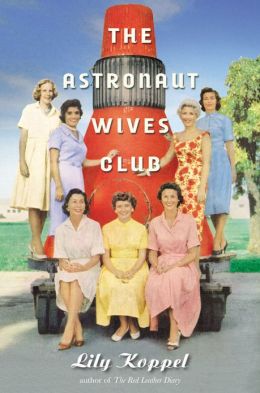
The Astronaut Wives Club by Lily Koppel

astronautThe US space program began in 1958, with an original group of seven astronauts. Their seven wives were expected to be the classic 1950’s perfect housewives; and that blissful domestic harmony was considered as important a job qualification for the men as was their athleticism and stamina. (Later rounds of astronauts would be highly educated engineers and technologists; the early ones emphasized physical attributes a little more.) The Astronaut Wives Club studies those original seven wives, and later additions which swelled the group toward 50. Lily Koppel examines the lives of these women and their husbands: marital dramas, difficulties with the press, lifestyles, tragedies, and lives after NASA was done with them. She interviewed the available surviving women. It comes across as a truthful depiction of them: women whom, unlike their husbands, we have surprisingly never thought to study until now.

The first space program was based out of Cape Canaveral in Florida, moving to Houston (my hometown and current place of residence) in 1962. It was fun to read about the early suburbs of Clear Lake and Friendswood, which I’m familiar with in slightly different forms today. A guide at the front of the book to “the astronaut wives” groups them by wave: the original seven (Mercury), the new nine (Gemini), the fourteen (more Gemini and Apollo), and the nineteen that came in 1966. The original seven are those we get to know the best, and their influence would remain on those that followed, but even the later waves of wives receive good personal treatment. From 1950’s stereotyped domesticity to the hesitant beginnings of women’s lib (which, unsurprisingly, came later to Space City wives than to certain segments of the population), these women tended to stick together, presenting a united front against the intrusive media and comforting each other in times of tragedy. But there was also competition: just as their husbands competed for the honors of “firsts” (outer space, moon orbit, moon walk), their wives had to compete to present the proper image on husband’s behalf. And as later waves of wives rolled in, the earlier ones were, perhaps predictably, a little distrustful of newcomers; they had worked hard to establish a tight-knit, protective club that still had its own internal issues to boot.

Koppel treats these women with sensitivity and respect. Their stories, and their collective story, is moving, poignant, and brought to life. On the night I finished this book, I dreamed about the astronaut wives. I can’t tell you much about my dream, because it faded so quickly, but I had been planning a trip, and I think I was consulting with the wives about some of my plans. I don’t dream about many books I read (at least not that I can recall), so this should be taken, probably, as a vote of confidence in the reality and staying power of what I’d read.

The Astronaut Wives Club is a well-deserved first look at a particular and unique group of women in history. As a bonus, it’s a fun glimpse into Americana of the 1950’s, 60’s, and 70’s. There is almost no science involved, so if you’re looking for the specifics of space technologies, look away; this is the homebound perspective on the man on the moon. While they suffered widowhood, divorce, and even suicide, this group of women is charming, funny, likeable, and amusing. I found it fascinating to consider this period through its unsung background heroes.


Rating: 7 Valium.

Teaser Tuesdays: The Astronaut Wives Club by Lily Koppel

Teaser Tuesdays is a weekly bookish meme, hosted by MizB of Should Be Reading. The idea is to open your current read to a random page and share a few sentences. And try not to include spoilers!

astronaut

I am pleased with this newly-released work of nonfiction focusing on the wives of the first astronauts (and their immediate successors). A developing reading niche of mine is what I am calling “biographies of little-known women in history,” and this qualifies. To set the tone:

The wives pored over their fifteen-page “Seven Brave Women Behind the Astronauts” spread. Through touching up and editorial tinkering, Life had transformed seven very different, complicated women into perfect cookie-cutter American housewives. There was not a whiff of domestic turbulence.

What is written boldly between these lines is that there was domestic turbulence, right? Nothing horrendous (that I’ve encountered so far, at least), but the point is that the program that employed the astronauts in question began in 1959, and thus the all-American, 1950’s, dimples-and-apple-pie version of family life was paramount. These women were expected to exemplify that image, for the sake of their husbands and their country. And that’s really something: a daunting challenge, I think.

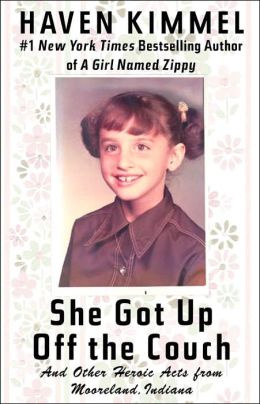
She Got Up Off the Couch by Haven Kimmel

couchHavel Kimmel aka Henrietta Krinkle, you are still my favorite.

This book follows A Girl Named Zippy, and I adore Kimmel’s explanation in her Preface: that she would definitely never write a sequel to Zippy, but that people kept on asking her if her mother ever got up off the couch; and here we are. This is an extension of that first memoir, then, with the focus being not on the girl called Zippy (Haven Kimmel herself) but on her mother, who in that first volume was a somewhat shapeless woman who mostly inhabited the couch and read a lot, talked on the phone, watched television, and didn’t worry too much about her children. This is told not unlovingly, but as fact. Zippy’s childhood is on balance awfully joyful and fun, and although a critical adult’s eye might point out lots of points of minor neglect, she clearly loves her family very much. This tone is continued in She Got Up Off the Couch. The family and each of its members is still, realistically, flawed, but lovable and well-loved. Kimmel’s brother is now mostly absent, with a family of his own; her sister marries and has two babies; her father finds work as a sheriff’s deputy (or similar job title); but her mother’s is the great change of this second memoir. This was, what, the late 1970’s I suppose, in a tiny Indiana town of a few hundred people. Zippy’s dad, Bob Jarvis, holds the keys: her mother Delonda doesn’t know how to drive. This will work as a fine metaphor (and indeed is part of the literal action), as Delonda calls a phone number on a television commercial to look into going to college. She wrangles a ride into the next town over for an entrance exam, which places her out of fully 40 hours of college credits. Under Bob’s clear disapproval – he says of the woman who takes Delonda to her test, “time was, a woman wouldn’t have gotten in a man’s marriage that way” – she persists in attending classes, studying, reading, talking to new people, and in 23 months, graduates summa cum laude – and continues on to graduate school. Eventually she earns a Master’s degree in English and becomes a high school teacher. This is all a stunning change. Along the way, to get to school and back, she learns how to drive and purchases a vehicle that is, in itself, a good joke.

She Got Up Off the Couch also follows the format of A Girl Named Zippy: chapters jump around, more as connected anecdotes than as clear narrative. Each chapter stands alone admirably as a hilarious or heartfelt – usually both – nugget of tears, joy, preadolescent confusion, and filial love. [In fact, as soon as I finish writing this review I’m off to read my favorite chapter out loud to Husband, if he’ll let me, while he smokes a brisket in the backyard. If you’re curious, it’s called “Treasure,” and is about a hippie college student hiking cross-country who camps out in the Jarvis backyard for a few days. It’s hilarious and heart-wrenching.] It’s a great structure, this anecdotal style. If I ever write my own mother’s biography, which I keep dreaming about, I have something similar in mind. Yes, there are odd characters that the reader of just one chapter would wrinkle her forehead at; but this is true of the whole book, too. Zippy has had an odd and happy life, and that’s exactly why we enjoy reading about it.

Zippy herself, naturally, also grows and changes in this book. Delonda is our star and makes the most life-changing journey. Kimmel writes in her preface, “I will never do anything half so grand or important,” and I know exactly what she means: the decision of Delonda and other women of her time who broke out of where they were told they belonged have done something for the women of my generation that we are now saved from having to do, if that makes any sense. It is something I’ve long felt about my own mother. But I was saying that Zippy continues to grow up: we see more of her engaging and eccentric friends, Rose and Julie Ann, and we meet a new friend, Jeanne Ann. And when she gets a nephew and then a niece, Zippy becomes hopelessly devoted. The blizzard that sweeps through when her niece is long overdue and panics the family is, again, funny and riveting at the same time.

I’ve now read everything that Haven Kimmel has written except for every single one of her blog posts, and that one children’s book. I hope she is getting to work right now on another book – fiction or non, more Haven Kimmel, stat.

I love it. Funny, true, humble, real.


Rating: 9 cherry-red polyester suits.

Defiant Brides: The Untold Story of Two Revolutionary-Era Women and the Radical Men They Married by Nancy Rubin Stuart

Parallel profiles of two wives on opposite sides of the American Revolution.

defiant

Margaret “Peggy” Shippen Arnold and Lucy Flucker Knox have traditionally been treated as historical footnotes in relation to their more famous husbands, Benedict Arnold and Henry Knox. Nancy Rubin Stuart (The Muse of the Revolution) remedies this neglect in Defiant Brides, a double biography that examines these two women as individuals as well as influential players in the American Revolution.

Peggy was a beautiful blonde belle of Philadelphia society, from a family that favored the British. Lucy was from a well-to-do, firmly Loyalist Boston family. The Shippens reluctantly admitted the political expediency of Peggy’s marriage to military hero Benedict Arnold; the Fluckers disowned Lucy for the sin of matrimony with patriot Henry Knox. Lucy supported her husband’s military and political careers in relative poverty and socialized with George and Martha Washington, even as she fretted over Knox’s long absences and missed the opulence of her youth. Peggy staunchly championed her husband through his treason and banishment and their subsequent financial difficulties in England and Canada; her part in Arnold’s betrayal at West Point, and her own possible role as a spy, remain controversial.

Stuart’s thoughtful research and consideration brings each woman forward into her own spotlight, reflecting on the flaws and strengths that Peggy and Lucy brought to their marriages and to the events of their time. Defiant Brides is an effortless read and a fresh perspective on the American Revolution, featuring two women who defied their parents to marry into a conflict that shaped a nation.


This review originally ran as a *starred review* in the April 23, 2013 issue of Shelf Awareness for Readers. To subscribe, click here, and you’ll receive two issues per week of book reviews and other bookish fun!


Rating: 7 degrees of loyalty.

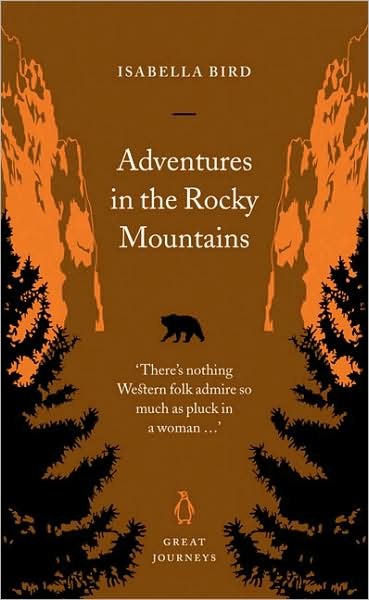
Adventures in the Rocky Mountains by Isabella Bird

adventuresI have a friend named Fil who won’t stop bringing me books. I’ve told him how badly my reading is backlogged, but still we can’t have dinner or a drink without bringing me a book, or several. There are worse problems to have. He certainly does a fine job of selecting them, there’s no question about that; I just worry about finding time for them all. This one, however, fit perfectly into a hole in my reading at the time it arrived: I was a little behind and needed a quick read to review for you all here when he brought me this small, slim paperback of 119 pages. Perhaps it’s wrong to choose one’s reading based on length! but sometimes it does go that way. So, enter Isabella Bird.

From a brief bio in the opening pages, I learned that she was born in 1831 in England, and was sickly and in poor health for the first 40 years of her life, until she traveled to Hawaii and climbed a volcano. From there, she realized that outdoor activity was much more her style than were British sickrooms, and she embarked on a different lifestyle. Adventures in the Rocky Mountains is a collection of letters (and excerpts from letters) she sent to a sister back home while tramping around the Rockies, then not yet a part of the United States but a frontier dominated by hard drinking, hard living, and men.

Bird’s writing is remarkable for its lovely, evocative descriptions of natural scenery, as well as its equally evocative, but less praising, descriptions of frontier life. She retains some disdain for the uncivilized dress and manners of some of her neighbors, but before we call her prudish we will note that she was “bagging 14ers” in a time and place when women were scarce, and were hardworking frontier wives rather than adventurers. In other words, despite preferring a well-dressed conversationalist as companion to a ragged and “coarse” one, she was a tough cookie. A quotation from one of her letters graces the front cover: “There’s nothing Western folk admire so much as pluck in a woman…”

Aside from the descriptions of natural beauty and frontier life, I found a third reason to recommend this book: the character of Mr Nugent or ‘Jim’ (never referred to without the ‘single quotation marks’!), and his dog ‘Ring’ (also always so designated). ‘Mountain Jim’ is a well-known ruffian and desperado with no end of violence and criminality in his past – he confides in Bird at one point such atrocities that she can’t bring herself to relate them. But he is also a perfect gentleman, apparently, in the right mood. He is a “countryman” of Bird’s, a wonderful conversationalist, and quite chivalrous as well as respectful of her abilities to be one of the guys. He is described as charmingly as are the Rocky Mountains. For that matter, the less prominent Evans (another very likeable but also alcoholic and problematic frontiersman) gets a similarly colorful character sketch; and the UNlikeable Lyman as well; so really I should add characterization of people generally to Bird’s list of literary talents.

I am going to stop telling you and show you, through a few choice passages, below.

on a sunset:

The sun was setting fast, and against his golden light green promontories, wooded with stately pines, stood out one beyond another in a medium of dark rich blue, while grey bleached summits, peaked, turreted, and snow-slashed, were piled above them, gleaming with amber light. Darker grew the blue gloom, the dew fell heavily, aromatic odours floated on the air, and still the lofty peaks glowed with living light, till in one second it died off from them, leaving them with the ashy paleness of a dead face. It was dark and cold under the mountain shadows, the frosty chill of the high altitude wrapped me round, the solitude was overwhelming, and I reluctantly turned my horse’s head towards Truckee, often looking back to the ashy summits in their unearthly fascination.

on ‘Jim’:

Heavily loaded as all our horses were, ‘Jim’ started over the half-mile of level grass at a hand-gallop, and then throwing his mare on her haunches, pulled up alongside of me, and with a grace of manner which soon made me forget his appearance, entered into a conversation which lasted for more than three hours, in spite of the manifold checks of fording streams, single file, abrupt ascents and descents, and other incidents of mountain travel.

on a sunrise, and the lightening of the world:

There were dark pines against a lemon sky, grey peaks reddening and etherealising, gorges of deep and infinite blue, floods of golden glory pouring through canyons of enormous depth, an atmosphere of absolute purity, an occasional foreground of cottonwood and aspen flaunting in red and gold to intensify the blue gloom of the pines, the trickle and murmur of streams fringed with icicles, the strange sough of gusts moving among the pine tops – sights and sounds not of the lower earth, but of the solitary, beast-haunted, frozen upper altitudes.

on a high mountain lake:

I thought how their clear cold waters, growing turbid in the affluent flats, would heat under the tropic sun, and eventually form part of that great ocean river which renders our far-off islands habitable by impinging on their shores.

on society, even where people are scarce:

…in truth, this blue hollow, lying solitary at the foot of Long’s Peak, is a miniature world of great interest, in which love, jealousy, hatred, envy, pride, unselfishness, greed, selfishness, and self-sacrifice can be studied hourly, and there is always the unpleasantly exciting risk of an open quarrel with the neighbouring desperado, whose “I’ll shoot you!” has more than once been heard in the cabin.

Isabella Bird’s story of travel through Colorado Territory in the 1870’s, told in letters to her sister, spans almost precisely three months in time; but it is a lifetime of beautiful, incisive, gorgeously told observations, and we are lucky to have them today.


Rating: 7 breaths of rarefied air.

As usual, thanks Fil!

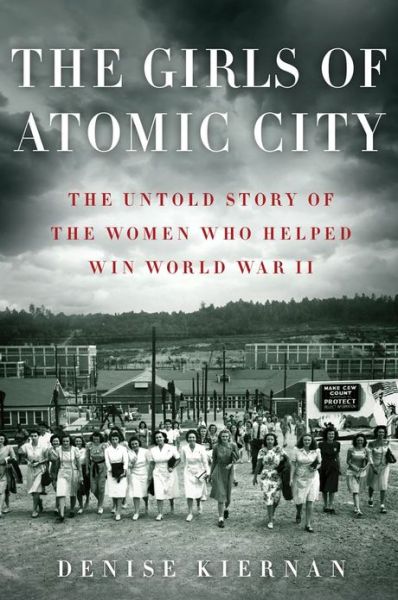
The Girls of Atomic City by Denise Kiernan

An evocative view of the Manhattan Project through the eyes of the women who worked and lived in the secret city of Oak Ridge, Tenn.

atomic

Oak Ridge, Tennessee was born in the fall of 1942, but would remain unknown until August 6, 1945, when the United States dropped the atomic bomb on Hiroshima. Oak Ridge, or “Site X,” housed factories for the enrichment of uranium. The workers at those factories at their peak numbered some 75,000, living in a secret city and working on they knew not what.

Diverse young women traveled from around the country fill the jobs needed to help win a war. Denise Kiernan’s The Girls of Atomic City is a unique glimpse into their strange experience of working on a project whose nature was kept from them. Most expected to leave Oak Ridge as soon as the war was won, but many stayed on for decades. Due to the fine supply of handsome young men in uniform, a number of Kiernan’s subjects would make families and homes there.

Based on interviews with their now-elderly subjects, the stories of Jane the statistician, Virginia the chemist, Kattie the janitor and many more are vivid and human in Kiernan’s telling. The focus of the book briefly zooms out for the dropping of the bomb, visiting Truman’s White House during the decision-making process, but then plunges back into Oak Ridge, where women who tested for leaks in pipes and kept tanks clean were rocked by the revelation of what they’d contributed to. Kiernan melds hard science and history with the moving stories of women caught in events bigger than themselves, whose experiences and whose work changed the world irrevocably. The result is a compelling and unusual new perspective on the Manhattan Project and World War II.


This review originally ran in the March 5, 2013 issue of Shelf Awareness for Readers. To subscribe, click here, and you’ll receive two issues per week of book reviews and other bookish fun!


While I am always constrained by the limited space available for reviews in Shelf Awareness (you know I can get wordy!), this book was especially difficult to boil down, touching as it does on women’s issues, history, science, working conditions, civil rights, war and ethics… It could be compared to Soundings or The Immortal Life of Henrietta Lacks in its intersection of hard science with the creative, feeling portrayal of women’s lives. Additionally, Kiernan’s use of primary sources – interviews with survivors of the era – made me pause to think of my grandfather, a WWII veteran who’s over 90 years old now, whose memories will someday be lost to us. This is a fine book on an interesting subject and I just had to say a few more words to that effect.


Rating: 8 acronyms.

Speaking Truth to Power by Anita Hill, second half review

anitahillI am pleased to report that I had a different experience with the second half of this book, in all the right ways. You will recall (or, I will direct you to) my first half review of same: I thought it was a wonderful book but such a painful story that I had to put it down for a little while. Well, in a nutshell, the second half is: still painful, tragic, and true, but also uplifting, far more hopeful than I expected; and equally well-written and impressive. I wholeheartedly recommend it.

Anita Hill continues to be thoughtful and thorough – I definitely see the mind of a lawyer at work, as she discusses the what-if’s, the precedents, the niceties of the law. She is quite cerebral in her theories on society and stereotyping; far from being a simple revelation of her experiences, this is a treatise on gender & race. She examines the relationship between issues of gender and of race, and the indivisibility of feminism from the fight for racial equality, and the relationships between race and sexism. Hill is clearly an extremely intelligent women! She is also warm and loving about her family, and always seeking privacy, not eager to be a symbol or a leader. In other words, she comes firmly across as a “just regular” person, and someone I’d like to know.

Her story is also entirely convincing. It is beautifully put together and well-written: not lyrical, but methodical, structured, can I say thorough and lawyerly again? And she preaches more hope than I felt in my first-half review. However, the battle is still not over, and I still feel upset & angry that Hill’s experience reads so familiarly more than 20 years later. On that note, I’ll refer you to Jessica Valenti’s lovely speech to my local Planned Parenthood group, here. Well said, Jessica. You give me hope, too.


Rating: 9 strong women, please.