The Great Night by Chris Adrian

This book is billed as a modern-day retelling of Shakespeare’s A Midsummer Night’s Dream, which sounds fairly ambitious. The original classic is far too much to mess around with lightly. I find it beautiful, haunting, magical, and surprisingly accessible; I think anyone and everyone should be able to enjoy a production of this play, which might not be true of all the bard’s work, no matter how wonderful. But I have to give Adrian full credit: I feel that he created something new out of it, definitely a recognizable retelling, but something new and beautiful in its own way, very different and very wonderful too.

Three young people, Henry, Will, and Molly, are all (separately) lost in Buena Vista Park in San Francisco at dusk on midsummer night’s eve. All three were on their way to the same party which none really wanted to attend; all three are tenuously connected without actually knowing one another; and all three are quite neurotic in their own ways. Meanwhile, Titania is grief-stricken, having lost her Boy to leukemia (and being unfamiliar with the mortal concept of death), and then having lost Oberon, who left her when they quarreled in their shared grief. In despair and resignation, she releases Puck from his bond of servitude, and he rages as the Beast throughout the park. Also meanwhile, a troupe of homeless aspiring actors meet to rehearse a musical play, but are separated, as the fairies come out to frolic, or flee Puck, or make mischief.

Chapter by chapter we get inside the heads of the three mortal lovers, and sometimes of Titania too. The character development is exquisite; I loved learning more about the histories of Will, Molly, and Henry, and gradually putting together the clues and learning how they’re interconnected and where their respective neuroses might have come from. The depth of these complex, nuanced, disturbed characters might have been my most favorite part of this book.

Titania gets substantially more development, too. The lengthened and deepened relationship with the Boy, and his battle with cancer, allow for her to mature and look outside herself in ways that a fairy queen would not normally be called to do. Even Puck gets a more significant personality, and desires of his own.

Part fairy tale – of course – The Great Night has all the magic and all the lavish scenery that Shakespeare’s Titania & Oberon could have wanted, helped along by the alternately lush & misty San Francisco parkland. As in the play, there are disturbing moments; but these are fully fleshed out. I guess the great difference here is that this is a lengthy novel (~300 pages) with all the exposition that comes with this format, and there is simply less opportunity in a slim play for this kind of development. But Adrian’s work is darker, and more graphic. (There is Sex. Seriously.) The ending is not lighthearted and happy as it is in A Midsummer Night’s Dream. Among the mortal characters, we meet a tree doctor; men and women recovering from the suicides of loved ones; and the mess that OCD can make of a life; the lovers are gay and straight but always damaged. But the worlds are so fully realized… and the three youth are so fully developed, I ached for them. When every chapter closed, I regretted leaving that chapter’s focus character, but was happy to reunite with the next.

This was one of those books I was very sorry to see the end of. I wish there were more. Luckily, Adrian has written other books!

I recommend The Great Night. Certainly nothing is taken away from Shakespeare’s masterpiece; but this is a different realization of the same story-skeleton, in a different format, and it is absolutely an accomplishment all by itself.

Teaser Tuesdays: The Great Night by Chris Adrian

Teaser Tuesdays is a weekly bookish meme, hosted by MizB of Should Be Reading. Anyone can play along! Just do the following:

* Grab your current read
* Open to a random page
* Share two “teaser” sentences from somewhere on that page
* BE CAREFUL NOT TO INCLUDE SPOILERS! (make sure that what you share doesn’t give too much away! You don’t want to ruin the book for others!)
* Share the title & author, too, so that other TT participants can add the book to their TBR Lists if they like your teasers!

This is the modern-day re-telling of Shakespeare’s A Midsummer Night’s Dream, in which three young people wander into a San Francisco park at dusk and have adventures while Titania searches for her lost love, Oberon, who left her when they fought following the death of their Boy. So far I’m finding it to be a beautiful, evocative painting of a book. I like.

From page 146:

There was another, grander room beyond them, a cozier hall than the last, only about half as big, with grass on the floors and flowers on the walls, and a ceiling hung with hundreds of little colored lanterns. It was empty of furniture except for a table the size of a flatbed truck piled with food and surrounded by chairs of every conceivable size, and empty of people except for the girl, who had called herself Eleanor Roosevelt. She was sprawled in a chair with a bottle of wine in her hand.

“You all again,” she said.

catching up: Niffenegger weekend

Hello there. Sorry I’m slow to cover my weekend’s reading for you. Here I am now!

This was a fun weekend because the Husband did a marathon mountain bike race while I watched and supported for a change. He did much better than he had hoped, and seemed to do it pretty easily too, so I’m very proud. I had a good time watching a number of friends do very well, in fact.

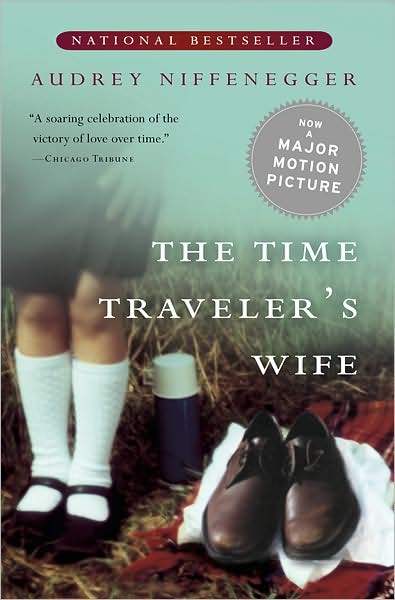
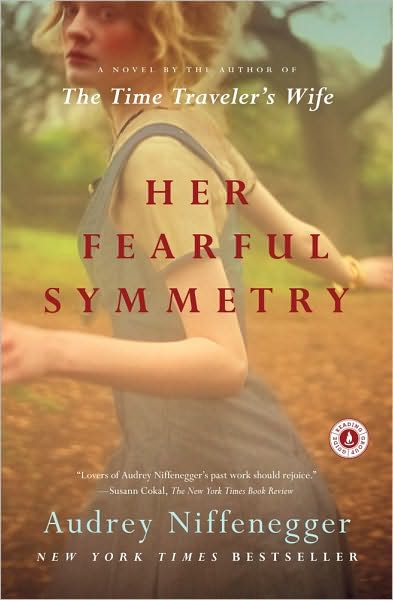
I also managed to finish Audrey Niffenegger’s The Time Traveler’s Wife and then Her Fearful Symmetry (finished today at lunch), so it’s been a Niffenegger-heavy weekend. I didn’t intend to read two of hers in row, but was already reading and enjoying Time Traveler when a library patron brought me her personal (autographed) copy of Symmetry, to borrow – thereby making me feel like I should read it next…

So first things first. The Time Traveler’s Wife was very enjoyable! I felt like it had a little lighter feel to it earlier in the book, then gets a little more thoughtful, dark, contemplative, and frightening later in the book. This is actually appropriate, for Clare’s point of view, since she takes her time-traveling husband lightly when she’s younger, only realizing risks & dangers as she grows older. When she is an adult and understands all the implications, things become very frightening indeed. I found all the emotions and reactions pretty human, and was very absorbed in the characters. I also found the novel’s implied questions, about fate, sequence, causality, responsibility, forgiveness, and other issues of humanity, to be compelling. The time-travel construct worked well for me. I was impressed by a beautiful, romantic story with believable characters. I was also impressed with some of the emotional scenes Niffenegger managed to “paint” for us, like the dream sequences on pages 373-4.

And, I found myself crying. Again! Something strange must be happening to me. At least I can say it’s NOT my biological clock 🙂 because I continue to be just a little impatient with all the maternal stuff in several books I’ve been reading over the last several months: The Time Traveler’s Wife, Audrey Niffenegger; Still Missing, Chevy Stevens; Look Again, Lisa Scottoline; I’d Know You Anywhere, Laura Lippman; My Sister’s Keeper, Jodi Picoult – just off the top of my head. I’m a bit fed-up with motherhood and maternity as themes, and have decided to purposefully avoid (in the near future at least) Emma Donoghue’s Room, which I’ve been interested in for months now, because it sits pretty squarely on those themes.

I give this one a strong rating and am glad I finally picked it up.

With some hesitation, then, I picked up Niffenegger’s Her Fearful Symmetry as my next read. I hesitated because I rarely read the same author, or even theme or style or subject matter, back-to-back. I don’t even think I can remember reading back-to-back in a series. I guess I just feel like my brain likes a break, a palate-cleanser if you will. So with slight trepidation I began the next book; and I think I was right to be a bit nervous, because the first book ends with a death and a partner mourning, and the second book begins with a death and a partner mourning, and really never gets much happier than that. No, they’re not serial, just continue a similar tone.

Plot synopsis: Twins Valentina and Julia do not know their mother’s twin sister Elspeth until they inherit Elspeth’s London flat. There are two conditions: they must inhabit the flat for a year before they can sell; and their parents cannot set foot in it. Upon arriving in London, these ethereal, deeply attached young girls meet their interesting neighbors: Martin is an endearing but very sick obsessive-compulsive; and Robert was Elspeth’s lover, and is having quite a bit of trouble “letting go” her memory. They also get to know their mysterious aunt.

The melancholic, obsessive grief that starts this book doesn’t really let up. Perhaps I simply wasn’t in the mood to be made to feel this way, but I didn’t *love* this book as much as I did Time Traveler. I think it was almost every bit as well-crafted, and the emotions (while disturbing) still rang true; but it was just a bit too creepy. I won’t go any further for fear of spoiling, but this was a creepy book. To be fair, I had trouble putting it down; I think it was well done. But it didn’t feel as good. I think The Time Traveler’s Wife accomplished a feat: it took me through a range of emotions and life stages and, if it didn’t tie things up in a happy cozy way, at least it tied things up in a way that felt very complete. Her Fearful Symmetry, on the other hand, explored dark emotions rather deeply without a great deal of light. The paranormal aspects in the first book were a quirky vehicle through which to experience emotions and relationships and ask interesting questions. The latter read more like a ghost story (more and more so as the story develops), with an ending that was a little Poe-like in its creepiness.

I preferred the first, obviously, although if you were a bit more open to the ghost-story aspect, you might like the second better than I did. I believe even objectively, though, the first was a greater achievement. Or maybe I just shouldn’t overindulge in Niffenegger, hm?

I’ve heard a fair amount about her recent graphic novel, The Night Bookmobile, as well. Librarians and libraries and books play an important role in Niffenegger’s work in general (Henry from The Time Traveler’s Wife is a librarian; Elspeth from Her Fearful Symmetry is a bookseller), and the starring role in this latest. But the consensus amongst the library groups I hear from seems to be that her treatment of the librarian in The Night Bookmobile is downright and absolutely creepy. They don’t seem to like it. Again, maybe we just need to be looking for a ghost story? Or is there really something “wrong” with these stories? Presumably there are readers out there who love them. Any thoughts?