



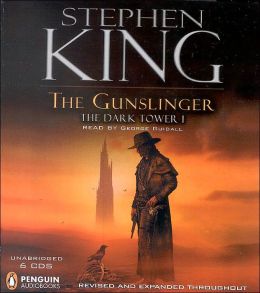
The Gunslinger by Stephen King (audio)


This is my 1000th post! Thanks for your support, friends!

gunslingerI so very much enjoyed The Wind Through the Keyhole from Stephen King’s Dark Tower series that I had to find The Gunslinger, book one in that series. I was captivated by King’s own narration of the former, and disappointed to find that he didn’t read this one himself; but narrator George Guidall did a fine job, and I shouldn’t punish him for not being Stephen King.

In a fantastical spin on the western genre, we open with Roland Deschain walking alone with his mule, his guns holstered at his hips. He is pursuing “the man in black”, with an eventual destination of “the dark tower.” These terms are archetypal and possibly metaphorical. He has to cross a desert. He talks with a lone farmer (accompanied by a talking crow), and tells the man a story. (The story-within-the-story is repeated in The Wind Through the Keyhole, very enjoyably.) In the gunslinger’s story we experience the town of Tull, where Roland had also stayed for a spell, in pursuit of the man in black, with some nasty consequences. This is the first of the gory-bloody bits in The Gunslinger, but not the most extreme. We are also learning something of the magical nature of this world that the gunslinger inhabits. The man in black casts spells to entrap Roland; time doesn’t flow normally. At a glance, however, this could be our own world – possibly following war or other disaster.

Next, Roland meets “the boy,” Jake, who has himself come from some other world. As he describes it, Roland thinks he must be making things up; but the reader recognizes modern-day New York City. Jake and Roland travel together for a spell, still across the desert, and then have to climb a mountain, and then go into the mountain. I’ve put off saying this for long enough: The Lord of the Rings is strongly present. The dark tower, the linguistic touches, the lone-ranger type which is borrowed both from western books & movies and from Tolkien, and now the trip into the evil mountain with the ghoulish parahumans threatening them along the way, are all clearly inspired by that exemplary world-building trilogy. Come to think of it, I’m pretty sure I referenced Tolkien in my review of The Wind Through the Keyhole, too.

Anyway. They’re traveling, and Roland tells Jake a story, too – another story-within – this time about his training as a gunslinger, and the climactic, life-determining moment when he fought his teacher. This is the truly gory bit: it made me cringe a little, and I don’t consider myself a squeamish reader, so take note. This is Stephen King, after all. Horror joins western and fantasy-epic in King’s genre mashup. Roland and Jake will have a final meeting with the man in black; and I shall leave you there.

I enjoyed this book very much. Stephen King is, without question, expert at world-building and believable, fully-wrought, finely detailed backgrounds. Roland is both an archetype and a real person I easily learned to care about. The tension, suspense, and dramatic action are engaging and had me sitting up straight waiting for the next blow. The boy Jake is sympathetic. There is a mystery surrounding the man in black, and the final confrontation – I said I wouldn’t go there. On the other hand, The Gunslinger felt to me grittier, grainier, less literarily refined than The Wind Through the Keyhole, which in my memory, at least, was a superior book; but not by much. And for that matter, a grainier, less refined beginning feels like it suits this series. I am enchanted by the pulling together of genres, as I stated: western, horror, fantasy, and epic adventure. I don’t think I’m doing it justice in this review, but this is fine work, friends. I’ll be seeking out book two.


Rating: 7 slow mutants.

Teaser Tuesdays: The Gunslinger by Stephen King

Teaser Tuesdays is a weekly bookish meme, hosted by MizB of Should Be Reading. The idea is to open your current read to a random page and share a few sentences. And try not to include spoilers!

gunslinger

Today I am thrilled to finally be finding time for book one in the Dark Tower series by King, which I entered with a later installment, The Wind Through the Keyhole. I loved it. I’m just sorry this one isn’t read by Stephen King, too!

I picked out my favorite early lines for you:

He had laid his fuel in a pattern that was not artful but only workable. It spoke of blacks and whites. It spoke of a man who might straighten bad pictures in strange hotel rooms. The fire burned its steady, slow flame, and phantoms danced in its incandescent core. The gunslinger did not see. The two patterns, art and craft, were welded together as he slept.

I love this pictorial expression of the gunslinger’s melding of art and craft, and how it “speaks of blacks and whites.” I am a King fan. I feel confident this one will be good…

A Wrinkle in Time by Madeleine L’Engle (audio)

wrinkleWhat fun to dig back into this children’s classic. I only vaguely remembered enjoying this as a kid, and I got to rediscover it via this audiobook, read by the author. My memory didn’t provide much: I think I was most familiar with the opening scene, in which Meg Murry is awake and frightened in her attic room alone by a storm outside. She is grumpy, frustrated with her family: her father for being away for so long; her baby brother Charles Wallace for not feeling her pain and coming to her as he usually does.

Next, of course, Meg and Charles Wallace meet the not-quite-mortal Mrs. Whatsit, Mrs. Who, and Mrs. Which, and an unusual boy from Meg’s school named Calvin. This unlikely team will adventure together via the “tesseract” – a wrinkle in time and space as well, if you will – to try and find Mr. Murry, and save him, and save the world (and all the worlds) from the Black Thing.

This is a children’s chapter book. Madeline L’Engle notes in an introductory section that publishers thought it would be too hard for children; but her own kids loved it, and as it turns out, so does the world. It’s won several awards including a Newberry, and remains popular today. (Originally published in 1962 and still in print.) I can see how it would be “hard” for children, particularly the physics bits; but then, we don’t have to understand it fully to enjoy it, do we? And lots of adults are puzzled by physics too! This book has appeal for adults – perhaps obviously, here I am, and I don’t read a whole lot of children’s books. It still rings like a kids’ book, but I found the characters and the plot both engaging. I have a slight criticism that Meg occasionally sounds a little adult for her age; she does whine appropriately, but sometimes her observations are startlingly astute. It’s a common complaint with young characters in books. But only slightly, here.

Meg, Charles Wallace, and Calvin are all likeable but human; their parents are similarly well-rounded, sympathetic characters. The Mrs’s are charming, and the world-building – in the world of Aunt Beast, for example – is well done. I like that Meg grows some in the course of the story; and L’Engle certainly leaves us open for a sequel, what with the possibility of a burgeoning romance, and the happily-ever-after-at-least-for-now ending (with the Black Thing still looming). Mostly I was just disappointed that it was over so quickly! (Another feature of children’s books.)

I was a little surprised to find religious references within; I didn’t remember those. Not many, but a few mentions of having God on one’s side, or being the chosen ones, fighting for good. It got me thinking. I’m not particularly good at spotting religious allusions, not having been raised in church or on the bible. They mostly pass me by. But spelling out G-O-D will catch my eye every time! It’s not a technique that appeals to me but it wasn’t a central enough theme here that it threw me off much, either. A theme that is central is a good-versus-evil dichotomy, which of course could be interpreted as being religious; but the book-banners have protested certain aspects of this story, too – including the grouping of Jesus with mortal fighters-for-good such as Da Vinci, Michelangelo, Shakespeare, Pasteur, Einstein, Gandhi, Beethoven, Copernicus and a lone woman, M. Curie. So there you are: all matters of interpretation.

In a nutshell, I found this book a delightful, too-brief romp in another world. I am tempted to pursue further work by L’Engle; four books follow this in a quintet, and others of her oeuvre reference the same characters. Realistically, I don’t know if I’ll get to them. But this was an enjoyable read, and not just for children.


Rating: 7 pairs of spectacles.

book beginnings on Friday: A Wrinkle in Time by Madeline L’Engle

Thanks to Rose City Reader for hosting this meme. To participate, share the first line or two of the book you are currently reading and, if you feel so moved, let us know what your first impressions were based on that first line.

wrinkle

I am just as pleased as can be to experience again a book I enjoyed in childhood, a book that won several awards including a Newberry. Madeline L’Engle’s A Wrinkle in Time begins:

It was a dark and stormy night.

In her attic bedroom Margaret Murry, wrapped in an old patchwork quilt, sat on the foot of her bed and watched the trees tossing in the frenzied lashing of the wind.

L’Engle is winking at us, I believe, when she uses this well-worn literary opening line; but it works beautifully, don’t you think? It’s atmospheric, and if it’s “pre-owned,” I find it still effective. It brings to mind the attic reading scene in The NeverEnding Story, which I also loved.

I’m just a few minutes into this audio recording, read by the author, but I’m glad to be back in L’Engle’s world. Happy weekend!

Lost in a Good Book by Jasper Fforde

lostAll those books on my shelves waiting to be read, and I couldn’t resist taking this one out from my local library and jumping in. You will recall that I enjoyed the first Thursday Next book on audio. I couldn’t find this one in that format, so text it is. I have some observations on the format, but first, what is it about?

Thursday Next is back, recently married, and pregnant. She and Landen are happy, but overwhelmed by the publicity linked to her successful but still controversial victory over Acheron Hades, which involved changing the ending of Jane Eyre. The forces of darkness are not through, however: Goliath Corporation wants Jack Schitt back (oh, these names!), and his brother Schitt-Hawse is not afraid to use some pretty ugly blackmail techniques to get him. Landen is in trouble, and Thursday will have to follow Schitt into Poe’s The Raven to execute both men’s safe return. And finally, Acheron Hades may be dead, but (shockingly) he had friends…

Everything I liked about the first book is here: silliness and hilarity, but also some rather sober statements on the ugliness of war, and an evil, all-powerful corporation that is both deliciously ogreish and frighteningly true to life. Not to mention that most central quality: that in this alternate world, books and literature are deeply important to everyone. This fantasy is deeply enjoyable for those of us who feel that way in the real world but who are, sadly, the minority.

What is better about book 2 than book 1 is that there is far more entering of books: in this edition, Thursday acquires the skill, with the help of the Cheshire Cat and Miss Havisham, of reading herself into any book she chooses. Thus we get to visit Sense and Sensibility and The Raven, and of course Great Expectations, as well as a few others, even unpublished manuscripts. Great fun! This aspect of the story’s possibilities (that is, the possibilities of Fforde’s delightful invented world) is not perhaps exploited fully; but the series continues, and I am joyfully anxious to read the next installment.

Format-wise, I loved the voices (and the accents) on the audiobook I listened to of book 1; but there’s a lot to be had in the print version of this one. For one thing, certain inhabitants of Book-World speak to Thursday in foot-notes, which only she can hear and which appear to me as actual foot-notes on the bottom of the page – the disjointedness of which was quite appropriate. I don’t know how that would have been executed in audio format. And there are other things: spellings, subscripts, and the like, that are very much printing jokes, and thus best (only?) enjoyed in print. So while I like the convenience of audio (and the accents!), this may be a series to read in actual book form. Which is probably how Thursday and her Book-World/JurisFiction cohorts would have it, anyway.


Rating: 7 pounds of cheese. (It fits, really.)

The Eyre Affair by Jasper Fforde (audio)

eyreaffairThe Eyre Affair is the first in the Thursday Next series of bookish mysteries by Jasper Fforde, and I am pleased to have discovered it. The alternate world inhabited by Thursday Next (our protagonist) is ingeniously imagined, fully realized, and great fun: centrally, books are very, very important, and justify an entire branch of law enforcement (which is, admittedly, sort of a stepchild in the law enforcement community, but we’ll take it). Extinct species have been recreated through genetic engineering: Thursday has a pet dodo bird named Pickwick. In a sobering parallel to reality, the Crimean War is ongoing; Thursday opposes it, having served, herself, and having lost her beloved brother in action. Wales is an independent republic. And on, but you get the picture: Fforde is a fine worldbuilder, and his is a world both hilarious and serious.

Thursday works as a LiteraTech, one of those book-police, and is still scarred by her experience in the Crimea, and the loss of her brother there. She remembers fondly her former fiancé, who lost a leg in the same battle, but can’t quite be with him, for reasons we have to learn as the book unfolds. Her father is a time traveler, put briefly, and we get occasional time-stopping visits from him which also color the alternative universe Thursday dwells in. She finds herself a villainous opponent in Acheron Hades, her former college professor and now professional criminal extraordinaire. He has special powers (appearing in various forms, impervious to gunshot wounds) and Thursday is uniquely able to combat him, although not without personal injury and great risk. Their conflict takes Thursday back to her hometown, where we meet her delightful inventor uncle Mycroft (he of the bookworms), and witness the (clearly inevitable) reunion with the former fiancé.

The genius of The Eyre Affair, in case I have not sufficiently made this point, is the world that Fforde creates. All the little details are charming, fun, and silly in the best possible way; the characters are likeable and real. Thursday’s trauma as a war veteran is believable and makes her a fuller character. Her uncle is sweetly flawed and fabulous. Only Landen, the former fiancé, might be a little saccharine; and this is the book’s only real shortcoming: where Fforde digresses into romance he tends to be a little too sweet. His skill is not particularly apparent in terms of plot. The mystery story is fine, passable, amusing – and the villain is deliciously evil, taking pleasure in evil for its own sake – an adequate vehicle for the characters and worldbuilding that are Fforde’s greatest strengths. The love story is a little bit pat, but who cares? Give me more Thursday Next, set in this outrageously entertaining alternate universe, and I will be happy. Oh, and audio reading by Susan Duerden is fun and perfect; I will be looking for her reading of the next book in the series as well.


Rating: 7 dodos.

Teaser Tuesdays: The Eyre Affair by Jasper Fforde

Teaser Tuesdays is a weekly bookish meme, hosted by MizB of Should Be Reading. Anyone can play along! Just open your current read to a random page and share a few sentences. Be careful not to include spoilers!

eyreaffair

Sorry. I know I just teased you with this one recently, but it’s simply too much fun. See:

He patted the large book that was the Prose Portal and looked at Mycroft’s genetically engineered bookworms. They were on rest & recuperation at present in their goldfish bowl; they had just digested a recent meal of prepositions and were happily farting out apostrophes and ampersands; the air was heavy with them.

How could I have passed up the meal of prepositions and the farting of apostrophes? I ask you. Great fun, this world of Thursday Next!

Happy reading in 2013, kids! Year-in-review post coming later on today.

Teaser Tuesdays: The Eyre Affair by Jasper Fforde

Teaser Tuesdays is a weekly bookish meme, hosted by MizB of Should Be Reading. Anyone can play along! Just open your current read to a random page and share a few sentences. Be careful not to include spoilers!

For those unfamiliar with Jasper Fforde, he writes unique fantasy or alternate-reality mystery novels that take place in a world of books. I read his The Big Over Easy years ago, about the eyreaffairpushing of Humpty Dumpty over the wall; this is my first (and the first) of his Thursday Next series, in which a character by that name (yes, Thursday) works as a Literary Detective. Here’s a tease from the early pages:

…no one was taking any chances since a deranged individual had broken into Chawton, threatening to destroy all Jane Austen’s letters unless his frankly dull and uneven Austen biography was published.

What I think is charming about this story is the world in which books, and art, matter as much as anything does. It’s great fun for those of us who love books, to imagine a world that shares our value system. Also, because cloning and genetic engineering has come so far in Thursday’s alternate world, she has a pet dodo bird named Pickwick, and that’s pretty cute, too.

Abraham Lincoln: Vampire Hunter by Seth Grahame-Smith (audio)

Abraham Lincoln: Vampire Hunter is an alternative history with fantasy/paranormal elements thrown in. It reexamines Abraham Lincoln’s life, his presidency, and the American Civil War, with a twist: the US is overrun with vampires, mostly unknown to the public, who are secretly pulling the strings that shape Abe’s life, the institution of slavery, and war. The book opens with a charming sequence in which a would-be novelist in a small town on the Hudson Valley meets a new resident and gets a book idea from him. The foreboding sense in the idyllic setting reminded me of Stephen King, which is a compliment.

It is a rather fascinating concept. I had my doubts at first – again, the whole vampires-in-pop-fiction trend gave me pause; it’s not a trend I have bought into in the past. But as soon as I began the book, I was drawn in. So full points for intriguing me early on. I loved the parts about Abe’s early life; the atmosphere, the mood of tension, of Abe’s efforts against long odds, his determination in the face of tragedy, are all well executed.

But I think the middle section of the book dragged on far too long; it’s a great concept that Grahame-Smith indulged in for too many pages. All of which is to say, it probably made a great movie! That may be the proper format.

Another concern: I had some misgivings about the use of vampires to explain some of the evils in our national history. Slavery, secession, civil war, all belong to vampires in this book (with a quick mention of WWII’s genocide apparently coming from the same source). While Grahame-Smith struck me as careful to always treat these heavy topics with due sobriety, it still makes me a little uneasy to play with them in this way. Slavery and civil war are unsettling, terrifying, gruesome, disturbing enough in fact; it rather feels like diminishing their somber import to make them the fictional playthings of entertainment in this way, no matter how carefully treated. And again, the tone of this book is serious and in always respectful. But I’m just not entirely sure. It gives me pause.

Late in the book, I really missed our narrator of the beginning section: the writer, that is, who is approached by the mysterious stranger and given the lost diaries of Abraham Lincoln. The quick sketch of small-town life and the birth of this novel was a definite strength, and I regret that we never returned to that early narrator at the end of the book. I was looking forward to revisiting him.

So I have my criticisms, as you can see; but I really did enjoy this audiobook, and never considered putting it down. I think Grahame-Smith could have executed his rather genius story concept in less space: my audio ran to 9 CDs, and he could have kept it under 6, in my opinion. But again, this only makes me more interested in the movie version. Apparently the screenplay is written by Grahame-Smith as well, which is a good sign; and hopefully that format will push for a little more condensed action, which the book could have used as well. Call this a rare case where I am excited for the movie after reading the book.

The audio narration by Scott Holst was good. He emphasizes mood as a narrator should; he varied the voices of his characters a little, was not overly theatrical, but lent atmosphere where it belonged.

As always when I read historical fiction, I found myself contemplating the line where fact meets fiction. In this case, I’m sad to say (and it’s far too often that I’m sad to say this!) I don’t know the subject well enough to judge for myself; but here are a few notes of interest. At the end of my audiobook is a short interview with the author, in which I learned: first, that he was in fact quite purposefully following the aforementioned trend of vampires in pop fiction; and secondly, that he had great respect for his subject and did a fair amount of research. Now, this is a subjective measure (and he’s judging himself, which makes the judgment even more subjective), but I still find it encouraging. Finally, he mentioned a particular source of nonfiction inspiration: Doris Kearns Goodwin’s Team of Rivals, which I have in my iPod just waiting my attentions. And that was the most encouraging detail of all. 🙂


Rating: 6 fangs.

Teaser Tuesdays: Abraham Lincoln: Vampire Hunter by Seth Grahame-Smith

Teaser Tuesdays is a weekly bookish meme, hosted by MizB of Should Be Reading. Anyone can play along! Just open your current read to a random page and share a few sentences. Be careful not to include spoilers!

I confess I thought this looked a little silly. Maybe it’s the whole vampires-in-pop-fiction trend? But I confess, I like it. And there’s a movie, you know… Here’s a teaser.

I shouted after him: “Why haven’t you killed me!” His answer came calmly from the next room. “Some people, Abraham, are just too interesting to kill.”

And maybe that’s how the book is striking me, too. Too interesting to kill. 🙂

What are you reading this week? Do share.