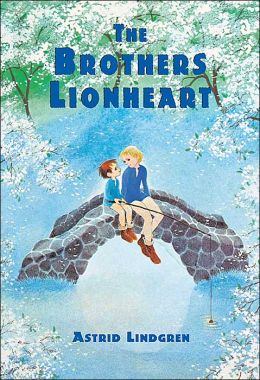
The Brothers Lionheart by Astrid Lindgren

lionheartI was asked some time ago what my favorite book was as a child, and I couldn’t say. I could have listed a dozen, at least, that I loved, but I don’t know how I could have chosen one. I asked my mother, and she said my favorite book as a child was the one I was reading right that minute. I read a lot.

But something about The Brothers Lionheart has stayed with me. I don’t know when I read it, or how many times – not many, I think, maybe only once; but it made a strong impression, and I’ve found myself thinking about it over the years. (Astrid Lindgren is better known as the author of Pippi Longstocking, but I think this one kicks Pippi’s butt.) So I finally went and got my hands on a copy recently, and I’m so glad I did!

The story is fantastical. When it opens, little Karl Lion is sick; he’s been in bed for six months. But his older brother Jonathan is a good big brother, one of those golden people, beautiful and strong and talented and kind, and modest because he seems to just really not notice or care how special he is. He’s sweet to his little brother, and stays up late telling him stories. Karl knows he’s going to die. Jonathan tells him it’s okay, because he’s going to a beautiful place beyond the stars called Nangiyala, a land still in the time of campfires and sagas, where the brothers can have adventures together. Jonathan is only sorry that Karl will get there before he does, since Jonathan seems destined to live a long and healthy life.

But there is a fire, and Jonathan saves his brother’s life but forfeits his own; and when Karl succumbs to his illness, Jonathan is waiting for him at Knights Farm in Cherry Valley in Nangiyala. They have horses, and rabbits, and a vegetable garden; Jonathan tends the rose gardens of a nice woman named Sofia, and they are friends with everyone in the town. Karl is happy. But too soon, he learns of Wild Rose Valley, the next neighborhood over, where things are not so simple and joyful: an evil tyrant named Tengil has enslaved the people of Wild Rose Valley and built a wall to keep them from their friends in Cherry Valley. Jonathan and Sofia are part of the resistance; and although Karl is very small and very frightened, he finds himself involved, as well.

There are forces of evil dressed in black uniforms and scary helmets; there is an occupation; there is a fire-breathing dragon; and there are brave citizens. It is a saga itself, and Jonathan is its shining golden hero, but Karl doesn’t do too badly either. I loved this story very much, this time as much as when I read it as a child. And the ending thrills me as much as ever.

This is definitely a book for kids; the language is simple and childlike, and the thing I found most striking upon this adult read was the pacing. It moves very quickly! It takes very few pages to establish how lovely & simple & calm Cherry Valley is; and then we’re on to the darkness next door immediately. An adult book would have been longer and allowed the action to develop a little more slowly. But this made for a very enjoyable, quick read. I’d recommend it for anyone who likes fantasy and dreams and adventure, and who might not be up for a longer, more involved novel.

There is another level on which this story can be read as allegory. Tengil’s occupying force presents several clear options for comparison (and I think also offer some tips on how not to do it). One valley looks so sweet, good, prosperous and happy, and yet if you open your eyes just a little – zoom out to the point where you can see as far as just the next valley over – things are not nearly so happy or easy as you thought. Without putting too fine a point on it, I think this offers an analogy for capitalistic western culture. Speaking of capitalism, I was charmed by the idea of everyone helping everyone & taking care of one another in this idealistic Nangiyala. One can dream.

Themes include the beauty of a deeply felt brotherly love, resistance against evil, loyalty, hope, and courage; but there are also themes related to death & what happens after, tyranny, war and betrayal. The book has been criticized for its approach to suicide (although I would argue it’s not quite that simple). For me, the good is bigger than the darkness, and the ending is happy. I feel that the interplay of dark and light is part of what makes this story the kind that has stuck with me for over 20 years, and keeps it from being saccharine. But not everyone will see it that way.

I am so pleased to report that Jonathan was still simply heroic, Karl still sweet and surprisingly brave, Sophia still good and the dragon still scary, even now that I’ve grown up. Do check out my childhood favorite with me.


Rating: 9 trips along a river.

book beginnings on Friday: The Brothers Lionheart by Astrid Lindgren

Thanks to Rose City Reader for hosting this meme. To participate, share the first line or two of the book you are currently reading and, if you feel so moved, let us know what your first impressions were based on that first line.

lionheart

Astrid Lindgren is far better known as the author of Pippi Longstocking. But I remember Pippi only vaguely, and have remained enchanted by The Brothers Lionheart since I read it first as a child. I was excited to find a new copy and open it back up again. We begin:

Now I’m going to tell you about my brother. My brother, Jonathan Lionheart, is the person I want to tell you about. I think it’s almost like a saga, and just a very little like a ghost story, and yet every word is true; though Jonathan and I are probably the only people who know that.

I love this childlike tone. But don’t be fooled: this is a hell of a story, exciting and beautiful and poignant and scary and fantastic.

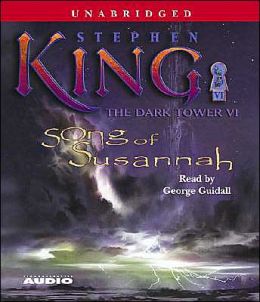
Song of Susannah by Stephen King (audio)

Just to review the Dark Tower series:

The Gunslinger (I)

The Drawing of the Three (II)

The Waste Lands (III)

Wizard and Glass (IV)

The Wind Through the Keyhole, written last but fitting between books IV and V

Wolves of the Calla (V)

and here we are with book VI, Song of Susannah.


susannah

I’m sorry to say I have to agree with what Jeff Coleman said (in a comment, here), about the series beginning to fray in this book. Our beloved ka-tet, in which we, the readers, have invested so much care and worry, is beginning to come apart. The characters are now separated and working independently or in pairs, and I think both the storyline, and the emotional investment King can ask of us, suffer. In fact, I am going to compare this problem to a recent television event: I think watchers of The Walking Dead are frustrated by how everyone is split up. We still care enough to watch week to week (at least my household does!) but we’re a little unhappy with the producers for keeping us so much in the dark as to where everyone is. We don’t mind a little conflict, a little suspense and fear – in the case of the Dark Tower series and the zombie tv series, both, I think we’re here for the suspense and the fear; and no story is anything without conflict – but it’s getting a little harder to invest as we’re spread around so thinly.

Susannah/Mia is battling, basically, herself; she is by herself; and her survival is not assured. Eddie and Roland are off on their own worrying about the rose, and they have a bizarre adventure in which they meet Stephen King himself, on which more in a moment. Jake and Pere Callahan, and thank goodness Oy, are… still around, but I’m not sure what they contribute to this novel other than to still pull my dog-loving heartstrings (Stephen King KNOWS I won’t stop reading as long as Oy is around). I am sorry to say that this may be the first book in this series in which nothing happens.

Stephen King writing about people who are in a book that Stephen King wrote, and who then go off to find & meet Stephen King, so as to convince him to write about them – this is interesting. It’s mind-bending, intriguing, very meta, and perhaps a little silly; I’m not sure how egomaniacal he’s being here, but I think I dig it. I like a good mind-bender. Again, though, I’m not sure what it contributes to the arc of the plot of this series; I am impatient for our characters to get together again; I’m worried about them, but not in a plot-progress kind of way. Hurry up and give us more action, King.

There is also a quick reference – so quick you could almost miss it, except that it is SHOCKING and I gasped on the train and people looked at me – that distressed me. I’ll write it here in white text, and you can highlight to read it if you’re unafraid of spoilers. There is a line that says something like “Eddie never got a chance to, because by then he and Roland would be separated by death.” What a heck of a thing to foreshadow, Stephen King. I am upset.

This penultimate book in the series leaves me anxious for the next one – I’m anxious for our splintered ka-tet, and also anxious that the last book will be a good one. It’s certainly a fat one; I couldn’t find it on audio, so I’ll have to wait until I find the print-reading time to slot in these 1,000 pages. Dear, dear.


Rating: 5 turtles.

(but only because it’s part of this series.)

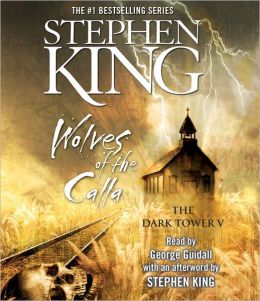
Wolves of the Calla by Stephen King (audio)

Just to review the Dark Tower series:

The Gunslinger (I)

The Drawing of the Three (II)

The Waste Lands (III)

Wizard and Glass (IV)

The Wind Through the Keyhole, written last but fitting between books IV and V.

and here we are with V: Wolves of the Calla.


wolvesThis is a very long one. My library copy of the audio came on 22 CD’s. Off the top of my head, I can only remember Anna Karenina being longer; but where that was a painful experience for me (sorry, Tolstoy fans), this was pleasurable.

The action of Roland’s ka-tet of 5 – Roland, Eddie, Susannah, Jake and Oy – takes up very little geographical space, unlike most of the previous volumes. They leave Topeka and the Wizard of Oz world, and encounter an envoy from a local town, Calla Bryn Sturgis. The locals are tormented by the Wolves from Thunderclap, the neighboring badlands: these “wolves” come about once a generation to the Calla, where a single-born child (or “singleton”) is a rarity. Most children are born in twins, and the wolves come to take own of each set away with them; when they are sent back to their families shortly after, they grow into severely mentally handicapped giants who live short, painful lives. The folken of the Calla have heard that there are gunslingers in the area, and they are struggling to decide whether to ask the gunslingers’ aid in defending their town against the coming wolves – or letting them take half the town’s children, as always.

Among them, to the great surprise of Eddie, Susannah and Jake – all originally from New York City, although of three different whens – is Father Callahan, also transplant from their world, and with terrible stories to tell about the vampires he had hunted in his former life, before coming to the Calla and settling among the people of Roland’s world. He will be an important player, among other reasons, because he is in possession of another piece of the wizard’s glass: the big bad one, Black 13. As he tells his strange life story, and the gunslingers interview the townspeople in preparation to fight against the wolves, Roland worries about this delay of their greater mission, the quest for the Dark Tower. He has a bad feeling about what will befall them here; but a gunslinger asked for his aid cannot demur.

To complicate things further, each of the ka-tet becomes aware on his or her own schedule of another terrifying fact: Susannah is pregnant, or at least one of the women living inside her body is – a result of the fighting-sex she had with a demon in the second drawing of Jake, in The Waste Lands. We recall that when we first met the woman who is now Susannah Dean, wife of Eddie, she was Odetta Holmes – and also Detta Walker. This schizophrenic (or possessed?) double became one, healthier, stronger woman in Susannah; but now she has a new inhabitant, the one called Mia, who is mother to a demon child that threatens Susannah’s life. (Whew. Got that straight?) It is a weakening of the ka-tet that each of them learns this fact separately and is reluctant to share it with the others. Also, Detta appears to be making a comeback within the split body of Susannah Dean. We still haven’t entirely categorized her as being mentally ill, or a victim of black magic… but considering the setting for this fantasy series, I think it’s the latter.

And in a final plotline and complication: the rose in the vacant lot in New York is confirmed as being an important part of the quest as well, being firmly linked to the Dark Tower itself. The ka-tet is now concerned with getting back and forth to New York to buy the lot and protect the rose as well.

As this lengthy (but not wearying) epic plays out, Roland and the reader begin to understand that beating the wolves, seeing Susannah safely through Mia’s pregnancy, protecting the rose, and handling the awful power of Black 13 are all related to the great mission of this series: achieving the Dark Tower. At the end of the story, the wolves are vanquished (at least for now), but Susannah/Mia is off on her own; Eddie is distraught, the ka-tet is splintering, and its efforts are divided between multiple aims.

My praise of the series continues; the strengths of one are the strengths of all. I’m still deeply invested in our ka-tet (and OH, when Oy made his little speech and bow! he still might be my favorite) and in their eventual fate; and I continue to find the shorter-lived characters of each book – in this case, the Calla-folken – worthwhile investments, too. I marvel at the mind of Stephen King that can create such large and involved worlds with all their interconnections. And what a tricky one he is! For Father Callahan comes from another of his novels, Salem’s Lot – one I’ve not read, so I had to have the joke spelled out for me, but it tickled me nonetheless; I can only imagine for the folks who had read it, what a great joke and mindbender this was.

I am now heading into book VI, Song of Susannah. I was on a road trip when the one ended, and just started right up into the next without pause. As we begin this next installment, the integrity of our little group is highly questionable, and I’m anxious for them. Stay tuned!


Rating: 7 sharpened dishes.

Teaser Tuesdays: Wolves of the Calla by Stephen King

Teaser Tuesdays is a weekly bookish meme, hosted by MizB of Should Be Reading.

wolves

Hooray for Stephen King as usual! This is a long one, which I appreciate, as I get to lose myself in the Outworld of this novel, the fifth in the Dark Tower series.

For our teaser today: I was struck by these lines.

“But if you get her killed, Roland.. you’ll take my curse with her when you leave the calla, if you do, no matter how many children you save.”

Roland, who had been cursed before, nodded.

Doesn’t bode particularly well, does it?

What are you reading this week?

book beginnings on Friday: Wolves of the Calla by Stephen King

Thanks to Rose City Reader for hosting this meme. To participate, share the first line or two of the book you are currently reading and, if you feel so moved, let us know what your first impressions were based on that first line.

Hooray! The next Dark Tower novel! This is number 5.

wolves

I am passing over the rather lengthy introductory bit entitled “the final argument,” in which we are reviewed on the first four books of the series. I found this part mildly entertaining but could have done without it, considering how recently I’ve been speeding through the series; I think it’s extremely good to have, though, for readers beginning with this book or picking up after a long break. I do not think it suits today’s book beginnings theme, however.

So we start here with the prologue.

Tian was blessed (though few farmers would have used such a word) with three patches: River Field, where his family had grown rice since time out of mind; Roadside Field, where ka-Jaffords had grown sharproot, pumpkin, and corn for those same long years and generations; and Son of a Bitch, a thankless tract which mostly grew rocks, blisters, and busted hopes.

That makes for a fine echo of the classic Western thread that runs through these books. I am very glad to be back in the hands of Roland Deschain today.

Wizard and Glass by Stephen King (audio)

wizard and glassHow to continue to describe the outrageously imaginative, engrossing masterpiece that is Stephen King’s Dark Tower series? Oh my word.

Wizard and Glass is book 4 and, I think, my favorite so far. We met the gunslinger in book 1; met his three compatriots in book 2; and were reunited with the boy Jake in book 3. As this next installment opens, the ka-tet of Roland, Eddie, Susannah, Jake and Oy find themselves in Kansas; but it is a strange, other-worldly Kansas, perhaps parallel to the one we recognize. Along the road, the group stops for the night and Roland tells a story. This telling will fill the vast bulk of the book, so that as in The Wind Through the Keyhole, it’s a story within a story, with the inner one taking top billing.

Roland’s tale is that of his first love, his first adventure and battles as a gunslinger, and the genesis of his quest for the Dark Tower, which is by this point a quest willingly shared by his companions. It’s a great story, what King does best.

Roland begins by referring to the way he won his guns, and his right to be a gunslinger, in a fight against his teacher, Cort. Roland was 14, and his father was angry, and also worried, and sent Roland away along with his two best friends, Cuthbert and Alain. They travel to the back-country town of Hambry, in the barony of Mejis, where they are given a deceptively simple task that immediately complicates. Roland encounters a young woman named Susan and falls in love; their love is (naturally) thwarted by her unwilling role in the intrigue in which Mejis is entwined. Roland, Cuthbert and Alain, assisted by Susan and a deeply likeable local named Sheemie, will end up doing battle with the forces of “the good man” (who is of course bad) in this outer barony; and Roland’s love is doomed.

This story is endlessly moving, and engrossingly suspenseful. There is something sweepingly large and yet entirely believable about the teenage love story of Roland and Susan; and Cuthbert and Alain, who until now have been referred to only obliquely, become fully-developed great friends to the reader as well as to Roland. The reader is every bit as enthralled as Roland’s contemporary ka-tet (Eddie, Susannah, Jake and Oy) are; and I loved the slight jolt King inserts when Eddie breaks in to ask how Roland could know the story from all angles: what Susan thought, what the witch did when she was alone… this reminds us just when we’re starting to lose ourselves in Roland’s tale, that we’re actually still on the side of the road in Kansas with the new ka-tet, at the same time.

When Roland finishes talking, the five companions continue on the road towards… the emerald city. Genres, and worlds, mash up again when they come to the emerald castle and encounter the Wizard (of Oz?) – he of the book’s title, and we’ll also see the glass for the first time (which played such a role in Roland’s story). At the finish of the book, relatively little has happened to our main characters; they return to following the path of the Beam in search of the Dark Tower. But the wizard does entreat them to abandon their quest, and each in turn gets to articulate that he or she is by Roland’s side by choice now and from now on. The saga continues.

I am reeling; I never wanted this book to end; I reveled in it and rather tore at my hair when I realized I’m still wait-listed at my local library for the next in the series. (The horror!) My former policy of reading series willy-nilly with no respect for their order is gone; I am a purist. Stephen King has reformed me.


Rating: 9 pulses of pink.

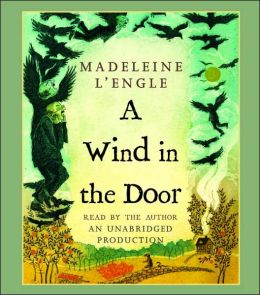
A Wind in the Door by Madeleine L’Engle (audio)

wind in the doorThe second book in L’Engle’s Time Quintet series stars the same quirky, likeable Murry family members: chiefly Meg, along with her brother Charles Wallace; and to a lesser extent, their mother and twin brothers. (Their father is again away in this story. I wonder if he’ll come to play a stronger role in later books.) Calvin, friend of the family and Meg’s tentative romantic interest, plays a lead role alongside Meg. Where their task in A Wrinkle in Time was to save the Murry father, this time it’s Charles Wallace himself who’s in danger: there’s something wrong with his mitochondria, and the farandolae who dwell therein.

As A Wrinkle in Time used outside supernatural influences – Mrs. Whatsit, Mrs. Who, and Mrs. Which – to direct Meg and Charles’s actions, A Wind in the Door features a Teacher named Blajeny and a cherubim named Proginoskes (Progo for short). Yes, cherubim is generally considered to be plural, but Proginoskes is “practically plural” – he is at first mistaken for a drive of dragons by Charles Wallace.

To save Charles Wallace from the rebellion of his farandolae (and you can look it up: while farandolae are fictional, mitochondria are as real as the tesseract that starred in A Wrinkle in Time), Meg and Calvin, along with Blajeny and Progo, must become very very very small and get to know one of Charles Wallace’s farandolae intimately, going inside Charles Wallace to fix him up.

I enjoy the characters that L’Engle creates. I will say that her young people don’t always sound like young people – which is explained in Charles Wallace’s case because he is nothing like a normal young person (this book opens with him being constantly beat up at school for talking about mitochondria and the like); but I think Meg is supposed to represent a more approachable, normal-ish girl, and along with Calvin, Sandy and Dennis, she can be a little odd. But somehow, even as I note this, it doesn’t bother me. Realism is not a central dogma of this series; it is fantasy after all.

I love the science (even though it’s science fiction, and I suppose might confuse the young readers – and the not-so-young – as to what’s real; that’s a concern), and I love that L’Engle makes science interesting and relevant in a series starring a girl. That’s no small thing even today, but these books were published in the 1960’s, 70’s, and 80’s, and I think this deserves note and applause. That said, Meg is on the one hand a mathematical genius, and on the other a little whiny and reliant upon big strong Calvin. Perhaps that’s where the realism comes in.

With a few quibbles, I definitely did, again, enjoy this listen. It’s read by the author in a somewhat gravelly voice, and she does voices for her characters. I recommend the books, for readers of all ages (I am not much of a YA [young adult] reader, myself), and I recommend the audio. I’ll be continuing with the series: next up is Many Waters.


Rating: 6 snakes.

The Waste Lands by Stephen King

waste landsThe Waste Lands is book 3 in King’s Dark Tower series. (See my reviews of book 1 and book 2.) As Jeff said in a comment on an earlier review, they keep getting better and better! (He also said that the first 4 are the best, meaning that we’re headed downhill here soon; but I am optimistically hoping that the slope will be gradual, and/or that I will disagree with him!)

Plot-wise, I’m going to be brief here. There are copious summaries all over The Internet. See my reviews of the first two books for discussion of what this series is really about, in all its sweeping epic genre-mashup glory.

Roland and his two new companions, Eddie and Susannah, are continuing on their quest towards the Dark Tower; but really, this is Roland’s quest, with the other two along as less-than-eager fugitives from their own world. One of the plot arcs involves Eddie and Susannah becoming increasingly invested in the quest for its own sake, rather than accompanying Roland as a self-preservation method. The central struggle of this book, however, is to get Jake (“The Boy”) over from his world to theirs. Jake played an important role in The Gunslinger, where he… seems to have died… twice… but here he is again, because as he so importantly cried out in book 1, “there are other worlds than these.” Jake and Roland both have memories of their shared experiences, which conflict with parallel memories that say they never met. Both are in the process of being driven crazy by these warring memories; bringing our four characters together in the flesh will resolve that threat. Finally, we pick up a 5th: a billy-bumbler (that is something like a cross between a raccoon and a dog, that talks, and likes people) they call Oy. He’s really Jake’s billy-bumbler, and turns out to be a very clever one, who helps save the day repeatedly. I am over-the-moon smitten with Oy and delighted to have him along for the ride. I want a billy-bumbler, too.

At the close of The Waste Lands, our newly minted, secure, united ka-tet of Roland, Eddie, Susannah, Jake and Oy is headed towards likely death in a monorail train with a consciousness that likes riddles. However, there is a book 4 to come, so I suspect they will manage to elude destruction once again!

I love this series; I’ve already ordered the rest of the books so I won’t have to take any more breaks! Hooray for Stephen King and his mind-boggling ability to create immense, epic, complex and fascinating worlds in his head and then invite the rest of us into them. I think somebody should write a dissertation on why King is Literature despite also being Popular With The Kids. Keep ’em coming.


Rating: 8 gold-ringed eyes.

The Drawing of the Three by Stephen King

drawing threeThis is book 2 in the Dark Tower series. I reviewed book 1, The Gunslinger, here (and a later installment, The Wind Through the Keyhole, here). And I have just ordered my copy of book 3.

At the end of The Gunslinger, Roland – the title character, the last gunslinger in his changing world – met up with the man in black (not Johnny Cash), and fell into a deep sleep; when he awoke, it seemed that a long time had passed, maybe years. This is the beginning of The Drawing of the Three; we’ve lost no time, except what Roland lost while he slept. As the man in black read in his tarot cards, the gunslinger will now encounter three individuals who will shape his future, and enable him – maybe – to reach the dark tower, his only goal.

He awakens on a beach with a strange creature approaching him – something like a giant lobster, with the ability to verbalize nonsensical questions, and with menacing claws. These figures he will call the lobstrosities (I love it), and they’ll be a constant threat. Roland does encounter the characters that the man in black predicted: the Prisoner, the Lady of Shadows, and Death (though Death will come under a different name). I’ll leave the plot alone at that.

This is a fantasy novel with all the captivating elements I mentioned when I reviewed The Gunslinger. It is perhaps less overtly a genre mashup; this struck me more as a whimsical mashup of worlds. Roland travels back and forth between his world, which shares characteristics with ours but is clearly other, and a New York City that the reader recognizes. This world-shifting fascinates me. I am reminded of a book I read as a kid called Eva, by Peter Dickinson. I was transfixed by the question of whether Eva lived before our time, or after our time; it could have gone either way. Similarly there was another “chapter book” called Enchantress from the Stars, by Sylvia Engdahl, around the same time that raised the same questions for me: is the enchantress from our planet? before or after our time? or another “star” altogether? Something along these same lines struck me with The Drawing of the Three.

What I think I’m trying to say here is that Stephen King, as always, excels at representing both realism, and fantasy or “other”, all at the same time. The backstory for each of the four characters in this book – Roland, the Prisoner, the Lady, and Death – is meticulous. King doesn’t give the Prisoner a life just as he relates to Roland, our star; he gives him a history, and it’s magnificent. As for plot tension, there’s nothing higher-stakes than the fate of the world, which is the epic conflict of this series.

If The Gunslinger was slightly less impressive than The Wind Through the Keyhole, this second in the series more than recovers. I am transfixed; I am riveted to Roland’s world, committed to his costars (I hope King doesn’t kill them off too quickly!), and even though I’ve read a few books since this one as I write this review, I can’t stop thinking about the Dark Tower series. I can’t get my hands on book 3, The Waste Lands, quickly enough. Stephen King continues his winning streak.


Rating: 7 lobstrosities.