rerun: Honeycomb by Joanne M. Harris, illus. by Charles Vess

I’m still thinking about this one with some longing. Maybe it’s time to dip back in. Can I tempt you, or me?

Fairy tales for grown-ups, allegories, visions and horrors: these gorgeously illustrated linked stories are guaranteed to transport.

With Honeycomb, the prolific Joanne M. Harris (Chocolat; Peaches for Father Francis), who has written fantasy, historical fiction, suspense, cookbooks and more, offers an enchanting collection of darkly delightful, imaginative fairy tales and parables of the modern world. (These stories began as a series on Twitter.) Illustrator Charles Vess (Stardust; Sandman) brings to life Harris’s Silken Folk, “weavers of glamours, spinners of tales… whom some call the Faërie, and some the First, and some the Keepers of Stories,” in richly detailed images.

In the world of Honeycomb, the Sightless Folk (regular humans) unwittingly often share space with the numerous and diverse Silken. “There are many doors between the worlds of the Faërie and the Folk. Some look like doors; or windows; or books. Some are in Dream; others, in Death.” These 100 stories form a whole that is magical, fanciful, enchanting and occasionally nightmarish. Some center on single-appearance characters, and some characters are revisited, but all belong to the same universe. “Dream is a river that runs through Nine Worlds, and Death is only one of them.” In special moments, “all Worlds were linked, like the cells of an intricate honeycomb, making a pattern that stretched beyond even Death; even Dream,” and the stories are likewise linked cells.

Some act as allegories, as in “The Wolves and the Dogs,” in which the Sheep elect a Wolf to protect them because at least he is honest. In “The Traveller,” the titular character passes quickly by many delights in pursuit of his destination, which turns out less impressive than he’d hoped. “Clockwork” is a horrifying tale in which a husband rebuilds his wife piece by piece. “The Bookworm Princess,” on the other hand, ends with deep satisfaction. There is the Clockwork Princess and the watchmaker’s boy; a girl who travels with a clockwork tiger; and a mistrustful puppeteer who manifests what he fears. A recurring farmyard is packed with colorful animal characters–a troublesome piglet, a petulant pullet–and allegory, Orwellian and otherwise. The connecting character is the Lacewing King, whom readers meet at his birth in “The Midwife” and follow for hundreds of years, as the fate of Worlds hangs in the balance. “There are many different ways to reach the River Dream. One is Sleep; one is Desire; but the greatest of all is Story….”

Completely engrossing, exquisitely inventive, brilliantly illustrated and thought-provoking, Honeycomb is a world, or Worlds, to get lost in. “Some of these tales have stings attached. But then, of course, that’s bees for you.”


This review originally ran in the May 3, 2021 issue of Shelf Awareness for the Book Trade. To subscribe, click here.


Rating: 9 candied cockroaches.

Fairy Tales of Appalachia ed. by Stacy Sivinski, photographs by Jamie Sivinski

I really loved The Crescent Moon Tearoom earlier this year, so imagine my delight to find that its author had also compiled and edited this collection of fairy tales from my adopted home region. The two books are of course very different. But I can hear the echo that the same author/editor was involved with each.

Sivinski opens with twenty-plus pages of introduction in which she details how this book came to be, and this was my favorite part of the book. She begins with her childhood, which was rich with oral storytelling, via her family and community and a unique elementary school that emphasized oral history. An early interest in oral history, and the experience of folktales as living, breathing, changing, current beings, took her through college and graduate school. It was as a graduate student that she found a shortage of “books that portrayed Appalachian folklore as a living genre.” Those she did find felt dated, in their illustrations and in their text, and often felt patronizing or stereotyped, as in their use of ‘eye dialect.’ A new term for me, this is the “transcription process that deliberately misspells words to make them seem more ‘authentic.'” In her graduate research, Sivinski was delighted by the recordings she found of Appalachians telling stories that often featured strong women and girls as central characters, and that played in curious ways on the familiar fairy tales and folktales of Scotch-Irish and German (Grimm) traditions. She quickly began thinking about how to offer those stories in a more modern and ‘living’ book than the ones she found available. And, wouldn’t you know, her sister Jamie Sivinski was already working as a photographer “who specializes in fairy-tale shoots.” So here is this book, a family affair.

There is more to the introduction, about fairy tale traditions, about research and transcription processes and Sivinski’s decision making there, about storytellers and collectors who’ve come before, and about the definitions of fairy tales, folktakes, and wonder tales. I found all of it fascinating, but I liked Sivinski’s personal history and story of this book’s birth the best.

Fairy Tales of Appalachia focuses intentionally (although not exclusively) on stories that center girls and women, with a bit of a corrective aim in response to a story-collecting tradition that has tended to center men. Stories are short – eight or ten pages or just two or three. Each is preceded by Sivinski’s brief notes placing the story in a larger context, for example, of fairy tale traditions: some play on Cinderella or Beauty and the Beast, some combine known elements, and some subvert them. Each contains a reference to the recording (or, in a few cases, transcription) where Sivinski found it. “The Hare Bride” comes from a transcription, with two credited storytellers – Sivinski interprets that one was the teller and the other the transcriber – and one of them hailed from Upshur County, West Virginia, where I live now.

The stories themselves are short, simple, often formulaic, and were not the part of the book that interested me most. (I found the same thing with the Foxfire book, Oral Tradition in Southern Appalachia.) To be fair, Sivinski points out that these stories are best read aloud and shared that way. I did read one aloud and agree that it improves the experience; haven’t tried it with friends yet. I liked the academic work and personal background at least as much as the stories themselves. I’m so grateful they’re collected here.

Jamie Sivinski’s accompanying photographs are certainly beautiful. Some are in black and white and some in color, all matte rather than glossy. I didn’t find that they especially correspond with or illustrate any stories in particular, but rather felt that they just set the tone. While I appreciate the effort, I actually found their inclusion a little distracting, in part because I was looking for connections I didn’t find. I worry that the effort to update the dated illustrations of past collections will only be dated in turn. And… there wasn’t a ton of diversity in the characters / models depicted. I know we think of Appalachia as overwhelmingly white (and my little town here certainly is), but that’s less true throughout than the reputation asserts. The characters in these pictures are almost all girls and women, almost all white, and all stunningly beautiful – rather than looking like ‘real’ people. Maybe that’s the fairy-tale aspect of it. It didn’t work all that well for this reader, although the photos are undeniably lovely in themselves.

I’m glad this scholarship exists and glad the stories are collected in this way, and I’m just trying to figure out which of several friends I’ll pass this one on to.


Rating: 7 apples.

Heartless by H. G. Parry

From memory, I’m going to say the Peter Pan story was sweet and heartwarming, with some good healthy ideas in it about always retaining a lovably childlike (not childish!) spirit and the magic of believing. We fly through the stars and have adventures! We help each other. And even when we have to (sigh) grow up, we can access that magic again through the power of imagination.

Then there was the movie Hook, which had Robin Williams and was therefore great, and (again in my possibly faulty memory) more or less followed those themes. We all have to grow up, but it wouldn’t be healthy to lose all the joy of childhood.

This is not that version of Peter Pan.

H.G. Parry, who I fell for hard with The Magician’s Daughter, takes us on a more realistic and darker journey with Heartless. Now the protagonist is neither a Darling nor a Lost Boy nor Peter himself, but an orphaned child in a Dickensian sort of London named James, who gives himself the fanciful last name Hook when he gets a chance at self-invention. James is a born storyteller, a skill which endears him to the only boy at the orphanage James really cares about, a careless but compelling child named Peter. For Peter, James tells stories: ones his mother told him or read him, ones he’s read himself, ones he’s made up. For Peter he makes up the child-king Peter Pan and his sometimes-antagonist the pirate Captain Hook, who inhabit a magical (and made up) island called Neverland. These tales keep Peter at James’s bedside until the night that Peter leaps off the orphanage’s high roof and flies into the stars: “second to the right, and straight on till morning.” James wants to follow his best and only friend, the boy who did not so much as look back. But when James leaps, he falls to the stone courtyard below.

From here we follow James Hook (his new identity) and his friend Gwendolen Darling (who takes the identity of James’s younger brother, George Hook) in their adulthood. James is forever chasing after Peter. He will eventually find what he’s looking for and find also that it’s not what he was looking for at all. This brief book (141 pages) is Peter Pan, yes, but retold with a different protagonist at its sympathetic center and a decidedly sinister twist; fairies are not sweet but uncaring. Captain Hook, of all people, is the one we feel for. And we are centered on the power not only of imagination but of storytelling – and like all of them, this is a power that can be used for good or ill. “[The fairies] didn’t understand that stories weren’t meant to be lived in forever; they were meant to be shared, passed on, questioned, to mingle with a thousand other tales and poems and experiences and be changed by them. They didn’t understand that stories, too, needed to grow. He hadn’t understood himself until recently.”

A retelling of a classic with rather more realism (especially in the London setting) and more darkness, but also still sweet and wholesome, with Parry’s absolutely lovely style; I’m going back for more from her.


Rating: 8 leaves.

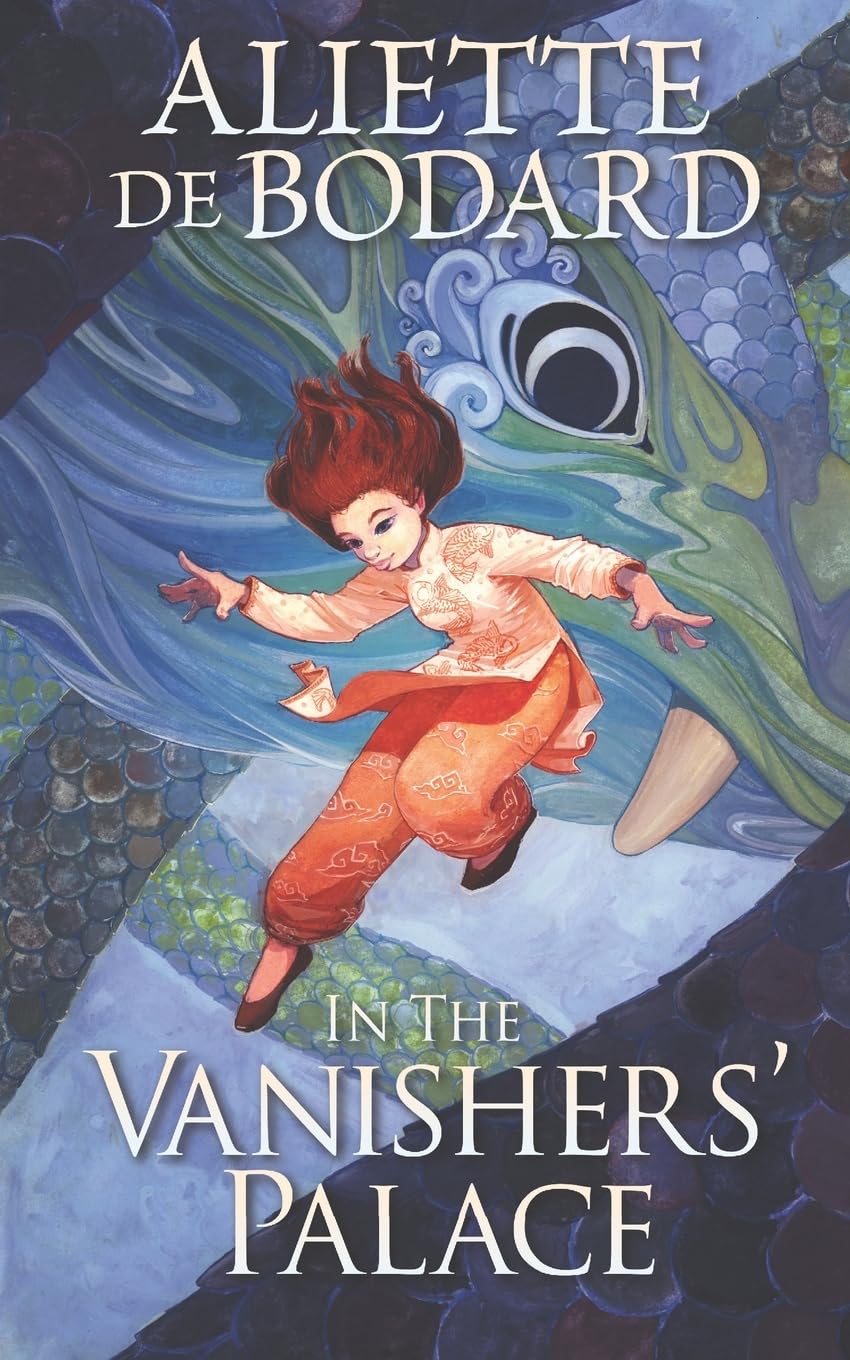
In the Vanishers’ Palace by Aliette de Bodard

This fantasy novel(la) comes billed as a reimagined, queer retelling of Beauty and the Beast. Perhaps I’m just working at a great distance from that original, but it didn’t recall it strongly for me. There is definitely a young girl kept captive in a palace by a being that’s understood to be a monster, and their relationship changes. The palace itself may have some powers. I see the parallels, but would never have thought of Beauty if I hadn’t been told to.

All of which is neither here nor there and has no bearing, for me, on enjoyment of the book. (Novella? At almost 200 pages, it might be pushing novella-length – these things are so tricky to define! – but it felt that contained, to me.)

Yên and her mother live in a somber village in a post-apocalyptic world, in which creatures called the Vanishers have (yes) vanished, but their legacy lingers: mysterious viruses, illnesses, and spirits, dangers lurking everywhere. Yên has failed as a scholar; her mother has value to the village as a healer, but as her mother’s just-mediocre assistant, Yên’s future is not assured. It does not surprise her to be sold away to pay off the village’s debts, to a frightening dragon: everyone expects she will be tortured to death by her new master, Vu Côn, but it turns out that Vu Côn (who can shape-shift between human and dragon forms) has other needs. She is the mother of intelligent, willful twins. And Yên, who had been teacher to her village’s children (apparently this was not judged a value??!), finds herself with new pupils.

Vu Côn and her children live in an abandoned Vanishers’ palace, a place of disconcerting, Escheresque, physically impossible dimensions and movements. The twins, Thông and Liên, possess powerful magic, and being nonhuman, as well as the children of her master, they give Yên different challenges than she’s faced with the village children. But they are children, nonetheless, clever and respectful of their new teacher (if headstrong), and she does care for them. Her feelings for Vu Côn are more complicated, blending desire with fear and resentment, and it appears this conflict is mutual.

The dragon’s eyes were a light grey, the color of storm clouds gathering. She was looking at Yên with an expression that was half-irritation, half-hunger, as if she would gobble Yên whole, given half a chance.

And what scared Yên most? This might, in the end, be just what she longed for.

Yên is dissatisfied living in the frightening Vanishers’ palace. She misses her mother and fears for her mother’s safety in their village; she misses home and knows it is unavailable to her, as the village elders who sold her away would never allow her return. She doesn’t know where to turn. And the readers understand before Yên does that there are deeper, darker secrets in the Vanishers’ palace than she’s yet discovered. But there are opportunities, too.

It’s a curious fantasy world, offering familiar elements (as they do) of our human desires and conflicts, but always with a twist – shape-shifting dragons, sure, but also, for example: Vu Côn has a magnetic sex appeal for our protagonist, but where I’m accustomed to seeing this expressed as heat, Yên experiences Vu Côn’s dragon-body as cold, wet, briny, and very sexy in these elements. That’s a new one for me, and I don’t find it easily accessible: “sea salt and cold, tight air, and a faint aftertaste like algae,” “wet cold creeping up her skin like fingers” – slimy, even! It’s an interesting twist, and one where I have to just trust in Yên’s tastes for Yên. But that’s what fiction asks of us, in different ways, right?

This was a fascinating adventure for me, in the ways that it did and did not fit into my expectations. And in the end, it calls upon some useful universals: big thinking about right and wrong, the way we relate to lover, friend, family, and community, the yearning for self-actualization and belonging. Dragons? Sure. I find Aliette de Bodard a lively imagination and I liked this punchy tale.


Rating: 7 strokes.

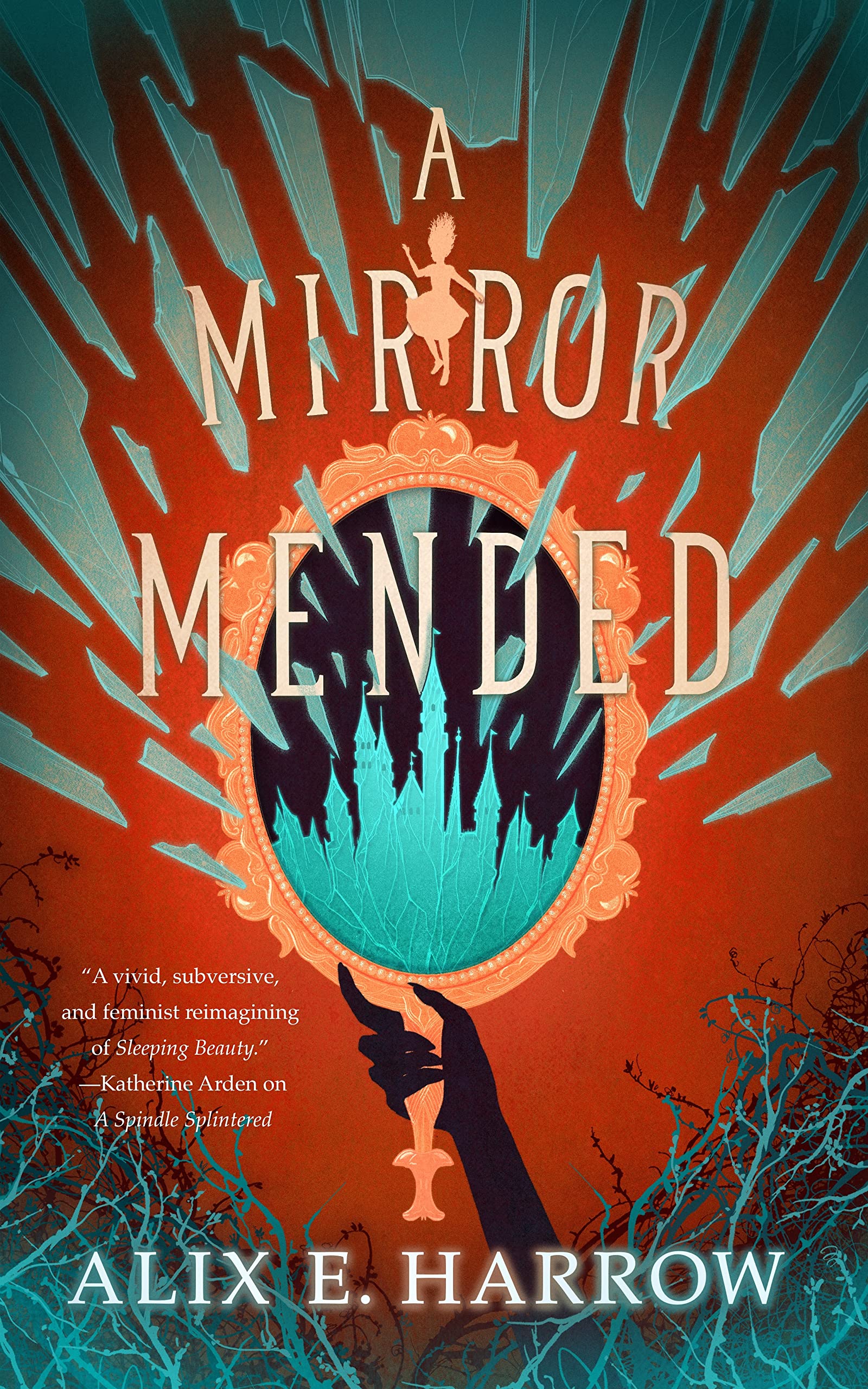
A Mirror Mended by Alix E. Harrow

My *only* complaint about these gems is their brevity. I could sink into Harrow’s retold fairy tales for much longer than ~120 pages. Can’t wait for the next installment.

Following the action of A Spindle Splintered, Zinnia Gray’s exciting life traveling through the fairy tale multiverse, saving princesses and sending them off into their happily-ever-afters is getting a little tiresome. “I’ve rescued princesses from space colonies and castles and caves; I’ve burned spindles and blessed babies; I’ve gotten drunk with at least twenty good fairies and made out with every member of the royal family. I’ve seen my story in the past and the future and the never-was-or-will-be; I’ve seen it gender-flipped, modern, comedic, childish, whimsical, tragic, terrifying, as allegory and fable; I’ve seen it played out with talking woodland creatures, in rhyming meter, and more than once, God help me, with choreography.” Zinnia’s story, as we know from book one, is Sleeping Beauty. But things are about to get weird again.

Looking in the mirror (hung over after another happy wedding), our heroine is surprised to see a very different face: not her own, and not that of a princess. This one is a haughty, threatening queen, holding a mirror in her hand, demanding a way out of her own story. Zinnia recognizes that she is the villain – but not of Sleeping Beauty’s story. She has somehow jumped not just from one world into another, but into another fairy tale entirely. And this time she doesn’t have her awesome best friend Charm to help her out, because of a mysterious estrangement that the reader doesn’t puzzle out til near the end of the book.

A Mirror Mended is again a delight, an irreverent, queer, cynical-but-sweet reimagining of Snow White that questions narrative truths about protagonists, villains, agency, resonance and cohesion. Zinnia knows there must be a back way into a castle because it’s a known plot device. She expects a certain evil queen to be ugly, “which is pretty fucked up of me, but in my defense, Western folklore persistently and falsely equates a character’s physical appearance with their inner morality.” [In case you forgot, Zinnia has a degree in folklore.] When yet another stranger doesn’t meet expectations, Zinnia assumes, because “I know a protagonist when I see one.” But as the walls between fairy tales thin, Zinnia will learn to question her assumptions.

I love the rethinking of gender expectations and of narrative tropes, and the examination of agency, the power we all might have to rewrite our own stories. It’s empowering and awesome and feel-good without ever being saccharine, although it can be awfully, wonderfully sweet. Zinnia learns some important lessons in this story, finds a little romance for herself this time around, and leaves us with the perfect setup for book three in the Fractured Fables series. I can’t wait, and I hope it goes well past a trilogy. Highly recommend.


Rating: 8 bodice laces.

The World’s Wife: Poems by Carol Ann Duffy

I got this title out of Pandora’s Jar (review still forthcoming!), and it’s every bit as good as I’d hoped. These are the women’s stories, from myths and classics and fairy tales, reconfigured. Many of these women are new to their tales, like Mrs. Aesop, Mrs. Sisyphus, Queen Kong, Frau Freud, and Pope Joan. Others already had their own myths before Duffy arrived to rewrite them: Penelope, Demeter, Circe, Salome. The book begins, for example, with “Little Red-Cap,” whose relationship to the Big Bad Wolf takes a different angle. A few of my very favorites are “Mrs. Midas” and “Mrs. Darwin,” although I’m also captivated by Duffy’s Eurydice, who was so relieved at the quiet of the Underworld and so sorry to see that damned Orpheus again. Clever, clever, cynical Eurydice.

I am pretty confident in calling these persona poems: each takes the first-person perspective of a female hero we’ve not heard enough of until now. Each has its charms and its surprises; I have been slow in writing this review over more than a week–unusual, and a bad hole to fall into usually, but they haven’t left the top of my mind in that time. I think Duffy was the perfect author to do this job, the new highlighting of both familiar traits and of delightful surprises. (Guess what body part Frau Freud assigns no fewer than 31 nicknames to in fifteen lines.) These poems are often funny, often fraught and moving, and always lovely. See these images: “a thousand windows, each with its modest peep-show / of boredom or pain, of drama, consolation, remorse.” And these judgments: “The Devil was evil, mad, but I was the Devil’s wife / which made me worse.” What else has Duffy written? I would read more poetry if it all worked like this: easy to access but inviting lots of processing time, deep and rich and wide.


Rating: 8 teeth of the rich.

A Spindle Splintered by Alix E. Harrow

This delightful little book brought to us once again by Liz. In this, the first in the Fractured Fables series, Alix E. Harrow retells the story of Sleeping Beauty in winning fashion, set in a recognizable modern Ohio but with a portal into magical realms, featuring various strong female and queer characters and general reclamation. It’s dedicated to “everyone who deserves a better story than the one they have,” and feels like a perfect response to the Toni Morrison quotation: “if there’s a book that you want to read, but it hasn’t been written yet, then you must write it.” A Spindle Splintered is just a novella at a hair over 100 pages, and I’m thoroughly entranced; I’ve already preordered book 2 in the series (A Mirror Mended), which should ship to me in June from Gaslight Books.

Sleeping Beauty is pretty much the worst fairy tale, any way you slice it.

It’s aimless and amoral and chauvinist as shit. It’s the fairy tale that feminist scholars cite when they want to talk about women’s passivity in historical narratives. (“She literally sleeps through her own climax,” as my favorite gender studies professor used to say. “Double entendre fully intended.”)…

Even among the other nerds who majored in folklore, Sleeping Beauty is nobody’s favorite. Romantic girls like Beauty and the Beast; vanilla girls like Cinderella; goth girls like Snow White.

Only dying girls like Sleeping Beauty.

In the first page, we learn these things about our narrator, Zinnia Gray: that she’s a nerd who majored in folklore. That she’s dying – has been dying all her life. That she loves Sleeping Beauty even though she knows it’s problematic as hell. In fact, Sleeping Beauty has been one of her life’s great obsessions. The action begins on Zinnia’s twenty-first birthday, when her best friend Charmaine Baldwin (Charm) throws her a Sleeping-Beauty-themed birthday party, in a tower and with an ancient spinning wheel, no less. Charm is a badass lesbian science major and Zinnia’s absolute champion. This twenty-first birthday is especially heavy, because no sufferer of Zinnia’s very rare disease (caused by environmental pollutants) has ever lived to twenty-two. Zin manages to prick her finger on the spindle of Charm’s birthday party prop – no small thing, as it’s quite dull, but she is a determined dying girl – “and then something happens, after all.”

Zin has an adventure in another world, side-by-side a plucky princess named Primrose. They aim to avoid not only the spindle of a spinning wheel but an unwanted marriage; they travel to take on a wicked fairy who is not who she seems; and they learn that they are but two in a whole galaxy of doomed or cursed or dying princesses or girls or women, who would all like the chance to rewrite their own stories. This is not “one of those soft, G-rated fairy tales, stripped of medieval horrors,” but rather “the kind of tale where prices are paid and blood is spilled.” Except it’s also a tale of empowerment and badass womanhood, of female friendships and love, and it ends in a joyful go-forth sort of moment. And it’s hilarious: Zinnia as narrator is wry, sarcastic, vulnerable, irreverent, just someone I’d love to know. (Dying girls sometimes use humor as a shield. “I personally feel that accepting my own imminent mortality is enough work without also having a healthy attitude about it.” And what of it?)

I am extremely excited about the next installment – I was afraid A Mirror Mended might take on another standalone fairy tale rewrite, but this is indeed the continued adventures of Zinna Gray, “professional fairy-tale fixer and lapsed Sleeping Beauty,” and I can’t wait.


Rating: 8 stones slick and dark with blood.

The Sister Who Ate Her Brothers: And Other Gruesome Tales by Jen Campbell, illus. by Adam de Souza

This delightful book, I’m pretty sure, came from another Shelf review. Jen Campbell teases her reader, in a brief foreword, with a playfully sinister tone; she notes that “brilliant, horrible tales” once “known far and wide” have somehow been replaced with “‘happily ever afters’ where nothing really awful happened and, well, a lot of them became boring.” She wants to restore the gruesome; thus this book, which offers fourteen tales from around the world (each presented with its country of origin), adapted and tweaked by Campbell. They are indeed deliciously gruesome, and complemented by Adam de Souza’s illustrations, which nod to each story’s cultural origin. I really liked this intersection of fairy tales, traditional storytelling, modern twists, and horror. Campbell’s afterword neatly bookends the collection with a cozier tone, now that we’ve gotten to know each other and all.

The title story is Korean, and straight horrifying. “The House That Was Filled With Ghosts” (Japan) I enjoyed for its victorious ending (bit of a ‘happily ever after’ here, Campbell!). “The Adults Who Lost Their Organs” (Germany) reminds me of a story I knew as a child but cannot name now… “The Man Who Hunted Children” (South Africa) is I think the “Hansel and Gretel” reference. “The Wife Who Could Remove Her Head” (El Salvador) had a refreshing outcome for the rebellious wife; likewise a bit of justice in India’s “The Son of Seven Mothers.” But my absolute favorite was definitely the final story, from Spain: “The Woman and the Glass Mountain.” There are book lovers, adventures, a wedding in a library, triumphant women, and queer love. I am smitten with this story and this whole book, and will put it in the growing pile of fairy tales & folktales that are somewhat simultaneously creepy and weirdly comforting. What a treat. I definitely recommend this book to anyone who enjoys tracking storytelling in human history and across cultures, or fairy tales and their origins, or spookiness in general. Good times.


Rating: 8 fingers.

The People Could Fly: American Black Folktales told by Virginia Hamilton, illus. by Leo and Diane Dillon

I got this title from Well-Read Black Girl, although the cover was familiar enough that I wonder if I had it as a child at some point. (I definitely recognized some of the characters, like Brer Rabbit and the Tar Baby, if not these particular stories.) In a larger format, with a number of rich, grayscale illustrations, it offers a selection of folktales passed down as oral tradition from the Americas’ earliest Black residents: enslaved Africans and their descendants. Virginia Hamilton has done good work in compiling these stories, of course, but an equally important contribution is her brief notes about what each one represents and where it falls in the larger scheme of storytelling traditions in time and geography. (I really appreciated the occasional personal note, too.) She notes the families each story falls into and her choice to use more or less dialect, and the global traditions that contribute to each.

These stories appear in sections, headed by a title story and then grouped by type: animal stories, tales of the supernatural, tales of the real, extravagant, and fanciful, and slave stories of freedom. This last section finishes with the title story, “The People Could Fly,” and I think it’s the right note to end on. The illustrations really did add something – just look at that cover, where I find the facial expressions evocative; I feel like it conveys the movement and inspiration of the title story.

I love the animal stories, which perhaps felt most familiar – not only do I know Brer Rabbit, as mentioned, but these recall Aesop’s fables and many other storytelling traditions. I do love a tall tale, like “Papa John’s Tall Tale.” And I was pleased by the “grisly realism” of “The Two Johns” – just as a matter of personal taste, I suppose. There’s a general sense of rural settings close to nature, that I think comes of the enslaved experience (as Hamilton notes about the animal tales in particular); there’s a feeling common to all folktales and traditional storytelling, of trying to explain the world through stories. There’s something comforting about that effort, even when the resulting explanation is discomfiting.

I enjoyed the stories, but I think what makes this book special is Hamilton’s work, in her footnotes, to put them in context. I especially enjoyed the geography, or the references to global patterns in storytelling – that the opening story, “He Lion, Bruh Bear, and Bruh Rabbit,” for example, “ranges throughout North and South America, Europe, and Africa.” It’s pretty wild to think about how stories can encompass so much of the world: that they are that important and elemental.

With its moving illustrations, excellent and concise footnoting, and its range of fine stories, I think this is an essential book for any home library – for children and adults. Glad I came across it.


Rating: 7 clever rabbits.

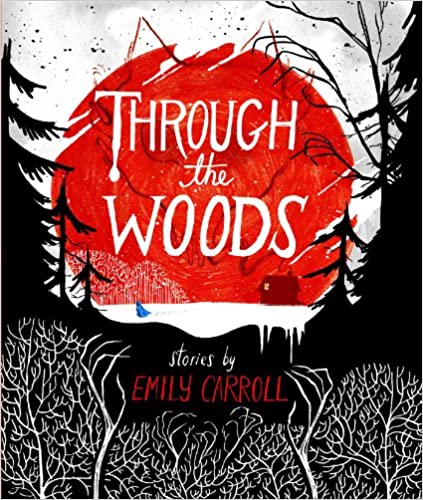
Through the Woods by Emily Carroll

This was a delightful quick read: five spooky stories, with brief introduction and conclusion to bookend. Carroll’s illustration style is lovely – I almost want to say simple, but deceptively so, for sure. She communicates a lot of emotion. I am reminded of the graphic versions of Gaiman’s work. I loved the woman “with starry eyes,” and indeed there were tiny little stars in her pupils.

These tales are deliciously unnerving, creepy, and enigmatic – it’s not always clear that there is something to be scared of in the end, but there sure might be. There’s a lot of question of who to trust, of things that go bump in the night and come out of the woods (as “most strange things do”). Friendships and familial relationships are perhaps less stable and trustworthy than they first appear. There might be monsters, after all. Houses and spaces hold nasty potential. I’ve decided to call these stories dark fairy tales; they definitely recall that style and the traditional setting (and at least one is a clear reference).

This is the kind of horror that is just deeply fun, and in this graphic format, even sumptuous. There are multiple spreads that I could see hanging on the wall. I love the idea of keeping this around for quick, easy, luxurious, high-impact reads. Carroll deserves her accolades. I’d buy another volume of this work in a minute.


Rating: 8 teeth.