Still Alice by Lisa Genova (audio)

stillaliceI have a favorite book of the year so far, you guys. Still Alice is one of the most remarkable books I’ve read in some time. I enjoyed Lisa Genova’s second novel, Left Neglected, very much. (I listened to that one as an audiobook, too.) But Still Alice gripped me from the first lines, and never let me go – I was riveted. Let me tell you more.

The two books have more than a few threads in common. Both feature married women, with three children, in male-dominated fields with all the requisite toughness and work ethic but also with plenty of feminine soft spots, struggling to reconcile the two; both live in Boston. One could easily surmise that these are attributes shared by the author, a Harvard-educated neuroscientist-turned-novelist. Where Sarah of Left Neglected had young children, though, Alice Howland has grown children: one lawyer trying to get pregnant, one doctor just finishing his medical training, and one relatively wayward daughter who has scorned college in favor of acting. Alice is a Harvard professor of psychology, and her husband John is also a Harvard doc, working with human cells & a possible cure for cancer. She is nearing her 50th birthday when the book opens, and shortly after it, she is diagnosed with early-onset Alzheimer’s disease. The story is concerned with the progression of her disease, the changes it wreaks on her life and the lives of her husband and three children, and their struggles (independently and as a family unit) to handle these changes. It is also centrally about Alice herself, as a person, what Alzheimer’s does to her and her reactions & dealings with that disease. Again, the author is a neuroscientist, so while I (thankfully) don’t have any experience with Alzheimer’s disease by which to judge this portrayal, I trust Genova’s ability to tell it truly.

I became deeply engrossed in this story from the very beginning. Although told in the third person, we are very much inside Alice’s head (call it third person limited, for which I like this explanation because of the example chosen!). Alice felt very much like a real, flawed-but-likeable person. I was occasionally exasperated with her choices: to fight with Lydia over her acting career, to fail to appreciate her, and to put off telling her husband about her diagnosis. But I always sympathized, and liked her throughout. I would like to spend a day or a week with this woman. In fact, in telling Husband about this story as I listened to it, I referred to her as my friend. This is not something I normally do with fictional characters.

I was deeply emotionally involved. If I was angry with Alice for not telling John she had Alzheimer’s right away, I was even angrier with John for his reaction, and his repeated failures to be supportive. I wanted to cry when they began considering their future. And I did cry, often, as the disease progressed and Alice’s family was – still flawed and imperfect, but earnest and effortful and loving in their handling of these events. I hope it’s not too much of a spoiler to say that I was charmed by the silver-lining aspect, where Alice’s relationship with Lydia grew stronger in this time of sickness. I pondered whether it was a bit too fictional-happy, to insert such a silver lining, and decided it wasn’t.

This is a sad story, certainly, and I cried more than a few times. (I finished this book in the gym, and it took great effort not to weep on the elliptical machine. What would people have thought?) But there is love, and hope, and strength; Alice keeps a certain dignity that made me love her more as she got sicker. I can see how this would be a painful read for someone whose own life has been affected by Alzheimer’s, but I’m inclined to think it might be worth the pain for the beauty it expresses.

If you’ve read the book or don’t care to, highlight the white text to read my spoiler-y discussion below; but if you intend to read this book, don’t.

I was saddened by Alice’s decision to plan her suicide, but I respected it. When she got so sick that she couldn’t execute her own plans, I found that sadder still. I wondered a little at Genova’s decision to end the story the way she did, with Alice fading into gray; I would have liked to know her final fate, when and how she died, whether John moved her to a place she never wanted to be (a “home,” or New York), but I think this way was for the best. That fade-to-gray is probably most like the end of Alice’s own understanding of things – most like Alzheimer’s disease.

Unlike Left Neglected, this book is read by the author, and when I heard that I was thrilled, because my author-narrated audiobook experiences have so far been 100% wonderful. Still Alice is no exception. Genova’s goodreads page tells us she’s an actress as well as a neuroscientist and novelist, so perhaps it’s no surprise that she delivers her characters feelingly (or that she wrote a lovely, passionate actress character into this book). For the record, I really enjoyed the audio reading of Left Neglected, too, but I would never pass up an author-read version, and highly, highly recommend this audio version of Still Alice.

This is without a doubt going to make my list of best books read in 2013. I am so relieved to see that Genova has a third novel out already, Love Anthony, and is working on a fourth – whew! I can’t say enough good things about this book. I love Alice.


Rating: 9 thingies.

Turn of Mind by Alice LaPlante

This was a sad and fascinating book. I read it in a day – not unheard of, but fairly rare considering that it was a regular work day. Started on my lunch break and finished before bedtime. It was absorbing and unique. A murder-mystery, yes, but also sort of a psychological thriller. The unique framing element of the book is this:

Dr. Jennifer White is sixty-four, and has dementia. When the book opens, she’s in the early-to-mid stages of the disease, living at home with a full-time, live-in caretaker. Her best friend of several decades, who is also her three-doors-down neighbor and godmother to her daughter, has been murdered, several fingers cleanly amputated. Dr. White (whose specialty was hand surgery, ahem) is a suspect, and doesn’t know herself whether she did it or not. Her story is told in first-person; we read snippets from the notebook she keeps, hear conversations, and listen to her private thoughts as she struggles with the questions. The questions are only rarely about Amanda’s murder. In reading about this book I thought the murder case was the main focus, but it’s not. Dr. White is only occasionally aware of the question of her friend’s death, because she’s only occasionally aware that her friend is dead. Her disease and its progression, her confusion, the attempts by her adult children to shape her future, and her eventual fate are the book’s main concern – because we see through Dr. White’s eyes.

The mystery of who killed Amanda is different from the usual mystery we encounter, because we don’t see a murderer trying to cover his or her tracks. Dr. White’s children, and the lawyer they hire, work to protect her from an investigation that may damage her fragile mental health. At one point it is decided that she did kill her friend, but the legal system of course won’t take its normal course even in that event. (I’m not giving it away; there are still twists and turns.) And again, the mystery is not the primary focus of the book. As Dr. White’s story unfolds – backwards, in snippets, jumping around chronologically, and never reliably – talk about an unreliable narrator – we learn more about her husband, Amanda, Amanda’s husband, and Dr. White’s two children, as well as the hired caretaker and even the primary police investigator. Of course, no one’s story is simple or unblemished.

A fascinating and engrossing mystery is only part of the attraction of this book. It’s an exploration into the head of an Alzheimer’s sufferer, engaging and overwhelming and sad and riveting. Make no mistake: this is a terribly sad story. Being young myself, and having parents in excellent health and with plenty of youth and life left, I hadn’t thought much about nursing homes, but this book’s portrayal terrified me. If you can steel yourself for the tragedy, though, this is a beautiful story, communicated in a unique format, gripping and sensitive. I recommend it highly.

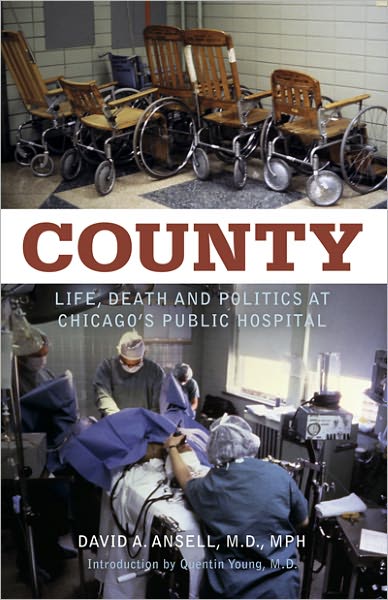
County: Life, Death and Politics at Chicago’s Public Hospital by David A. Ansell

I read ~150 of County‘s ~200 pages in one night, and forced myself off to bed. Finished the next day. Ansell is no professional writer; I itched to get out my red pen here and there. But his story is powerful and evocative, and his passion for the injustices he describes absolutely screams off the page.

I found myself swept away in the story of “County,” as Ansell refers to the Cook County Hospital in Chicago where he spent the bulk of his career. As a med student, he and his friends suspected they wanted to go to County, famous for its overcrowding, underfunding, racial disparity, and incredible challenge. His group was concerned about social injustice. Fresh off antiwar protests and sensitive to racism, these idealistic young med students drove down from New York to Chicago to visit the hospital and interview with Quentin Young, then Chairman of the Department of Internal Medicine, famous pioneer of desegregation and human rights in health care. They were shocked at the squalor and disorganization, even having come in with some impressions. Ansell & friends, eventually known as the “Syracuse Group,” conspired to become residents at County, precisely because of the challenges it presented.

Ansell is strongest when telling his personal story. Residents at County in his day (he started in 1978) had little to no supervision or assistance from their attending physicians; he describes an environment in which the residents all muddle through together, cooperatively, learning as they went. This was a great education but often resulted in less-than-optimal care for the poverty-stricken patients. From resident, he goes on to a position as an attending physician at County, although his original plan had been to head back east after completing his residency. He was immediately hooked, though, by the neediness of County, the organization, and his patients. He was also involved in politics and activism from his first moment on campus – literally. He attended a meeting on the day of his scheduled interview for residency.

Over the years, Dr. Ansell would serve in various positions in the ER and in the outpatient clinic, and be part of the birth of the Breast Cancer Screening Program and County’s AIDS Clinic. His patients, and their problems, made deep impressions on him. He was active in trying to right the wrongs of the health care system and of County’s management and underfunding in particular. When the politics really get going, Ansell can get a little bit soap-boxy. I have mixed feelings about this aspect of the book. While unquestionably passionate, righteous, and well-informed, he can tend to come on a little strong. Preachy, even. My concern here is the one my old buddy Gerber expressed about Barbara Ehrenreich’s Nickled and Dimed: On Not Getting By in America, years ago: the author’s personal political starting point is so overtly obvious that the (actually very strong) point of the book may be dismissed because of the author’s prejudice. Speaking as someone who DOES share Ansell’s politics, and who still feels that he can get a little preachy, I have concerns about the book achieving its goal of education and perhaps even changing minds.

But the stories about Ansell’s experience learning and working as a professional doctor, the stories about his patients and their troubles, and the stories about the challenges of County… its politics, the underfunding, the horrific and inhumane conditions… these are where Ansell shines. It’s a powerful, emotional, evocative book. It makes good points: it argues that access to health care is a human right, and should not be dependent upon health insurance or employment status. It is definitely a political book. I recommend it, just with a few reservations. Because it is short and engrossing, you can almost read this book in one sitting or two. And I think it is absolutely worth your time.