residency readings

Again! I know! I’m graduated; but I’m still back. This summer I’m honored to be serving as residency assistant for the usual residency period. This gets me in to all the seminars, so I’m doing all the reading as usual. Also as usual, you can view seminar descriptions here. Note that not all seminars assign readings at all; there may be others there you find interesting even though they’re not mentioned here.

Also note that this post is written as if residency is in the future, even though it’s past by the time this publishes – such is my review backlog these days!

I thought I’d just cover what are, for me, the highlights.

Savannah Sipple, who will teach on “Right to Discover: Conventions in Queer Writing in Appalachia and Beyond,” assigned three online pieces: “To Suffer or To Disappear,” “Who Cares What Straight People Think?,” and this essay by Carter Sickels. I appreciated hearing from Sickels again (he has also served as guest faculty at Wesleyan, but before my time), and his story was moving. The other two pieces both address the great success of Hanya Yanagihara’s novel A Little Life, which I have not read but which I know is much loved by my Shelf editor Dave, who is a serious reader and writer, and a gay man; these perspectives are complicating and therefore interesting. I’m certainly interested to hear from Sipple on this topic.

For Jon Corcoran’s seminar on “The Analytical Hybrid: Using Notes, Texts, and Poetry to Push Your Narrative Toward a Deeper Truth,” I read excerpts from Rachel Hadas’s Strange Relation, Joan Didion’s The Year of Magical Thinking, Francisco Goldman’s Say Her Name, and Jenny Offill’s Dept. of Speculation. I felt warmly toward Didion, pleased to recognize something I appreciated at the time. But the Hadas memoir and Goldman novel were the real winners here: I have added both of these books to my hopeful-someday list. I was sorry when each excerpt ended.

Devon McNamara’s assigned reading for “Utterly Present,” her cross-genre generative session, included an excerpt from Virginia Woolf’s Moments of Being, which I was not particularly happy to see again (mercifully it was short). But it also included a short story called “Foster” by Claire Keegan which blew me away. Read this one immediately: here. Of the two assigned poems there was also one standout: “The Same City” by Terrance Hayes. Whew.

Cynthia McCloud is graduating this residency, and for her graduate seminar, “Ordering Your Private World: Discovering the Structure That Fits Your Project,” she began with a couple of chapters assigned from John McPhee’s Draft No. 4. I need to thank Jeremy Jones again for that recommendation; the whole book was outstanding, and I’ve so enjoyed rereading these pages (but my favorite essay in the book, one of my favorite essays of all time, is still “Frame of Reference“). It was a real treat to see both “Progression” and “Structure” again. Thanks, Cynthia! She also asked us to read Jean-Dominique Bauby’s The Diving Bell and the Butterfly, which will come in its own review on Wednesday: in a nutshell, I was moved by this minimalist (and for good reasons) memoir. Finally, Cynthia had us listen to a podcast: “The Murder Ballad of Spade Cooley” from Cocaine and Rhinestones (found here). I like dark and gritty crime stories and I like country music, so I liked this podcast – that is, aside from the goriest of details. (I thought the warnings about how bad it was were slightly exaggerated. Only slightly.) She recommended reading Fun Home, but I don’t have a copy of that with me, and decided not to bother with the reread (though it’s a very good book). I’m very interested in the topic of Cynthia’s seminar, and pleased with all her readings, so I’m looking forward to this one.

Richard Schmitt always assigns enjoyable readings. This time he’s teaching “Stereotypes: An Aspect of Characterization,” which sounds like ‘stereotypes but in a good way’ in his description. Okay. Here he’s assigned a series of short stories and novel excerpts (one of which he totally assigned us to read very recently – okay, it was two years ago, summer 2017 – don’t ask how long I just spent tracking down that fact in my hard drive). It was a good packet, but some pieces stood out more than others. “Sunday in the Park” by Bel Kaufman was memorable, even accounting for the fact that it’s the repeat from ’17. Cheever’s “The Swimmer” is sort of a favorite of mine. The rest each had some sparkle, and I can see why they were included.

And finally, best for last (this is the order they came in!), Jessie’s seminar: “Valley of Dry Bones: Bringing Non-Narrative Prose to Life.” For one thing, I think this is a topic I’m going to love. For another, she assigned two of my all-time favorite books: a chapter from Amy Leach’s Things That Are, and the entirety of Mark Doty’s Still Life With Oysters and Lemon. Swoon. Finally, she gave us a short piece by Robert Vivian called “Hearing Trains” that was lovely but, for this reader, probably overshadowed by the other two stars.

I’m so very much looking forward to this residency. For a change, I have extra mental space: no deadlines pressing down (except for the odd book review!), no workshop to attend or prep for, no pressure to “do” school at all – but rather the privilege of attending seminars as I desire. And there is some richness here. I am lucky, lucky.

Late Migrations: A Natural History of Love and Loss by Margaret Renkl

This subtle, searing essay collection examines the griefs of family and of the natural world as one.

Margaret Renkl’s Late Migrations: A Natural History of Love and Loss is a quiet but stunning collection of essays merging the natural landscapes of Alabama and Tennessee with generations of family history, grief and renewal. Renkl’s voice sounds very close to the reader’s ear: intimate, confiding, candid and alert.

Renkl grew up in “lower Alabama,” the adored child of parents, grandparents and great-grandparents: in an old picture, “my people are looking at me as if I were the sun.” Her childhood was lived close to the red dirt, pine needles and blue jays of that space. As an adult, she lives in Nashville with a husband and three sons, and carefully cultivates a backyard garden with bird nests, baths and feeders. These are the backdrops to her observations of nature. “The cycle of life might as well be called the cycle of death: everything that lives will die, and everything that dies will be eaten.”

Sections are headed with simple, natural-world titles (Tomato, River, Thunderstorm) and adorned with illustrations by the author’s brother, Billy Renkl. Within these sections, the essays are brief–often just two or three pages–and can stand alone, but accrue to form a truly lovely larger picture. “Safe, Trapped” handles the duality of protective spaces: that shelter is also captivity. An echo, several chapters later: the realization that her childhood was never the sanctuary she thought it was at the time. Alongside the concern of how to keep loved ones safe, she writes about the natural cruelty of rat snakes, crows and snow.

Late Migrations studies family and loss: the deaths of great-grandparents, grandparents and parents; Renkl becoming a parent herself and worrying over her children. Spending a night in a prewar infirmary on the grounds of an orphanage, dreaming of babies in cages, Renkl goes to the window to view cardinals at a feeder and “watched until I knew I could keep them with me, until I believed I would dream that night of wings.” At about the midpoint of her book, this feels like a point of synthesis. Dreaming of babies in cages and trading them for wings, to “keep them with me,” represents a neat joining of her themes, which are of course not nearly so separate as they initially appear.

This is a book about the labors of bluebirds, red-tailed hawks and cottontails, and about grief: the loss of loved ones, the risks to her own children and the everyday struggles of backyard nests. A book of subtlety and sadness, yes, but also a tough, persistent joy in the present and the future. “Human beings are creatures made for joy,” Renkl writes. “Against all evidence, we tell ourselves that grief and loneliness and despair are tragedies…. In the fairy tale we tell ourselves, darkness holds nothing resembling a gift.” Part of her work in this book is to find and recognize the gift in the darkness, “to reveal it in its deepest hiding place.” Late Migrations is itself that gorgeous, thought-provoking gift.


This review originally ran in the June 11, 2019 issue of Shelf Awareness for the Book Trade. To subscribe, click here.


Rating: 8 bluebirds.

I sat reading, in Renkl’s chapter “Bluebird” at a state park in North Carolina, about bluebirds nesting in bluebird boxes. And I looked up to see a male bluebird, brightly feathered, ducking into a bluebird box, his anxious, drabber mate sitting on top and watching me and my little dog with concern. I couldn’t believe it: I looked down at the page, up at the bluebirds. We were a dozen feet apart. I kept reading and watching as the couple kept up their cycling through the box – she got a little more comfortable with me over time, but stayed watchful. A rare experience.

shorts by Cather; Sandor; Wheeler; Irving; Chesnutt; Maren; and Bourne of National Geographic (and links followed, etc.)

Whew, a long one today – sorry, folks, but I’ve been reading.

Because I’m not busy enough (ha) I’ve been reading a few short prose pieces here and there. Some of the following come from the Library of America’s Story of the Week (an email you can sign up for for free, if you have tons of free time or are a glutton like me). One I found languishing in a file on my computer. The internet, and friends’ referrals, account for the rest.


Willa Cather’s “A Death in the Desert” was a Story of the Week, viewable here. I found it a moving story, but much more so with the context included, about Cather’s devotion to a composer who died young. As the Library of America points out, the fact that this story was published in three versions, each subsequently edited and shortened, makes it an excellent opportunity to study editing for length (if you were to go find all three). There’s something Victorian in the manners and fainting emotions in the story that is less compelling and relateable for me personally, though. I’m glad to have learned a bit more about Cather, but it’s not my favorite thing I’ve read this month.


Marjorie Sandor’s “Rhapsody in Green,” however, blows my mind. (This was the one found on my hard drive. Originally published by The Georgia Review and viewable here, if you sign up for a free account.) It is a very brief lyric essay about, yes, the color green. Sandor evokes so much via this color, and her search for an unachievable shade: color, we might think, is a visual element, but she uses touch, smell, and taste as well. On its face about this color she can’t find, this essay is also a glancing view of the narrator’s life story, at least in a few relationships and geographical locations. There are four references (in less than three pages) to a time “I fell in love when I shouldn’t have.” It is a brave and risky move to so emphasize an event that she never explains further. As we writing students say, this one would have been destroyed in workshop. But I love it, this level of tantalization, and her bold implication that no, we don’t need to know any more about it than that. There are also two references to “a/my friend who puts up with such eccentricities.” I love this epithet, this characterization, and in both cases – this, and the “fell in love when I shouldn’t have” – I appreciate the use of an intentional echo to good effect. Also, nothing I’ve said here begins to get at the loveliness, the lyricism and sensual intimacy, of Sandor’s writing. Do go check this one out.


Disclosure: Dave Wheeler is my editor at Shelf Awareness, and a friend.

I have done a poor job of keeping up with Dave’s work, and recently returned to see what I’d missed, particularly in his essays, which impress me so. I am gradually catching up now – you can see his published essays here (and more in other links on that page). And I love a lot of what Dave writes: I appreciate the short, dreamy, feeling quality of “Science for Boys”, and the inquiring mind exposed in “Death and Its Museum”. But I think my favorite essays of those I’ve read so far deal with art, and how Dave takes it in. “Two Men Kissing” and “Some Holy Ghost” each offers so much, and I’ve forwarded them to many friends.

Today, I am very pleased by “A Moment Spins on the Axis of You: The Fourth Dimension of Yayoi Kusama’s ‘Infinity Mirrors'”. Here Dave encounters Kasuma’s installation, in particular, and the grand scale of its claimed subject. But even more than the named artwork, he considers what it means to wait – for art, for anything – and what contribution waiting, or time, or the audience experience, may offer. I appreciate his voice: he speaks with authority about his own experiences, but with a humbleness as regards the world of art criticism; he can be playful even as we feel he is serious. And of course I recognize myself when he writes, “As a lifelong reader, I have cultivated a sharp sense of when I can quit a book without worrying that I have missed something of importance. As a wide-eyed novice to visual arts, I am less assured.” I think I feel something like the same thing when I try to see my own reactions to visual art: I don’t even know what I don’t know.

Perhaps recognizing myself in Dave is part of recognizing Dave, someone I know personally and enjoy talking to, however infrequently we get around to it. And maybe that enjoyment is inextricable from my appreciating his writing. Maybe you want to help me test this: go check out Dave’s work and let me know what you think.

Good, right?


Washington Irving’s “Rip Van Winkle”, another Story of the Week, was engaging enough in its descriptive power; I was interested in getting a better grasp on one of those legends that’s in our collective consciousness whether we’ve read it or not (I don’t believe I had). The misogyny in the treatment of Dame Van Winkle, and the cursory treatment of all the women in the story (none of whom, if memory serves, had names), rankled. I’m not sorry I took the time, but it wasn’t a highlight, or anything.


Charles W. Chesnutt’s “The Bouquet”, on the other hand, was both lovely and harrowing. (I went ahead and followed this link to a Wiley Cash article in Salon, where he argues for Chesnutt as genius, and I don’t disagree.) If you want to feel gutted by our national heritage where race is concerned – well, none of us does, but I feel it’s important we don’t look away, either – give this short story a try. It has a surface on which it can act as a sweetly sad and simple tale, but its depths are significant.


Disclosure: Mesha Maren regularly serves as guest faculty at West Virginia Wesleyan College in my alma mater MFA program. I consider her a friend.

I was deeply impressed with Mesha’s recent essay in Oxford American, titled “West Virginia in Transition”. She moved away as a young, closeted, queer woman, and upon moving back, she investigates the experiences of her counterparts: queer youth growing up twenty years later in her own hometown. She muses on the ways in which their lives are different and the ways in which they’re similar. It’s a story that’s important to me, because both queer communities and Appalachian ones are much on my mind. I’m glad topics like this are getting bandwidth. But also, as anyone who knows Mesha’s work will expect, it’s a gorgeously written story. “The way these ridges and hollows both cradle and cleave.” Beautifully done, and highly recommended.


Finally, my father sent me a link to this story from National Geographic: “Clotilda, ‘last American slave ship,’ discovered in Alabama.” Joel K. Bourne, Jr. brings us up to date on the recent confirmation that Clotilda has been identified where she was burned and scuttled in the Mississippi Delta after a voyage spurred by a wealthy white man’s bet that he could import slaves from Africa more than 50 years after such imports became illegal. In 1860, 109 men, women, and children survived the voyage into Mobile and were then sold into slavery. Part of what’s unique about this group of abducted Africans is that late date: Clotilda’s survivors lived long enough in some cases to be interviewed on film. They founded Africatown on the edge of Mobile, and their some of descendants live there today. When I passed through Mobile this spring, I missed Africatown. But, unknowing, I stayed in Meaher State Park, which is named after a wealthy white family, including the man who made the bet.

I found this article, accompanied by pictures and video, moving. I think it’s an important story to read and consider today. I also followed several links, like this one offering a list of destinations to visit for African American history and culture. I found a few of these on my travels this year; I’ve added to rest to my itinerary.


There is always something to keep our minds busy. I just feel lucky to have the time to follow these leads. What have you read lately?

Appalachia North: A Memoir by Matthew Ferrence

Disclosure: Matt Ferrence was visiting faculty at this past winter’s residency at WVWC, and we really hit it off; I think he’s great, and he gifted me my copy of Blue Highways.


A shorter review now, with more to follow, because Still: the Journal has agreed to published my book review *and* an interview with Ferrence in their October issue. Hooray! For now, a teaser.

Building a literature based only on darkness is just another way to shackle ourselves to decline. Instead, we are who we are, and that’s the sound of red-winged blackbirds chirping in the blowing reeds alongside restoration wetlands, a dark plain bird with a hidden flash of brilliance, the real marker of hope.

You know I’m on an extended trip right now. I’ve been keeping track of birds, among other things. In the mid-east-coast area, I started to see red-winged blackbirds, which I don’t recall ever having seen before. They are a delight, that shock of bright red underlined by bright yellow on black-black background. I saw just a few, and then lots of them, diving and swooping and chattering at one another, plentiful as grackles. I looked them up, and see that they live where I’m from, too. How come I never saw a red-winged blackbird before?

This book is a little like that, for me. The recognition of something I didn’t know I needed, although it seems thoroughly obvious now I’ve seen it. And it’s from where I’m from, too. The synchronicities like this kept stacking up. Matt’s parents and my dad all love Wendell Berry, although his took it a step further and farmed on the farm they purchased when he was young, while we kept our city home even after purchasing a ranch when I was young. We’ve struggled with similar questions about where we’re from. My brain injury and his brain tumor are different, but also alike. Even the Facebook surveys we each put out about our home places, Pennsylvania or Northern Appalachia, and Texas. I can’t tell you how many times I scribbled “me too” in these margins. I don’t usually scribble anything in the margins at all, but when Matt sent me Blue Highways, I learned something.

Okay, then.

This book is that blend that I love best in nonfiction: both memoir and outward-looking examination of something larger than the self. Ferrence grew up on a farm in southwestern Pennsylvania. He didn’t know it yet, but he was born and raised in Northern Appalachia. At forty, he is diagnosed with a brain tumor. Appalachia is a much-maligned and little-understood region of this country, at least from the outside. Northern Appalachia is less understood, and (as Ferrence has it) exiled from both Appalachia and the U.S. He examines the geology and geography of sedimentary rock, mountains, and his own brain through many layers of metaphor. He pulls in plenty of outside voices: writers he admires (Abbey, Dillard, Sanders), and some he takes issue with. That’s another duality I deeply appreciate, that balance between one’s own voice and the voices that have informed it.

That’s all I want to say, in advance of Still‘s October issue – I will repost my longer review, and interview with Matt, when they’re available. For now, please know that this book caught me in that perfect place: both personally resonant in all the deepest ways, and an intellectual and artistic accomplishment I admire and would like to emulate. This is one of the most highly recommended books of 2019. And I don’t care who you are and where you’re from: you have something to learn from Appalachia North. Get out and get you a copy today. You’re welcome.


Rating: 9 collection points.

“Road Writing” at Heartwood blog

My MFA alma mater’s lit journal, Heartwood, also hosts a blog for program-related news and such. Check out my recent guest post.

Thanks! (Remember you can always read my travel-related reporting at Foxylikeaturtle.)


Housekeeping: yes, it’s Monday. I’m having to switch back to three posts per week now, as the backlog grows! Good problems; semi-retirement is working! So, look for posts on Monday-Wednesday-Friday for a while now. I’m sure when I start teaching in the fall things will dry up again…

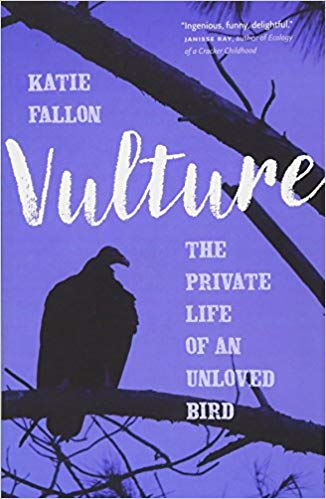
Vulture: The Private Life of an Unloved Bird by Katie Fallon

Disclosure: Katie Fallon was my first semester advisor at WVWC, and is a friend.


I have been looking forward to reading Vulture for years! I read Katie’s Cerulean Blues first, because Vulture was still awaiting publication; but if I’m honest, the bigger bird is the one I’m more naturally drawn to, and I know the turkey vulture was Ed Abbey’s favorite bird and all. I was really looking forward to this one.

And it had all the pleasant notes offered by familiarity, because by now I’ve heard Katie read from it a few times, so certain passages felt like old friends; and the personal content was familiar as well, because I know Katie personally (the names of her three daughters, for example, although only the first two come along within the timeline of this book). Reading this therefore felt a little like coming home, and you know how I like to feel at home in a book.

This is a book about vultures: the world over, but in particular the turkey vulture, which is Katie’s own favorite. It is also a personal memoir, about the author’s own life and coming-to-terms. As she considers the vulture’s place in mythology and historical relationships – often including associations with women and with motherhood – and observes vulture mothers caring for their young, she experiences her own much-desired first pregnancy. The places she goes in her own life, both geographically and emotionally, mirror the places she takes her reader in relationship to her subject. Along with her husband Jesse (a veterinarian specializing in birds), she travels to real-world locations in search of vultures: Hinckley, Ohio, for their “Return of the Buzzards” celebration; Pennsylvania’s Meadowcroft Rockshelter and Hawk Mountain Sanctuary; the Grand Canyon; India’s Hill of the Sacred Eagles; Gettysburg; and more. She also visits with an impressive array of vulture experts worldwide. This may be a beginner’s or introductory version of the vulture’s story, but it is also an authoritative and detailed one.

The book hits what I feel is a perfect balance between personal content (Katie’s life, family, and personal reasons for vulture adoration) and scientific. I remember Katie telling the story of (gulp) reading online reviews, the user-generated kind on Amazon and Goodreads and whatnot, and being bemused to see that everyone with negative feedback either found it had too much science or too much personal: in other words, they wanted an absolute, a commitment to one side or the other of that spectrum. This was funny to me because I thought her balancing of these two elements was perhaps the book’s most graceful accomplishment. Can’t please them all, can we.

For a final element, she adds a touch of speculation about the vulture’s inner life. Each chapter opens with a brief, italicized (and illustrated) paragraph featuring an imagined vulture at the center of the book. I found these so lovely, and a beautiful contribution. (Somewhere out there another reviewer is complaining that they ruined everything, I’m sure.) Katie occasionally anthropomorphizes within her chapters, too, but always with self-awareness and some hesitation: here is what she might be feeling, Katie might muse, even while acknowledging that birds are not people and this speculation is perhaps silly – but also natural, I think. Don’t we all anthropomorphize the animals we love best?

I’d like to close this review with a snippet of the final italicized from-a-vulture’s-eyes section.

She knew the seasons in her bones. She felt the length of days, the sun’s movements, the changes in the winds. Knew the smells of mud, gasoline, fish, rot. Knew palms, aspens, oceans, deserts. All were reborn in her, all connected. She held the whole world in her eyes.

Recommended.


Rating: 7 backpacks.

Little personal crossover: I’ve been keeping notes on a few birds over at my van-travel blog.

Scott Russell Sanders in recent Orion, Brian Doyle, and considering death

A synchronicity: my father sent me a recently published essay by Scott Russell Sanders that coincides with some reading and thinking I’ve been doing lately.

The essay occurred in the Autumn 2018 issue of Orion, which you can purchase here, but cannot read without purchasing – sorry. It’s called “At the Gates of Deep Darkness,” and it is about the dire cancer diagnosis of Sanders’s son, Jesse, who is 40 and has young children. In it, Sanders tries to navigate grief, and the intersection of his religious upbringing with his devotion to science, his love for this world and his sadness & anger at Jesse’s coming end.

It’s an essay I appreciate in many ways: for its language, its attention to detail, its careful plotting of divergent beliefs and feelings, and its place within Sanders’s body of work. I enjoyed his listing of “great pioneers such as Emerson, Thoreau, Muir, Leopold, and Carson, as well as accomplished contemporaries such as Barry Lopez, Terry Tempest Williams, Chet Raymo, John Elder, Kathleen Dean Moore, Pattiann Rogers, and David James Duncan” – what a list! – with whom he has some things in common. I really do recommend it.

But, separately, what is interesting about this as synchronicity is my recent reading of Brian Doyle’s short essay “Joyous Voladoras,” which you can read here. It was assigned by Matt Ferrence* for his seminar, and when Matt and I got a chance to talk more later, he told me it’s an excerpt (?) or vastly shortened version (?) of Doyle’s book The Wet Engine, which I have not read but of course want to. It’s about the heart – the hummingbird heart, and Doyle’s own. The book makes it clear, though, that this interest in the heart was inspired by his very young son’s need for open heart surgery.

His son survived, and is now an adult, and Doyle has since died (in 2017). When my father sent me the Sanders essay, he said it “presents us, like Doyle does, with a thoughtful writer wrestling with faith in real time in public.” Pops means Doyle wrestling with his own mortality, as he did while dying very quickly of brain cancer. But fresh off “Joyous Voladoras,” I thought of the even closer parallel, of worrying for one’s child.

Grief, obviously, is one of those universal topics. Sanders acknowledges, “In sharing this personal story, I do not mean to impose my grief on readers, for we all have more than enough griefs to bear, both public and private.” Even grief for a child is common enough. But for artists such as Sanders or Doyle, there is still something to offer. Sanders continues, “I tell of Jesse’s cancer because it has made clear to me the persistence of those questions, intuitions, fears, and longings that inspired my early devotion to church-going and Bible-reading. I still puzzle over the sources of suffering; I still experience wonder and terror and awe; I still yearn for a sense of meaning; I still seek to understand the all-encompassing wholeness to which I belong.” And onward. This is why we read, and this is why we write.

Among the lines that I marked in Sanders’s essay:

My calling of Jesse’s name is timed to the rhythm of my footsteps, my breath, my heartbeat. A mother’s heartbeat is the first sound we hear. Once outside the womb, we respond to that rhythm in the beating of drums, in the bass notes of music, in the iambic pentameter of poetry.

The heartbeat, again, took me back to Doyle and the hummingbird heart, which comes to be everyone’s heart. The unique and the universal.

Do go read Doyle – it will take only minutes, and you’ll feel so much. And consider that issue of Orion, which I imagine contains other gems than this one. Consider too the full-length Doyle book, which I’ve added to my to-do list (Dog help me). Thanks for following me on this winding path today and always.


*Matt Ferrence was a guest faculty member at this most recent residency at my MFA program, at West Virginia Wesleyan College. We really hit it off and had several good conversations; I’m glad to know him and although I haven’t read it yet, I’m confident that I can recommend his book Appalachia North, forthcoming on February 1! (There will be a review here, eventually.)

Truth Serum by Bernard Cooper

Among the central concerns of Truth Serum lie questions of truth and memory. This is a memoir-in-essays of Cooper’s coming-of-age in Hollywood from the 1950s onward, including his identity as a gay man in the early days of the AIDS virus. I found several elements I appreciated from Maps to Anywhere: lyric language and a profound attention paid to the world. I was reminded of Mark Doty in the moments that Cooper leans in, seeming to slow down time, to examine what’s around him, that the rest of us might have called the everyday. Maps to Anywhere, as I remember it*, had some longer essays but more short ones, several of which qualified as prose poems; by comparison, the essays in this collection are on balance longer, and while the language is undeniably lovely, few of these shapeshift toward poetic form. These essays more frequently offer clear narrative structure.

One shorter one I’d seen before was “The Fine Art of Sighing,” about the sighs of three family members. I’m pretty sure* this one reappears in Short Takes (ed. Judith Kitchen), and/or I’ve read it for class. I also really appreciated the opening piece, “Where to Begin,” which is very much about that problem of creating art: that the biggest question is not what to put in, but what to leave out. Else we’ll end up trying to paint, or write, the whole world, and be defeated before we begin. I loved “Burl’s” for its epiphany of gender fluidity. “Against Gravity,” about weightlifters and men and mortality, was a lovely longer meditation… I really enjoyed how it ranged and returned. “If and When” is a beautiful, tearing-open essay about discovering the narrator’s HIV status, and his partner’s. (I am reminded of an essay Cooper contributed to… some essay collection, about handling the public’s response to his revealing private information, this information in particular.) It’s a simply gorgeous and wrenching portrayal, and I think it’s a generosity. “Tone Poem” answers my statement above, about there being less poetry in this collection than in Maps. It’s not so much a poem itself, though, I argue, as it is about poetry, about finding something beautiful in the mundane. “Train of Thought” was the essay I thought might be a poem: it explores the etymology of that phrase, ‘train of thought,’ and the music and language of trains.

In one seminal dream from my childhood I was on a train with a woman who was dressed in an enormous satin skirt. I was sitting on her lap and we ladled cupfuls of cool water into each other’s mouths. Her petticoats crackled whenever I lifted the cup to her lips. “Where are we going?” I asked her. “To the city,” she said, “where the rustling of a woman’s skirt sounds the same as the rain.”

Which I misread, initially, as ‘the same as a train.’ This attention to language and sound, and a final memory about a boy who memorizes numbers, made me feel a little floated above the world. Lovely.

Finally, I was reminded of Ryan Van Meter’s If You Knew Then What I Know Now. Most obviously, both essay collections handle the narrators’ coming-of-age and coming to terms with being gay men. But that’s not all, and I hope I’m not guilty of that kind of simplification. I’m thinking more about the ordering of essays in both collections, where they proceed more or less chronologically, and with an overarching opening up from the immediately personal (and confusion about the subject at hand) to the outward-facing, the public issues involved with being a gay man (for example) in the 1980s as an unknown virus blooms.

Another lovely one from Cooper, although I missed the poetry in Maps and hope to get back into that book one day, too.


Rating: 8 plums.

*I owe y’all an update on this at some future date, but I’m about to be undertaking some travel and have been packing all my books to go into storage… so the other books I’ve mentioned here are not at hand as they’d usually be. I already miss my library!

the next big adventure

Edited to add: there’s a new website afoot at foxylikeaturtle.com.


Everyone wants the familiar. (Yes, people often say the opposite, that they crave the new and long for adventure and novelty. They really don’t. What we call adventure is the process of meeting the new and turning it into the known as fast as possible. We want to name the unnamed and touch the untouched so that they are no longer unnamed and untouched. No longer strange. Then we can go tell people all about what we’ve found.)

–“Here Be Monsters,” Violation, Sallie Tisdale

I guess this is the best way to share my news: below please find the first short essay of my thesis.

Foxy

I bought a van, y’all. Her name is Foxy. She began as a 1995 Chevy G20, then underwent a conversion to become a model called Gladiator. This process installed a bed, shelves and storage and additional lighting, two big comfortable captain’s chairs, and privacy shades. The interior is all polished wood-grain and leather. There’s a television, the first that I have owned; luckily, it doesn’t work. She was named Foxy by Cody and Marie, who lived in her and traveled the country for most of a year, before they sold her to another couple, Kyle and Portia. Kyle and I started our new jobs at a small-town Texas brewery together, on the same day, and we’ve become good friends. He says when they went to look at the van they knew it was meant to be, because Cody and Marie are a tall skinny white guy with glasses and a short brown girl, like Kyle and Portia. “Her name is Foxy and she loves adventure,” Cody said. And now it’s my turn. Although I am neither a tall skinny white guy with glasses nor a short brown girl, I hope she’ll treat me as well as she did them.

I am a single woman living alone with two little dogs, and I already have a serviceable Honda to drive to work and back again. I’ve never before owned two vehicles, let alone one old enough to drink. Why do I need a van? It’s a contradiction: I want a house with a yard I can fill with bird feeders and a bird bath where the hummingbirds will come to know me and visit me from one year to the next. I want stability, and a home of my own, a backyard in which to plant anew. Texas bluebonnets, forget-me-nots. Why then would I take off? I’m still struggling to explain this to myself, but I feel inside me, in the homing parts, that I can get to a place of verdant possibilities—a stable and still place to grow—only through movement.

My little rental house, my part-time brewery job, the young man I keep company with some of the time: none of these is enough to keep me in place. One year ago, I left my husband and a well-established home. My freedom and my relative homelessness have not come cheaply, and have not always been joyful. And yet here I go again: pulling up roots, because sometimes they feel like chains. Not stability, but a holding back.

Foxy is like a turtle: she is slow and steady, ready, I hope, to win the race by feats of endurance. She carries her home on her back. And she is the animal of my heart. I’ve collected turtles—not live ones—since I was a little girl, since I can’t remember when. In high school I had forty or fifty of them, one of those shortcut gifts people learn to buy. At some point I downsized this collection, culling the stuffed turtles, the chipped or cheap ones; I’m down to a dozen or so of my favorite specimens. But more downsizing will be necessary. Foxy offers approximately seventy square feet of living space; what of my life will fit?

Turtles are one of the few animals with multiple collective nouns. Such fun, collective nouns: a murder of crows, a crash of rhinoceroses, a business of ferrets. Turtles make up a bale, a turn, a nest, or a dole. I am building a nest of turtles, or a nest for myself within the turtle that is Foxy.

As the year closes, then, I’m giving up my rental and moving into a twenty-four-year-old Chevy van. I’ll drive west to a desert I love; east to the Gulf oysters I’ve missed so much; north to a litany of national parks and breweries and friends’ driveways; south to the troubled border. Here comes the next exhilarating, terrifying thing. Her name is Foxy, and she loves adventure.

Today, the last day of November, I am out of the little house and on the road. I am also returning to West Virginia, in a little under a month, for my final residency there. I will give a thesis reading, teach a graduate seminar, and graduate (pending my final thesis deposit at the beginning of February). And I will be living out of a van. So, lots of big changes around here.

What does this mean for the blog? I’m not entirely sure yet. Many aspects of my life are up in the air, and I want to honor the process and follow it. But I can’t imagine not reading books and responding to them, so I think we’re safe in some ways, at least. Posts will continue on the normal schedule through the end of this calendar year, and after that – well, we’ll learn together, won’t we.

Thanks always, friends, for being understanding and flexible with me as I grow. Drop me a comment, please, and tell me what you’d like to see happen to pagesofjulia.

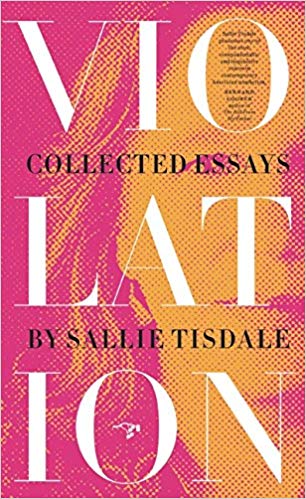
Violation: Collected Essays by Sallie Tisdale

This was a real treat, and an interesting balance between the experience of Many Circles – mind-bending, challenging, slow work – and If You Knew Then What I Know Now, which I read with pleasure in one big gulp. Violation was different from each of those, but fell just between them in its pacing. I was engaged and felt a sense of momentum throughout, but also had to stop and sit with what I was learning, or to react.

These essays span thirty years of Sallie Tisdale’s writing career, and are presented in the order in which they were published, with the final essay previously unpublished. Some of them were in progress for years before publication, but still a chronological order of a sort. While subject matters range quite a bit – elephants, flies, abortion clinics and cancer hospitals, sports, childhood and motherhood – they clearly track the evolution of one mind. Tisdale is a Buddhist, although that doesn’t come up as an explicit fact til late in the collection. She is an artist, passionate, but practically minded. She is concerned with the body, and with feminism, in different ways. I enjoyed very much getting to know her in these essays; but I also have an impression of her as a very private person, and in some ways don’t think I really got to know her very well at all.

The introduction gave me my first moment of aha! simpatico joy: “Long before I knew how to describe it, I liked ambivalence. Certainty has always seemed a bit dishonest to me.” This is so much what I feel, and it’s perhaps something I’m still working on describing, myself. It was my first, early signal that I would get along with this writer.

I really enjoy her style. She is the essayist’s essayist, or these are examples of the classical essay-as-assay: the mind wanders on the page. She is curious. She brings in a huge amount of outside research, sometimes, as when she writes about elephants and moray eels. She reminds me of Annie Dillard in the combination of immediate personal experience with science, but without the raving exuberance that Dillard often brings. Instead, Tisdale remains calm. On the other hand, the title essay is about the memoirist’s famous problem: family responses to one’s work. The nature of memory, and the question of what is ours to write about. More purely personal essays like this one require little or no research.

These essays are concerned with art and creativity, yearning, body image, and what boys and girls were allowed to do (and still are and are not allowed to do)… so many things, but not all at once. They take on really different things. And while most are alike in basic structure – discrete essays, with narrative journeys and mountains to climb and points unto themselves – one of the ones that most struck me was the segmented essay “Scars,” published in 2003, about raising a son. I loved the wordplay (of each segment’s title) and the enormous scope in a small package (just over 7 pages total). It spans a lot of time: sections are labeled with years from 1982 to 1997, and a brief note at the end says that the first section, in its original draft, was one of the first essays Tisdale wrote. I really appreciated seeing the bones of this one a little bit. And then, immediately following, comes “On Being Text,” about what it’s felt like as a writer to be included in anthologies that teach literature or writing: to read what’s said about her and about her methods and intentions. (It’s not all good.) This juxtaposition helped me again to appreciate the range in this collection.

But definitely some of my favorite essays were the two about elephants, “The Only Harmless Great Thing” and “The Birth.” The first, early in the collection (1989), is over 40 pages long, and brings in an enormous amount of scientific and historical information about elephants and zoos, and calls as well on literature and myth. It’s also personal: the narrator feels lucky to have gained back-room access to the elephants at Portland’s Washington Park Zoo. The elephants are magic, and she writes about them beautifully. This was an essay I snuggled into, fascinated and comforted by these strange creatures so loved and respected.

And then “The Birth” (2003), under ten pages, and tender and very much in-the-moment; it handles the same setting and the same (elephant and human) characters, but easily stands alone from the earlier essay too. “Elephants are so outside the size of things.” They “held up the world.” As she later does with the moray eel, Tisdale insists upon a distance from these animals: she acknowledges the temptation to feel close, to anthropomorphize, but holds herself to appreciating their otherness too. These essays are dreamy.

Tisdale is curious, thoughtful, considerate, and honest. I’m so glad that she allows this curiosity and careful consideration to range over the wide, wide world. (I didn’t even get into the lengthy treatise, “The Sutra of Maggots and Blowflies,” about much-maligned insects and Buddhism.) This was a treat, and I highly recommend it for curious readers of all kinds.


Rating: 8 sheep bot flies.