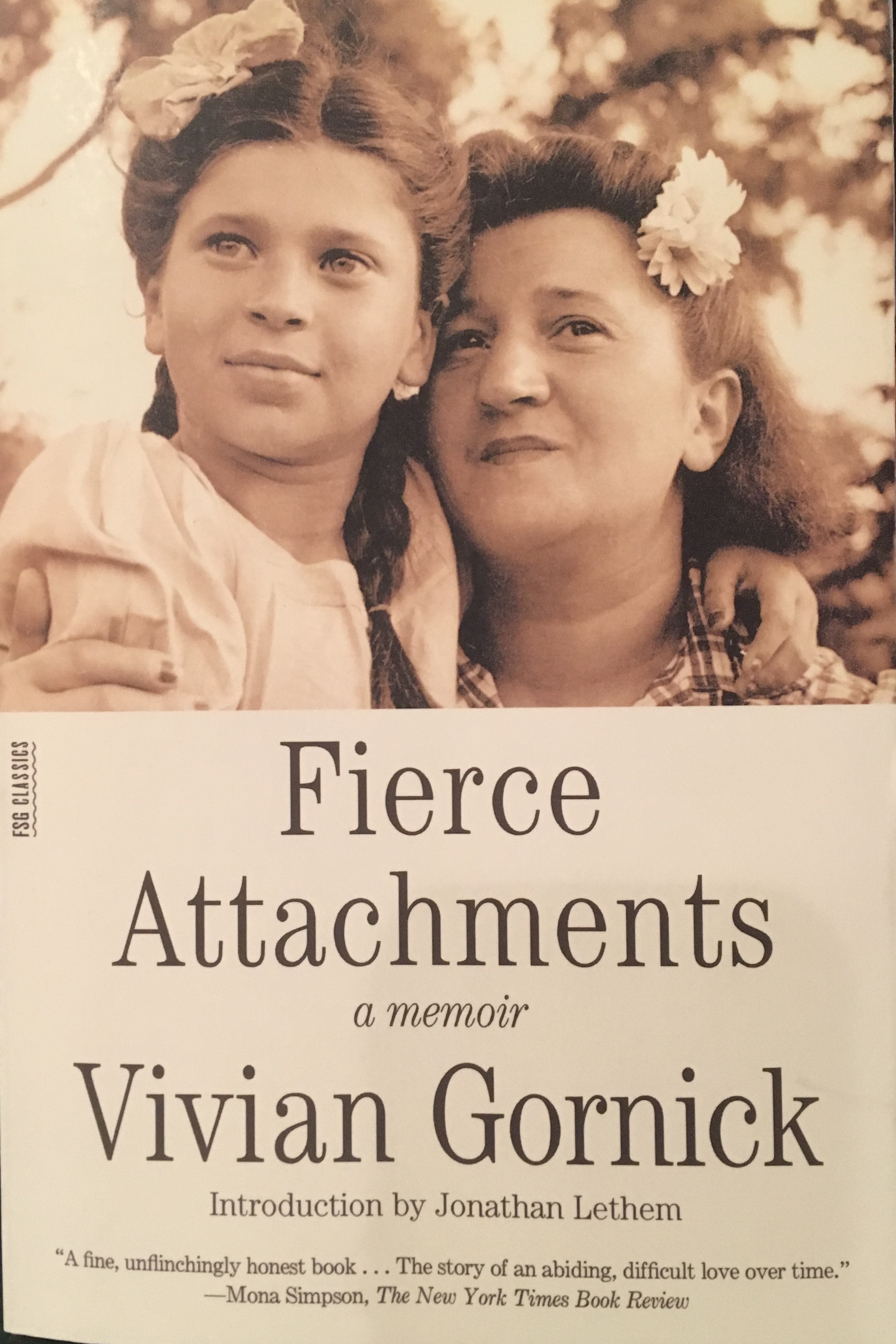
Fierce Attachments by Vivian Gornick

Just a week ago I gave you this book’s beginning and told you I was excited about it. It turned out to be everything I’d hoped.

Fierce Attachments is about Vivian Gornick’s mother and their relationship. It is told in two threads: the narrator’s memory of the events of her childhood in a tenement in the Bronx, and the narrative present, in which she and her mother walk together in Manhattan (where the latter lives) and throughout the city. The second thread features a daughter in her fifties and a mother in her seventies, finally eighty years old. The two threads eventually meet, as the remembered events follow a young Vivian growing up: from child to teenager, to college student, through marriage and divorce, into middle age and the walks in Manhattan. It is a very natural-feeling structure and one that makes great sense. It allows the reader to follow the heart of this book: neither the events of past or present, nor the story of one woman or the other, but rather, the story of their evolving relationship over decades, all its pain and small healings. It is also therefore about memory. The walks, which are also talks, allow Vivian and her mother to remember together, to create these stories.

In last week’s book beginning, I observed that the opening scene–a single paragraph–was given in present tense. All the narrative present events (walking in the city) are also given in present tense; but an event from the past doesn’t take the present tense again until page 91, nearly halfway through this book (at 204 pages an oddly quick read, for one so deep). It does not happen again until the past stories catch up with, merge with the present, when the mother turns eighty in the final pages and the two women find a small space in which to ease their combativeness. I had to flip back through the book to make these observations; I didn’t take notes as I went through, and in fact would have told you that more of the book took the present tense than I’ve found when I checked. I guess that makes the point that the past, rendered with lots of feeling and details, can feel pretty immediate.

There is much to admire here. I loved getting a feeling for Gornick’s inner life, as one lover calls it, her development as a writer, and the sad, conflicting story of going to City College and moving away–figuratively–from her mother, when she starts using complicated sentences and words the older woman does not understand. I appreciated the string of men she allies with, and her efforts to understand them, their places in her life and what they’ve had in common. Whatever her mother may think, Gornick uses beautiful sentences. And there is no arguing with the richness of her material: that tenement upbringing, the colorful women and sensory texture and exciting events. But for me what is most crystalline here is the relationship that is her main focus. The rendering of its difficulties.

And I see I’m writing this review prematurely, that I have not yet grasped what makes that rendering so clear. I think it has something to do with dialogue, and more to do with voice: that Vivian and her mother both get such clear voices, and not only them but many other, lesser characters as well. And perspective, the blending of what Sue William Silverman and Suzanne Paola call the “voice of innocence” and the “voice of experience”: the young Vivian, living in the past as it happened, and the writer Vivian walking with her mother and writing this book, and the way the two brush up against one another and eventually merge. The clear search for meaning, the honest, present wondering on the page: the classic assay.

I have a lot more to learn here; I’ll be back to Fierce Attachments soon, I expect. For now, please discover it for yourself, if you have any interest at all in the love and anguish of parent-child relationships, or admire creative nonfiction.


Rating: 8 corners.

Fearless Confessions: A Writer’s Guide to Memoir by Sue William Silverman

Edit: see follow-up post here.


Sue William Silverman is an established memoirist with Because I Remember Terror, Father, I Remember You and Love Sick: One Woman’s Journey Through Sexual Addiction (among other books, including poetry). This is the first of hers I’ve read, though.

Her title is intended as an answer to accusations that memoirs during the “memoir craze” of recent decades, and particularly those by women or other marginalized demographics that she refers to as the “other,” are confessional-in-a-bad-way, or sensational, or oversharing, or navel-gazing. With this title, Silverman reclaims the term and redefines it. Confessions are good, are therapeutic and cathartic, and lead to healing for the confessor and opportunities for fellow sufferers to begin their own healings. It’s a positive sentiment, although in this telling it occasionally carries a bit more touchy-feeliness than I might like.

I love the balance Silverman strikes between general philosophies of writing and nuts-and-bolts strategies. Each chapter concludes with a series of writing prompts or exercises. The craft books I’ve read for school (now in my third semester) have been successful reads, for me, at a lower rate than the rest of my reading. I don’t know if I’m pickier about craft books, just tend to like them less as a category, or am having trouble selecting the right ones. But my complaints often center on this balance issue: a writer holding forth about Writing (capital W) because he likes the sound of his writing, versus the practical how-to. I was pleased, early in Fearless Confessions, at the balance, which feels just right to this Goldilocks.

There is, though, a touch more cheerleading and rah-rah than I might like, just a hint of a tone that could be patronizing. Silverman has a tendency to wrap up chapters or concepts with “now go forth and do it, you’ll be great!” statements. Some of this is because there is an emphasis on trauma writing, Silverman’s own experience and (arguably) her specialty: the uncovering of a source of shame (incest, sexual abuse, sex addiction) which becomes an empowering and healing experience, and an aid to others. It makes sense to me that writers dealing with these kinds of issues deserve and need a certain amount of cheerleading. But I think Silverman has a lot to offer those of us who are doing different work, less revealing-of-trauma, and her tone came off just a touch strong for me, personally, and perhaps for other writers like me.

It also sometimes felt a bit more beginner than I needed, like in the first appendix, a discussion of the subgenres of creative nonfiction, which I found a little stark in its delineations–although a good primer it would be. Other appendices include a reading list (long, and by subject–I’ll be returning to that), and a handful of craft essays and examples of creative nonfiction essays. These were valuable inclusions that broadened the book and diluted Silverman’s peppy teacher’s tone.

I hear myself waffling as I write this review, and I guess that ambivalence is the story of my reading experience: great content, but often delivered in a way I found just slightly frustrating. And there was great content! I was really excited by Silverman’s concepts of highlighting, with different color highlighters, different plot elements or characters in a memoirist’s story to serve different plots. Or her idea of erasing the parts that don’t serve whichever story is being told: where a fiction writer builds plot, a nonfictionist sculpts one by erasure. These metaphors worked really well for me, and are perhaps the best expressions I have read of concepts I’ve been trying to articulate and wrap myself around.

I think I came to this one at a little the wrong time, and it would have suited me earlier in my studies. I’m glad I read it, but I found myself sometimes a tad impatient with the tone. I think I’ll be returning to this book, and going back to the writing prompts and exercises Silverman offers. I do recommend Fearless Confessions, just with a little patience, if indeed your tastes tend to follow mine, or if your background in creative nonfiction is already established. Or, to put it another way: an excellent introduction to writers new to memoir.


Rating: 7 pairs of red shoes.

book beginnings on Friday: Fierce Attachments by Vivian Gornick

Thanks to Rose City Reader for hosting this meme. Participants share the first line or two of the book we are currently reading and comment on any first impressions inspired by that first line.

It has been a long, long time since I’ve featured a book beginning here (over a year), but I wanted to share these opening lines because I find them a fine example.

First: I knew before I even got to Gornick’s text that I had misjudged her. I think I’d been cool on this book because I did not enjoy Gornick’s craft book, The Situation and the Story. But as I opened Fierce Attachments to Jonathan Lethem’s glowing introduction, I knew this was different, and I felt I’d been wrong to wait so long.

Gornick’s opening lines are,

I’m eight years old. My mother and I come out of our apartment onto the second-floor landing. Mrs. Drucker is standing in the open doorway of the apartment next door, smoking a cigarette.

I love the immediacy of this scene, the way Gornick places us there in the very moment, in present tense. Even that first sentence, “I’m eight years old,” is such a choice on the part of the writer. It does what we are sometimes afraid to do: just comes out and gives up a piece of setting-information (age, in this case) outright. It’s simple, but that present tense makes it snappy somehow. That sentence says scene, bam. And I’m on board.

Thanks for stopping by for a book beginning. I’ll be back to reviews next week.

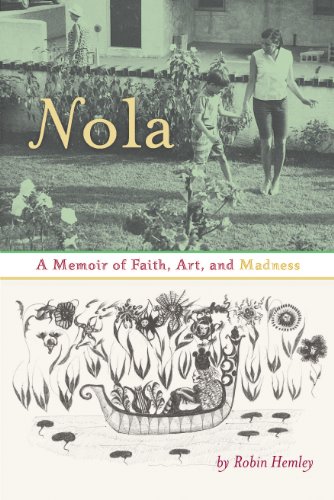
Nola: A Memoir of Faith, Art, and Madness by Robin Hemley

I appreciated Robin Hemley’s A Field Guide for Immersion Writing, and so I was interested when I learned he’d written a memoir of a difficult-to-write-about family member.

The first paragraph of Hemley’s prologue introduces five characters in a nuclear family. Father Cecil, who died when Robin (the youngest child) was seven. Brother Jonny, who “used to be good at everything, from languages to sports to the sciences,” but as an adult specializes in Orthodox Judaism (he and Robin are not close). The eldest, sister Nola, who “was good at everything, too, art and language, but especially things of the spirit.” Mother Elaine, writer and teacher, who is good at surviving. And here Robin introduces himself, as larcenous. Throughout this book, he is tormented by the thought of the stories, secrets, feelings and anguishes he’s stealing from his family members, particularly Elaine and Nola. Brilliant, spiritual, disturbed Nola, who always heard voices and saw fairies and angels and communicated with God, was treated for the last several years of her life for schizophrenia, in and out of mental institutions until she died when she was twenty-five years old, and Robin was fifteen.

This is a memoir filled with documents. The Hemleys are a writing family, and Robin mines Nola’s unpublished autobiography, her drawings, his own and his mother’s short stories, letters sent among the family, court documents, and more. Nola’s writing in particular appears peppered with struck-through text and additions, mostly the work of their mother as editor. These edits are not redacted; the reader gets both versions at once, often unsure of whether a change is Nola’s or Elaine’s. It is disconcerting, and entirely appropriate.

Nola: A Memoir of Faith, Art, and Madness is well-named. It is not an easy read. Just over 300 pages feels longer, as Hemley navigates the pain and distress of layers of family trauma–his father’s death and the deaths of several school-age friends; moves to ill-suited towns; a permissive, struggling mother; everyday sibling discord, and Nola’s increasing difficulties with a world she characterizes as “a strange and unbearable monster.” This is Nola’s book, but it follows side-threads, too, as when eleven-year-old Robin goes to live for part of a school year with elderly relatives in Florida (“By any yardstick other than a conventional one, I was essentially an elderly person… I really liked being old”). Later, he finds middle school frightening and chooses instead to attend day school at the psychiatric hospital where Nola is an inpatient. The Children’s Ward is a comfortable enough home for Robin, until he finds out they might not let him out again. Years after Nola’s death, when Robin is a graduate student, he has a girlfriend who suffers a psychotic break echoing his sister’s. Obviously, these threads are part of Nola’s story, her mystery, as well.

Not an easy read at all, as the book’s progress follows Nola’s descent into a misery she will not escape from. I do not recommend staying up late into the night to finish reading this as a winter storm rolls in. I found it quite upsetting, in fact. There’s no question that Hemley achieves emotional engagement, a representation of some of the agony his family has experienced. It’s a complicated achievement, all these layers of family trauma–often still with hope strung through them, at least while Nola retains it–and the writerly impulses of a family committed to communication and the written word, to education, and to some version of truth, however complicated. [Elaine’s technique is to write the family stories as fiction. Hemley’s essay “Truths We Could Live With,” appearing in Joy Castro’s (ed.) Family Troubles, and assigned by Jeremy Jones for my recent residency, discusses the difficulties he’s had with this practice. You can read an excerpt here.] A major thread of Nola follows the back-and-forth communications of mother and son, as Robin researches his family history for this book, and Elaine both helps (consulting, remembering, mailing him copious documents) and worries over the pain this will cause her, and Robin worries in turn.

So, a rich and complicated story. And cerebral: the Hemleys are a heavily educated, intellectual and mystic family, as well. (Cecil was co-founder of Noonday Press, and with Elaine translated and edited I.B. Singer’s work.) Almost every page is dense with philosophy (Nola’s grad-school discipline), religion, theory: faith, art, and madness indeed. I was having trouble getting through it, until I decided to let Nola’s concepts in particular sort of wash over me, and stop trying to understand them. (Much easier this way.) This book is an accomplishment worthy of study, but it will cost you something in the reading, so I recommend it with that qualification. Maybe stick to the daylight, too.


Rating: 7 Blakean drawings.

“The Fourth State of Matter” by Jo Ann Beard

At the gracious request of Uriah Pariah, here is a my response to an essay I admire greatly, and more and more every time I read it. “The Fourth State of Matter” appears in Jo Ann Beard’s collection The Boys of My Youth, and you can read it here.


NOTE: This review includes spoilers, and I feel strongly about the reader’s first experience with this essay being a blind read. If you don’t know what it’s about, please STOP now and go read it yourself first before continuing with my lesser words.


I think this post has to include the story of how I came to this essay in the first place. It was assigned reading in Suzanne Paola’s Intro to Creative Nonfiction Writing class at Western Washington University, an undergrad course I took in my early 30s a few years ago, surrounded by people not old enough to legally purchase beer (itself a weird time). Suzanne is a gift to the world and to this art form, but that’s another story. I read the essay she’d assigned without knowing anything about it. So my experience was innocent, like most of the readers (I assume) who first encountered it in The New Yorker in 1996. I have since been assigned the same essay several times, and have read it additional times for “pleasure” (though that’s not quite the right word) and study. I’ll never have that first read again, but it still gets better every time. I wish the same for you.

So, on first read, this is what presented itself to me: the narrator has an old dog, a collie, who is nearing death, in the most sympathetic, almost apologetic fashion. Jo Ann sleeps in fits and starts, between cleaning up after the collie’s incontinence. She has squirrels in her spare bedroom, and her husband has just left her. It’s a rough time. Then we go to work with Jo Ann, and meet her quite likable colleague, Chris. They are quite different–he is a space physicist, she is the managing editor of the space physics journal and vague on the science–but have a genial relationship, so comfortable that I instantly relate, even envy them a little.

This essay is a braid, and a very fine example of that form, but sort of subtle too, because the various braids (and there are several: dying dog, squirrels, estranged husband, work relationships with Chris and others) all come from the same timeline, the present tense of the essay. It’s not clear at first whether they will work as braided fibers or a single story, although I think they come out in a braid, and like the finest such essays, they are tied up together at the end, so that there is a moment of reveal: the reader’s aha, when she sees how tragically these narrative threads are all in fact one.

Because what this essay is “really” about is the 1991 shooting at the University of Iowa, when a graduate student killed five and maimed a sixth before shooting himself. Jo Ann knew the shooter and several of his victims, including her dear friend Chris.

This “real” material comes on slowly, then suddenly. There are foreshadowing moments of darkness, but when the first bullet flies the reader still feels a shock. It felt very realistic to me in this way: it felt like the faculty and students on campus might have felt that day.

Jo Ann goes home in shock. She takes care of the collie dog. She has already had an old friend take care of the squirrels in the spare bedroom. She is surrounded by friends who want to help her, although they don’t know how; her estranged ex-husband (not a sympathetic character) comes around and bumbles some more. Again, the telling feels like what she might have experienced in the living of it. The essay ends on a heartbreakingly beautiful elegiac note, and we are bereft: that this fine piece of art is over, and that lives have been lost, along with the squirrels and the not-quite-yet-dead-but-still-dying beloved dog.

One of the things that struck me most on my first reading was how much the dog affected me. Because, be clear, five people were murdered and followed by one suicide, then another; an additional victim was left paralyzed; a major university was deeply wounded. But the dog. My own old dog has been getting older and less cogent for years now–he’s still going, amazingly, but even when I first read this essay, I could feel his mortality. When we discussed “The Fourth State of Matter” in that undergraduate class, I was a little surprised to learn that nearly everyone had this story, though, about a beloved old dog, dead or dying. Of course, I quickly saw what nonsense it was to think that I had a monopoly on this. It’s a pretty universal feeling. We love our dogs.

Also, though, the essay starts with the dog. Beard’s first line reads, “The collie wakes me about three times a night, summoning me from a great distance as I row my boat through a dim, complicated dream.” My personal impression of this essay is that the collie dog–who goes unnamed, lending her even more of the universal, the ur-dog, the archetypical beloved–stands in for everything else that is lost. The youth and innocent partying of the squirrels, the broken love of the husband, the lives (Chris, who Jo Ann was close to, but also Bob, who she disliked and fought with constantly)–all of this, for me, is contained in the dog. For me, it’s a near-perfect essay, if not perfect. I haven’t even mentioned all the single lines that are crystalline, funny and perfect, as well. Go read it, again.

There have been criticisms. For one thing, Beard plays loose with the facts in characterizing the shooter, Gang Lu, attributing thoughts and feelings to him, supplying some of the content of letters he left behind explaining his actions. On first reading, I gave her the benefit of the doubt, thinking that maybe enough of those letters (for example) had been released to the public to allow her to know what she claims to know in this essay, but that is not the case. I’m so much on board with this essay that I no longer care. Funny, I’m a stickler for truth in nonfiction, until my heart has been won, and then I don’t care anymore. (See also Albert Goldbarth’s “Fuller.”)

Then there is the question of how we write about violence, about trauma, and about other people’s losses. This was the subject of Katie Fallon’s seminar at my recent residency, for which I was most recently assigned this essay, among other lovely pieces of writing. The class was divided, although “The Fourth State of Matter” was not at the center of our discussion–we mostly focused on Brian Doyle’s “Leap,” another piece I dearly love, although my peers are not all in agreement about it. We wonder, with pieces like these, about exploiting trauma, about glorifying violence, about whether to number the gunman in the death count, about when a story is “ours” to write about. We all have different reactions to these questions, and that’s not really what this blog post is meant to be about, but I will say about “The Fourth State of Matter” that I think Beard stays well on the side of writing about her own personal experience of this tragedy. She may not be all in the clear on the question of fact-in-nonfiction, but I think she’s fairly safe on exploiting violence. Again, because she makes it about a dog, some squirrels, and a dear friend. Or, as the original commenter put it when he requested this post: “it’s the fact that it was her story to tell, and a true one at that, that lends it its ultimate power.” That’s why nonfiction, my friend.

Uriah Pariah, thank you for asking me to write this. Hope it’s been helpful.

I already said it when putting together my best-of-2017 post:


Rating: 10 faces of love.

residency readings, part II

Note: I’m out of pocket during my residency period at school. I love your comments! But it may take me several days or a week or more to respond. (As this post was written pre-residency, I’m using a future tense for seminars that have by now taken place.)


Continuing Wednesday‘s post…

I already reviewed Eric Waggoner’s assigned book, Line by Line. In a word, I didn’t find it a very interesting cover-to-cover read! More of a reference book.

Jeremy Jones‘s packet was, I felt, an ideal example of pre-residency reading. For one thing, I appreciate that it was brief! (I was asked to read some 400+ pages for this residency, including my peers’ work that required in-depth response, and watch three movies and view additional material online.) But also, I felt that the selection of works he assigned were an excellent overview to his topic, and read like an introduction to his seminar. This packet, for a seminar on “writing about other people,” includes essays on the topic from a more academic, instructive point of view as well as personal reports by writers with experience writing about close friends and family, and the fallout. The final piece is Jeremy’s own, and I am looking forward to his promise to “talk through changes [he] made and reactions the ‘subject’ had about drafts and the final product.”

I enjoyed that Richard Schmitt’s package was much like him: pithy and to the point. He assigned three enjoyable short stories by Alice Munro, Flannery O’Connor, and Ernest Hemingway, respectively. Richard’s seminar is about “the art of leverage,” or power shifts in narrative, and these three stories look like great examples of that. I can’t wait. Also, I love anyone who requires me to reread Hemingway.

Rebecca Gayle Howell is teaching a seminar on “the documentary imaginary,” and I have no idea at time of writing what that means. She assigned three movies, three websites, and several readings. (You’ve already seen the movies reviewed here.) As I moved from Deliverance to The True Meaning of Pictures, I noted my clear preference (not for the first time) for literal and explicated narratives. I’m thinking about the discomfort that poetry brings me, because I can’t understand exactly what the poet meant at all times; where I love a memoir or an essay in which the narrative voice tells me precisely what she’s up to. In the same way, I guess Deliverance as an assigned viewing offered lots of possibilities for what we’d be discussing in class. But The True Meaning said what it was about. It discussed what it wanted to discuss, right there on the page, if you will. I felt much more comfortable with that content. Sherman’s March was a different experience, as I’ve already said.

The readings that Howell assigned were intriguing. Let me repeat, at the time of writing these lines, I remain confused about the topic of her seminar. Some of this confusion has got to come from the fact that I am in the minority in this program (whose tagline is “write in the heart of Appalachia”) as an outsider to the Appalachian region. I read the first three chapters of a novel called Mothering on Perilous (what a title!!), and I enjoyed them enough to wish I had time to read the rest, although I knew no more than when I’d started about Howell’s seminar. And then I read an essay called “McElwee’s Confessions,” which I commented on briefly in the comments section of my review of Sherman’s March. This essay is an appreciation of McElwee’s work, and while it did not convince me, it does help me to acknowledge–somewhat grudgingly–that there is more to it than I found in the one film. The essay’s author is familiar with the whole body of McElwee’s work, which I’m sure helps. And not everything is for everybody.

Finally, Howell assigned three websites for viewing: an audio interview with James Dickey (poet and author of Deliverance the novel); a gallery of Doris Ulmann’s photography; and the project “Looking at Appalachia.” That last captivated me. I highly recommend taking a good chunk of time to look through these photographs. The concept is dear to my heart, something like what I was up to at Defining Place, which has gone dormant. “Looking at Appalachia” is my new favorite thing.

Finally, Vicki Phillips’ assignment of Jane McCafferty’s brief “Thank You for the Music” was a touching read. I’m still trying to decide which of the graduate seminars to attend in that final slot, and this lovely little story made it that much harder.


Obviously it was a full and enriching experience just preparing for all these classes. And nothing here reflects the fact that I also spent time preparing for workshop: I read about 20 pages each of four of my peers’ work, and submitted about 20 pages of my own, and during residency we’ll be doing in-depth small-group discussion of those pieces (and exchanging written responses and marginalia). It is an intense time, in every sense. Thank you for being patient with me. As of now, I’m back home and readjusting to home and work life, getting to know my little dogs again and doing laundry–and, of course, getting to work on assignments for the semester. I look forward to hearing from you and reengaging. Life is ever a whirlwind. Again, thanks for your patience.

residency readings, part I

Note: I’m out of pocket during my residency period at school. I love your comments! But it may take me several days or a week or more to respond. (As this post was written pre-residency, I’m using a future tense for seminars that have by now taken place.)


I posted last month about the readings (etc.) I’d be doing to prepare for this upcoming semester and residency. As I worked my way through the assignments, I wanted to share a few highlights and my general impressions. Again, you can take a look at the readings and seminar descriptions here.

In order of appearance, and therefore the order in which I read and viewed them:

Because of my longstanding problem with poetry, the packet assigned for Diane Gilliam’s seminar on “reading as a writer” was fairly mysterious to me, though not unenjoyable–I just didn’t know what I was supposed to get out of it. Maybe I’m too much a control freak for poetry. Because the contents of her packet weren’t spelled out at the link above, I’ll just list the poets here. It included works by Louise McNeill, T’ai Freedom Ford, Theodore Roethke, *William Stafford, *Ross Gay, Eavan Boland (author of “The Black Lace Fan” that I remember studying in high school), Li-Young Lee, *Lauren Rusk, W.S. Merwin, Gwendolyn Brooks, *Audre Lorde, Charles Simic, and *Eleanor Wilner. (My favorite poems were by the *asterisked names.)

Jessie‘s assigned readings for “writing in the gaps” included an excerpt from Housekeeping (so at least I was a little familiar, if also ambivalent); a craft essay I really enjoyed by Andrea Barrett that had plenty of personal essay to it as well; and, among other things, Albert Goldbarth’s essay “Fuller.” That last was a reread, and I got so much more out of it this time. Jessie is smart, and deep, and I have no illusions that I am grasping the point of her seminar yet.

Next was Katie Fallon’s packet, which I loved and swooned over, although it was indeed hard emotional stuff. It begins with Maggie Smith’s poem “Good Bones,” a poem I felt I got. Brian Doyle’s “Leap” was a reread but an always-welcome one. “NeVer ForgeT” by Matthew Vollmer resonated with me in many ways, especially when he meditated on the distances we feel from tragedies close to home, and the different ways we mourn. And though I loved everything in between, the final piece, Jo Ann Beard’s “The Fourth State of Matter” always stands out. I’ve read it a number of times now, though I haven’t written much about it. I had such a wild time with it again on this reading that I had to amend my “best of the year” post to put it at the very top. I felt close to Katie as I read this packet, too, knowing her as my first semester’s advisor, and knowing from reading her Cerulean Blues of her own experience with trauma. I am very interested in her seminar on “writing personal responses to public violence,” and I imagine that teaching it will cost her something, but I also know she has a lot to teach.

Jacinda Townsend’s packet of magical realism blew my mind. I guess I should be reading more of this stuff?! I loved Byatt’s “A Stone Woman,” and then the next and the next and the next. This was not the first enjoyable reading of the residency assignments, but it was the first time I lost myself. Go find these stories immediately! Wow. I’m really looking forward to this seminar.


That’s all for now–this began as a single really long post but I’ve taken pity on you. Come back on Friday to read about the rest of my assigned readings for this residency period. Thanks for sticking around!

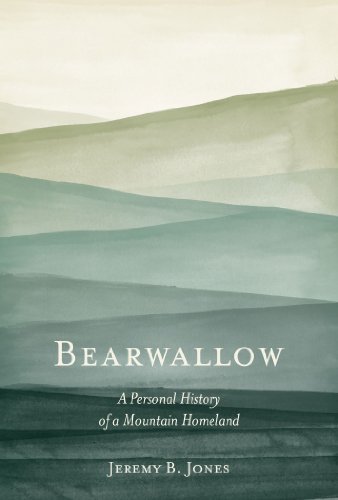
Bearwallow: A Personal History of a Mountain Homeland by Jeremy B. Jones

Disclosure: I read this book in preparation to meet its author at school in a few weeks, where he is guest faculty for the upcoming semester. There is some chance that he will be my advisor for this semester.


I bought Bearwallow more than a year ago, when I was researching MFA programs I might want to attend, and he came up as past guest faculty at WVWC, where I did end up going. I thought it would be good to get to know their faculty better by reading books like this one, but I didn’t get around to it until we got word that he was actually on his way back to serve as guest faculty again. I’m pleased I finally found time for this memoir, which does have something to teach me. And I’m looking forward to meeting Jeremy, not least because I learned in these pages that he is an avid cyclist! (Road, not mountain, but close enough. I remember roads.)

In the timeline of Bearwallow, its narrator is a young man recently returned to the shadow of Bearwallow Mountain where he grew up. Jeremy wanted to leave Appalachia, and he and his wife Sarah lived for a time in Honduras, where they taught young children English. But he kept feeling struck by those mountains’ familiarity, their relationship to his own mountains; and he ended up coming home to teach the children of his own old neighborhood. There, he teaches ESL (English as second language) to the children of immigrants. As he considers language, mountains, and our relationships to place, he watches developers parcel out the top of Bearwallow and plan for it to change. The book is about Jeremy’s life (still a short one in the book’s timeline), his family history, his region’s history, the significance of change and growth, and what place means to people. (You can see why I like this book.)

This is a young man’s memoir, which is a tricky undertaking. But Jones handles it well. For one thing, his story is not chiefly or firstly about him. He opens with the story of one of his forefathers, a Dutchman named Abraham who helped to settle the region where Jeremy would grow up. He always grounds his own experiences in their larger settings: the mountains of North Carolina and Honduras; a family history; the challenges of immigrants and immigration; a young person’s dual drive to leave home and to return to it. He also frequently references his own youth, acknowledging the uncertainties of anything he can know about himself as a man in his 20s. In fact, this book ends when the narrator and wife go off to graduate school, leaving again and only perhaps to return (as we, outside the book, know he did, at least to the region if not the town and neighborhood).

I found the narrator easy to like. He is humble, though not self-deprecatory. He has an open mind and questions his own decisions and impressions. I also liked the kind of musing he does. People and place, the dubious demands of family and inheritance, and the complexities of a place like Appalachia, all speak to me. I appreciated Jones’s use of scenes to transition into memory, or historic topics: scenes and scenery as smooth transitional material between more abstract subjects, and of course for their added interest and characterization.

This is an enjoyable, easy read, but it’s also got something to offer the writing student. In fact, its ease is one of those deceptive qualities: apparently effortless, so that the style fades into invisibility, but that’s some of the hardest prose to write. Again, on a personal level, I look forward to meeting Jeremy as a fellow cyclist (and I think of my mother, a fellow teacher of English as foreign language). Recommended.


Rating: 8 lots.

annotation: “At the Dam,” by Joan Didion

This is a first: because of one commenter’s interest in my original post on The White Album, I’m just going ahead and publishing the craft annotation I wrote for school on “At the Dam.” You’ll have to let me know if this is interesting or the opposite. Call it an experiment.

10/14/2017
Annotation 14: Finding the Star Map (or central image)

Didion, Joan. “At the Dam.” The White Album. Farrar, Straus and Giroux, 1979.

“At the Dam” is an essay less than four pages long, which describes Hoover Dam and its ongoing fascination for the narrator. Its very short length and the scale of its subject (literally, in terms of the dam, and figuratively, in terms of its large pull on Didion) make it an interesting study for me, especially because it deals with place. I found that my reactions to the essays of The White Album varied widely: some interested and involved me more than others. This essay inspired my imagination.

Only five paragraphs: and what work do they do? The first paragraph begins, “Since the afternoon in 1967 when I first saw Hoover Dam, its image has never been entirely absent from my inner eye.” Didion goes on to say where she sees the dam appear in that “inner eye”: Los Angeles, New York, while driving; and what it looks like: pristine, gleaming white, vertiginous, shadowed, ominous; its setting: harsh rusts and taupes and mauves. She hears its turbines (a sound as yet undescribed). She wonders how much water is being released (a fascination more generally revealed in an earlier essay in this collection, “Holy Water”). This is all good setting of the scene and the stakes, and includes images.

The second paragraph juxtaposes two ways of thinking about the dam: she compares it to the Mindanao Trench or the stars (baffling enormity), then calls dams “commonplace.” She places the Hoover Dam in history. It “made the Southwest plausible… convey[ed], in the innocent time of its construction, the notion that mankind’s brightest promise lay in American engineering.” This is a short paragraph, but important in that it provides these choices of context. The dam is as vast and inexplicable as the stars; it is familiar; it embodies the American dream, its promise and hubris. This last holds extra significance, because the essence of “America” (here meaning the United States) is one of Didion’s themes in this collection.

Paragraph three develops this idea, “that sense of being a monument to a faith since misplaced.” Images include a memorial plaque, a model city, “a toy triangular grid of green lawns and trim bungalows,” bronze sculptures, “Winged Victories guard[ing] the flagpole,” the flag. My favorite is an empty Pepsi-Cola can: how American, and how expressive of disappointment and disillusionment. Someone has littered at this failed American monument, which however still works, in the practical sense.

The fourth paragraph begins, “But history does not explain it all,” and so Didion will have to keep trying. The practical work of the dam–its capturing and transforming of energy into a form more useful to our human society–does not explain it either. She describes touring the dam with a man from the Bureau of Reclamation, and I pause to look this up: it’s the federal institution that manages water and power in the west. In this paragraph, Didion allows “Reclamation” to stand in for the man himself, a metonymy with religious overtones: “‘Touch it,’ the Reclamation said, and I did.” (A typo for “the Reclamation man”? I like it this way.) In this paragraph she describes the physical features of the dam, its workings, and the area around it, emphasizing its weirdness. Sexual overtones, parts where visitors do not go, alien, complete and beautiful, unpeopled; cranes move as if on their own, machinery roars and hums and vibrates. She finishes with the odd statement that the peculiar moment was “so explicit as to suggest nothing beyond itself.” This one made me stop to think.

The fifth and final paragraph makes a final attempt to grasp something “beyond energy, beyond history.” Didion again juxtaposes everyday Americana with the alien world of the dam. And then she fixes on an image: “the marble star map that traces a sidereal revolution of the equinox and fixes forever, the Reclamation man had told me, for all time and for all people who can read the stars, the date the dam was dedicated. The star map was, he had said, for when we were all gone and the dam was left.” This, she decides, stands in for the dam, “a dynamo finally free of man, splendid at last in its absolute isolation, transmitting power and releasing water to a world where no one is.” In five paragraphs, she has stated her fascination (obsession, even?) with the Hoover Dam, explored its significances (history, energy, sheer scale) without finding its true significance to her, and then found it at last.

In reading this essay, my personal background inspired an initial gut reaction: Edward Abbey and my father agree that big dams like this are bad for the natural world. But on closer reading, I think that a) Didion doesn’t necessarily deny that truth and b) it doesn’t matter; she is not making a value judgment, but an observation of the dam’s power over her. That dynamo free of man (more metonymy–I’d prefer humankind) is impressive whether we agree with its rightness or not.

“At the Dam” has inspired me to write an essay modeled on hers about a place that matters to me, although I haven’t figured out yet what that place is. I’m okay with this. I’m working on the essay in my head without knowing what it’s about yet, and sometimes they come out this way: I work on them for six bike rides and then come home and the thing bursts out fully formed like Athena (but a lumpy and misshapen Athena that requires editing, of course). I want to model an essay on the form and structure–and length–of hers, and I hope to find its star map. I’ll be on the lookout for such a place in my own personal history; I’m sure it exists.

Street Shadows by Jerald Walker

Before he wrote The World in Flames, Jerald Walker wrote this memoir-in-essays focused on a later part of his life, when he was navigating a growth from a series of performed roles, most dramatically that of a Chicago inner-city gangster, to college professor and married father of two. This book only touches upon that supremely weird upbringing (black child of blind black parents in a white supremacist doomsday cult, whew), concentrating instead on the period from young adulthood into, say, early middle age. Central to this arc, unsurprisingly, is his evolution of understanding race, which remains incomplete for the narrator at the time in which he’s writing.

The essays included here are both narratives from a life and traditional essays that explore questions in the narrator’s mind. I noted their organization, which generally alternates between the more distant past (a youth filled with mistakes) and the apparent present (or “narrative present”–not without its ongoing mistakes, but with an emphasis on self-awareness and attempts to understand and improve). The next step that seems natural to me, which I have not (yet) taken, would be to examine each essay for its content in terms of narrative vs. traditional assay/thinking on the page. I have a hunch there may be an organizational trick on that level, too.

I found these essays thought-provoking, engaging, and easy-to-read, a trifecta much harder than it looks. There was something a little effortful for me, though, that I’m having trouble articulating. It’s like I can catch just a glimpse of the writer in the background, building his work, on purpose. The essays that most blow me away have a feeling of effortlessness to me, like there’s no writer at all–a narrator, but no writer, no craftsman. Think of E.B. White, or Eula Biss, or Joan Didion. I’ll be hard at work trying to figure out what makes the difference I’m talking about. And for the record, I think it’s a matter of taste: I know readers who prefer the more crafted-feeling essay to the more obscurely drawn one (I’m thinking of Eula Biss’s subtle through-lines).

Feel free to ignore the above confused paragraph, though, and take this recommendation: Street Shadows is a remarkable work on several levels, including its organization, its storytelling style, and the intense and important subject matter Walker is moved to address.


Rating: 8 photographs taped to the door.