book beginnings on Friday: The Reef: A Passionate History: The Great Barrier Reef from Captain Cook to Climate Change by Iain McCalman

Thanks to Rose City Reader for hosting this meme. To participate, share the first line or two of the book you are currently reading and, if you feel so moved, let us know what your first impressions were based on that first line.

reef

A passionate history of explorers and climate change (and thus, one expects, necessarily of climate politics as well)? You have me sold, sir. Here is the opening paragraph of chapter 1:

James Cook did not know, on Sunday May 20, 1770, two weeks after leaving Botany Bay on the east coast of New Holland, the western portion of the continent, named by the Dutch captain Abel Tasman in 1644, that the HMS Endeavor was sailing into the southwest entrance of a vast lagoon where reef-growing corals began their work. It was a channel that later navigators would call the Great Barrier Reef inner passage. Cook didn’t realize that then, and he never would.

I am going to pick these first sentences apart a little here; bear with me. The concept McCalman opens with is a compelling one, and one he’ll return to: Cook was ignorant of what he discovered, and history in hindsight often makes the mistake of giving to discoverers credit for intention that they never had. Also, I think it’s a powerful image, this captain’s ship entering a dangerous and unknown area, and not even realizing it. In other words, I think McCalman chose a good opening subject; but golly, look at that first sentence! All the clauses: “he didn’t know, on the day, in the place, which was such a place, where this happened… that he didn’t know.” I dare McCalman to diagram that sentence; it might lead him to reconsider. And please do note that this is a pre-publication galley copy; he may still change it (or his editor might), so give the published look a glance and see when it comes out in late May. I am recommending the book despite a clause-heavy opener. Stay tuned.

This quotation comes from an uncorrected advance proof and is subject to change.

the best of scientific fiction, from Pops

Not to be confused with traditional science fiction (although I have something for you on that topic, as well) – today’s is a quasi-guest post from Pops, who is excited to share about a recent author talk event he attended. The presenter was Kirk Smith, speaking on Lab Lit: Putting Real Science Into Fiction. Pops’s report:

I attended the Lab Lit program tonight. And I signed you up to review a book. Well, sorta. We should talk.

So, to review: Kirk Smith is an old-guy Seattle author with a passion for fiction about “realistic scientists doing realistic science” – ideally where the science is the central story, not ancillary. He has high standards for credibility and likes writers who can really “get inside the head” of scientist-protagonists. Eventually he became frustrated that satisfying examples were so rare, and resolved to write his own version.

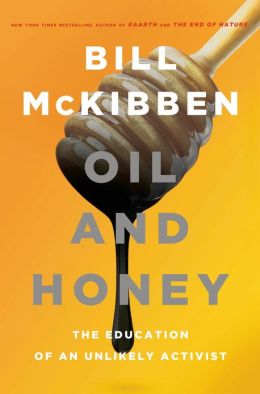
This is sort of a special interest of my father’s. He’s been interested in several scientific issues over the last few years, and often disappointed in their presentation by the finest minds in the field – scientific minds being, unfortunately, often unable to communicate what they know clearly to the rest of us. The big exception being Bill McKibben (who I reviewed recently: Oil and Honey). This is a paraphrase of my father – hope I got that about right, Pops.

It was interesting; simply an avid, insightful reader sharing a niche passion; nothing topical like climate change & how to communicate science, though I would have enjoyed that too.

He spent 45 minutes talking knowledgeably about all the books on the attached handout [see below], and 15 minutes reading from & talking about his book (an ode to Einstein, with a female character). He lauded Isaacson’s Einstein, the only overlap I detect with your reviews (you get credit for enjoying a “challenging read!”). He recommends Einstein in Love.

Not true, Pops! I reviewed not only Einstein but also Flight Behavior, which I loved.

[His passion for this niche reminds me of my own for running fiction; of course he reads other forms! I get it.]

You are onto something here. As you said in your first paragraph, Smith “likes writers who can really ‘get inside the head’ of scientist-protagonists,” and I think that’s exactly what you like about running books: sharing an experience with the protagonist, recognizing the unique and awesome thing that is being a runner – or a scientist. Or (to digress), I suspect that Susan Vreeland gets accurately inside the head of an artist, in her Clara and Mr. Tiffany or The Forest Lover, both of which I loved. However, not being much of an artist, I can’t entirely attest.

You’ll see he covered non-fiction and biographies as well as other forms; he also has his own web site where he blogs & reviews, and recommends the LabLit site (by one of the authors) that inspired the terminology. He has corresponded with several of the authors on the list.

I came home with a free UK-only-available copy of The Falling Sky by Pippa Goldschmidt. One of us is committed to reviewing it by Feb 15, before its spring USA release. Call me.

Of course by the time I called, he had already started reading this book, which is fine because I have plenty of deadlines in the next two weeks without this one (!), which would require cross-country shipping to get to me, too! But I’m next in line for it when he’s done (so I have a more relaxed schedule to read it on), and his review will be cross-posted here when complete. Hooray! Guest reviews!

And for those who are curious about Smith’s reading list – I know I was! I’m sharing here the handout he shared at this book event, with Pops’s annotations on it (how lucky we are), and hoping that the wise and magnanimous Kirk Smith will not consider this a copyright violation too egregious. :-/ Seriously, thank you Kirk for the info; and readers, do check out his website here.

(click to enlarge)

(click to enlarge)


An addendum from Pops:

First, I noticed his top three fictions are all by female authors with female protagonists; then he eventually acknowledged the fact himself, in passing; then his reading (of his own novel) revealed the female protagonist in his own novel; and in response to a question explained (superficially I thought) why she is his stand-in for a fictional Einstein; and with a follow up question, finally spoke briefly but incisively about the challenge for girls & women in math & science fields to gain grudging credibility & respect.

So, one wonders: are the women appearing in his list (authors & characters both) a factor of his own selection, or if one did an “objective” survey of the landscape, would we see the same? An outbreak of women expressing a new voice? (In literature, or science, or both?)

Such fodder for future expression!

Such fodder indeed! I have no idea how to answer your questions, of course – possibly Smith could speak to these? (It would have been a great line of questioning to pursue on the spot with the audience! It sounds like he wasn’t anxious to head in this direction – of social commentary – on his own. But I understand how it took a day or two to get these thoughts, and thus this line of questioning, straightened out in your own head.) The pessimist (or realist?) in me doubts that there is a general and widespread trend toward a women’s majority in science & literature! Although for the most part we are increasingly represented, hm? That’s just a guess from me, though.

Oil and Honey by Bill McKibben

Highly literate and expert musings on climate change, from home to the global theatre.

oil
Oil and Honey centers partly on climate change, a subject on which Bill McKibben (The End of Nature; Eaarth; founder of 350.org) is expert; but it is also personal in nature, a dualism reflected by the title. McKibben is concerned simultaneously with oil–representing fossil fuel industry practices and climate change–and honey. Having entered into a land-share agreement with his friend, beekeeper Kirk Webster, McKibben finds his home and Webster’s apiaries exerting a gravitational pull just as his political activism draws him far and wide. These two sides of his life–personal and political, local and global, analog and digital–are the focus of this combination memoir and call to action.

The subtitle refers to his journey from writer to activist, by way of 350.org and the Keystone Pipeline–a trip he did not intend but found obligatory. Activist though he may be, McKibben remains a fine writer, evocative, articulate, clever and humble in examining his mistakes. In piercing prose, McKibben unites his longstanding authority on climate change with his novice stature in the world of beekeeping. He muses on the small-scale and private implications of our changing world, which incline him to work with his family and Kirk’s bees in his beloved local community in Vermont; and likewise on the necessity for global action to combat the continuing quest for fossil fuels. Oil and Honey travels the world but always cycles back, like the seasons, to McKibben’s Vermont home, likening global systems to beehives in a manner both profound and lyrical–and important.


This review originally ran in the – issue of Shelf Awareness for Readers. To subscribe, click here, and you’ll receive two issues per week of book reviews and other bookish fun!


Rating: 8 degrees.

remarkable bits from Pilgrim at Tinker Creek

Correct: we are still not done with Annie Dillard. I may have to make her a tag as I have done for Abbey and Hemingway. (…Haven Kimmel, Norman Maclean…)

EDIT: here we are.

On top of my reviews, I felt the need to share some of my favorite lines and passages with just a few notes. Enjoy.

There are seven or eight categories of phenomena in the world that are worth talking about, and one of them is the weather.

One wonders very much what else would make her list!!

I want to think about trees. Trees have a curious relationship to the subject of the present moment. There are many created things in the universe that outlive us, that outlive the sun, even, but I can’t think about them. I live with trees. There are creatures under our feet, creatures that live over our heads, but trees live quite convincingly in the same filament of air we inhabit, and in addition, they extend impressively in both directions, up and down, shearing rock and fanning air, doing their real business just out of reach. A blind man’s idea of hugeness is a tree. They have their sturdy bodies and special skills; they garner fresh water; they abide. This sycamore above me, below me, by Tinker Creek, is a case in point; the sight of it crowds my brain with an assortment of diverting thoughts, all as present to me as these slivers of pressure from grass on my elbow’s skin.

I loved this because I, too, love trees; and this is a well-articulated (but still rather charmingly airy, too) explanation why. Also, I enjoy Dillard’s use of the semi-colon, my personal favorite punctuation mark. (Yes. I’m a librarian and a reader and writer. I have a favorite punctuation mark.)

My God, I look at the creek. It is the answer to Merton’s prayer, “Give us time!” It never stops. If I seek the senses and skill of children, the information of a thousand books, the innocence of puppies, even the insights of my own city past, I do so only, solely, and entirely that I might look well at the creek.

“It never stops.” Golly, I hope she’s right. Climate change has us receiving too much rain here and not enough rain there; the forests are burning; the glaciers are melting; I fear the creeks are stopping (and starting up elsewhere). But in 1974, I can understand this thinking.

I suspect that the real moral thinkers end up, wherever they may start, in botany.

This, too, is charming: a nerdy confirmation of the power of trees and other green things (and non-green things as well).

John Cowper Powys said, “We have no reason for denying to the world of plants a certain slow, dim, vague, large, leisurely semi-consciousness.” He may not be right, but I like his adjectives. The patch of bluets in the grass may not be long on brains, but they might be, at least in a very small way, awake.

Who is Dillard to say that he may not be right? Goodness, with all the time travel and metaphoric “patting the puppy” she gushes and coos, why not let trees have a certain semi-consciousness? And those complaints aside, does anyone else hear the Ents walking through those lines? Lovely.

All the green in the planted world consists of these whole, rounded chloroplasts wending their ways in water. If you analyze a molecule of chlorophyll itself, what you get is one hundred thirty-six atoms of hydrogen, carbon, oxygen, and nitrogen arranged in an exact and complex relationship around a central ring. At the ring’s center is a single atom of magnesium. Now: If you remove the atom of magnesium and in its exact place put an atom of iron, you get a molecule of hemoglobin. The iron atom combines with all the other atoms to make red blood, the streaming red dots in the goldfish’s tail.

And that blows my mind: a scientific, tiny-scale, real-life confirmation, like a metaphor but grounded in reality on the molecular level, of our intricate connection as living, breathing, animal things to living, breathing green things. I love that.

Pilgrim at Tinker Creek by Annie Dillard, part the second

pilgrimattinkercreekI’m afraid I am continuing with my mixed feelings here, as in my first review. Pilgrim at Tinker Creek, for me, comes in sections, or in three parts. As I wrote, the early bits were difficult for me, a little too metaphysical and spiritual. And then, remember how I said that chapter 7 blew me away? Well, chapter 8 is even better.

Chapter 8 is entitled “Intricacy,” and addresses the amazing, extraordinary intricacy, complexity, tiny detail and huge scale and huge scale of tininess in the natural world. Dillard relates statistics that are mind-boggling: “the average size of all living animals, including man, is almost that of a housefly.” “There are… two hundred twenty-eight separate and distinct muscles in the head of an ordinary caterpillar.” “Six million leaves on a big elm.” She writes about the Henle’s loop in the human kidney, the lower lip of the dragonfly nymph. Tiny, infinitely complex things that make our world so strange. She uses this phenomenon to explore the idea of a creator – and here Dillard and I will disagree a little, but that’s okay. “Look… at practically anything… and see that not only did the creator create everything, but that he is apt to create anything. He’ll stop at nothing.” She takes the strange and prolific nature of our world to be proof of a creator – “no claims of any and all revelations could be so far-fetched as a single giraffe” – and I don’t. It’s all right, though; this book is plenty safe for atheists; she’s not preaching. She’s just exploring. And I love the science, all that tiny tiny trivia, the explanations of the human kidney and the aquatic horsehair worm.

Next is chapter 9, “Flood,” and here I am going chapter by chapter – that’s how good this book is. “Flood” addresses Hurricane Agnes, and hurricanes are something we’re increasingly familiar with, not only in Houston but in New York City these days as well. (Which leads me to point out that Dillard is blissfully unaware of climate change and ecological collapse; happy her in 1974.) There is more of what I love in Dillard: detail, observation, science, and a glorious, joyful celebration of the world.

And then it falls off again, descending (or ascending, depending on your feelings) into the spiritual once again. My level of detail falls off here, too, because what can I say? I paid less attention when she zoomed back out into the mistiness. The last few pages of this book were an effort, and I didn’t retain anything I can tell you about now.

Verdict? Rather a difficult one. Liz said, great, I’ll just read those middle chapters! But of course that’s no way to go unless you know your tastes are mine.

I am glad I read this book; it yielded some inspirational moments and great quotations (as you will see). But those came overwhelmingly from the middle portion of the book. Others, I have no doubt, will swoon over the “patting the puppy” and the tree with the lights in it. Discover for yourself; but I do think it’s worth the effort, in the end. If I were to do it again, I would just read the middle parts. Rather like Walden, then, in my final conclusions – just as I thought at the beginning.


Rating: in an attempt to be fair, 6 mushrooms.

Flight Behavior by Barbara Kingsolver (audio)

flightAnother beautiful, thought-provoking book from Kingsolver; and another outstanding narration by the author herself. Like The Lacuna, which I called one of the best books I read in 2012, this will be a standout. I fear this will be one of those longer reviews, as I have so much to say…

We open with a young mother of two in a less-than-thrilling marriage, named Dellarobia Turnbow, hiking up a mountain to meet a man for adulterous purposes. On her way there, she’s distracted by an amazing sight. The hills appear to be aflame, but there is no sound and no heat. She is amazed, and disturbed, and stands up her would-be lover and goes back home; it’s something like a religious experience, although she’s not particularly religious. She does, however, attend church – one of many compromises for the sake of her mother-in-law, who terrifies her.

Dellarobia lives on her in-laws’ sheep farm in Tennessee and rarely gets to leave the property. Her husband is kind but dull. She is frustrated. The strange thing happening up on the mountain, however, will expand her world: it has implications for climate change, and is variously interpreted as an event of an environmental as well as a religious nature.

The cool orange flame on the mountaintop is a mass migration of Monarch butterflies, pushed out of their normal overwintering site in Mexico by a mudslide that killed a village, caused in turn by clearcutting and climate change. Dellarobia doesn’t have the context to begin to comprehend such happenings, so she has to learn slowly; aiding her in this process is the amazing Dr. Ovid Byron, an entomologist who has written the book (many of them) on Monarchs who shows up to park his camper on the Turnbow farm and study their special mountain. Ovid is a striking figure – physically, as a black man, he is of such a minority in the rural mountains of Tennessee as to be exotic to Dellarobia; audibly, his accent (similar to Jamaican) is mellifluous and musical; and intellectually, he boggles Dellarobia’s mind and pushes her to new ways of thinking. This is a young woman who would have gone to college if she hadn’t gotten pregnant, and her thwarted ambitions are sparked by Ovid’s presence.

Meanwhile, the local religious community becomes convinced that Dellarobia prophesied the Monarchs’ arrival, that she had a vision; she is tentatively treated as a hero or religious figure, which doesn’t sit well with her feared mother-in-law, Hester. The media – local, and then national – blows things out of proportion, highlights the sensational, and alternately threatens to turn her into a sex symbol or accuses her of suicidal tendencies. Her marriage – which we learned in the opening scene was not strong or happy – is predictably strained by all the activity and attention. And perhaps most poignantly, her small son Preston is told by Ovid that he is a scientist, and begins a new way of thinking, himself.

As a family story or the story of one woman, alone, this would be an extraordinary masterpiece. Dellarobia is a remarkable woman, and I think she is probably representative of many young women who have greater abilities than they end up exploring, trapped (in Dellarobia’s case) in rural and familial circumstances that limit her. Just as in The Lacuna, one of Flight Behavior‘s greatest strengths is Dellarobia’s realness: her quirks, her frustrations, her fantansies, her day-to-day life and thoughts. We get to experience this story inside her head, and the inside of Dellarobia’s head, all by itself, would be a glorious gift for Kingsolver to bestow upon us. The other characters too, all of them, are fully realized, more real than the people I know in the real world; they’re complex, and even the initially unlikeable ones (I’m looking at you, Hester) are multi-faceted and deserving of our sympathy in the end.

But! That’s not all! There’s more to this story than Dellarobia and her family of wonderfully real, odd people. The Monarch butterflies, climate change, the complexities of farming in a changing world, the environmental movement, 350.org, and academia are all explored and examined in a wonderfully nuanced way. Idealistic young – and old – environmentalists show up on the scene as well, and there’s a lovely scene in which one of them quizzes Dellarobia on her commitment to leave a smaller carbon footprint. As it turns out, being rural and poor puts her in a pretty good place footprint-wise already, a fact which humbles (not to say embarrasses) her interlocutor.

Dellarobia turns out to be the perfect vehicle for teaching us all the science of Monarchs, of migration, of weather patterns and geography, of climate change, and of relationships among people and cultures. She’s ignorant, but not unintelligent, and once she learns how to open her mind, she is an inquisitive student; and Ovid Byron is a wonderful teacher, and let me add, his dreamy accent, so well performed in this audio edition, is to die for. [I do recommend listening rather than reading, upon which more in a moment.] However, this is never a polemic, and Dellarobia is far, far more than a vehicle; you remember I was terribly bothered by that issue in Sophie’s World, and a little bothered by it in Ishmael, but there is no trace of it here. As I wrote above, Dellarobia is very, very real. Instead, this is a moving, complex story, starring sympathetic, believable characters, that also handles some large, important questions: like, what are we doing with our world?

I have a quick note to make on the ending, mostly for my father. Pops has noted that where Derrick Jensen is brutally honest about our future, Bill McKibben tends to draw intelligent conclusions and then inexplicably end on what feels like an unrealistically optimistic note. Well, in the same vein, Kingsolver may end things a trifle more hopefully than is realistic – it feels good, you understand, but it’s a McKibben ending rather than a Jensen one, if you follow. And then she thanks McKibben in her Author’s Note, so that’s fitting.

The Author’s Note also includes a brief discussion of what in this story is true to life (and how she found it out), and what is fiction. This is a well-researched book, and I appreciate her delineating the boundary between fact and fiction, as I always do.

The audio narration by Kingsolver herself could not be improved upon. Dellarobia has an Appalachian twang and darling figures of speech. Her BFF Dovey is even cuter and mouthier; she collects jokey church billboard sayings, some of which Dellarobia is sure she makes up (“Moses was a basket case”). Dellarobia’s in-laws have their own audible personalities; her husband Cub is nothing in life if not sloooow in all respects including speech. And Ovid Byron! Oh, the accent. Swoon. Kingsolver does all these beautifully. If you have to read this book rather than listen to the author read it, then fine, but I pity you. Get the audiobook!! Do it!


Rating: without question a perfect 10 newborn lambs.

This book is so wonderful – particularly in Kingsolver’s masterful narration – that I wonder if I should go back and try some of her earlier work again. I remember being decidedly nonplussed by The Poisonwood Bible, and I know I’ve read The Bean Trees but have no impression of it (which is not a good sign); I can’t decide if I’ve read The Prodigal Summer or Animal Dreams or not (also not a good sign). But The Lacuna and this one are both so grand, I feel I should delve more deeply. Also, while I’m pondering past readings, I wonder why I keep getting Kingsolver crossed with Margaret Atwood in my mind? I wanted to attribute The Robber Bride (which I enjoyed) to Kingsolver. Maybe it’s that I’ve found them both a little hit-or-miss; I was less impressed with The Year of the Flood and ambivalent about Oryx and Crake and The Blind Assassin; have no impression from Surfacing; but loved The Penelopiad, and found The Edible Woman mindblowing.

Endgame, Volume 1: The Problem of Civilization by Derrick Jensen

endgameHow to write about this book for you here? Derrick Jensen fearlessly assesses the terrifying state of our world, for us as people and as not-the-only inhabitants of a globe that is sick with our presence and practices. It is difficult to write about what he has to say and my reactions to it; it’s very personal, because I and/or people I love may or may not be trying to follow some of Jensen’s teachings even as we speak. What I really want to say in this so-called “book review” is, go read Jensen now, and then do something about it.

The concept of endgame is familiar to me from chess. The idea is that we’re trying to get to a final outcome of this chess match, trying to establish a winner and a loser, and there’s no sense hanging on to all these pieces and stretching things out. Instead, I will happily give up my bishops (knights, rooks, queen, all of ’em) in exchange for yours, in order to hurry up the desirable end of the game. Endgame takes the same concept – a desirable hurrying of this game onto its inevitable finish – and applies it to our world, or rather, to civilization. He tells his reader why and how our civilization or culture is hopelessly, insanely f*cked up. He argues that we ARE headed for an end to civilization – and quite appropriately and desirably so – and that we should be hastening this end, the sooner that we can then begin living more sanely (if there’s any “we” left), and the healthier that the planet and anything left on it will be post-endgame.

This may very well sounds nuts to you, if you haven’t given things like global warming, mass extinctions, water shortage, and worldwide social injustices much thought. But it might make a great deal of sense – especially if you let Derrick Jensen tell it, which I really recommend, as he does a far better job of it than I do. Perhaps my first surprise in reading Endgame is that there were no surprises. Jensen makes these arguments so incredibly articulately, cleverly, even funnily, and backs them up so solidly, that I am wowed; but nothing he had to say was entirely new or surprising to me (sadly). He does a really fabulous job of expressing clearly what I already knew, suspected or feared. He also presented some new angles that I hadn’t much considered; and he expands the scope and scale of our problems in a way that I appreciate and found thought-provoking. Make no mistake: Jensen is a philosopher, a thinker, a cerebral guy who has clearly done copious research and spent time talking with some of the smartest people out there. Would that we all had time to do this kind of research and thinking! (Since we don’t, read Endgame.) My father has noted that even climate change experts like Bill McKibben stop short of the dire predictions Jensen posits. I think considering these scary truths is useful, instructive, and constructive, even while it’s sad and terrifying.

If you believe that we just need to drill for more oil; that those with lots of money have the right (and the duty) to protect what’s theirs; and that poor people in poor countries that still have some trees (oil, etc.) left should just move over for those of us that know better – Jensen is unlikely to convince you otherwise. He doesn’t really bother with you, in fact: you are not his audience. (“I was going to suggest those who think the U.S. invasion [of Iraq] has nothing to do with oil should put the book down, but realized they’ve probably already tired of the big words.”) And maybe that’s as it should be, too. Convincing those people is a big job – possibly an impossible one – and there’s other important work to be done. I don’t know that we should be wasting our Derrick Jensens on convincing the hardline fans of civilization that they’re wrong.

Aside from the clearly central issue that I appreciate what he had to say, see the wisdom of his arguments, and applaud his articulations, I also really enjoy Jensen’s conversational style. He can somewhat ramble, but is abundantly coherent for all that; maybe it was just my deep interest and passion for what he was saying (I’m nodding and saying “yea, yea!” as I read), but it all flowed very well even while jumping around a little. Of course I must say too that I loved his love for parentheticals (he mentions how much this frustrates his editor!) because, can you tell, I share it. I believe it was on his website that I read that he completes each page (or several), completely, before moving on to the next: that is, when he’s writing page 11, pages 1-10 are done. I find this fascinating. (I’m always interested in the mechanics of my favorite writers.) And it allows for a journal-like feel: he’ll break off from an argument he’s making to tell an anecdote, like “tonight I gave a talk, and at the end a woman said…”, and the reader is right there in the present with him. He wrote that paragraph on the night that that woman said that thing.

I would also like to make a contrast to yesterday’s DNF book, and say that a key piece of Jensen’s structure here is in stating at the start 20 premises he believes in. He writes,

I want to lay them out as clearly as I can, for you to accept or reject. Part of the reason I want to do this is that the questions I’m exploring regarding civilization are the most important questions we as a culture and as individuals have ever been forced to face. I don’t want to cheat. I want to convince neither you nor me unfairly (nor, for that matter, do I want to convince either of us at all), but instead to help us both better understand what to do (or not do) and how to do it (or why not). This goal will be best served by as much transparency – and honesty – as I can muster.

He then spends 450 pages proving his premises.

I appreciate this clarity. Frankly, I was already on board with his assumptions, but agree wholeheartedly that this is far too important a problem to make assumptions about; the intellectual exercise of questioning our assumptions is absolutely necessary. I like that he is so reflective, asking questions he can’t answer, reconsidering. This is too important a moment for blustering false positivity. Therefore, even though I was willing to buy into premises like, “The culture as a whole and most of its members are insane. The culture is driven by a death urge, an urge to destroy life,” I still value having them proven to me. Jensen questions himself and his own motives. And that’s something I respect.

A solid ‘A’ for style, then, but the real ‘eureka’ for his thoughts and arguments and philosophies. I can’t wait to read Volume II: what we’re going to do about it.


Rating: take note: 10 salmon.

guest review: The Longest Race by Ed Ayres, from Pops

As I read The Longest Race, I thought of my father throughout. He is a marathon runner and a trail runner, and has been contemplating issues of climate change, sustainable living, and humans’ place in nature quite a bit recently. I thought this would be a perfect book for him in its combination of themes, which you can read about in my review. Here, he responds. [His page numbers come from my advance review copy.]

Julia has already done her usual commendable job reviewing this book; my personal interest in Ayres’ two main themes – running, and human degradation of our earthly habitat – compel me to comment further (as she knew it would.) At the same time, I want to parse her use of “metaphor” to describe how running and human development are related in Ayres’ story. While he does often employ metaphor, I believe in many cases he is saying that running actually is part of human development and does have an impact on how we relate to the world. Such is the hubris that plays a part in his tale.

For the above reasons, I really enjoyed this read. That doesn’t mean I found it uniformly superb or satisfying, but the book’s strengths were more than enough to keep me going.

Using a 50-mile ultra to structure his narrative worked better than I expected. There were few threads about his race that required following intently, and those were not lost as we periodically reconnect to that story. The more esoteric subjects he contemplates along the way vary greatly – just as would one’s thoughts during the hours of such an endurance event. In fact, that is an example of the athletic authenticity I found throughout. While I was only familiar with Ayres generally as editor of the early magazine “Running Times,” his deep experience as a lifelong runner shows through. His mental meanderings during a 50-miler – and their sometimes-questionable lucidity – are a familiar element of “running long.”

I was not familiar with Ayres’ background in the themes of human impact on the earth; he worked for the Worldwatch Institute and describes how this commitment evolved from a Quaker upbringing and through a lifetime’s experience. Along the run, we gather bits of his own back-story and “meet” such characters as Mohammed Ali, Mikhail Gorbachev and Ted Taylor (nuclear weapon physicist); such moments are fun and interesting – and chilling, as with his quotation from Taylor evoking the cold war’s nuclear terror (p.94). Also chilling is Ayres’ observation that for those who study the science of ecology, the survival of modern human society is “not just an abstract, academic concept;” it is very immediate.

We learn with him on his journey; e.g. Jared Diamond’s observation that agriculture is “in many ways a catastrophe from which we have never recovered” (p.102) – or “anthropomorphism as a major root cause of the ecological crisis” as noted by many literary luminaries over the years (p.106) – or the 1992 consensus-scientists’ dire & explicit climate change declaration so long ago (p.163) – or a reminder that the regressive “progress” of a suburban lifestyle model may prove to be a mere 2-generation phenomenon. We also meet such authorities as Paul Shepard, Rachel Carson and Wendell Berry along the way.

Similarly, Ayres has much to offer about running itself – not just practical stuff, but history and science as well. He met and/or learned from such names as Joan Benoit, Ted Corbitt and George Sheehan. He cites a Joe Henderson article that I know I read at the same time 25 years ago. Ayres is not the namedropper – that’s my doing throughout here – but rather all these names simply arise as part of his story.

His introduction to the JFK ultra event’s origin unwinds into a period piece on the Kennedy Physical Fitness campaign (which I too experienced), including analysis of JFK’s civic motivation and his 1960 column in Sports Illustrated (who knew?!). I loved learning of David Carrier’s fascinating theory of primitive “persistence hunting,” where humans demonstrated the superior endurance trait that we runners still attempt to conjure (Ch.4). In fact, the role of endurance running throughout early history is compelling – including the Chasquis, the Inca runner-messengers.

Chasqui runner

Chasqui runner


The brief 23 page Appendix, “Notes for an Aspiring Ultrarunner,” is an worthy overview but any really interested reader will do well to research the many other references available.

All together, I enjoyed the blending of themes, emotions and ideas in Ayres’ book. Here is a single passage where Ayres is so nicely able to blend his heritage, running and science:
“The last sounds of the spectators faded, and, after a period of silence that could have been either five minutes or the hundred years it takes for a Quaker kid to sit through Sunday meeting, I found myself glancing left and right, the way I’d been taught as a teenager to drive a car – keep your eyes moving, don’t get fixated on the road ahead. Maybe that was a vestige of the hunter-gatherer’s need to read his surroundings.”

While it is different in some ways, a reader drawn to Ayres book may also appreciate Long Distance, by Bill McKibben. Here you would find a foremost climate change writer who instead writes about his experience pursuing an endurance goal (cross-country skiing) and the lessons he derives for surviving in our every day lives. (Interestingly, the one promotional blurb on the cover of Ayres’ book is a McKibben quote.)

Finally, I must note two of my own favorite observations about running, which he mentions along the way. One is the uncanny and almost inexplicable way that a seasoned trail runner, moving quicker than the eyes seem to process, can cover rough ground dense with rocks & roots – and yet every footstep survives the gauntlet (“almost inexplicable” because there is a scientific story, of course); this phenomenon is well-captured in the exclamation “do my feet have eyes of their own?!” (p.58)

The other fave comes after he has related the many challenges that can test a runner’s resolve and motivation, all the aches & pains & setbacks – which are all so easily overcome by the most sublime moments (or preferably hours!) This he also captures with a mere phrase: “When running is good, there is nothing like it.” (p.98) Alas, as we age, it becomes harder to remember that lesson – but after 35 years it can still be good, and there is still nothing like it.

So glad you liked it, Pops. Thanks for sharing.

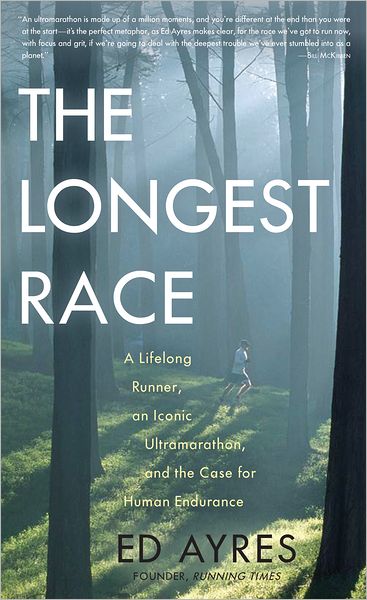
The Longest Race: A Lifelong Runner, an Iconic Ultramarathon, and the Case for Human Endurance by Ed Ayres

An ultramarathon, run by a master of the sport, becomes a metaphor for the race for human sustainability we are all running.

Ed Ayres has been running competitively for more than half a century. On a professional basis, he’s also studied climate change, sustainability and a variety of issues facing the future of the human race and our planet. The Longest Race is the story of his 2001 run at the JFK 50 Mile, the United States’ oldest ultramarathon. As Ayres attempts, at age 60, to set a new age-group course record, he contemplates the relationship of human endurance to the sustainability of human life in a fast-changing world.

Ayres’s recollections a decade later are heavy on metaphor. The ultramarathon is a symbol not just for his life, but for any man or woman’s life, and ultimately for the lifespan of humanity. The attributes that work toward sustainability at an individual level are equally valuable in a large society, Ayres says, and today’s “sprint culture” would do well to reconsider the concept of pacing. He also touches on the atom bomb, human evolution, the U.S. crisis in physical fitness and the reasons for following a vegetarian diet. But for all its peripatetic allegory, The Longest Race is always the story of one epic 50-mile race in all its technical and visceral elements, and also a celebration of the sport of running and of our ability to keep running in changing times. For those readers inspired by his story, the appendix offers practical advice to the aspiring ultrarunner.


This review originally ran in the October 19, 2012 issue of Shelf Awareness for Readers. To subscribe, click here, and you’ll receive two issues per week of book reviews and other bookish fun!


Rating: 8 miles to go.

EDIT: See also my father’s glowing review of same.

On a Farther Shore: The Life and Legacy of Rachel Carson by William Souder

Rachel Carson was born in 1927 and by the 1950’s was the author of several bestsellers, a national hero for her lyrical, literary, scientifically accurate books about the ocean. She also published myriad magazine and newspaper articles, both as a government employee and as a freelance writer. In 1962 she published a somewhat different kind of book. Silent Spring retained the literary style for which she was well loved, but its subject – while still the natural world – took a different tone. Carson wrote about the then-widely-used pesticide DDT and its sinister effects, not just on the insects it claimed to target, but on wildlife generally including many fish and birds (hence the title) and even human life.

The immediate reaction to her book was mixed. Critical reviews were more positive than negative, but the government (to varying degrees) and the pesticide industry (predictably and totally) offered less praise. Carson came under attack as a hysterical nature faddist and Communist sympathizer, even as Silent Spring topped bestseller lists and initiated federal investigations. Today, the ecology and environmental movements credit Rachel Carson and Silent Spring with helping to establish what is now a central issue of our times.

William Souder’s new biography of Carson, published on Silent Spring‘s 50th anniversary, begins with the conjecture that Carson’s name is now “unknown to almost anyone under the age of fifty.” There are a few of us, of course (although I confess my personal poll may not constitute a random sampling), but his point is well taken: in 2012, Carson is less on our minds. But even if DDT is no longer sprayed on kids playing at the beach and the rivers we catch our fish out of, environmental issues are among the most pressing of our day. (I am thinking of climate change, overpopulation, water tables, land use, urban sprawl, species extinction…)

That’s the argument for Carson as a biographer’s subject. Now, how did Souder do? As observed yesterday, his style is rather a traditional one. Souder himself does not enter into the story as a character; he doesn’t give us his own impressions (unless you delve into the Notes at the back of the book, on which more is coming in a later post). I am a fan of the newer style of “creative nonfiction” exemplified most recently at pagesofjulia by Soundings, but that doesn’t mean the straightforward sort of biography is necessarily dry, either.

Souder brings his subject to life. His plentiful research (again see those Notes) clearly and exhaustively outlines Carson’s background and personality, and enigmas. For instance, he notes the weekend in college when she went one two dates with a boy from another school, and then as far as we can tell, never dated again. He writes eloquently of her strange single-mindedness, for example in reading Henry Williamson for his nature writing (which she loved) while totally ignoring his frank Nazi sympathies.

I will mention one angle that I noted as absent: there is nothing in Souder’s book about Carson suffering for her sex in the field of science. This seemed like a natural obstacle for her to have faced as a science writer in the 1950’s and 1960’s, and I wonder at its absence, particularly in comparison to Soundings, where Tharp’s professional limitations as a woman are one of the central issues. Did Carson not feel that she was held back? Did Souder miss something? His work feels thorough. I am hesitant to think he missed such an important angle, but it makes me wonder. There are a few references by her contemporaries to her status as a “spinster,” but even these don’t feel particularly biting. And apparently her critics entirely missed the lesbian question. Carson had a very close female friend for the final 10-12 years of her life with whom she exchanged ardent letters. Whether they had a sexual relationship is not known, although Souder makes the case that it’s unlikely; but that’s irrelevant in looking for contemporary criticism of her for it. It seems like such an obvious way for her detractors to attack her. I just wonder.

Despite my questions about the role sexism might have played in Carson’s career, this biography feels well-researched, thoughtful, and finely wrought. It can also serve as a fairly good quick introduction to the history of ecology, environmentalism, and nature writing: Aldo Leopold, John Muir, and Teddy Roosevelt all get put into context. In fact, context is one of its strengths (again, see yesterday’s post). I feel like I know Carson much better now, which is of course what I was looking for, but it was also an enjoyable read. I recommend On a Farther Shore, because Rachel Carson is every bit as relevant today as ever.


Rating: 7 birds’ eggs.