The Hunchback of Notre Dame by Victor Hugo (audio): first half

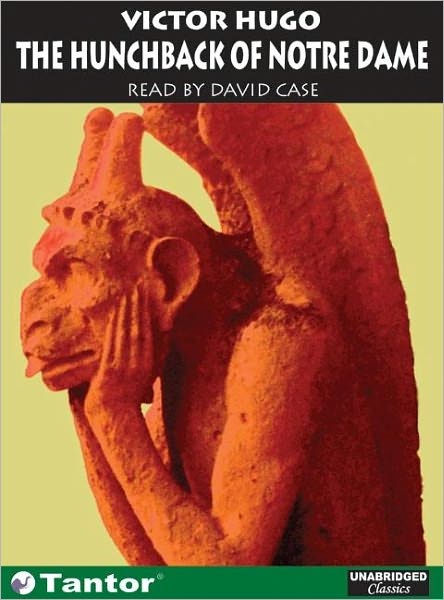
hunchbackThis is a long book, and listening to it as an audiobook makes it longer still. I’ve been at it a week and a half now and am not quite halfway through, so I thought it might be appropriate to break it into two reviews – to remind myself, as much as anything else.

I will not devote too much space to plot synopsis here; this work has plenty of presence in the public consciousness and a rather thorough Wikipedia article as well. The story within the book most centrally concerns Quasimodo, the eponymous hunchback, and Esmeralda, a beautiful young gypsy woman with several admirers. While the story revolves around these two protagonists and their eventual fates, its range is much larger than that. Between events in the lives of Quasimodo, Esmeralda, and the other characters who effect their stories, Hugo describes the architecture of Paris (note the prominence of the Cathedral of Notre Dame in the title and in the story) and the history of both the city and its architecture. He connects changes and trends in architecture to changes in culture, and thereby tells a larger story than just that of his characters; this is also a book about Paris and its people in history.

It can get a little dry. I find this reading (listening) experience to be mixed: at its best, Hugo is hilarious, dry, droll, witty, and sketches people and scenes charmingly. At its drier moments, however, my mind wanders as he describes architecture (I confess, not a particular area of personal interest) and the various period styles involved in the Cathedral, etc. I can blank out on this book for 30 minutes at a time, and I am not highly motivated to fight it; I just let Hugo’s words wash over me, gathering the main effect, and wait for Esmeralda et al to reappear and entertain me. While I am a fan of some forms of narrative within descriptive or didactic ramblings (The Perfect Storm being the perfect example of this done beautifully), this is not one of the more effective or enjoyable versions I’ve come across.

The narrator of this version, David Case, has what I assume to be a fine French accent (that is my mother’s area, not mine), but its nasal, whinging nature can be a little trying. I don’t want to give the impression that I am impatient or annoyed with this book (or this narration) on balance; but I do have some criticisms, you see. I turned it off for a few days in favor of MUSIC (what a joy!), but I was glad to get back to it.

I think this is a great story, and a great point of cultural reference, and I am getting some (needed, and appreciated) education on French culture. I am enjoying it – particularly the narrative parts. It takes a little patience and forbearance – a little more than a faster-paced story would – but I believe it will be worth it. More a Dickens than a Lee Child, you see.

Have you read The Hunchback of Notre Dame? Or do you have any other experiences with similar classics: medium-lengthy, verbose and descriptive, a little challenging but worthwhile?


Rating: I’m going to finish it before I judge.

Teaser Tuesdays: The Hunchback of Notre Dame by Victor Hugo

Teaser Tuesdays is a weekly bookish meme, hosted by MizB of Should Be Reading. The idea is to open your current read to a random page and share a few sentences. And try not to include spoilers!

hunchback

I have begun The Hunchback of Notre Dame as an (unabridged) audiobook. Am I overly ambitious? We shall see. I will say that so far he may be a less-than-ideal gym companion, but time will tell. Here are a few lines I like very much so far…

“Monsieur the Archduke has more than once sought his gloves among my hose.”

A burst of laughter and applause ensued. A witticism or a pun is instantly comprehended in Paris and consequently sure to be applauded.

Oh, so clever. I believe this is a fair representation of some of the humor Hugo has on offer.

What are you reading this week?

movie: Gentlemen Prefer Blondes (1953)

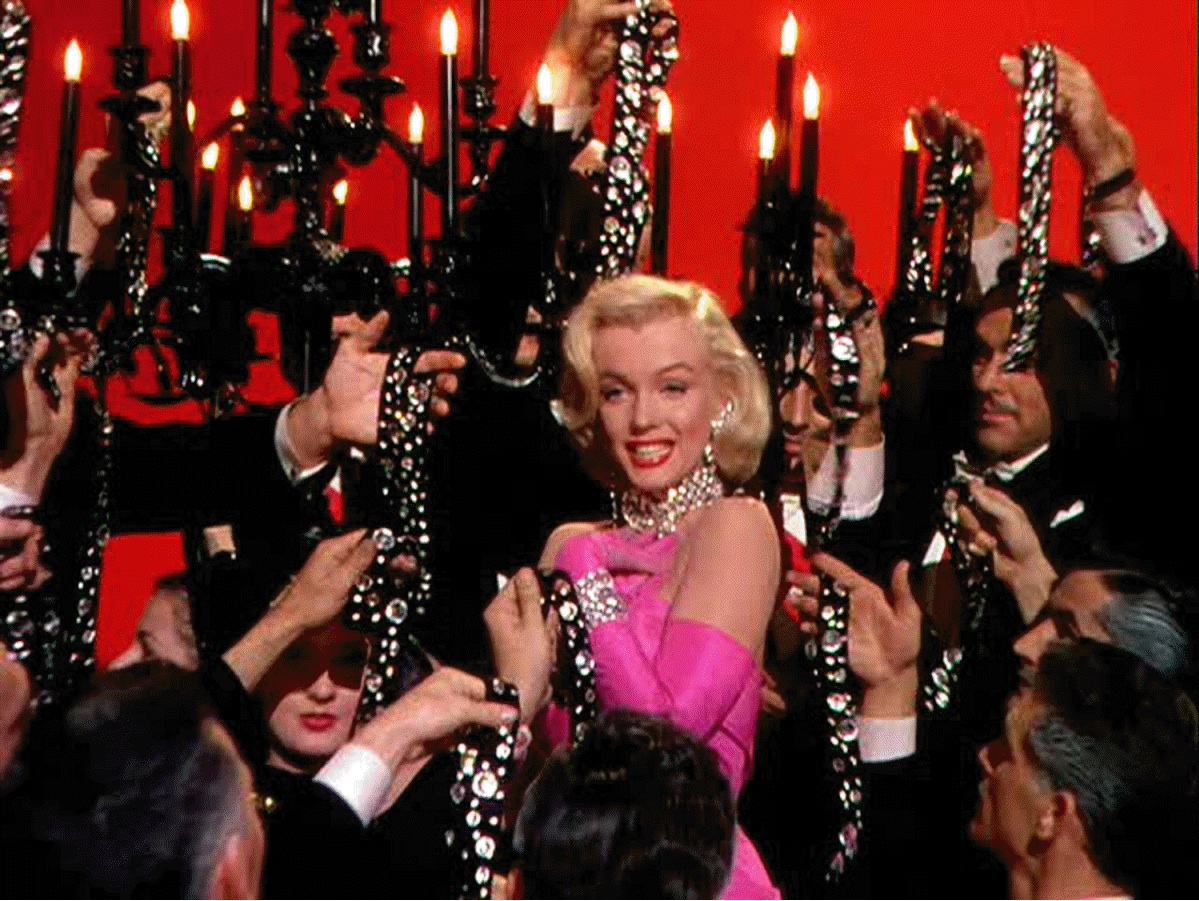
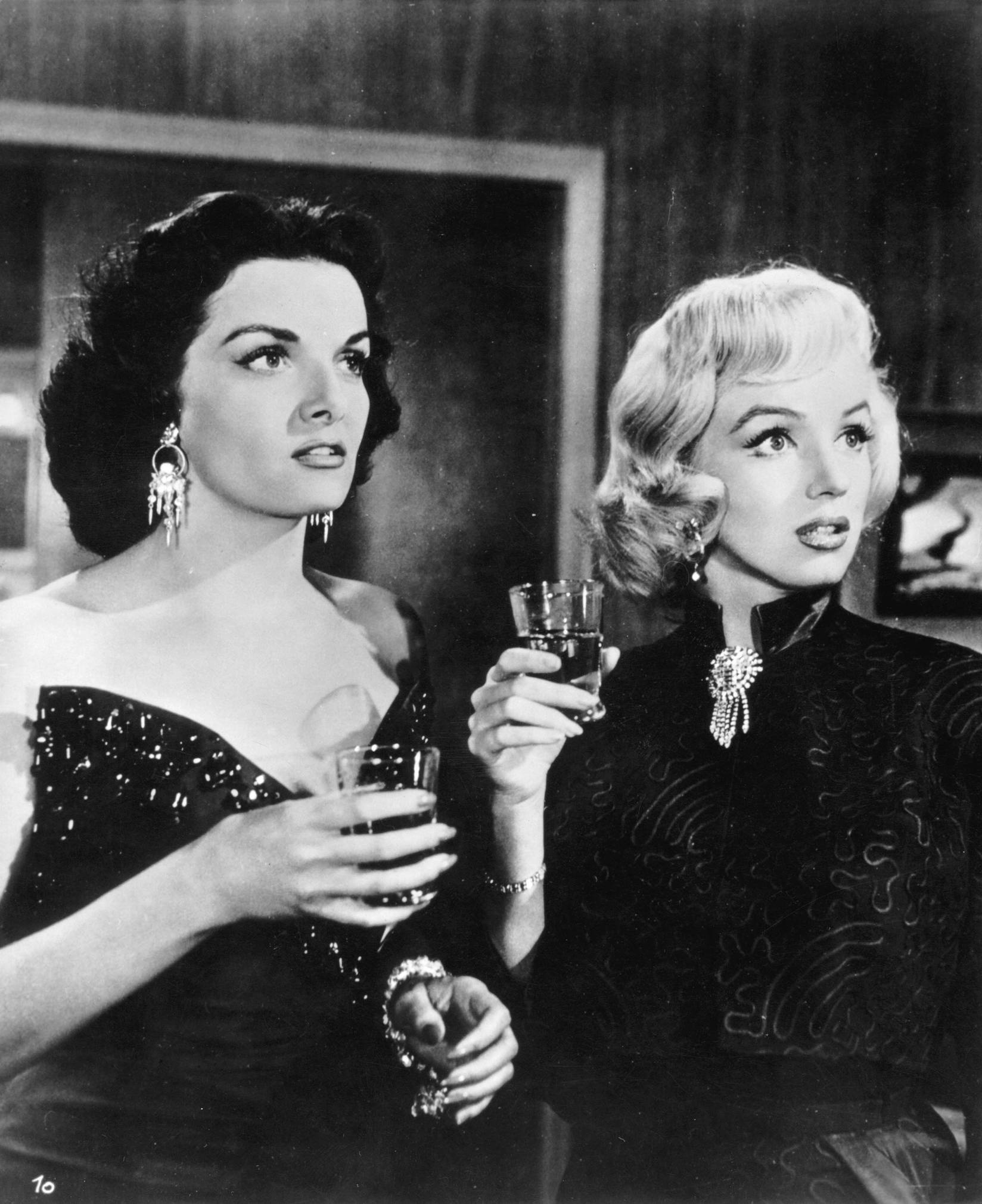
Another classic for you that I found on the airplane: Gentlemen Prefer Blondes, starring Marilyn Monroe and Jane Russell! I had never seen either in a movie before (isn’t that shameful?). And aren’t they both fabulous. I confess, though, I came in rooting for Jane, as the title made her the underdog from the start. [Full disclosure: I was born a blonde and am gradually darkening towards brunette as I age. Does that make me neutral?]

I almost don’t want to bother with a plot synopsis here, as I felt the plot really wasn’t the point, but okay. Jane & Marilyn (I have lost track of their characters’ names) are showgirls. Marilyn is quite a ditzy blonde, and concerned with marrying a man with lots and lots of money. Jane likes to have a good time and wants a man who wants the same, money be damned. Marilyn has a fiancé who is requisitely wealthy, and they intend to marry in France, but his father prevents him from sailing, because he objects to the gold-digging Marilyn; thus Marilyn & Jane sail together. The action of the movie takes place on the ship, where Jane meets a man she might be able to settle down with, and Marilyn meets the owner of a diamond mine and goes bonkers over that possibility. (Enter the song, “Diamonds are a Girl’s Best Friend.” I am rather offended.) From there on it’s all spoilers. But again, the plot isn’t important.


There is mischief and chicanery. This is a comedy, as it turns out, not only an exhibition of the fabulous Jane and the fabulous Marilyn – who do rock every scene in classic, visual splendor. The high-jinks are fun and the slapstick is quite charming. And it’s a musical as well, although there is far less singing than there might be. I was surprised and pleased to note that there is some objectification of the men – how progressive! And they are some nice looking men, too.

I found this film to be more of a fun visual spectacle with great slapstick than such a great story. But there’s no question it was enjoyable – and classic.


Rating: 6 glittery diamonds (naturally).

movie: A Streetcar Named Desire (1951)

On my recent very very long overseas flight, I watched several movies. Thanks Husband for spotting this classic for me! As you may know, A Streetcar Named Desire was a play by Tennessee Williams, published in 1947. I have not read the play, although I studied his Glass Menagerie in high school and appreciated it. Now that I’ve seen the movie, I want very much to read the original, and I would love to see one of TW’s plays performed one day. This film was released in 1951, directed by Elia Kazan, and stars Vivien Leigh and Marlon Brando – wow! [Also in high school, I studied Kazan’s On the Waterfront, alongside Arthur Miller’s The Crucible. Guess what the connection there was.]

You can get a plot synopsis anywhere, so I’ll be brief and spoiler-free. Blanche DuBois shows up at her sister Stella’s apartment in New Orleans from the plantation back in Laurel, Mississippi. She tells Stella that the plantation has been lost and she needs to stay a while. While Blanche is a delicate, swooning southern belle, and Stella a tougher urban woman, Stella’s husband Stanley is all muscle and sensuality. He has no patience with Blanche’s needy weakness, and her presence throws the small household out of balance, just as Stella is expecting a child. There is conflict. I’m stopping there.


This is a masterfully put together film. I positively adored the black and white French Quarter setting: although more than 50 years old now, it was instantly recognizable. I could almost smell the booze and feel the humid heat. Vivian Leigh, Marlon Brando, and Kim Hunter (Stella) are all so perfect, picturesque, and work as archetypes of the characters they play. Kazan is a master of the use of light and dark. Blanche undergoes a metamorphosis of sorts when moving from shadow to light – there is a dramatic scene dealing with the issue. And while I’m on dramatic scenes, the style here is highly melodramatic, with Blanche being the perfect example of what that means: fluttering hands, shrieks and gasps and exclamations, “OH! I just don’t know how I can take it…”, all of which are perfect for her damaged-southern-belle role. And perhaps this adds to the melodrama, but clothes sure do tear easy in this movie. I gave up counting the clothing that got ripped in the action.

Here’s a quick discussion with spoilers. Highlight the following white text to read: I was a little maddened by not knowing whether Stanley raped Blanche in that fade-to-black scene. So I looked it up. Wikipedia tells me that it is indeed only “implied” in Williams’s original. They certainly carried the implication into the film. I think he did rape her. I also learned from Wikipedia that Blanche’s husband had a homosexual affair prior to his suicide, which I had not gathered from the movie; and sure enough, it is later stated in the article that this detail is left out of the film, because of the Hays code. This is unsurprising in context, as I recall from high school that Kazan was a good, government-compliant filmmaker.

Tennessee Williams is absolutely recognizable to me from The Glass Menagerie: he likes his damaged and increasingly crazy southern belles, and their gentlemen callers, doesn’t he? I felt I’d seen Vivien Leigh deliver her closing line before: “I have always depended on the kindness of strangers.” But I’m sure I hadn’t. Maybe it’s just that famous.


As a piece of excellent directing and acting by all three leads (and isn’t Brando smoking hot), and as a fine production of a very fine play, I give this one a near-perfect rating and recommend it as a classic film.


Rating: 9 fluttering eyelids.

The Lady and Her Monsters by Roseanne Montillo

A spirited investigation of the bizarre times that inspired Mary Shelley’s Frankenstein.

monsters

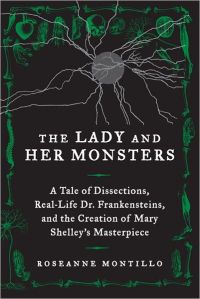
On its surface, Roseanne Montillo’s The Lady and Her Monsters is an exploration of the genesis of Mary Shelley’s Frankenstein. But Montillo clearly rejoices in meandering through the volatile times that gave life to Shelley’s gothic classic, and her multifaceted literary study expands to include discussions of anatomy and alchemy, suicides, ghoulish dissections of men not quite dead and the dramatic death of Percy Shelley at sea.

In the early 19th century, Europe grew increasingly fascinated with life, death and man’s ability to control nature. Grave robbers known as “resurrectionists” provided subjects for human dissections that were conducted both in medical schools and for the general public’s entertainment. Scientists and imposters experimented with the capacity of electricity to restore life. Into this environment, Mary Shelley was born to Mary Wollstonecraft (A Vindication of the Rights of Woman) and William Godwin, a famous reformer of the day. Percy Bysshe Shelley was her lover and eventual husband; her sister was lover to Lord Byron. The foursome were traveling in Italy, telling the ghost stories with which Percy Shelley was obsessed, when–as Mary Shelley and legend have it–a human monster appeared to Mary in a waking dream. It was also in Italy that she may have first heard the surname Frankenstein, tied to the inspiration for Bram Stoker’s Dracula, as well as to Sir George (he who killed the dragon). In Montillo’s enthusiastic prose, such diverse and macabre subjects make for a lively survey, not only of Shelley’s masterpiece, but of an odd and colorful time in European history.


This review originally ran as a *starred review* in the February 8, 2013 issue of Shelf Awareness for Readers. To subscribe, click here, and you’ll receive two issues per week of book reviews and other bookish fun!


Rating: 5 volts.

book beginnings on Friday: The Lady and Her Monsters by Roseanne Montillo

Thanks to Rose City Reader for hosting this meme. To participate, share the first line or two of the book you are currently reading and, if you feel so moved, let us know what your first impressions were based on that first line.

monsters

The Lady and Her Monsters: A Tale of Dissections, Real-Life Dr. Frankensteins, and the Creation of Mary Shelley’s Masterpiece is a fascinating title, isn’t it? I was attracted immediately. It begins:

Camillo’s footsteps echoed loudly as he crossed the empty cobblestone streets of Bologna toward his uncle’s house. The afternoon was hot, and the scorching heat, coupled with that lazy midafternoon spell between noon and evening, allowed him to go by virtually unnoticed.

Although this is a work of nonfiction, I think these atmospheric opening lines are appropriate, since its subject is something of a gothic ghost story.

Happy reading to you this weekend!

This quotation comes from an uncorrected advance proof and is subject to change.

The Adventures of Sam Spade (audio)

Here’s an interesting one for you. I had to do a little research to figure out exactly what I have here, and I’m still unclear on a few issues. Please pardon my rather lengthy introductory remarks.

Sam Spade is a character created by Dashiell Hammett in The Maltese Falcon, which I have not read but very much want to. Dashiell Hammett shares some early pulp-classic mystery genre credit with Raymond Chandler, who I have read (just a little) and enjoyed; also, Hammett was partner to Lillian Hellman for some 30 years. “The Adventures of Sam Spade” was a radio series in the 1940’s through 1951, based on Hammett’s character, but I think that Hammett was uninvolved (or marginally involved) in the radio version. His name (says Wikipedia) was removed from the show when his association with the Communist Party became known.

This three-cd set presents six episodes of the radio show, “digitally remastered” and “including never-before-released episodes” – I take it to mean these are original recordings, then, although I haven’t been able to confirm that in my (casual) online research. They do include advertisements for Wildroot Creme Oil, a hair product that was the show’s sponsor. These advertisements are initially somewhat charming in being period pieces, but they are many, and like any advertisement, they get old. Again, this speaks to the authentic feel of the production.

So what about the stories? The six episodes are… “The Insomnia Caper” (1948), “Sam and the Psyche” (1946), “Love Letter” (1949), “The Overjord Caper” (1949), “The Bow Window Caper” (1947), and “The Charogagogmanchogagogchabuna-mungamog Caper” (1949). Howard Duff plays Sam Spade and Lurene Tuttle plays his secretary Effie. These are radio shows rather than your average audiobook, so they include sound effects – gunshots, breaking glass, revving engines, traffic noise – and not just reading of the stories; rather than a single narrator doing voices for different characters, various actors play each character. This is classic pulp stuff, and it’s great fun. There is a definite element of tongue-in-cheek (at least that’s my reading, I can’t speak to the original intent, and the 1940’s are pretty remote to me, but surely…?) in Sam’s character: he is the exemplar of the wise-cracking, hard-boiled, tough-guy detective.

Each story tends to involve a person hiring Sam as a PI, often against Sam’s own wishes: in “Love Letter”, he gets a love letter from a woman he doesn’t know and heads to the assigned meeting point to find himself immediately involved in a situation he’d rather have avoided. His clients are as dodgy as any other character in the story; and there is often a woman who tries to seduce (or seduces) Sam, as a means of distracting him from a plot. Howard Duff’s gruff playing of the role is a large part of the effective mood of these stories.

While the plot of each is formulaic and somewhat forgettable, and the characters are rather stock, that needn’t detract from the fun of these stories. Formulas are often successful and that’s why they’re repeated (think about Agatha Christie). As a regular listener to audiobooks, this radio format that came with multiple actors and sound effects was a refreshing change. The Adventures of Sam Spade is a little simplistic, and definitely easy listening, but great fun, and different from the usual fare.


Rating: 6 double crosses.

Boule de Suif by Guy de Maupassant

I found a few unaccounted-for minutes the other night, and picked up a short read I’d been meaning to get to: the short stories of Guy de Maupassant. [Recommended by Hemingway.]


This review contains spoilers.

Set in the Franco-Prussian war, this story sees a group of ten citizens of Rouen fleeing Prussian occupation in a stagecoach for Le Havre. They are a mixed group representing a neat cross-section of French society: a merchant couple; a bourgeoisie couple; a count & countess; a Democratic revolutionary; a courtesan; and two nuns. They settle into polite chatting in the stagecoach along social lines, with all turning their noses up at the courtesan. But as the journey goes longer than expected and they are unable to find an inn to serve them lunch or dinner, the courtesan produces a large basket filled with delicacies, and everyone thaws. They make nice with her, and eat her food. The title Boule de Suif is generally translated as “Dumpling” or “Butterball” or the like (I believe, more literally, it is “ball of fat”) and refers to the courtesan:

Short and round, fat as a pig, with puffy fingers constricted at the joints, looking like rows of shorts sausages; with a shiny, tightly-stretched skin and an enormous bust filling out the bodice of her dress, she was yet attractive and much sought after, owing to her fresh and pleasing appearance.

But upon arrival at their overnight lodging, they are held up: the Prussian soldier in charge forbids they continue on their journey until the courtesan will provide her services to him. She refuses, being a patriotic and proud Frenchwoman. And the group seethes: their travels are being held up and, as they point out, this is her business anyway, isn’t it? Why shouldn’t a whore be a whore with a Prussian as well as any other man? They wheedle, exhort, and command – even the nuns – until she is broken down and does the deed and they continue on their way. In the final scene, the socially elevated ladies turn their shoulder away from her again. And everyone has remembered to pack a lunch except Boule de Suif, and no one offers to share with her.

This is a masterfully executed short story, and I can see why Hemingway admired it. The human element is heartbreaking. It is painful to see the defeat of Boule de Suif’s pride and principles; it is maddening to see the disgraceful behavior of the socially superior characters. It is also a neatly devised statement on social class: the merchant and bourgeoisie couples are greedy and grabbing, clearly willing to place their allegiance with whomever will leave them to their profits; the count and countess are weak and craven; the nuns are unchristian in their failure to share food with a hungry courtesan; and the revolutionary is a lecherous drunk. The courtesan is the most patriotic, brave, and principled of the group.

The writing style is enjoyable, too, and again I can see where Hemingway was influenced. Just look at this first sentence:

For several days in succession fragments of a defeated army had passed through the town.

and tell me you don’t see Hemingway there. The meter or rhythm alone reminds me of him; obviously the subject matter as well.

I am rusty in my close-reading skills. I recall a poem I read in high school, for English class, that we picked apart line by line and word by word, finding three and four layers of meaning therein. It was The Black Lace Fan by Eavan Boland, and I really enjoyed the lesson. I think this short story would bear the same sort of close scrutiny. Or, it can be enjoyed as a quick read.

Highly recommended, and I hope I find time for the rest of the stories in this volume soon.


Rating: 9 pretenses.

great beer quotations in literature: Boule de Suif by Guy de Maupassant

Friends, I proudly come from a family of beer lovers, and have my eyes peeled not only for bicycle quotations in the books I read, but for those concerned with beer as well. I dipped into my very first de Maupassant the other day, and he satisfied.

He had his own fashion of uncorking the bottle and making the beer foam, gazing at it as he inclined his glass and then raised it to a position between the lamp and his eye that he might judge of its color. When he drank, his great beard, which matched the color of his favorite beverage, seemed to tremble with affection; his eyes positively squinted in the endeavor not to lose sight of the beloved glass, and he looked for all the world as if he were fulfilling the only function for which he was born. He seemed to have established in his mind an affinity between the two great passions of his life–pale ale and revolution–and assuredly he could not taste the one without dreaming of the other.

This evocation of trembling beer appreciation captivated me entirely. I am easily charmed.

It’s a great short story, too. Review to come.

selected quotations from Walden, with a qualification

Henry David Thoreau’s Walden is a highly quotable and oft-quoted book. I found myself marking passages rather more often than usual, sometimes because I was charmed and wanted to share a line with you later, and sometimes because I noted the origin of a maxim I was familiar with, whose author I hadn’t known before. I’ve already reviewed Walden, and now I want to share a selection of quotations with you too. But first, a qualification.

A friend & coworker sent me this article, which chiefly makes the point that Thoreau was a very complicated man who wore many hats (figuratively. who knows, maybe literally as well). The author notes the danger of quoting Thoreau: so many people know him through his reputation and these handpicked quotations, while rather few have read his work; and his work being so many things at once, so contradictory, handpicked quotations can be a dangerous tool. In other words, many of us may be thrown off by the quotations alone without reading the work. I’ve now read Walden, but the man was so terrifically prolific that I am hardly any closer to knowing Thoreau than I was before! So, fair warning. But I will now share my quotations just the same.

In order of their appearance (page numbers come from my pocket-sized red Barnes & Noble Collector’s Library edition). The book opens:

When I wrote the following pages, or rather the bulk of them, I lived alone, in the woods, a mile from any neighbour, in a house which I had built myself, on the shore of Walden Pond, in Concord, Massachusetts, and earned my living by the labour of my hands only. I lived there two years and two months. At present I am a sojourner in civilised life again. (7)

The mass of men lead lives of quiet desperation. What is called resignation is confirmed desperation. From the desperate city you go into the desperate country, and have to console yourself with the bravery of minks and muskrats. (12)

I say, beware of all enterprises that require new clothes, and not rather a new wearer of clothes. (28)

I had three pieces of limestone on my desk, but I was terrified to find that they required to be dusted daily, when the furniture of my mind was all undusted still, and threw them out the window in disgust. (42)

…a man is rich in proportion to the number of things which he can afford to let alone. (88)

I went to the woods because I wished to live deliberately, to front only the essential facts of life, and see if I could not learn what it had to teach, and not, when I came to die, discover that I had not lived. (98)

I wanted to live deep and suck out all the marrow of life, to live so sturdily and Spartan-like as to put to rout all that was not life, to cut a broad swath and shave close, to drive life into a corner, and reduce it to its lowest terms, and, if it proved to be mean, why then to get the whole and genuine meanness of it, and publish its meanness to the world; or if it were sublime, to know it by experience, and be able to give a true account of it in my next excursion. (98)

Simplicity, simplicity, simplicity! I say, let your affairs be as two or three, and not a hundred or a thousand; instead of a million count half a dozen, and keep your accounts on your thumb-nail. (98)

My house never pleased my eye so much after it was plastered, though I was obliged to confess that it was more comfortable. (256)

The stove not only took up room and scented the house, but it concealed the fire, and I felt as if I had lost a companion. You can always see a face in the fire. (269)

Our village life would stagnate if it were not for the unexplored forests and meadows which surround it. We need the tonic of wildness – to wade sometimes in marshes where the bittern and the meadow-hen lurk, and hear the booming of the snipe; to smell the whispering sedge where only some wilder and more solitary fowl builds her nest, and the mink crawls with its belly close to the ground. At the same time that we are earnest to explore and learn all things, we require that all things be mysterious and unexplorable, that land and sea be infinitely wild, unsurveyed and unfathomed by us because unfathomable. We can never have enough of nature. (334)

I will not try to improve upon this. Good day.