television: Agatha Christie’s Poirot

I have been thinking, again, about some wonderful memories that have helped to shape me. For starters, please go revisit this post, as I think about what a precious gift my Grammy gave me when she took me to see my first live Shakespeare production at a beautiful theatre in San Diego when I was ten. And just now, I’ve been remembering watching Poirot, perhaps Agatha Christie’s best-known detective, when I was a little girl with my mother. I recall vividly the art-deco entry sequence. I loved this show.

In my memory, this was an old show, but I see now that it began in 1987, when I was five years old. So by the time I was watching it it was not new releases, but still pretty recent. Well, I’ve just rediscovered the series thanks to a few different channels on Amazon Prime. There are now thirteen seasons, and thank goodness, because I can’t get enough.

The early seasons are what I remember from childhood. The tone is fairly lighthearted; the audience is invited to laugh gently at Poirot, who takes himself too seriously, and who is accompanied by the variously comic Miss Lemon (with her ridiculous hairstyle and her lovable passion for filing), Captain Hastings (“I say!”), and Scotland Yard’s over-serious Inspector Japp. This is the cast of characters I loved so much as a child, and I find them as remembered, but with more depth and nuance now that I’m a few years older. (Or maybe my memory just got vague.) It goes without saying that Poirot himself is played by David Suchet, my first Poirot and the only one I recognize; I have since encountered other iterations and they are all offensively wrong for the role in my eyes. What can I say; I’m loyal to my first experience? but I really think he is the portrayer. I am not alone. “Agatha Christie never saw David Suchet in the role but her grandson Mathew has commented: ‘Personally, I regret very much that she never saw David Suchet. I think that visually he is much the most convincing and perhaps he manages to convey to the viewer just enough of the irritation that we always associate with the perfectionist, to be convincing!'” (source)
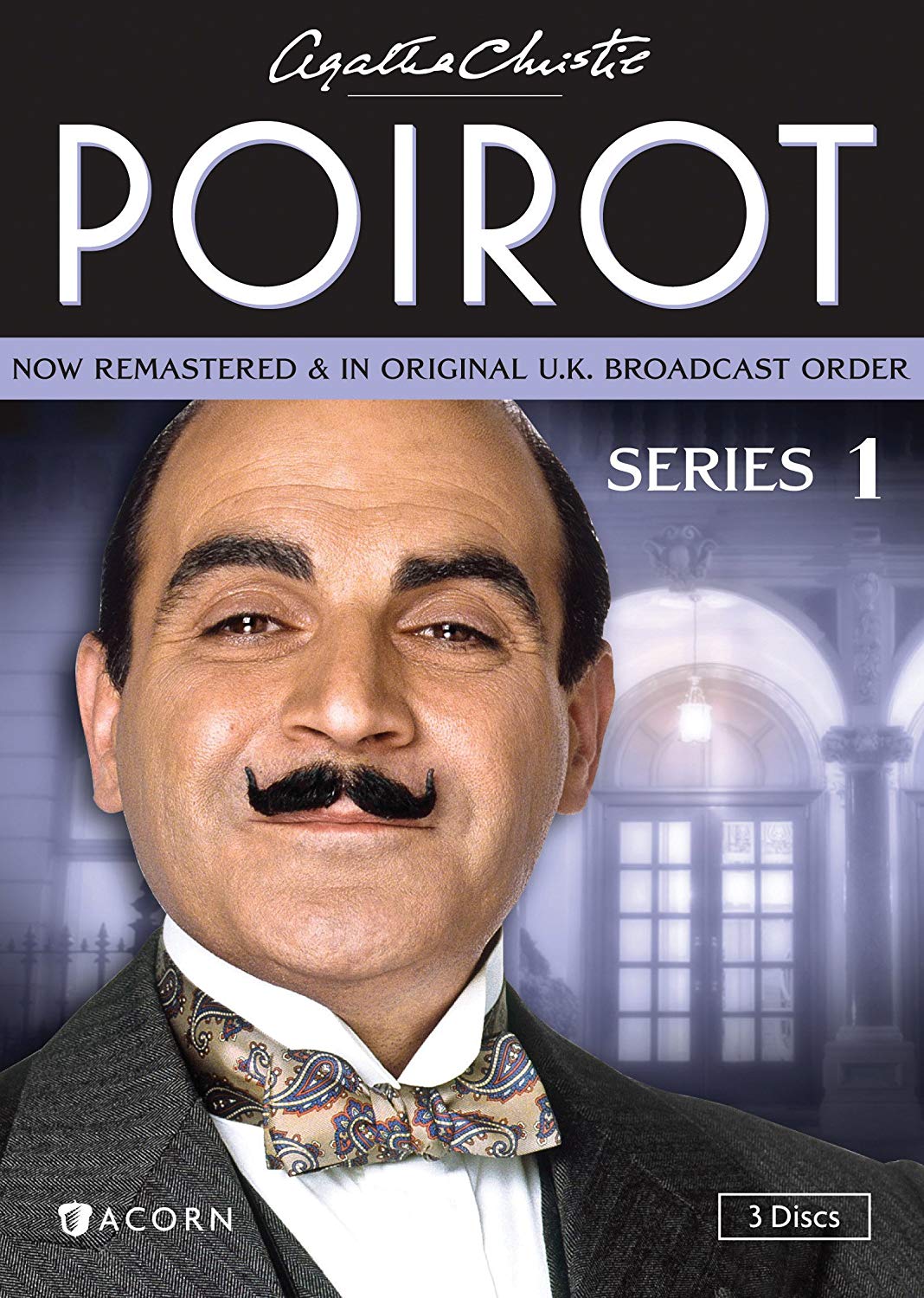
note the twinkle in the eye and the little smile

I am sorry to say that after season eight, Miss Lemon, Captain Hastings, and Inspector Japp mysteriously disappear on us. Poirot is rather more alone from here, although he does gain (in season ten) a new butler, George, and a new friend, Ariadne Oliver, an irreverent mystery novelist who is always, always eating an apple. While Mrs. Oliver is good for a laugh or two, George does not provide much comic relief; neither of them replaces the original trio. The overall tone of the show has gotten less light, too. It feels a little bit, to me, as if the show has taken a step toward taking Poirot as seriously as he takes himself. I think the loss of tongue-in-cheek humor hurts. I love a good dark, grim, gritty mystery as much as anyone does, but having loved a slightly ridiculous Poirot I am less enamored of the darkly serious one. It is also somewhere in here that his Catholicism begins to play a role. I may misremember, but I feel like he used to be cynical about religion; now he is devout, always whispering over his beads. It’s not bad, but it’s different, and if my love for Poirot is much about nostalgia, I don’t like having my original version messed with.

we are getting more serious now

I’m very glad it keeps going, though. By the time I got to Murder on the Orient Express, near the end of season twelve, I was marveling at what wonderful storytelling Christie’s original was, for one thing, and at how glad I am to have this cinematic telling. The Catholicism is big in this one, and the darkness. Atmosphere, and the snowed-in backdrop, are very effectively done. It’s a grand story that I feel I’ve seen and read and heard in several formats by now, and this version does the whole thing justice. I’m so glad this production exists in the world; I feel lucky.

I am impressed to read that Suchet has played the entire Poirot canon by now! and “only slightly short of the target he had set himself of completing the entire canon before his 65th birthday.” (I’m using Wikipedia as a source; original interview here.) But I have the usual feeling of impending loss, as I finish season twelve and face the approaching end. Thank goodness there are so many stories in the world, yes? I hear Bosch is returning for a sixth season this spring…


Rating: 8 little gray cells, obviously.

I guess I rate television shows now too. What the heck.

guest review: Sylvia Center for the Arts presents Orlando (2019), from Pops

From Pops, from Bellingham’s Sylvia Center (formerly the iDiOM).

Sylvia Center for the Arts presents Orlando, by Sarah Ruhl in 2003 and directed by WWU professor Rich Brown, with five players on a spare stage. Woolf and the story are still mostly inscrutable to me, but the players and staging are wonderful, with multiple vignettes easily adequate to carry the story and action. This production is creatively played with humor and energy as the narrative speeds through centuries, while centered on Orlando personally.

It is a very physical interpretation with much movement, often choreographed like dance; passage of time is depicted by the actors furtively running in circles or helter-skelter in the small stage area. They may use each other for props like tables and chairs; small props emerge on cue from pockets or capes. Some minor wardrobe changes occur in the flow of staging. Ship voyages are inventively evoked by actors’ bodies locked together and swaying with the waves.

Karlee Foster as the androgynous Orlando is perfect, physically as well as in body language and expression. She is ruffled, wild and spirited, but also ruminates over social conventions; all of which is belied by a tranquil and well-groomed promotional studio photo. The 3-man chorus is excellent, and not mere backdrop; they serve as continuous narrators but each also plays at least one woman’s part. The fifth player is an exotic Sasha, Orlando’s lifelong icon of youthful love. Her ‘Romanian’ accent is nearly overdone and perplexing, but her irresistible effect on Orlando is intently, comically obvious.

Suiting the tale, Orlando passionately kisses each of many characters (and all players) at least once – or more! Other, intimate couplings are openly implied with inventive, chaste staging devices, like backlit silhouettes or covering capes. And, always fun, there is a Shakespearean play-within-a-play – of Shakespeare’s own Julius Caesar! (the murder of Cassius) It was delightful, lively entertainment; kudos to the venue, the company and the small arts community that continues to display actors of such craft and energy.

What fun this sounds like! I remain unsure of Woolf, and remember Orlando as daunting (I believe from the 1992 film) (then again, I was 10 in 1992, what do you expect). But this stage performance sounds delightful. Maybe that’s just my feeling about (well-produced) theatre in general. I am jealous; I’m not seeing more theatre these days…

Thanks, Pops!

Houston Shakespeare Festival presents Comedy of Errors

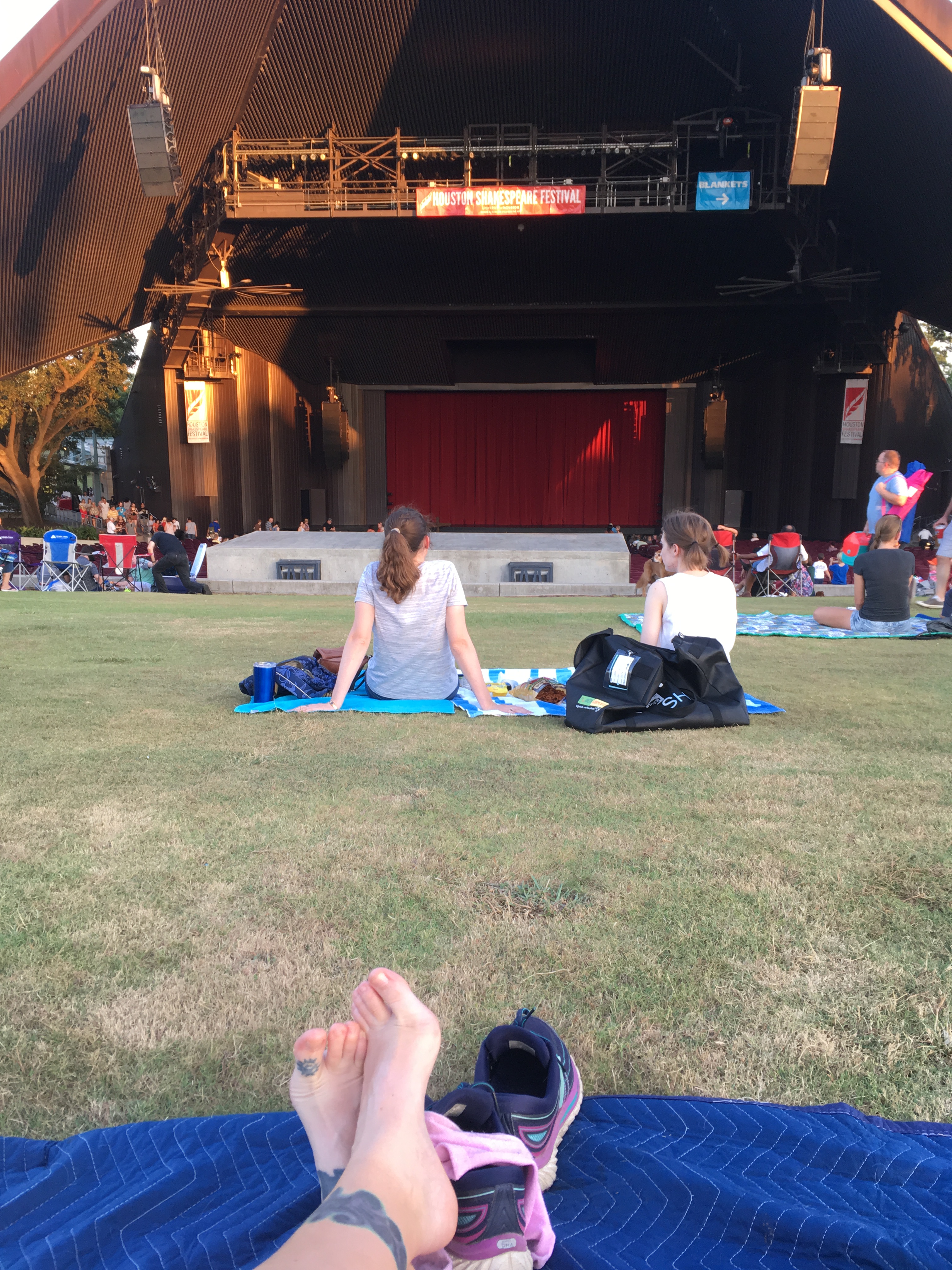
I went home a few weeks ago to see a favorite Shakespeare play as part of a favorite annual event. I’ve been attending the Houston Shakespeare Festival and other events at Miller Outdoor Theatre since I was a small child, and I’ve always loved seeing productions of Shakespeare, as I’ve written about before.

This year’s comedy was Comedy of Errors, a classic. This is Shakespeare’s first comedy, or among his first, and one that establishes several Shakespearean tropes: mistaken identities, twins separated at birth, love triangles (squares, hexagons…). Two sets of twins have been separated, forming two sets of master-and-servant in two rival cities. One set has a father; one set lives near their mother, but doesn’t know it. When the four younger men come into the same setting, hilarity ensues: wives mistake the wrong twins for husbands; goods are delivered to one twin, payment denied by the other. Classically, though, it all comes out right in the end.

my feet before the show

It was lovely being back on the hill at Miller in Hermann Park, with a blanket and a date and a bottle of wine. The setting was so much of it: with people all around me of all ages, skin tones, and configurations; families and couples and groups of friends and solos; picnics ranging from boxes of fast-food fried chicken through elaborate cheese-and-charcuterie spreads. I have to say, though, that this was not the best production I’ve seen the Festival put on. The Houston Press‘s review saw a show in which sound issues had been resolved, but the show I saw had some difficulties; the sound effects to match the slapstick comedic blows were often off, and there were some issues with the actors’ microphones. This was a shame, because the acting was overall very good. A few actors fumbled a few lines, giving a more amateur impression than I remember from years past. But I’m patient with artists doing their best. I was both puzzled and amused by the “exit, pursued by a bear” joke, which comes from The Winter’s Tale and not Comedy of Errors at all, but okay. There were some modernizations, including references to sports and the use of a group of (I’m guessing) elementary school-aged kids. I’m not sure what this contributed, other than to give young actors a chance at the stage, which is a thing I generally support and so I’m amiable about it, but again, puzzling as an inclusion here.

The thing that troubled me most was use of a stereotyped AAVE by the characters played by black actors. A prologue-style opening involved a rap performed by two actors, one black and one white, offering two rather different effects; this made me uncomfortable from the first moments, and every time a black actor stepped onstage, it continued. I don’t see how this contributed to any positive feature of the play. It seems to me that Shakespeare can be produced in two ways. First, it can be done “straight,” that is, played as Shakespeare wrote it, by actors of all races and appearances, without their race making any difference to the characters they play. Or, it can be modernized, and race (along with other constructs, social issues, identity politics) can be brought into the play. But this was neither. This was like straight Shakespeare but with black bodies played for laughs. Ouch. I’m quite surprised that other reviewers didn’t mention this aspect, because it bothered me considerably.

When I can look past this problem with the play–which is on the one hand a huge problem, but on the other hand present for rather few minutes of the evening overall, because the black actors were few–I’m glad to see Shakespeare in the park, for free and produced for the love of it. My date found this, his first Shakespeare play, funny and accessible and fun, for which I’m grateful. I’m glad to see the crowds gather to take in a classic comedy, and I’m looking forward to seeing further endeavors. But this one, not the finest effort of a long-lived institution. I hope they do better next year.


Rating: 5 chains.

San Diego’s Old Globe presents Uncle Vanya

I previewed this one for you a few weeks ago.

Uncle Vanya started slow but ended up enjoyable. The first half, pre-intermission, dragged a little; Grammy felt so, and I did, and I heard similar murmurings about us. I suspect the conversational model for this production (see that earlier post) contributed to this impression, as it indeed took more audience effort to engage with the actors and their lines. And here’s a major flaw in the model: we had read quite a bit about the quietness and the recommendation to use the offered assistive listening devices. We were greeted upon arrival with further cautions on this point. But then we were told that the device was incompatible with hearing aids. Grammy was told that she could take her hearing aids out to use the device, but that her hearing aids should be sufficient. Well, they weren’t. She pretty much missed the first half of the production. We set her up during intermission, and she caught the second half fine, but we did some pretty serious debriefing after the show about what she’d missed, so that she really got the overall story only after the fact. I’m very disappointed in this aspect. It’s a shame that after such effort was taken, we were so poorly served. An innovative production can only be appreciated to the extent that it can be taken in.

That said, the second half picked up in pace (and I found it much funnier), and Grammy could hear, and I observed that the crowd around me perked up. It’s really a fine play by Chekhov, only it requires a little patience. The acting was fine! And the theatre is a lovely space: small and intimate and atmospheric. There is something so special about a theatre in the round. (I spent the first half watching an elderly gentleman in the front row across from me sleeping. He woke up but good in the second half.)

In a classic sense, the plot of the play involves several formations of unrequited love; the resentments of family, class, income, and caregiving roles; and general frustrations about the shape of human lives: family, and our relationship with the natural world. There is a fair amount of humor, but the chief feeling is one of distress. Also classic is the sense that if only these people would talk to each other outright, much would be resolved; but if this is an exasperating tendency of fiction plots, that’s only because it’s an exasperating tendency of people in real life. In the end, I felt sympathy for most of the characters, despite their flaws. I thought the acting was wonderful, especially Vanya, and the doctor, and Sonya, and I thought the production over all was a good one–setting, props, theatre management–and I, at least, had no trouble hearing. But again, the failure to serve my Grammy with the much-discussed assistive listening devices is a crying shame. I enjoyed it, but certainly have some criticisms. As always, I feel very lucky to take in fine theatre in a beautiful city and with great company. Thanks, Grammy.


Rating: 7 glasses of vodka, naturally.

upcoming: San Diego’s Old Globe presents Uncle Vanya

For today, a little background information on a review that is to come.

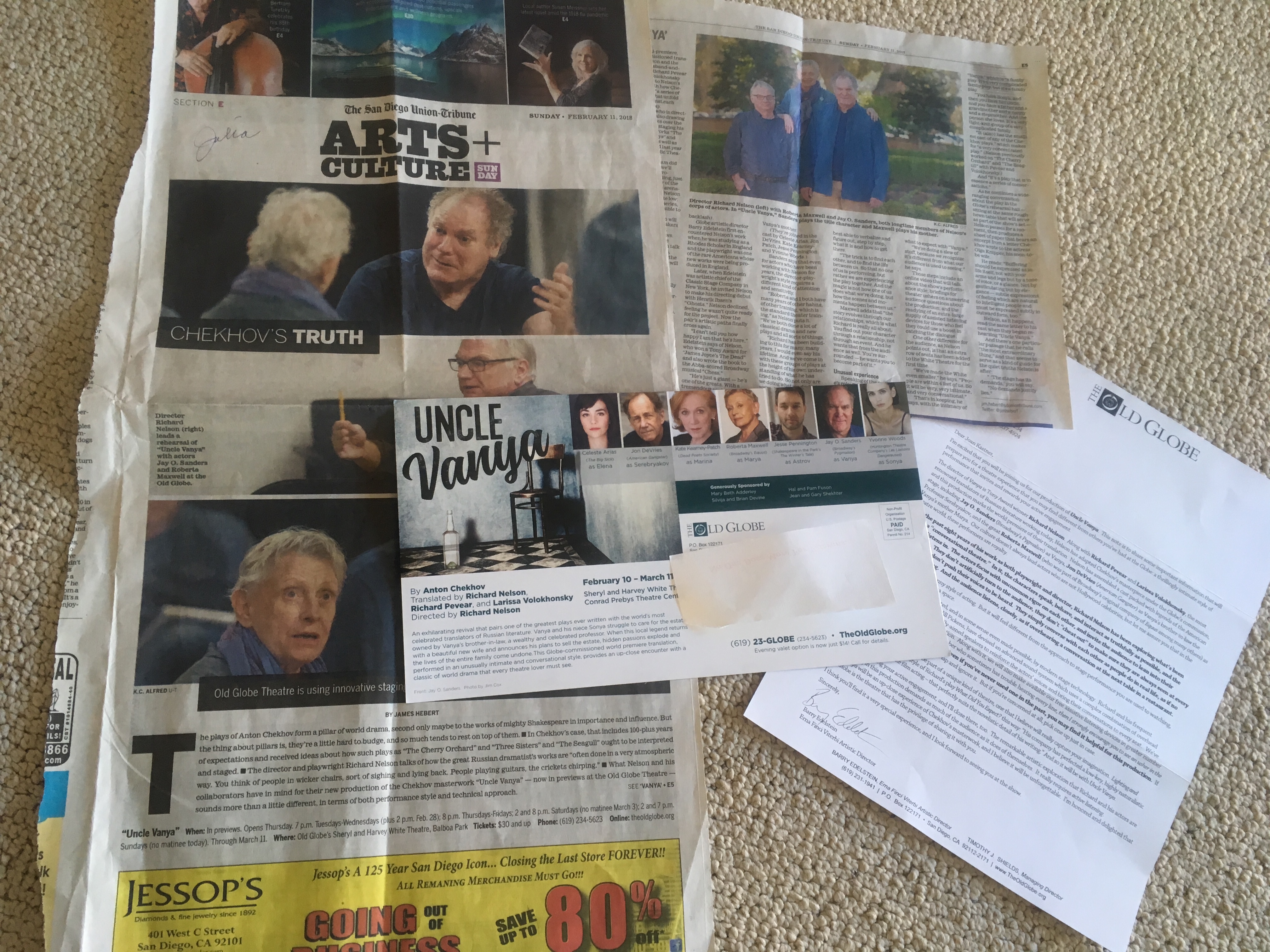
This week, I am so lucky to spend time with my Grammy in beautiful balmy southern California. Among other things, she takes me to such very fine events as this production. And clips all the relevant papers for me to peruse.

Grammy’s paperwork

This is such a different production that I wanted to do a post ahead of seeing the play, so that you get the same preview I did.

Much is being made of this play in advance. This translation of Chekhov’s Uncle Vanya by Richard Nelson, Richard Pevear, and Larissa Volokhonsky was commissioned by San Diego’s Old Globe Theatre, where I still remember seeing Shakespeare’s The Two Gentlemen of Verona with my Grammy and Pop when I was ten. (Lucky, lucky girl.) Pevear and Volokhonsky are today’s “pre-eminent latter-day translators of Russian translators” (from The San Diego Union-Tribune, and I certainly don’t know any better). The theatre installed an extra row of seats for the first time, so an already intimate space becomes still more so. And, stepping away from ingrained theatre traditions, according to a letter sent to my grandmother when she purchased the tickets:

Over the past eight years of his work as both playwright and director, Richard Nelson has been exploring what’s been dubbed a ‘conversational theatre.’ In it, the characters speak, behave, and interact as truthfully as possible, and the audience listens in. The actors focus with uncommon rigor on each other, and invite the audience to lean into their interactions. They don’t artificially turn to the audience, they don’t ‘cheat out’ to make sure they are always seen at every moment, they don’t push their voices to be heard. They simply converse with each other as people do in real life, as if no one were watching. And the audience listens, closely, as if overhearing a conversation at the next table in a restaurant.

Therefore, we are urged to pick up assistive listening devices, which are being provided in larger-than-ever numbers, to help us hear this quiet conversation. Director Nelson points out that Uncle Vanya is “a family play… a very complicated family play, but it’s a family play” with the smallest cast of any of Chekhov’s works.

Some years ago, I saw a play at Houston’s Alley Theatre that referenced this one, but other than that, this is my first experience with Chekhov, though his reputation of course precedes him. I’m really excited to see Chekhov performed at all, but this unusual production sounds especially interesting. It’s always such a treat–to see my Grammy, to see the Pacific Ocean (off her balconies!), and to see fine theatre in such a lovely little space as the Old Globe. I mark my gratitude here, then, and I’ll get you a review of the play in weeks to come!

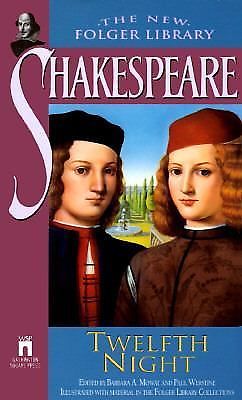
Twelfth Night by William Shakespeare

In preparation for Devon McNamara’s seminar at the recent residency, I reread Shakespeare’s Twelfth Night, in the copy I bought for an undergraduate class some 15 years ago. Some things don’t change. I still love Shakespeare’s comedy, and he remains relevant.

So many Shakespearean tropes here. The shipwreck, the twins, the gender-bending, the misplaced affections. Stranded in Illyria, separated from her brother who she presumes dead, Viola dresses up as a young man to serve the duke Orsino. He assigns her to court, on his behalf, the grieving countess Olivia. Orsino loves Olivia; as a boy “Cesario” Viola courts Olivia for Orsino’s sake; Viola loves Orsino; Olivia promptly falls for Cesario. Meanwhile, Viola’s brother Sebastian presumes her dead, even as Olivia mistakes him for Viola/Cesario. Confused yet? That’s natural. So are the characters of this lively play, but it all ends well* with a double-wedding, of course. Extra comedy is provided by Sir Toby Belch (great name) and his friend Sir Andrew, and Olivia’s Fool, and their fun at the expense of her self-important servant Malvolio (another great name). And wouldn’t you know it, this play is being produced at this summer’s Shakespeare Festival in my hometown, which I hate to miss.

*Not all ends well, though. Even as the heroes dance away to wed, Malvolio is embarrassed and offended, and even though we’ve enjoyed seeing him made fun of we feel badly to see this ill treatment. And Sebastian marries to the disappointment of one Antonio who has loved him throughout. Shakespeare’s tragedies tend to include some comedy; and his comedies do generally allow that all do not live happily ever after.

No major insights here, but Shakespeare is always worth your time, and this one is a good representative choice.


Rating: 8 banks of violets.

For the insight: Devon McNamara’s statement (paraphrased from my notes) that Shakespeare’s major concern was always the relationship between parents and children, upon which all other relationships depend. That is something to ponder, for those of us writing about our parents.

iDiOM Theater presents Hamlet

My third visit to iDiOM Theater, and I would love to be able to say it won’t be my last. It will be my last, because I’m moving away; but I have seen nothing but outstanding performances (one, two) here, and it will be a loss.

hamlet2Confession: I’m not sure I’ve seen Hamlet performed before, and I’m not sure I’ve read it, although I think I did, in high school. The story feels familiar, of course, but I could have gotten that through osmosis. Because I haven’t seen many Hamlets, I’ll defer to my parents, who have seen a number of them, including two or three in a single recent summer: they agree that this is the best Hamlet they’ve ever seen.
From the theatre’s website:

While retaining Shakespeare’s language, director Heather Dyer has abridged Shakespeare’s text to focus on Hamlet’s “struggle as a lost young man whose foundation has been completely shattered” and reducing the emphasis on the international political machinations between Denmark and Norway, giving prominence to the emotional conflict and relationships within the Hamlet family and court. (This edit also reduces the running time to more like two-and-a-half hours instead of the typical four.)

This works very well: two-and-a-half is probably long enough for most of us, and it was dynamic throughout. I’m typically more stimulated by interpersonal and emotional stories than international political ones, myself. The website also makes reference to modern set and costuming, but I have to say that these were quite invisible: both were so modest as to entirely disappear, and by that I mean that the incredibly fine acting outshone everything else. (This is a good thing.) Wonderful things can be done with set and costuming, certainly, but I really think these should be bonuses, not at all requisite to awesome theatre.

The lead is played by Matthew Kennedy, and he was spellbinding. The monologues are at the heart of this work, of course, and he pulled them off perfectly: dramatic but not overly or falsely so, and with all the facial elasticity to make it real. The acting was all-around very good. I enjoyed Ophelia (Nan Tilghman) and Polonius (Jeff Braswell) especially – Braswell’s Polonius was delightfully hilarious, taking full advantage of the script. What a play! I had forgotten (or maybe never fully appreciated) how good this play was, not that I’m surprised; Shakespeare’s genius is timeless. This has all the tragedy and the comedy.

iDiOM continues to please with a tiny, intimate theatre* and professional-level acting that is also, discernibly, community-based. A few actors fumbled a few lines. I can handle it. Hell, I may find time to go see this play a second time. That should be review enough. Congratulations again, iDiOM.


Rating: 9 facial expressions.

See the theatre’s website for details on the new space: this is the last play in the tiny, intimate one I’ve enjoyed. I’m sure new space will bring new wonders for this talented group, though.

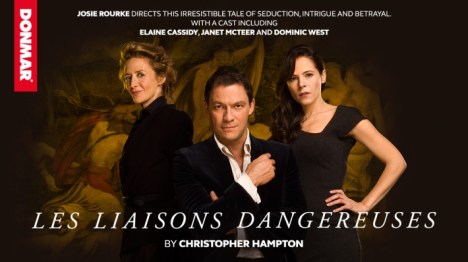
National Theatre Live presents Les Liaisons Dangereuses (2016)

liaisons

I am so glad this is a text format and I don’t have to try to pronounce this title for you.

NT Live always does an amazing job, and Les Liaisons Dangereuses is no exception. The play by Christopher Hampton is based on the 1782 epistolary novel by Pierre Choderlos de Laclos, and I came in with little prior knowledge of either play or novel: I did see a certain 1999 Hollywood movie based on the same plot, which I’m a little embarrassed to admit, but that’s the background I had coming in. And actually, the feel of the thing was recognizable, although the sumptuous costuming of NT Live’s period-appropriate version was a decided improvement.

In brief: this is a very sexual and sexy play. I find the Pickford‘s plot summary too perfect not to simply repost here.

Former lovers, the Marquise de Merteuil and Vicomte de Valmont now compete in games of seduction and revenge. Merteuil incites Valmont to corrupt the innocent Cecile de Volanges before her wedding night but Valmont has targeted the peerlessly virtuous and beautiful Madame de Tourvel. While these merciless aristocrats toy with others’ hearts and reputations, their own may prove more fragile than they supposed.

It is a story of sex, power, gender politics, revenge and spite. I have said before that the NT Live screenings sometimes come with too much exposition – that is, speechifying before the play and during intermission – but in this case I enjoyed and benefited from the background. Playwright Hampton makes some interesting points about the original being a feminist novel; I saw this interpretation in his strong female star, who may not be always likeable but certainly knows her own mind, and works with great awareness against the confines of her society.

This is more than a simple soap opera of who slept with whom and who was angry about it. Although I think it works, and titillates, on that level, I found it rather more political than shallow. And visually gorgeous, and emotive, and affecting; and as always with NT Live, the acting was outstanding and the cinematography perfect. Sorry, I’m raving again. But again, catch some NT Live if you can!


Rating: 8 letters.

movie: Breakfast at Tiffany’s (1961)

breakfastFinally got around to the movie! This 1961 adaptation of the Truman Capote novel was an enjoyable visual and emotional experience – not quite the same feat the novel achieved, but what else is new? Perhaps the main point – not that you didn’t know it – is that Audrey Hepburn is a doll. Movies this old generally feel slow-paced to today’s audiences, and while this was true here, the appealing visuals – Audrey, as well as historic New York – and intrigue of the story were plenty engaging for me. Husband went to bed before it was over, though. I wonder if it would have been more interesting if he had also read the book first.

audrey

It should not be surprising that the gender roles of the time were hard to watch sometimes, but again, what’s new. There were a few twists from the story Capote wrote (that’s why they call it an ‘adaptation’), but I felt that the feeling was faithful. Holly Golightly is an airhead, a dingbat, obnoxiously needy; but on another level, surprisingly self-aware and conniving, even wise. This is what I interpret O.J. Berman means when he calls her a “real phony.” The emotional effect of this character – dingy, ditzy, defiant, vulnerable, both an object and the vehicle of her own existence, both stupid and clever – is the strongest element of the film, despite certain weaknesses. For example, Mickey Rooney’s portrayal of Mr. Yunioshi is obviously, cringingly racist to today’s eyes. It can be hard to reconcile these things. But there it is; I watched the movie anyway.

This is a historic and iconic adaptation of a fine novella, and well worth viewing.


Rating: 7 cigarettes.

movie: Les Misérables (2012)

You know the title, of course. It began as a novel by Victor Hugo in 1862, with the original (French) version coming in somewhere near 2,000 pages long: fewer in English, but no, I have not read this one. (I listened to the audiobook of The Hunchback of Notre Dame. Also long.) It became a sung-through Broadway musical to great success (Wikipedia says it was the second-longest-running musical in the world), and I am now reviewing the 2012 movie, which I saw at home with Husband and Pops, courtesy of our local library.

I was pretty unfamiliar with the story: I read a quick synopsis online just before viewing. It wasn’t hard to follow, though. I’ll make it extra quick for you, since there are plenty of plot summaries out there and you may already know it, anyway. In 1815 France, Jean Valjean is finally released from a 19-year forced-labor sentence for stealing a loaf of bread to feed his sister, nephew and self. He is, unsurprisingly, resentful. He violates parole and disappears, reappearing to us some years later as a good man, mayor and factory owner who cares about the people he holds power over. Inspector Javert, who knew Valjean as a prisoner, continues to seek him out, hoping to hold him responsible for the crime of skipping parole. Valjean’s continued attempts to do good do him no good. He adopts the orphaned daughter of a local citizen, and goes on the run with his newly formed family. The evil innkeeper & wife who had been fostering the girl repeatedly offer comic relief from an otherwise tragic and horrifying plot. The story’s central conflict crescendos with the Paris Uprising of 1832.

This movie is packed with stars: Hugh Jackman, Russell Crowe, Anne Hathaway, Amanda Seyfriend (one of the ditzes from Mean Girls), Sacha Baron Cohen (Borat), Helena Bonham Carter, and Eddie Redmayne (The Danish Girl). Samantha Barks plays a beautiful Éponine. The imagery is gorgeous; all the costuming, scenery, etc., and of course all those beautiful people. I found the story evocative. And the singing! Who knew Crowe, Jackman, Hathaway, et al had such voices on them? The music was rousing and emotive: it’s not hard to see why the Broadway show did so well.

Am I inspired to read ~1500 pages of English-translated Hugo? No, not just yet. But I will gladly see a stage production of this musical story. It was a great and involving time.


Rating: 8 loaves of bread.