Hemingway’s recommended reading

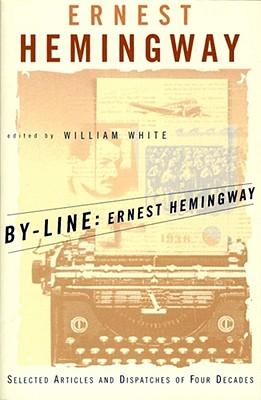
In reading By-Line: Ernest Hemingway, I have been struck several times over, now, by his graciously recommending books that I should be reading. I have compiled them here for you in case you are as interested as I am:

Anna Karenina, Tolstoy
Far Away and Long Ago, W.H. Hudson
Buddenbrooks, Thomas Mann
Wuthering Heights, Bronte
Madame Bovary, Flaubert
War and Peace, Tolstoy
A Sportsman’s Sketches, Turgenev
The Brothers Karamazov, Dostoevsky
Hail and Farewell, George Moore
Huckleberry Finn, Mark Twain
Winesburg, Ohio, Sherwood Anderson
La Reine Margot, Dumas
La Maison Tellier, De Maupassant
Le Rouge et le Noir, Stendhal
La Chartreuse de Parme, Stendhal
Dubliners, James Joyce
Yeats’s Autobiographies
Midshipman Easy, Marryat
Frank Mildmay, Marryat
Peter Simple, Marryat
L’Education Sentimentale, Flaubert
Portrait of the Artist, James Joyce
Ulysses, James Joyce
Tom Jones, Henry Fielding
Joseph Andrews, Henry Fielding
The Open Boat, Stephen Crane
The Blue Hotel, Stephen Crane

…as well as “all the good De Maupassant, all the good Kipling, all of Turgenev… Henry James’s short stories, especially Madame de Mauves, and The Turn of the Screw, The Portrait of a Lady, The American -” here he is interrupted by the young writer to whom he has been dictating. (The young man says he can’t possibly write all these down, and Hemingway promises to give him more the next day; “there are about three times that many.”)

The list I’ve compiled here for you comes from two different articles. In the first, he’s basically discussing boredom, not having the opportunity to hunt or fish, and having already read for the first time all “the best of the books”; he says he “would rather read again for the first time [these books] and a few others than have an assured income of a million dollars a year.” In the second story, Hemingway portrays himself as pestered by a young struggling writer who has traveled to Key West to beg for his advice and help. Hemingway employs the young man and is tortured (it would seem) by having these advice-giving sessions, in one of which he gives a slightly different list of books that it is “necessary” a writer have read. I have bolded for you the ones that appear in both of his lists.

So how do we feel about this? Well, first of all I feel shamed, because I have read exactly THREE of these books. Dear, dear! I’m not exquisitely well-read but I generally feel I’m above-average. (Don’t ask me what the average is, that’s a whole new subject. I am especially above it if the “average” is those kids on Jersey Shore. They write books too, you know.) I have read Wuthering Heights, Madame Bovary, and of course The Adventures of Huckleberry Finn, all three of which I absolutely agree are outstanding and timeless books. So do I need to follow Hemingway’s advice? Well, as I’ve said before, I consider myself awfully a fan of his. I am inclined to want to read the books he considered “best” and “necessary.” These generally sound like solid pillars of a person’s education who wants to call herself well-read. I shall put them on The List but you know how that goes. The List is pages and pages long.

What about you? What do you think? Are you inclined to take advice from Papa? (Perhaps you despise Papa. Some people do. It’s allowed.) Or what about your favorite author – would you feel strongly about reading the books he or she described as “best” and “necessary”? How about the fact that there is only one book on his list by a woman? How bothered are you by this? I’d love to hear your feelings! Thanks and have a happy Tuesday!

vacation reading: a series of short reviews

The Strange Case of Dr. Jekyll and Mr. Hyde by Robert Louis Stevenson. Still a good story! Spooky and short, it’s a bit reminiscent of Poe. Action-packed and efficient. I would not have sworn I had read this before, but now I recognize that I have. What a classic. I highly recommend this as a bang-for-the buck, action-packed, early sci-fi spookster with a bit of meditation on the human condition. Not sure if I should count this for the Classics Challenge as its a re-read. :-/


Worth Dying For by Lee Child. (audiobook) Surprisingly good as audio. I wasn’t sure. I’m such a BOOK purist that audio doesn’t always work for me; but it can’t be argued with on a road trip. Part of what made it special, too, is that I got to share it with the Husband, who doesn’t normally read. He got really into it, and we shared this suspenseful adventure together. That’s priceless.

Classic Jack Reacher! He’s such a Rambo. It’s a bit comical in the over-the-top violence and general bad-ass-ness, but I eat it up. It’s great fun. We both enjoy the slight absurdity of it, while also appreciating that we can count on this guy to get it right. And I finally begin to understand, at least a little bit, what was so frustratingly up-in-the-air at the end of 61 Hours. This may be my favorite Reacher novel yet.


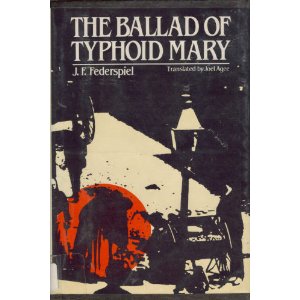
The Ballad of Typhoid Mary by J.F. Federspiel. Opening quotation: “Life is strange and the world is bad.” (Thomas Wolfe) This sets the tone.

This is another creepy story. It’s historical fiction, and I have made a note in large letters to read up on the concept of Typhoid Mary and how much we know about her in the real world. She was a carrier of typhoid fever: she never got sick herself, but she made people around her sick, to the tune of several hundred at least. She was a cook, passionate about cooking for people, despite seeming to understand that she was killing them. She wasn’t a serial killer; she didn’t do it on purpose; she just didn’t let it stop her. What can we expect, in an age with poor understanding of hygiene and the spreading of disease, of a poor, uneducated, abused & orphaned young woman with no opportunities who suspects she might, in some way, be responsible for all these deaths around her? This was a fascinating read, and another very short one, too.


The Man Who Mistook His Wife for a Hat by Oliver Sacks.This is a collection of case studies, or short stories, or essays, by a neurologist who also fancies himself a philosopher with literary leanings. It was quite attention-grabbing, and I had to keep putting it down to tell the Husband stories. Reading about brain injuries or anomalies of the brain is infinitely more interesting to me since I had my bad wreck and experienced some brain injury and healing of my own. The most interesting thing about a number of these cases is that these patients often don’t realize that anything is wrong!

Sacks’s approach is to contemplate the relationship between mind, body, and soul, which perhaps too few of our hard scientists do. It still ended up a bit on the hard-science side for me, perhaps; he made a number of references (unexplained) to other hard scientists, which made it a bit less accessible to us laypersons. But I loved the stories, the concepts, possibilities, complexities of the human mind.


In the Woods by Tana French. I’ve been hankering for more of Tana French since reading Faithful Place. I really fell for that Frank Mackey! This one opens with immediately recognizable poetry-in-prose, stark, gritty, and strongly Irish. Then I was disappointed to recognize a familiar story: grown male detective forced to confront unsolved childhood trauma of missing friend(s). Argh! But I guess why mess with a good thing…

Oh man. I stayed up nearly all night to finish this book. (and this, in a place where I LIKE to get up to watch the sun rise!) Same story my head; it did have its plot similarities but it was so gripping and spooky, like a ghost story, except even spookier because there was nothing supernatural at all, just creepily realistic human nature. I can’t wait to get the next book!

Side note: the beautiful, tragic, doomed, perfect friendship reminded me somewhat of One Day by David Nicholls, which had an entirely different tone to it.


Echo Park by Michael Connelly. (audiobook)Another highly enjoy audiobook! This one unabridged, thank goodness. (I realized AFTER we listened to Worth Dying For that it was abridged, and now have to go back and read the book.) Connelly, for all that he’s sort of stark and black-and-white, also strikes me as a poet; I love that Bosch “educates” his ice with vodka. That’s unique! I’ve read this book before, but it’s been long enough that I still enjoyed the mystery. I like all the background or frame elements in Connelly, like the jazz (and I like that the Library of Congress, and some clever librarian there, make an appearance in relation to the jazz), and the audio format took advantage and gave us a few jazz riffs in the background here and there, which was a nice touch. I hadn’t really thought about using music on on audiobook, and actually, there were some other snippets of music added that I didn’t think worked so well; but jazz behind Connelly is a strong choice.


Whatever You Say I Am (the life and times of Eminem) by Anthony Bozza.I put this in the same category as the Hefner biography, actually. These are some highly controversial men, offensive to many if not to all, who have impacted our world; without making a value judgment, I can say I find them interesting to read about. My feelings about Eminem are complicated, just like with Hefner. (I was talking with my Pops the other night along these lines and we put Reagan in the same category but that’s a whole new can of worms.) I haven’t finished this book, am less than halfway through, but I can say I really enjoy the way Bozza puts his reader fully into a time and place. For example, to help place us in the year in which Eminem was working to release his first album, he gives us a full rundown of the musical hits and award winners of the year in various categories, as well as what movies and television were hot. Now, I’m not generally all that up to date on pop culture, but this worked for me; it really evoked a time in my life. I think that works for all of us, because isn’t sound or music second only to smell as a mnemonic? Doesn’t hearing a particular song take to you a time and place? At any rate, I’m enjoying this biographical study of a controversial figure.


And finally, By-Line: Ernest Hemingway. As I’ve said, I’m enjoying reading Hemingway’s usual tone and style, that I know so well, used in journalism. I hadn’t read any of his journalism before. I guess the nonfiction I’ve read would be Death in the Afternoon and A Moveable Feast, and then all that fiction that’s so heavily autobiographical. Any Hemingway I can get, I like.


I’ll keep you up to date on the books I still have to finish; and I have a few Maisie books waiting for me. I might finally be caught up!

book beginnings on Friday: Dr. Jekyll and Mr. Hyde

Thanks to Katy at A Few More Pages for hosting this meme. To participate: Share the first line (or two) of the book you are currently reading on your blog or in the comments. Include the title and the author so we know what you’re reading. Then, if you feel so moved, let us know what your first impressions were based on that first line, and let us know if you liked or did not like the sentence. (You might also consider visiting the original post where you can link to your own book beginning.)

Okay, so it’s not on the loooooooong list of TBR’s I made you suffer through last night. 😛 I just needed something to get me through a few spare moments til I could get home and on the road, where my TBRs await. I chose The Strange Case of Dr. Jekyll and Mr. Hyde by Robert Louis Stevenson (author of Treasure Island, yum!) because it’s a whopping 78 pages – just what I needed.

So, here’s your book beginning!

Mr. Utterson the lawyer was a man of a rugged countenance that was never lighted by a smile; cold, scanty and embarrassed in discourse; backward in sentiment; lean, long, dusty, dreary and yet somehow lovable. At friendly meetings, and when the wine was to his taste, something eminently human beaconed from his eye; something indeed which never found its way into his talk, but which spoke not only in these silent symbols of the after-dinner face, but more often and loudly in the acts of his life.

It takes a moment to get into this sort of semicolon-laden prose but I do enjoy it. Good fun, and I shall finish it before the sun goes down and get on to those TBRs. 🙂 Happy travels to me, and happy weekends and whatnots and whatevers to you, adieu.

Challenge Update: Classics

Continuing in the theme of challenge updates, we have a slow-starter here, for me at least. Good thing I only signed up for a bachelor’s degree in this Classics Challenge; I’m feeling rather ho-hum and not too proud of it.

The idea, as designed by Stiletto Storytime, is expressed with some purposeful vagueness: we get to decide what a classic is! The bachelor’s level comes out to 10 books in a whole year. I can do this! I just haven’t started yet.

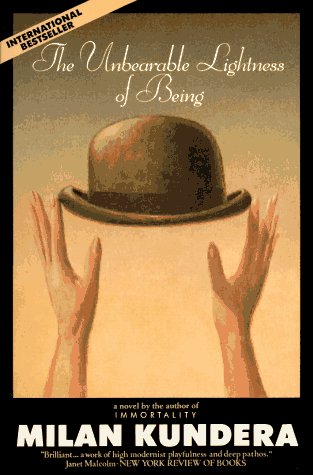
I do have a few ideas in mind… I have The Unbearable Lightness of Being by Milan Kundera set aside… and I keep wanting to reread The Count of Monte Cristo. But I don’t think a reread should count; do you? Ah dear. Which brings me to my question for this post – please do comment and let me know! What is a classic? How does one choose? How old does it have to be to be a classic? Can we judge a 2010 book as being a “classic” already? It can be fiction or non, right? The challenger answers thusly: “A classic to me is a book that has in some way become bigger than itself. It’s become part of culture, society or the bigger picture. It’s the book you know about even if you have not read it. It’s the book you feel like you should have read.” …which I think pretty clearly allows nonfiction, but hasn’t settled my question of publication date at all. I don’t really have a book in mind that I’m questioning, but I’ll definitely ask you if I come up with a specific question. 🙂

I think I’m still (still!) suffering from laziness-in-books, after finishing graduate school 14 months ago now. I’m so entertained by fluffy genre fiction (Child! Connelly! Burke! ok he’s less fluffy, a bit), and have trouble getting into heavier books. Does a classic have to be heavy? I did recently sit down and devour Pride and Prejudice in one sitting, yum. (another reread.) Wish me luck in this one… this might be my most challenging challenge, so I’m glad I took it on! Will let you know how it goes.

book beginnings on Friday

I shall optimistically post a Book Beginning today, in the hopes that I will soon be able to Begin a new Book.


I’m struggling with which of the four books on my desk to choose for my Next. Let’s see. There’s a Jack Reacher novel by Lee Child, Persuader (great title for Reacher, I think!), set in Maine (this is important for the sake of the Where Are You Reading? Challenge). I like Reacher very much; this is tempting. It would be “light” after this clunker nonfiction that I’m currently involved in, hm.

Next there’s The Unbearable Lightness of Being by Milan Kundera, an oft-mentioned classic (thus good for the Classics Challenge, hm) that I’ve never read and know that I Should.

Then comes By-Line: Ernest Hemingway. This is required reading for me because I’m a huge, huge fan of Hemingway, and this is one I have NOT read – I’ve read all his novels and I THINK all his short stories although it’s hard to figure out for sure considering all the various collections; but only a few of his nonfiction. This is a collection of his journalism, and the back of the book claims that “more intimately than all his fiction, Hemingway the reporter reveals Hemingway the man.” I need it.

And finally we have The Man Who Mistook His Wife for a Hat by Oliver Sacks. This caught my eye because Eva over at A Striped Armchair was just recently extolling the author and specifically this book. It’s sort of pop-science in a series of case studies by neurologist Sacks. I’m intrigued, all the more so by Eva’s glowing praise. I’ve discovered a handful of pop-science/medical, very readable nonfiction in recent years, like My Stroke of Insight by Jill Bolte Taylor, The Immortal Life of Henrietta Lacks by Rebecca Skloot, and The Spirit Catches You and You Fall Down by Anne Fadiman. This one might be up next.

This is not a very successful book beginning post just yet. With which should I tease you, and me?

Let’s try this again.


Thanks to Katy at A Few More Pages for hosting this meme.

How to participate: Share the first line (or two) of the book you are currently reading on your blog or in the comments. Include the title and the author so we know what you’re reading. Then, if you feel so moved, let us know what your first impressions were based on that first line, and let us know if you liked or did not like the sentence.

From the first page of Lee Child’s Persuader:

“The cop climbed out of his car exactly four minutes before he got shot. He moved like he knew his fate in advance.”

This is so like Child. Everything is exact. I love it. What’s Reacher gotten himself into this time?

Thanks for bearing with my messy post this evening. 🙂 Have a lovely weekend and I’ll “see” you on Monday!

Classics Challenge 2011


I’ve decided to take on another challenge, because this one is just my cup of tea. I studied Political Science as an undergrad, but sort of still regret not studying English Lit. I continue to consider going back for… a second BA? a second master’s? or a PhD someday? (am I crazy?) in literature. I earned a master’s degree in Library Science as a career choice, in part because of my love of books, classic and otherwise, but with a special passion for the classics. So it sounds like I have a lot in common with Courtney over at Stiletto Storytime.

The Classics Challenge she’s putting on offers several levels, and I guess I AM crazy for even mentioning the PhD above, because the PhD level is 40 classics this year!! You might want to be a PhD candidate (and not otherwise employed) to do that. I guess it’s possible for the rest of us, but with my busy life I’d probably have to read ONLY classics to make it work, and I’m not interested in specializing quite that much. For one thing, my library job is best done if I can discuss the latest, greatest bestsellers with my patrons, and these do not tend to be classics.

I think I’m going to jump on board at the bachelor’s degree level. This means reading 10 classics before the end of the year. I think this is a reasonable goal. Thanks so much Courtney for getting me involved! Now where to begin? Mmmm.