The School Between Winter and Fairyland by Heather Fawcett

Can’t get enough Heather Fawcett; I’m powering through her books for younger readers. This is offered to ages 8-12. Autumn Malog is twelve years old when we meet her. She serves as a beastkeeper for the Inglenook School for young magicians, as the Malogs always have. It is a humble role, and she’s a little wistful for the magicians’ cloaks and privileges and learning, but you can’t change what you come from. And anyway, she’s far more concerned about her twin brother, Winter, who has been missing for nearly a year now, presumed dead by everyone but Autumn. She has always been able to feel Winter and his whereabouts; she can’t tell where he is now, but she is sure that he still is. “Nobody believed her, and she couldn’t really blame them. It sounded far-fetched even to her. So, rather than trying to convince anyone, she set about gathering evidence.” Autumn is no-nonsense like that. Better to get it done than to muck about. She is burdened with three useless older brothers, and the family is rounded out by Gran, even more no-nonsense than Autumn, unsentimental, but gifted in her care of the monsters that the family keeps safe and healthy for Inglenook.

Then Autumn encounters Cai Morrigan, one of Inglenook’s most famous students ever. Just twelve years old, he is prophesied to save their kingdom from the Hollow Dragon. But he is less impressive up close than his reputation would have it; and he shares with Autumn his great secret: he is terrified of dragons, to the point of fainting within dozens of yards of them. He asks for her help, and Autumn in turn asks him to help her find Winter. These two quests will bond the two young people, and offer bigger, more existential challenges than either anticipates.

I love this wholesome story about toughness, finding one’s tribe, and when to accept and when to push back against the limitations life proposes. It is also about friendship as well as familial love. And fanciful monsters, and plucky heroes, and the call of the forest. All good things, compellingly told. I will continue to live in Fawcett worlds as long as she creates them.


Rating: 7 slices of seabread.

rerun: Gone to the Woods: Surviving a Lost Childhood by Gary Paulsen

I still think about this book and should find time for a reread. In case you missed it, please check on Gary Paulsen and his wonders (and traumas).

I had not thought of Gary Paulsen in years, until I saw the Shelf Awareness review of this new book. (Hat tip to my colleague Jen Forbus for that review.) Paulsen might have been the first author I really fixated on; I remember setting out to own all his books, and while I didn’t get very far (maybe six or eight of them), I’m pretty sure I wrote “Julie’s Gary Paulsen library” or some such inside the cover of each one, and had them set up on their own little shelf. Early signs of something, there. My favorite was Hatchet, of course, and its sequel; and I vividly remember a scene from the beginning of another book where the narrator watches a… chipmunk? eating another creature, blood down its front… what book was that?

Anyway – when I saw that he’s returned with a memoir of his own childhood, I was sold. And let me tell you. This book had me entranced from the opening lines. I wept.

Gone to the Woods has an innocence and a simplicity built into its writing style and the value system, I think, of its narrator. This makes it accessible to younger readers, but not at all to them alone. I think this is a memoir for everyone. Paulsen tells his story in the third person, calling his protagonist only ‘the boy,’ although the name ‘Gary’ is used once or twice by other characters. This helps to give the boy an elemental quality, like he’s sort of an archetypal boy, although his story is very specific. When the book opens, he is five years old, living in Chicago with his mother in 1944. She has a factory job, and coming from a small farm in northern Minnesota, is “not even remotely prepared to resist the temptations of the big city.” She lives in the bars and does not parent her small son, who she’s trained to perform for the men who try to win her favor. Grandmother hears of this lifestyle and is “critical, then concerned, and finally… past horrified and well into scandalized.” Her solution colors the boy’s method of problem-solving for life: “If it doesn’t work Here, go over There.”

The first adventure of the book, then, is the five-year-old boy’s solo journey by train from Chicago to International Falls, Minnesota. This takes several days and involves a train absolutely jam-packed with severely injured soldiers, smelling of and oozing pain and death, so that the boy is physically ill from it all – because didn’t I say, his father, who he’s never met, is a soldier off in the war. The boy becomes stuck in a train toilet, among other things, and observes out the train window the woods that will become his sanctuary. By the time he arrives at his aunt and uncle’s farm he is wrung out with exhaustion, trauma, and confusion. But the farm will be a perfect place for him, the first place he feels he belongs, is valued, is taught. He’s given his own room and bed. It’s lovely. Then it’s taken away from him.

I’ll stop summarizing here. The boy’s upbringing is one trauma after another, including a few years on the streets of American-occupied Manila, and a continuing absence of parental concern. I appreciate that the narrator is slow to judge his parents, and I think it would have been easy (narratively speaking) to be ugly about the mother’s drinking and many boyfriends, for example, but neither the young boy nor the adult man who writes these lines takes that easy road. (At least until the teenager’s perspective, at which point he thinks of both parents as vipers. But this is about the damage they do to him, rather than some puritanical judgment of mom’s moral choices.) He is an unjudgmental creature in general. Paulsen is wonderfully good at the innocent child’s perspective, elements of which are present in the teenager too.

Trauma after trauma, but with a few bright points, like the aunt and uncle in the Minnesota woods, and a saintly librarian when he is thirteen years old who makes him a gift of notebook and pencil, for whom this book might be considered a gift in return. And the woods and rivers and streams, which are always a bright point. From age five, the boy learns that the woods will allow him to take care of himself, even when he lives in a city again, keeping to the alleys and nights to avoid bullies, and escaping to the stream where he can fish for food or shoot squirrels and rabbits when his parents fail to provide for him. Even in Manila, a city of a certain sort of trauma (truly, the violence and death this child witnesses by his sixth birthday is unfathomable), he finds beauty and human kindness.

At times the events were hard for me to take in, and I wondered if younger readers were really the right audience for this. But on reflection, I think Paulsen offers just enough. I think children might take away what they need from this book – I’m no proponent of censoring life’s pains from kids – and it’s the adult mind and perspective that makes it even harder to read, if that makes sense.

The story is harrowing but also lovely, always riveting, and an important testimonial from a generation that we will eventually lose access to. It is excruciatingly beautiful in how it’s told. The immediacy of traveling with the boy is heart-rending and direct. I can’t imagine how this book could be improved upon.


Rating: 10 willow branches.

The Grace of Wild Things by Heather Fawcett

Another hit by Fawcett; I’ve just checked to be sure that *all* of her books are either here or on their way to me.

The Grace of Wild Things is based on Anne of Green Gables, loosely enough that all of its parts move freely, but with enough connection to be recognizable if you know the original. Of course, no knowledge of the earlier classic is required here, and I think Fawcett’s telling will be more accessible to modern young readers, and possibly younger ones. As much as I love Montgomery’s original, I suspect her writing style would be a little harder for my favorite rising eighth grader to take in. This book is absolutely headed to her bookshelf next.

We meet twelve-year-old Grace as she gazes out of the dark woods at the witch’s cottage. Accompanied by her crow friend, Windweaver, she has made a remarkable overland journey to get here, despite hearing about the witch’s evils (including cooking children in her oven and eating them, à la “Hansel and Gretel”). Grace has spent her life at an orphanage featuring no great abuse but a pattern of rejection, loneliness, friendlessness, and a lack of appreciation for her unique qualities, which include talking too much, a love of poetry (shared by Windweaver), an excess of imagination, and oh yes, magic. She is here to apprentice herself to the witch and try to find a home and a life where she can be accepted for who she is.

The first day’s cycle is rough: the witch pretends to welcome her, throws her in the oven and tries to roast her, then, thwarted, rejects her once again: “tomorrow you will go back to that orphanage, if I have to drag you there by your hair.” Grace decides she’d rather be eaten. And she really did love the witch’s cottage, and the perfect little bedroom there that she’d hoped to call her own. But in a combination of cleverness, determination, and dumb luck – or is it magic? – she meets a fairy and saves his life, and impresses the witch with a gift sufficiently that the witch agrees to let Grace attempt a challenge. If Grace can cast every spell in the witch’s first grimoire, from her own childhood, before a venerable cherry tree blooms the next spring, she will become the witch’s apprentice. If she fails, she will give up her magic to the witch. This also means losing Windweaver, her only friend in the world, who the witch says is Grace’s familiar: she never realized.

What else is there to do? Grace agrees. But there are 100 1/2 spells in the grimoire – the last one is incomplete – and they appear increasingly impossible to her untrained eye. (The witch refuses to help.) Luckily, our plucky protagonist quickly makes a friend, Sareena, a clever, no-nonsense neighbor girl who pledges lifelong loyalty. The fairy boy she’d saved, Rum, is bound to come at Grace’s command for three years, the deal they’d cut; but he also insulted her and she desires never to speak to him again. (Some readers will recognize the reworked Diana and Gilbert.) As the always-game Sareena and the increasingly devoted Rum dedicate themselves to helping Grace gather the impossible ingredients for the witch’s spells (a piece of the moon, a pitcher of midnight, three left footprints of a deer, a day lasting twenty-five hours), their little group grows, until Grace is overwhelmed by kindness and friendship. Even the prickly old witch softens slightly, and more disturbingly, sickens. When an outside force threatens their idyllic cottage and garden in what locals have long known to be the witch’s woods, Grace may have even bigger problems than the grimoire. But her powers are growing, too.

Anne-with-an-e is definitely alive and well here, with the imagination, the verbosity, the flair for drama, the questions, the enthusiasm and the emotions. “I never thought witches would be so leaky,” Sareena says of Grace’s disconcerting habit of expressing feelings through tears. We’ve identified Diana and Gilbert; the raspberry cordial episode is reworked, more magically, and that of saving Sareena’s beloved younger sister. The witch makes a fine Marilla, grumpy but secretly charmed by her unwanted orphan girl; she even has a brother, although he’s a bit less corporeal than Matthew was. Prince Edward Island remains the setting, and I am inclined to trust (but did not fact-check) that the many botanical details and spell ingredients are appropriate.

But Grace is also a lovely invention. She struggles with wanting to do good in the world while embracing her true identity and powers, which she takes for granted must be associated with evil. She feels gratitude and loyalty to the witch who gave her a home, even though she can see the witch’s wrongdoings (although we also benefit from learning more about her long and adventurous life). She learns the big lessons. “…the witch had said in one of her few helpful moments that many spells had more than one use. Since then, Grace had come to think of magic like poetry–a poem, after all, could mean more than one thing, or mean different things to different people.” Upon achieving a spell for wisdom: “Being wise, apparently, was not knowing a lot of things, but knowing all the things you didn’t know. It was dreadful. She felt very sorry for all the wise people of the world.” And of course, she has every bit as much gumption and potential as Anne Shirley ever did.

I am devoted to this author. Loved every page, can’t get enough.


Rating: 9 buckets of ice cream.

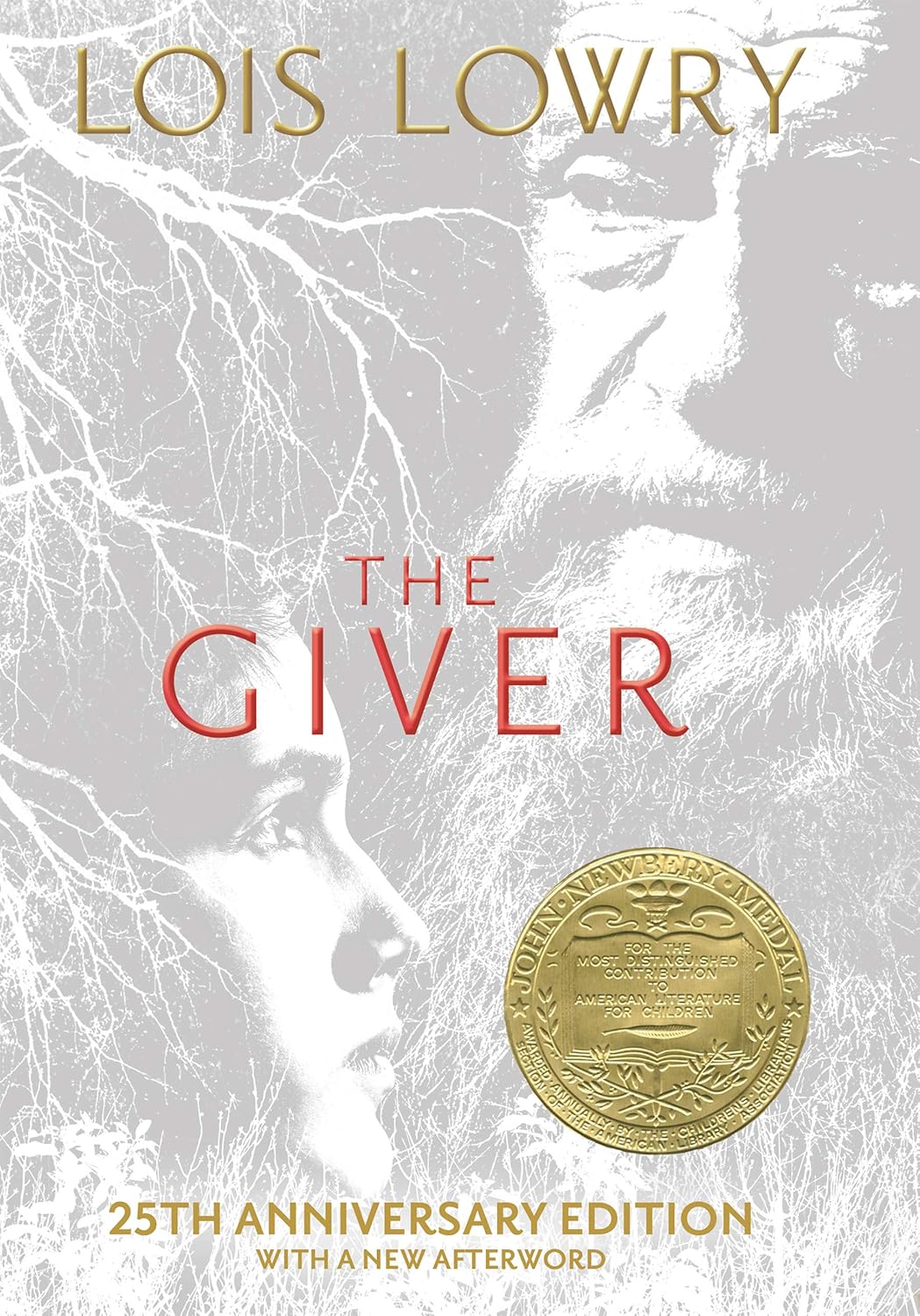
The Giver by Lois Lowry

My favorite now-13-year-old* wanted to talk about this book which I, surprisingly, had never read. (I’ve read some Lowry but this one missed me. My favorite was Number the Stars.) So, what do you do? I got a hold of the book.

I’m impressed by this clean-lines novel which feels expansive, but whose ~225 pages zipped by in a single day for me. It absolutely reminds me of Le Guin’s “The Ones Who Walk Away From Omelas” and Jackson’s “The Lottery,” but this longer book (compared to those two short stories) develops its characters further: Le Guin did not name characters, and Jackson gave us the briefest of sketches, mostly to type. Both of those choices serve their stories very well, I think, but The Giver is doing more, going further.

The tale is set in a community where everything runs very much according to system. There is a great emphasis on uniformity and order. All the children born in a single year (always 50 of them) turn one year old, officially, in December; some are great big babies and some are newborn, but by the time they are three, we’re told, it all evens out. There are certain milestones at each year, including, importantly, the Nines receiving their own bicycles. But the big one is the Ceremony of Twelve, where each child is given their lifetime assignment, their job. These assignments are made by the Committee, which spends a lot of time throughout the children’s lives – but especially when they are Elevens – observing them for preferences and talents. After the Ceremony, the Twelves are no longer children, but adults, albeit early in their training.

Our protagonist is Jonas, and we meet him as he’s approaching becoming a Twelve. Somewhat unusually, he has no idea what his assignment will be. Most children understand their own predilections, but Jonas is truly unsure. At the after-dinner ritual where everyone in his family shares and discusses their feelings, he shares his apprehension (he has thought hard about this word, because precision in language is important to Jonas), but his parents assure him the Committee always chooses well. (It is partly through this ritual that the reader learns about families in this community. Always two children, one male and one female, per household. The parents were carefully paired with the same kind of methodical, clinical decision-making as the assignments. Jonas’s father is a Nurturer: he takes care of babies their first year, after they are born to a Birthmother [shades of Handmaid’s Tale] and before they are awarded to an applicant couple. Jonas’s mother works in Law and Justice. His little sister is a Seven.)

And then the Ceremony of Twelve, where Jonas is selected for a very special role, one he’s never heard of before. Jonas is to be his community’s next Receiver of Memory.

From here on out, his life will not resemble that of his friends. He sees little of them, in fact. They enter training to work in various parts of the community, but Jonas is shut away with an old man, the former Receiver, who now requests that Jonas call him the Giver. He transfers memories to Jonas: memories of a time before the community embraced Sameness. It is only when Jonas begins receiving these memories that the reader learns just how much has been missing from his life.

So. It is a bit of a parable, and offers up similar questions to the two classic short stories I mentioned above. But it goes deeper than either, and in its details, feels closer to reality. (“Omelas,” by contrast, with its nameless character-types and invitation for the reader to fill in the details they prefer, is much more strictly a parable or thought experiment.) I absolutely appreciate the thought-provoking nature, and the emotional impact of each reveal. It feels like a truly great place for a middle-school-age class to dwell and discuss, and I can’t wait to hear more about my young friend’s experience both with the book and in the classroom. My copy included some supplemental text at the back, including a ‘guide for discussion and classroom use’ which seems potentially genuinely useful, but most special are the supplements from Lowry: “Ever After” describes the many inspirations for this story which I loved and found revealing, and her Newbery Acceptance Speech was such a treat as well.

Easy to read in one sense, but with Big Themes that require careful consideration. Excellent matter for thoughtful conversation at school or at home. I can’t wait to talk to my friend about it.


Rating: 8 snowflakes.

*She and her sister account for the books at this new tag.

Even the Darkest Stars by Heather Fawcett

I just went ahead and followed Ember and the Ice Dragons with another Fawcett book for younger readers. This one is a bit darker than that; I see that Ember is catagorized as middle-grade where this one is young adult, for what that’s worth.

Even the Darkest Stars is set in a magical-world version of the Himalayas, with yaks and butter tea and very high, very cold mountain climbing. But a parallel world to our own, in which an emperor rules over a huge region, keeping everyone safe from the witches of a bygone time. Our protagonist is Kamzin, a teenaged girl in the village of Azmiri, which is far from the emperor’s Three Cities. Her father is the village Elder; her mother was a great explorer in service to the emperor, but she’s been dead for years. Her older sister Lusha will be the next Elder. She studies astrology. As the younger daughter, Kamzin’s fate is to be the village’s next shaman. She is apprenticed to the current shaman, but is a poor student. Instead, Kamzin has always felt a strong pull to travel, to climb, to run, to map, to explore. When the emperor’s Royal Explorer, the famous River Shara, comes to the backwater of Azmiri, Kamzin knows she must stop at nothing to become a part of whatever has brought him here.

And after some brief intrigue and machinations, we wind up with a race. Lusha, the obnoxious older sister, takes to the road with one of River’s own retinue, aiming to beat the Royal Explorer himself to the top of Raksha – the highest mountain in the world, never climbed by a human, which defeated even Kamzin and Lusha’s late mother. Kamzin succeeds in joining up with the great River Shara, a handsome young man – younger than she’d expected – whom she finds bewitching. Also in their small party is Kamzin’s best friend, Tem, a far more accomplished (though untrained) shaman. And a stowaway: Kamzin’s familiar is a fox (or foxlike critter) named Ragtooth. They share a close bond but also he is apt to bite her. Oh and there are dragons: they are more tangential here than in the last book, but your standard ‘house dragon’ will eat just about anything remotely edible and in response, their bellies put out light. So an alternative to a lantern is to feed your scraps to a dragon. Part pet, part appliance, sometimes a nuisance. It’s quite fun. There’s a lot that is fun in this imaginative world… but also, Kamzin’s world and everyone she loves is in grave danger. It takes a while for the true nature of River’s quest to Raksha to be revealed, but once it is, the stakes couldn’t be higher.

This is a compelling story, populated by mystery, magic, fun creatures, breathtaking landscapes, true friendship, the germ of romance, and a tortured coming-of-age made harder by the possible end of the world. There is also great adventure, death-defying climbs, races for fun and for life-or-death… bit of a Princess Bride list there. My favorite part is that it ends with a clear nod to a sequel, which I’ll have my hands on in a day or so. But yes, also darker than Ember. More bad things happen here, and more is at stake. I may not hand it off to the thirteen-year-old yet. But I am so in for book two.


Rating: 7 sour apples.

Ember and the Ice Dragons by Heather Fawcett

For all the girl scientists, whether human or dragon.

I was deeply sad to have finished the last (so far!) of Heather Fawcett’s adult books, so I dipped into her back catalog of books for younger readers. Alongside Woods & Words, I am so pleased to have this one to pass along to a young person I love. (This one is for an older sister, age 13, as in love with dragons as ever. Woods & Words is for both sisters together.) Heather Fawcett, young adult fantasy, plus dragons for a friend in particular – all wins.

When we meet Ember St. George, she is twelve years old. She has just set her father’s office on fire, accidentally, again. It’s not Ember’s fault – she is a fire dragon, whom her (human, adoptive) father rescued fresh out of the egg, immediately after her biological (dragon) parents were killed by dragon hunters. Lionel St. George, an academic and a magician, cast a spell to turn her into a human girl. She still has her wings, though they are invisible, which can make it awkward to move in crowds. And she sometimes accidentally bursts into flames. She’s afraid of hurting someone, especially Lionel, who is a good and loving father. And so, in the opening pages, she contrives to move from the London university where she has always lived to a research station in Antarctica with an aunt she has never met. [It is believed that sunlight and heat contribute to the spontaneous combustion. Also, fewer people to hurt with the flames in Antarctica.]

This is how, before we’ve known Ember for long, we follow her on an ocean journey and into an unknown environment. At the research station, Ember must attend school for the first time, with a handful of other children. She has always avoided children, finding them strange – she is not precisely one herself, remember, but she must pretend; almost no one knows she is actually a dragon – and has never gone to school. (Instead, her eccentric father lets her read what she pleases, and discusses it with her. Theirs is a world divided into mostly-antagonistic schools of Magic and Science, and Ember most wants to be a biologist.) There is a humorous exchange over a certain novel concept:

“You’re going to go back inside and do your homework.”

Ember was surprised. “Why would I do that?”

Aunt Myra stared. “Haven’t you been doing your homework?”

“No.” Madame Rousseau had told them to read a chapter a day of a strange book about two children who had rhyming conversations with various animals that looked as if they’d been drawn by someone who’d never seen one. It was the most ghastly thing Ember had ever read. She had felt sorry for Madame Rousseau, who couldn’t have seen many books if she thought something like that was worth reading. Ember hadn’t been aware that this ‘homework’ was mandatory. When she didn’t like something her father gave her to read, she simply told him so, and they had a lively debate about it.

In her new home, Ember befriends some unusual penguins, explores the beautiful, icy surrounds (cold does not bother her, for reasons that might be obvious – fire dragon), and makes her first human-child friend, not entirely by choice. The attentions of a mathematical genius, Nisha, perplex Ember at first, but she finds a friend is a nice thing to have. Nisha’s friendship includes another, with a mysterious, pale, quiet boy named Moss, an orphan whose background is unknown.

Next, Ember discovers that Antarctica is home to the Winterglass Hunt, a royal expedition to kill rare ice dragons for their valuable, jewel-like scales. Ember is outraged, and schemes to join the hunt so as to sabotage it from within. She is very lucky to have her friends, who insist upon accompanying her, as it turns out that the many dangers she encounters will require their assistance.

The world of Ember and the Ice Dragons is fascinating and (this being Fawcett) well-constructed with internal logic, which I appreciate. The story is entirely wholesome, with its strong girls and women, solid friendships, and life lessons. Ember’s secret dragonhood, and Moss’s existential mystery, offer meditations on what it is to be different, and what identity can mean.

Both Moss and Nisha felt alone, even though they weren’t – they weren’t the last of the their kind, after all, and Nisha had both her parents. She decided eventually that there must be different kinds of alone, just as there were different species of lantern fish.

Enchanting, absorbing, entertaining, positive, and fun. I swear Fawcett left room for a sequel; my greatest complaint about this book is that there isn’t one yet.


Rating: 8 riddles.

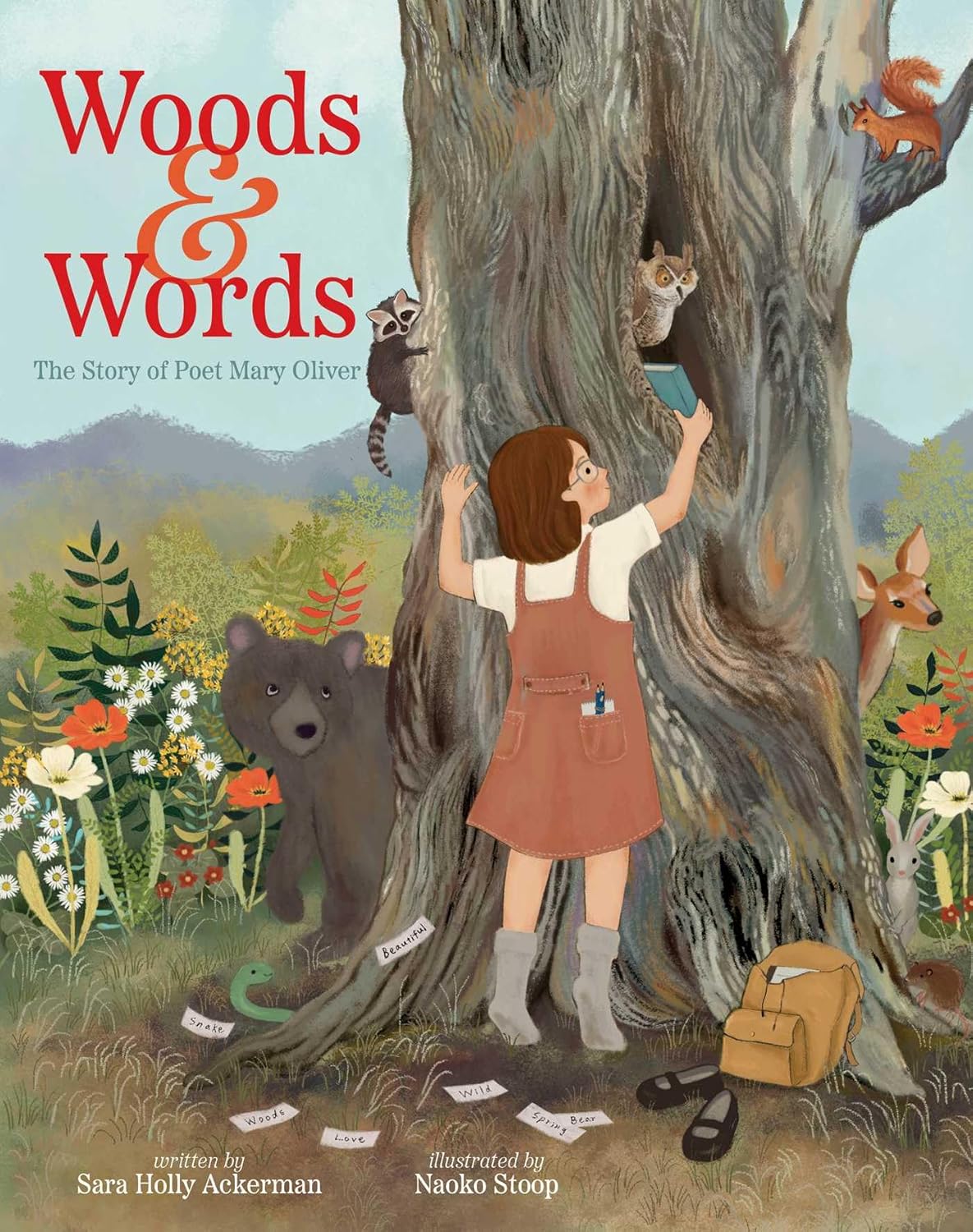
Woods & Words: The Story of Poet Mary Oliver by Sara Holly Ackerman, illus. by Naoko Stoop

I was sold on this book by my Shelf Awareness colleague’s review. I purchased it for some young friends who I think will enjoy it, but that was partly a reason to enjoy it myself first, before I passed it on.

This is a beautiful book, in its simple storytelling, its lovely sentiments and the values it communicates, and in the charming illustrations, full of plants and animals and sweetly expressive human faces. Rated for ages 4-8, it took only a few minutes to page through once, but will reward multiple and slower readings. I liked looking for the critters tucked away in the illustrations’ crevices, and reading through the words that trip and twist across the pages (outside of the narrative). I love that this story, which can be appreciated for its own sake, also introduces young readers to the life of Mary Oliver, an artist for whom mainstream “success” was not guaranteed. The Author’s Note notes that Mary Oliver’s home life, as a child, was “difficult.” She was a woman, she was queer, and she wrote poems that were defiantly “plain,” diverging from a tradition that makes poems less accessible to us regular people. This is what we love her for; but it presented some barriers in her acceptance by critics.

So, a beautifully rendered illustrated children’s book bringing the life of a great American poet to young people. An utter joy to read and look at, much like Oliver’s poetry. Strongly recommend for the kids in your life, and you will enjoy sharing it with them. More of this, please.


Rating: 9 shingles.

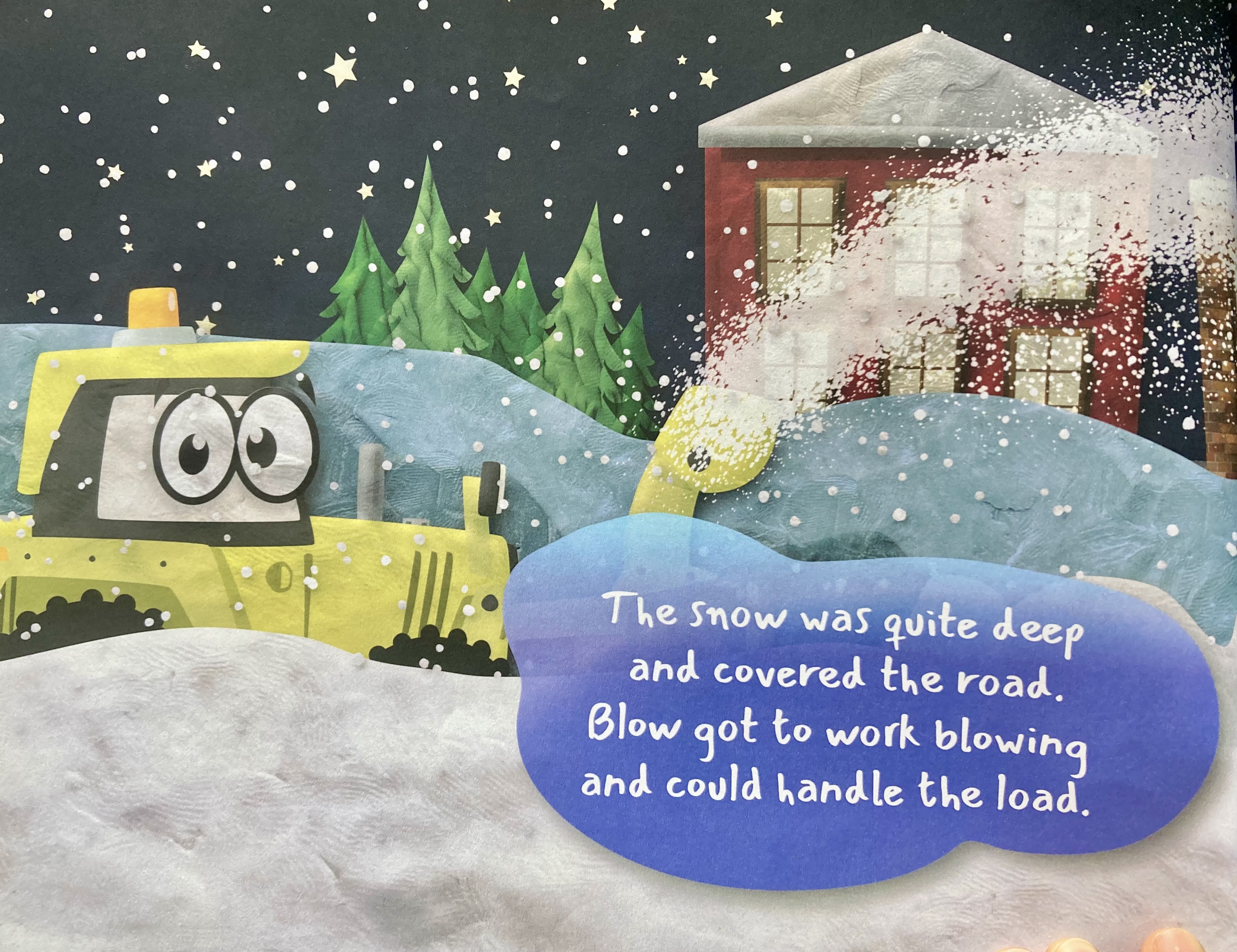
Hookers and Blow Save Christmas written & illus. by Munty C. Pepin

Tom Transport is stuck in a snowdrift with all the presents for the town Christmas party and it’s up to Hookers and Blow to save the day… and the party!

This is a super fun kids’ book. Bear with me. My friend JJ loaned me this for humor’s sake – he got it as a gift when his kids (probably just one at that point) were little. You have already noted the heavy irreverence. It’s actually not only great laughs for the grown-ups, but a perfectly sweet story for kids young enough to miss the joke that is obvious to the bigger kids among us. There are the odd off-color moments throughout –

but also a wholesome story about a snowblower and a wrecker pulling the 18-wheeler into town in time to save the community’s holiday event. All’s well that ends well. I had a fabulous time with this one, reading it aloud (even alone!) for the rhyme and meter, and we all had a great time at a bike shop Christmas party together too. Fun for later: if you’re into that sort of thing, search Amazon for Pepin’s name and you’ll find plenty of similar titles. I can’t speak for the wholesomeness of any of those, yet.

Happy holidays and thanks for the silly times, JJ.


Rating: 7 gifts.

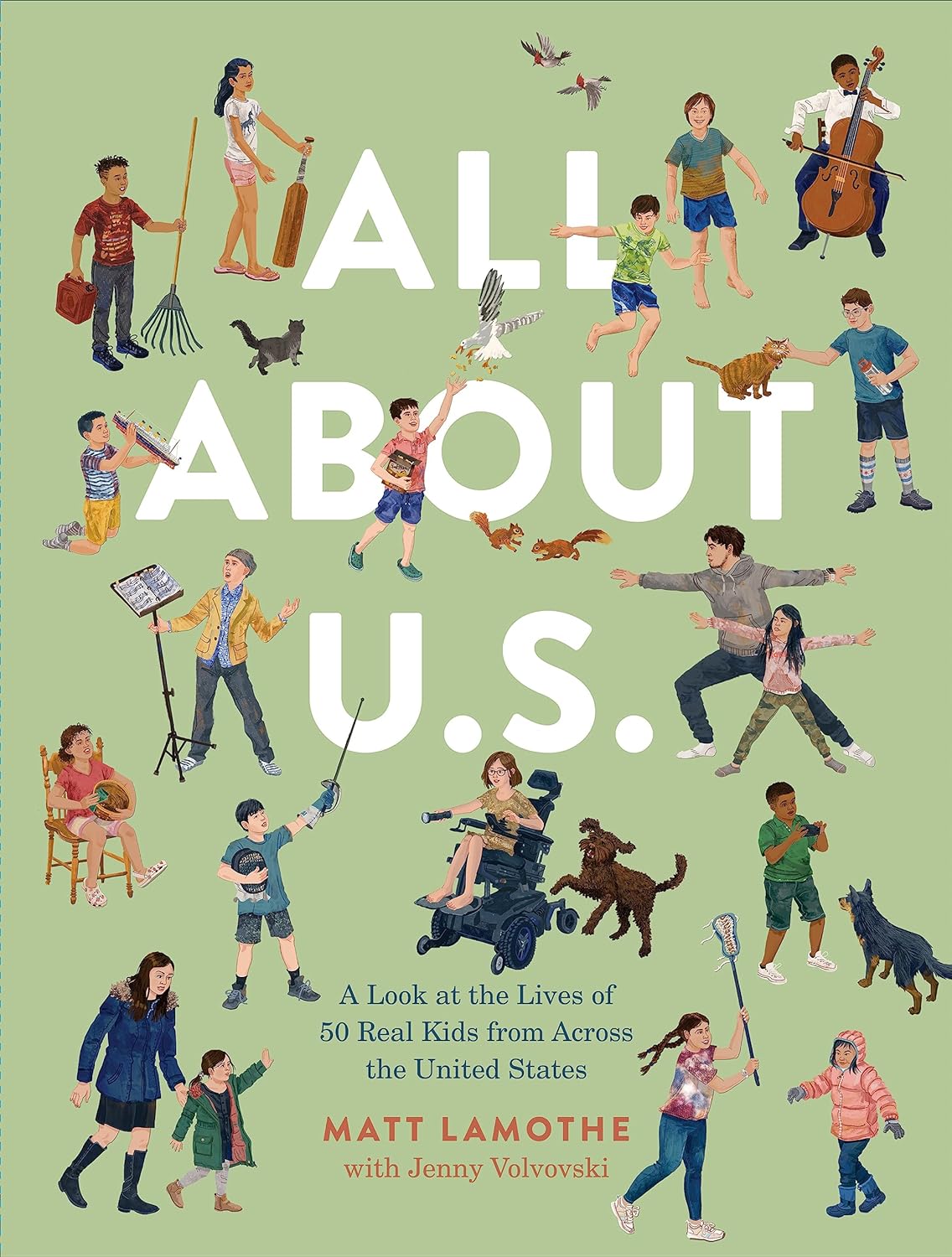
All About U.S.: A Look at the Lives of 50 Real Kids from Across the United States by Matt Lamothe & Jenny Volvovski, illus. by Matt Lamothe

I loved the look of this large-format illustrated book for kids (and their adults!), and preordered it for a couple of my favorite kids, sisters ages 8 and 12. The book is labeled as serving ages 8-12, so I figured that would be perfect. And naturally I had to take a look first.

I love the concept. From the authors of This Is How We Do It comes this glimpse into the lives of 50 kids, one apiece from the 50 states. Author/illustrator Lamothe and author/designer Volvovski took great pains to closely approximate the demographics of the country as a whole in choosing the kids and families they feature here: sections on Process and Demographics at the end of the book detail those elements, in writing that will skew toward the older end of the book’s projected age range and/or serve adults best. The 50 families in the book match national stats in religion, family type, structure and size, gender identities, school and home types, annual family income, national origin of parents and guardians, sexual orientation of parents and guardians, and more, quite closely. “The biggest demographic discrepancy in the book is the overrepresentation of multiracial kids. However, the race/ethnicity of their parents and guardians more closely matches the demographics of the country. According to Pew, the number of Americans who identify as more than one race almost doubled between 2010 and 2020 [when work began on the book]. As this trend seems likely to continue, we feel it is important to show how multiracial families balance their cultures and traditions.” This struck me as solid reasoning. I’m also comfortable with slight overrepresentation of traditionally underrepresented groups.

The bulk of the book is the kids themselves. Each gets either a single page or a two-page spread (of which most of the space is illustration; my impression is that the written stories are equal in size) in this large-format book. A beautiful, engaging, full-color, detailed illustration accompanies a brief written profile of a child, ages 5-11, in the context of their family and home. Generally, parents’ or guardians’ jobs or interests are mentioned, as well as siblings and pets, but the kid in question gets the most focus, via their hobbies, tastes, favorites foods and toys, activities, etc. I love the charming images as (yes) illustrations of what is described in print. I can easily see the sisters I’m giving this book to enjoying the combination of images with text; I expect the older sis to have an easier time with the reading part.

Clearly the enormous diversity of the kids and families featured here is a big part of the appeal. I really enjoyed how varied these lives appear. There are many skin tones, religions, family structures and styles; there are kids with mental and physical health differences and those who have faced major life challenges. Some are rural and some are urban (a demographic element apparently not tracked). I’m pretty sure that each story includes at least one direct quotation, so that the kids’ voices come through. Across all their differences, they all sound stimulated by the chance to talk about their own lives.

And these are real kids. Near the front of the book is a spread with each child’s illustrated head shot; near the back, a similar spread of photographs of the same kids. A few source images are included there as well, like landscape views, and descriptions of how this research was completed (many hours of video calls, online questionnaires, photographs and video tours). I especially appreciate how detailed are the illustrations, and liked reading that each family was consulted in back-and-forth correspondence on both the illustrations and the text before publication.

I was on the lookout for stereotypes. (I did note the authors’ acknowledgment that no one family could represent an entire state.) With such attention paid to demographic data, I feel good about the overall portrait of the country; but what does it look like to choose a single kid/family to stand for New York or Texas? Heavens. I of course turned first to the two states I know best, Texas and West Virginia. In Texas, Noah lives with a large family who enjoy traveling to Big Bend (yes!) from what might be San Antonio. In West Virginia, Jade raises prize-winning steers at his rural home. These are individual stories, woven into a tapestry with plenty of diversity in it.

All in all, it’s a beautiful book that I think will yield some great conversation, and I feel great about giving it to my young friends.


Rating: 8 windows.

The Lost Girl by Sangu Mandanna

I am a creature, a girl, life stitched from nothing. I am eerie and frightful. And I’m stronger than all of them. I can’t allow any hunter, or Weaver, or betrayal to defeat me. Believing that is all I have. It’s all that might save me.

I have been a fan of Mandanna’s witchy book and this YA trilogy. I’m jumping back in time here to her debut novel, a YA sci fi with some romance elements, naturally enough a coming-of-age story, with some pretty neat philosophical questions. It’s quite good, but she’s gotten better since.

Eva is an echo, as opposed to a human: she was not born but made to order by the Weavers for a family who requested her. Echoes are sort of spares: Eva is based on her ‘other,’ or her original, a girl named Amarra who lives in Bangalore. Eva lives in a small English village where she is heavily guarded and tutored and trained in how to be Amarra. She reads what Amarra reads, consumes the same music and movies and foods, wears the same clothes. As far as possible from Bangalore to the English countryside, she is supposed to mimic Amarra, to be prepared to be Amarra if something should happen to the valued human girl. But something has gone awry with Eva: she has a personality of her own. She is not as agreeable as Amarra seems to be. She is strong-willed and stubborn, has interests that different from those of her other. She asks too many questions. Even to have taken a name of her own is a serious crime. [Can I just say how remarkable I find it that she’s taken the same name as in Peter Dickinson’s YA novel that I loved so much?!] And then, of course–this would be necessary for the story’s sake–Amarra dies. And Eva is up for the role of a lifetime, that for which she has been designed.

With obvious parallels to The New One, and a classic we’ll discuss shortly, The Lost Girl examines concepts that humanity has considered before; but that’s certainly not a criticism, nor am I alleging unoriginality. (This book predates The New One, for the record.) Rather, I guess I’m observing that the questions Mandanna is playing with here are of perennial interest. What power do we have to design the people or have the babies we want? Is it appropriate or moral to play with technology that would do so? (There are some efforts at work too in pursuit of immortality, that other perennial human preoccupation.) Eva literalizes the idea of a young person coming of age under the constraints of society or family’s expectations; but on some level every young person wrestles with similar bounds, and necessarily rebels against them. Is Amarra a better girl, or just a different one? Does Eva have a right to self-determination? Many people in their world see Eva as less-than, an abomination. What makes someone human, or a person, or deserving of respect? How do we combat prejudice that’s based on ignorance? How are we to navigate grief? (Hint: maybe not by having a copy of our beloved daughter made to spec, and then demanding she live up to impossible ideals.)

Eva is in a difficult spot. She has to be someone she’s not, both for the sake of her literal survival (echoes are destroyed if they can’t do their jobs) and because she genuinely wishes to comfort Amarra’s bereaved family, who seem like decent people. But she isn’t Amarra. And even dead, the ‘other’ looms large. “Maybe that’s what the dead do. They stay. They linger. Benign and sweet and painful. They don’t need us. They echo all by themselves.”

Mandanna, and the system of echoes, and Eva, are all clear on the reference to Frankenstein here. Echoes are firmly forbidden access to the book, which Eva rightly senses is because there’s something there. Who is the monster–the scientist or his creation? What if you let the Creature set his own path?

Eva’s first-person voice is spot on, the rules of this world are well established for most of the novel, the questions it asks are compelling and thoughtfully explored. The characters are complex and sympathetic, the stakes are high, the whole thing is absorbing. There is a romantic subplot, with tension between Amarra’s boyfriend and Eva’s potential (and obviously highly forbidden) love interest. It’s all really well done, and this novel was headed for a higher rating, but it gets a bit out of control towards the end. The action is a bit unwieldy and the rules of the world collapse a bit, for me, in terms of believability. A certain promise is asked to carry an awful lot of weight in the plot denouement, as if promises are more binding than we know them to be in our world, at least, and indeed it seems to come down to a villain keeping their word, which feels doubtful at best. In an invented world like this, Mandanna could have made a rule of some sort about how promises work–they could have been literally binding–but she didn’t, and the importance of the promise didn’t work for me. I suspect I’m seeing Mandanna’s evolution as an author here, and I’m not mad about it and will still be seeking out her work. My rating of 7 is still solid! But it looked even stronger for a while. I think this author has grown a great deal since her debut.

Great premise, and well done through most of the book; fell off a bit at the end. I am still a fan.


Rating: 7 scones.