Even the Darkest Stars by Heather Fawcett

I just went ahead and followed Ember and the Ice Dragons with another Fawcett book for younger readers. This one is a bit darker than that; I see that Ember is catagorized as middle-grade where this one is young adult, for what that’s worth.

Even the Darkest Stars is set in a magical-world version of the Himalayas, with yaks and butter tea and very high, very cold mountain climbing. But a parallel world to our own, in which an emperor rules over a huge region, keeping everyone safe from the witches of a bygone time. Our protagonist is Kamzin, a teenaged girl in the village of Azmiri, which is far from the emperor’s Three Cities. Her father is the village Elder; her mother was a great explorer in service to the emperor, but she’s been dead for years. Her older sister Lusha will be the next Elder. She studies astrology. As the younger daughter, Kamzin’s fate is to be the village’s next shaman. She is apprenticed to the current shaman, but is a poor student. Instead, Kamzin has always felt a strong pull to travel, to climb, to run, to map, to explore. When the emperor’s Royal Explorer, the famous River Shara, comes to the backwater of Azmiri, Kamzin knows she must stop at nothing to become a part of whatever has brought him here.

And after some brief intrigue and machinations, we wind up with a race. Lusha, the obnoxious older sister, takes to the road with one of River’s own retinue, aiming to beat the Royal Explorer himself to the top of Raksha – the highest mountain in the world, never climbed by a human, which defeated even Kamzin and Lusha’s late mother. Kamzin succeeds in joining up with the great River Shara, a handsome young man – younger than she’d expected – whom she finds bewitching. Also in their small party is Kamzin’s best friend, Tem, a far more accomplished (though untrained) shaman. And a stowaway: Kamzin’s familiar is a fox (or foxlike critter) named Ragtooth. They share a close bond but also he is apt to bite her. Oh and there are dragons: they are more tangential here than in the last book, but your standard ‘house dragon’ will eat just about anything remotely edible and in response, their bellies put out light. So an alternative to a lantern is to feed your scraps to a dragon. Part pet, part appliance, sometimes a nuisance. It’s quite fun. There’s a lot that is fun in this imaginative world… but also, Kamzin’s world and everyone she loves is in grave danger. It takes a while for the true nature of River’s quest to Raksha to be revealed, but once it is, the stakes couldn’t be higher.

This is a compelling story, populated by mystery, magic, fun creatures, breathtaking landscapes, true friendship, the germ of romance, and a tortured coming-of-age made harder by the possible end of the world. There is also great adventure, death-defying climbs, races for fun and for life-or-death… bit of a Princess Bride list there. My favorite part is that it ends with a clear nod to a sequel, which I’ll have my hands on in a day or so. But yes, also darker than Ember. More bad things happen here, and more is at stake. I may not hand it off to the thirteen-year-old yet. But I am so in for book two.


Rating: 7 sour apples.

Ember and the Ice Dragons by Heather Fawcett

For all the girl scientists, whether human or dragon.

I was deeply sad to have finished the last (so far!) of Heather Fawcett’s adult books, so I dipped into her back catalog of books for younger readers. Alongside Woods & Words, I am so pleased to have this one to pass along to a young person I love. (This one is for an older sister, age 13, as in love with dragons as ever. Woods & Words is for both sisters together.) Heather Fawcett, young adult fantasy, plus dragons for a friend in particular – all wins.

When we meet Ember St. George, she is twelve years old. She has just set her father’s office on fire, accidentally, again. It’s not Ember’s fault – she is a fire dragon, whom her (human, adoptive) father rescued fresh out of the egg, immediately after her biological (dragon) parents were killed by dragon hunters. Lionel St. George, an academic and a magician, cast a spell to turn her into a human girl. She still has her wings, though they are invisible, which can make it awkward to move in crowds. And she sometimes accidentally bursts into flames. She’s afraid of hurting someone, especially Lionel, who is a good and loving father. And so, in the opening pages, she contrives to move from the London university where she has always lived to a research station in Antarctica with an aunt she has never met. [It is believed that sunlight and heat contribute to the spontaneous combustion. Also, fewer people to hurt with the flames in Antarctica.]

This is how, before we’ve known Ember for long, we follow her on an ocean journey and into an unknown environment. At the research station, Ember must attend school for the first time, with a handful of other children. She has always avoided children, finding them strange – she is not precisely one herself, remember, but she must pretend; almost no one knows she is actually a dragon – and has never gone to school. (Instead, her eccentric father lets her read what she pleases, and discusses it with her. Theirs is a world divided into mostly-antagonistic schools of Magic and Science, and Ember most wants to be a biologist.) There is a humorous exchange over a certain novel concept:

“You’re going to go back inside and do your homework.”

Ember was surprised. “Why would I do that?”

Aunt Myra stared. “Haven’t you been doing your homework?”

“No.” Madame Rousseau had told them to read a chapter a day of a strange book about two children who had rhyming conversations with various animals that looked as if they’d been drawn by someone who’d never seen one. It was the most ghastly thing Ember had ever read. She had felt sorry for Madame Rousseau, who couldn’t have seen many books if she thought something like that was worth reading. Ember hadn’t been aware that this ‘homework’ was mandatory. When she didn’t like something her father gave her to read, she simply told him so, and they had a lively debate about it.

In her new home, Ember befriends some unusual penguins, explores the beautiful, icy surrounds (cold does not bother her, for reasons that might be obvious – fire dragon), and makes her first human-child friend, not entirely by choice. The attentions of a mathematical genius, Nisha, perplex Ember at first, but she finds a friend is a nice thing to have. Nisha’s friendship includes another, with a mysterious, pale, quiet boy named Moss, an orphan whose background is unknown.

Next, Ember discovers that Antarctica is home to the Winterglass Hunt, a royal expedition to kill rare ice dragons for their valuable, jewel-like scales. Ember is outraged, and schemes to join the hunt so as to sabotage it from within. She is very lucky to have her friends, who insist upon accompanying her, as it turns out that the many dangers she encounters will require their assistance.

The world of Ember and the Ice Dragons is fascinating and (this being Fawcett) well-constructed with internal logic, which I appreciate. The story is entirely wholesome, with its strong girls and women, solid friendships, and life lessons. Ember’s secret dragonhood, and Moss’s existential mystery, offer meditations on what it is to be different, and what identity can mean.

Both Moss and Nisha felt alone, even though they weren’t – they weren’t the last of the their kind, after all, and Nisha had both her parents. She decided eventually that there must be different kinds of alone, just as there were different species of lantern fish.

Enchanting, absorbing, entertaining, positive, and fun. I swear Fawcett left room for a sequel; my greatest complaint about this book is that there isn’t one yet.


Rating: 8 riddles.

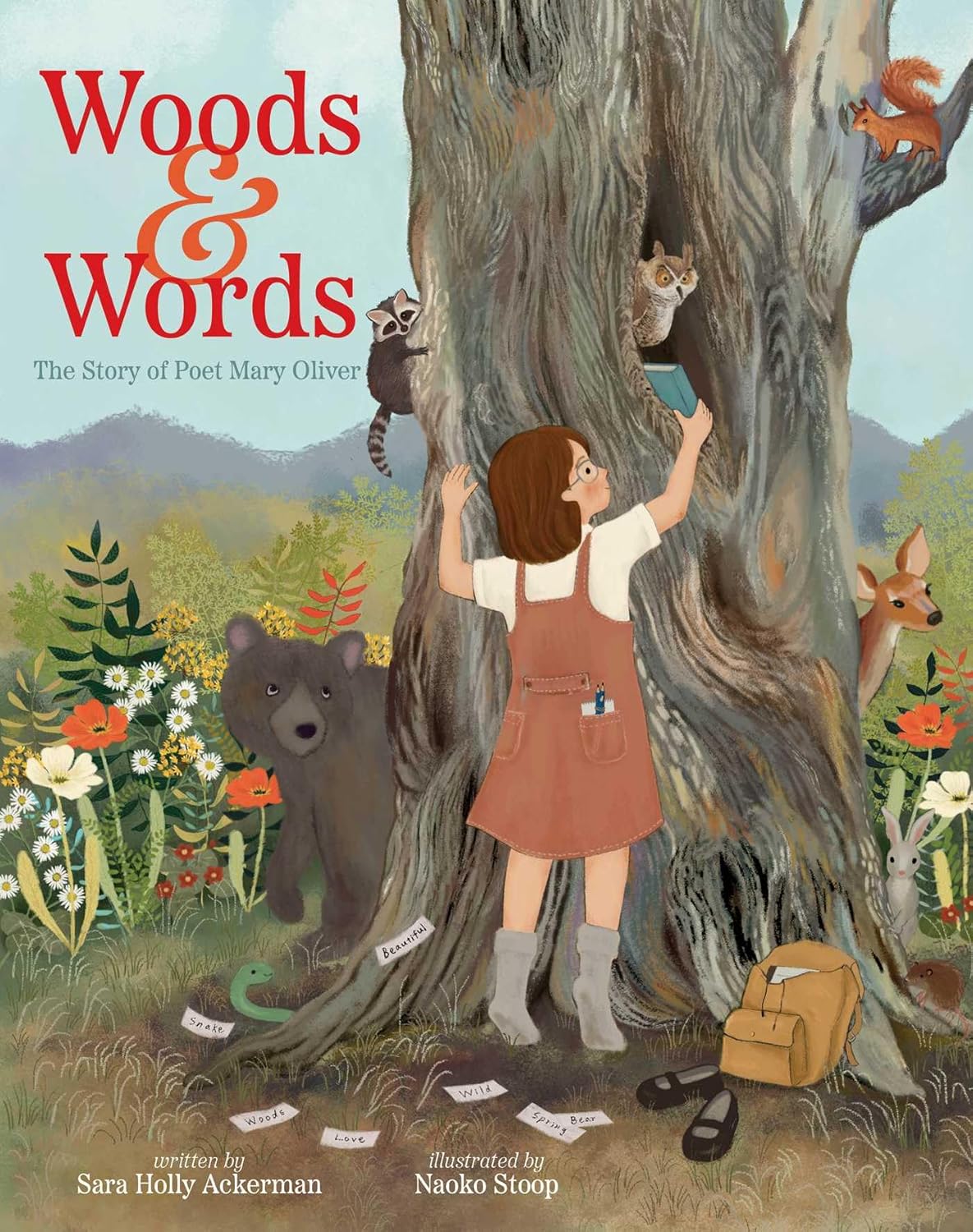
Woods & Words: The Story of Poet Mary Oliver by Sara Holly Ackerman, illus. by Naoko Stoop

I was sold on this book by my Shelf Awareness colleague’s review. I purchased it for some young friends who I think will enjoy it, but that was partly a reason to enjoy it myself first, before I passed it on.

This is a beautiful book, in its simple storytelling, its lovely sentiments and the values it communicates, and in the charming illustrations, full of plants and animals and sweetly expressive human faces. Rated for ages 4-8, it took only a few minutes to page through once, but will reward multiple and slower readings. I liked looking for the critters tucked away in the illustrations’ crevices, and reading through the words that trip and twist across the pages (outside of the narrative). I love that this story, which can be appreciated for its own sake, also introduces young readers to the life of Mary Oliver, an artist for whom mainstream “success” was not guaranteed. The Author’s Note notes that Mary Oliver’s home life, as a child, was “difficult.” She was a woman, she was queer, and she wrote poems that were defiantly “plain,” diverging from a tradition that makes poems less accessible to us regular people. This is what we love her for; but it presented some barriers in her acceptance by critics.

So, a beautifully rendered illustrated children’s book bringing the life of a great American poet to young people. An utter joy to read and look at, much like Oliver’s poetry. Strongly recommend for the kids in your life, and you will enjoy sharing it with them. More of this, please.


Rating: 9 shingles.

Hookers and Blow Save Christmas written & illus. by Munty C. Pepin

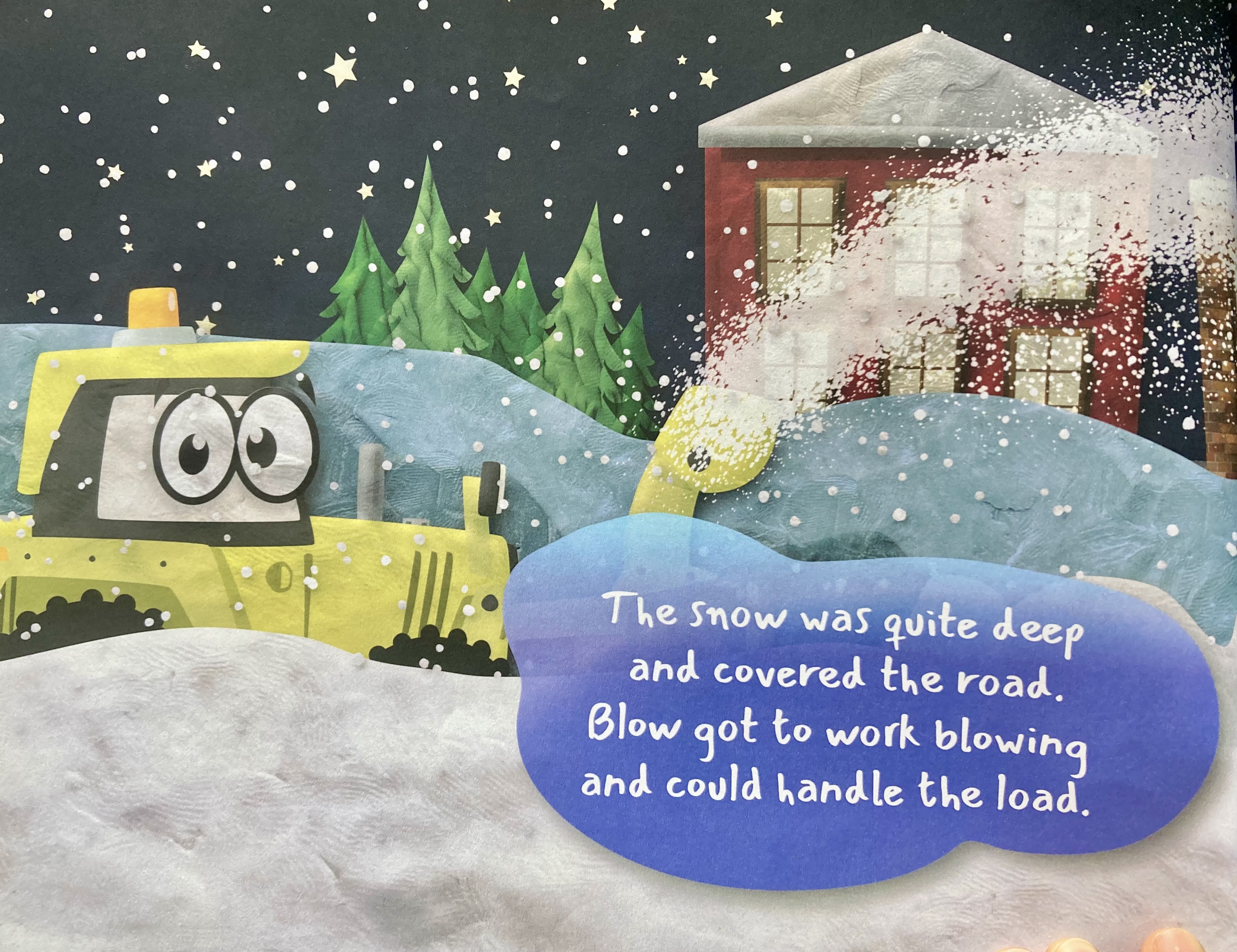
Tom Transport is stuck in a snowdrift with all the presents for the town Christmas party and it’s up to Hookers and Blow to save the day… and the party!

This is a super fun kids’ book. Bear with me. My friend JJ loaned me this for humor’s sake – he got it as a gift when his kids (probably just one at that point) were little. You have already noted the heavy irreverence. It’s actually not only great laughs for the grown-ups, but a perfectly sweet story for kids young enough to miss the joke that is obvious to the bigger kids among us. There are the odd off-color moments throughout –

but also a wholesome story about a snowblower and a wrecker pulling the 18-wheeler into town in time to save the community’s holiday event. All’s well that ends well. I had a fabulous time with this one, reading it aloud (even alone!) for the rhyme and meter, and we all had a great time at a bike shop Christmas party together too. Fun for later: if you’re into that sort of thing, search Amazon for Pepin’s name and you’ll find plenty of similar titles. I can’t speak for the wholesomeness of any of those, yet.

Happy holidays and thanks for the silly times, JJ.


Rating: 7 gifts.

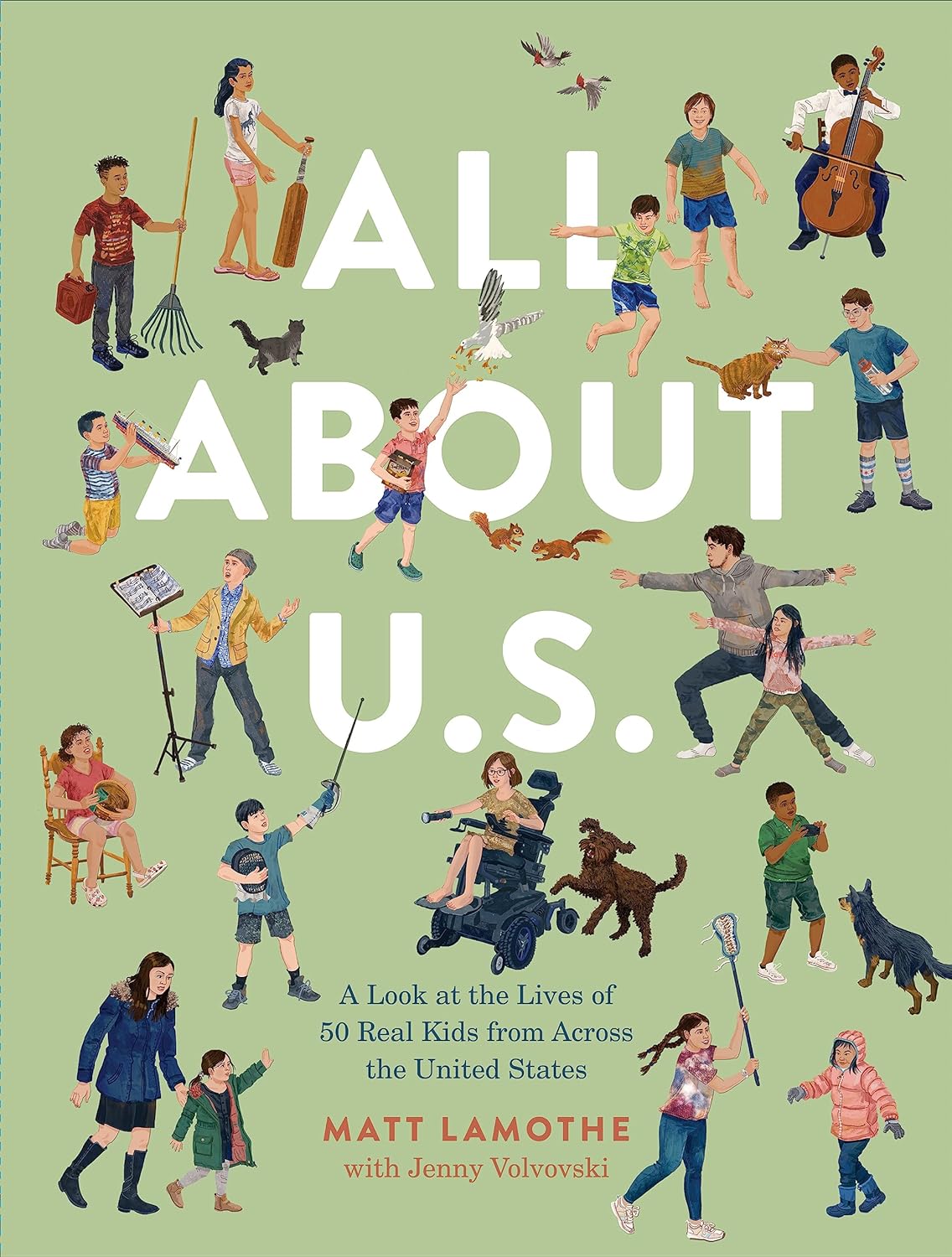
All About U.S.: A Look at the Lives of 50 Real Kids from Across the United States by Matt Lamothe & Jenny Volvovski, illus. by Matt Lamothe

I loved the look of this large-format illustrated book for kids (and their adults!), and preordered it for a couple of my favorite kids, sisters ages 8 and 12. The book is labeled as serving ages 8-12, so I figured that would be perfect. And naturally I had to take a look first.

I love the concept. From the authors of This Is How We Do It comes this glimpse into the lives of 50 kids, one apiece from the 50 states. Author/illustrator Lamothe and author/designer Volvovski took great pains to closely approximate the demographics of the country as a whole in choosing the kids and families they feature here: sections on Process and Demographics at the end of the book detail those elements, in writing that will skew toward the older end of the book’s projected age range and/or serve adults best. The 50 families in the book match national stats in religion, family type, structure and size, gender identities, school and home types, annual family income, national origin of parents and guardians, sexual orientation of parents and guardians, and more, quite closely. “The biggest demographic discrepancy in the book is the overrepresentation of multiracial kids. However, the race/ethnicity of their parents and guardians more closely matches the demographics of the country. According to Pew, the number of Americans who identify as more than one race almost doubled between 2010 and 2020 [when work began on the book]. As this trend seems likely to continue, we feel it is important to show how multiracial families balance their cultures and traditions.” This struck me as solid reasoning. I’m also comfortable with slight overrepresentation of traditionally underrepresented groups.

The bulk of the book is the kids themselves. Each gets either a single page or a two-page spread (of which most of the space is illustration; my impression is that the written stories are equal in size) in this large-format book. A beautiful, engaging, full-color, detailed illustration accompanies a brief written profile of a child, ages 5-11, in the context of their family and home. Generally, parents’ or guardians’ jobs or interests are mentioned, as well as siblings and pets, but the kid in question gets the most focus, via their hobbies, tastes, favorites foods and toys, activities, etc. I love the charming images as (yes) illustrations of what is described in print. I can easily see the sisters I’m giving this book to enjoying the combination of images with text; I expect the older sis to have an easier time with the reading part.

Clearly the enormous diversity of the kids and families featured here is a big part of the appeal. I really enjoyed how varied these lives appear. There are many skin tones, religions, family structures and styles; there are kids with mental and physical health differences and those who have faced major life challenges. Some are rural and some are urban (a demographic element apparently not tracked). I’m pretty sure that each story includes at least one direct quotation, so that the kids’ voices come through. Across all their differences, they all sound stimulated by the chance to talk about their own lives.

And these are real kids. Near the front of the book is a spread with each child’s illustrated head shot; near the back, a similar spread of photographs of the same kids. A few source images are included there as well, like landscape views, and descriptions of how this research was completed (many hours of video calls, online questionnaires, photographs and video tours). I especially appreciate how detailed are the illustrations, and liked reading that each family was consulted in back-and-forth correspondence on both the illustrations and the text before publication.

I was on the lookout for stereotypes. (I did note the authors’ acknowledgment that no one family could represent an entire state.) With such attention paid to demographic data, I feel good about the overall portrait of the country; but what does it look like to choose a single kid/family to stand for New York or Texas? Heavens. I of course turned first to the two states I know best, Texas and West Virginia. In Texas, Noah lives with a large family who enjoy traveling to Big Bend (yes!) from what might be San Antonio. In West Virginia, Jade raises prize-winning steers at his rural home. These are individual stories, woven into a tapestry with plenty of diversity in it.

All in all, it’s a beautiful book that I think will yield some great conversation, and I feel great about giving it to my young friends.


Rating: 8 windows.

The Lost Girl by Sangu Mandanna

I am a creature, a girl, life stitched from nothing. I am eerie and frightful. And I’m stronger than all of them. I can’t allow any hunter, or Weaver, or betrayal to defeat me. Believing that is all I have. It’s all that might save me.

I have been a fan of Mandanna’s witchy book and this YA trilogy. I’m jumping back in time here to her debut novel, a YA sci fi with some romance elements, naturally enough a coming-of-age story, with some pretty neat philosophical questions. It’s quite good, but she’s gotten better since.

Eva is an echo, as opposed to a human: she was not born but made to order by the Weavers for a family who requested her. Echoes are sort of spares: Eva is based on her ‘other,’ or her original, a girl named Amarra who lives in Bangalore. Eva lives in a small English village where she is heavily guarded and tutored and trained in how to be Amarra. She reads what Amarra reads, consumes the same music and movies and foods, wears the same clothes. As far as possible from Bangalore to the English countryside, she is supposed to mimic Amarra, to be prepared to be Amarra if something should happen to the valued human girl. But something has gone awry with Eva: she has a personality of her own. She is not as agreeable as Amarra seems to be. She is strong-willed and stubborn, has interests that different from those of her other. She asks too many questions. Even to have taken a name of her own is a serious crime. [Can I just say how remarkable I find it that she’s taken the same name as in Peter Dickinson’s YA novel that I loved so much?!] And then, of course–this would be necessary for the story’s sake–Amarra dies. And Eva is up for the role of a lifetime, that for which she has been designed.

With obvious parallels to The New One, and a classic we’ll discuss shortly, The Lost Girl examines concepts that humanity has considered before; but that’s certainly not a criticism, nor am I alleging unoriginality. (This book predates The New One, for the record.) Rather, I guess I’m observing that the questions Mandanna is playing with here are of perennial interest. What power do we have to design the people or have the babies we want? Is it appropriate or moral to play with technology that would do so? (There are some efforts at work too in pursuit of immortality, that other perennial human preoccupation.) Eva literalizes the idea of a young person coming of age under the constraints of society or family’s expectations; but on some level every young person wrestles with similar bounds, and necessarily rebels against them. Is Amarra a better girl, or just a different one? Does Eva have a right to self-determination? Many people in their world see Eva as less-than, an abomination. What makes someone human, or a person, or deserving of respect? How do we combat prejudice that’s based on ignorance? How are we to navigate grief? (Hint: maybe not by having a copy of our beloved daughter made to spec, and then demanding she live up to impossible ideals.)

Eva is in a difficult spot. She has to be someone she’s not, both for the sake of her literal survival (echoes are destroyed if they can’t do their jobs) and because she genuinely wishes to comfort Amarra’s bereaved family, who seem like decent people. But she isn’t Amarra. And even dead, the ‘other’ looms large. “Maybe that’s what the dead do. They stay. They linger. Benign and sweet and painful. They don’t need us. They echo all by themselves.”

Mandanna, and the system of echoes, and Eva, are all clear on the reference to Frankenstein here. Echoes are firmly forbidden access to the book, which Eva rightly senses is because there’s something there. Who is the monster–the scientist or his creation? What if you let the Creature set his own path?

Eva’s first-person voice is spot on, the rules of this world are well established for most of the novel, the questions it asks are compelling and thoughtfully explored. The characters are complex and sympathetic, the stakes are high, the whole thing is absorbing. There is a romantic subplot, with tension between Amarra’s boyfriend and Eva’s potential (and obviously highly forbidden) love interest. It’s all really well done, and this novel was headed for a higher rating, but it gets a bit out of control towards the end. The action is a bit unwieldy and the rules of the world collapse a bit, for me, in terms of believability. A certain promise is asked to carry an awful lot of weight in the plot denouement, as if promises are more binding than we know them to be in our world, at least, and indeed it seems to come down to a villain keeping their word, which feels doubtful at best. In an invented world like this, Mandanna could have made a rule of some sort about how promises work–they could have been literally binding–but she didn’t, and the importance of the promise didn’t work for me. I suspect I’m seeing Mandanna’s evolution as an author here, and I’m not mad about it and will still be seeking out her work. My rating of 7 is still solid! But it looked even stronger for a while. I think this author has grown a great deal since her debut.

Great premise, and well done through most of the book; fell off a bit at the end. I am still a fan.


Rating: 7 scones.

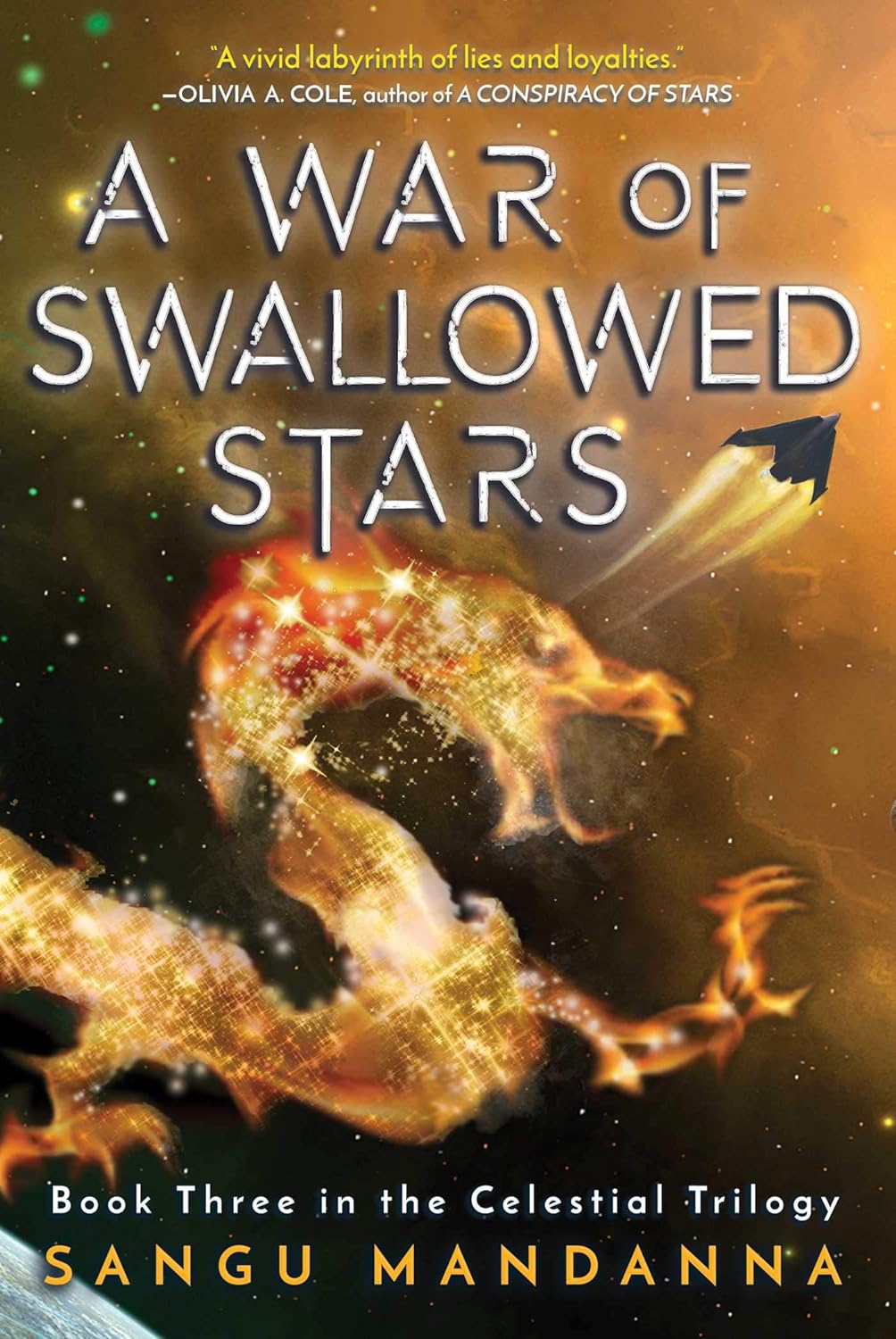
A War of Swallowed Stars by Sangu Mandanna

This review contains spoilers for books that precede it in the series, but is spoiler-free for this book.


This is the third in a trilogy, following A Spark of White Fire and A House of Rage and Sorrow. And it had me pretty rapt, y’all. I was on the edge of my seat throughout, and I cried at the end, but in a good way, which makes me feel glad for the newly-12-year-old I’ve just gifted it to for her birthday. (I teased her that she had to wait because these books are labeled 12 and up!) The world we have come to care about over three books is in great peril, as are the relationships we’ve invested so much in. And it’s not that nobody we love is lost in this book; but it all ends in a way that feels right.

The Celestial Trilogy has featured magical weapons, gods and monsters, murderous family members, and friends where we’d least expect them. Esmae has experienced great and intense trauma, and weathered some very real depression. “I don’t know how to make my way through to the other side of it… I can’t see anything but the dark. I feel like I’ve fallen down a cold, dark hole and I’ll never get out.” Whew. But she has good friends. And she has good on her side. Hang in there, readers.

Mandanna took us through a lot in this series, but the emotional roller coaster has been well-earned, and it pays off in a big way. I can’t wait to hear what my young friend thinks. And you all.


Rating: 8 moments of eye contact.

A House of Rage and Sorrow by Sangu Mandanna

As I’ve decided will be my regular procedure around here, this review contains spoilers for books that precede it in the series, but is spoiler-free for this book.


Following A Spark of White Fire is A House of Rage and Sorrow, book 2 in the Celestial Trilogy by the author of The Very Secret Society of Irregular Witches. I love it.

Esmae is still reeling from the loss of her best friend at the end of book one. Also quite painful is the fact that Rama was killed by her twin brother in a duel, as he thought he was fighting Esmae herself: not only did Rama die, but her brother meant to kill her. Esmae’s anger is beyond description. She wants to burn it all down. She is also carefully avoiding a burgeoning romance, because (I judge) she is as angry with herself as with anyone, and doesn’t think she deserves it.

She is also, however, making friends. Surly Sybilla has cracked open and become as loyal to Esmae as to Max; beloved Rama’s sister Radha has appeared on the scene and begins making her way into the group, not without hiccups. There is a small, new, perhaps fragile, but very real family of friends forming around the girl who has always mourned not having a family.

Then again, the political intrigues and betrayals surrounding her flesh and blood keep multiplying, and the revelations and bad news keep coming. Just how much can one teenaged girl go through? A House of Rage and Sorrow ends on a cliffhanger, not unlike book one; but unlike that finish, this time I had the next installment at hand. Stay tuned for book three in this trilogy.

I love that romance keeps developing (and not just for Esmae!) alongside anguish and intrigue, and a very real and believable coming-of-age arc in which Esmae tries (at least a little) to balance her rage against her better wishes for her loved ones and her wider world. I can’t wait to see where we’ll go next.


Rating: 7 lions.

Junia, The Book Mule of Troublesome Creek by Kim Michele Richardson, illus. by David C. Gardner

Well, I was sure I’d been sold on this book by one of my talented colleagues at Shelf Awareness, but I cannot find that review. Somebody sold me on it, and I’d credit them if I could, because it was a solid recommendation.

Junia is an absolute delight. Aimed at readers aged 4-8, it’s a sweet picture book in simple but fun prose, starring the mule Junia that some readers will know from 2019’s successful novel The Book Woman of Troublesome Creek. Junia and her Book Woman travel the hills and hollers of eastern Kentucky during the Great Depression as part of that state’s Pack Horse Librarian project, under the WPA. (The books are fiction but strongly rooted in fact; Richardson is a recognized researcher of this unusual bit of history.) The book follows them for a single day of environmental and climactic hardships, including encounters with wildlife and a narrow miss when a bridge washes away. They visit diverse households and communities, delivering reading material and having amiable interactions with readers. The relationship between Junia and her Book Woman is loving; it’s an all-around wholesome story.

There is alliteration, fun onomatopoeia, and perfectly wonderful illustrations that reward a close look: note the identifiable rhododendron, the child with the paper airplane and a book called Flight, and a faraway fire tower that we’ll approach on later pages. The visual style is sort of soft-edged but quite detailed, with a bit of whimsy, and lots of personality for the starring mule. I love the regional, historical focus, and I feel it strikes a lovely balance between entertaining and readable, and educational. The book’s text is followed by an Author’s Note with “real” facts and historical photographs, so the young reader (perhaps with extra help in this section) can get a bit more enrichment out of it, and quite painlessly, I think.

I did buy this book with a particular reader in mind, who is eight years old, and I thought of her several times as I read: I know her dad will tickle her with his own “soft whiskered muzzle” as Junia does to her favorite little readers, and I know they’ll enjoy the farts. This quick read was really fun for me – I’m glad I stepped out of my usual zone to check it out. I guess I’ll try the Book Woman novel next!


Rating: 8 shiny red apples.

A Spark of White Fire by Sangu Mandanna

A very fun sci fi novel and first in a trilogy. Aimed at younger readers, it still has plenty of plot and character to engage us kids-at-heart.

I’d call this ‘light’ sci fi in that the science isn’t ‘hard’ and doesn’t contribute crucially to any plot points. You might call it speculative fiction instead: political and familiar intrigues, with coming-of-age issues and romance, set in a world that is not quite like our own. Esmae has grown up in the spaceship kingdom of Wychstar, but she belongs on Kali. By winning an archery contest, and therefore winning a gods-blessed undefeatable warship, she is able to return to the home she’s never known; but reuniting her fractured family and putting the rightful heir back on the throne may be a bigger job than she’s realized.

Esmae is a teenager who’s lived most of her life appearing as an unremarkable orphan, although she also enjoys the close friendship of Wychstar’s youngest prince Rama. He’s a true and lovely friend. Secretly, she has also enjoyed training under a famous warrior named Rickard, who is bound to teach no one but the offspring of Kali’s late king. Rickard and the gods are the only ones who know Esmae’s true identity at the novel’s start.

So, like I said: speculative fiction, at the juncture of fantasy and sci fi, with political intrigue and the challenges of coming of age. Esmae’s troubles winning a kingdom may be outside the experiences of most young readers, but exploring the larger world and finding one’s place in it, struggling to find one’s truest identity, making friends and feeling attraction and navigating conflicting loyalties – all these are absolutely universal. I think it’s a very accessible story for young readers.

I read this book for my own pleasure, absolutely, but also because I was hoping to pass it on to my favorite almost-12-year-old, and for that reason I paid more attention than usual to anything that might cause concern for the younger set. There’s some very mild bloodshed, and some intro-to-sexual content: basically a quick but passionate kiss, and some reference to wanting hands on one’s body and feelings of warmth. By my standards, this is plenty appropriate for a middle schooler. I pointed these passages out to my friend’s parent, and we agreed that she’d be fine. (You know I’m not inclined to censorship, and I was reading far spicier stuff at a younger age. And sometimes confused by it! I also appreciate that this kid is doing other reading about bodies, and doing a fair amount of reading with her parents. All solid.)

Fully invested in books two and three. I’ll read more by this author, too.


Rating: 7 birds of feathers and buttons.