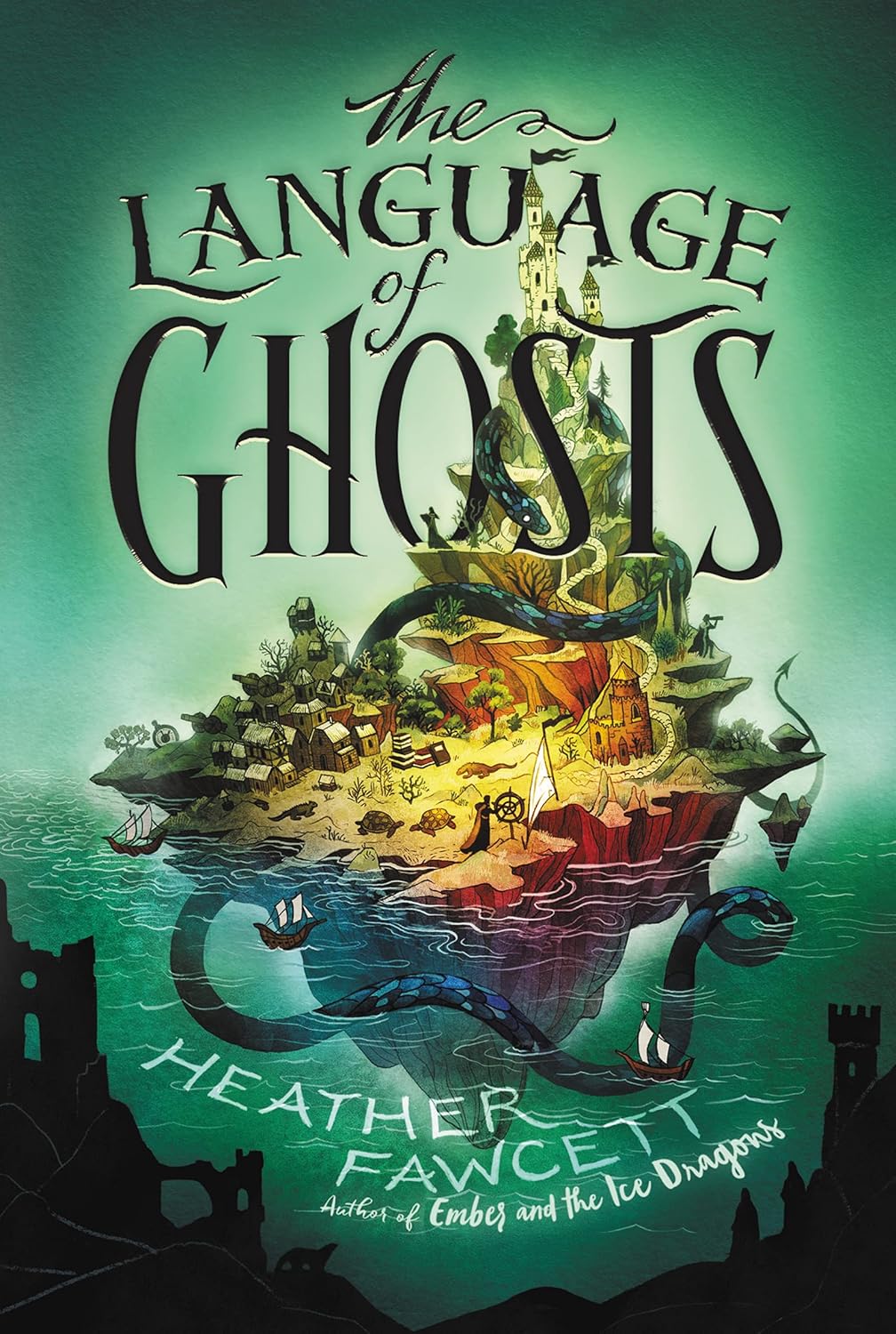
The Language of Ghosts by Heather Fawcett

With this, I have read all of Fawcett’s published books (although I do have Agnes Aubert’s Mystical Cat Shelter on preorder). Sad day.

The Language of Ghosts, offered for middle grade readers, continues to please. In the opening pages, young Noa is sorely grieving the recent death of her mother, queen of Florean. Her brother Julian is newly crowned king although just a teenager. Florean is an archipelago nation, long ruled by the Marchena family of which Julian is now the eldest. The Marchenas are all magicians, and Julian, like his mother, is a dark mage: this means that instead of speaking just one magical language (like most magicians in their realm), they have multiple languages. Julian is completely unique in that he can speak all nine. The Princess Noa, at eleven, is unique among the Marchenas for having no magic at all. In this opening scene, we find her dashing out of the banquet hall in tears at the presentation of their late mother’s favorite dessert (raspberry sundae). Hiding with her emotions in her closet that night, Noa is able to avoid the assassins who come to kill her and her little sister, five-year-old Mite; together the three siblings escape a violent coup in a small fishing boat and set up housekeeping on a new island. Whew.

Fast forward two years. Julian, a powerful magician but with very little think-first instinct, strategy, or perhaps even common sense, is much assisted by his younger sister Noa, who has no magic but lots of strategy, planning, and organizational skill. Cataloging, listing, and mapping are among her passions. Young Mite has two interests: insects and getting dirty. Well, and food. Operating as a king-in-exile with a small but important following, Julian both relies on Noa’s talents and also tends to discount her. Mite follows her around endlessly. The reader might surmise that the smallest Marchena has been through some trauma and finds constant contact with a sibling comforting; Noa is just annoyed.

Julian has enchanted the island of Astrae so that it moves, like a large ship, piloted by his loyal former-pirate captain Kell. They’ve been roaming the seas, taking back Florean one island at a time, but under constant threat by the usurper king, Xavier. Noa, the star of this story, is hard at work on two missions: to get her brother back on the throne where he belongs. And, privately, to prevent the dark magic he wields from turning him to darkness. The Marchenas discover that Xavier is on the hunt for a weapon that could take Julian down: one or more lost magical languages. Our young royal siblings know that they must get there first. Imagine everyone’s surprise when it turns out that, of all people, previously non-magical Noa is the only one who can speak the language of death. She is herself split between puffed-out pride at her new power, and a desperate desire to speak to her mother again. And to save Julian and the Florean kingdom, of course.

The Language of Ghosts showcases Fawcett’s best features. These are three rather ‘normal’ siblings, underneath all the magical and royal trappings: they have three distinct personalities and sets of skills and interests, and are experiencing different phases of childhood. They clash constantly but love each other dearly. Meanwhile, they dwell in a world that emphasizes Fawcett’s imaginative powers, with magical languages, dragons, illusions, sea monsters, betrayals, intrigue, and a wide array of wonderful cakes. Noa is engaged in learning some of the most important lessons of growing up, including the idea that even when we want the best for our loved ones, we can’t control them. I love the nuance Fawcett gives her young characters. Like the others, this is a book that manages to be funny and silly, heartfelt, harrowing, and wholesome. I would follow this author anywhere.


Rating: 8 mouthfuls of octopus pie (throwback to The Islands of Elsewhere).

Verity Vox and the Curse of Foxfire by Don Martin

This lovely book came to me from a Shelf Awareness review. I was hopeful that it will be right for one of my young friends next, especially with the Appalachian connection. And I think I was right!

The town of Foxfire, deep in the dark woods in a holler, is cursed. Following the withdrawal of the coal companies, struggling, the townspeople had made some deals with a traveling peddler who calls himself Earl. It started out innocently enough, but Earl’s prices were untraditional: one’s ability to see the color blue for fair weather. The hearing in one’s left ear for his horse to be healthy. A man’s jaw for some good canned vegetables. When the town pushes back against their tormentor, he takes his revenge. The bridge that connects the town to the rest of the world is destroyed, and attempts to rebuild it always fail. Animals sicken, food rots, the earth will no longer yield produce. The people seem doomed to despair and slow deaths, able neither to provide for themselves nor to leave.

Someone in Foxfire sends out a message.

And then the reader meets Verity Vox, a young witch in training, awaiting her next assignment. Her familiar, Jack-Be-Nimble (generally known as Jack), who normally appears as a black cat (sometimes a kitten) and sometimes as a black bull, a jaguar, a black rat, a crow (etc.), finds the message: “We’re cursed. Send help!” And Verity Vox goes to Foxfire.

Verity is young and still learning. Part of any witch’s training involves moving around: she can only stay in a place for one year, and then she must follow the signs to the next place she can help. Her powers and talents have come naturally to her; she is accustomed to easy success, and to being welcomed wherever she goes. People are glad to have her assistance. In Foxfire, however, things are different. The town got burned hard by the last magical being from whom they accepted ostensible help. And these hills can be a little insular. For the first time, her advances are unwelcome. Verity is perplexed; but she only wants to help, she keeps repeating. Her first reluctant customer (so to speak) keeps asking what she owes Verity, and Verity is baffled. Mistrust, it seems, is an unfamiliar concept.

So, Verity and the town have much to learn about each other. And then there is the pressing mystery of Earl – who he is, from where he draws his power, what it would take to rid Foxfire of his malice once and for all. Magic can do a lot, but there are still rules. For example, “tea… eluded even the most powerful of witches. It simply could not be rushed and every attempt to do so resulted in a brew that was bitter, bland, or box turtles.” Verity is very powerful. But there is much she doesn’t know yet about the world, and Earl is an unprecedented challenge, and the more she gets to know the people of Foxfire, the more she wants to improve their lot. There is a point where she thinks she will be able to offer them an escape, a literal exit from the place, and is surprised to learn that they don’t want to leave their home. More lessons to learn for our young witch protagonist, but she remains determined. “What was magic after all but having the gall to believe you could tell the world around you how it ought to be and then watching as it did as it was told?”

This is a beautiful story about learning and growing up, facing challenges, relationships formed with people and with place. The connection to Appalachia feels very special to me, and I have been telling everyone I know about it. The book is recommended for grade levels 10-12, although I see no reason not to give it to kids a little younger than that, and obviously it has enormous appeal for some of us adults, as well. Will be on the lookout for more from this author!


Rating: 8 candles.

The Islands of Elsewhere by Heather Fawcett

Another sweet, feel-good, funny, wholesome, middle-grade book by Heather Fawcett. I believe I have just one left in this age range, after which (if she’s not published more!) I’ll have to return to the Emily Wilde series to get my fill, and refresh my memory on how Fawcett matures her characters (and subject matters) for adult readers. I’m really enjoying just swimming in her imagination.

The Islands of Elsewhere stars the three Snolly sisters, but especially the middle sister, Bee. Eldest Hattie likes math, money, and being bossy; youngest Plum never stops moving, likes all sports, and generally teams up with Hattie, especially in their shared love of witches, fairies, and all things magic. Plum prefers to wear a costume, always: some of them store-bought Halloween costumes, many handmade by their loving Mom, who works for and performs in the theatre. And then there’s Bee, who appreciates science, especially botany, and is ever annoyed by her sisters’ belief in dreamy magical nonsense. Their toddler brother Dore rounds out the small family. Dad is mostly off-screen, but he and his girlfriend get along great with Mom, and he’ll be picking up the sisters for a camping trip in a few weeks’ time.

But first, Mom and the four kids are off to stay with Granddaddy at his home on the beach. They haven’t been there in a long time – Bee was too young to remember the last time. The sisters are delighted to arrive and discover that he lives right on the ocean! And his property includes an island – no, three islands! Fairy Island, Little Fairy, and Ghost come with some fascinating, even sinister stories in the little community of Misty Cove. The girls will have plenty to keep them busy: Hattie is practicing for a sandcastle contest that she intends to win (with a grand prize of one hundred and seventy five dollars!), Bee’s collecting new specimens of leaves and flowers, and Plum finds costume inspiration in the new setting: she wants to be a seal next, among other things. But there’s also a sadder reason for their visit. Beloved Granddaddy, an accomplished surfer and prolific and inventive baker of chocolate chip cookies, is having trouble with his memory. Mom is afraid he may not be able to live on his own for much longer.

The girls hatch a plan. If they can find the hidden treasure rumored to have been hidden away by their great-great-grandmother – an actual pirate – maybe they can afford to all live with Granddaddy from now on. The Snolly sisters must band together to search the fabled islands, and deal with octopuses, surly islanders, and the possible ghost of a witch along the way.

I loved the family dynamics here, which are nontraditional in some ways but always loving and positive. I loved the sibling relationships, and the earnest attempt to save the day. I loved Granddaddy’s quest for the perfect chocolate chip cookie, which includes everything from gum drops to Halloween candy to pumpkin pie, and maybe even octopus? It’s just all good clean fun, but not so clean as to be stuffy. In between heavier reads, I will take Fawcett’s younger-reader offerings any day. I hope she’s still hard at work. Hugs to Bee and the rest.


Rating: 7 unexpected ingredients.

All the Wandering Light by Heather Fawcett

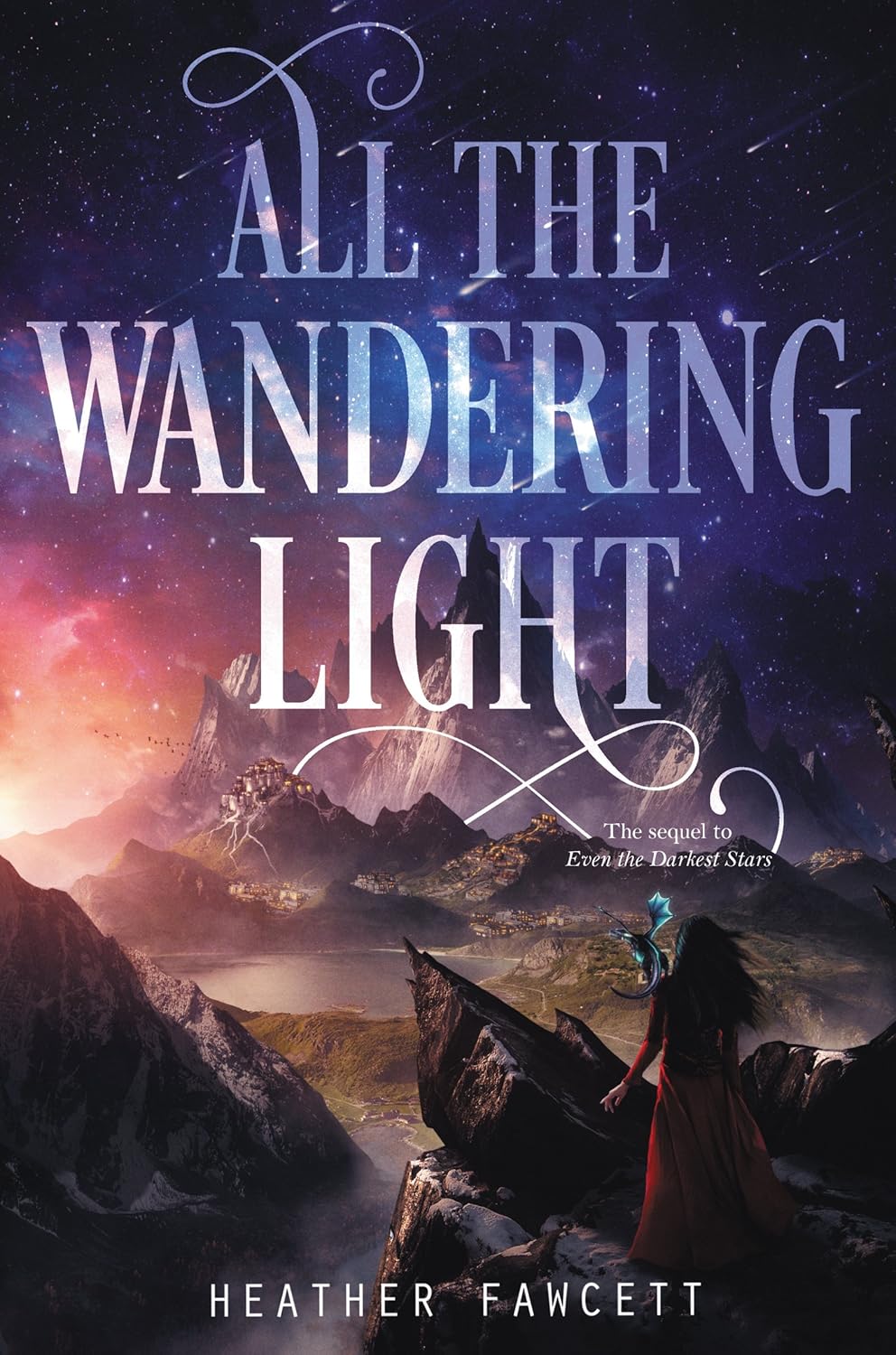
This one follows Even the Darkest Stars, with similar darkness, coming-of-age growth and learning and complication, and love. As is my usual practice, this review will contain spoilers for that previous book but not for this one.

So, on with the spoilers: at the end of book one, we had been hit with the shocking news that River himself was secretly a witch, and therefore obviously (to Kamzin and those of her world) a natural enemy. He has broken the binding spell that stole the witches’ power generations ago, and now their powers are restored, and the Empire is in danger. We learn quickly, though, that River is not so much motivated by wanting to overthrow or hurt anybody; rather, he wanted the freedom of possessing the powers he was born to. He wants to be himself. But by releasing all witches, he has enabled those who have crueler goals than he does, including revenge. His brother Esha intends to be the next emperor of the witches, and desires power enough to destroy the humans’ Empire, including Kamzin and everyone she loves.

In similar fashion to book one, a race is on, this time to get to a fallen star that is said to offer unimaginable power to whomever wields it: the human Emperor or the witch one. Kamzin travels with her friend Tem, her sister Lusha (and the two sisters offer nearly infinite messy siblinghood), and for part of the way, Mara, who was once a member of River’s crew. In the other camp, River reluctantly, even half-heartedly, helps his brothers. The plot of the book follows these two groups, centered on our protagonist, Kamzin–angry and hurt at her betrayal by the magnetic River, who had been a bit of a romantic interest–and her counterpart, River himself, who is likewise confused at the way the world reshapes around him and the power struggles that involve him even without interesting him much. This conflict will build to affect (again) the very fate of the world, and hinge upon the ability of the humans, in particular, to reconsider old prejudices.

Along the way, the part of this book that I struggled most with was the detail in some of the fighting or conflict scenes. Maybe it’s just this reader, for whom the fighting (in its minutia) will never be the most interesting part of the story. But especially with the ethereal, ghostly sort of enemy (and other only-halfway-there monsters), the shadowplay violence is a bit abstract, and doesn’t hold my attention well enough to sustain the way some of those scenes dragged on. I got a bit impatient. I think where Fawcett excels is, yes, worldbuilding, but most of all relationships: the way people (or witches, or stars!) interact and communicate and treat each other. And/or, this is where I’m most engaged with any story. There was lots to love here, just a little that I wished moved a bit more quickly. It’s worth noting that the two books in this duology were Fawcett’s first two. It’s clear to me that she’s improved from here.

I have just two more middle grade books of hers to read and then we have to wait for her to write more. Fawcett remains one of my favorite authors of the last year or two, so I hope she’s hard at work!


Rating: 7 beautiful ball gowns (what?!).

A Galaxy of Whales by Heather Fawcett

I needed this little break in between heavier reads, and I love knowing I can turn to Heather Fawcett to scratch that itch. A Galaxy of Whales is offered for readers ages 8-12, and features 11-year-old Fern, who is having a difficult summer. Her best friend Ivy has been pulling away from her, spending more time with other friends. Her family’s business, Worthwhale Tours, is in some trouble. Their main rivals, Whale of Fortune, are also their next-door neighbors, the Roys; and 11-year-old Jasper Roy is especially annoying to Fern. Her one-year-older brother Hamish is always buried in a Space Dragons book – also annoying. Worst of all, Fern still misses her father. “Maybe if your dad had died three years and two months ago, you shouldn’t be sad enough to cry anymore.” She’s not sure.

Then she learns about the youth wildlife photography contest. It’s perfect: if she wins, her photo will be on the front page of the paper. It might be enough to win Ivy back. The prize money could help the family business. She could defeat Jasper, who wants to enter the contest as well, despite not being into photography at all. And photography is absolutely Fern’s thing – the thing she shared with her father, whose camera and gear she takes with her everywhere, who taught her everything she knows. She has to win.

Just off Fern’s little Pacific Northwest town of Goose Beach, on the Salish Sea, there is a famed pod of endangered killer whales that she knows is just the right subject for her award-winning shot. But they’re hard to track, and time is running out. Fern tries to work together with Ivy, who is clearly not all that interested. She tries to work with Hamish, who is decidedly indoorsy, not a natural wildlife photography assistant. Finally, she resorts to working with Jasper, the enemy – unless he’s becoming her new best friend.

In this momentous summer between fifth and sixth grades, Fern learns a lot about family, friendship, whales, astronomy, and how to continue to navigate grief. A Galaxy of Whales offers these lessons organically and sweetly, in just the sort of package I was looking for: wholesome and loving.


Rating: 8 ice cream sandwiches.

The School Between Winter and Fairyland by Heather Fawcett

Can’t get enough Heather Fawcett; I’m powering through her books for younger readers. This is offered to ages 8-12. Autumn Malog is twelve years old when we meet her. She serves as a beastkeeper for the Inglenook School for young magicians, as the Malogs always have. It is a humble role, and she’s a little wistful for the magicians’ cloaks and privileges and learning, but you can’t change what you come from. And anyway, she’s far more concerned about her twin brother, Winter, who has been missing for nearly a year now, presumed dead by everyone but Autumn. She has always been able to feel Winter and his whereabouts; she can’t tell where he is now, but she is sure that he still is. “Nobody believed her, and she couldn’t really blame them. It sounded far-fetched even to her. So, rather than trying to convince anyone, she set about gathering evidence.” Autumn is no-nonsense like that. Better to get it done than to muck about. She is burdened with three useless older brothers, and the family is rounded out by Gran, even more no-nonsense than Autumn, unsentimental, but gifted in her care of the monsters that the family keeps safe and healthy for Inglenook.

Then Autumn encounters Cai Morrigan, one of Inglenook’s most famous students ever. Just twelve years old, he is prophesied to save their kingdom from the Hollow Dragon. But he is less impressive up close than his reputation would have it; and he shares with Autumn his great secret: he is terrified of dragons, to the point of fainting within dozens of yards of them. He asks for her help, and Autumn in turn asks him to help her find Winter. These two quests will bond the two young people, and offer bigger, more existential challenges than either anticipates.

I love this wholesome story about toughness, finding one’s tribe, and when to accept and when to push back against the limitations life proposes. It is also about friendship as well as familial love. And fanciful monsters, and plucky heroes, and the call of the forest. All good things, compellingly told. I will continue to live in Fawcett worlds as long as she creates them.


Rating: 7 slices of seabread.

rerun: Gone to the Woods: Surviving a Lost Childhood by Gary Paulsen

I still think about this book and should find time for a reread. In case you missed it, please check on Gary Paulsen and his wonders (and traumas).

I had not thought of Gary Paulsen in years, until I saw the Shelf Awareness review of this new book. (Hat tip to my colleague Jen Forbus for that review.) Paulsen might have been the first author I really fixated on; I remember setting out to own all his books, and while I didn’t get very far (maybe six or eight of them), I’m pretty sure I wrote “Julie’s Gary Paulsen library” or some such inside the cover of each one, and had them set up on their own little shelf. Early signs of something, there. My favorite was Hatchet, of course, and its sequel; and I vividly remember a scene from the beginning of another book where the narrator watches a… chipmunk? eating another creature, blood down its front… what book was that?

Anyway – when I saw that he’s returned with a memoir of his own childhood, I was sold. And let me tell you. This book had me entranced from the opening lines. I wept.

Gone to the Woods has an innocence and a simplicity built into its writing style and the value system, I think, of its narrator. This makes it accessible to younger readers, but not at all to them alone. I think this is a memoir for everyone. Paulsen tells his story in the third person, calling his protagonist only ‘the boy,’ although the name ‘Gary’ is used once or twice by other characters. This helps to give the boy an elemental quality, like he’s sort of an archetypal boy, although his story is very specific. When the book opens, he is five years old, living in Chicago with his mother in 1944. She has a factory job, and coming from a small farm in northern Minnesota, is “not even remotely prepared to resist the temptations of the big city.” She lives in the bars and does not parent her small son, who she’s trained to perform for the men who try to win her favor. Grandmother hears of this lifestyle and is “critical, then concerned, and finally… past horrified and well into scandalized.” Her solution colors the boy’s method of problem-solving for life: “If it doesn’t work Here, go over There.”

The first adventure of the book, then, is the five-year-old boy’s solo journey by train from Chicago to International Falls, Minnesota. This takes several days and involves a train absolutely jam-packed with severely injured soldiers, smelling of and oozing pain and death, so that the boy is physically ill from it all – because didn’t I say, his father, who he’s never met, is a soldier off in the war. The boy becomes stuck in a train toilet, among other things, and observes out the train window the woods that will become his sanctuary. By the time he arrives at his aunt and uncle’s farm he is wrung out with exhaustion, trauma, and confusion. But the farm will be a perfect place for him, the first place he feels he belongs, is valued, is taught. He’s given his own room and bed. It’s lovely. Then it’s taken away from him.

I’ll stop summarizing here. The boy’s upbringing is one trauma after another, including a few years on the streets of American-occupied Manila, and a continuing absence of parental concern. I appreciate that the narrator is slow to judge his parents, and I think it would have been easy (narratively speaking) to be ugly about the mother’s drinking and many boyfriends, for example, but neither the young boy nor the adult man who writes these lines takes that easy road. (At least until the teenager’s perspective, at which point he thinks of both parents as vipers. But this is about the damage they do to him, rather than some puritanical judgment of mom’s moral choices.) He is an unjudgmental creature in general. Paulsen is wonderfully good at the innocent child’s perspective, elements of which are present in the teenager too.

Trauma after trauma, but with a few bright points, like the aunt and uncle in the Minnesota woods, and a saintly librarian when he is thirteen years old who makes him a gift of notebook and pencil, for whom this book might be considered a gift in return. And the woods and rivers and streams, which are always a bright point. From age five, the boy learns that the woods will allow him to take care of himself, even when he lives in a city again, keeping to the alleys and nights to avoid bullies, and escaping to the stream where he can fish for food or shoot squirrels and rabbits when his parents fail to provide for him. Even in Manila, a city of a certain sort of trauma (truly, the violence and death this child witnesses by his sixth birthday is unfathomable), he finds beauty and human kindness.

At times the events were hard for me to take in, and I wondered if younger readers were really the right audience for this. But on reflection, I think Paulsen offers just enough. I think children might take away what they need from this book – I’m no proponent of censoring life’s pains from kids – and it’s the adult mind and perspective that makes it even harder to read, if that makes sense.

The story is harrowing but also lovely, always riveting, and an important testimonial from a generation that we will eventually lose access to. It is excruciatingly beautiful in how it’s told. The immediacy of traveling with the boy is heart-rending and direct. I can’t imagine how this book could be improved upon.


Rating: 10 willow branches.

The Grace of Wild Things by Heather Fawcett

Another hit by Fawcett; I’ve just checked to be sure that *all* of her books are either here or on their way to me.

The Grace of Wild Things is based on Anne of Green Gables, loosely enough that all of its parts move freely, but with enough connection to be recognizable if you know the original. Of course, no knowledge of the earlier classic is required here, and I think Fawcett’s telling will be more accessible to modern young readers, and possibly younger ones. As much as I love Montgomery’s original, I suspect her writing style would be a little harder for my favorite rising eighth grader to take in. This book is absolutely headed to her bookshelf next.

We meet twelve-year-old Grace as she gazes out of the dark woods at the witch’s cottage. Accompanied by her crow friend, Windweaver, she has made a remarkable overland journey to get here, despite hearing about the witch’s evils (including cooking children in her oven and eating them, à la “Hansel and Gretel”). Grace has spent her life at an orphanage featuring no great abuse but a pattern of rejection, loneliness, friendlessness, and a lack of appreciation for her unique qualities, which include talking too much, a love of poetry (shared by Windweaver), an excess of imagination, and oh yes, magic. She is here to apprentice herself to the witch and try to find a home and a life where she can be accepted for who she is.

The first day’s cycle is rough: the witch pretends to welcome her, throws her in the oven and tries to roast her, then, thwarted, rejects her once again: “tomorrow you will go back to that orphanage, if I have to drag you there by your hair.” Grace decides she’d rather be eaten. And she really did love the witch’s cottage, and the perfect little bedroom there that she’d hoped to call her own. But in a combination of cleverness, determination, and dumb luck – or is it magic? – she meets a fairy and saves his life, and impresses the witch with a gift sufficiently that the witch agrees to let Grace attempt a challenge. If Grace can cast every spell in the witch’s first grimoire, from her own childhood, before a venerable cherry tree blooms the next spring, she will become the witch’s apprentice. If she fails, she will give up her magic to the witch. This also means losing Windweaver, her only friend in the world, who the witch says is Grace’s familiar: she never realized.

What else is there to do? Grace agrees. But there are 100 1/2 spells in the grimoire – the last one is incomplete – and they appear increasingly impossible to her untrained eye. (The witch refuses to help.) Luckily, our plucky protagonist quickly makes a friend, Sareena, a clever, no-nonsense neighbor girl who pledges lifelong loyalty. The fairy boy she’d saved, Rum, is bound to come at Grace’s command for three years, the deal they’d cut; but he also insulted her and she desires never to speak to him again. (Some readers will recognize the reworked Diana and Gilbert.) As the always-game Sareena and the increasingly devoted Rum dedicate themselves to helping Grace gather the impossible ingredients for the witch’s spells (a piece of the moon, a pitcher of midnight, three left footprints of a deer, a day lasting twenty-five hours), their little group grows, until Grace is overwhelmed by kindness and friendship. Even the prickly old witch softens slightly, and more disturbingly, sickens. When an outside force threatens their idyllic cottage and garden in what locals have long known to be the witch’s woods, Grace may have even bigger problems than the grimoire. But her powers are growing, too.

Anne-with-an-e is definitely alive and well here, with the imagination, the verbosity, the flair for drama, the questions, the enthusiasm and the emotions. “I never thought witches would be so leaky,” Sareena says of Grace’s disconcerting habit of expressing feelings through tears. We’ve identified Diana and Gilbert; the raspberry cordial episode is reworked, more magically, and that of saving Sareena’s beloved younger sister. The witch makes a fine Marilla, grumpy but secretly charmed by her unwanted orphan girl; she even has a brother, although he’s a bit less corporeal than Matthew was. Prince Edward Island remains the setting, and I am inclined to trust (but did not fact-check) that the many botanical details and spell ingredients are appropriate.

But Grace is also a lovely invention. She struggles with wanting to do good in the world while embracing her true identity and powers, which she takes for granted must be associated with evil. She feels gratitude and loyalty to the witch who gave her a home, even though she can see the witch’s wrongdoings (although we also benefit from learning more about her long and adventurous life). She learns the big lessons. “…the witch had said in one of her few helpful moments that many spells had more than one use. Since then, Grace had come to think of magic like poetry–a poem, after all, could mean more than one thing, or mean different things to different people.” Upon achieving a spell for wisdom: “Being wise, apparently, was not knowing a lot of things, but knowing all the things you didn’t know. It was dreadful. She felt very sorry for all the wise people of the world.” And of course, she has every bit as much gumption and potential as Anne Shirley ever did.

I am devoted to this author. Loved every page, can’t get enough.


Rating: 9 buckets of ice cream.

The Giver by Lois Lowry

My favorite now-13-year-old* wanted to talk about this book which I, surprisingly, had never read. (I’ve read some Lowry but this one missed me. My favorite was Number the Stars.) So, what do you do? I got a hold of the book.

I’m impressed by this clean-lines novel which feels expansive, but whose ~225 pages zipped by in a single day for me. It absolutely reminds me of Le Guin’s “The Ones Who Walk Away From Omelas” and Jackson’s “The Lottery,” but this longer book (compared to those two short stories) develops its characters further: Le Guin did not name characters, and Jackson gave us the briefest of sketches, mostly to type. Both of those choices serve their stories very well, I think, but The Giver is doing more, going further.

The tale is set in a community where everything runs very much according to system. There is a great emphasis on uniformity and order. All the children born in a single year (always 50 of them) turn one year old, officially, in December; some are great big babies and some are newborn, but by the time they are three, we’re told, it all evens out. There are certain milestones at each year, including, importantly, the Nines receiving their own bicycles. But the big one is the Ceremony of Twelve, where each child is given their lifetime assignment, their job. These assignments are made by the Committee, which spends a lot of time throughout the children’s lives – but especially when they are Elevens – observing them for preferences and talents. After the Ceremony, the Twelves are no longer children, but adults, albeit early in their training.

Our protagonist is Jonas, and we meet him as he’s approaching becoming a Twelve. Somewhat unusually, he has no idea what his assignment will be. Most children understand their own predilections, but Jonas is truly unsure. At the after-dinner ritual where everyone in his family shares and discusses their feelings, he shares his apprehension (he has thought hard about this word, because precision in language is important to Jonas), but his parents assure him the Committee always chooses well. (It is partly through this ritual that the reader learns about families in this community. Always two children, one male and one female, per household. The parents were carefully paired with the same kind of methodical, clinical decision-making as the assignments. Jonas’s father is a Nurturer: he takes care of babies their first year, after they are born to a Birthmother [shades of Handmaid’s Tale] and before they are awarded to an applicant couple. Jonas’s mother works in Law and Justice. His little sister is a Seven.)

And then the Ceremony of Twelve, where Jonas is selected for a very special role, one he’s never heard of before. Jonas is to be his community’s next Receiver of Memory.

From here on out, his life will not resemble that of his friends. He sees little of them, in fact. They enter training to work in various parts of the community, but Jonas is shut away with an old man, the former Receiver, who now requests that Jonas call him the Giver. He transfers memories to Jonas: memories of a time before the community embraced Sameness. It is only when Jonas begins receiving these memories that the reader learns just how much has been missing from his life.

So. It is a bit of a parable, and offers up similar questions to the two classic short stories I mentioned above. But it goes deeper than either, and in its details, feels closer to reality. (“Omelas,” by contrast, with its nameless character-types and invitation for the reader to fill in the details they prefer, is much more strictly a parable or thought experiment.) I absolutely appreciate the thought-provoking nature, and the emotional impact of each reveal. It feels like a truly great place for a middle-school-age class to dwell and discuss, and I can’t wait to hear more about my young friend’s experience both with the book and in the classroom. My copy included some supplemental text at the back, including a ‘guide for discussion and classroom use’ which seems potentially genuinely useful, but most special are the supplements from Lowry: “Ever After” describes the many inspirations for this story which I loved and found revealing, and her Newbery Acceptance Speech was such a treat as well.

Easy to read in one sense, but with Big Themes that require careful consideration. Excellent matter for thoughtful conversation at school or at home. I can’t wait to talk to my friend about it.


Rating: 8 snowflakes.

*She and her sister account for the books at this new tag.

Even the Darkest Stars by Heather Fawcett

I just went ahead and followed Ember and the Ice Dragons with another Fawcett book for younger readers. This one is a bit darker than that; I see that Ember is catagorized as middle-grade where this one is young adult, for what that’s worth.

Even the Darkest Stars is set in a magical-world version of the Himalayas, with yaks and butter tea and very high, very cold mountain climbing. But a parallel world to our own, in which an emperor rules over a huge region, keeping everyone safe from the witches of a bygone time. Our protagonist is Kamzin, a teenaged girl in the village of Azmiri, which is far from the emperor’s Three Cities. Her father is the village Elder; her mother was a great explorer in service to the emperor, but she’s been dead for years. Her older sister Lusha will be the next Elder. She studies astrology. As the younger daughter, Kamzin’s fate is to be the village’s next shaman. She is apprenticed to the current shaman, but is a poor student. Instead, Kamzin has always felt a strong pull to travel, to climb, to run, to map, to explore. When the emperor’s Royal Explorer, the famous River Shara, comes to the backwater of Azmiri, Kamzin knows she must stop at nothing to become a part of whatever has brought him here.

And after some brief intrigue and machinations, we wind up with a race. Lusha, the obnoxious older sister, takes to the road with one of River’s own retinue, aiming to beat the Royal Explorer himself to the top of Raksha – the highest mountain in the world, never climbed by a human, which defeated even Kamzin and Lusha’s late mother. Kamzin succeeds in joining up with the great River Shara, a handsome young man – younger than she’d expected – whom she finds bewitching. Also in their small party is Kamzin’s best friend, Tem, a far more accomplished (though untrained) shaman. And a stowaway: Kamzin’s familiar is a fox (or foxlike critter) named Ragtooth. They share a close bond but also he is apt to bite her. Oh and there are dragons: they are more tangential here than in the last book, but your standard ‘house dragon’ will eat just about anything remotely edible and in response, their bellies put out light. So an alternative to a lantern is to feed your scraps to a dragon. Part pet, part appliance, sometimes a nuisance. It’s quite fun. There’s a lot that is fun in this imaginative world… but also, Kamzin’s world and everyone she loves is in grave danger. It takes a while for the true nature of River’s quest to Raksha to be revealed, but once it is, the stakes couldn’t be higher.

This is a compelling story, populated by mystery, magic, fun creatures, breathtaking landscapes, true friendship, the germ of romance, and a tortured coming-of-age made harder by the possible end of the world. There is also great adventure, death-defying climbs, races for fun and for life-or-death… bit of a Princess Bride list there. My favorite part is that it ends with a clear nod to a sequel, which I’ll have my hands on in a day or so. But yes, also darker than Ember. More bad things happen here, and more is at stake. I may not hand it off to the thirteen-year-old yet. But I am so in for book two.


Rating: 7 sour apples.